
UNHCR United Nations High Commissioner for Refugees CCR
- Slides: 25
UNHCR United Nations High Commissioner for Refugees CCR Edmonton, 24 May 2007 Mr Vincent Cochetel Department of International Protection UNHCR, Geneva
I- Basic Facts about UNHCR and Resettlement Activities II- Canada’s contribution to Resettlement Activities III- Global Trends & Challenges for UNHCR
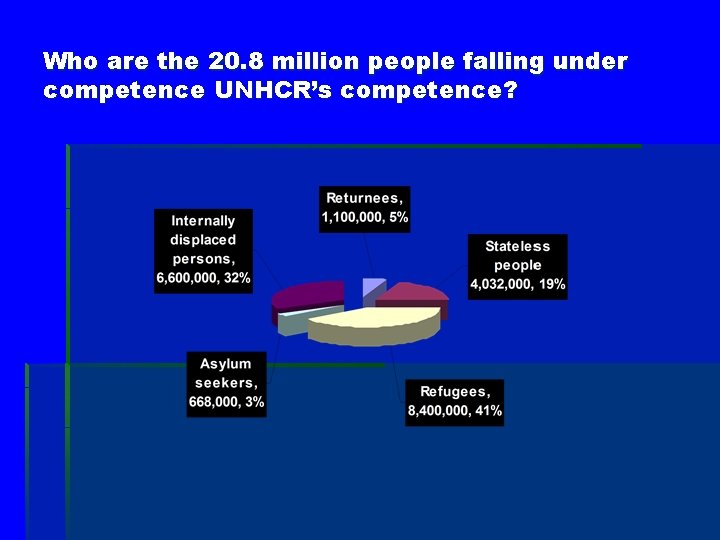
Who are the 20. 8 million people falling under competence UNHCR’s competence?
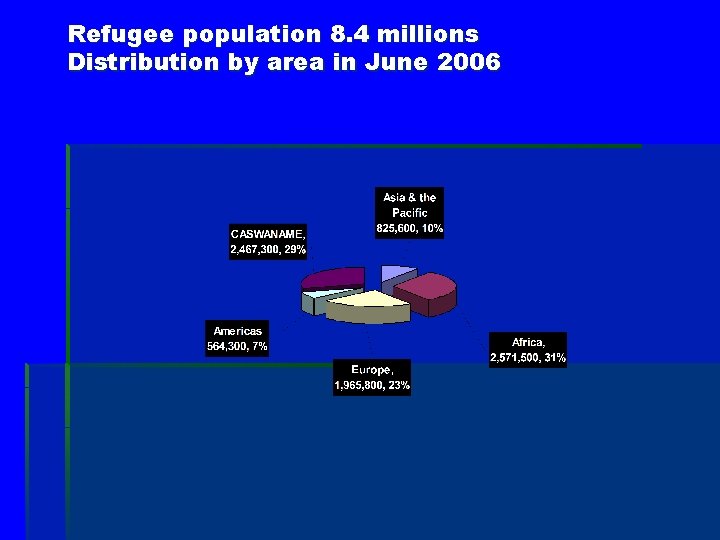
Refugee population 8. 4 millions Distribution by area in June 2006
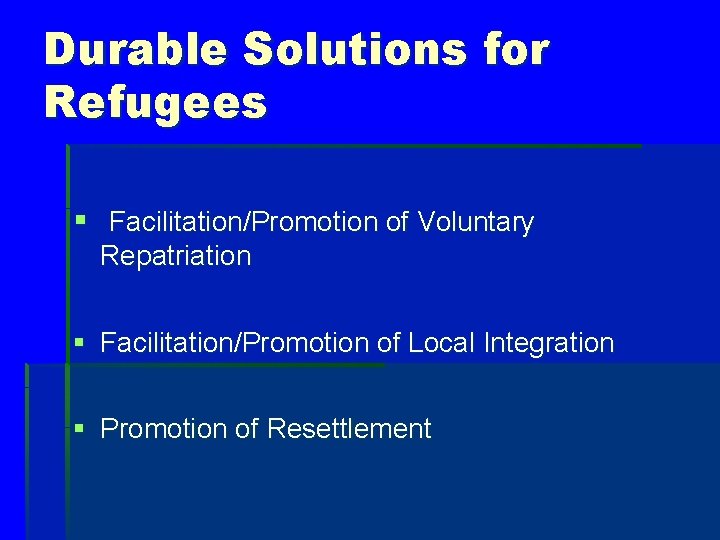
Durable Solutions for Refugees § Facilitation/Promotion of Voluntary Repatriation § Facilitation/Promotion of Local Integration § Promotion of Resettlement
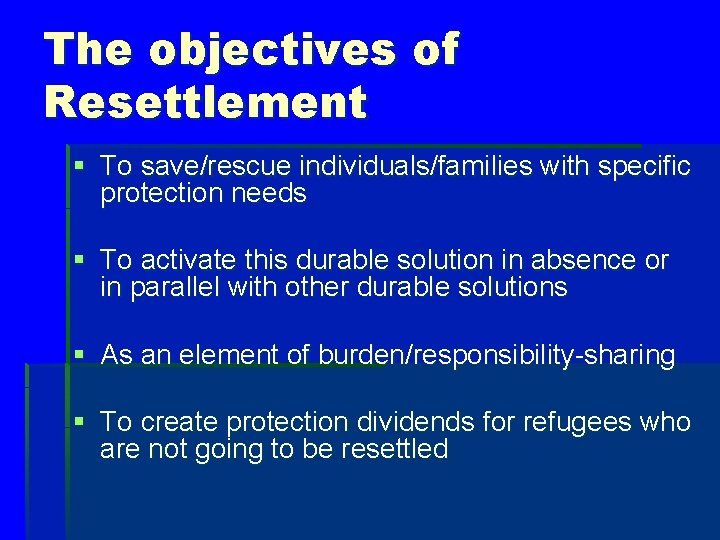
The objectives of Resettlement § To save/rescue individuals/families with specific protection needs § To activate this durable solution in absence or in parallel with other durable solutions § As an element of burden/responsibility-sharing § To create protection dividends for refugees who are not going to be resettled
Resettlement Submissions § Submissions by dossier § Submission during selection missions
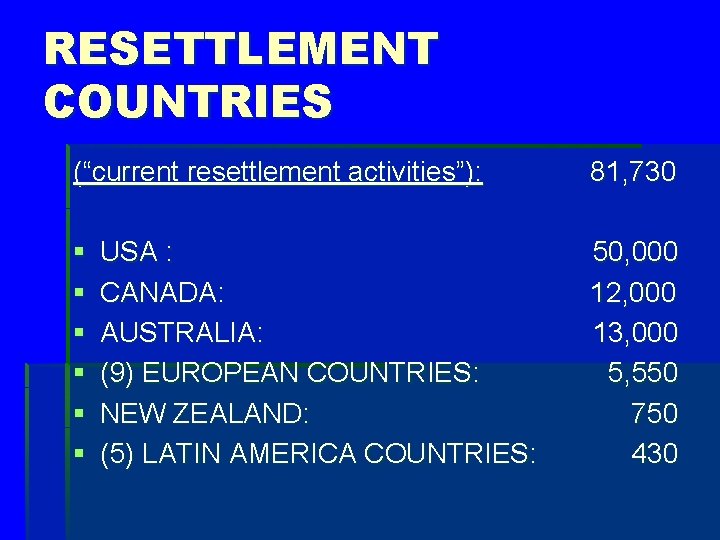
RESETTLEMENT COUNTRIES (“current resettlement activities”): 81, 730 § § § 50, 000 12, 000 13, 000 5, 550 750 430 USA : CANADA: AUSTRALIA: (9) EUROPEAN COUNTRIES: NEW ZEALAND: (5) LATIN AMERICA COUNTRIES:
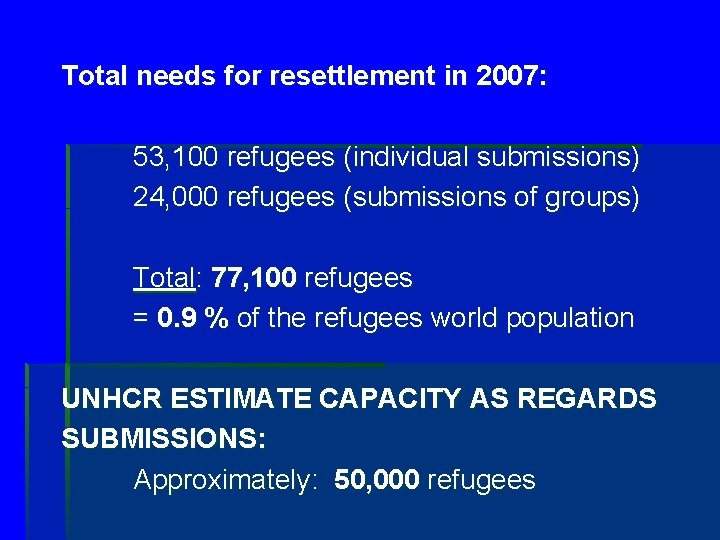
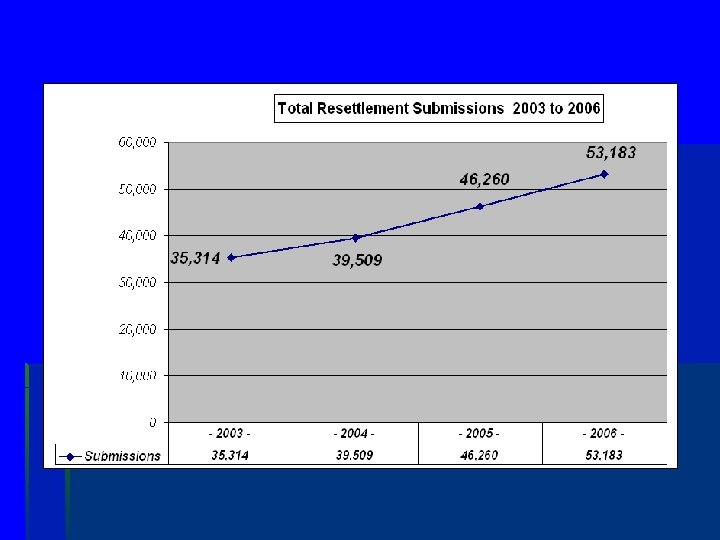
Total needs for resettlement in 2007: 53, 100 refugees (individual submissions) 24, 000 refugees (submissions of groups) Total: 77, 100 refugees = 0. 9 % of the refugees world population UNHCR ESTIMATE CAPACITY AS REGARDS SUBMISSIONS: Approximately: 50, 000 refugees
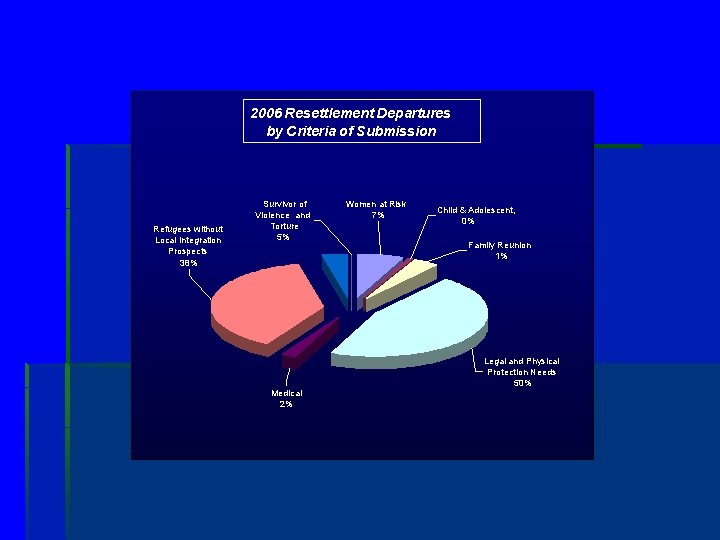
2006 Resettlement Departures by Criteria of Submission Refugees without Local Integration Prospects 38% Survivor of Violence and Torture 5% Medical 2% Women at Risk 7% Child & Adolescent, 0% Family Reunion 1% Legal and Physical Protection Needs 50%
Canada’s contribution to Resettlement Activities § One of the “big three” resettlement countries in the world § A resettlement programme sensitive to protection concerns/priorities (e. g. Palestinian refugees in Jordan) § Canada’s significant support to several resettlement/protection-related programmes
§ A refugee resettlement program usefully complemented by the Private Sponsorship Program (PSR) § Canada’s readiness to use resettlement for protracted refugee situations (e. g. Bhutanese refugees in Nepal or Eritrean refugees in Sudan) § Canada’s commitment to use resettlement in a strategic manner (i. e. protection dividends arising out of resettlement activities) (e. g. support to MPA)
§ Consistent public support § Strong involvement of NGOs, volunteers and local/central authorities § Improved predictability in referrals in 2005 -2006
Global trends § Impact of new anti-terrorist legislation (admission, security screening, delays in departure…) § Excessive use of a criteria of “local integration potential” by certain countries of resettlement § Increase in the emergency resettlement requests because of the deterioration of the situation in certain countries of first asylum
§ Difficulties for resettlement countries of considering various groups in many countries of first asylum and temptation to turn to a mode of selection by group, with the risk of limiting geographical diversity in in-take. § Effective access employment market in several countries of resettlement
Challenges for Canada’s Resettlement Programme § Ensure better synergies between the Government-Assisted Refugee Resettlement program and a strategic use of the Private Sponsorship Program § Pilot the use of dossier places and/or interviews by remote
§ Improve and shorten the length of security screening by CBSA § Build upon group resettlement experiences § Improve the functioning / responsiveness of the UPP
Enhance the role of NGOs ü in needs identification process ü in case preparation and referrals to UNHCR ü in verification exercises (group processing) ü in cultural orientation/language/literacy courses in countries of asylum
Challenges for UNHCR § To improve planning, predictability, coherence in the resettlement submissions § To make the resettlement accessible : Ø to larger number of refugees, Ø from more countries of first asylum Ø and towards a broader number of countries of resettlement
§ to promote the implementation of durable solutions strategies in particular for the protracted situations § Implementation of the conclusion No. 105 of the UNHCR Executive Committee on women-at-risk § to document country-by-country benefit resulting from a strategic use of the resettlement § to give a “human face” to the resettlement activities as effective way to combat xenophobia and to promote this solution
§ To promote harmonized approaches for refugees in order to ensure equitable access to this solution and to reduce secondary movements § To establish “temporary transit facilities” for refugees having an immediate need for evacuation § To broaden the base of resettlement countries in Europe and Latin America
§ To draw lessons from the group resettlement and other forms of simplification of procedures § To encourage the harmonization of the programs of cultural orientation before the departure to resettlement countries § To roll-out UNHCR resettlement anti-fraud program
§ To collect and disseminate “ best practices” § To further engage NGOs in the promotion of resettlement activities