
UNFCCC Ramsar synergies 1 The Ramsar Convention and
- Slides: 30
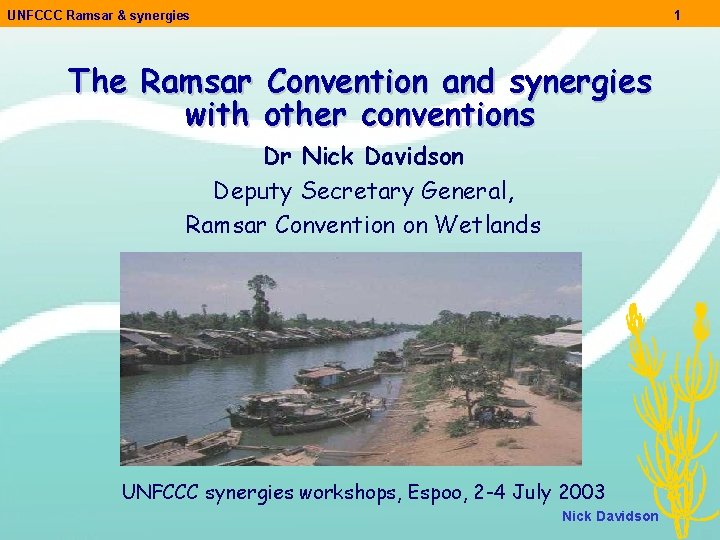
UNFCCC Ramsar & synergies 1 The Ramsar Convention and synergies with other conventions Dr Nick Davidson Deputy Secretary General, Ramsar Convention on Wetlands UNFCCC synergies workshops, Espoo, 2 -4 July 2003 Nick Davidson
UNFCCC Ramsar & synergies 2 What is the Convention on Wetlands? • Oldest of the global environmental conventions • the only global convention focussing attention on an ecosystem (wetlands) • covers very wide range of wetlands - from coral reefs to mountains Why the “Ramsar” Convention? • Ramsar, Iran - where Convention agreed 2 February 1971 XX so not an acronym (RAMSAR) XX Nick Davidson
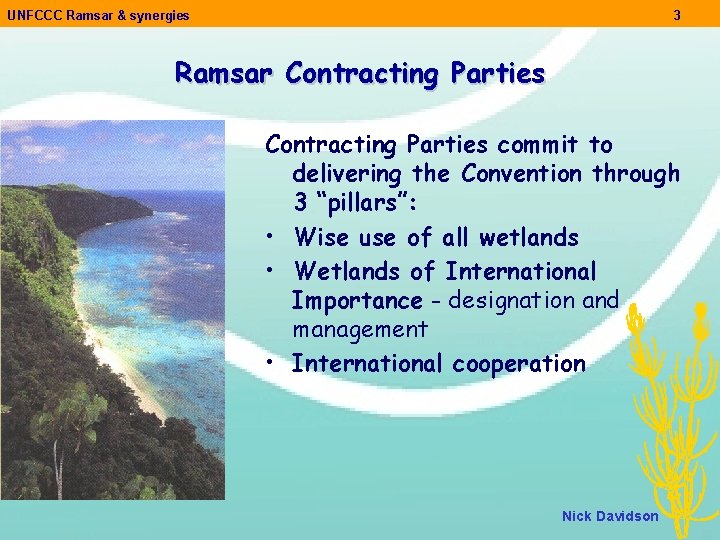
UNFCCC Ramsar & synergies 3 Ramsar Contracting Parties commit to delivering the Convention through 3 “pillars”: • Wise use of all wetlands • Wetlands of International Importance - designation and management • International cooperation Nick Davidson
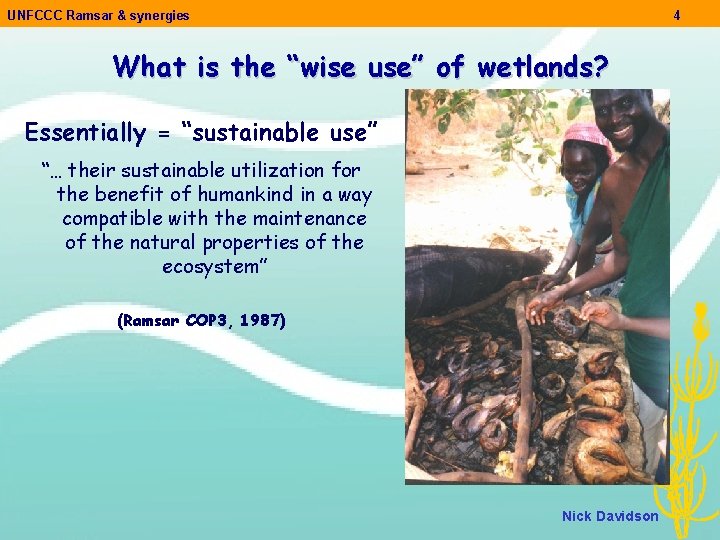
UNFCCC Ramsar & synergies 4 What is the “wise use” of wetlands? Essentially = “sustainable use” “… their sustainable utilization for the benefit of humankind in a way compatible with the maintenance of the natural properties of the ecosystem” (Ramsar COP 3, 1987) Nick Davidson
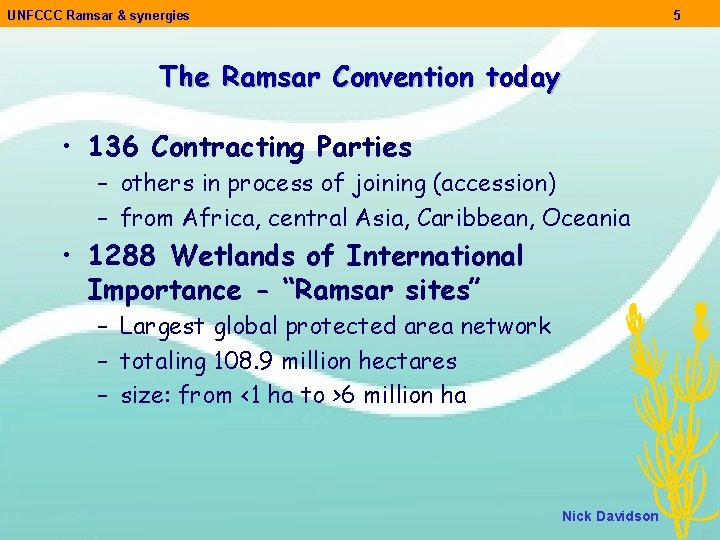
UNFCCC Ramsar & synergies 5 The Ramsar Convention today • 136 Contracting Parties – others in process of joining (accession) – from Africa, central Asia, Caribbean, Oceania • 1288 Wetlands of International Importance - “Ramsar sites” – Largest global protected area network – totaling 108. 9 million hectares – size: from <1 ha to >6 million ha Nick Davidson
UNFCCC Ramsar & synergies 6 Ramsar links with other organisations Extensive cooperation with: • NGOs and expert networks • regional environmental organisations • UN agencies • other environmental conventions Nick Davidson
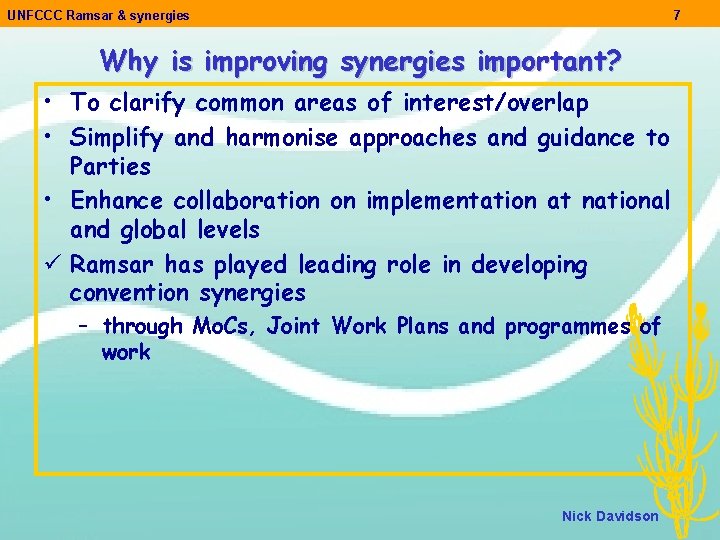
UNFCCC Ramsar & synergies 7 Why is improving synergies important? • To clarify common areas of interest/overlap • Simplify and harmonise approaches and guidance to Parties • Enhance collaboration on implementation at national and global levels ü Ramsar has played leading role in developing convention synergies – through Mo. Cs, Joint Work Plans and programmes of work Nick Davidson
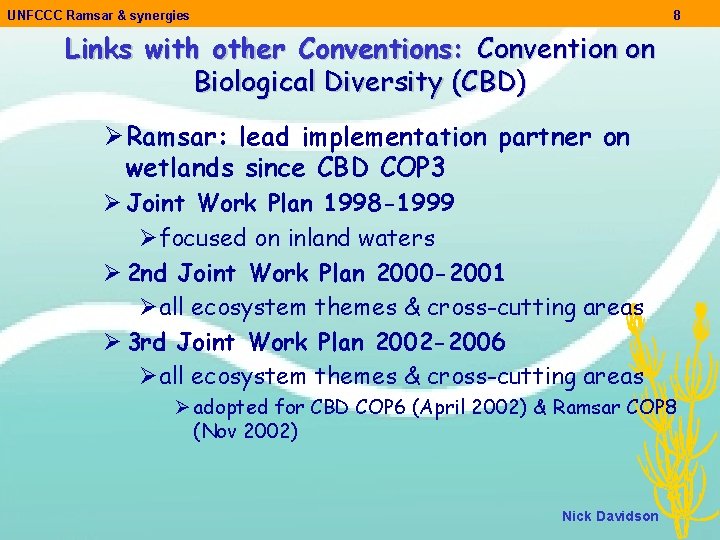
UNFCCC Ramsar & synergies 8 Links with other Conventions: Convention on Biological Diversity (CBD) Ø Ramsar: lead implementation partner on wetlands since CBD COP 3 Ø Joint Work Plan 1998 -1999 Øfocused on inland waters Ø 2 nd Joint Work Plan 2000 -2001 Øall ecosystem themes & cross-cutting areas Ø 3 rd Joint Work Plan 2002 -2006 Øall ecosystem themes & cross-cutting areas Ø adopted for CBD COP 6 (April 2002) & Ramsar COP 8 (Nov 2002) Nick Davidson
UNFCCC Ramsar & synergies 9 CBD-Ramsar 3 rd Joint Work Plan • Joint Ramsar-CBD River Basin Initiative – on wetlands, biodiversity and integrated river basin management • all ecosystem themes – inland waters, marine & coastal, forests, agriculture, drylands, mountains • cross-cutting issues – e. g. invasive species, monitoring and indicators, inventory & assessment, CEPA, traditional knowledge, protected areas; incentives • joint cooperation with other conventions • national reporting – streamlining reporting -drawing on UNEP national pilot projects Nick Davidson
UNFCCC Ramsar & synergies 10 CBD-Ramsar 3 rd Joint Work Plan • Enhanced cooperation includes: – CBD COP 6 guidelines on impact assessment adopted by Ramsar COP 8 with annotations for Ramsar context – joint development of technical guidelines - rapid assessment methodologies (inland waters; coastal/marine) – joint review and elaboration of CBD inland waters programme of work - for CBD COP 7 (2004) – increased participation in each others’ technical working groups Nick Davidson
UNFCCC Ramsar & synergies 11 CBD/Ramsar collaboration - direction from • Identifying common issues, & • making available each other’s guidance to respective Parties through • adopting each other’s guidance for common national implementation to • joint development of initiatives (e. g. RBI) • joint development of technical guidance and programme implementation simplified and consistent guidance for national implementation Nick Davidson
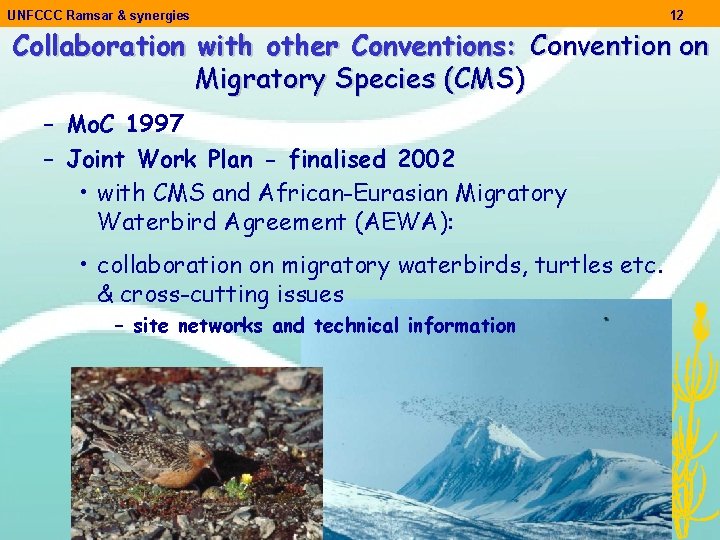
UNFCCC Ramsar & synergies 12 Collaboration with other Conventions: Convention on Migratory Species (CMS) – Mo. C 1997 – Joint Work Plan - finalised 2002 • with CMS and African-Eurasian Migratory Waterbird Agreement (AEWA): • collaboration on migratory waterbirds, turtles etc. & cross-cutting issues – site networks and technical information Nick Davidson
UNFCCC Ramsar & synergies 13 Collaboration with other Conventions: UNESCO • Mo. C with World Heritage Convention -1999 • Joint programme of work with Man and the Biosphere Programme (MAB) - 2002 – focus: • protected areas monitoring and management • consolidation & expansion of management planning guidance Nick Davidson
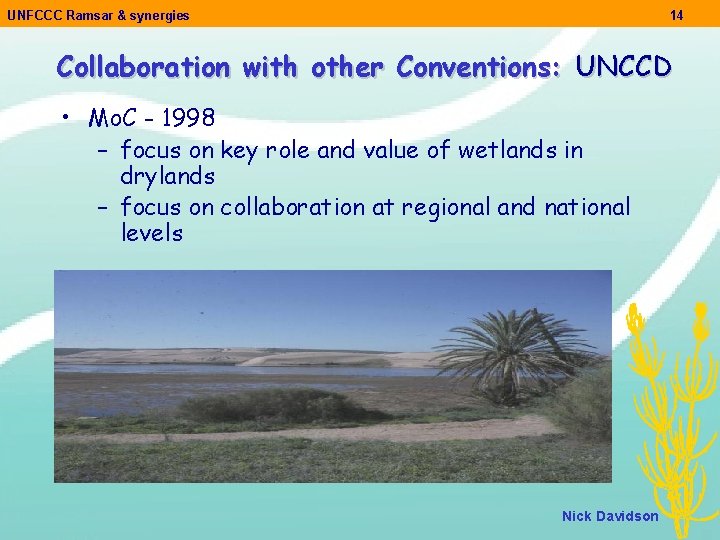
UNFCCC Ramsar & synergies 14 Collaboration with other Conventions: UNCCD • Mo. C - 1998 – focus on key role and value of wetlands in drylands – focus on collaboration at regional and national levels Nick Davidson
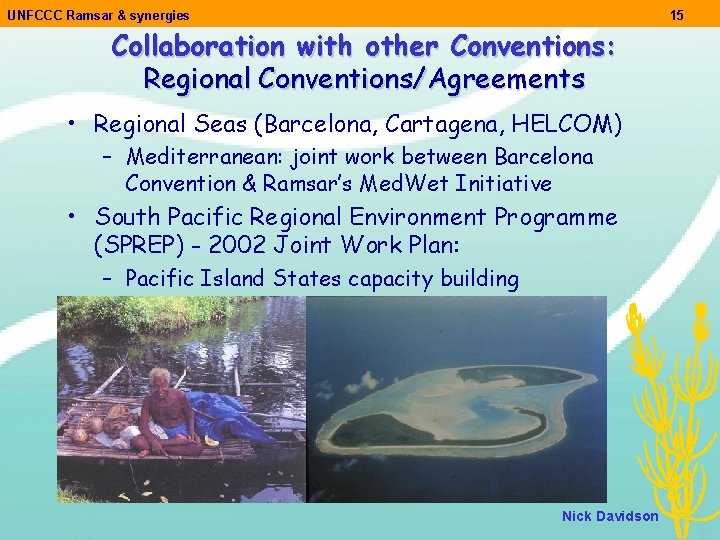
UNFCCC Ramsar & synergies 15 Collaboration with other Conventions: Regional Conventions/Agreements • Regional Seas (Barcelona, Cartagena, HELCOM) – Mediterranean: joint work between Barcelona Convention & Ramsar’s Med. Wet Initiative • South Pacific Regional Environment Programme (SPREP) - 2002 Joint Work Plan: – Pacific Island States capacity building Nick Davidson
UNFCCC Ramsar & synergies 16 Collaboration with other Conventions: UNFCCC • Ramsar COP 8 (November 2002) – considered technical reports & adopted Resolution (VIII. 3) on: “Climate change and wetlands: impacts, adaptation and mitigation” – basis for focussing on key cross-cutting issues for future common action – requested special attention to capacity & synergies: wetlands and climate change – Ramsar Parties’ commitments to conservation and sustainable use and management of inland coastal wetlands: • provide existing mechanisms for climate change adaptation and mitigation action Nick Davidson
UNFCCC Ramsar & synergies 17 Ramsar and climate change • Ramsar COP 8 recognised potential for conflicting requirements of Ramsar & UNFCCC/Kyoto Protocol • Parties to ensure climate change implementation – through revegetation and forest management, afforestation and revegetation – does not conflict with commitment to conservation and sustainable use of wetlands Nick Davidson
UNFCCC Ramsar & synergies 18 Status of national-level synergies • Ramsar COPs have strongly urged collaboration between focal points for many years – Strategic Plan actions – COP decisions (Resolutions) • but extent of national collaboration still very variable • analysis of 131 National Reports to Ramsar’s COP 8 provides insights • Most Reports from countries who are Parties to all global MEAs Nick Davidson
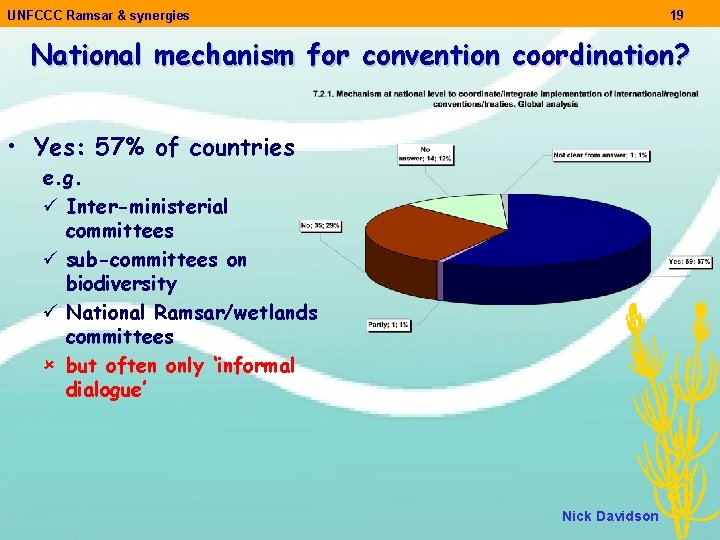
UNFCCC Ramsar & synergies 19 National mechanism for convention coordination? • Yes: 57% of countries e. g. ü Inter-ministerial committees ü sub-committees on biodiversity ü National Ramsar/wetlands committees û but often only ‘informal dialogue’ Nick Davidson
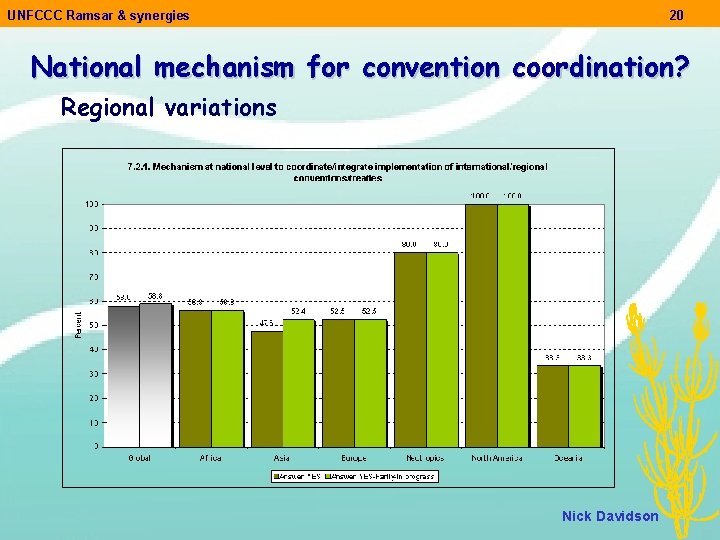
UNFCCC Ramsar & synergies 20 National mechanism for convention coordination? Regional variations Nick Davidson
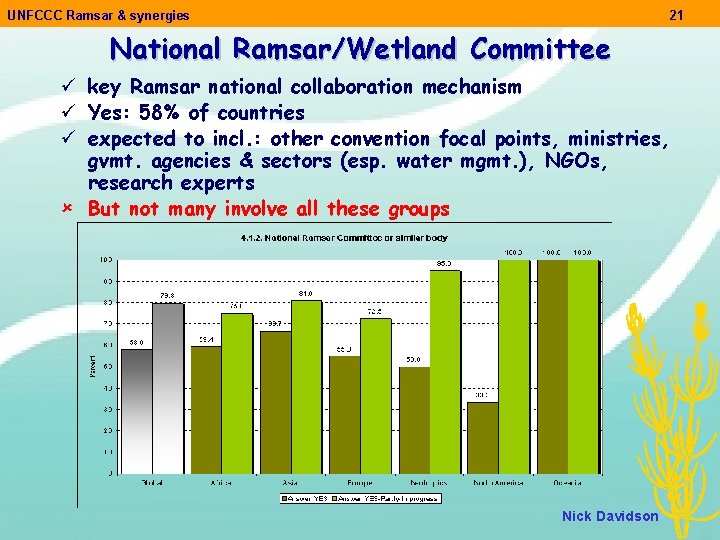
UNFCCC Ramsar & synergies 21 National Ramsar/Wetland Committee ü key Ramsar national collaboration mechanism ü Yes: 58% of countries ü expected to incl. : other convention focal points, ministries, gvmt. agencies & sectors (esp. water mgmt. ), NGOs, research experts û But not many involve all these groups Nick Davidson
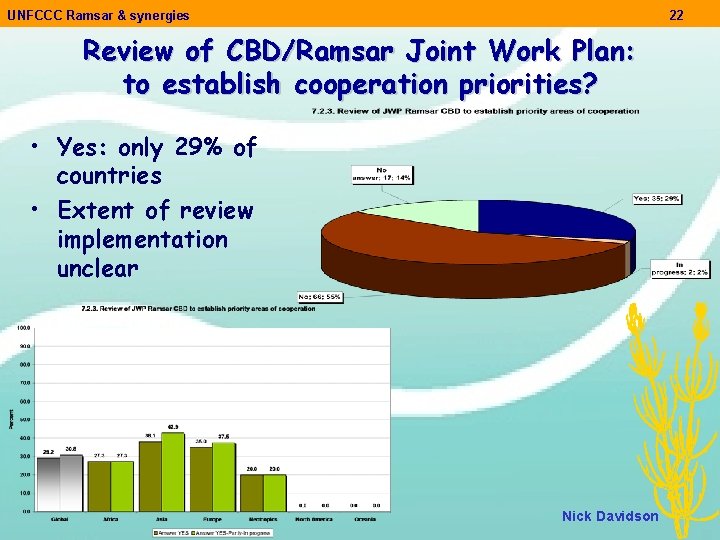
UNFCCC Ramsar & synergies 22 Review of CBD/Ramsar Joint Work Plan: to establish cooperation priorities? • Yes: only 29% of countries • Extent of review implementation unclear Nick Davidson
UNFCCC Ramsar & synergies 23 Conclusions: national-scale collaboration on implementation • mechanisms exist in many countries, but lacking in many others • do not appear to always work effectively • Are Focal Points of each Convention wary of ‘interference’ from other Conventions’ FPs? • lack of engagement from other government sectors? – environment ministries often weaker than other sectors Nick Davidson
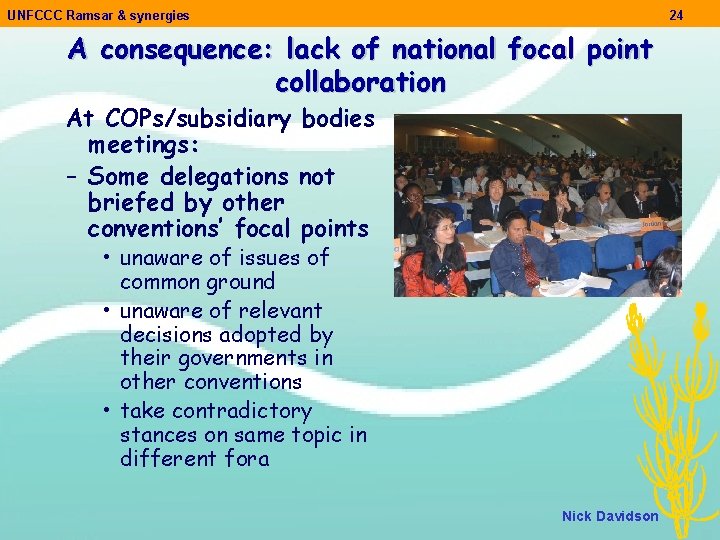
UNFCCC Ramsar & synergies 24 A consequence: lack of national focal point collaboration At COPs/subsidiary bodies meetings: – Some delegations not briefed by other conventions’ focal points • unaware of issues of common ground • unaware of relevant decisions adopted by their governments in other conventions • take contradictory stances on same topic in different fora Nick Davidson
UNFCCC Ramsar & synergies 25 Collaboration challenges • most joint activity at global level (secretariats, subsidiary bodies) – need to enhance national level collaboration • many bilateral work plans complexity for Parties • establishment & implementation of joint work plans workload of overstretched secretariats • different governance schedules & priorities (COPs, subsidiary bodies) & • differing subsidiary body modus operandi difficulties of undertaking and reporting on joint work Nick Davidson
UNFCCC Ramsar & synergies 26 Global-scale challenges: Way forward? • multi-convention joint work plans? • needs clear analysis of common issues and overlap of national implementation requirements basis for implementation harmonization • Are there conflicting national requirements under different conventions? • Streamlining national reporting – important capacity issue for Parties – should follow from common issues analysis and national harmonization of implementation – not the starting point for activity • i. e. treat the problem, not the symptom Nick Davidson
UNFCCC Ramsar & synergies 27 Thank you Nick Davidson
UNFCCC Ramsar & synergies 28 Nick Davidson
UNFCCC Ramsar & synergies 29 Ramsar and climate change - 1 • COP 8 Resolution VIII. 3 calls on Parties to: – manage wetlands to increase resilience to climate change and extreme events – promote restoration & management of peatlands and other wetlands which are significant carbon stores or sequester carbon – research role of wetlands in • carbon storage & sequestration, and • sea-level rise mitigation – special attention to strengthening institutional capacities and synergies to address climate change and wetland linkages Nick Davidson
UNFCCC Ramsar & synergies 30 Ramsar and climate change - 2 • COP 8 recognised potential for conflicting requirements of Ramsar & UNFCCC/Kyoto Protocol • Parties to ensure climate change implementation – through revegetation and forest management, afforestation and revegetation – does not conflict with commitment to conservation and sustainable use of wetlands • STRP preparing further guidance on vulnerability assessment methodologies for wetlands in relation to climate change • Requested IPCC to consider preparing technical report on climate change and wetlands Nick Davidson