
UNESCO Information Literacy A Case Study Digital Divide
- Slides: 27
UNESCO Information Literacy – A Case Study Digital Divide & Bridging The Gap Objectives: - To understand UNESCO Information Literacy - To understand digital divide and how to bridge the gap References: 1. Towards Information Literacy Indicators, Conceptual Framework Paper by Ralph Catts & Jesus Lau, UNESCO Paris, 2008. 2. ICT and Our Society (4 th Edition) by Yeo Gee Kin & Oh Lih Bin, Mc. Graw Hill Publication. Computing in Society (CIS), Year 1 Semester 1, AY 2010/2011 Copyright © 2010 NP School of Info. Comm Technology. All rights reserved. Lecture xx Slide 1
Information Literacy (IL) Why IL is important to people? Computing in Society (CIS), Year 1 Semester 1, AY 2010/2011 Copyright © 2010 NP School of Info. Comm Technology. All rights reserved. Lecture xx Slide 2
UNESCO Information Literacy • United Nations Educational Scientific and Cultural Organisation (UNESCO) Advocates the building of knowledge societies. . . “ A Basic Human Right in the Digital World” Computing in Society (CIS), Year 1 Semester 1, AY 2010/2011 Copyright © 2010 NP School of Info. Comm Technology. All rights reserved. Lecture xx Slide 3
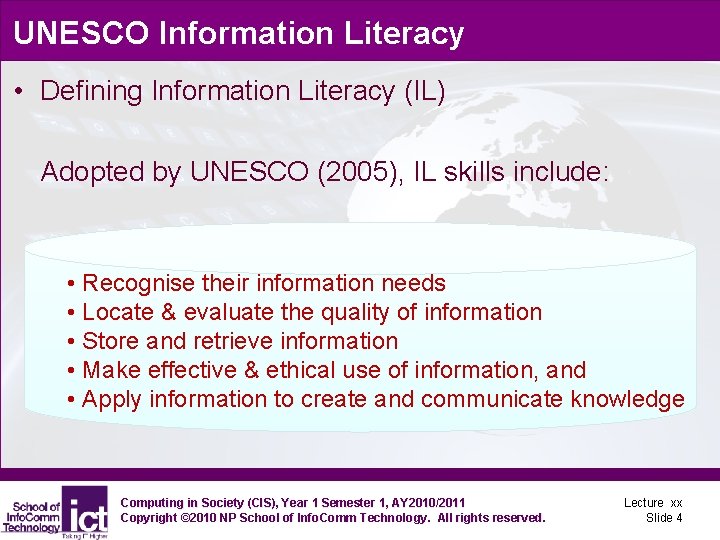
UNESCO Information Literacy • Defining Information Literacy (IL) Adopted by UNESCO (2005), IL skills include: • Recognise their information needs • Locate & evaluate the quality of information • Store and retrieve information • Make effective & ethical use of information, and • Apply information to create and communicate knowledge Computing in Society (CIS), Year 1 Semester 1, AY 2010/2011 Copyright © 2010 NP School of Info. Comm Technology. All rights reserved. Lecture xx Slide 4
UNESCO Information Literacy • Distinguishing IL and ICT Can people be information literate in the absence of ICT? Computing in Society (CIS), Year 1 Semester 1, AY 2010/2011 Copyright © 2010 NP School of Info. Comm Technology. All rights reserved. Lecture xx Slide 5
UNESCO Information Literacy • UNESCO Information Literacy Context IL is essential for individuals to achieve personal, social, occupational and educational goals in a knowledge society. • Implications of IL need to be considered at both national & international levels in : • Society • Work • Education • Well-Being Computing in Society (CIS), Year 1 Semester 1, AY 2010/2011 Copyright © 2010 NP School of Info. Comm Technology. All rights reserved. Lecture xx Slide 6
UNESCO Information Literacy • IL for Health & Well-Being Health Professionals • Access to current and best practice to the delivery of quality services. Right of Individuals • Obtain, interpret, and understand basic health information and services. • Use of information and services which are health-enhancing. • Distinguish between information from credible sources, such as WHO, and information from manufacturer / medical suppliers. Computing in Society (CIS), Year 1 Semester 1, AY 2010/2011 Copyright © 2010 NP School of Info. Comm Technology. All rights reserved. Lecture xx Slide 7
UNESCO Information Literacy • IL and Civic Society A civic society in which people may participate actively in a democratic process – active participation (self-directed) creating government as enabling rather than directive. An informed society in which people act creatively, and takes initiatives to make new meanings & new ways of governance. Computing in Society (CIS), Year 1 Semester 1, AY 2010/2011 Copyright © 2010 NP School of Info. Comm Technology. All rights reserved. Lecture xx Slide 8
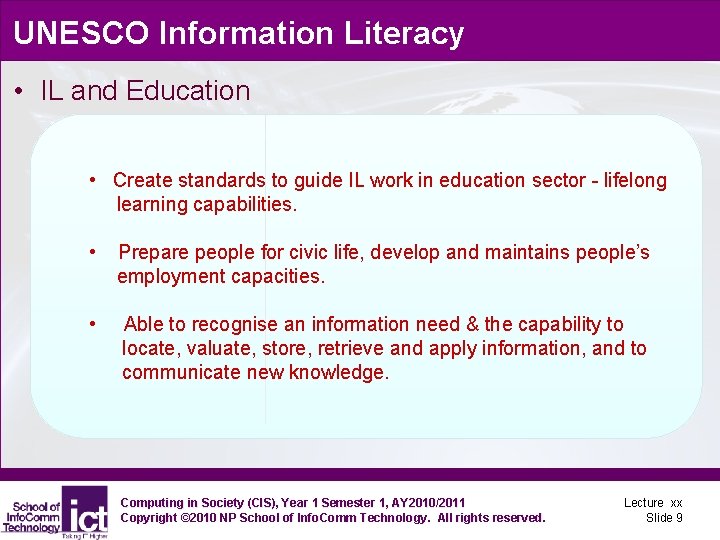
UNESCO Information Literacy • IL and Education • Create standards to guide IL work in education sector - lifelong learning capabilities. • Prepare people for civic life, develop and maintains people’s employment capacities. • Able to recognise an information need & the capability to locate, valuate, store, retrieve and apply information, and to communicate new knowledge. Computing in Society (CIS), Year 1 Semester 1, AY 2010/2011 Copyright © 2010 NP School of Info. Comm Technology. All rights reserved. Lecture xx Slide 9
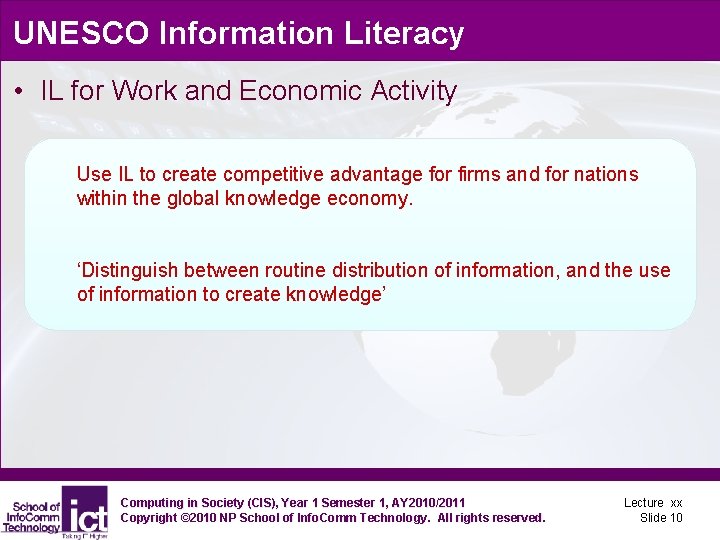
UNESCO Information Literacy • IL for Work and Economic Activity Use IL to create competitive advantage for firms and for nations within the global knowledge economy. ‘Distinguish between routine distribution of information, and the use of information to create knowledge’ Computing in Society (CIS), Year 1 Semester 1, AY 2010/2011 Copyright © 2010 NP School of Info. Comm Technology. All rights reserved. Lecture xx Slide 10
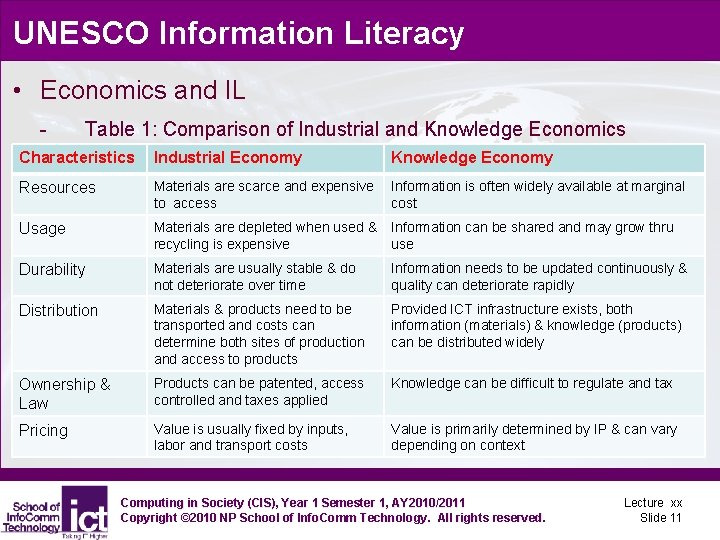
UNESCO Information Literacy • Economics and IL - Table 1: Comparison of Industrial and Knowledge Economics Characteristics Industrial Economy Knowledge Economy Resources Materials are scarce and expensive to access Information is often widely available at marginal cost Usage Materials are depleted when used & recycling is expensive Information can be shared and may grow thru use Durability Materials are usually stable & do not deteriorate over time Information needs to be updated continuously & quality can deteriorate rapidly Distribution Materials & products need to be transported and costs can determine both sites of production and access to products Provided ICT infrastructure exists, both information (materials) & knowledge (products) can be distributed widely Ownership & Law Products can be patented, access controlled and taxes applied Knowledge can be difficult to regulate and tax Pricing Value is usually fixed by inputs, labor and transport costs Value is primarily determined by IP & can vary depending on context Computing in Society (CIS), Year 1 Semester 1, AY 2010/2011 Copyright © 2010 NP School of Info. Comm Technology. All rights reserved. Lecture xx Slide 11
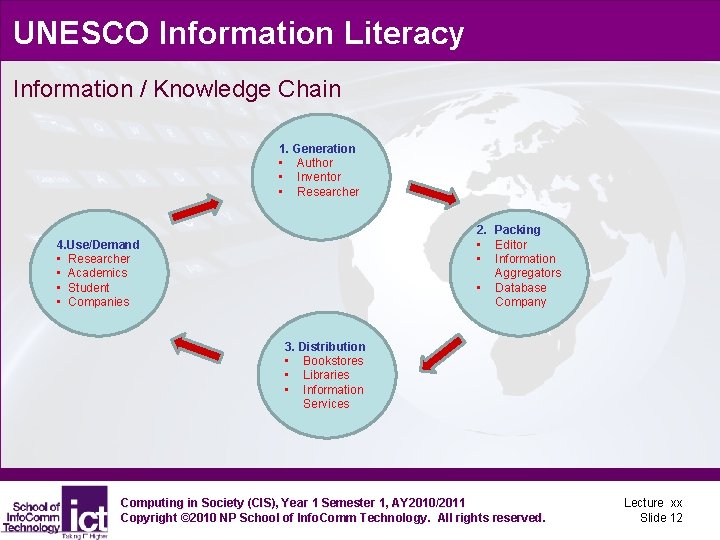
UNESCO Information Literacy Information / Knowledge Chain 1. Generation • Author • Inventor • Researcher 2. Packing • Editor • Information Aggregators • Database Company 4. Use/Demand • Researcher • Academics • Student • Companies 3. Distribution • Bookstores • Libraries • Information Services Computing in Society (CIS), Year 1 Semester 1, AY 2010/2011 Copyright © 2010 NP School of Info. Comm Technology. All rights reserved. Lecture xx Slide 12
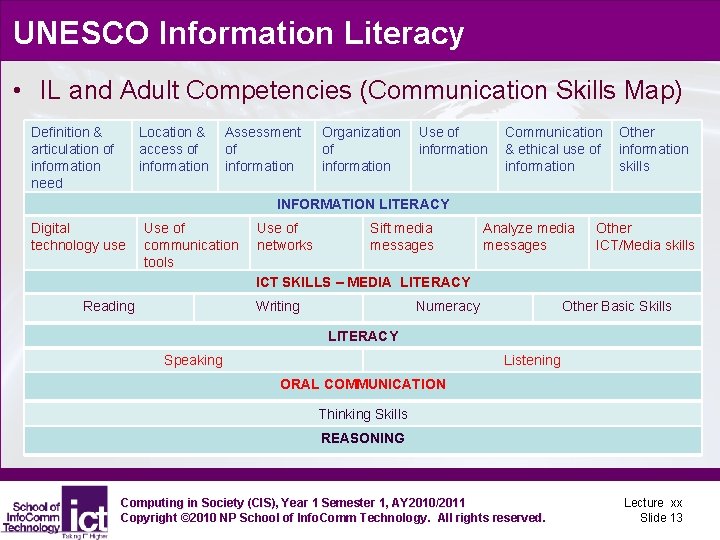
UNESCO Information Literacy • IL and Adult Competencies (Communication Skills Map) Definition & articulation of information need Location & access of information Assessment of information Organization of information Use of information Communication & ethical use of information Other information skills INFORMATION LITERACY Digital technology use Use of communication tools Use of networks Sift media messages Analyze media messages Other ICT/Media skills ICT SKILLS – MEDIA LITERACY Reading Writing Numeracy Other Basic Skills LITERACY Speaking Listening ORAL COMMUNICATION Thinking Skills REASONING Computing in Society (CIS), Year 1 Semester 1, AY 2010/2011 Copyright © 2010 NP School of Info. Comm Technology. All rights reserved. Lecture xx Slide 13
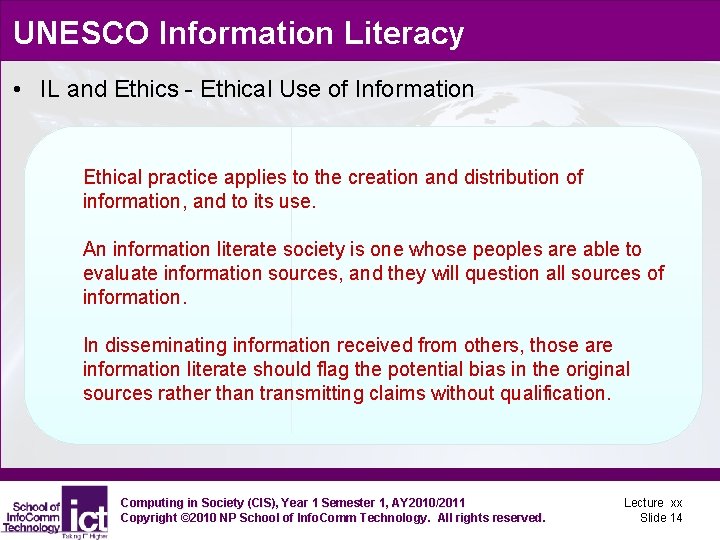
UNESCO Information Literacy • IL and Ethics - Ethical Use of Information Ethical practice applies to the creation and distribution of information, and to its use. An information literate society is one whose peoples are able to evaluate information sources, and they will question all sources of information. In disseminating information received from others, those are information literate should flag the potential bias in the original sources rather than transmitting claims without qualification. Computing in Society (CIS), Year 1 Semester 1, AY 2010/2011 Copyright © 2010 NP School of Info. Comm Technology. All rights reserved. Lecture xx Slide 14
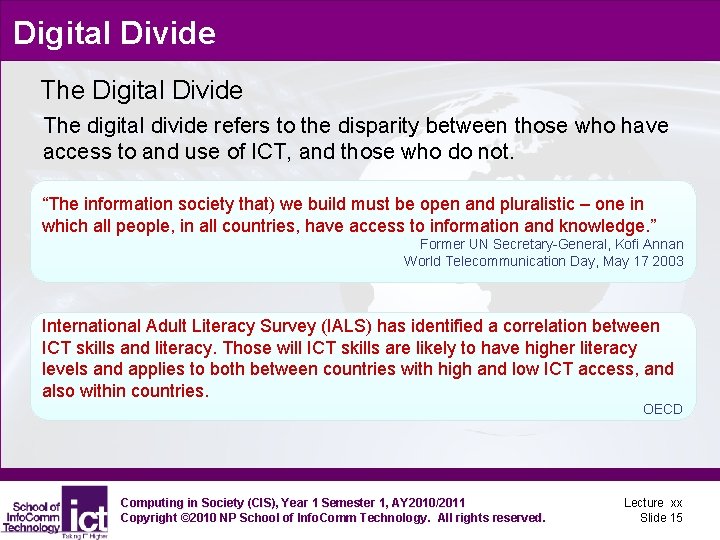
Digital Divide The digital divide refers to the disparity between those who have access to and use of ICT, and those who do not. “The information society that) we build must be open and pluralistic – one in which all people, in all countries, have access to information and knowledge. ” Former UN Secretary-General, Kofi Annan World Telecommunication Day, May 17 2003 International Adult Literacy Survey (IALS) has identified a correlation between ICT skills and literacy. Those will ICT skills are likely to have higher literacy levels and applies to both between countries with high and low ICT access, and also within countries. OECD Computing in Society (CIS), Year 1 Semester 1, AY 2010/2011 Copyright © 2010 NP School of Info. Comm Technology. All rights reserved. Lecture xx Slide 15
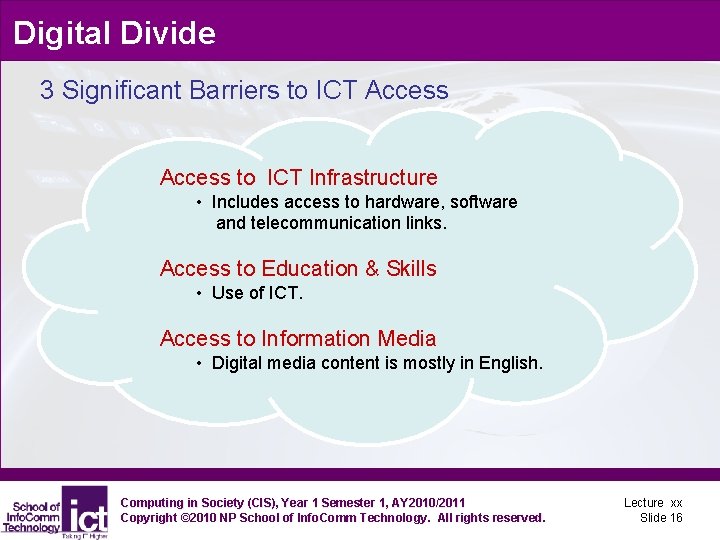
Digital Divide 3 Significant Barriers to ICT Access to ICT Infrastructure • Includes access to hardware, software and telecommunication links. Access to Education & Skills • Use of ICT. Access to Information Media • Digital media content is mostly in English. Computing in Society (CIS), Year 1 Semester 1, AY 2010/2011 Copyright © 2010 NP School of Info. Comm Technology. All rights reserved. Lecture xx Slide 16
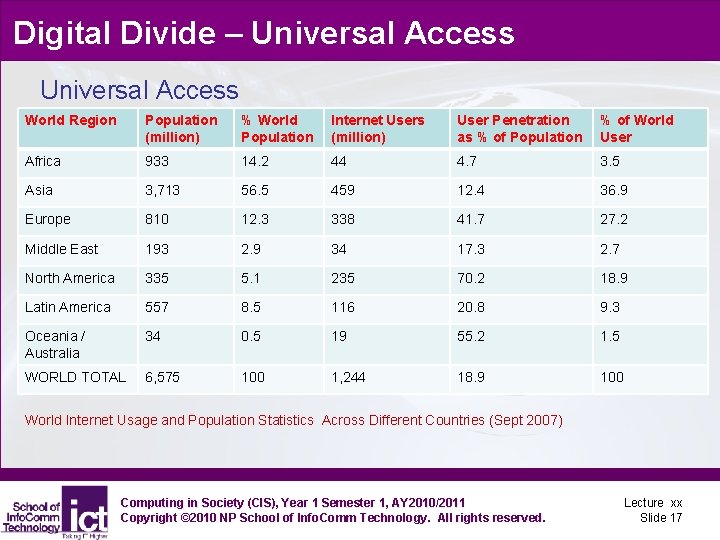
Digital Divide – Universal Access World Region Population (million) % World Population Internet Users (million) User Penetration as % of Population % of World User Africa 933 14. 2 44 4. 7 3. 5 Asia 3, 713 56. 5 459 12. 4 36. 9 Europe 810 12. 3 338 41. 7 27. 2 Middle East 193 2. 9 34 17. 3 2. 7 North America 335 5. 1 235 70. 2 18. 9 Latin America 557 8. 5 116 20. 8 9. 3 Oceania / Australia 34 0. 5 19 55. 2 1. 5 WORLD TOTAL 6, 575 100 1, 244 18. 9 100 World Internet Usage and Population Statistics Across Different Countries (Sept 2007) Computing in Society (CIS), Year 1 Semester 1, AY 2010/2011 Copyright © 2010 NP School of Info. Comm Technology. All rights reserved. Lecture xx Slide 17
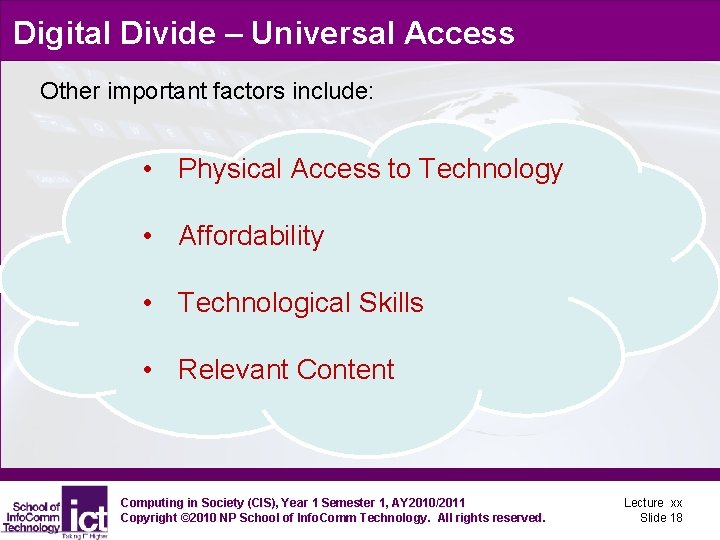
Digital Divide – Universal Access Other important factors include: • Physical Access to Technology • Affordability • Technological Skills • Relevant Content Computing in Society (CIS), Year 1 Semester 1, AY 2010/2011 Copyright © 2010 NP School of Info. Comm Technology. All rights reserved. Lecture xx Slide 18
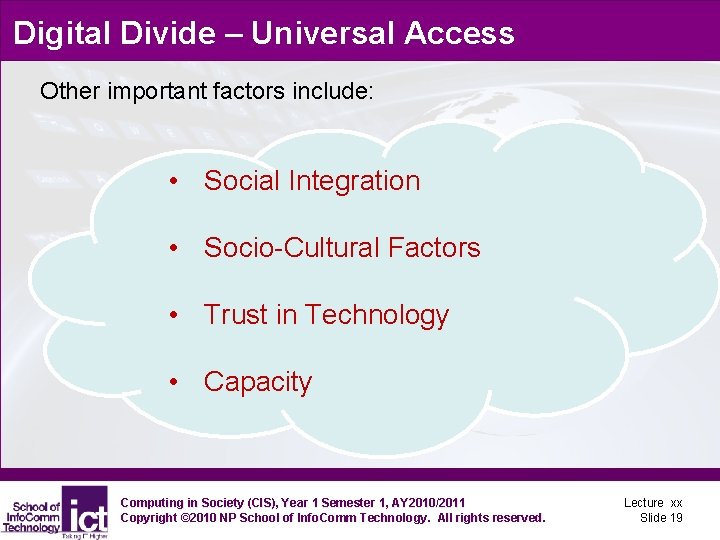
Digital Divide – Universal Access Other important factors include: • Social Integration • Socio-Cultural Factors • Trust in Technology • Capacity Computing in Society (CIS), Year 1 Semester 1, AY 2010/2011 Copyright © 2010 NP School of Info. Comm Technology. All rights reserved. Lecture xx Slide 19
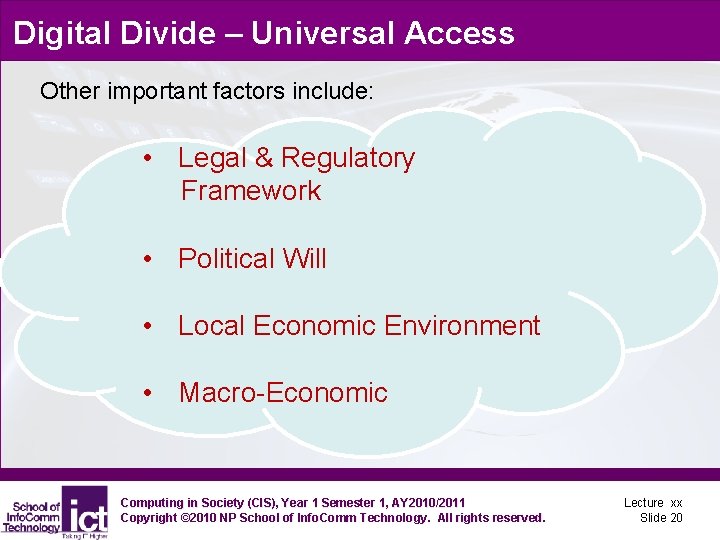
Digital Divide – Universal Access Other important factors include: • Legal & Regulatory Framework • Political Will • Local Economic Environment • Macro-Economic Computing in Society (CIS), Year 1 Semester 1, AY 2010/2011 Copyright © 2010 NP School of Info. Comm Technology. All rights reserved. Lecture xx Slide 20
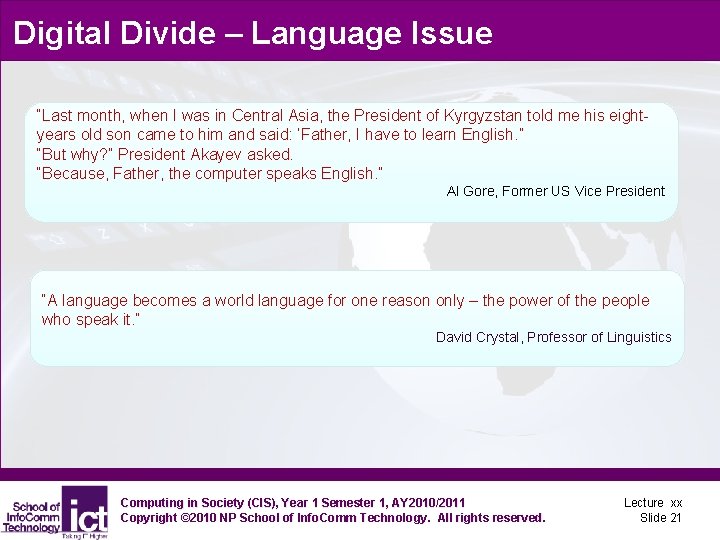
Digital Divide – Language Issue “Last month, when I was in Central Asia, the President of Kyrgyzstan told me his eightyears old son came to him and said: ‘Father, I have to learn English. ” “But why? ” President Akayev asked. “Because, Father, the computer speaks English. ” Al Gore, Former US Vice President “A language becomes a world language for one reason only – the power of the people who speak it. ” David Crystal, Professor of Linguistics Computing in Society (CIS), Year 1 Semester 1, AY 2010/2011 Copyright © 2010 NP School of Info. Comm Technology. All rights reserved. Lecture xx Slide 21
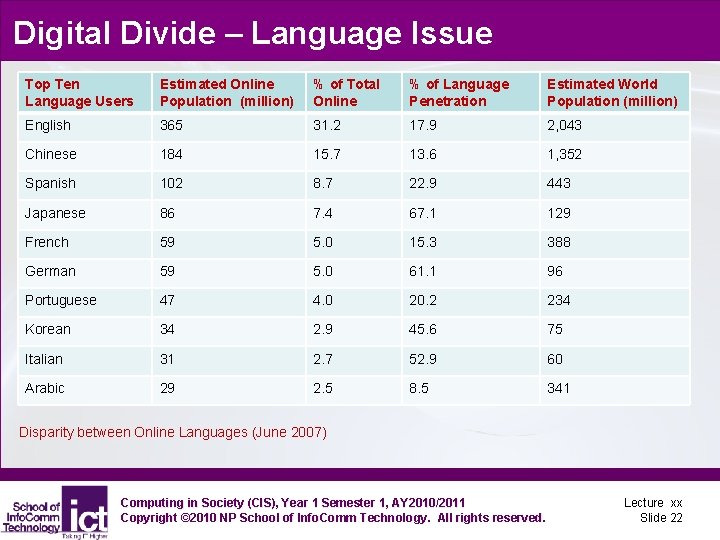
Digital Divide – Language Issue Top Ten Language Users Estimated Online Population (million) % of Total Online % of Language Penetration Estimated World Population (million) English 365 31. 2 17. 9 2, 043 Chinese 184 15. 7 13. 6 1, 352 Spanish 102 8. 7 22. 9 443 Japanese 86 7. 4 67. 1 129 French 59 5. 0 15. 3 388 German 59 5. 0 61. 1 96 Portuguese 47 4. 0 20. 2 234 Korean 34 2. 9 45. 6 75 Italian 31 2. 7 52. 9 60 Arabic 29 2. 5 8. 5 341 Disparity between Online Languages (June 2007) Computing in Society (CIS), Year 1 Semester 1, AY 2010/2011 Copyright © 2010 NP School of Info. Comm Technology. All rights reserved. Lecture xx Slide 22
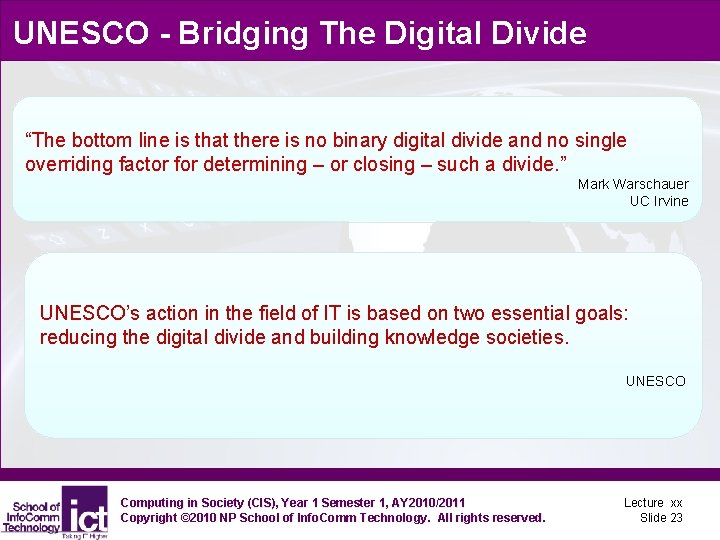
UNESCO - Bridging The Digital Divide “The bottom line is that there is no binary digital divide and no single overriding factor for determining – or closing – such a divide. ” Mark Warschauer UC Irvine UNESCO’s action in the field of IT is based on two essential goals: reducing the digital divide and building knowledge societies. UNESCO Computing in Society (CIS), Year 1 Semester 1, AY 2010/2011 Copyright © 2010 NP School of Info. Comm Technology. All rights reserved. Lecture xx Slide 23
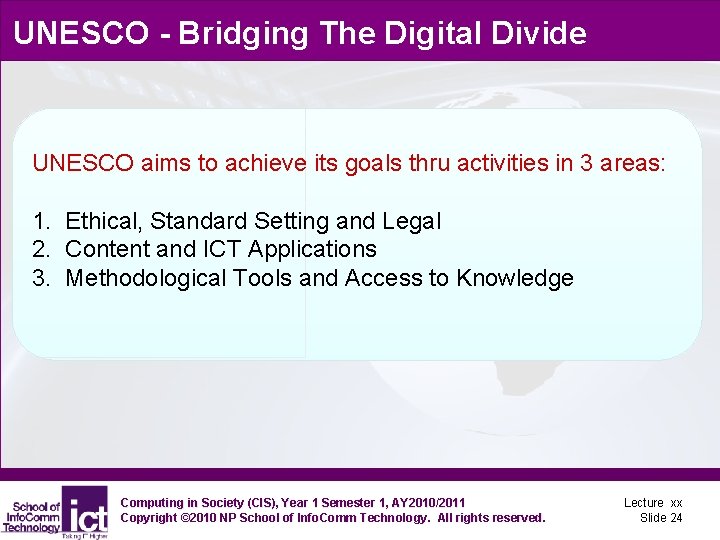
UNESCO - Bridging The Digital Divide UNESCO aims to achieve its goals thru activities in 3 areas: 1. Ethical, Standard Setting and Legal 2. Content and ICT Applications 3. Methodological Tools and Access to Knowledge Computing in Society (CIS), Year 1 Semester 1, AY 2010/2011 Copyright © 2010 NP School of Info. Comm Technology. All rights reserved. Lecture xx Slide 24
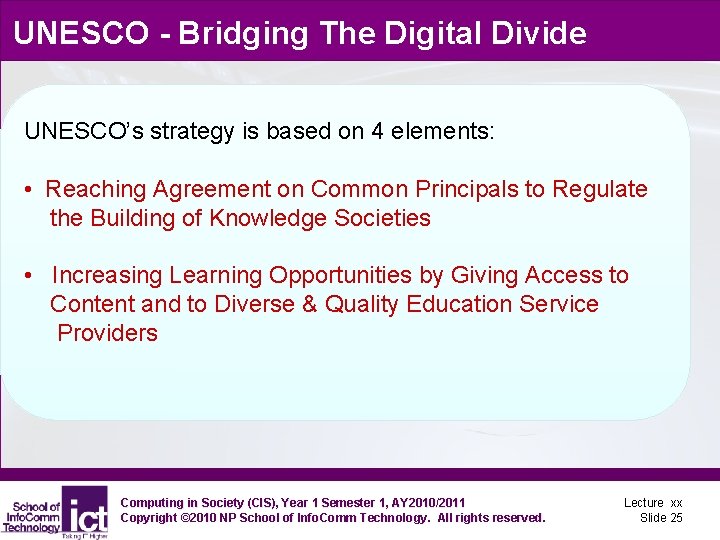
UNESCO - Bridging The Digital Divide UNESCO’s strategy is based on 4 elements: • Reaching Agreement on Common Principals to Regulate the Building of Knowledge Societies • Increasing Learning Opportunities by Giving Access to Content and to Diverse & Quality Education Service Providers Computing in Society (CIS), Year 1 Semester 1, AY 2010/2011 Copyright © 2010 NP School of Info. Comm Technology. All rights reserved. Lecture xx Slide 25
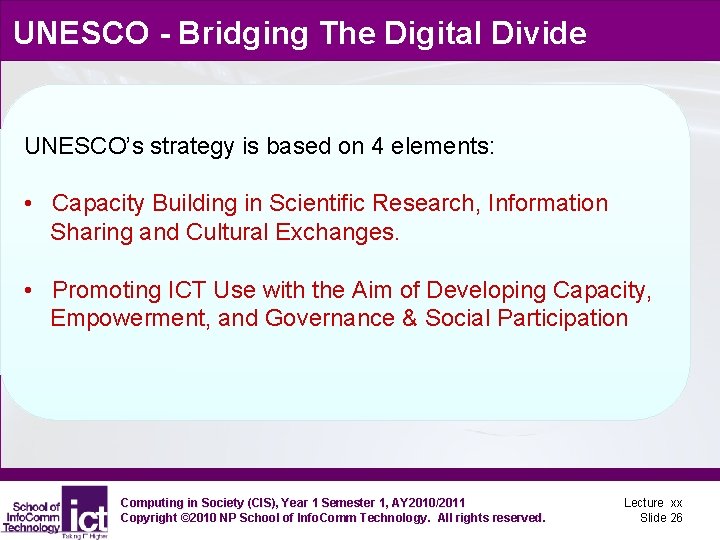
UNESCO - Bridging The Digital Divide UNESCO’s strategy is based on 4 elements: • Capacity Building in Scientific Research, Information Sharing and Cultural Exchanges. • Promoting ICT Use with the Aim of Developing Capacity, Empowerment, and Governance & Social Participation Computing in Society (CIS), Year 1 Semester 1, AY 2010/2011 Copyright © 2010 NP School of Info. Comm Technology. All rights reserved. Lecture xx Slide 26
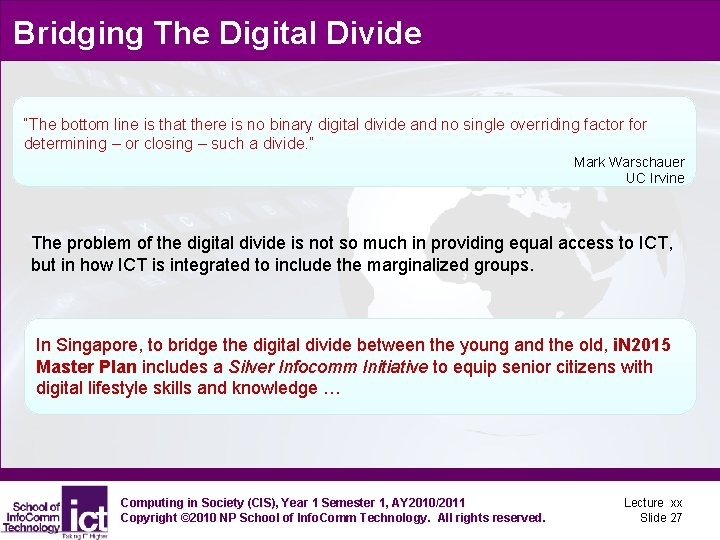
Bridging The Digital Divide “The bottom line is that there is no binary digital divide and no single overriding factor for determining – or closing – such a divide. ” Mark Warschauer UC Irvine The problem of the digital divide is not so much in providing equal access to ICT, but in how ICT is integrated to include the marginalized groups. In Singapore, to bridge the digital divide between the young and the old, i. N 2015 Master Plan includes a Silver Infocomm Initiative to equip senior citizens with digital lifestyle skills and knowledge … Computing in Society (CIS), Year 1 Semester 1, AY 2010/2011 Copyright © 2010 NP School of Info. Comm Technology. All rights reserved. Lecture xx Slide 27