
Unequal societies Why civilization led to social divisions

- Slides: 22
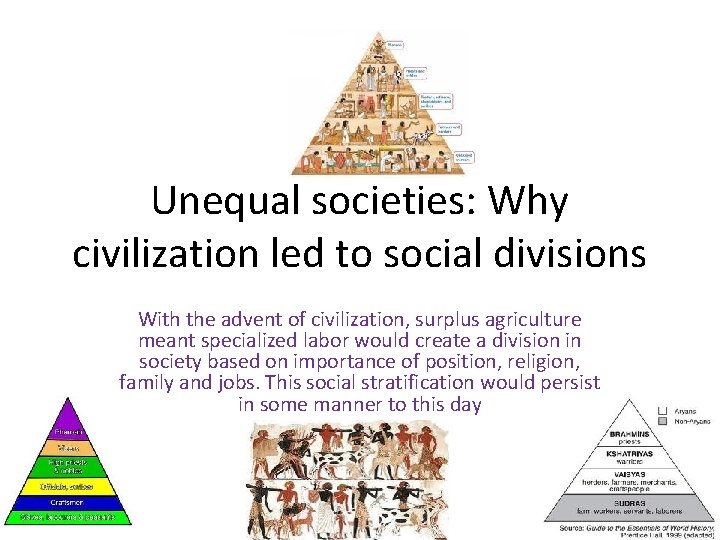
Unequal societies: Why civilization led to social divisions With the advent of civilization, surplus agriculture meant specialized labor would create a division in society based on importance of position, religion, family and jobs. This social stratification would persist in some manner to this day
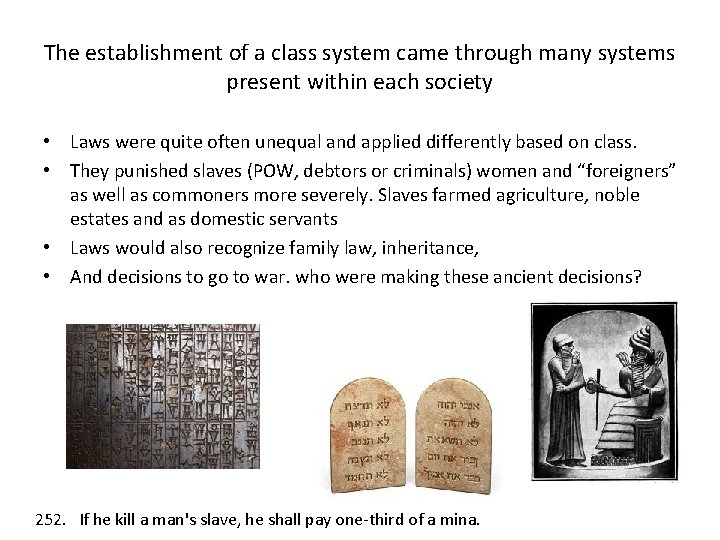
The establishment of a class system came through many systems present within each society • Laws were quite often unequal and applied differently based on class. • They punished slaves (POW, debtors or criminals) women and “foreigners” as well as commoners more severely. Slaves farmed agriculture, noble estates and as domestic servants • Laws would also recognize family law, inheritance, • And decisions to go to war. who were making these ancient decisions? 252. If he kill a man's slave, he shall pay one-third of a mina.
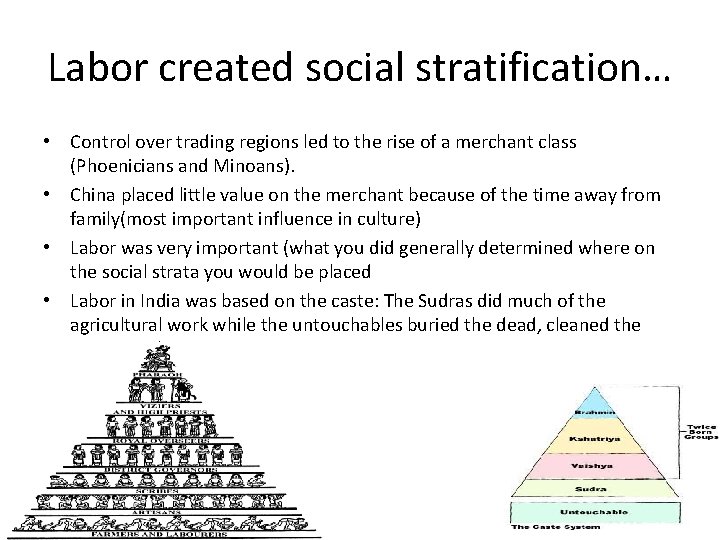
Labor created social stratification… • Control over trading regions led to the rise of a merchant class (Phoenicians and Minoans). • China placed little value on the merchant because of the time away from family(most important influence in culture) • Labor was very important (what you did generally determined where on the social strata you would be placed • Labor in India was based on the caste: The Sudras did much of the agricultural work while the untouchables buried the dead, cleaned the streets and sewers.
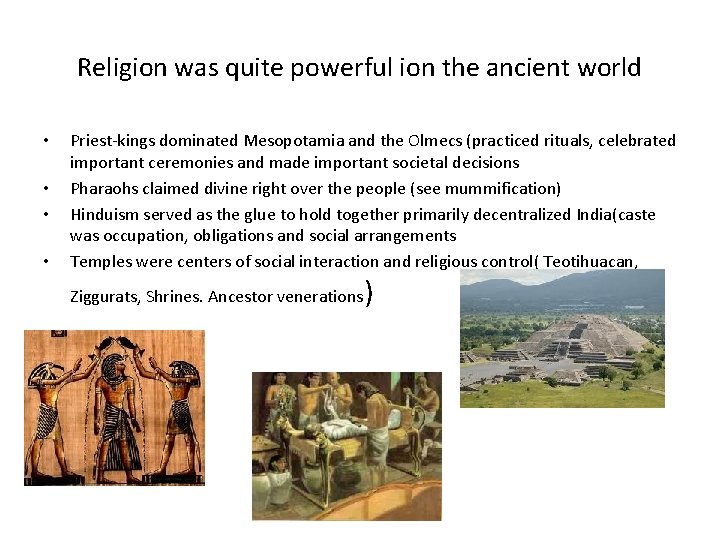
Religion was quite powerful ion the ancient world • • Priest-kings dominated Mesopotamia and the Olmecs (practiced rituals, celebrated important ceremonies and made important societal decisions Pharaohs claimed divine right over the people (see mummification) Hinduism served as the glue to hold together primarily decentralized India(caste was occupation, obligations and social arrangements Temples were centers of social interaction and religious control( Teotihuacan, Ziggurats, Shrines. Ancestor venerations )
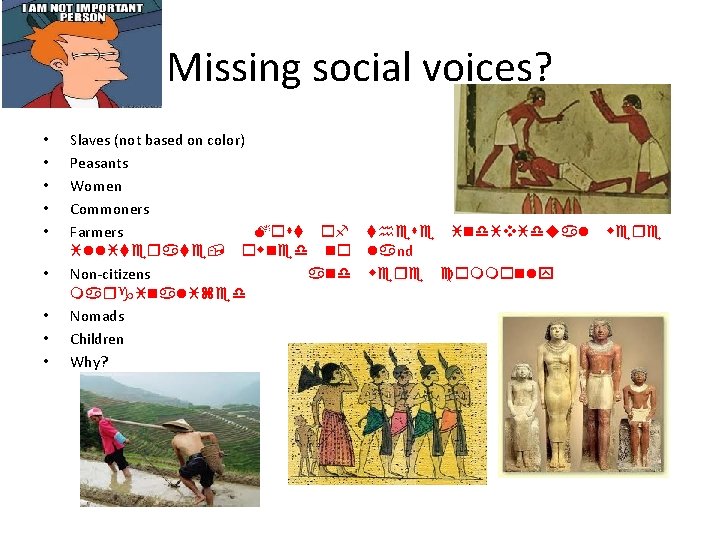
Missing social voices? • • • Slaves (not based on color) Peasants Women Commoners Farmers Most of these individual illiterate, owned no land Non-citizens and were commonly marginalized Nomads Children Why? were
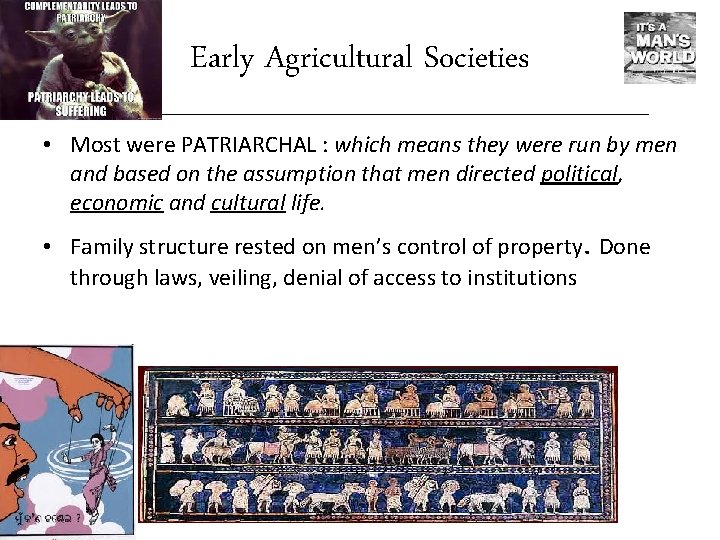
Early Agricultural Societies • Most were PATRIARCHAL : which means they were run by men and based on the assumption that men directed political, economic and cultural life. • Family structure rested on men’s control of property. Done through laws, veiling, denial of access to institutions
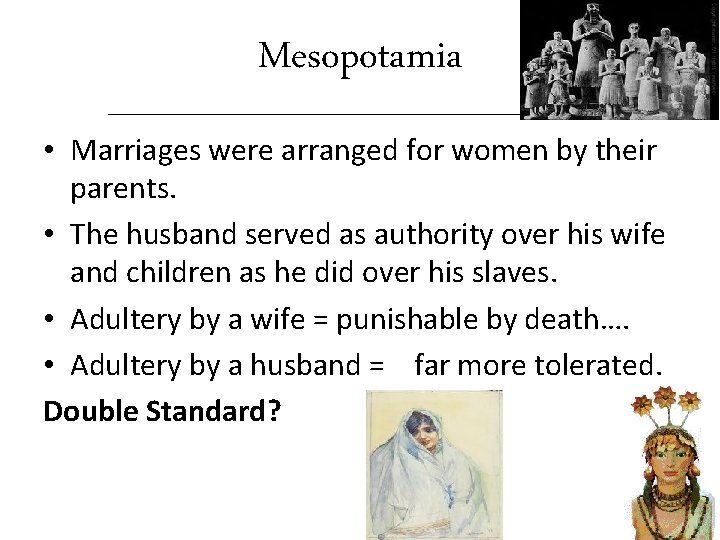
Mesopotamia • Marriages were arranged for women by their parents. • The husband served as authority over his wife and children as he did over his slaves. • Adultery by a wife = punishable by death…. • Adultery by a husband = far more tolerated. Double Standard?
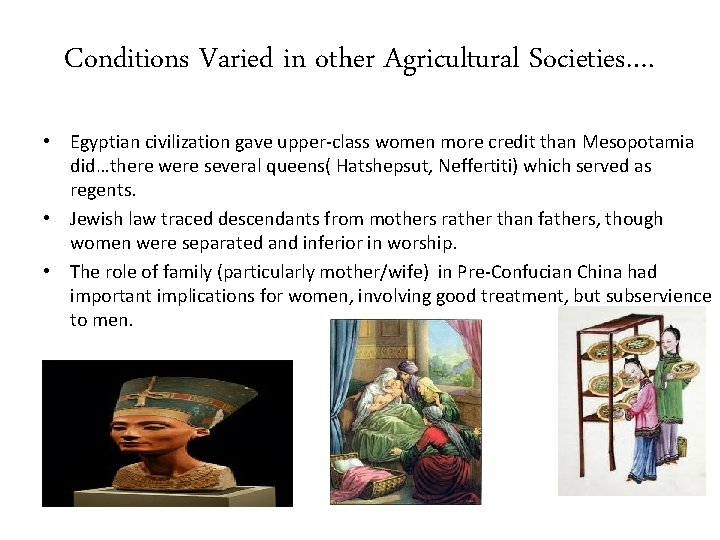
Conditions Varied in other Agricultural Societies…. • Egyptian civilization gave upper-class women more credit than Mesopotamia did…there were several queens( Hatshepsut, Neffertiti) which served as regents. • Jewish law traced descendants from mothers rather than fathers, though women were separated and inferior in worship. • The role of family (particularly mother/wife) in Pre-Confucian China had important implications for women, involving good treatment, but subservience to men.
Hammurabi’s Code • It frequently happened that the bride remained in her father’s house for as much as a year after the contract was signed. If in the course of that time the groom changed his mind he did not have to marry her but he lost the full bride price. (159) The bride’s father might also have changed his mind, in which case he would have been required to refund the purchase price in full (160). If a wife died before giving birth to a son the dowry, less the bride price, was returned immediately to her father’s house (163 -164).
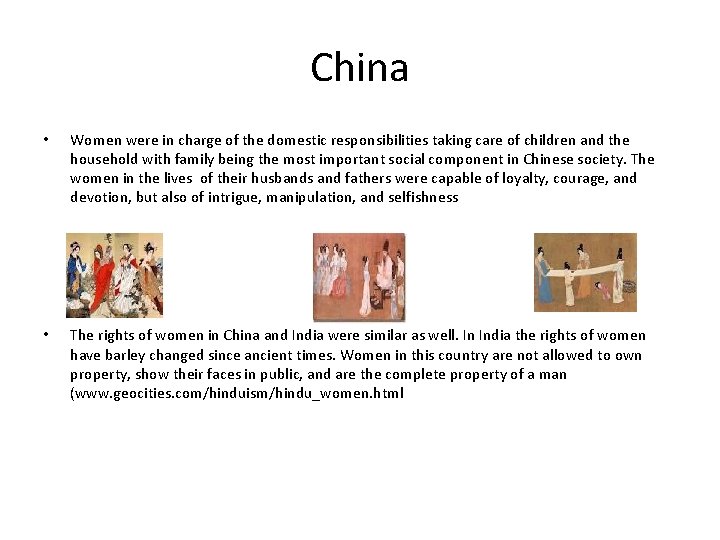
China • Women were in charge of the domestic responsibilities taking care of children and the household with family being the most important social component in Chinese society. The women in the lives of their husbands and fathers were capable of loyalty, courage, and devotion, but also of intrigue, manipulation, and selfishness • The rights of women in China and India were similar as well. In India the rights of women have barley changed since ancient times. Women in this country are not allowed to own property, show their faces in public, and are the complete property of a man (www. geocities. com/hinduism/hindu_women. html
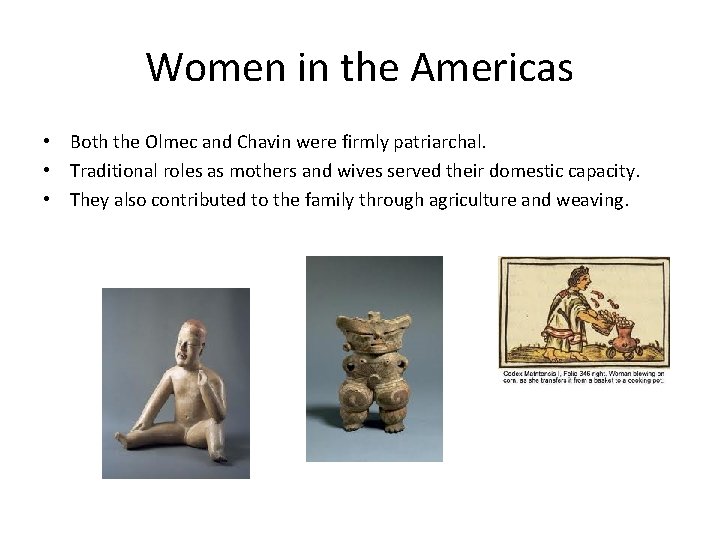
Women in the Americas • Both the Olmec and Chavin were firmly patriarchal. • Traditional roles as mothers and wives served their domestic capacity. • They also contributed to the family through agriculture and weaving.
Conclusions • • • Patriarchy was a commanding theme in agricultural societies. Laws and Culture regulated order. Women’s options were severely constrained. Girls were reared to accept this order…and boys were conscious of their superiority. When population excess threatened a family’s well-being, these assumptions often determined that female infants be killed as a means of population control.
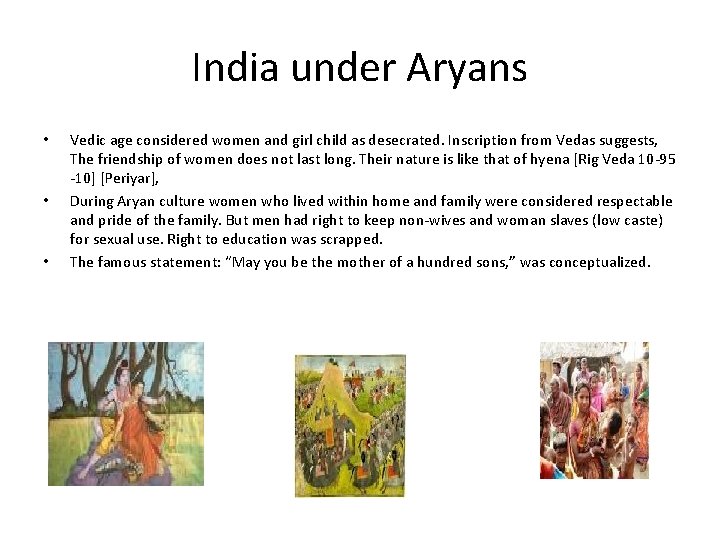
India under Aryans • • • Vedic age considered women and girl child as desecrated. Inscription from Vedas suggests, The friendship of women does not last long. Their nature is like that of hyena [Rig Veda 10 -95 -10] [Periyar], During Aryan culture women who lived within home and family were considered respectable and pride of the family. But men had right to keep non-wives and woman slaves (low caste) for sexual use. Right to education was scrapped. The famous statement: “May you be the mother of a hundred sons, ” was conceptualized.
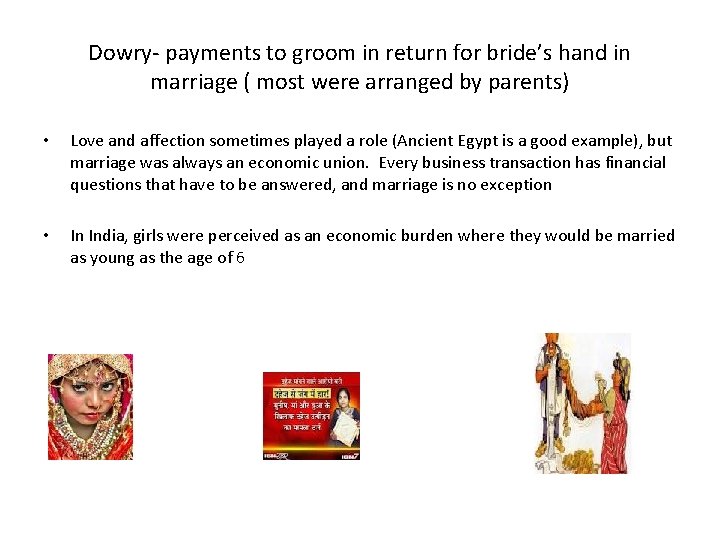
Dowry- payments to groom in return for bride’s hand in marriage ( most were arranged by parents) • Love and affection sometimes played a role (Ancient Egypt is a good example), but marriage was always an economic union. Every business transaction has financial questions that have to be answered, and marriage is no exception • In India, girls were perceived as an economic burden where they would be married as young as the age of 6
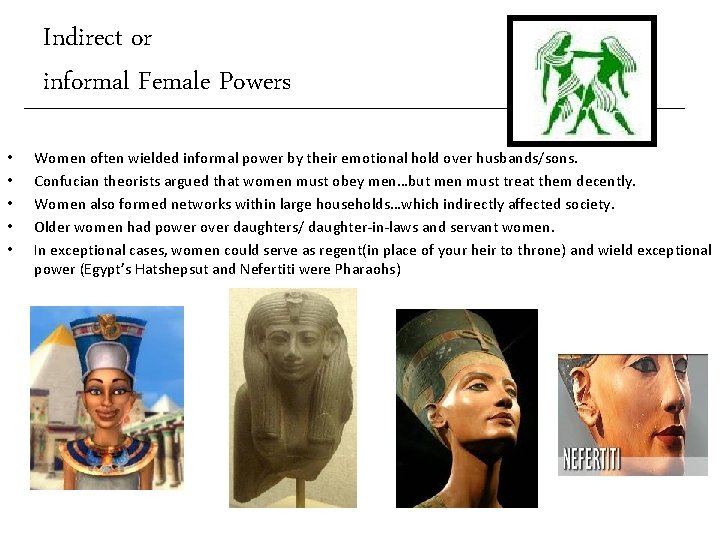
Indirect or informal Female Powers • • • Women often wielded informal power by their emotional hold over husbands/sons. Confucian theorists argued that women must obey men…but men must treat them decently. Women also formed networks within large households…which indirectly affected society. Older women had power over daughters/ daughter-in-laws and servant women. In exceptional cases, women could serve as regent(in place of your heir to throne) and wield exceptional power (Egypt’s Hatshepsut and Nefertiti were Pharaohs)
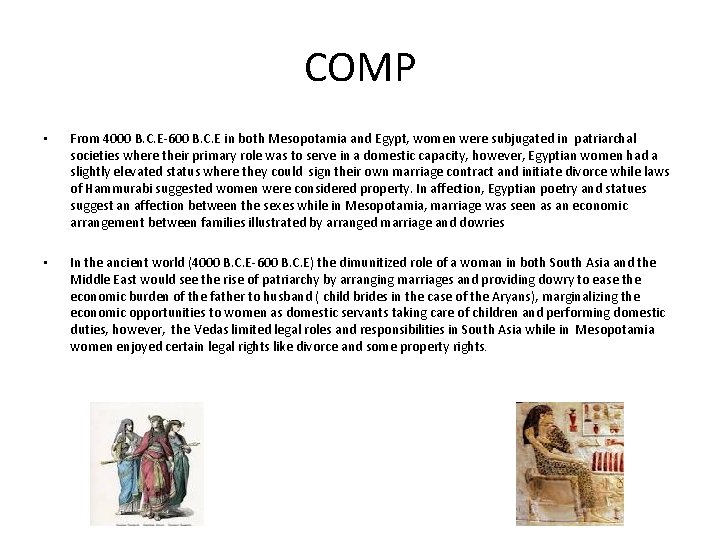
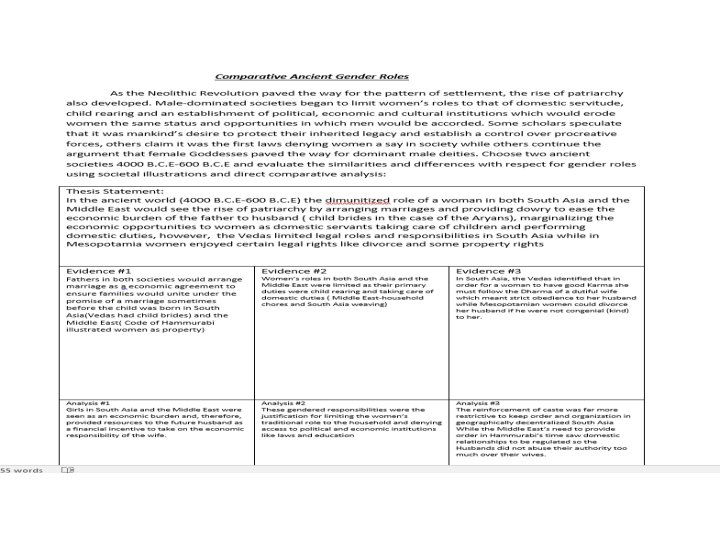
COMP • From 4000 B. C. E-600 B. C. E in both Mesopotamia and Egypt, women were subjugated in patriarchal societies where their primary role was to serve in a domestic capacity, however, Egyptian women had a slightly elevated status where they could sign their own marriage contract and initiate divorce while laws of Hammurabi suggested women were considered property. In affection, Egyptian poetry and statues suggest an affection between the sexes while in Mesopotamia, marriage was seen as an economic arrangement between families illustrated by arranged marriage and dowries • In the ancient world (4000 B. C. E-600 B. C. E) the dimunitized role of a woman in both South Asia and the Middle East would see the rise of patriarchy by arranging marriages and providing dowry to ease the economic burden of the father to husband ( child brides in the case of the Aryans), marginalizing the economic opportunities to women as domestic servants taking care of children and performing domestic duties, however, the Vedas limited legal roles and responsibilities in South Asia while in Mesopotamia women enjoyed certain legal rights like divorce and some property rights.
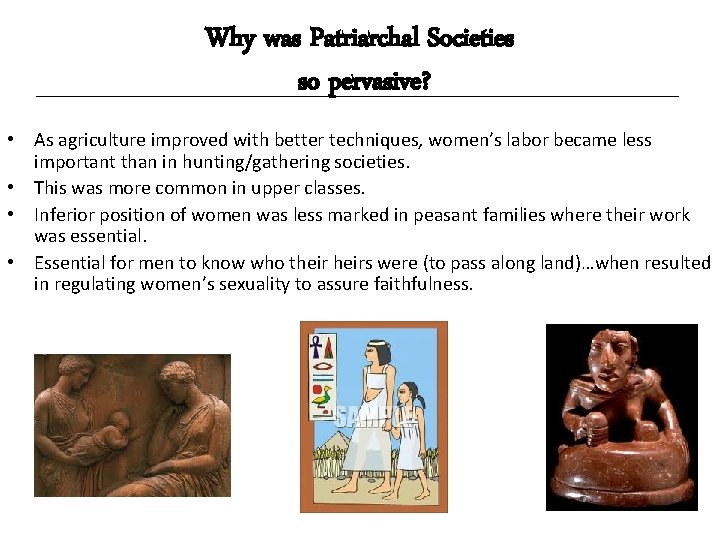
Why was Patriarchal Societies so pervasive? • As agriculture improved with better techniques, women’s labor became less important than in hunting/gathering societies. • This was more common in upper classes. • Inferior position of women was less marked in peasant families where their work was essential. • Essential for men to know who theirs were (to pass along land)…when resulted in regulating women’s sexuality to assure faithfulness.
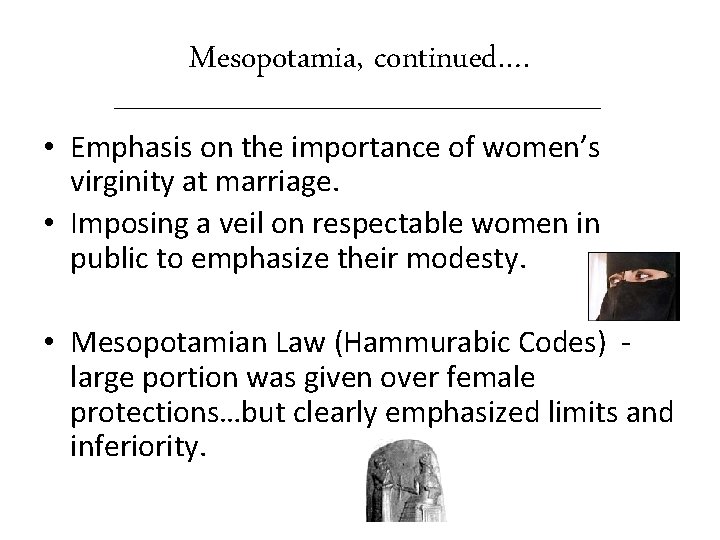
Mesopotamia, continued…. • Emphasis on the importance of women’s virginity at marriage. • Imposing a veil on respectable women in public to emphasize their modesty. • Mesopotamian Law (Hammurabic Codes) large portion was given over female protections…but clearly emphasized limits and inferiority.
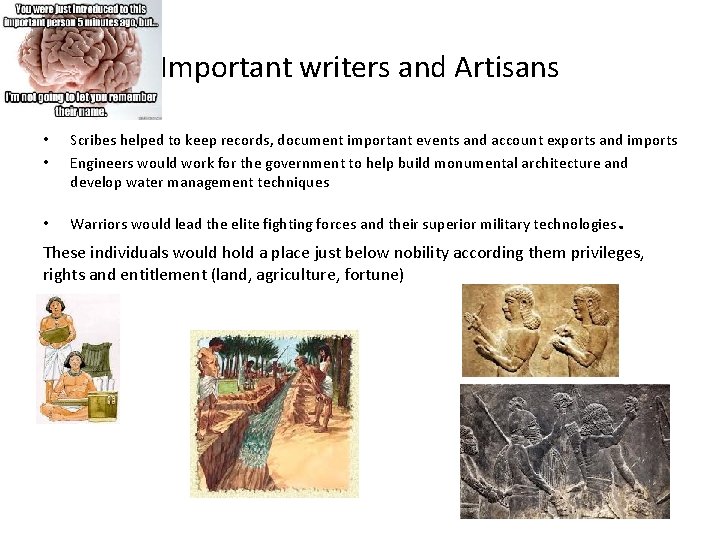
Important writers and Artisans • • Scribes helped to keep records, document important events and account exports and imports Engineers would work for the government to help build monumental architecture and develop water management techniques • Warriors would lead the elite fighting forces and their superior military technologies . These individuals would hold a place just below nobility according them privileges, rights and entitlement (land, agriculture, fortune)
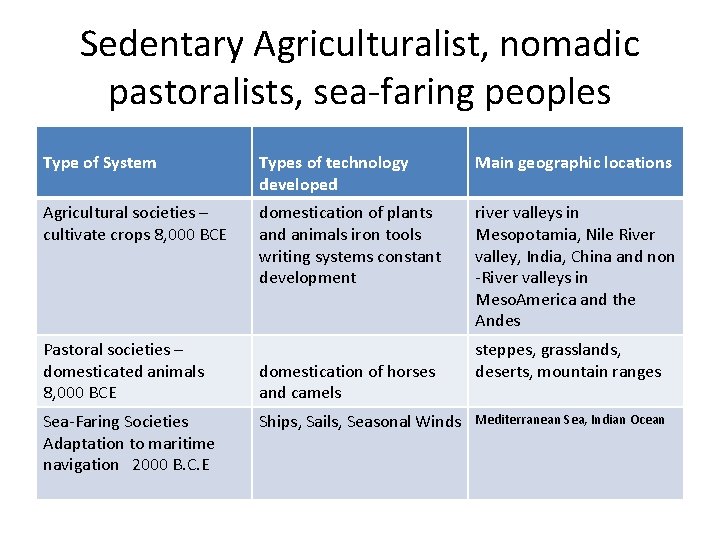
Sedentary Agriculturalist, nomadic pastoralists, sea-faring peoples Type of System Types of technology developed Main geographic locations Agricultural societies – cultivate crops 8, 000 BCE domestication of plants and animals iron tools writing systems constant development river valleys in Mesopotamia, Nile River valley, India, China and non -River valleys in Meso. America and the Andes Pastoral societies – domesticated animals 8, 000 BCE Sea-Faring Societies Adaptation to maritime navigation 2000 B. C. E domestication of horses and camels Ships, Sails, Seasonal Winds steppes, grasslands, deserts, mountain ranges Mediterranean Sea, Indian Ocean
Thesis • From 4000 B. C. E-600 B. C. E in both South Asia and the Middle East the role of women was diminished due to man’s need to protect his property inheritance, both had divisions of labor with a rigid social hierarchy with little chance of social mobility, however the caste system of the Aryans was religiously based on the Hindu principles illustrated in the Rig Veda while the social distinctions in Mesopotamia were based on legal distinctions in the code of Hammurabi • From 4000 B. C. E -600 B. C. E in Latin America and East Asia, the role of religion played an integral component to the development of unequal societies providing predictive powers to priests over the commoners, both had forced labor to facilitate monumental building projects, however, merchants in China’s Shang and Zhou Dynasty were looked down upon while merchants in Meso. America were highly valued in trading cities like Teotihuacan.