
Unemployment models The probability of unemployment Klaas Stijnen
Unemployment models The probability of unemployment Klaas Stijnen New Zealand Society of Actuaries Conference 2010 © 2010 Deloitte Actuarial Services
![Introduction P [unemployment | employment] = ? P [employment | unemployment] = ? Unchartered](http://slidetodoc.com/presentation_image_h2/1d32b40127a6653fcf58a13e492d6244/image-2.jpg "Introduction P [unemployment | employment] = ? P [employment | unemployment] = ? Unchartered")
Introduction P [unemployment | employment] = ? P [employment | unemployment] = ? Unchartered water? 2 © 2009 Deloitte Actuarial Services
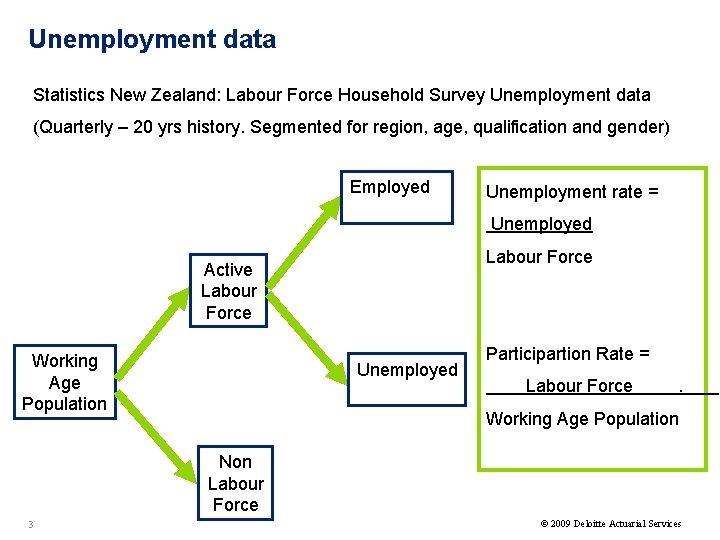
Unemployment data Statistics New Zealand: Labour Force Household Survey Unemployment data (Quarterly – 20 yrs history. Segmented for region, age, qualification and gender) Employed Unemployment rate = Unemployed Labour Force Active Labour Force Working Age Population Unemployed Participartion Rate = Labour Force . Working Age Population Non Labour Force 3 © 2009 Deloitte Actuarial Services
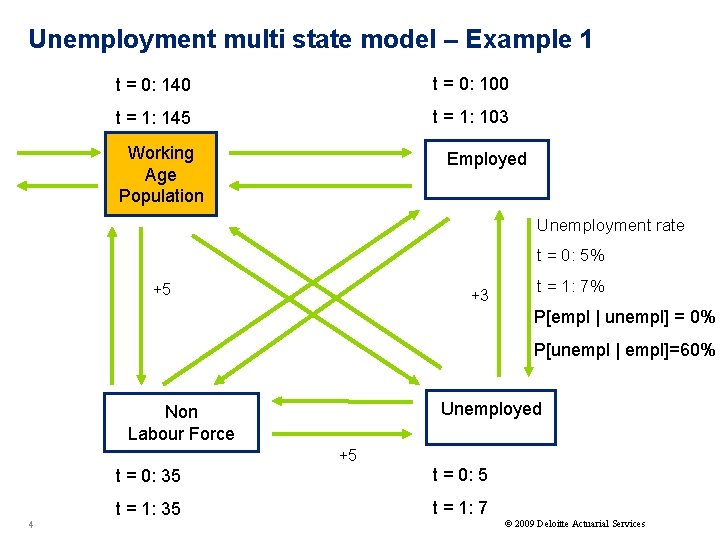
Unemployment multi state model – Example 1 t = 0: 140 t = 0: 100 t = 1: 145 t = 1: 103 Working Age Population Employed Unemployment rate t = 0: 5% +5 +3 t = 1: 7% P[empl | unempl] = 0% P[unempl | empl]=60% Unemployed Non Labour Force +5 4 t = 0: 35 t = 0: 5 t = 1: 35 t = 1: 7 © 2009 Deloitte Actuarial Services
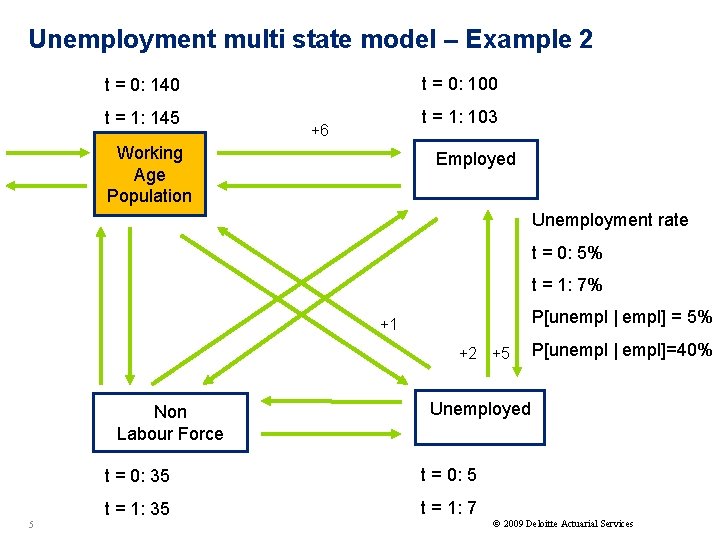
Unemployment multi state model – Example 2 t = 0: 140 t = 0: 100 t = 1: 145 t = 1: 103 +6 Working Age Population Employed Unemployment rate t = 0: 5% t = 1: 7% P[unempl | empl] = 5% +1 +2 +5 Non Labour Force 5 P[unempl | empl]=40% Unemployed t = 0: 35 t = 0: 5 t = 1: 35 t = 1: 7 © 2009 Deloitte Actuarial Services
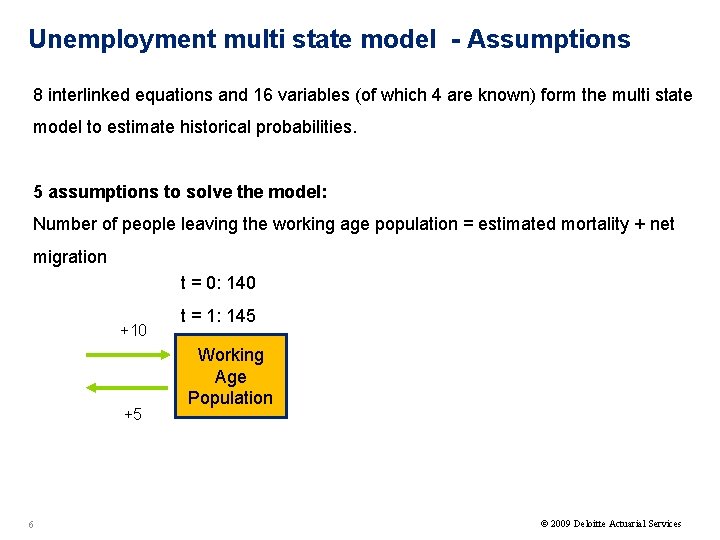
Unemployment multi state model - Assumptions 8 interlinked equations and 16 variables (of which 4 are known) form the multi state model to estimate historical probabilities. 5 assumptions to solve the model: Number of people leaving the working age population = estimated mortality + net migration t = 0: 140 +10 +5 6 t = 1: 145 Working Age Population © 2009 Deloitte Actuarial Services
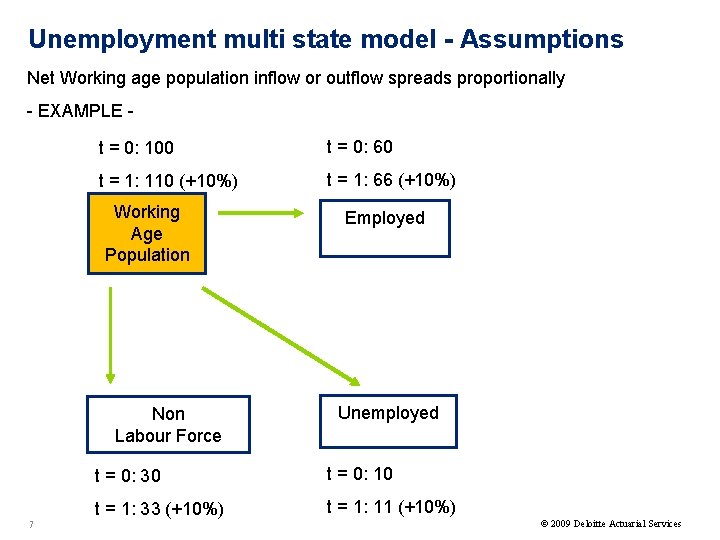
Unemployment multi state model - Assumptions Net Working age population inflow or outflow spreads proportionally - EXAMPLE t = 0: 100 t = 0: 60 t = 1: 110 (+10%) t = 1: 66 (+10%) Working Age Population Non Labour Force 7 Employed Unemployed t = 0: 30 t = 0: 10 t = 1: 33 (+10%) t = 1: 11 (+10%) © 2009 Deloitte Actuarial Services
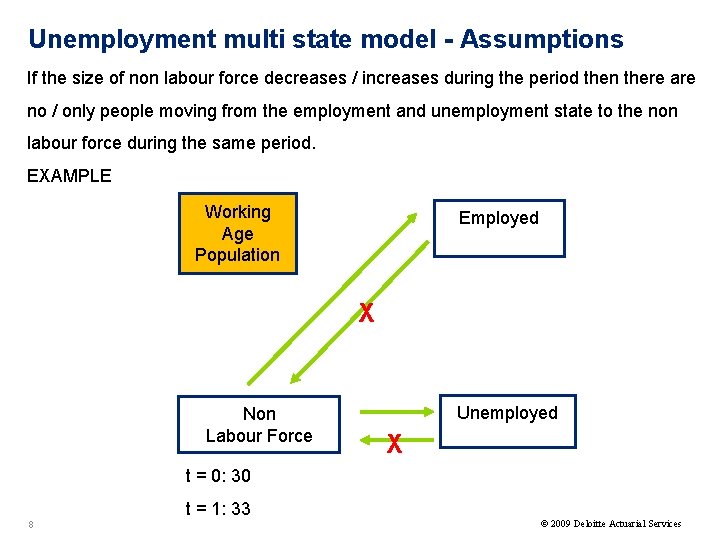
Unemployment multi state model - Assumptions If the size of non labour force decreases / increases during the period then there are no / only people moving from the employment and unemployment state to the non labour force during the same period. EXAMPLE Working Age Population Employed X Non Labour Force Unemployed X t = 0: 30 t = 1: 33 8 © 2009 Deloitte Actuarial Services
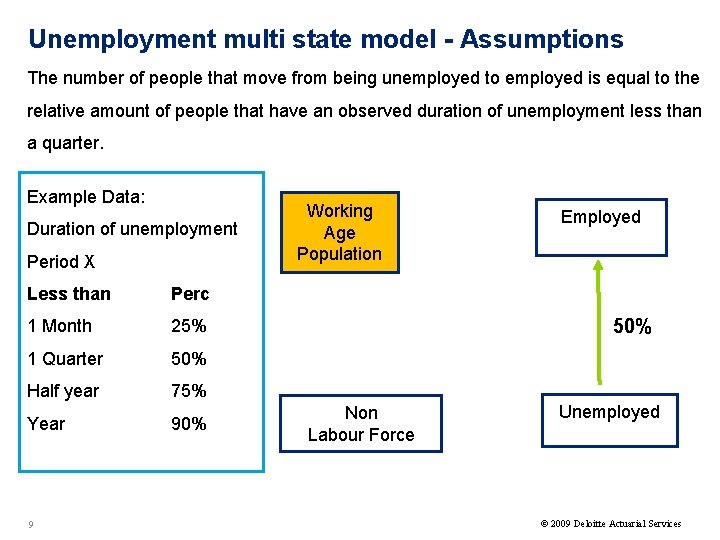
Unemployment multi state model - Assumptions The number of people that move from being unemployed to employed is equal to the relative amount of people that have an observed duration of unemployment less than a quarter. Example Data: Duration of unemployment Period X Less than Perc 1 Month 25% 1 Quarter 50% Half year 75% Year 90% 9 Working Age Population Employed 50% Non Labour Force Unemployed © 2009 Deloitte Actuarial Services
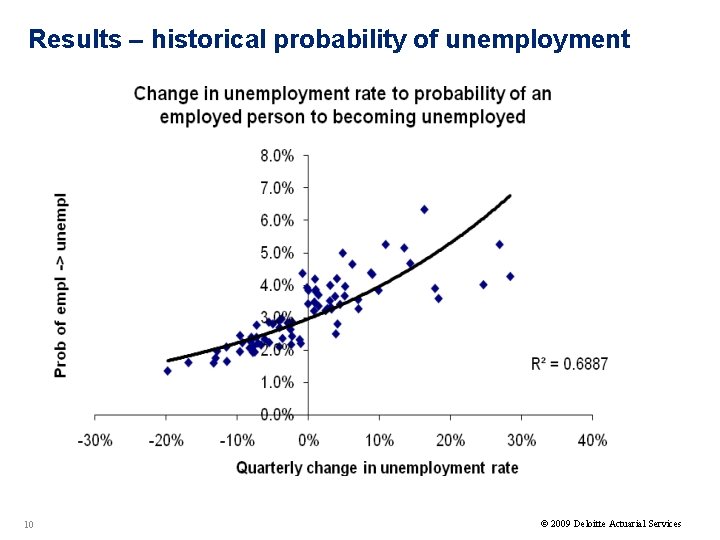
Results – historical probability of unemployment 10 © 2009 Deloitte Actuarial Services
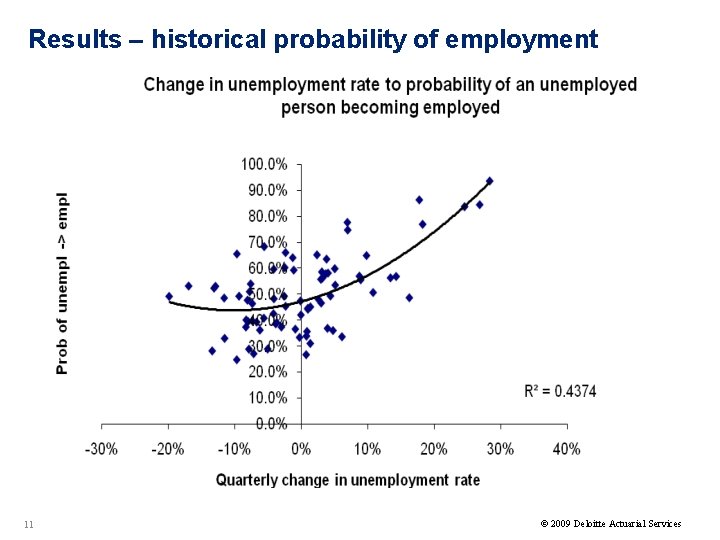
Results – historical probability of employment 11 © 2009 Deloitte Actuarial Services
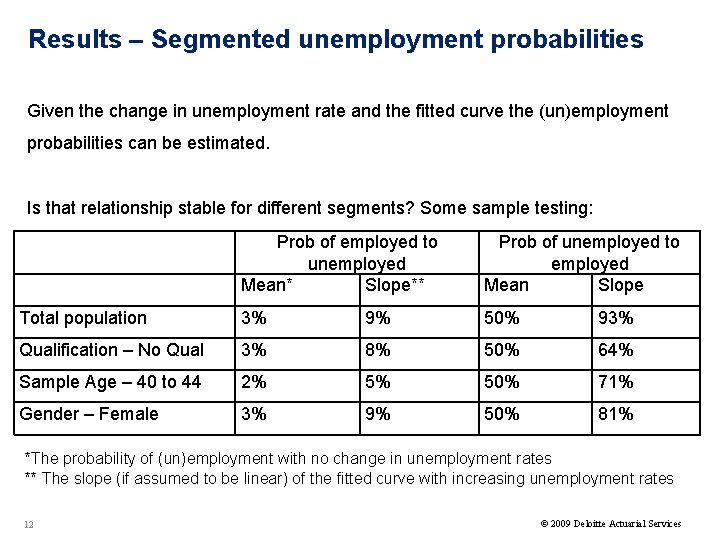
Results – Segmented unemployment probabilities Given the change in unemployment rate and the fitted curve the (un)employment probabilities can be estimated. Is that relationship stable for different segments? Some sample testing: Prob of employed to unemployed Mean* Slope** Prob of unemployed to employed Mean Slope Total population 3% 9% 50% 93% Qualification – No Qual 3% 8% 50% 64% Sample Age – 40 to 44 2% 5% 50% 71% Gender – Female 3% 9% 50% 81% *The probability of (un)employment with no change in unemployment rates ** The slope (if assumed to be linear) of the fitted curve with increasing unemployment rates 12 © 2009 Deloitte Actuarial Services
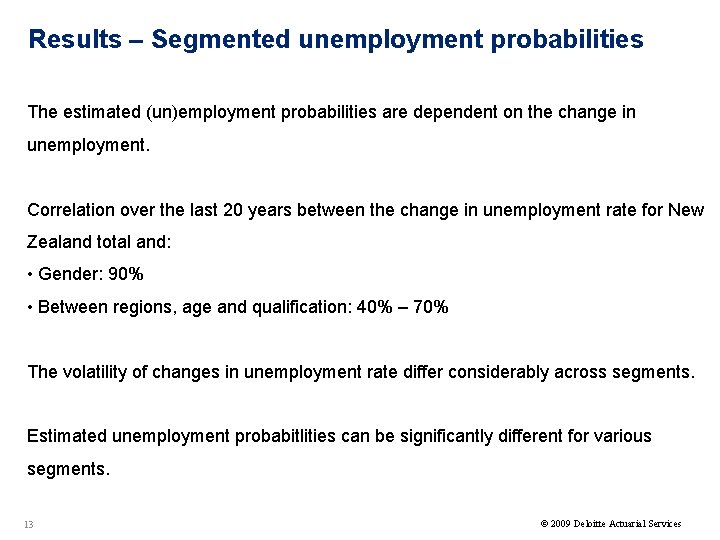
Results – Segmented unemployment probabilities The estimated (un)employment probabilities are dependent on the change in unemployment. Correlation over the last 20 years between the change in unemployment rate for New Zealand total and: • Gender: 90% • Between regions, age and qualification: 40% – 70% The volatility of changes in unemployment rate differ considerably across segments. Estimated unemployment probabitlities can be significantly different for various segments. 13 © 2009 Deloitte Actuarial Services
How can these results be used • Financial protection products (pricing and risk modelling): • Estimated probability of (un)employment • Estimated duration of unemployment • Probability distribution of duration of unemployment • Retail loans credit models • Probability of default • Loss given default • Macroeconomic forecasting models • More granular information than unemployment rate 14 © 2009 Deloitte Actuarial Services
- Slides: 14