
UNECE Standards for Agricultural Products in Trade Development
- Slides: 35
UNECE Standards for Agricultural Products in Trade: Development and Implementation Seminar on the Implementation of UNECE Standards in Trade Vilnius, Lithuania, 29 October 2004 Tom Heilandt United Nations Economic Commission for Europe UNECE 1
Outline • • • UNECE About UNECE Standards for Agricultural Produce Meat as a commodity Why meat standards? UNECE Standards for Meat 2
UNECE? • UNECE = United Nations Economic Commission for Europe • One of the 5 regional commissions of the UN • 55 member states in Europe, Asia and North America • Around 200 employees • Founded 1949 and located in Geneva • Work areas: Transport, Trade, Environment, Industry/Energy, Economic Analysis, Statistics UNECE 3
Trade in agricultural products in the ECE region in 1949 • Countries use national quality standards to regulate trade within their borders • Producers market • Growing interest in international trade • Existing national regulations become barriers to international trade UNECE 4
Harmonization of national standards • 1949 The Working Party on Agricultural Quality Standards takes up its work at UNECE in Geneva • 1954 The Geneva Protocol and Standard Layout are adopted • 1991 UNECE begins development of meat standards UNECE 5
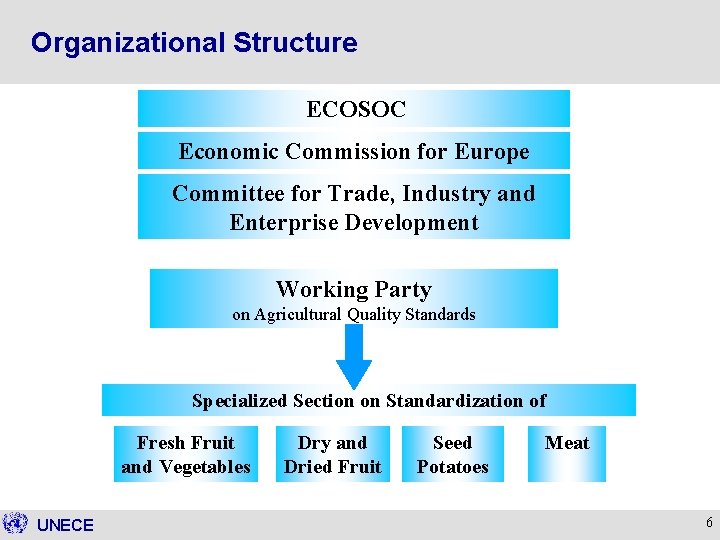
Organizational Structure ECOSOC Economic Commission for Europe Committee for Trade, Industry and Enterprise Development Working Party on Agricultural Quality Standards Specialized Section on Standardization of Fresh Fruit and Vegetables UNECE Dry and Dried Fruit Seed Potatoes Meat 6
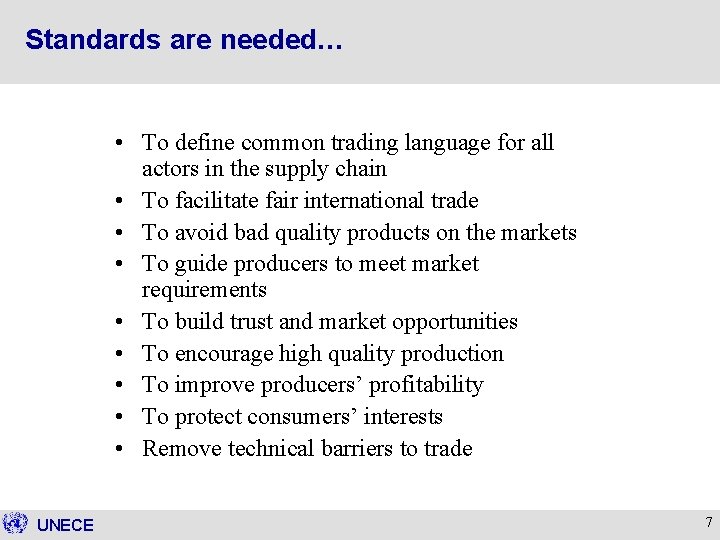
Standards are needed… • To define common trading language for all actors in the supply chain • To facilitate fair international trade • To avoid bad quality products on the markets • To guide producers to meet market requirements • To build trust and market opportunities • To encourage high quality production • To improve producers’ profitability • To protect consumers’ interests • Remove technical barriers to trade UNECE 7
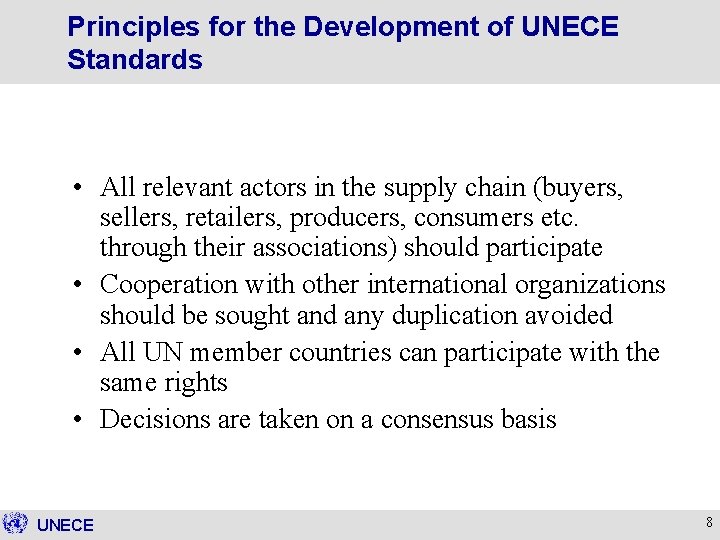
Principles for the Development of UNECE Standards • All relevant actors in the supply chain (buyers, sellers, retailers, producers, consumers etc. through their associations) should participate • Cooperation with other international organizations should be sought and any duplication avoided • All UN member countries can participate with the same rights • Decisions are taken on a consensus basis UNECE 8
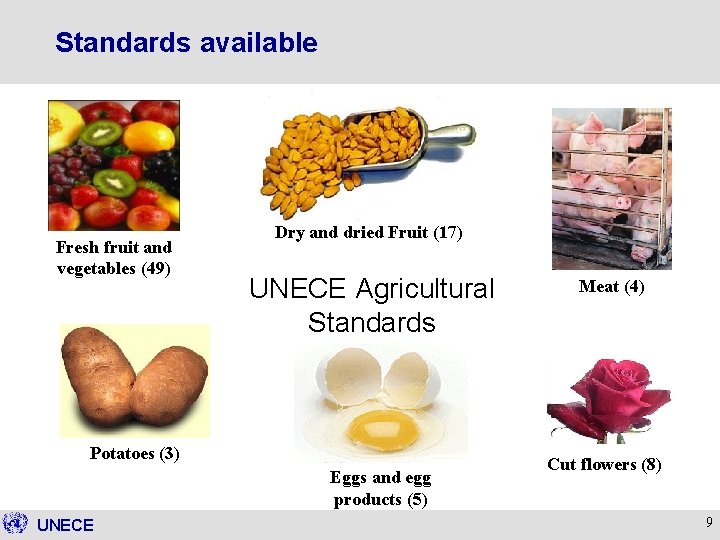
Standards available Fresh fruit and vegetables (49) Dry and dried Fruit (17) UNECE Agricultural Standards Potatoes (3) Eggs and egg products (5) UNECE Meat (4) Cut flowers (8) 9
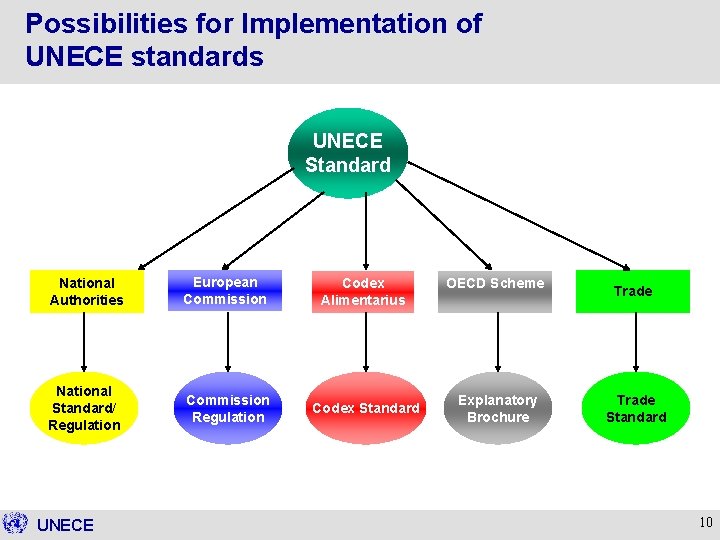
Possibilities for Implementation of UNECE standards UNECE Standard National Authorities European Commission Codex Alimentarius National Standard/ Regulation Commission Regulation Codex Standard UNECE OECD Scheme Explanatory Brochure Trade Standard 10
Implementation of rules • Mandatory rules are implemented because their non-implementation would have severe consequences (legal or financial) • Recommendations are implemented because: – it makes sense, – it is demanded by the buyer, – Everybody uses them UNECE 11
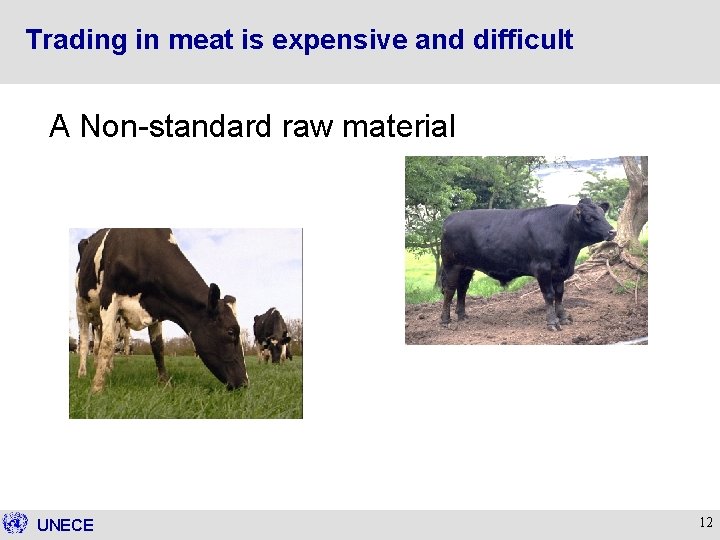
Trading in meat is expensive and difficult A Non-standard raw material UNECE 12
A complicated commodity • Meat is a complicated commodity • Many different actors are involved UNECE 13
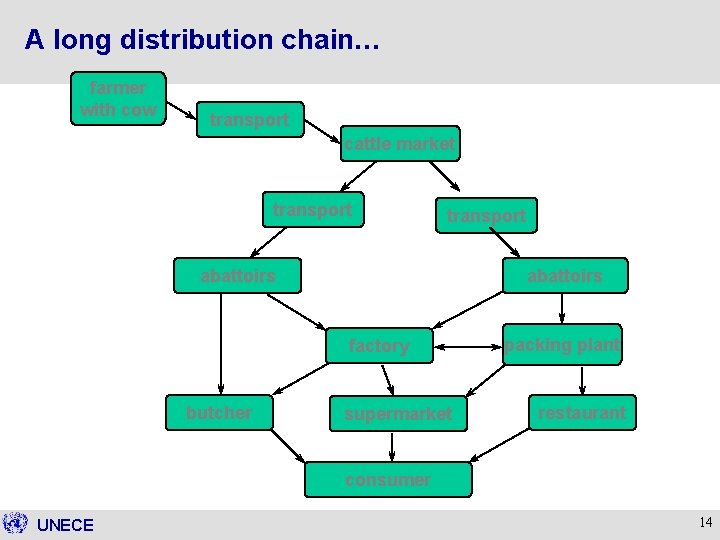
A long distribution chain… farmer with cow transport cattle market transport abattoirs factory butcher supermarket packing plant restaurant consumer UNECE 14
Common interest • In a long distribution chain most actors are customers and sellers • All have a common interest in understanding each other and • Ensuring the product quality and safety UNECE 15
Many rules from the stable to the table • There are international rules: Codex Alimentarius, OIE, UNECE, ISO, World Customs Organizations etc. • There are implementations of international rules and proprietary rules in countries and regional country groupings (e. g. European Union) • There are private rules: Global food safety initiative, Eurepgap • There are WTO rules about how rules should be made in order to ensure fair trade UNECE 16
“Administrative” Rules • Rules about customs procedures • Rules about transport and handling • Rules about labelling and accompanying documents • Etc. UNECE 17
“Quality rules” for the process and the product • The expected properties as broadly defined in ISO 9000: 2000: “The totality of features and characteristics of a product, process or service that bear on its ability to satisfy stated or implied needs” • "excellence" – something that distinguishes from similar objects that justifies demand. UNECE 18
Expected properties: Generic quality level of food products • Absence of defect, fraud and adulteration (e. g. food safety, quality defects) – regulated in food safety and quality standards • Presence of expected properties (e. g nutritional components, external and internal quality aspects) – regulated or starting to be in food quality or labelling standards UNECE 19
Excellence: Specific quality of food products • Added value through: – Forms of production (organic farming, environmental consideration, animal welfare), – Specific production areas (designation of origin) and their associated traditional production methods. • High interest in this area: – Operators try to distinguish their products from similar ones to attract customer attention and fidelity – Regulators provide a legal framework. UNECE 20
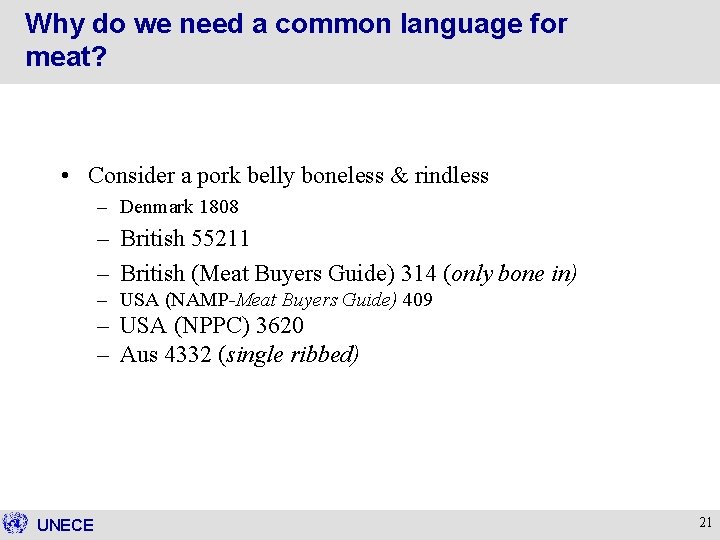
Why do we need a common language for meat? • Consider a pork belly boneless & rindless – Denmark 1808 – British 55211 – British (Meat Buyers Guide) 314 (only bone in) – USA (NAMP-Meat Buyers Guide) 409 – USA (NPPC) 3620 – Aus 4332 (single ribbed) UNECE 21
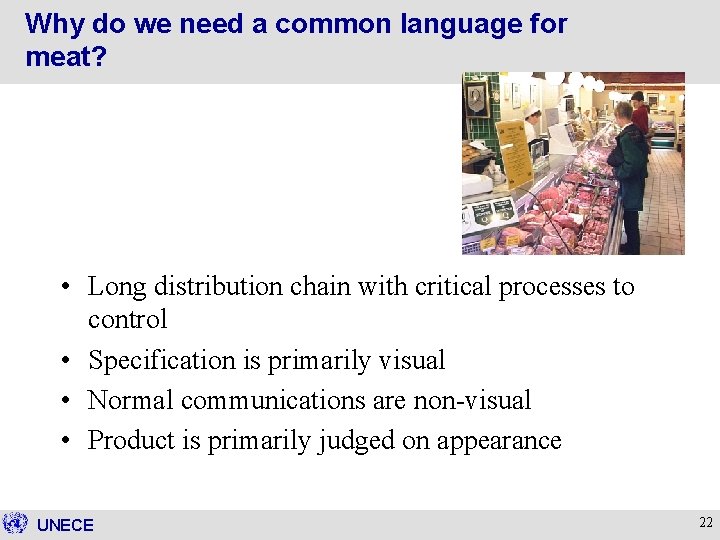
Why do we need a common language for meat? • Long distribution chain with critical processes to control • Specification is primarily visual • Normal communications are non-visual • Product is primarily judged on appearance UNECE 22
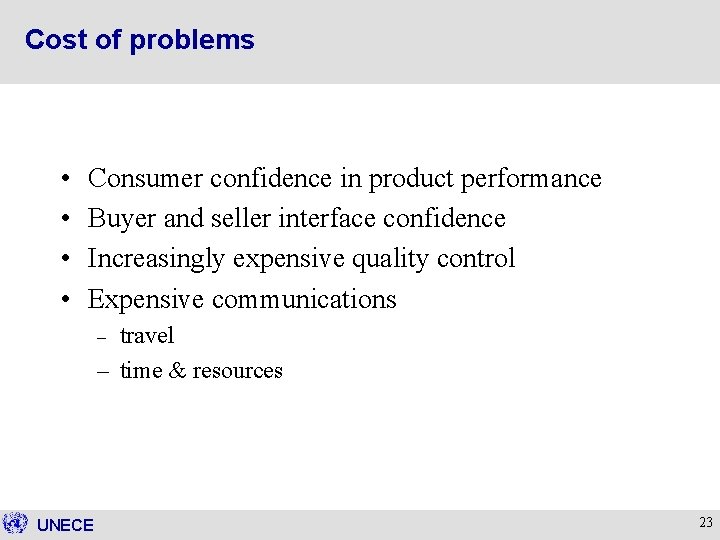
Cost of problems • • Consumer confidence in product performance Buyer and seller interface confidence Increasingly expensive quality control Expensive communications travel – time & resources – UNECE 23
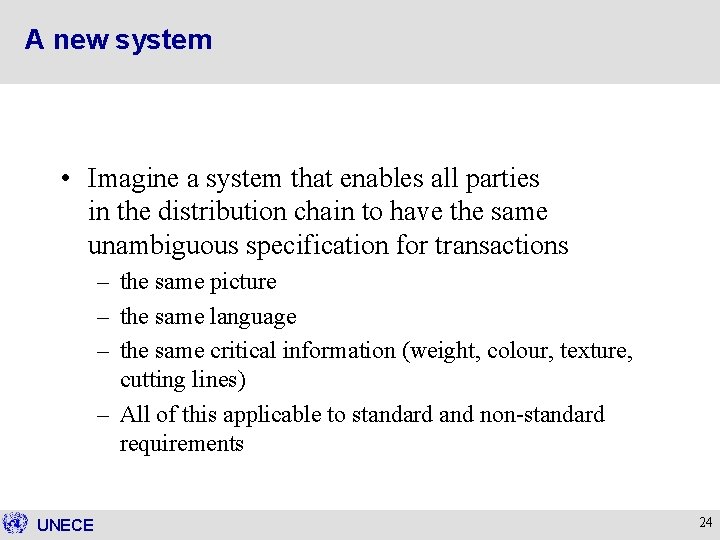
A new system • Imagine a system that enables all parties in the distribution chain to have the same unambiguous specification for transactions – the same picture – the same language – the same critical information (weight, colour, texture, cutting lines) – All of this applicable to standard and non-standard requirements UNECE 24
Applications • Government and other official bodies • Health professionals • Meat inspection services • Meat purchasing (commercial and official) • Meat traders and meat plants • Training organisations • Veterinary (practice and training) UNECE 25
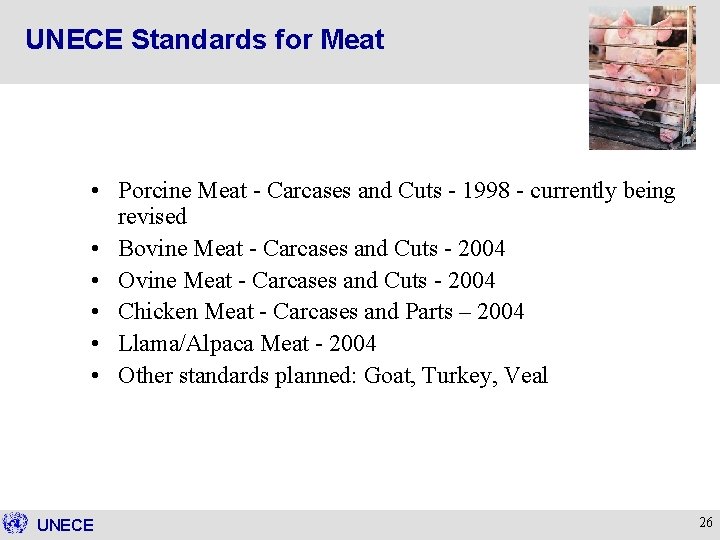
UNECE Standards for Meat • Porcine Meat - Carcases and Cuts - 1998 - currently being revised • Bovine Meat - Carcases and Cuts - 2004 • Ovine Meat - Carcases and Cuts - 2004 • Chicken Meat - Carcases and Parts – 2004 • Llama/Alpaca Meat - 2004 • Other standards planned: Goat, Turkey, Veal UNECE 26
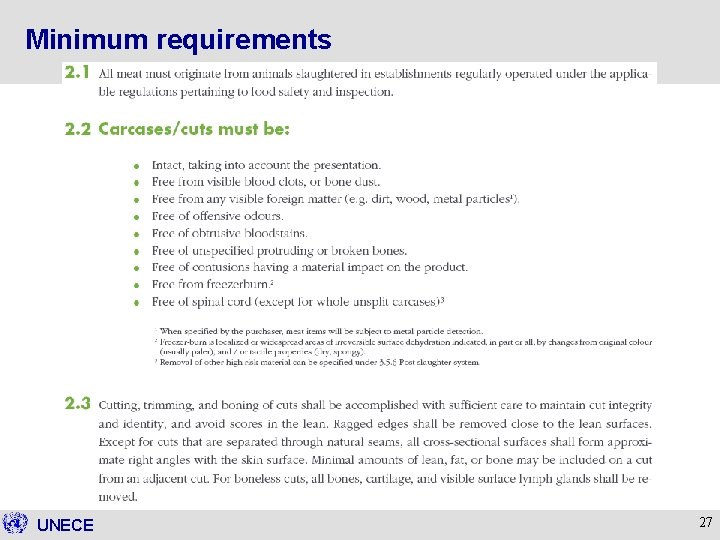
Minimum requirements UNECE 27
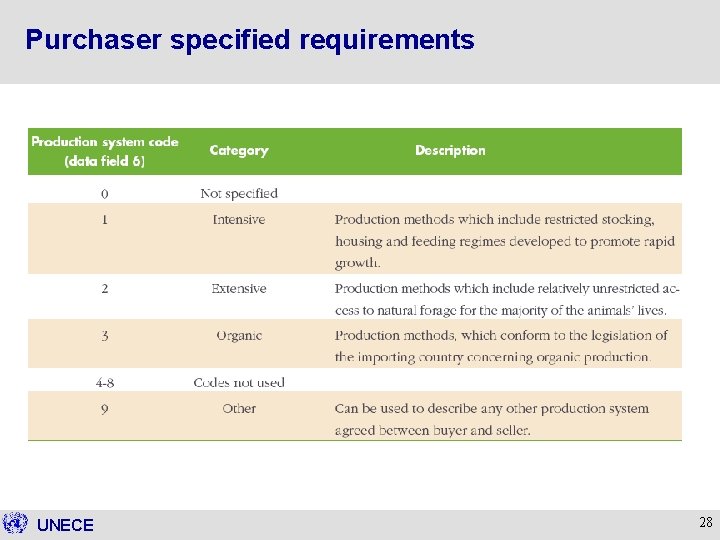
Purchaser specified requirements UNECE 28
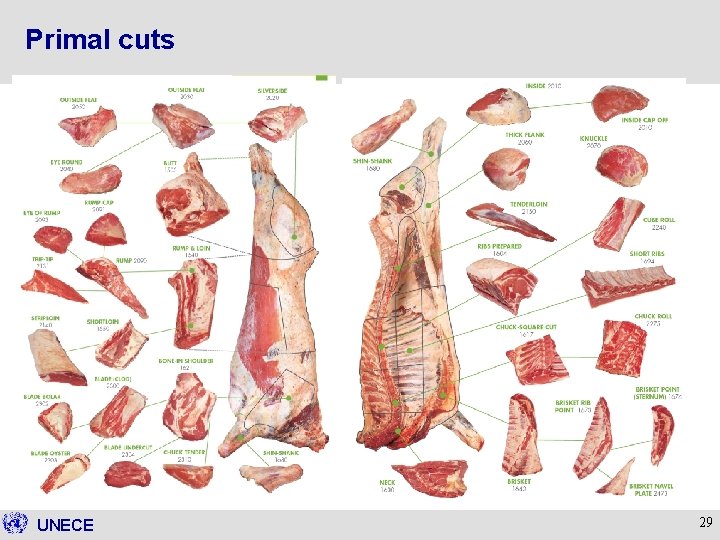
Primal cuts UNECE 29
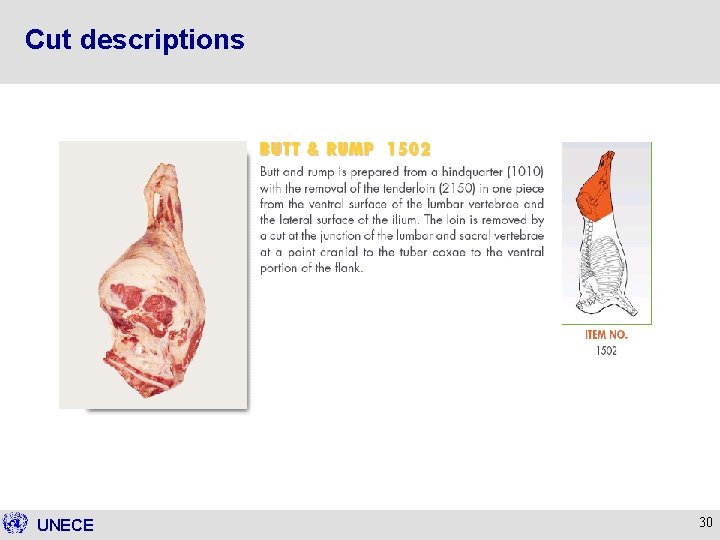
Cut descriptions UNECE 30
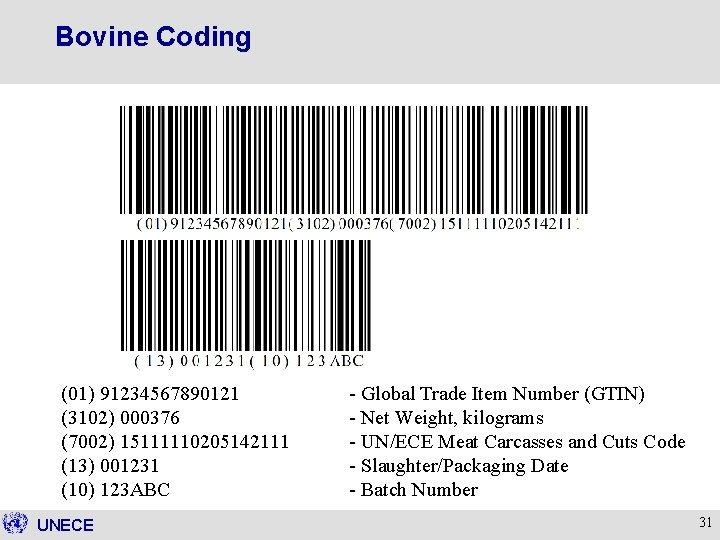
Bovine Coding (01) 91234567890121 (3102) 000376 (7002) 15111110205142111 (13) 001231 (10) 123 ABC UNECE - Global Trade Item Number (GTIN) - Net Weight, kilograms - UN/ECE Meat Carcasses and Cuts Code - Slaughter/Packaging Date - Batch Number 31
Implementation of UNECE Standards for Meat • UNECE Standards for Meat are Recommendations • They define a common trading language for buyers and sellers • The more they are used – the more useful they become • They are used because they facilitate trade and ensure customer satisfaction and repeat business UNECE 32
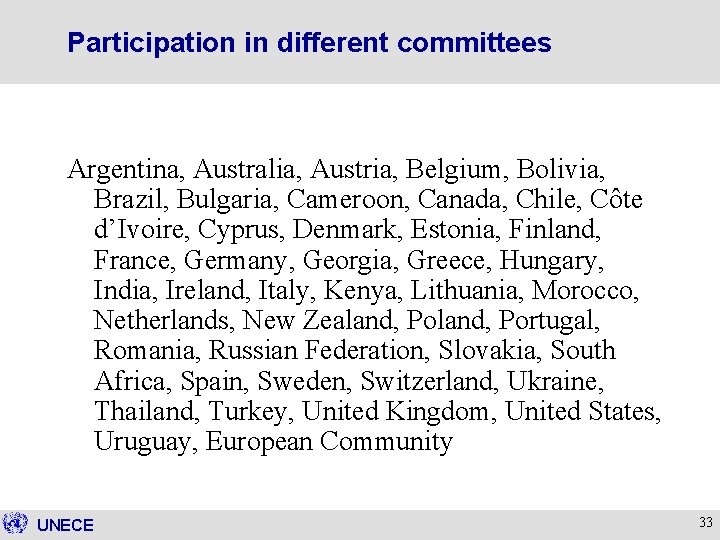
Participation in different committees Argentina, Australia, Austria, Belgium, Bolivia, Brazil, Bulgaria, Cameroon, Canada, Chile, Côte d’Ivoire, Cyprus, Denmark, Estonia, Finland, France, Germany, Georgia, Greece, Hungary, India, Ireland, Italy, Kenya, Lithuania, Morocco, Netherlands, New Zealand, Portugal, Romania, Russian Federation, Slovakia, South Africa, Spain, Sweden, Switzerland, Ukraine, Thailand, Turkey, United Kingdom, United States, Uruguay, European Community UNECE 33
Why participate in standardization? • To be integrated in the international trading system (to contribute and decide) • To propose standards for local products for which international standards do not exist • To network, exchange experiences, learn from others UNECE 34
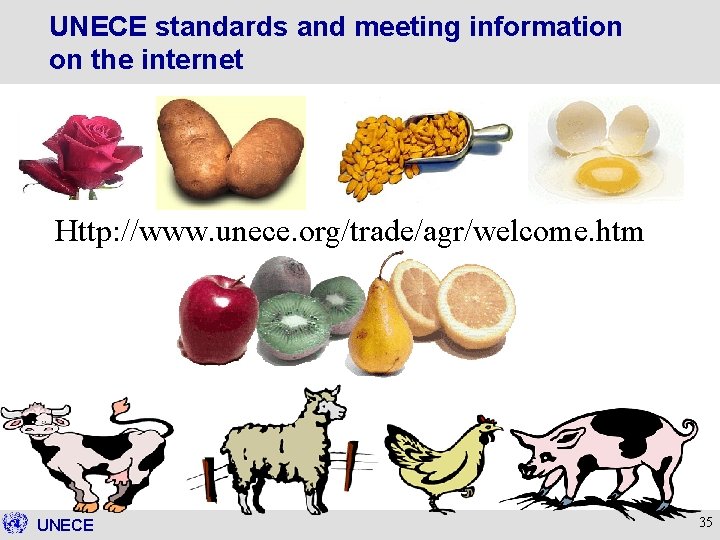
UNECE standards and meeting information on the internet Http: //www. unece. org/trade/agr/welcome. htm UNECE 35