
UNDERWATER CHANNEL CHARACTERIZATION FOR SHALLOW WATER MULTIDOMAIN COMMUNICATIONS
- Slides: 24
UNDERWATER CHANNEL CHARACTERIZATION FOR SHALLOW WATER MULTI-DOMAIN COMMUNICATIONS International Conference on Underwater Acoustics ICUA 2020 Jay Patel, Mae Seto Faculty of Engineering, Dalhousie University, Canada Funded by : 1
Outline Introduction Background Methodology & Demo Simulation and Results Conclusion References Underwater Channel Characterization for Shallow water Multi-domain communications, J. Patel, M. Seto 2
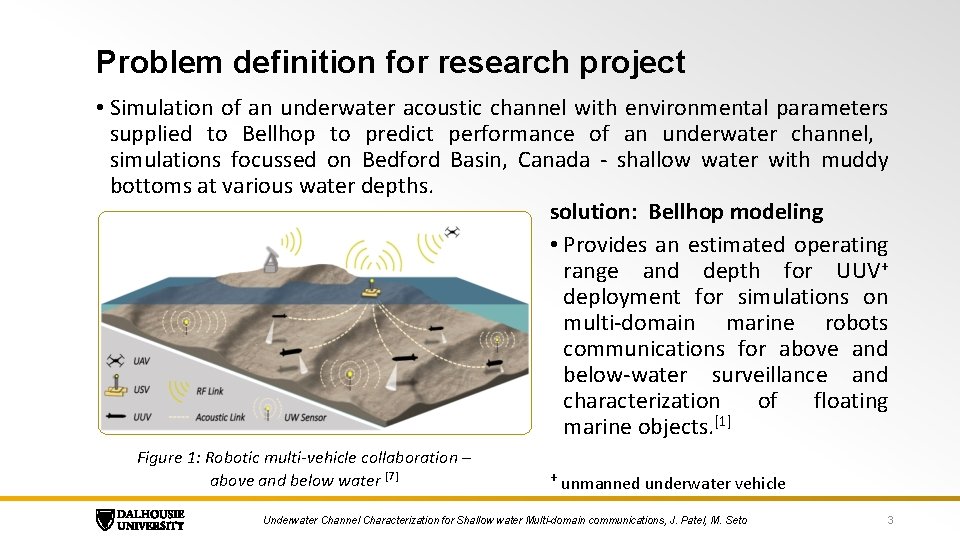
Problem definition for research project • Simulation of an underwater acoustic channel with environmental parameters supplied to Bellhop to predict performance of an underwater channel, simulations focussed on Bedford Basin, Canada - shallow water with muddy bottoms at various water depths. solution: Bellhop modeling • Provides an estimated operating range and depth for UUV+ deployment for simulations on multi-domain marine robots communications for above and below-water surveillance and characterization of floating marine objects. [1] Figure 1: Robotic multi-vehicle collaboration – above and below water [7] + unmanned underwater vehicle Underwater Channel Characterization for Shallow water Multi-domain communications, J. Patel, M. Seto 3
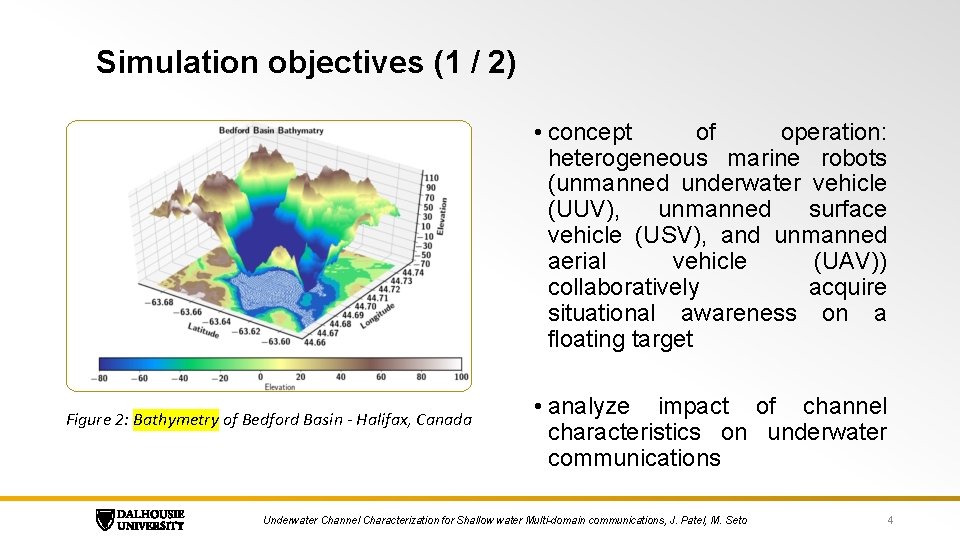
Simulation objectives (1 / 2) • concept of operation: heterogeneous marine robots (unmanned underwater vehicle (UUV), unmanned surface vehicle (USV), and unmanned aerial vehicle (UAV)) collaboratively acquire situational awareness on a floating target Figure 2: Bathymetry of Bedford Basin - Halifax, Canada • analyze impact of channel characteristics on underwater communications Underwater Channel Characterization for Shallow water Multi-domain communications, J. Patel, M. Seto 4
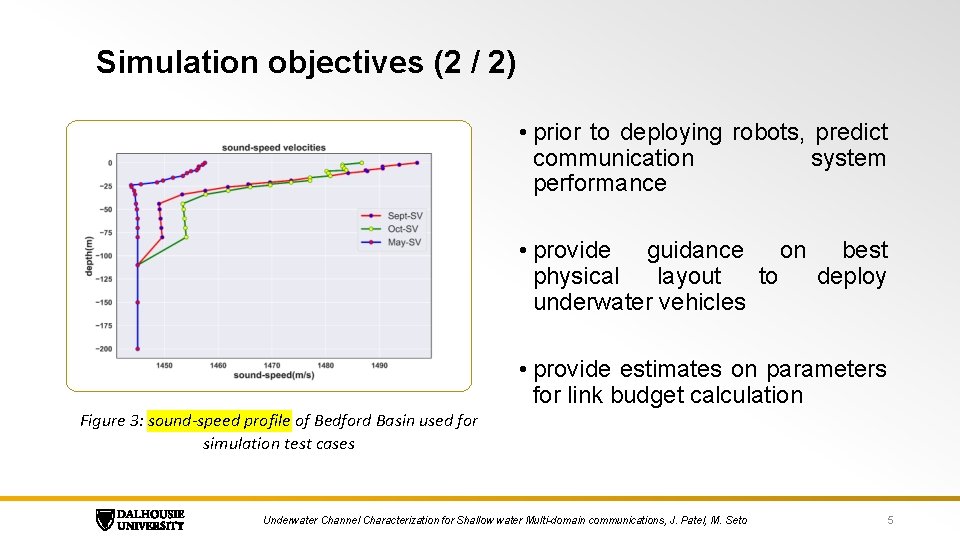
Simulation objectives (2 / 2) • prior to deploying robots, predict communication system performance • provide guidance on best physical layout to deploy underwater vehicles • provide estimates on parameters for link budget calculation Figure 3: sound-speed profile of Bedford Basin used for simulation test cases Underwater Channel Characterization for Shallow water Multi-domain communications, J. Patel, M. Seto 5
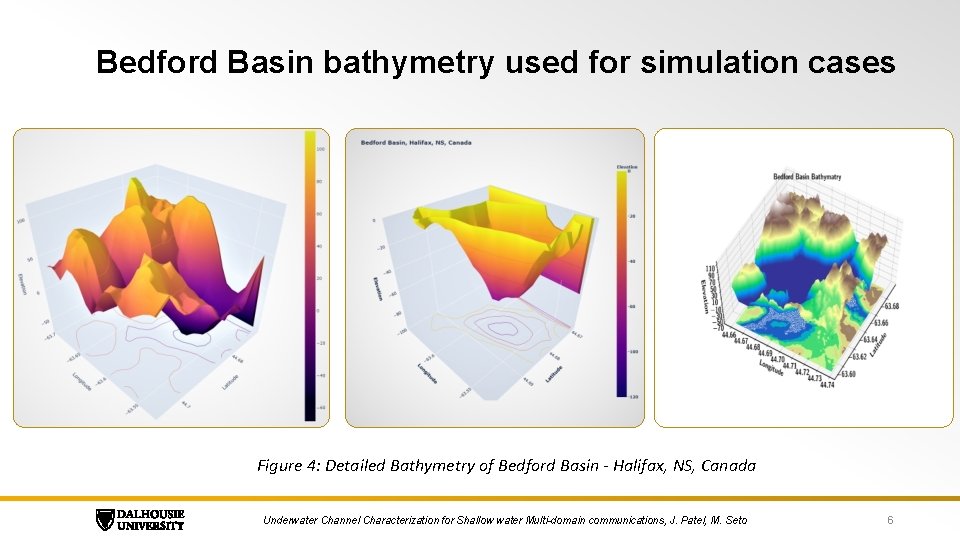
Bedford Basin bathymetry used for simulation cases Figure 4: Detailed Bathymetry of Bedford Basin - Halifax, NS, Canada Underwater Channel Characterization for Shallow water Multi-domain communications, J. Patel, M. Seto 6
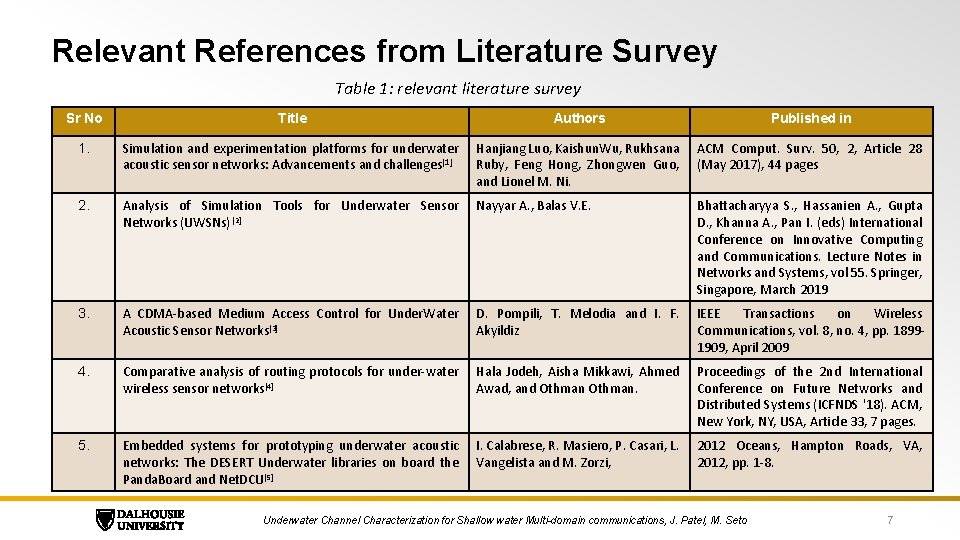
Relevant References from Literature Survey Table 1: relevant literature survey Sr No Title Authors Published in 1. Simulation and experimentation platforms for underwater acoustic sensor networks: Advancements and challenges[1] Hanjiang Luo, Kaishun. Wu, Rukhsana Ruby, Feng Hong, Zhongwen Guo, and Lionel M. Ni. ACM Comput. Surv. 50, 2, Article 28 (May 2017), 44 pages 2. Analysis of Simulation Tools for Underwater Sensor Networks (UWSNs) [2] Nayyar A. , Balas V. E. Bhattacharyya S. , Hassanien A. , Gupta D. , Khanna A. , Pan I. (eds) International Conference on Innovative Computing and Communications. Lecture Notes in Networks and Systems, vol 55. Springer, Singapore, March 2019 3. A CDMA-based Medium Access Control for Under. Water Acoustic Sensor Networks[3] D. Pompili, T. Melodia and I. F. Akyildiz IEEE Transactions on Wireless Communications, vol. 8, no. 4, pp. 18991909, April 2009 4. Comparative analysis of routing protocols for under-water wireless sensor networks[4] Hala Jodeh, Aisha Mikkawi, Ahmed Awad, and Othman. Proceedings of the 2 nd International Conference on Future Networks and Distributed Systems (ICFNDS '18). ACM, New York, NY, USA, Article 33, 7 pages. 5. Embedded systems for prototyping underwater acoustic networks: The DESERT Underwater libraries on board the Panda. Board and Net. DCU[5] I. Calabrese, R. Masiero, P. Casari, L. Vangelista and M. Zorzi, 2012 Oceans, Hampton Roads, VA, 2012, pp. 1 -8. Underwater Channel Characterization for Shallow water Multi-domain communications, J. Patel, M. Seto 7
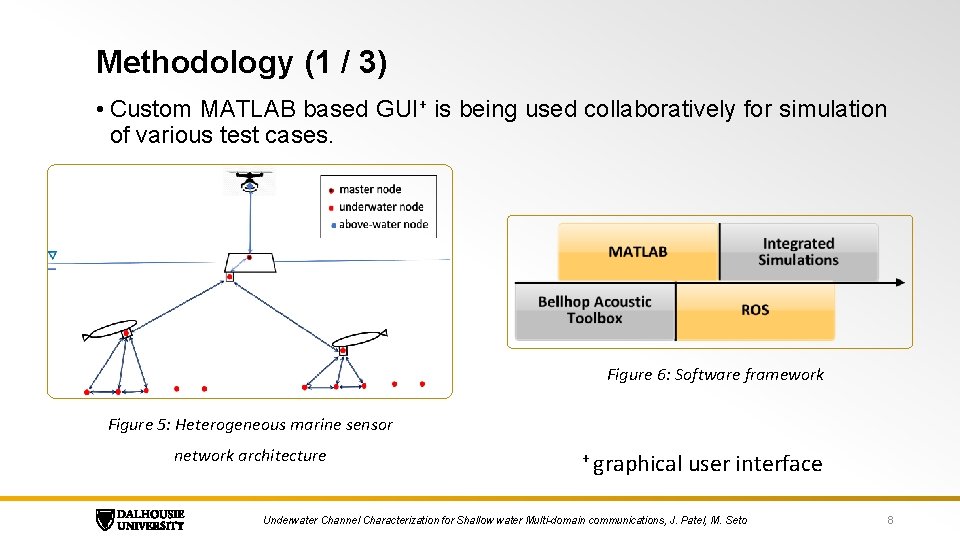
Methodology (1 / 3) • Custom MATLAB based GUI+ is being used collaboratively for simulation of various test cases. Figure 6: Software framework Figure 5: Heterogeneous marine sensor network architecture + graphical user interface Underwater Channel Characterization for Shallow water Multi-domain communications, J. Patel, M. Seto 8
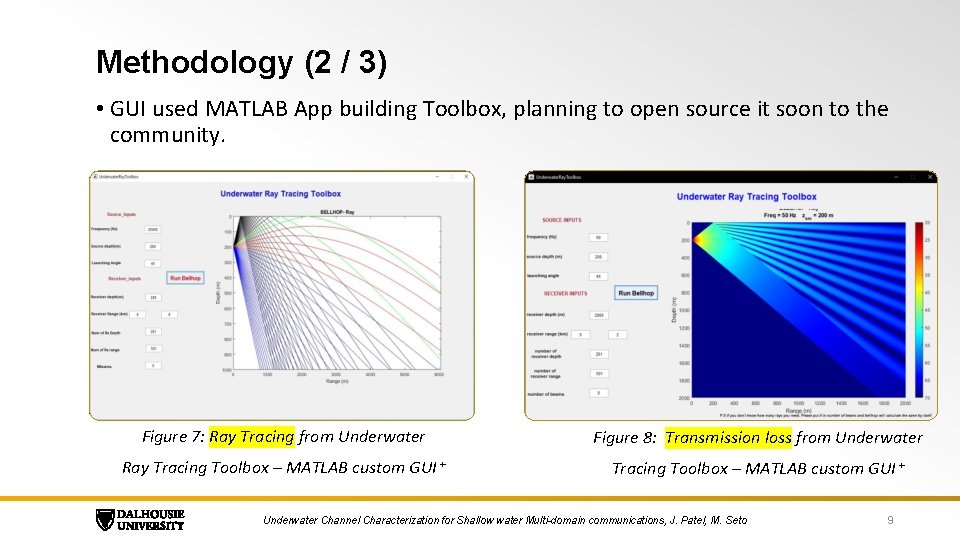
Methodology (2 / 3) • GUI used MATLAB App building Toolbox, planning to open source it soon to the community. Figure 7: Ray Tracing from Underwater Figure 8: Transmission loss from Underwater Ray Tracing Toolbox – MATLAB custom GUI + Underwater Channel Characterization for Shallow water Multi-domain communications, J. Patel, M. Seto 9
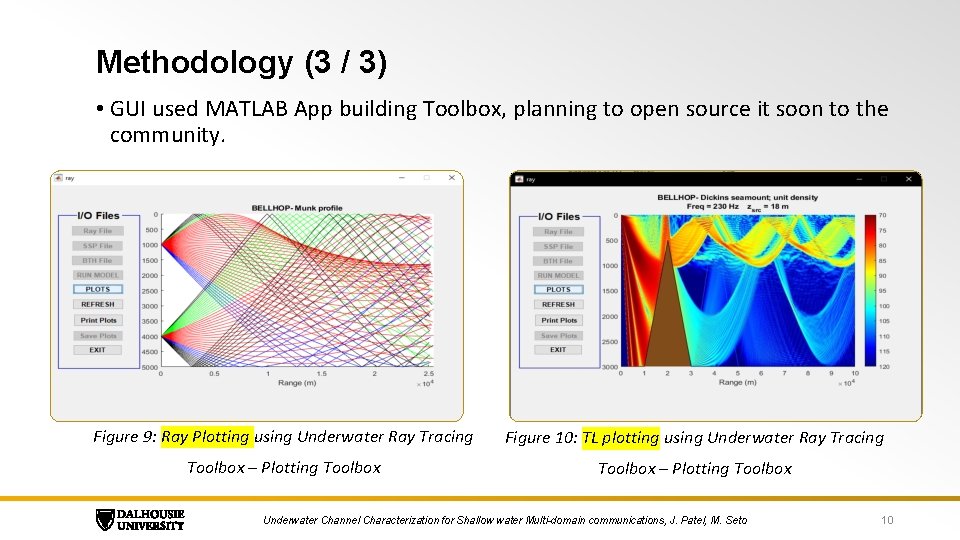
Methodology (3 / 3) • GUI used MATLAB App building Toolbox, planning to open source it soon to the community. Figure 9: Ray Plotting using Underwater Ray Tracing Figure 10: TL plotting using Underwater Ray Tracing Toolbox – Plotting Toolbox Underwater Channel Characterization for Shallow water Multi-domain communications, J. Patel, M. Seto 10
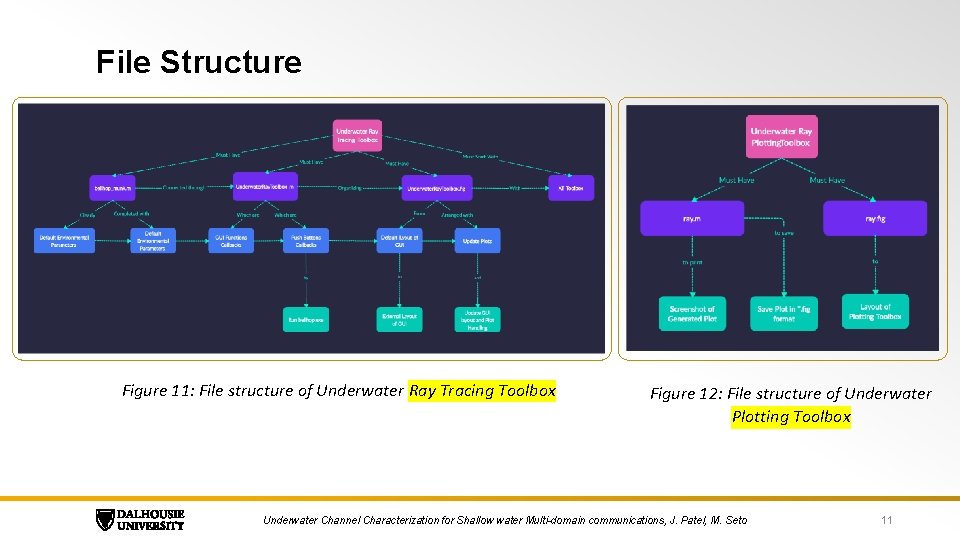
File Structure Figure 11: File structure of Underwater Ray Tracing Toolbox Figure 12: File structure of Underwater Plotting Toolbox Underwater Channel Characterization for Shallow water Multi-domain communications, J. Patel, M. Seto 11
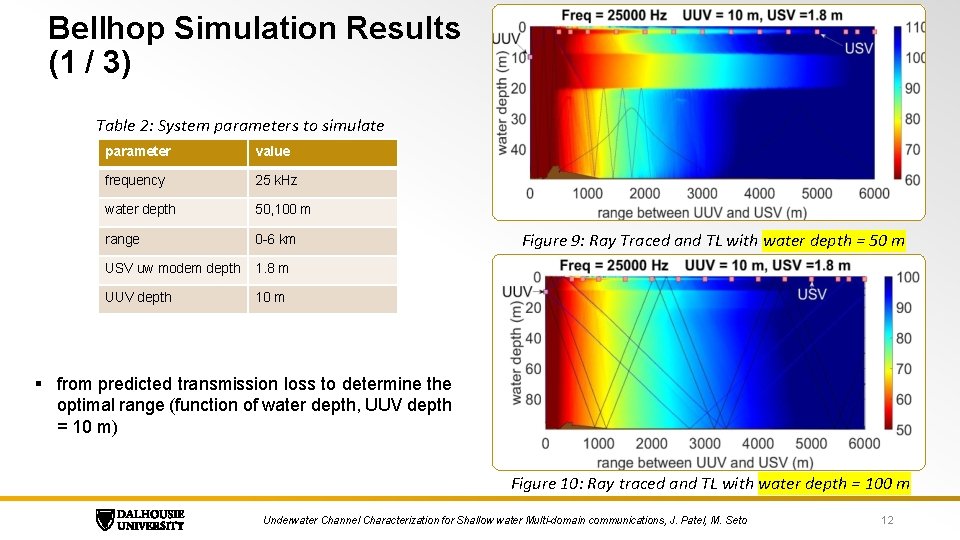
Bellhop Simulation Results (1 / 3) Table 2: System parameters to simulate parameter value frequency 25 k. Hz water depth 50, 100 m range 0 -6 km USV uw modem depth 1. 8 m UUV depth 10 m Figure 9: Ray Traced and TL with water depth = 50 m § from predicted transmission loss to determine the optimal range (function of water depth, UUV depth = 10 m) Figure 10: Ray traced and TL with water depth = 100 m Underwater Channel Characterization for Shallow water Multi-domain communications, J. Patel, M. Seto 12
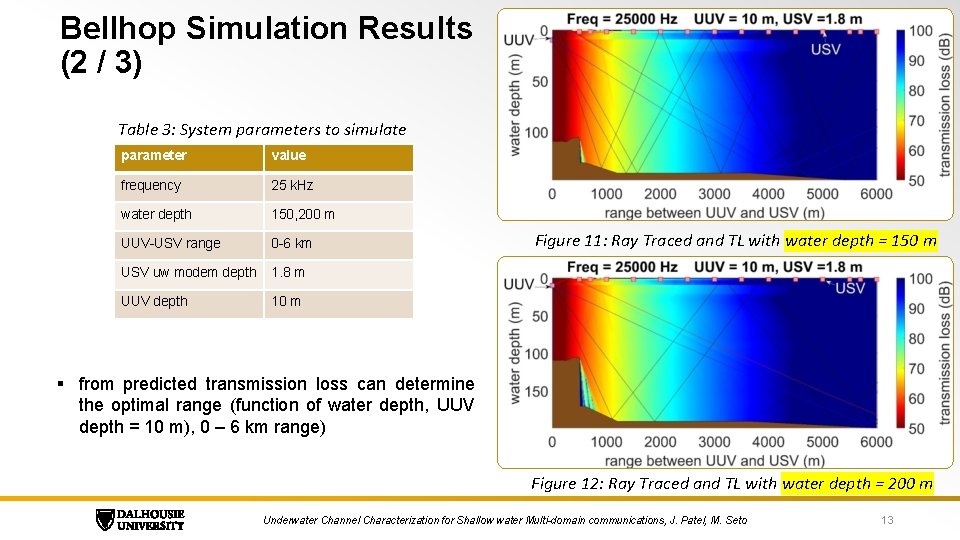
Bellhop Simulation Results (2 / 3) Table 3: System parameters to simulate parameter value frequency 25 k. Hz water depth 150, 200 m UUV-USV range 0 -6 km USV uw modem depth 1. 8 m UUV depth 10 m Figure 11: Ray Traced and TL with water depth = 150 m § from predicted transmission loss can determine the optimal range (function of water depth, UUV depth = 10 m), 0 – 6 km range) Figure 12: Ray Traced and TL with water depth = 200 m Underwater Channel Characterization for Shallow water Multi-domain communications, J. Patel, M. Seto 13
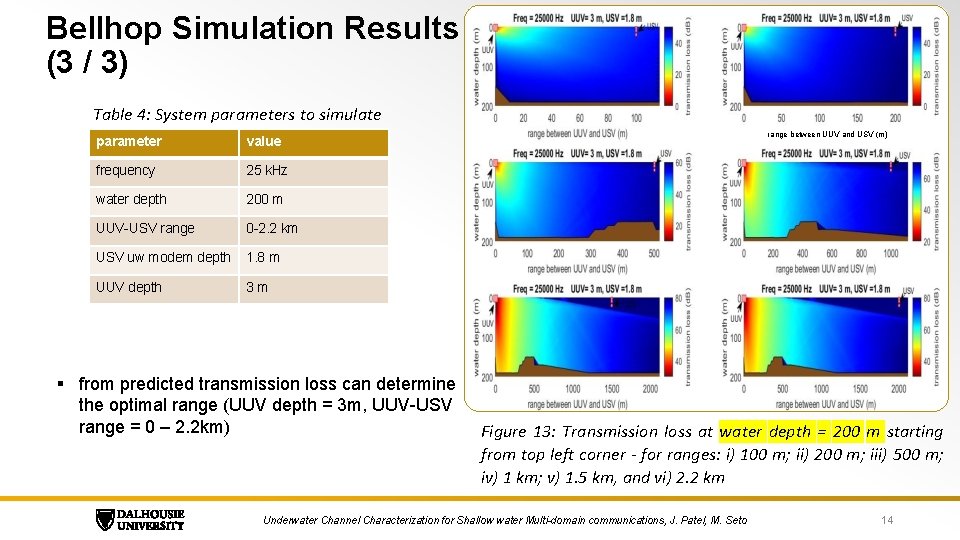
Bellhop Simulation Results (3 / 3) Table 4: System parameters to simulate parameter value frequency 25 k. Hz water depth 200 m UUV-USV range 0 -2. 2 km USV uw modem depth 1. 8 m UUV depth 3 m § from predicted transmission loss can determine the optimal range (UUV depth = 3 m, UUV-USV range = 0 – 2. 2 km) range between UUV and USV (m) Figure 13: Transmission loss at water depth = 200 m starting from top left corner - for ranges: i) 100 m; ii) 200 m; iii) 500 m; iv) 1 km; v) 1. 5 km, and vi) 2. 2 km Underwater Channel Characterization for Shallow water Multi-domain communications, J. Patel, M. Seto 14
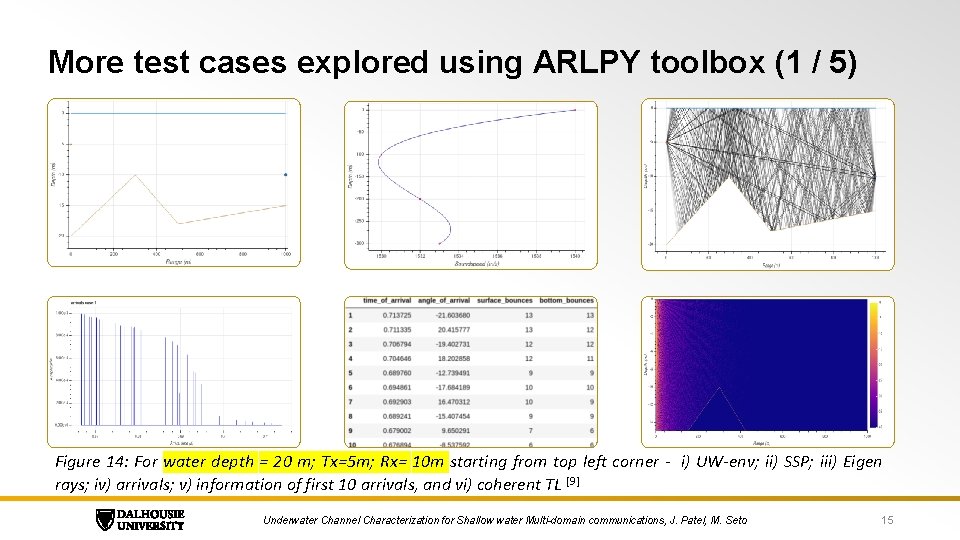
More test cases explored using ARLPY toolbox (1 / 5) Figure 14: For water depth = 20 m; Tx=5 m; Rx= 10 m starting from top left corner - i) UW-env; ii) SSP; iii) Eigen rays; iv) arrivals; v) information of first 10 arrivals, and vi) coherent TL [9] Underwater Channel Characterization for Shallow water Multi-domain communications, J. Patel, M. Seto 15
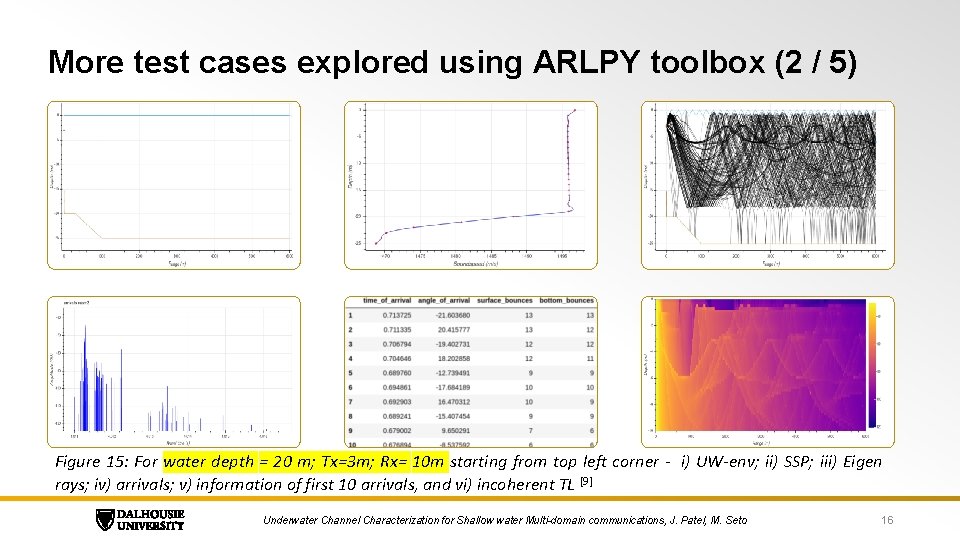
More test cases explored using ARLPY toolbox (2 / 5) Figure 15: For water depth = 20 m; Tx=3 m; Rx= 10 m starting from top left corner - i) UW-env; ii) SSP; iii) Eigen rays; iv) arrivals; v) information of first 10 arrivals, and vi) incoherent TL [9] Underwater Channel Characterization for Shallow water Multi-domain communications, J. Patel, M. Seto 16
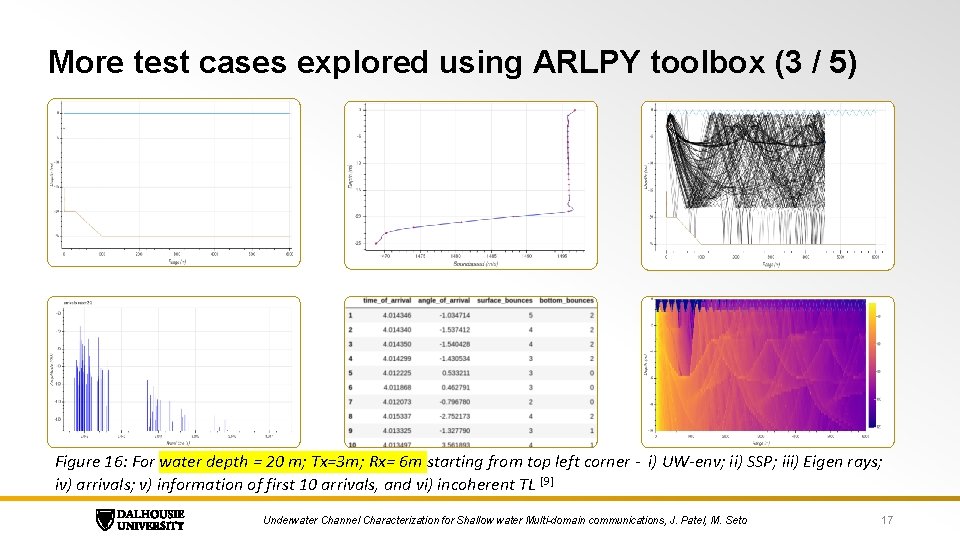
More test cases explored using ARLPY toolbox (3 / 5) Figure 16: For water depth = 20 m; Tx=3 m; Rx= 6 m starting from top left corner - i) UW-env; ii) SSP; iii) Eigen rays; iv) arrivals; v) information of first 10 arrivals, and vi) incoherent TL [9] Underwater Channel Characterization for Shallow water Multi-domain communications, J. Patel, M. Seto 17
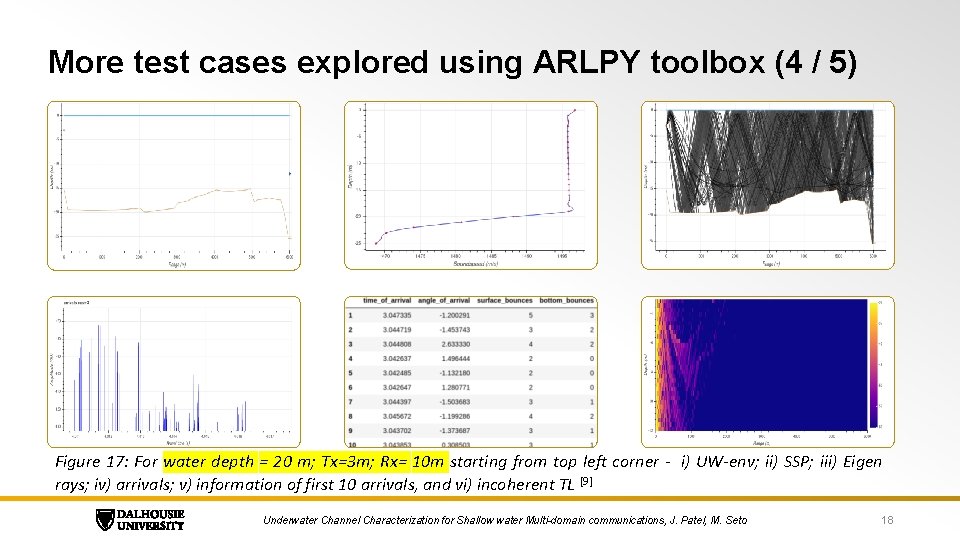
More test cases explored using ARLPY toolbox (4 / 5) Figure 17: For water depth = 20 m; Tx=3 m; Rx= 10 m starting from top left corner - i) UW-env; ii) SSP; iii) Eigen rays; iv) arrivals; v) information of first 10 arrivals, and vi) incoherent TL [9] Underwater Channel Characterization for Shallow water Multi-domain communications, J. Patel, M. Seto 18
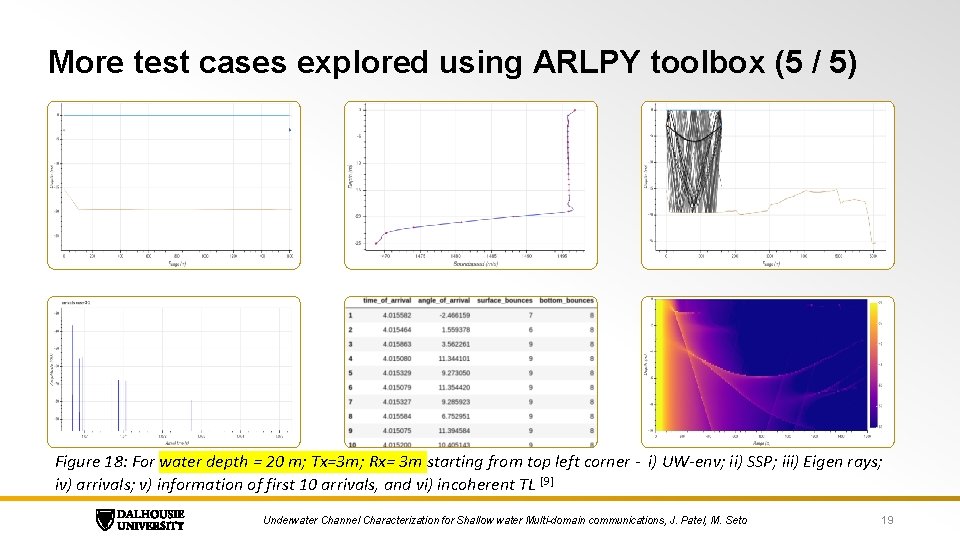
More test cases explored using ARLPY toolbox (5 / 5) Figure 18: For water depth = 20 m; Tx=3 m; Rx= 3 m starting from top left corner - i) UW-env; ii) SSP; iii) Eigen rays; iv) arrivals; v) information of first 10 arrivals, and vi) incoherent TL [9] Underwater Channel Characterization for Shallow water Multi-domain communications, J. Patel, M. Seto 19
Conclusion (1 / 2) § simulating several underwater networks test case, it was observed that for the given environmental conditions, feasible range between UUV and USV as less than or equal to 1. 3 km. Video 1: Gazebo simulations experimental validation of all 3 marine robots in the. § this tools were important part of any project in-which a real time uw-network operational range are critical parameter of the mission. Underwater Channel Characterization for Shallow water Multi-domain communications, J. Patel, M. Seto 20
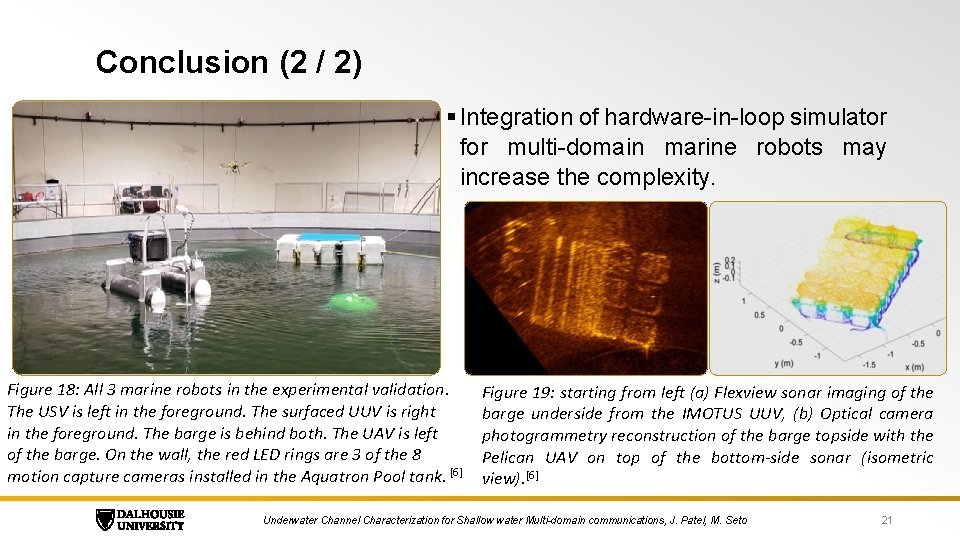
Conclusion (2 / 2) § Integration of hardware-in-loop simulator for multi-domain marine robots may increase the complexity. Figure 18: All 3 marine robots in the experimental validation. The USV is left in the foreground. The surfaced UUV is right in the foreground. The barge is behind both. The UAV is left of the barge. On the wall, the red LED rings are 3 of the 8 motion capture cameras installed in the Aquatron Pool tank. [6] Figure 19: starting from left (a) Flexview sonar imaging of the barge underside from the IMOTUS UUV, (b) Optical camera photogrammetry reconstruction of the barge topside with the Pelican UAV on top of the bottom-side sonar (isometric view). [6] Underwater Channel Characterization for Shallow water Multi-domain communications, J. Patel, M. Seto 21
Questions ? patel. jay@dal. ca Intelligent Systems Laboratory, Dalhousie University. Underwater Channel Characterization for Shallow water Multi-domain communications, J. Patel, M. Seto 22
References 1. Hanjiang Luo, Kaishun. Wu, Rukhsana Ruby, Feng Hong, Zhongwen Guo, and Lionel M. Ni. 2017, “Simulation and experimentation platforms for underwater acoustic sensor networks: Advancements and challenges”, ACM Comput. Surv. 50, 2, Article 28 (May 2017), 44 pages. 2. Nayyar A. , Balas V. E. (2019), “Analysis of Simulation Tools for Underwater Sensor Networks (UWSNs)”, Bhattacharyya S. , Hassanien A. , Gupta D. , Khanna A. , Pan I. (eds) International Conference on Innovative Computing and Communications. Lecture Notes in Networks and Systems, vol 55. Springer, Singapore, March 2019. 3. D. Pompili, T. Melodia and I. F. Akyildiz, "A CDMA-based Medium Access Control for Under. Water Acoustic Sensor Networks, " in IEEE Transactions on Wireless Communications, vol. 8, no. 4, pp. 1899 -1909, April 2009. 4. Hala Jodeh, Aisha Mikkawi, Ahmed Awad, and Othman. 2018, “Comparative analysis of routing protocols for under-water wireless sensor networks”, in Proceedings of the 2 nd International Conference on Future Networks and Distributed Systems (ICFNDS '18). ACM, New York, NY, USA, Article 33, 7 pages. 5. I. Calabrese, R. Masiero, P. Casari, L. Vangelista and M. Zorzi, "Embedded systems for prototyping underwater acoustic networks: The DESERT Underwater libraries on board the Panda. Board and Net. DCU, " 2012 Oceans, Hampton Roads, VA, 2012, pp. 1 -8. Underwater Channel Characterization for Shallow water Multi-domain communications, J. Patel, M. Seto 23
References 6. J. Ross, J. Lindsay, E. Gregson, A. Moore, J. Patel, and M. Seto. 2019 “Collaboration of multidomain marine robots towards above and below-water characterization of floating targets”. in IEEE International Symposium on Robotic and Sensors Environments (ROSE), pages 1– 7, June 2019. 7. J. Patel and M. Seto. 2019. “CDMA-based multi-domain communications network for marine robots”, in WUWNET’ 19: International Conference on Underwater Networks Systems (WUWNET’ 19), October 23– 25, 2019, Atlanta, GA, USA. ACM, New York, NY, USA, 2 pages. 8. https: //www. canada. ca/en/defence-research-development/news/articles/exerciseunmanned-warrior-an-international-exercise-using-autonomous-tech-to-detect-underwater -mines. html 9. M. Chitre 2020, “ARLPY python toolbox” , https: //github. com/org-arl/arlpy Underwater Channel Characterization for Shallow water Multi-domain communications, J. Patel, M. Seto 24