
Underutilized Land Preservation in the Purple Line Corridor
- Slides: 19
Underutilized Land Preservation in the Purple Line Corridor Nick Finio National Center for Smart Growth University of Maryland, College Park Zack Patton Enterprise Community Partners 4 -17 -20
Project Scope This work is funded by Kaiser Permanente, via the Center for Community Investment (CCI). There are two parts to this project: 1. Underutilized land inventory 2. Preservation inventory – Prince George’s County Project leads: Nick Finio, NCSG Zack Patton, Enterprise Community Partners
Project Scope – Underutilized land • Identify and map, at the parcel level, developable land of the following types: – Publicly owned land – Tax exempt land – Vacant land (of any ownership type) – Underutilized (underdeveloped) land of any type • End products – Lists of developable land – Maps of developable land • End state: a jumping off point for the pipeline development process
Project Scope – Preservation Inventory • Identify and map, at the parcel level: – – Publicly subsidized housing complexes and units Create GIS database Create summary excel tables Clean data on subsidy expiration date, subsidy type, ownership, etc Focus will be on Prince George’s County – Montgomery County has recently hired a consultant to do this work there.
Progress to date • Data gathered for underutilized land inventory – Preliminary data processing • Categorization of land into different ‘buckets’ • Elimination of unsuitable land –Irregular/small shapes, floodplains, schools, parks, etc • Data gathered for preservation inventory
Remaining work • Determine specific criteria for identifying priority parcels (via developer interviews) • Determine what will be most useful for PLCC HAAT (feedback from you!) • Add additional criteria and contextual data to the GIS databased on the above • Present results to the PLCC HAAT
Timeline April/May – Information gathering and dataset completion June – presentation of summary findings and strong candidate sites to HAAT July/August – iteration and refinement with HAAT guidance September – present final findings, recommendations and deliverables to PLCC Steering Committee, Kaiser Permanente and CCI.
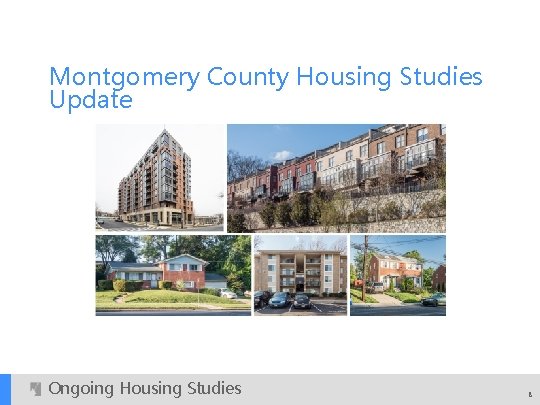
Montgomery County Housing Studies Update Ongoing Housing Studies 8
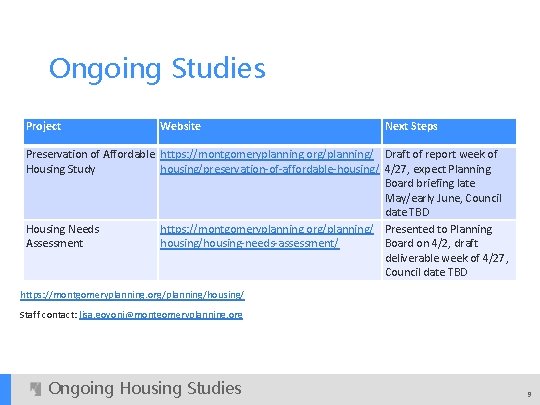
Ongoing Studies Project Website Next Steps Preservation of Affordable https: //montgomeryplanning. org/planning/ Draft of report week of Housing Study housing/preservation-of-affordable-housing/ 4/27, expect Planning Board briefing late May/early June, Council date TBD Housing Needs https: //montgomeryplanning. org/planning/ Presented to Planning Assessment housing/housing-needs-assessment/ Board on 4/2, draft deliverable week of 4/27, Council date TBD https: //montgomeryplanning. org/planning/housing/ Staff contact: lisa. govoni@montgomeryplanning. org Ongoing Housing Studies 9
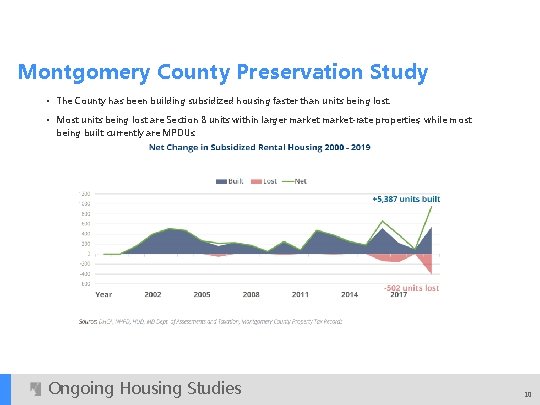
Montgomery County Preservation Study • The County has been building subsidized housing faster than units being lost. • Most units being lost are Section 8 units within larger market-rate properties, while most being built currently are MPDUs. Ongoing Housing Studies 10
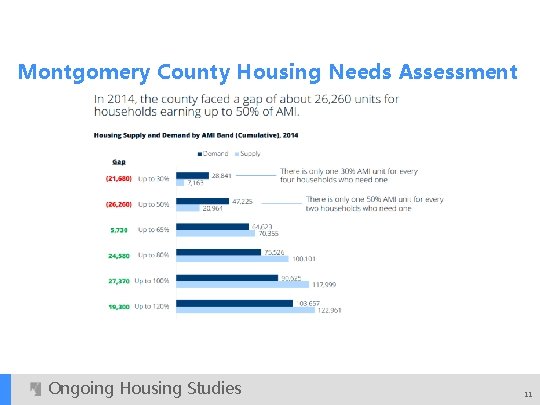
Montgomery County Housing Needs Assessment Ongoing Housing Studies 11
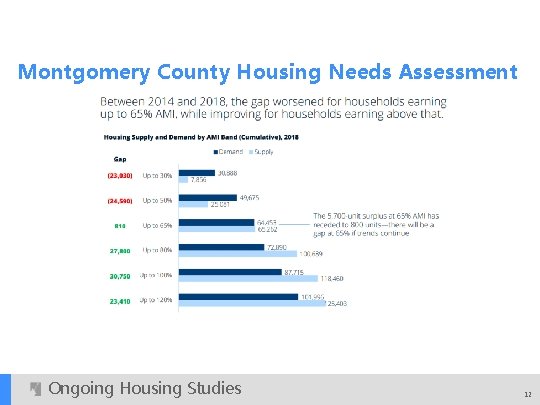
Montgomery County Housing Needs Assessment Ongoing Housing Studies 12
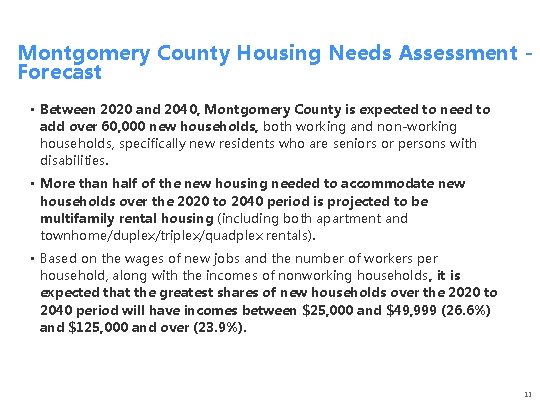
Montgomery County Housing Needs Assessment Forecast • Between 2020 and 2040, Montgomery County is expected to need to add over 60, 000 new households, both working and non-working households, specifically new residents who are seniors or persons with disabilities. • More than half of the new housing needed to accommodate new households over the 2020 to 2040 period is projected to be multifamily rental housing (including both apartment and townhome/duplex/triplex/quadplex rentals). • Based on the wages of new jobs and the number of workers per household, along with the incomes of nonworking households, it is expected that the greatest shares of new households over the 2020 to 2040 period will have incomes between $25, 000 and $49, 999 (26. 6%) and $125, 000 and over (23. 9%). Ongoing Housing Studies 13
The Challenge: Transforming Data into Action • We have: a documented problem and an ambitious goal to address it (No Net Loss) • We now also have: data that can help us identify opportunities to make progress (Inventories) • Our Challenge: How can we best use this to inform, support and initiate action?
Information Gaps We Can Solve For • Quantifying potential real estate resources available for advancing the No Net Loss goal – For each station area – At corridor level • Identifying/characterizing specific candidate sites for a preservation and development pipeline • Others we should be thinking about?
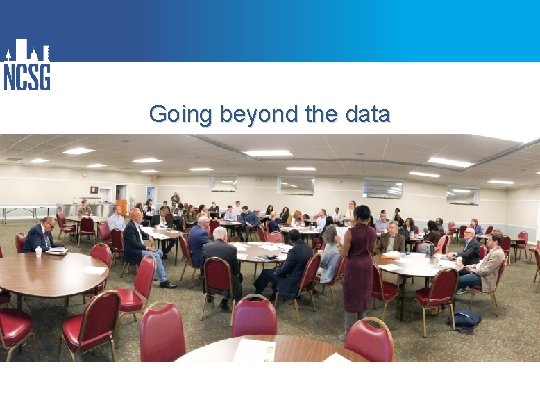
Going beyond the data
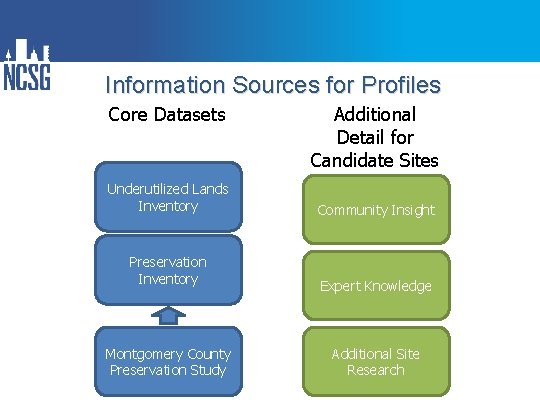
Information Sources for Profiles Core Datasets Underutilized Lands Inventory Preservation Inventory Montgomery County Preservation Study Additional Detail for Candidate Sites Community Insight Expert Knowledge Additional Site Research
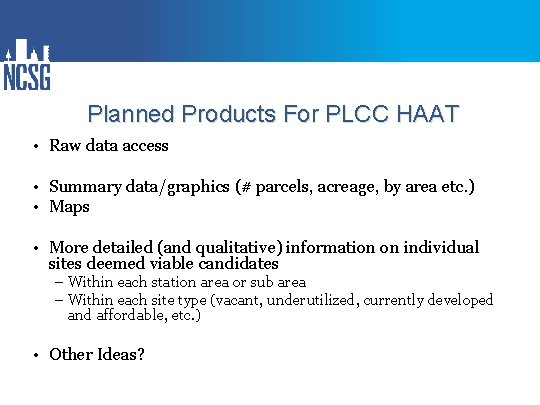
Planned Products For PLCC HAAT • Raw data access • Summary data/graphics (# parcels, acreage, by area etc. ) • Maps • More detailed (and qualitative) information on individual sites deemed viable candidates – Within each station area or sub area – Within each site type (vacant, underutilized, currently developed and affordable, etc. ) • Other Ideas?
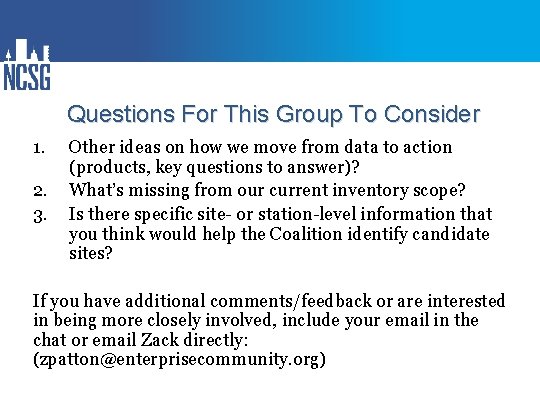
Questions For This Group To Consider 1. 2. 3. Other ideas on how we move from data to action (products, key questions to answer)? What’s missing from our current inventory scope? Is there specific site- or station-level information that you think would help the Coalition identify candidate sites? If you have additional comments/feedback or are interested in being more closely involved, include your email in the chat or email Zack directly: (zpatton@enterprisecommunity. org)