
UNDERTAKING A SCIENCE INVESTIGATORY PROJECT SY 2013 2014

- Slides: 50
UNDERTAKING A SCIENCE INVESTIGATORY PROJECT SY 2013 -2014
Science Investigatory Project ü ü ü an investigation about a scientific problem (question) a problem-solving process using the scientific method. phases of conducting an investigatory project 2
Types of Science Investigatory Projects ü ü collection of projects designing and building an apparatus, equipment or model developing a process for testing products improving/developing a new product or a new use for an existing product 3
Types of Science Investigatory Projects ü ü ü finding new ways/improved ways to do something describing material phenomenon demonstrating a scientific principle in action, or demonstrating an abstract principle in concrete terms science in everyday life survey studies 4
Objectives of Science Investigatory Projects ü ü apply rational and creative thinking processes demonstrate functional understanding collect, organize and evaluate communicate results clearly, honestly and objectively 5
Objectives of Science Investigatory Projects ü ü ü manifest an analytical and questioning attitude manifest self-reliance, independence, patience, persistence, and thoroughness show resourcefulness, originality and creativity 6
Phase I: The Proposal ü ü ü a detailed written plan of how the project will be done similar to designing an experiment since yet to be done, the future tense of the verbs is used 7
Phase I: The Proposal ü Selecting ü two Your Topic kinds of research ü pure research ü applied research 8
Phase I: The Proposal üKnowing Your Subject übackground of the problem ühow it arose üimportance üwhat will be done with the results 9
Phase I: The Proposal ü Defining Your Project üproblem is üaccurate üclear üobjectives are üSMART 10
Phase I: The Proposal üPlanning Your Project üplace ütime üequipment üproblems that may arise 11
Phase I: The Proposal üFormulating The Hypothesis ünull hypothesis üalternative hypothesis 12
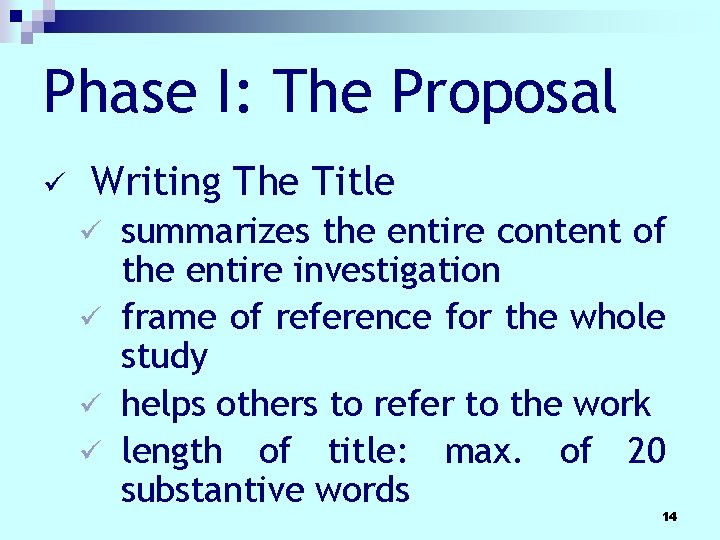
Phase I: The Proposal ü ü Problem ü stated as a question/scientific inquiry Title ü patterned from the question ü must contain only the essential words ü the overall aim or subject of the project ü catch the attention of the reader ü concise, descriptive and self-explanatory 13
Phase I: The Proposal ü Writing The Title summarizes the entire content of the entire investigation ü frame of reference for the whole study ü helps others to refer to the work ü length of title: max. of 20 substantive words ü 14
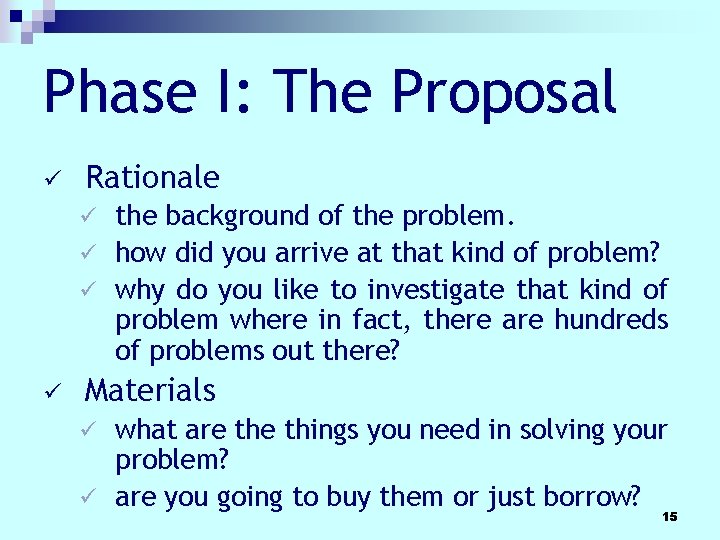
Phase I: The Proposal ü Rationale the background of the problem. ü how did you arrive at that kind of problem? ü why do you like to investigate that kind of problem where in fact, there are hundreds of problems out there? ü ü Materials what are things you need in solving your problem? ü are you going to buy them or just borrow? ü 15
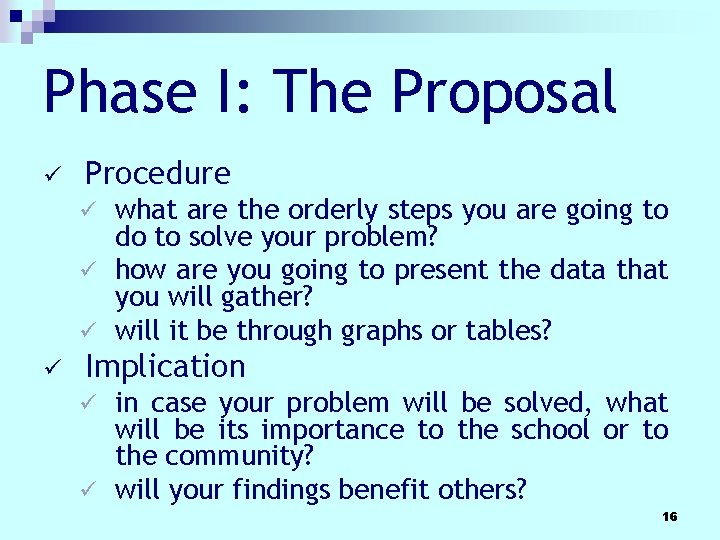
Phase I: The Proposal ü Procedure what are the orderly steps you are going to do to solve your problem? ü how are you going to present the data that you will gather? ü will it be through graphs or tables? ü ü Implication in case your problem will be solved, what will be its importance to the school or to the community? ü will your findings benefit others? ü 16
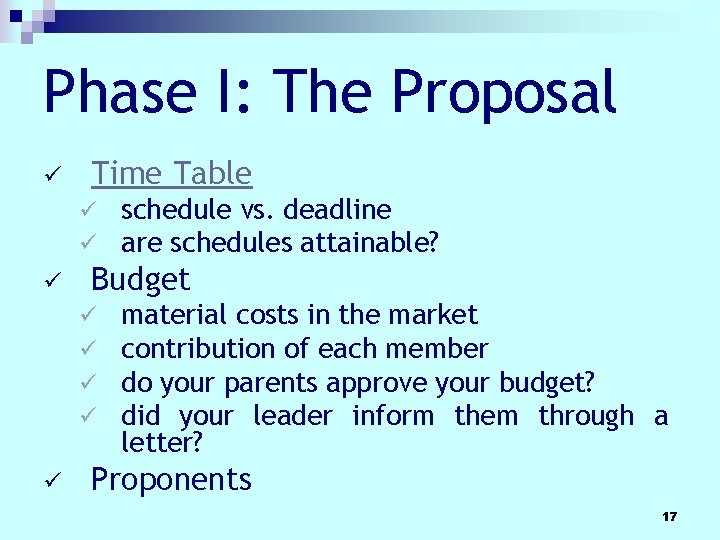
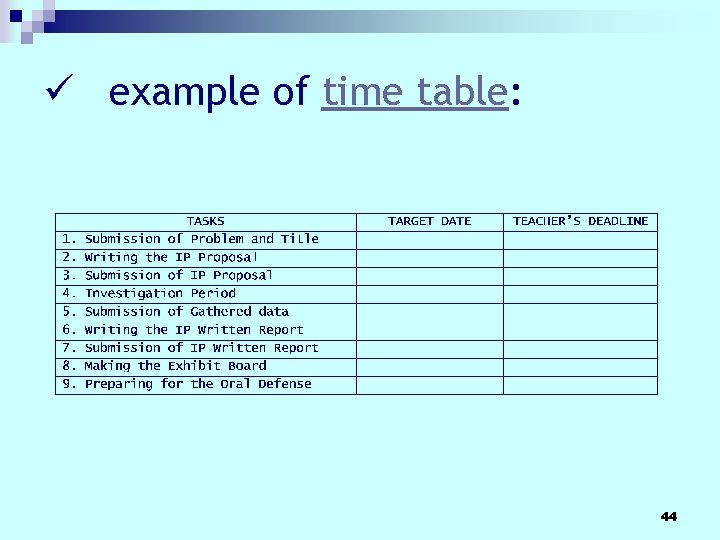
Phase I: The Proposal ü Time Table ü ü ü Budget ü ü ü schedule vs. deadline are schedules attainable? material costs in the market contribution of each member do your parents approve your budget? did your leader inform them through a letter? Proponents 17
Phase II: The Investigation ü ü as soon as your proposal is approved, start investigating your procedure will be your guide keep track of all your observations and data document all your works 18
Phase II: The Investigation ü Conducting Experiments üvariables üreplications ü Collecting and Recording Data üquantitative data and qualitative data ügraphs and tables 19
Phase II: The Investigation ü Analyzing and Interpreting Data ü support ü hypothesis vs. reject hypothesis Formulating Generalizations ü answers the objectives of the project ü valid when the same results are obtained if the same experiment is repeated ü Making Recommendations ü suggestions for other possible investigations related to the project 20
Phase III: The Output ü after conducting the investigation you are now ready to organize your gathered data and present your findings 21
Phase III: The Output ü The Written Report a recall of all the things you did to solve your problem ü mode of the verb is in the past tense ü 22
Phase III: The Output ü Characteristics Of A Good Report coherence ü good presentation ü thorough relevant background to the project with clearly stated aims ü careful critical analysis, interpretation and discussion of the results with pertinent reference to the literature ü 23
Phase III: The Output ü ü Title Acknowledgments general statement acknowledging the help given by individuals, institutions, departments, etc. ü list of people who advised and assisted in undertaking the investigatory project ü 24
Phase III: The Output ü Abstract brief overview which includes a concise result ü a short paragraph of around 200 to 250 words which gives the essential or principal features of the project or study ü 25
Phase III: The Output ü Abstract ü descriptive or informative enough to present a comprehensive picture of the study ü must contain the following: ü ü ü purpose of the study procedure findings 26
Phase III: The Output ü Introduction enrichment of proposal’s rationale ü a background to the project with the aims clearly stated ü 27
Phase III: The Output ü Areas Worth Introduction ü ü ü Considering for the general area of science concerned with background information problems/difficulties reasons for doing your project possible outcomes of the work importance 28
Phase III: The Output ü Review Of Related Literature where the information gathered from other sources is noted and properly documented ü contains findings of other studies or investigations similar as yours ü 29
Phase III: The Output ü Methodology And Materials full unambiguous description ü materials and equipment ü ü materials, reagents, chemicals, plants, animals, and other experimental units, as well as equipment 30
Phase III: The Output ü Methodology And Materials ü treatment procedure ü ü or general guided by the proposal procedure describe the procedure in such a way that anyone who is completely unfamiliar with your topic or methods will know exactly what you did and easily repeat your research 31
Phase III: The Output ü Methodology And Materials ü treatment or general procedure ü ü cites references for methods or treatment used and describe in detail any modification introduced includes the number of trials performed, variables used, and how data were gathered and organized 32
Phase III: The Output ü Information To Be Included In The Methods Section ü ü ü details about the samples/specimens maintenance of the samples/specimens collection methods precise variables measured preparations of instruments for measurement precautions 33
Phase III: The Output ü Results Observations And üa summary of results and observations clearly presented analyzed ü tabulated and graphed, if possible 34
Phase III: The Output ü Writing The Results Section decide on the best method to present your results ü do not include all results in all possible ways ü decide whether the results might be more clearly presented in sections ü 35
Phase III: The Output ü Writing The Results Section ü ensure that each diagram, table, etc. has: ü ü a reference, e. g. fig. 6 a heading which states exactly what is being shown a key to all the symbols and colors measurement units correctly given 36
Phase III: The Output ü Writing The Results Section ü write a text for your results section ü ü ü description and not discussion be precise in the text be honest 37
Phase III: The Output ü Discussion and Recommendation an explanation/debate of the results within the context of the aim of the project and other relevant studies or investigations ü immediate answer/findings about the problem ü 38
Phase III: The Output ü Points To Be Included In The Discussion strengths and weaknesses – be positive in your assessment of methods ü discussion of whether the results were expected or not ü explanations for the results ü 39
Phase III: The Output ü Points To Be Included In The Discussion implications and practical applications - how your results contributed to the field of study ü suggestions of what further work could be carried out ü 40
Phase III: The Output ü Bibliography ü list all the references used either alphabetically or in the order of citing in the text of the paper 41
Phase III: The Output ü The Exhibit üa showcase of your IP mounted on a board ü must attract viewers so that they may get interested to your IP 42
Phase III: The Output ü The Oral Defense ü present your work to a panel of judges ü questions will be asked about your project 43
ü example of time table: 44
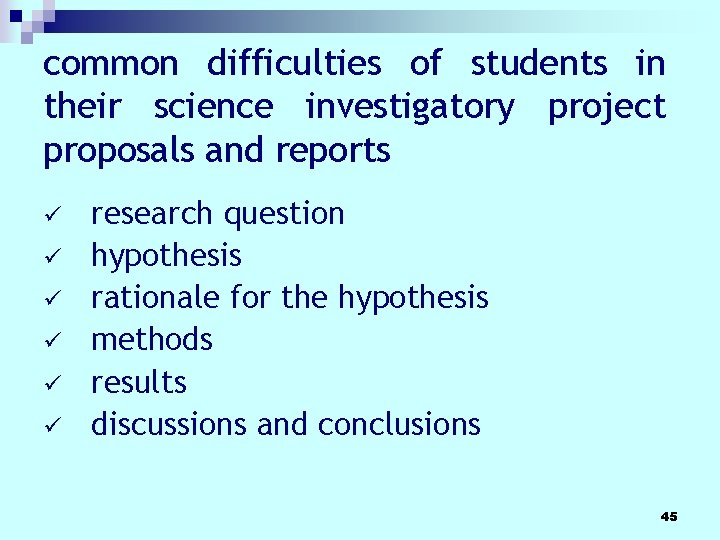
common difficulties of students in their science investigatory project proposals and reports ü ü ü research question hypothesis rationale for the hypothesis methods results discussions and conclusions 45
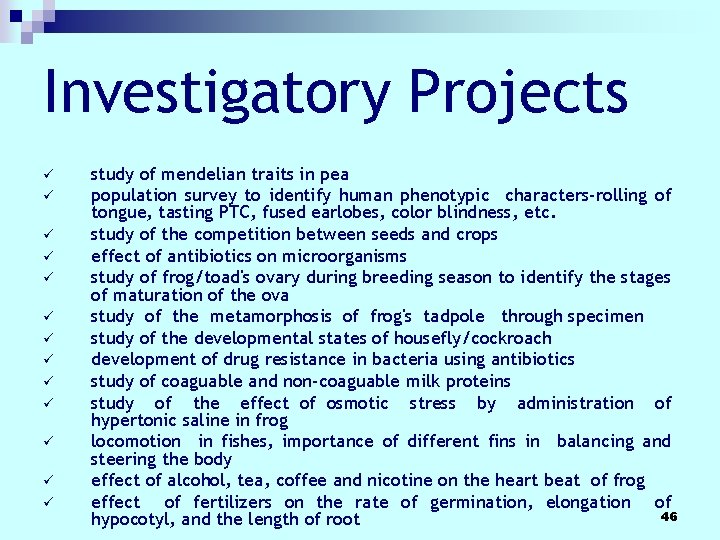
Investigatory Projects ü ü ü ü study of mendelian traits in pea population survey to identify human phenotypic characters-rolling of tongue, tasting PTC, fused earlobes, color blindness, etc. study of the competition between seeds and crops effect of antibiotics on microorganisms study of frog/toad's ovary during breeding season to identify the stages of maturation of the ova study of the metamorphosis of frog's tadpole through specimen study of the developmental states of housefly/cockroach development of drug resistance in bacteria using antibiotics study of coaguable and non-coaguable milk proteins study of the effect of osmotic stress by administration of hypertonic saline in frog locomotion in fishes, importance of different fins in balancing and steering the body effect of alcohol, tea, coffee and nicotine on the heart beat of frog effect of fertilizers on the rate of germination, elongation of 46 hypocotyl, and the length of root
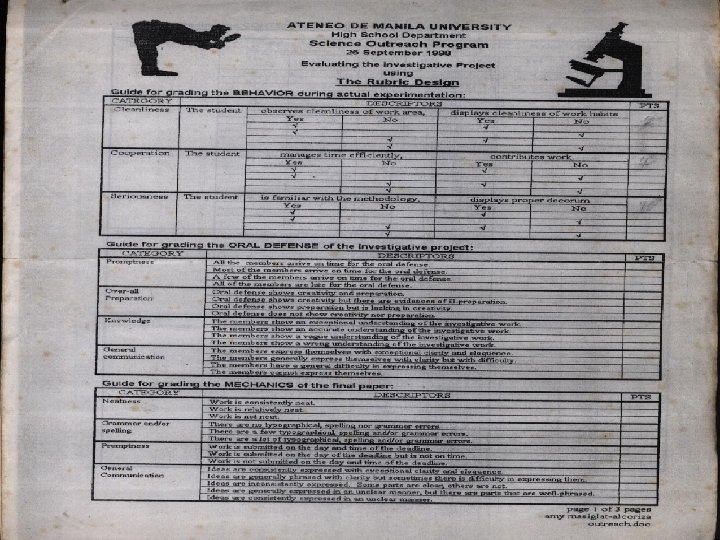
47
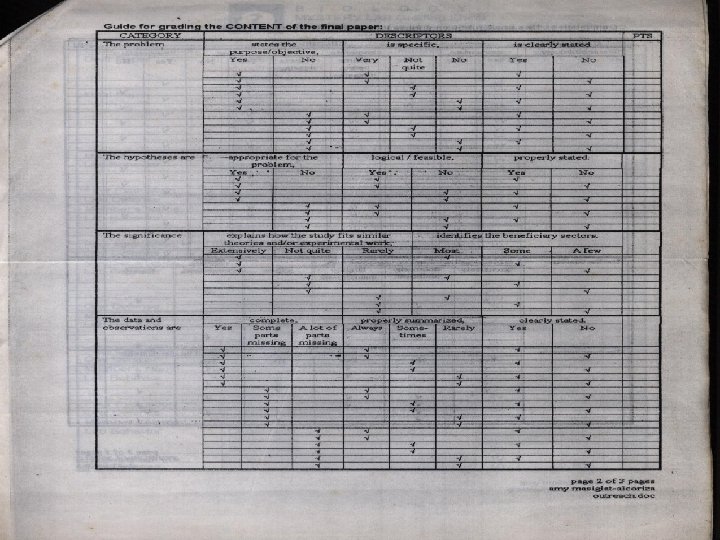
48
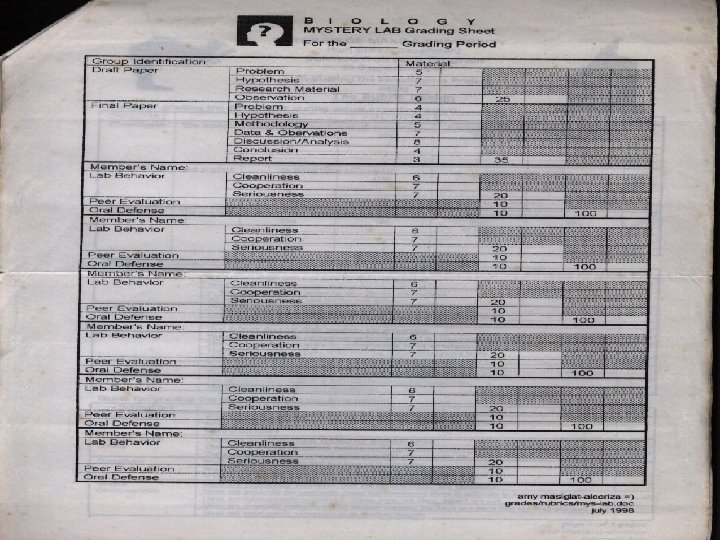
49
List of References ü ü ü Handouts from ADMU Science Teachers’ Outreach Program, September 26, 1998 Handouts from Abiva Publishing House, Inc. http: //www. geocities. com/egf 94/2 ndlo ngtest/ip. html http: //education. nic. in/cd 50 years/q/6 j /b 3/6 jb 3020 b. htm 50