
Understanding Your Body Image How much information do
Understanding Your Body Image
How much information do you already know about this topic area? A. B. C. D. Expert - I have done a lot of learning in this area already. Above average - I have learned some information about this topic. Moderate - I know a little about this topic. Rookie - I am a blank slate…but ready to learn! 1 1 (LE 100 -C 3 L 4: LQ 1)
If you have a sedentary lifestyle, this may make you more prone to _______. A. B. C. D. weight loss higher metabolism weight gain lower metabolism 1 1 (LE-100: C 3 L 4: LQ 2)
Lesson Overview Ø What is body image? Ø Weight problems and diet Ø Managing your appropriate weight Ø The dangers of eating disorders Chapter 3, Lesson 4
Vocabulary Questions Slide Index Click any link below to go directly to polling that question. 1. Way you see your physical self 5. Weigh more than the 2. Weight that is best for your appropriate weight range 6. Weigh less than the appropriate body 3. Ratio of body fat to lean body weight range 7. Body doesn't get the nutrients tissue 4. Measurement that allows you to assess your body size it needs to grow and function properly Click here to return to this index.
Vocabulary Questions Slide Index Click any link below to go directly to polling that question. 8. Bone loss, brittle/fragile bones 12. Measures how many calories 9. Energy is created and stored you burn when you're doing nothing from food 10. Energy is released for use 13. Not eating for long periods 11. System in charge of many of 14. Emotional state, something our body's processes, mood seems so important, always regulation thinking about it Click here to return to this index.
Vocabulary Questions Slide Index Click any link below to go directly to polling that question. 15. Extreme eating behaviors that 17. A person eats large amounts of food, then tries to purge can lead to sickness 16. Eating disorder characterized by self-starvation 18. Rapid consumption of an excessive amount of food Click here to return to this index.
Quick Write Many magazines and electronic media sources alter body images of young people and adults so they appear in the photo as thinner, heavier, or taller than they really are. Are these photos realistic? Should this really be done? Write down your opinions on this topic. Note to Instructors: Click the Show/Hide Response Display Button Photo Courtesy of Fotolia
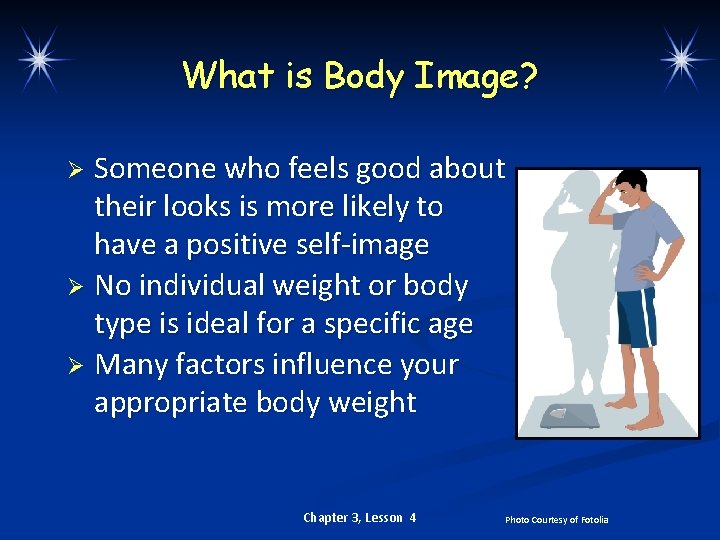
What is Body Image? Someone who feels good about their looks is more likely to have a positive self-image Ø No individual weight or body type is ideal for a specific age Ø Many factors influence your appropriate body weight Ø Chapter 3, Lesson 4 Photo Courtesy of Fotolia
Body Mass Index (BMI) Reliable indicator of body fatness Ø Used to identify possible weight problems Ø Compares your weight relative to your height Ø Estimates your total body fat Ø Chapter 3, Lesson 4 Photo Courtesy of Fotolia
Activity 1: Calculate Your BMI Ø Review the section in your textbook on your appropriate weight Ø Calculate your BMI Ø Answer the questions Chapter 3, Lesson 4
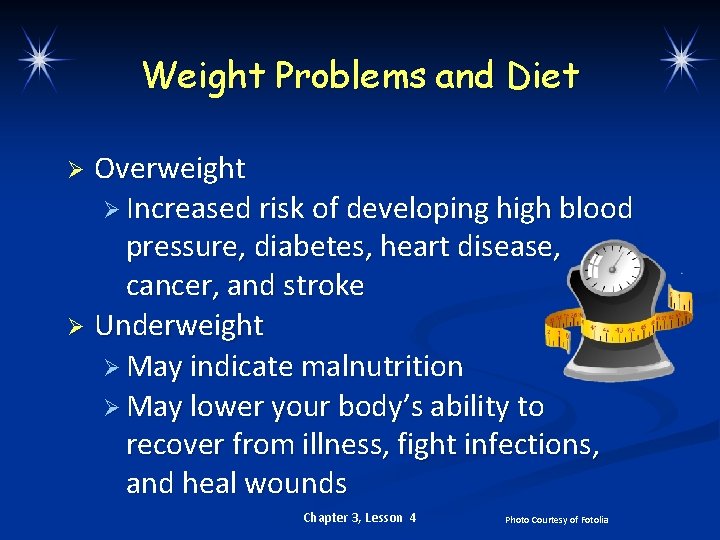
Weight Problems and Diet Overweight Ø Increased risk of developing high blood pressure, diabetes, heart disease, cancer, and stroke Ø Underweight Ø May indicate malnutrition Ø May lower your body’s ability to recover from illness, fight infections, and heal wounds Ø Chapter 3, Lesson 4 Photo Courtesy of Fotolia
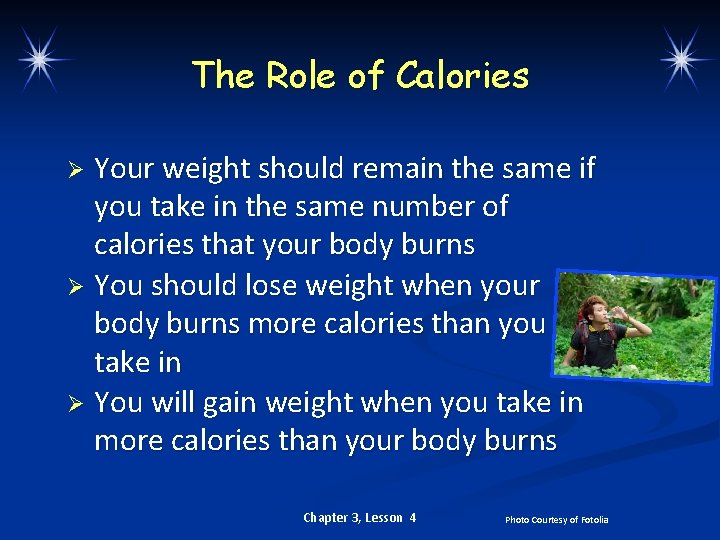
The Role of Calories Your weight should remain the same if you take in the same number of calories that your body burns Ø You should lose weight when your body burns more calories than you take in Ø You will gain weight when you take in more calories than your body burns Ø Chapter 3, Lesson 4 Photo Courtesy of Fotolia
Which of the following factors influence your appropriate weight? A. B. C. D. Gender Personality Medication history Fitness level 1 1 (LE-100: C 3 L 4: LQ 3)
Which of the following may be a reason that someone is underweight? A. B. C. D. Extreme fasting Limited exercise Medical issues Eating mostly empty calorie foods 1 1 (LE-100: C 3 L 4: LQ 4)
Activity 2: Keeping a Food Diary and Analyzing Your Daily Nutrition Ø Complete the steps to get an initial assessment of your current nutrition using My. Fitness. Pal Ø Identify areas to be improved Chapter 3, Lesson 4
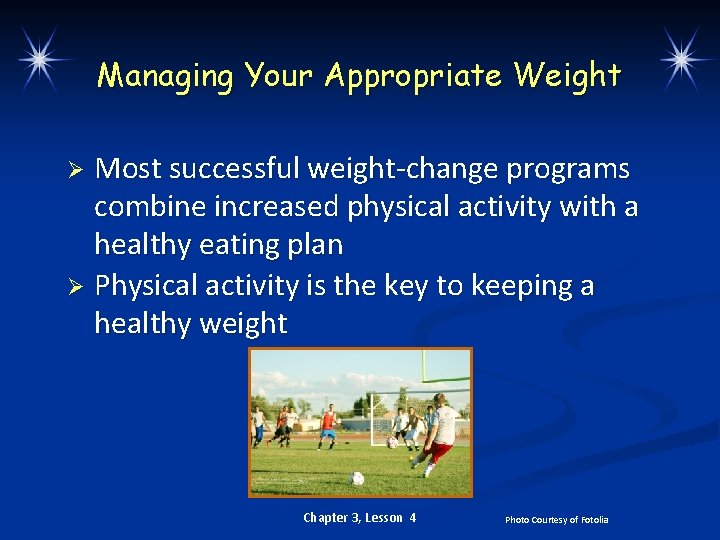
Managing Your Appropriate Weight Most successful weight-change programs combine increased physical activity with a healthy eating plan Ø Physical activity is the key to keeping a healthy weight Ø Chapter 3, Lesson 4 Photo Courtesy of Fotolia
Managing Weight Change It’s good to understand how your body uses the food you eat Ø You can control: Ø What you eat Ø How much physical activity you get every day Ø The more active you are, the more calories you burn Ø Chapter 3, Lesson 4 Photo Courtesy of Fotolia
Bad Decisions That Put Your Health at Risk Weight-loss programs that promise quick results Ø Relying on special products or formulas Ø Trying to lose more than 1/2 to 1 pound per week Ø Eating fewer calories a day than recommended Ø Skipping meals Ø Chapter 3, Lesson 4 Photo Courtesy of Fotolia
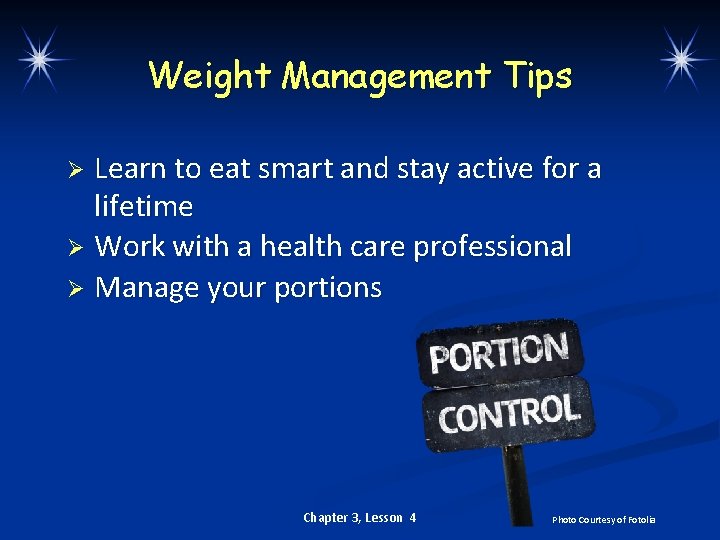
Weight Management Tips Learn to eat smart and stay active for a lifetime Ø Work with a health care professional Ø Manage your portions Ø Chapter 3, Lesson 4 Photo Courtesy of Fotolia
Activity 3: Calculate Your BMR and Total Calorie Needs Review the section in your textbook on your Basal Metabolic Rate (BMR) and Harris Benedict Equation Ø Calculate your BMR Ø Determine your daily calorie needs Ø Answer the questions Ø Chapter 3, Lesson 4
While you cant directly control how your metabolism works, you can control: A. B. C. D. the speed of your metabolism when you eat how much of each food group you eat how much physical activity you get every day 1 1 (LE-100: C 3 L 4: LQ 5)
Which of the following would be good decision when managing your weight? A. Relying on special products or formulas B. Trying to lose 1/2 to 1 pound per week C. Eating fewer calories a day than recommended from BMR calculation D. Skipping meals 1 1 (LE-100: C 3 L 4: LQ 6)
Activity 4: Your Health Habits Ø Complete the first chart to determine your health habits Ø Complete the second chart to identify your negative eating and food triggers Ø Answer the questions Chapter 3, Lesson 4
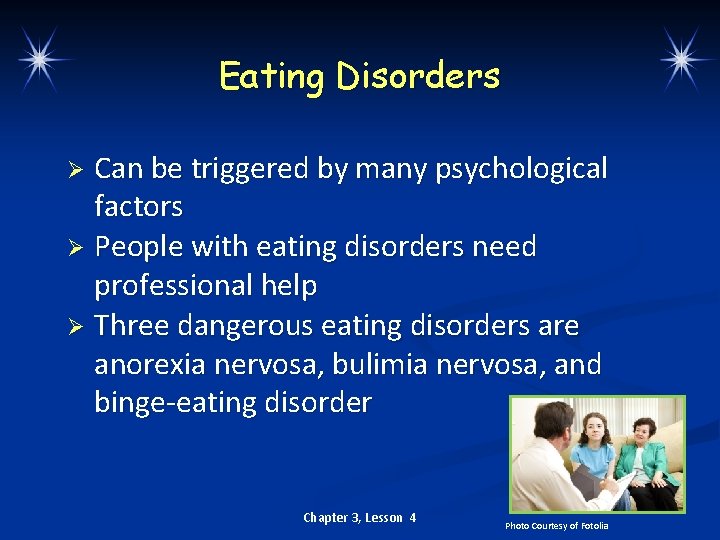
Eating Disorders Can be triggered by many psychological factors Ø People with eating disorders need professional help Ø Three dangerous eating disorders are anorexia nervosa, bulimia nervosa, and binge-eating disorder Ø Chapter 3, Lesson 4 Photo Courtesy of Fotolia
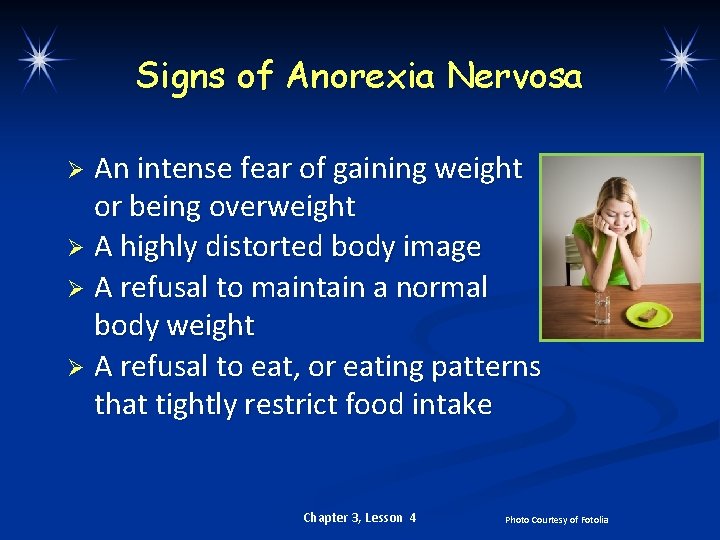
Signs of Anorexia Nervosa An intense fear of gaining weight or being overweight Ø A highly distorted body image Ø A refusal to maintain a normal body weight Ø A refusal to eat, or eating patterns that tightly restrict food intake Ø Chapter 3, Lesson 4 Photo Courtesy of Fotolia
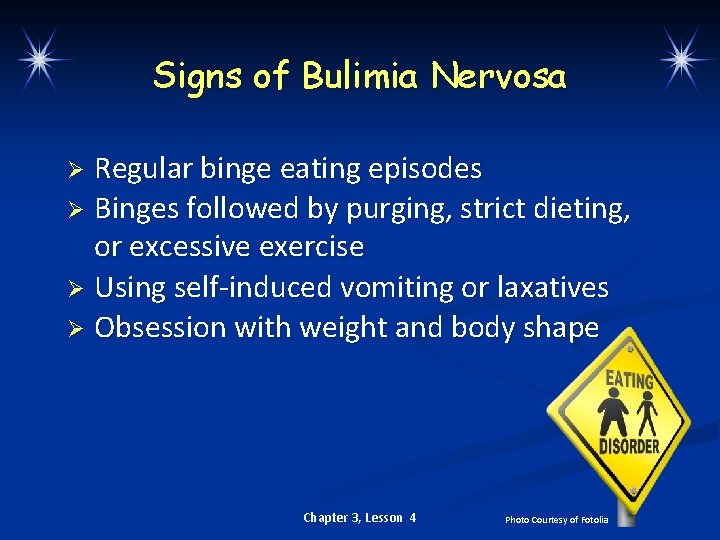
Signs of Bulimia Nervosa Regular binge eating episodes Ø Binges followed by purging, strict dieting, or excessive exercise Ø Using self-induced vomiting or laxatives Ø Obsession with weight and body shape Ø Chapter 3, Lesson 4 Photo Courtesy of Fotolia
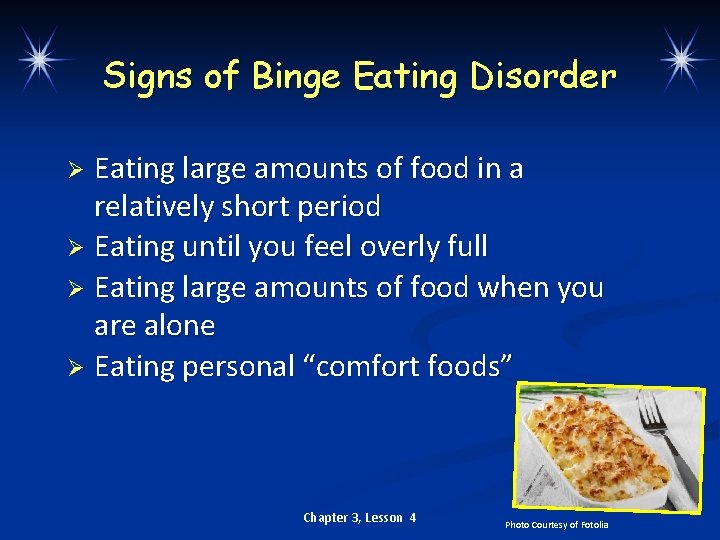
Signs of Binge Eating Disorder Eating large amounts of food in a relatively short period Ø Eating until you feel overly full Ø Eating large amounts of food when you are alone Ø Eating personal “comfort foods” Ø Chapter 3, Lesson 4 Photo Courtesy of Fotolia
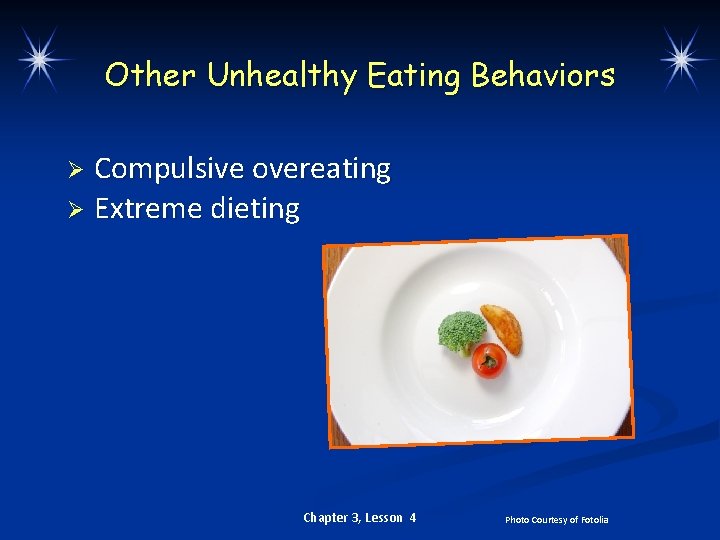
Other Unhealthy Eating Behaviors Compulsive overeating Ø Extreme dieting Ø Chapter 3, Lesson 4 Photo Courtesy of Fotolia
Which eating disorder causes some people to develop an irregular heartbeat that may lead to cardiac arrest? A. B. C. D. Anorexia nervosa Bulimia nervosa Binge eating disorder Extreme dieting 1 1 (LE-100: C 3 L 4: LQ 7)
Which eating disorder occurs when the persons obsessions are focused on each bite of food eaten and every pound of weight shed? A. B. C. D. Anorexia nervosa Bulimia nervosa Binge eating disorder Extreme dieting 1 1 (LE-100: C 3 L 4: LQ 8)
Activity 5: Eating Disorders Ø Research and locate an article about eating disorders Ø Identify the important issues, choices, and consequences Ø Take notes and answer the questions Chapter 3, Lesson 4
Summary Ø What is body image? Ø Weight problems and diet Ø Managing your appropriate weight Ø The dangers of eating disorders Chapter 3, Lesson 4
What are some ways you can positively affect your body image? Note to Instructors: Click the Show/Hide Response Display Button (LE-100: C 3 L 4: LQ 9)
Give one example of how you could APPLY what you learned in this lesson to the real world. For example, what difference could this information make in the way you think about the world, understand the viewpoints of others, or help you be successful in life? Note to Instructors: Click the Show/Hide Response Display Button (LE-100: C 3 L 4: LQ 10)
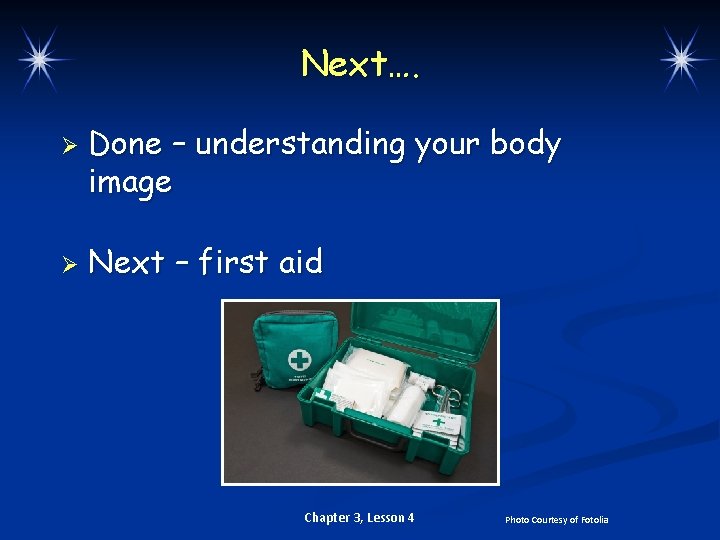
Next…. Ø Ø Done – understanding your body image Next – first aid Chapter 3, Lesson 4 Photo Courtesy of Fotolia
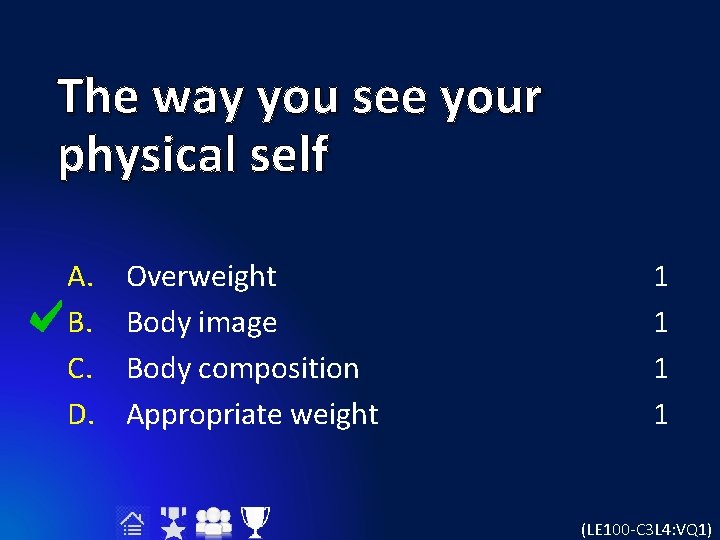
The way you see your physical self A. B. C. D. Overweight Body image Body composition Appropriate weight 1 1 (LE 100 -C 3 L 4: VQ 1)
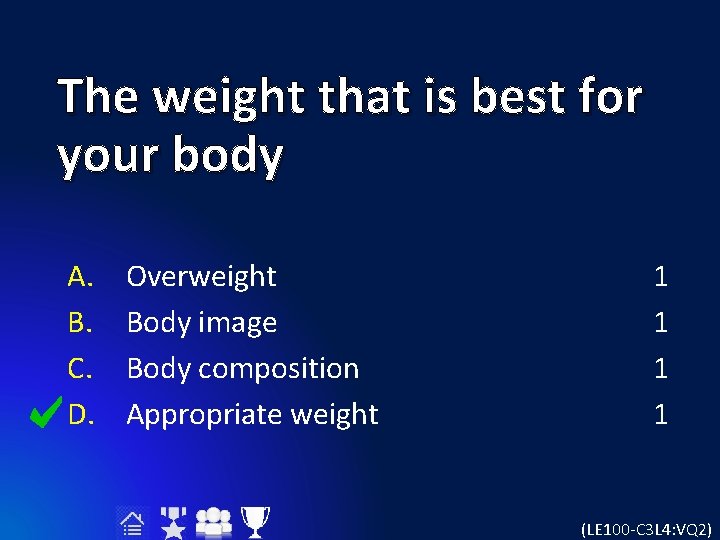
The weight that is best for your body A. B. C. D. Overweight Body image Body composition Appropriate weight 1 1 (LE 100 -C 3 L 4: VQ 2)
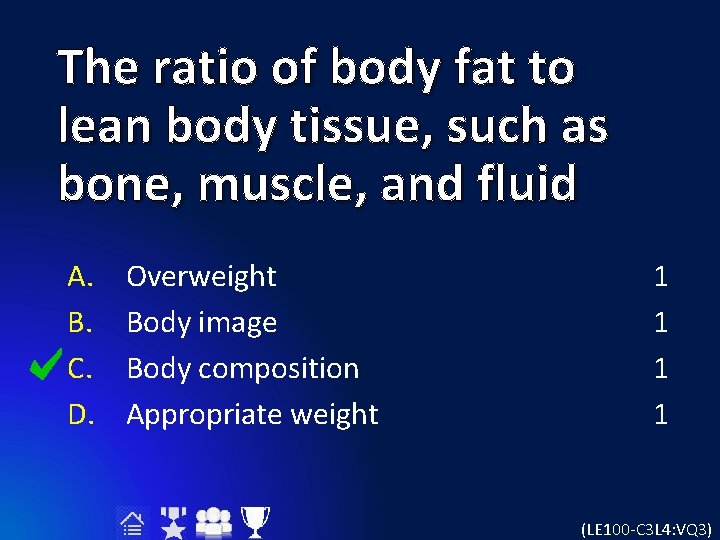
The ratio of body fat to lean body tissue, such as bone, muscle, and fluid A. B. C. D. Overweight Body image Body composition Appropriate weight 1 1 (LE 100 -C 3 L 4: VQ 3)
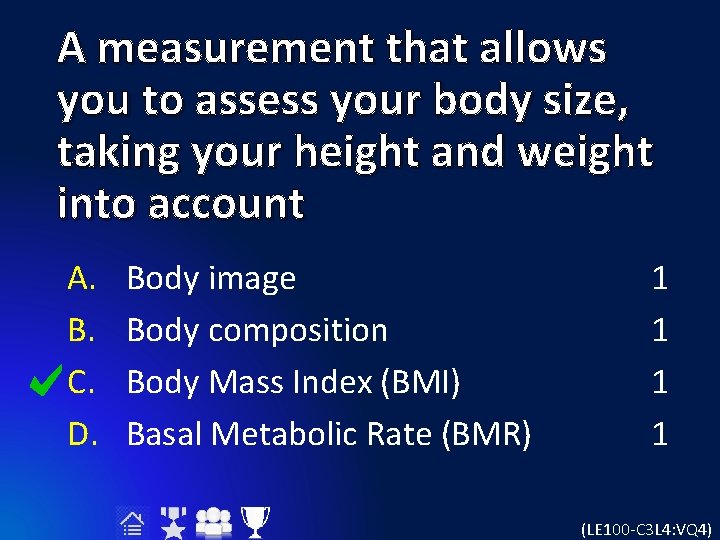
A measurement that allows you to assess your body size, taking your height and weight into account A. B. C. D. Body image Body composition Body Mass Index (BMI) Basal Metabolic Rate (BMR) 1 1 (LE 100 -C 3 L 4: VQ 4)
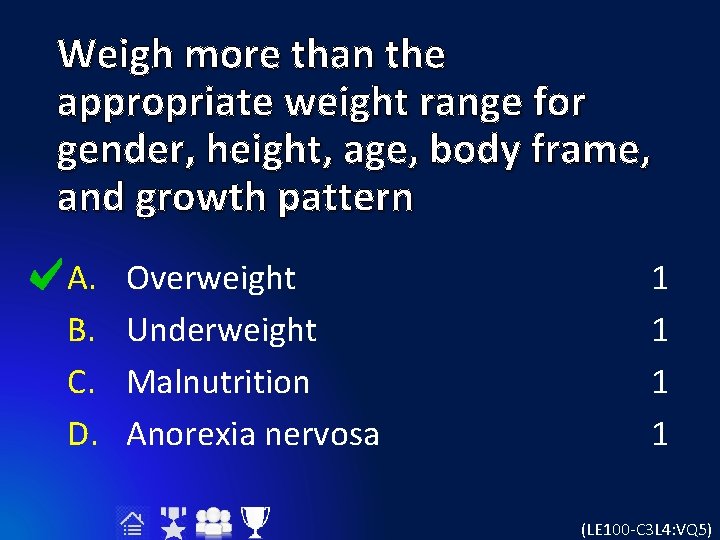
Weigh more than the appropriate weight range for gender, height, age, body frame, and growth pattern A. B. C. D. Overweight Underweight Malnutrition Anorexia nervosa 1 1 (LE 100 -C 3 L 4: VQ 5)
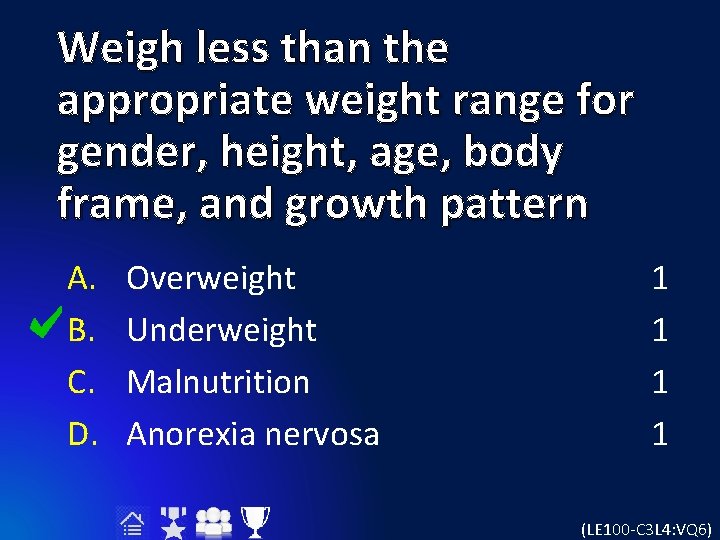
Weigh less than the appropriate weight range for gender, height, age, body frame, and growth pattern A. B. C. D. Overweight Underweight Malnutrition Anorexia nervosa 1 1 (LE 100 -C 3 L 4: VQ 6)
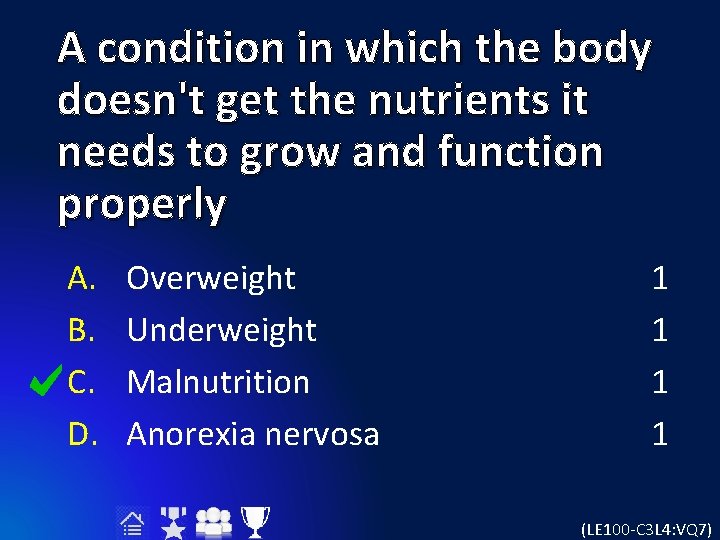
A condition in which the body doesn't get the nutrients it needs to grow and function properly A. B. C. D. Overweight Underweight Malnutrition Anorexia nervosa 1 1 (LE 100 -C 3 L 4: VQ 7)
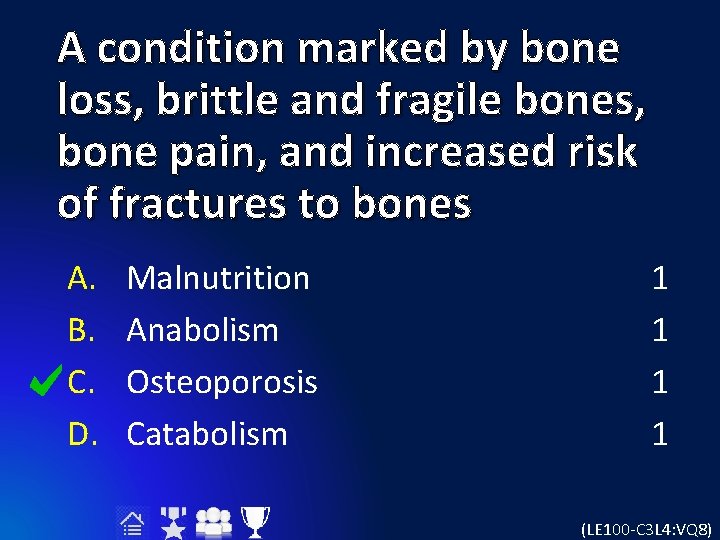
A condition marked by bone loss, brittle and fragile bones, bone pain, and increased risk of fractures to bones A. B. C. D. Malnutrition Anabolism Osteoporosis Catabolism 1 1 (LE 100 -C 3 L 4: VQ 8)
When energy is created and stored from food A. B. C. D. Malnutrition Anabolism Osteoporosis Catabolism 1 1 (LE 100 -C 3 L 4: VQ 9)
When energy is released for use A. B. C. D. Malnutrition Anabolism Osteoporosis Catabolism 1 1 (LE 100 -C 3 L 4: VQ 10)
The system in charge of many of our body's processes, from cell and tissue growth and repair to reproductive functions and mood regulation A. B. C. D. Anabolism Endocrine system Body Mass Index (BMI) Basal Metabolic Rate (BMR) 1 1 (LE 100 -C 3 L 4: VQ 11)
Measures how many calories you burn when you're doing nothing A. B. C. D. Body image Body composition Body Mass Index (BMI) Basal Metabolic Rate (BMR) 1 1 (LE 100 -C 3 L 4: VQ 12)
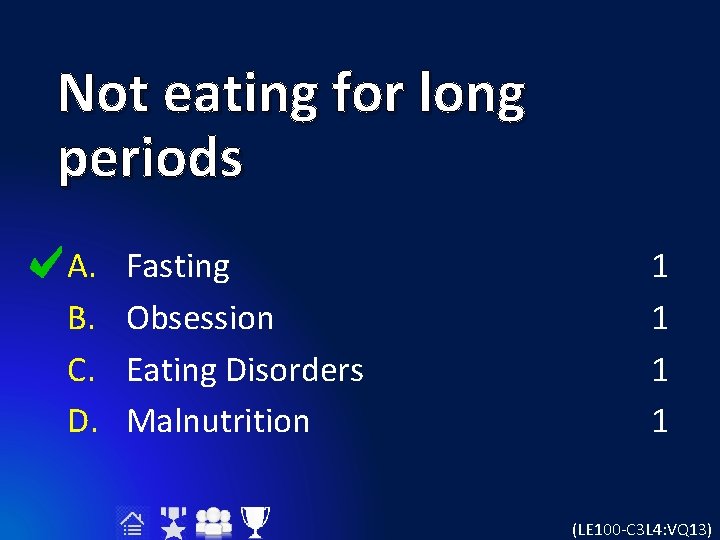
Not eating for long periods A. B. C. D. Fasting Obsession Eating Disorders Malnutrition 1 1 (LE 100 -C 3 L 4: VQ 13)
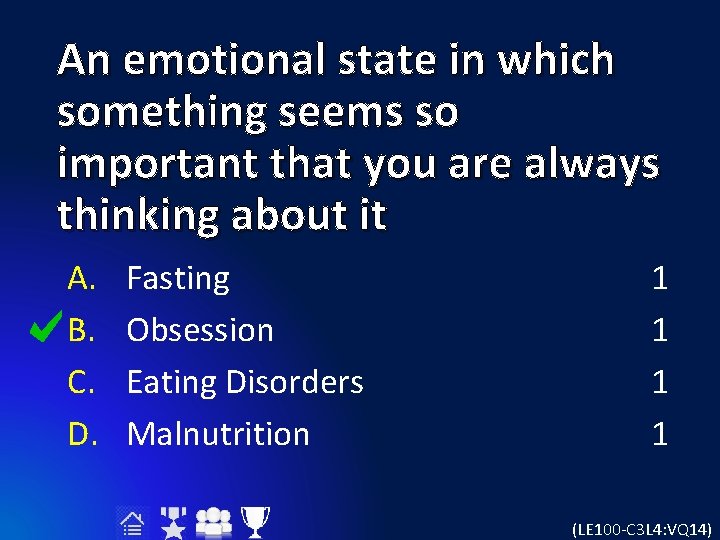
An emotional state in which something seems so important that you are always thinking about it A. B. C. D. Fasting Obsession Eating Disorders Malnutrition 1 1 (LE 100 -C 3 L 4: VQ 14)
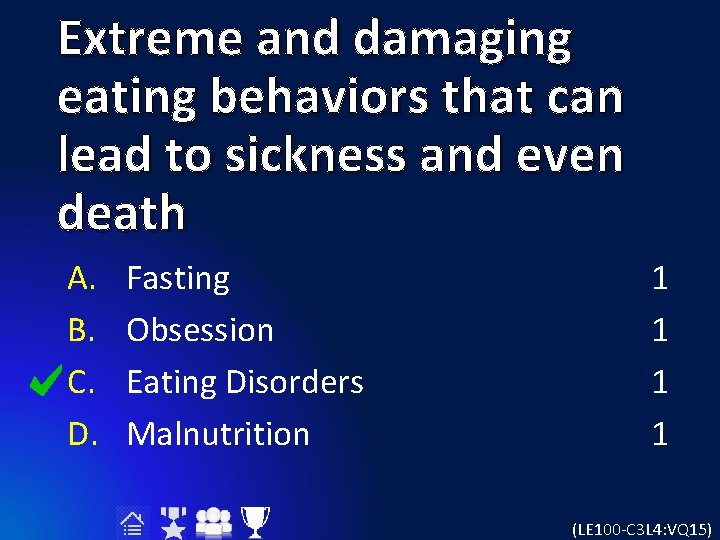
Extreme and damaging eating behaviors that can lead to sickness and even death A. B. C. D. Fasting Obsession Eating Disorders Malnutrition 1 1 (LE 100 -C 3 L 4: VQ 15)
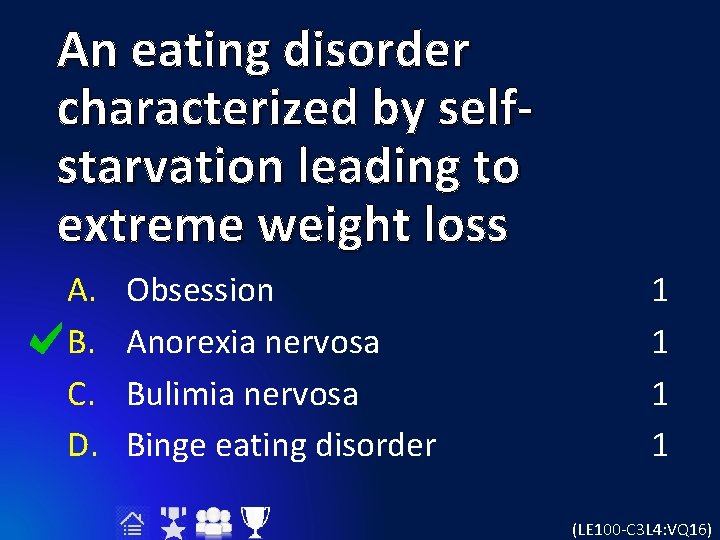
An eating disorder characterized by selfstarvation leading to extreme weight loss A. B. C. D. Obsession Anorexia nervosa Bulimia nervosa Binge eating disorder 1 1 (LE 100 -C 3 L 4: VQ 16)
A condition in which a person eats large amounts of food and then tries to purge A. B. C. D. Obsession Anorexia nervosa Bulimia nervosa Binge eating disorder 1 1 (LE 100 -C 3 L 4: VQ 17)
The rapid consumption of an excessive amount of food A. B. C. D. Obsession Anorexia nervosa Bulimia nervosa Binge eating disorder 1 1 (LE 100 -C 3 L 4: VQ 18)
- Slides: 54