
UNDERSTANDING WWII HIS 102 Online Grace Wade Moser
- Slides: 44
UNDERSTANDING WWII HIS 102 Online Grace Wade Moser
ANOTHER WORLD WAR People called WWI the “war to end all wars” but another more deadly war only a few decades later World War I Repeated? § § Involved military alliances again Fought either by or in most of the world’s major countries Axis Powers: Nazi Germany, Italy (until its defeat), and Japan Allied Powers: Great Britain and its Commonwealth (includes Canada, Australia, and other British colonies), France (until its defeat), and later the Soviet Union and the United States Basics of WWII § 2 Theaters of fighting: Europe and the Pacific § Fought from 1939 -1945 § Death in the millions—both soldiers and civilians Like WWI, its ending triggered another military conflict—The Cold War
UNDERSTANDING THE WAR AND AMERICAN INVOLVEMENT Causes of the War in Europe § The impact of the Versailles Treaty § Hitler’s Rise to Power Understanding the motivations of those involved § Both Japan and Germany The United States involvement after 1941 The origin of the Cold War out of WWII
ORIGIN OF WAR: THE VERSAILLES TREATY Germany identified as the main aggressor in WWI § High reparation payments § Crippled economic growth—no industry Japan, Italy, and Germany want to expand—restricted by Treaty § Willing to risk war to expand at same time Britain, France, and the US failed to intervene
UNDERSTANDING HITLER’S RISE TO POWER The Notorious H. I. T…ler § Bad reputation in history for obvious reasons § Today we have a hard time understanding how anyone could choose Hitler willingly as a leader To understand—have to look at the economic crisis in Germany in the 1920 s
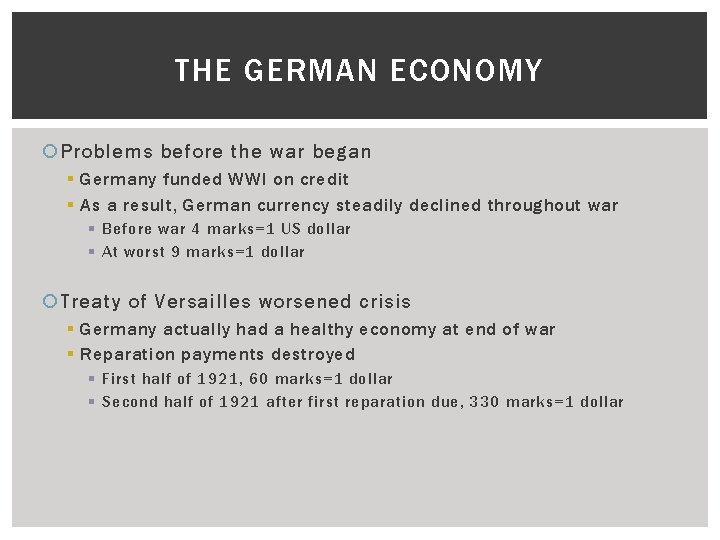
THE GERMAN ECONOMY Problems before the war began § Germany funded WWI on credit § As a result, German currency steadily declined throughout war § Before war 4 marks=1 US dollar § At worst 9 marks=1 dollar Treaty of Versailles worsened crisis § Germany actually had a healthy economy at end of war § Reparation payments destroyed § First half of 1921, 60 marks=1 dollar § Second half of 1921 after first reparation due, 330 marks=1 dollar
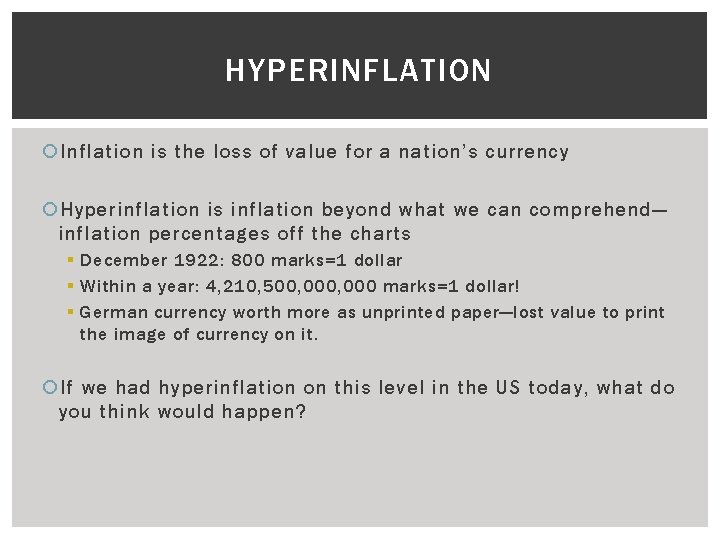
HYPERINFLATION Inflation is the loss of value for a nation’s currency Hyperinflation is inflation beyond what we can comprehend— inflation percentages off the charts § December 1922: 800 marks=1 dollar § Within a year: 4, 210, 500, 000 marks=1 dollar! § German currency worth more as unprinted paper—lost value to print the image of currency on it. If we had hyperinflation on this level in the US today, what do you think would happen?
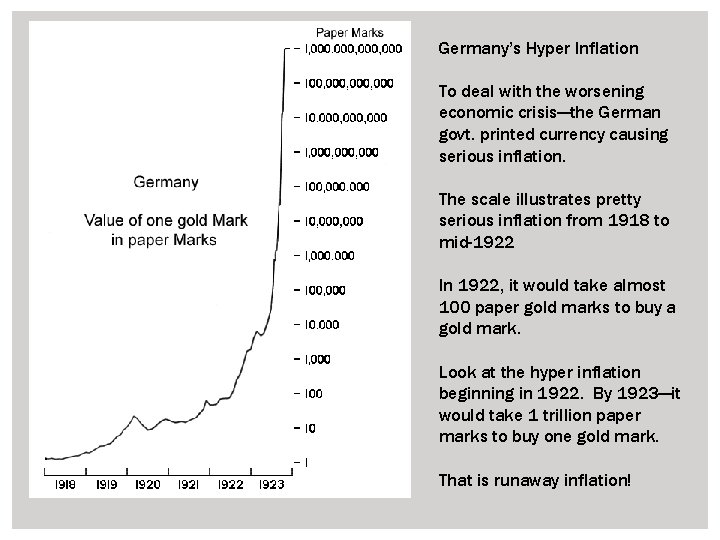
Germany’s Hyper Inflation To deal with the worsening economic crisis—the German govt. printed currency causing serious inflation. The scale illustrates pretty serious inflation from 1918 to mid-1922 In 1922, it would take almost 100 paper gold marks to buy a gold mark. Look at the hyper inflation beginning in 1922. By 1923—it would take 1 trillion paper marks to buy one gold mark. That is runaway inflation!
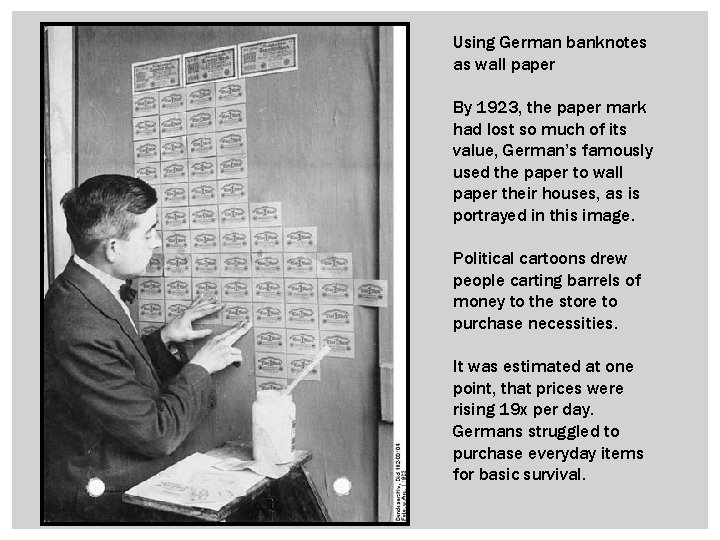
Using German banknotes as wall paper By 1923, the paper mark had lost so much of its value, German’s famously used the paper to wall paper their houses, as is portrayed in this image. Political cartoons drew people carting barrels of money to the store to purchase necessities. It was estimated at one point, that prices were rising 19 x per day. Germans struggled to purchase everyday items for basic survival.
YOU’D VOTE FOR HITLER TOO Hyperinflation=mass chaos in Germany Disillusioned with existing government § Government practices had actually worsened economic crisis § Purchased foreign money to fix inflation—ended up worsening the crisis Ordinary Germans began looking for people to represent them § Adolf Hitler and the Nationalist Socialist German Workers Party or the Nazi Party
THE RISE OF HITLER Austrian born German—believed in uniting people based on language A decorated WWI veteran—disillusioned with the reparation and punishment of Germany § Joined the German Worker’s Party in 1919 § There became associated with the idea that Jews were responsible for the problems of Germany § Eventually the Nationalist Socialist German Workers Party or the Nazi Party
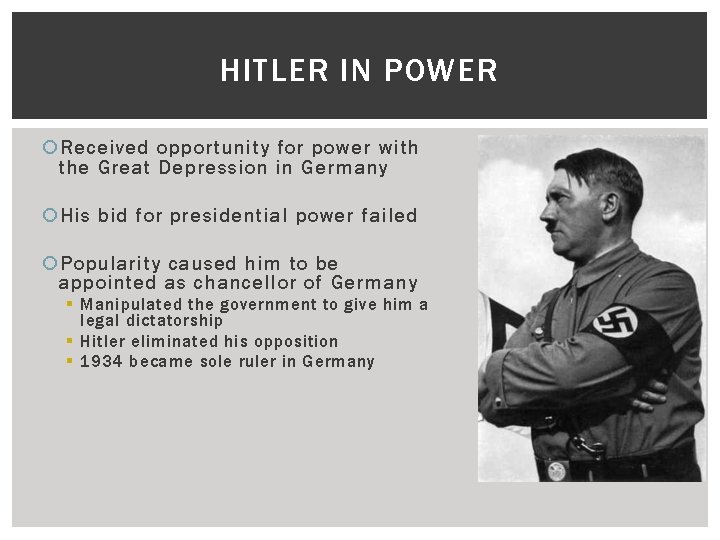
HITLER IN POWER Received opportunity for power with the Great Depression in Germany His bid for presidential power failed Popularity caused him to be appointed as chancellor of Germany § Manipulated the government to give him a legal dictatorship § Hitler eliminated his opposition § 1934 became sole ruler in Germany
THE ATTRACTION OF HITLER Promised to rebuild Germany to its former glory Massive reorganization of German industry—rebuilding industrial power from prior to WWI Germany withdrew from the League of Nations and began rearming—all violations of agreement after Treaty of Versailles § Britain, France and the US too anxious of triggering another war or too caught up in own affairs to intervene
DISCUSSING FASCISM Definition: a political philosophy, movement, or regime that exalts nation and often race above the individual and that stands for a centralized autocratic government headed by a dictatorial leader, severe economic and social regimentation and forcible suppression of opposition. German Fascism § National identity trumps individualism § German race, or Aryan race, is superior to all other races § Led to targeting of Jewish people
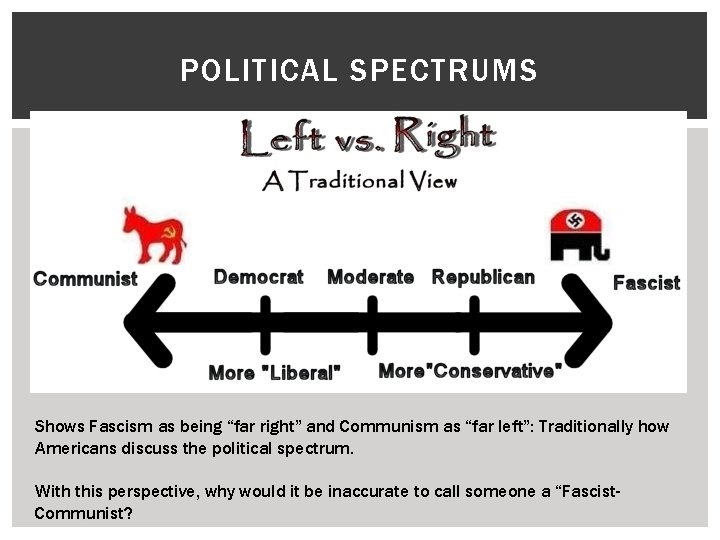
POLITICAL SPECTRUMS Shows Fascism as being “far right” and Communism as “far left”: Traditionally how Americans discuss the political spectrum. With this perspective, why would it be inaccurate to call someone a “Fascist. Communist?
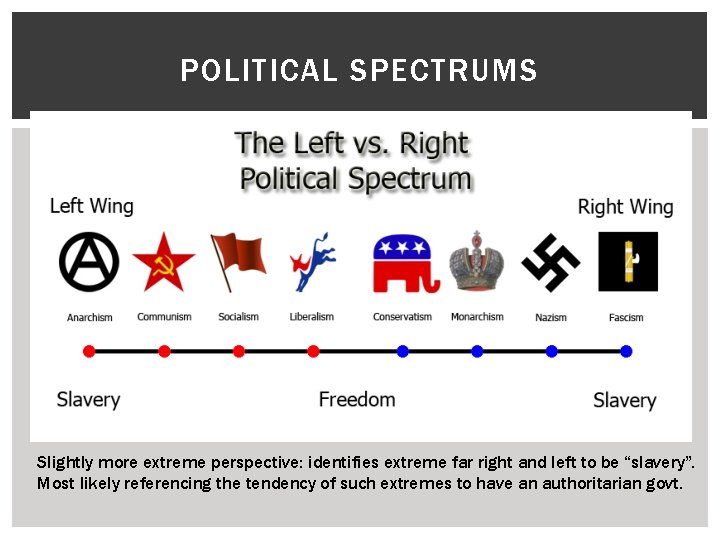
POLITICAL SPECTRUMS Slightly more extreme perspective: identifies extreme far right and left to be “slavery”. Most likely referencing the tendency of such extremes to have an authoritarian govt.
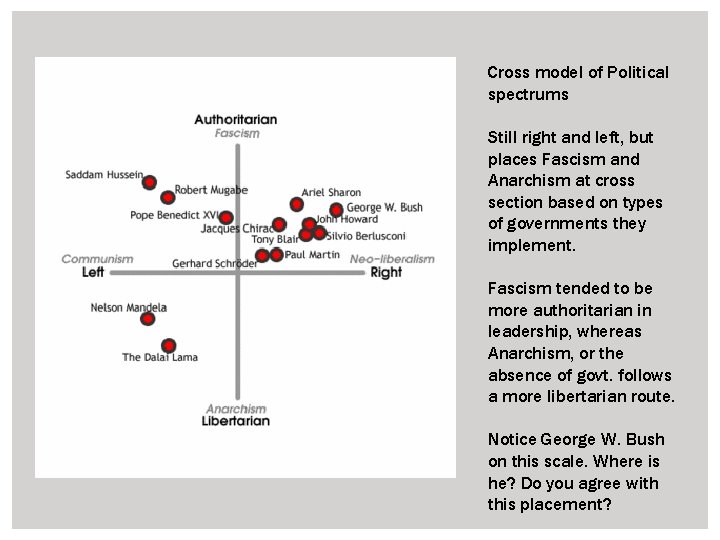
Cross model of Political spectrums Still right and left, but places Fascism and Anarchism at cross section based on types of governments they implement. Fascism tended to be more authoritarian in leadership, whereas Anarchism, or the absence of govt. follows a more libertarian route. Notice George W. Bush on this scale. Where is he? Do you agree with this placement?
UNDERSTANDING MOTIVATIONS What motivated Japan? § Japan’s attack of Pearl Harbor appears to come from no where to most Americans Understanding the US-Japanese relationship § History of imperialism—US relationship with Japan late 19 th century § Japan faced with a choice—adapt to western culture or be conquered § Chose to adapt Japan’s actions mirroring western imperialism
EARLY JAPANESE VIOLATIONS Recalled its diplomats from the League of Nations and began a rearming campaign similar to Germany’s § Began to look to China to regain lost territory from before the war Invasion of Manchuria § China under the control of leader Chiang Kai-Shek § Japan invaded in 1931—killing many Chinese in the process § The Kai-sheks would become allies with the Americans, but uneasy at best
AMERICAN INACTION Combatting isolationism § Americans hesitant to spend money overseas when the domestic crisis threatened to paralyze the nation. § Any similarities to today? FDR forced to be isolationist § Compromised by pursing economic recovery § A low-profile stance of disarmament § Free trade foreign policy Overall the US looked the other way when Japan and Germany violated the terms of the Versailles Treaty
MERCHANTS OF DEATH Growing idea in the United States—concept that American businessmen had manipulated US involvement in WWI for the purpose of making money Coined by Sen. Gerald Nye § Called American businessmen “merchants of death”—bankers, weapons manufacturers, and financiers § Fear growing European conflict would repeat merchant of death motivation for war Effects § Congress passed a series of neutrality acts between 1935 and 1937 prohibiting loans or selling arms to nations at war § Tied FDR’s hands in intervening
THE CASH AND CARRY PLAN By 1937, many Americans wanted an embargo on all trade with warring nations—but FDR concerned for American trade § Would potentially deepen the depression The Neutrality Act of 1937—maintained peace but still allowed foreign trade and helped out former allies Cash and Carry Plan—brainchild of FDR § Allowed warring nations to access non-military goods, but forced to pay cash and transport them in their own ships
MORE PROBLEMS IN EUROPE More German, Japanese, and Italian violations § Germany invaded the Rhineland in 1936 without opposition § Italy added Ethiopia to its Fascist regime § Japan captured the Nanking Province § The “Rape of Nanking” § resulted in the deaths of 200 k Chinese civilians Spanish Civil War—Fascist takeover § Franco supported by both Italy and Germany with soldiers, weapons, and aircraft § Loyalists supported by the Soviet Union and individual Americans, but not enough—defeated 1939
APPEASEMENT Hitler began his conquest of Europe shortly after taking the Rhineland § Austria in 1938 § Wanted the Sudetenland British and French policy of Appeasement § Proposed by British Prime Minister Neville Chamberlain § Give the Sudetenland to Hitler, but he has to promise to leave the rest of Czechoslovakia alone § Hitler accepted but never planned to obey—took Czechoslovakia March 1939, invaded without firing a shot § Moved on to Poland—April 1939; Britain and France promised to go to war if Poland were invaded
UNDERSTANDING APPEASEMENT Negative Reinforcement § Idea in child psychology—rewarding bad behavior reinforces the likelihood that behavior will be repeated § Candy Bar example § Your kid is throwing a tantrum in the grocery store § Giving him a candy bar will make him stop, but it will also teach him throwing a tantrum gets him a candy bar § You are teaching negative behavior Appeasement gave Hitler the candy bar—the Sudetenland—but assured him his negative behavior would be rewarded Created war rather than avoiding it PM Neville Chamberlain blamed for failure, would be replaced by Winston Churchill
BLITZKRIEG September I, 1939 “lightning war” on Poland—joined by the Soviets § Nazi-Soviet Treaty—negotiated between Stalin and Hitler for nonaggression § Opened up Poland for German conquest with Soviet help § Once Poland attacked—Britain and France declare war on Germany April and May 1940 § Hitler took Denmark, Norway, the Netherlands, Belgium, Luxembourg and France § The Maginot Line in France had failed § After France Hitler poised to attack Britain
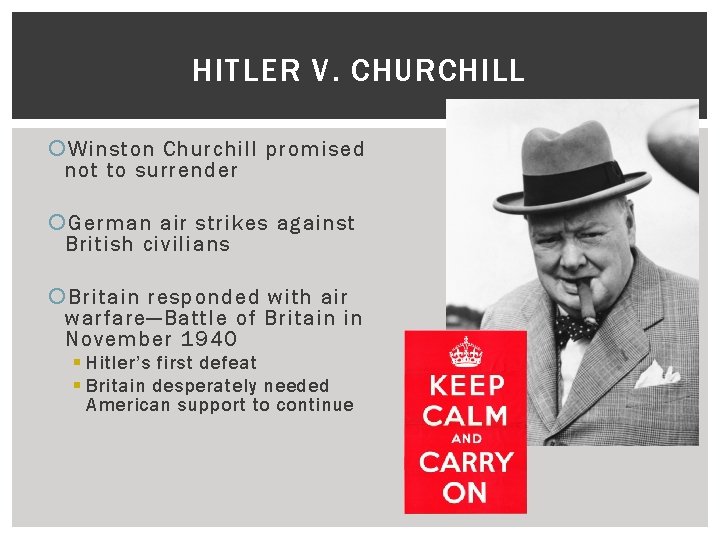
HITLER V. CHURCHILL Winston Churchill promised not to surrender German air strikes against British civilians Britain responded with air warfare—Battle of Britain in November 1940 § Hitler’s first defeat § Britain desperately needed American support to continue
AMERICAN NEUTRALITY ENDS 1937 Neutrality Act had banned the sale of weapons to warring nations § Americans still reluctant to relax the embargo § Relaxed some with Cash-and-carry plan, but FDR wanted a better solution FDR ran for a 3 r d term in 1940—campaigning for helping Britain § Wendell Wilkie called him a warmonger § But FDR easily won January 1941 brought the Lend-Lease Act § Allowed Britain to obtain arms § Congress passed in March 1941 --$50 billion sent to Britain through the course of the war (More than all the New Deal combined)
SOVIET UNION AND BRITAIN AS ALLIES Hitler invaded Soviet Union in 1941, despite alliance and treaty of 1939 § Pushed the Soviet Union into an alliance with the US § FDR extended the Lend-Lease Act to the Soviets The Atlantic Charter § Signed by Churchill and FDR § Committed the 2 countries to freedom of the seas and freedom of trade as well as the right of self-determination § Pledged the US and Britain as allies
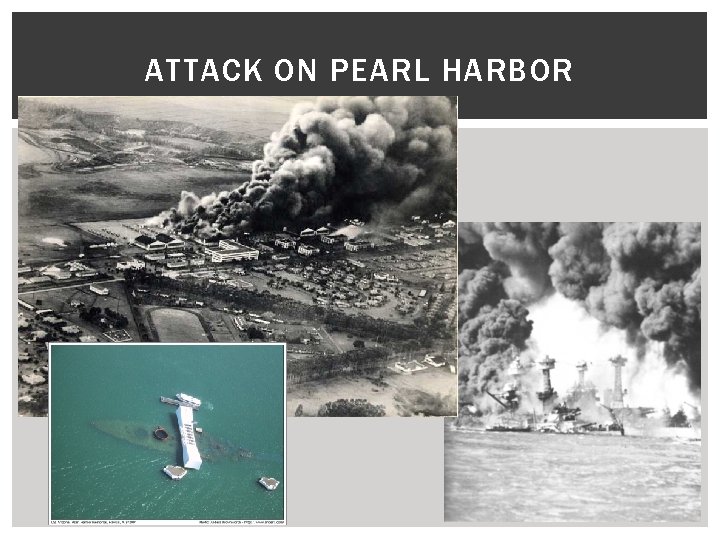
ATTACK ON PEARL HARBOR Japanese motivations for the attack § Japan viewed US as biggest block to imperialism § 1940—Japan had entered an alliance with Germany and Italy, the Tripartite Pact § US had passed embargo on Japan December 7, 1941— “The day that will live in infamy” § 183 Japanese attack aircraft attacked the Pacific fleet at Pearl Harbor on Oahu § Sank or disabled 18 ships, including all of the fleets battleships § Killed more than 2400 Americans; wounded more than 1 k § Almost crippled the US ability to wage war in the Pacific § Incited the Americans to join WWII § Dec 8, Congress endorsed a call to declare war § Dec 11, Germany and Italy declared war on the US
ATTACK ON PEARL HARBOR
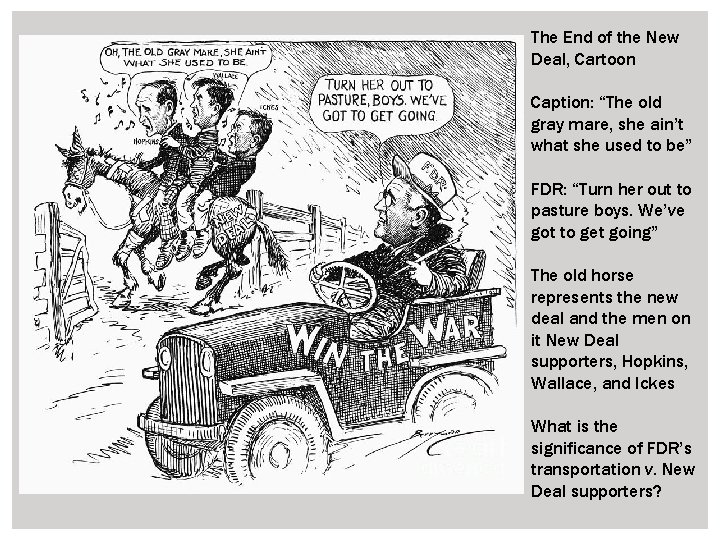
THE NEW DEAL ENDS American entrance into the war meant end of New Deal § FDR rerouted funding from programs into war effort § Alienated Eleanor for abandonment—truly committed to the New Deal The Economy Recovers § § Ironically, the Great Depression ends Demand for workers to produce war materials New opportunities for women and African Americans Labor protections and highest participation in unions Most gains for unions, African Americans, and women would not be kept once war over
The End of the New Deal, Cartoon Caption: “The old gray mare, she ain’t what she used to be” FDR: “Turn her out to pasture boys. We’ve got to get going” The old horse represents the new deal and the men on it New Deal supporters, Hopkins, Wallace, and Ickes What is the significance of FDR’s transportation v. New Deal supporters?
AMERICANS IN THE WAR By 1943, Soviets had defeated Hitler’s advance on Stalingrad, turning the tide of the war in Europe § 18 months and 95% death rate of Russian soldiers § But Hitler forced back—and focus now on getting Germany out of Eastern and Western Europe § US had plan to work on France but postponed for more than a year after Stalingrad § In Pacific—US working island by island to remove Japanese Allied forces at work in North Africa and Italy—American and British pilots flying bombing missions on Germany from Britain § 85 k American pilots killed in skies over Europe—many other shot down and kept as POWs
D-DAY November 1943—Churchill, FDR, and Stalin met to discuss wartime strategy § Stalin agreed to enter the war against Japan once Germany surrendered § Roosevelt conceded to Stalin that the USSR would exercise de facto control of the eastern European countries that the Red Army occupied in its advance on Hitler § Roosevelt and Churchill promised to launch a massive second-front assault in France; scheduled to begin May 1944 Operation Overlord § Largest amphibious assault in world history on D Day, June 6, 1944 § Allied soldiers finally succeeded in securing the beachhead at Normandy and set into the extremely well-defended hills surrounding, gaining a foothold in France § On August 25—Allies liberated Paris
TURNING POINTS December 16, 1944 to January 31, 1945—Hitler drove 55 miles into Allies lines before being stopped § 70 k Allied soldiers killed, including more Americans than any other war § Nazis lost more than 100 k men and hundreds of tanks—fatal blow to Hitler’s reserves Feb 1945—allied forces relentlessly pushed German forces backward Yalta Conference--secret conference in Russia between Churchill, Stalin, and Roosevelt § Discuss postwar world—FDR got Stalin to agree to self-determination of Eastern Europe § Allies pledged support to Chiang Kai-Shek in China § Also agreed on the formation of the United Nations § But FDR noticeable ill—would die April 12, 1945
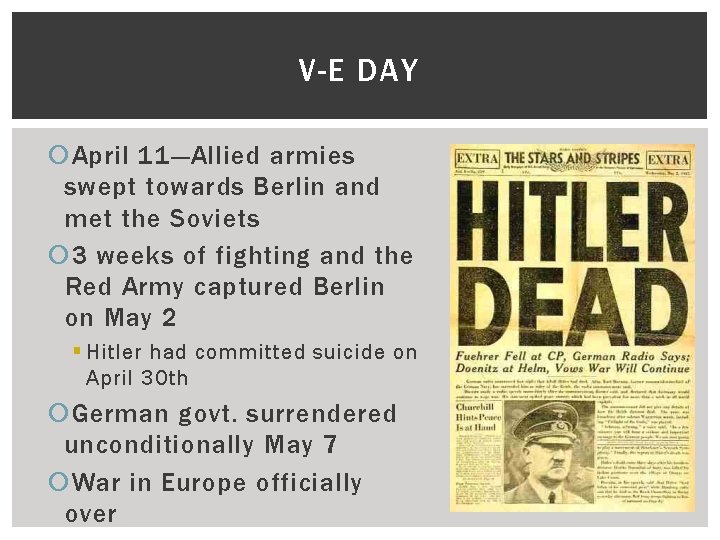
V-E DAY April 11—Allied armies swept towards Berlin and met the Soviets 3 weeks of fighting and the Red Army captured Berlin on May 2 § Hitler had committed suicide on April 30 th German govt. surrendered unconditionally May 7 War in Europe officially over
VICTORY IN JAPAN Island hopping campaign began in August 1942 § 6 month campaign for a strategic area § faced high death totals Influenced the decision of Truman to use the Atomic bomb as a weapon — § to prevent future deaths of both Americans and Japanese § Was this decision justified?
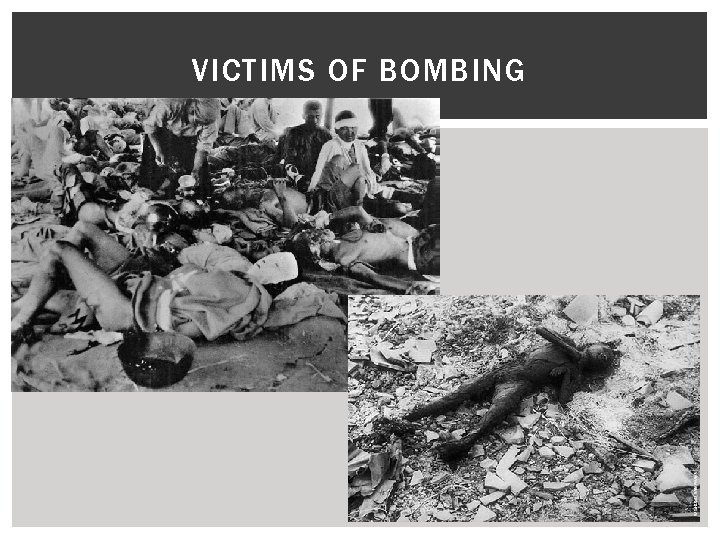
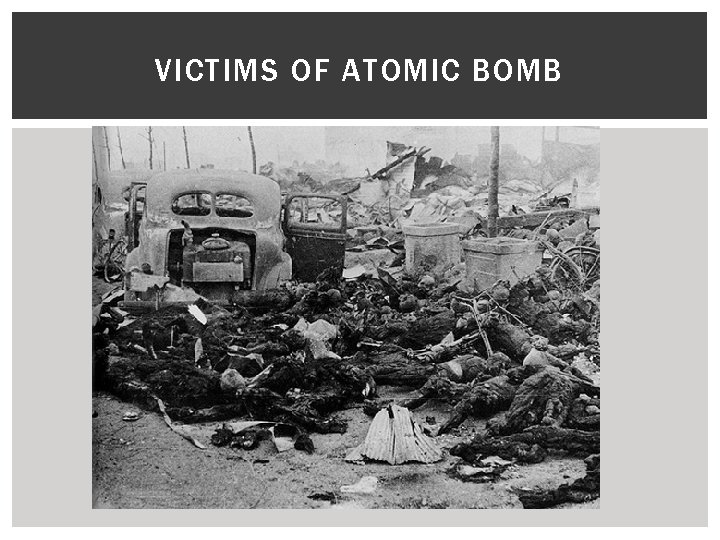
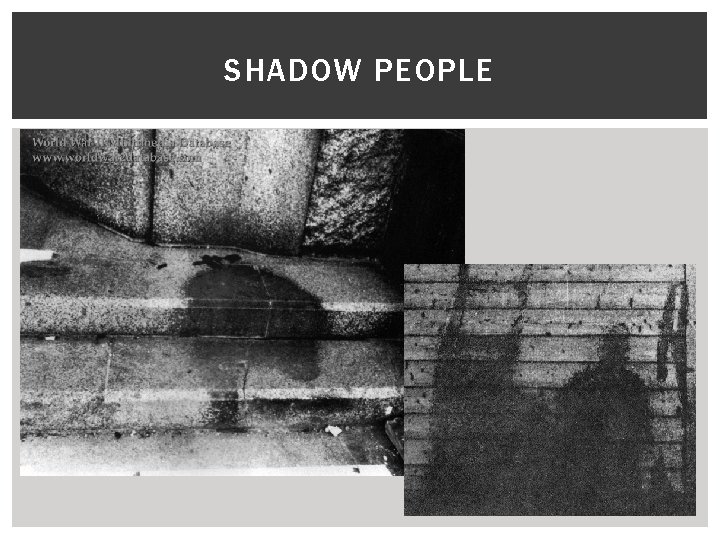
THE ATOMIC BOMB Manhattan Project—secret government project to create a super-bomb § Japan’s strength § 6 million reserves § 5 k kamikaze aircraft § Estimated American loss of life over 250 k § Truman made the decision to use atomic bomb against civilians § § § August 6 t h bomb dropped over Hiroshima August 9 t h bomb dropped on Nagasaki 78 k dead at Hiroshima 100 k dead at Nagasaki August 14 t h Japan surrendered unconditionally onboard a US battleship— the USS Missouri
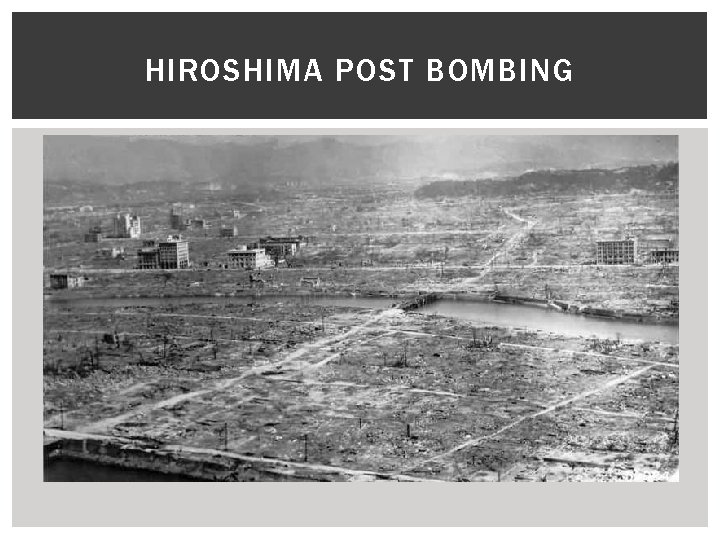
HIROSHIMA POST BOMBING
VICTIMS OF BOMBING
VICTIMS OF ATOMIC BOMB
SHADOW PEOPLE
IMPACT ON THE UNITED STATES Ended the Great Depression Stimulated unprecedented economic growth § US economy booming during and after war § No competition world wide Set the US up as a world power § US and Soviet Union emerged 2 most powerful nations § Ultimately lead to conflict Triggered the circumstances of the Cold War