
Understanding Variation Six Sigma Foundations Continuous Improvement Training

- Slides: 54
Understanding Variation Six Sigma Foundations Continuous Improvement Training Six Sigma Simplicity
Key Learning Points Variation in the data represents the voice of the process s Know the two types of variation – common cause and special cause – and the implication of the different causes s Use appropriate tools to study variation in discrete and continuous situations s Know how to use and interpret run charts and control charts and to take appropriate action based on the charts s
Variation All processes have variation All repetitive activities of a process have a certain amount of variation s Input, process, and output measures will fluctuate s This fluctuation is called variation s Variation is the voice of the process s
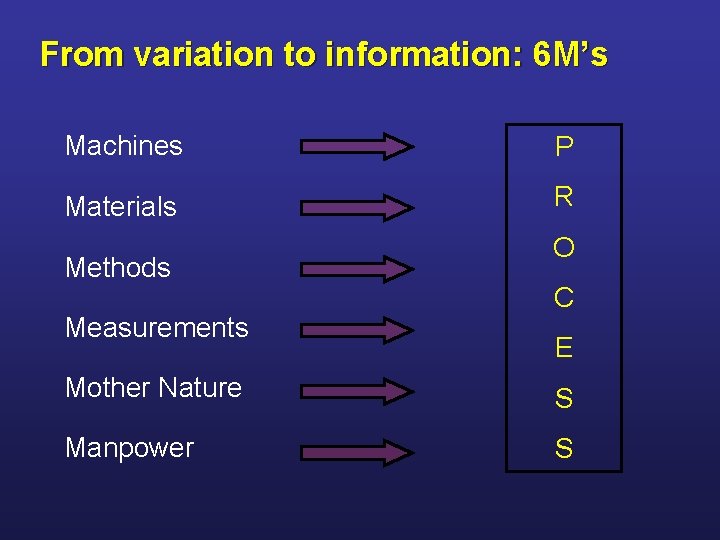
From variation to information: 6 M’s Machines P Materials R Methods Measurements O C E Mother Nature S Manpower S
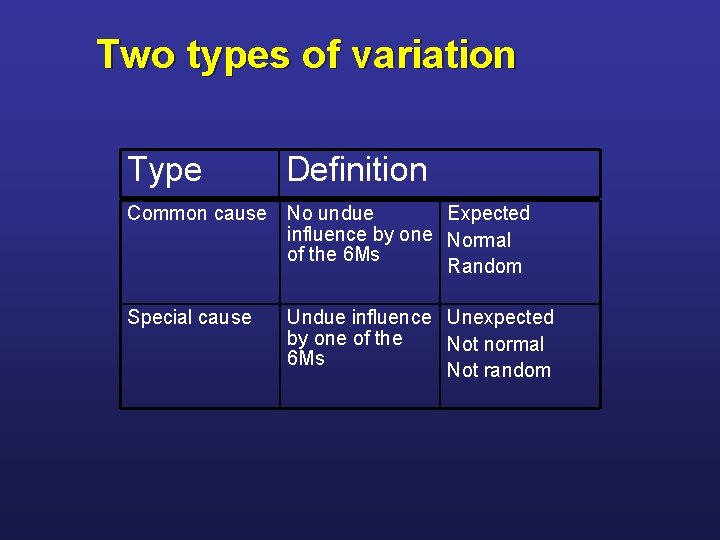
Two types of variation Type Definition Common cause No undue Expected influence by one Normal of the 6 Ms Random Special cause Undue influence Unexpected by one of the Not normal 6 Ms Not random
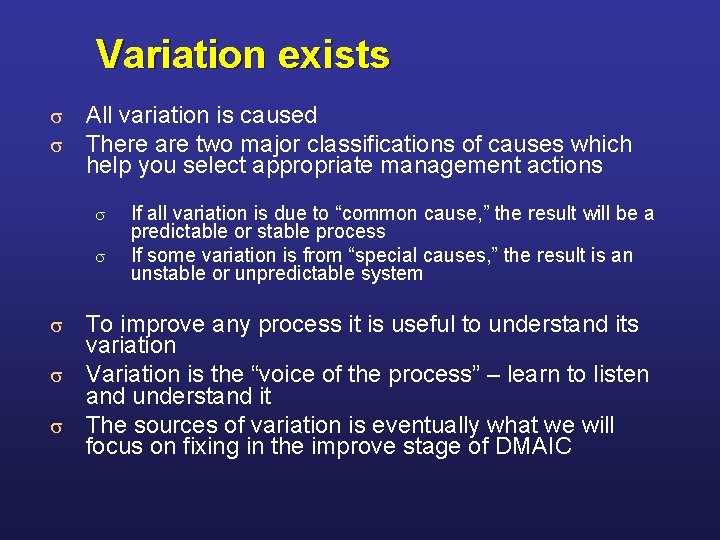
Variation exists s s All variation is caused There are two major classifications of causes which help you select appropriate management actions s s If all variation is due to “common cause, ” the result will be a predictable or stable process If some variation is from “special causes, ” the result is an unstable or unpredictable system To improve any process it is useful to understand its variation Variation is the “voice of the process” – learn to listen and understand it The sources of variation is eventually what we will focus on fixing in the improve stage of DMAIC
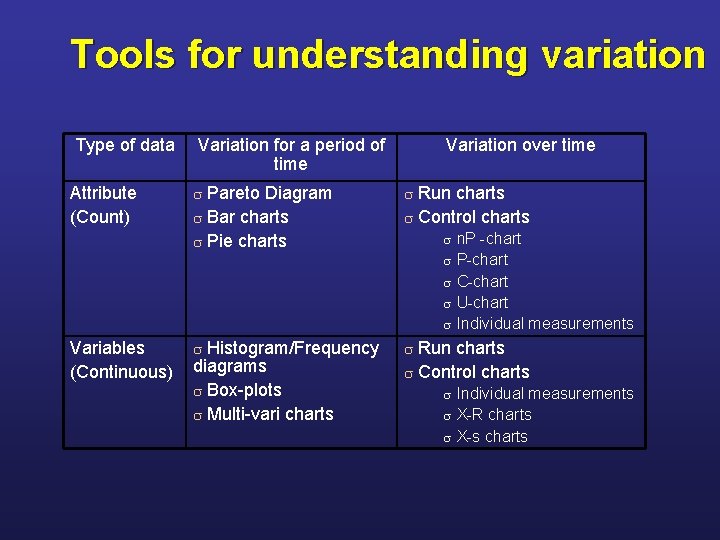
Tools for understanding variation Type of data Attribute (Count) Variables (Continuous) Variation for a period of time Variation over time Pareto Diagram s Bar charts s Pie charts s Histogram/Frequency diagrams s Box-plots s Multi-vari charts s Run charts s Control charts n. P -chart s P-chart s C-chart s U-chart s Individual measurements s Run charts s Control charts Individual measurements s X-R charts s X-s charts s
Control Charts “The use of control charts should start with management, not on the shop floor. ” -W. Edwards Deming “Management takes a major step forward when they stop asking you to explain random variation. ” -F. Timothy Fuller
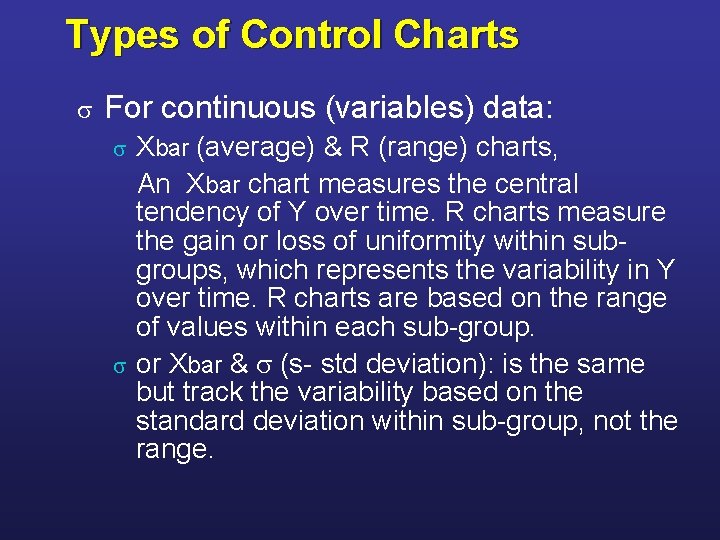
Types of Control Charts s For continuous (variables) data: Xbar (average) & R (range) charts, An Xbar chart measures the central tendency of Y over time. R charts measure the gain or loss of uniformity within subgroups, which represents the variability in Y over time. R charts are based on the range of values within each sub-group. s or Xbar & s (s- std deviation): is the same but track the variability based on the standard deviation within sub-group, not the range. s
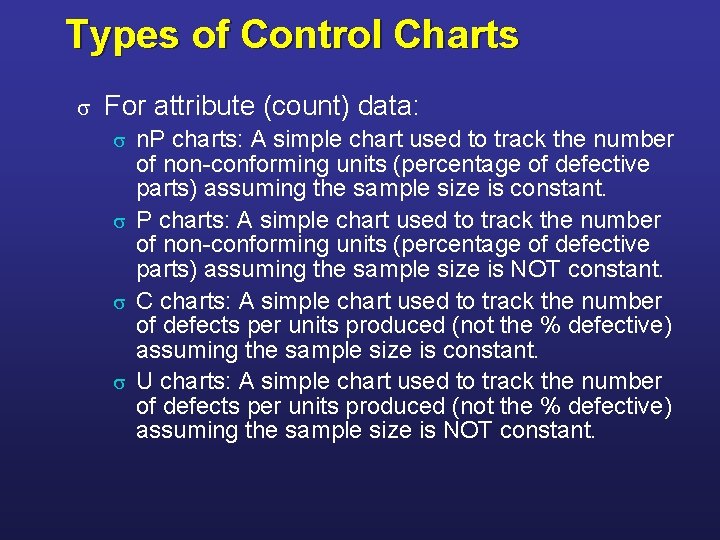
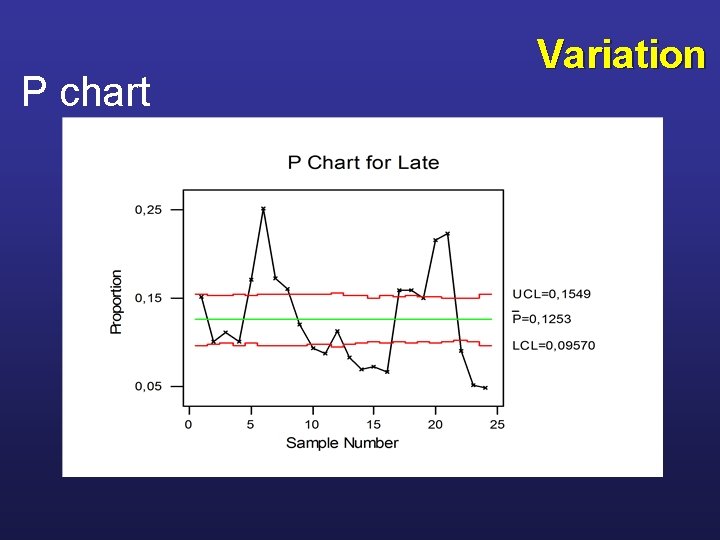
Types of Control Charts s For attribute (count) data: n. P charts: A simple chart used to track the number of non-conforming units (percentage of defective parts) assuming the sample size is constant. s P charts: A simple chart used to track the number of non-conforming units (percentage of defective parts) assuming the sample size is NOT constant. s C charts: A simple chart used to track the number of defects per units produced (not the % defective) assuming the sample size is constant. s U charts: A simple chart used to track the number of defects per units produced (not the % defective) assuming the sample size is NOT constant. s
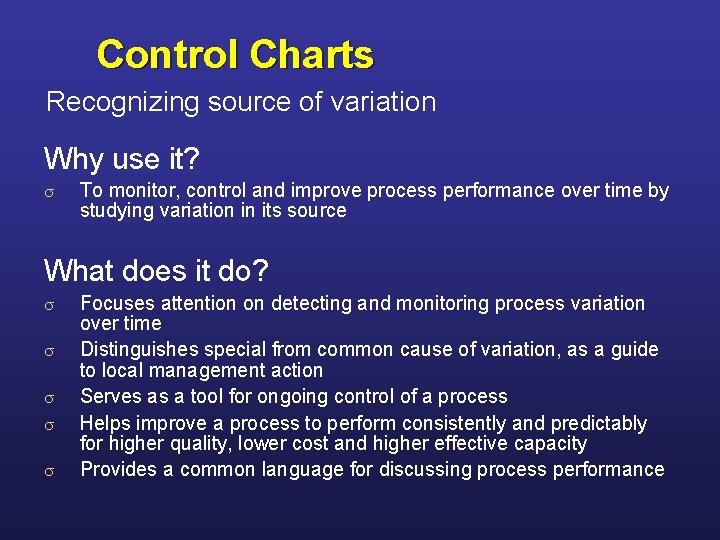
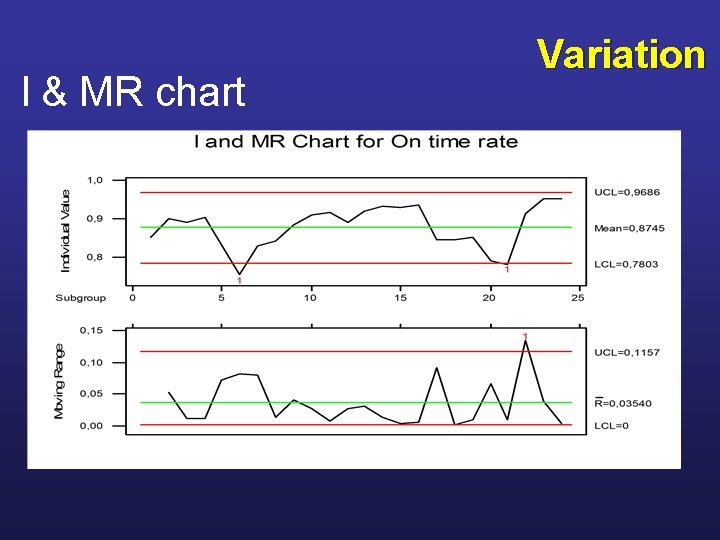
Control Charts Recognizing source of variation Why use it? s To monitor, control and improve process performance over time by studying variation in its source What does it do? s s s Focuses attention on detecting and monitoring process variation over time Distinguishes special from common cause of variation, as a guide to local management action Serves as a tool for ongoing control of a process Helps improve a process to perform consistently and predictably for higher quality, lower cost and higher effective capacity Provides a common language for discussing process performance
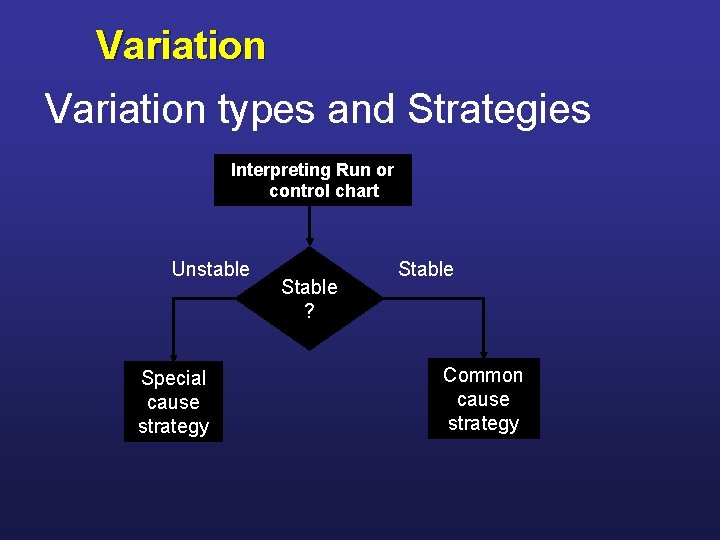
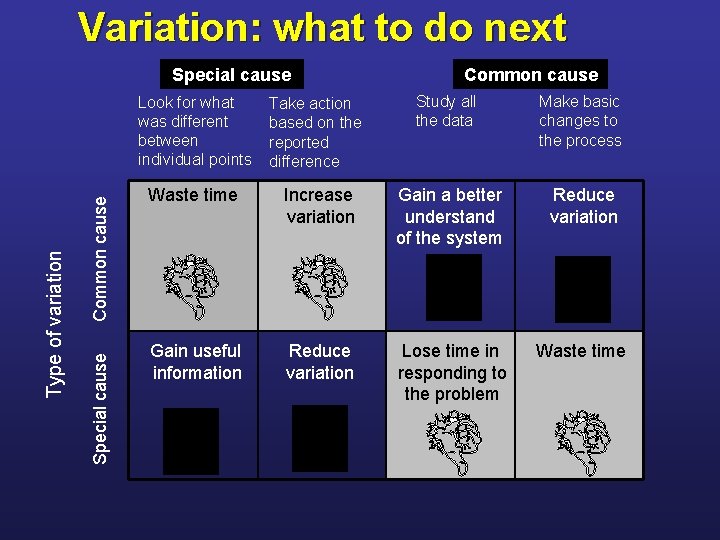
Variation types and Strategies Interpreting Run or control chart Unstable Special cause strategy Stable ? Stable Common cause strategy
Variation: what to do next Common cause Special cause Type of variation Special cause Common cause Look for what was different between individual points Take action based on the reported difference Study all the data Make basic changes to the process Waste time Increase variation Gain a better understand of the system Reduce variation Gain useful information Reduce variation Lose time in responding to the problem Waste time
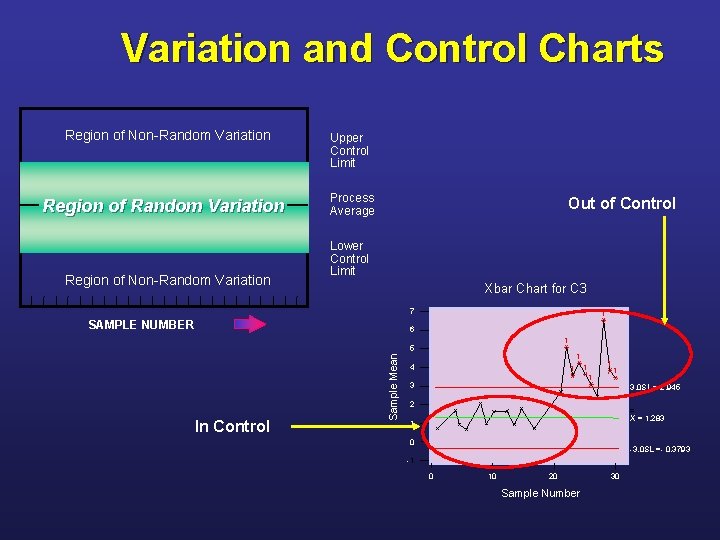
Variation and Control Charts Region of Non-Random Variation Upper Control Limit Process Average Out of Control Lower Control Limit Xbar Chart for C 3 7 SAMPLE NUMBER 1 In Control Sample Mean 6 1 5 1 4 1 1 3 1 3. 0 SL = 2. 945 2 X = 1. 283 1 0 -3. 0 SL =- 0. 3793 -1 0 10 20 Sample Number 30
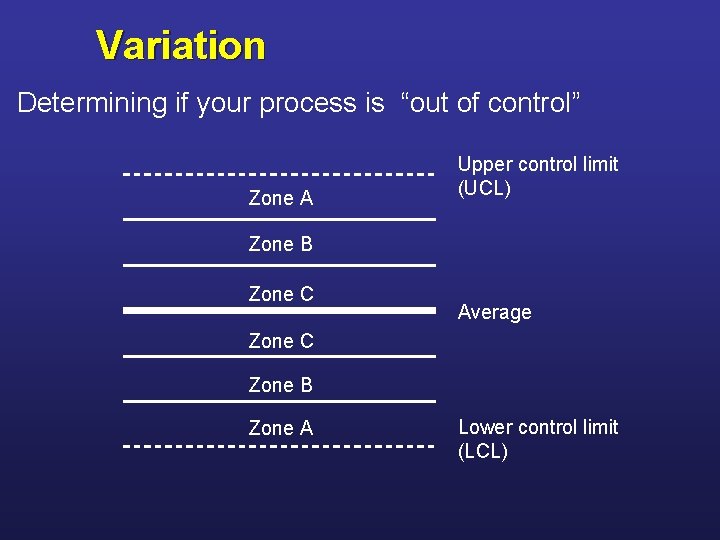
Variation Determining if your process is “out of control” Zone A Upper control limit (UCL) Zone B Zone C Average Zone C Zone B Zone A Lower control limit (LCL)
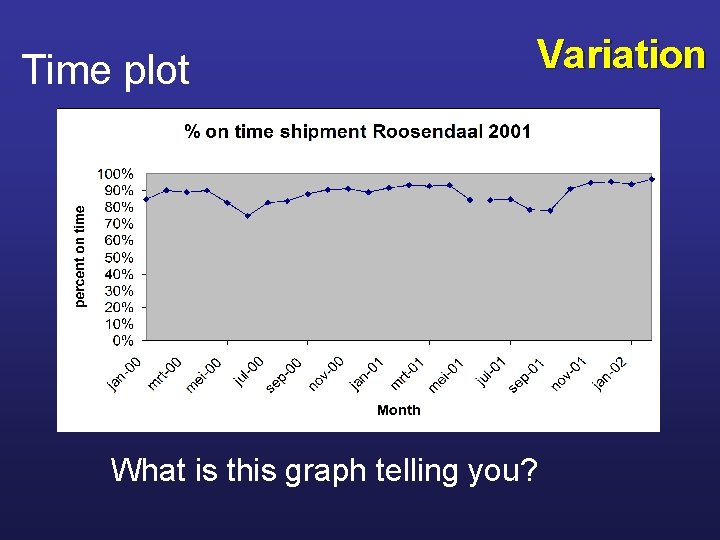
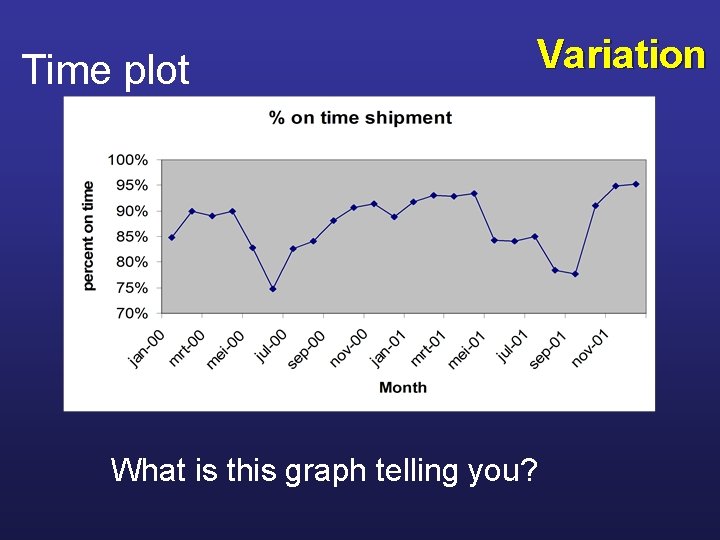
Time plot Variation What is this graph telling you?
Time plot Variation What is this graph telling you?
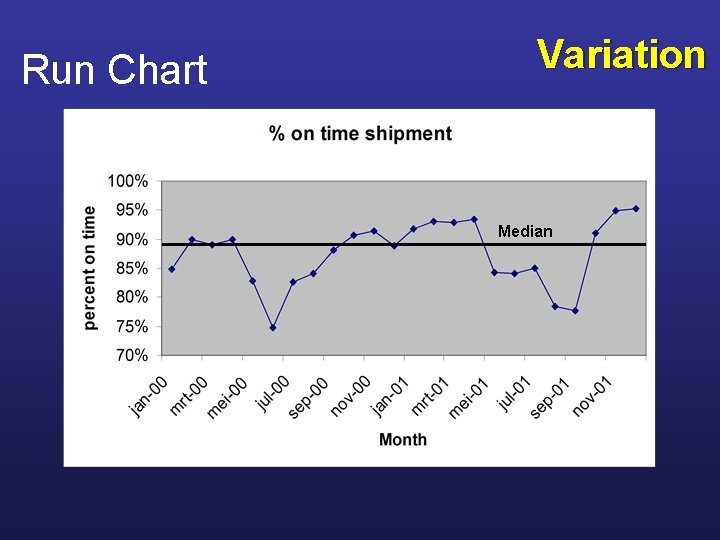
Run Chart Variation Median
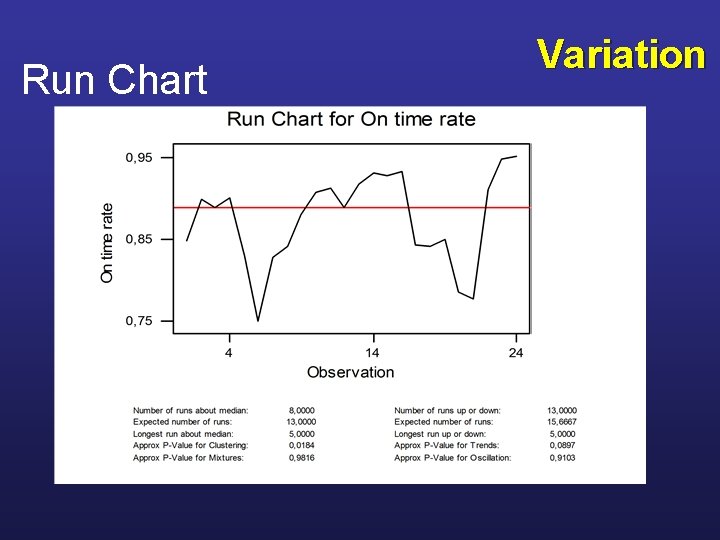
Run Chart Variation
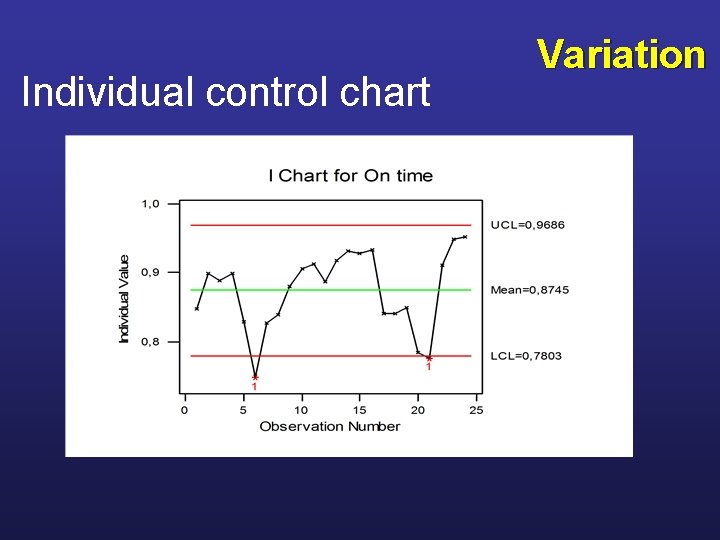
Individual control chart Variation
l & MR chart Variation
P chart Variation
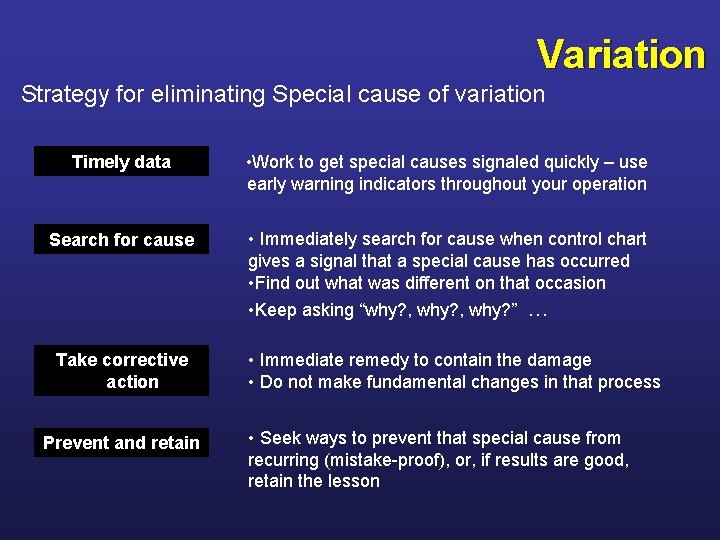
Variation Strategy for eliminating Special cause of variation Timely data • Work to get special causes signaled quickly – use early warning indicators throughout your operation Search for cause • Immediately search for cause when control chart gives a signal that a special cause has occurred • Find out what was different on that occasion • Keep asking “why? , why? ” … Take corrective action Prevent and retain • Immediate remedy to contain the damage • Do not make fundamental changes in that process • Seek ways to prevent that special cause from recurring (mistake-proof), or, if results are good, retain the lesson
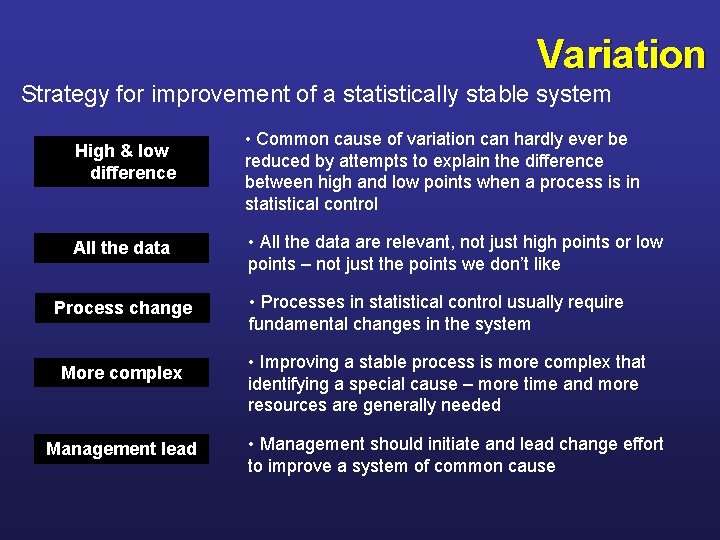
Variation Strategy for improvement of a statistically stable system High & low difference All the data Process change More complex Management lead • Common cause of variation can hardly ever be reduced by attempts to explain the difference between high and low points when a process is in statistical control • All the data are relevant, not just high points or low points – not just the points we don’t like • Processes in statistical control usually require fundamental changes in the system • Improving a stable process is more complex that identifying a special cause – more time and more resources are generally needed • Management should initiate and lead change effort to improve a system of common cause
Case Study 1 “Status Change” Requests
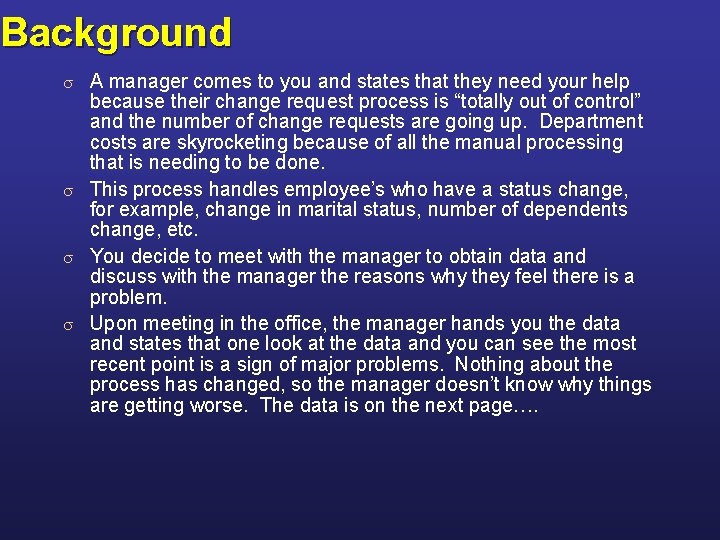
Background A manager comes to you and states that they need your help because their change request process is “totally out of control” and the number of change requests are going up. Department costs are skyrocketing because of all the manual processing that is needing to be done. s This process handles employee’s who have a status change, for example, change in marital status, number of dependents change, etc. s You decide to meet with the manager to obtain data and discuss with the manager the reasons why they feel there is a problem. s Upon meeting in the office, the manager hands you the data and states that one look at the data and you can see the most recent point is a sign of major problems. Nothing about the process has changed, so the manager doesn’t know why things are getting worse. The data is on the next page…. s
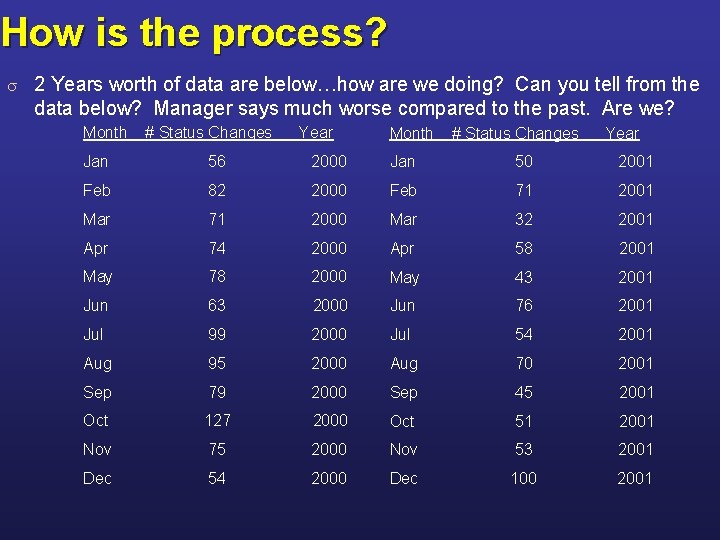
How is the process? s 2 Years worth of data are below…how are we doing? Can you tell from the data below? Manager says much worse compared to the past. Are we? Month # Status Changes Year Jan 56 2000 Jan 50 2001 Feb 82 2000 Feb 71 2001 Mar 71 2000 Mar 32 2001 Apr 74 2000 Apr 58 2001 May 78 2000 May 43 2001 Jun 63 2000 Jun 76 2001 Jul 99 2000 Jul 54 2001 Aug 95 2000 Aug 70 2001 Sep 79 2000 Sep 45 2001 Oct 127 2000 Oct 51 2001 Nov 75 2000 Nov 53 2001 Dec 54 2000 Dec 100 2001
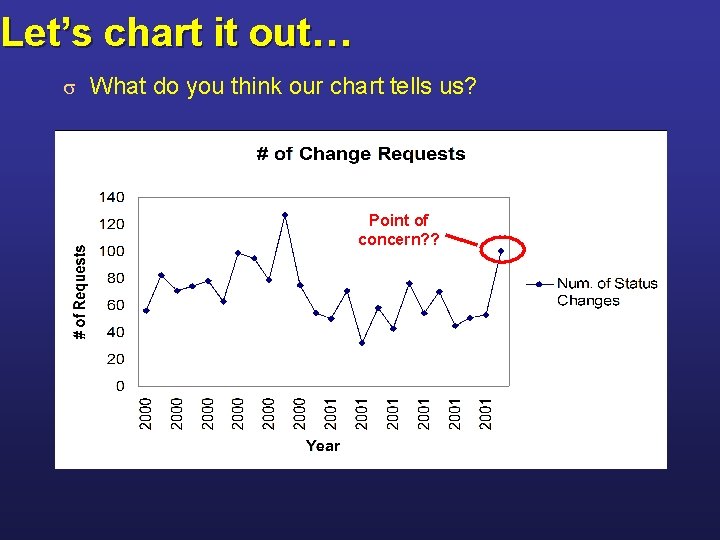
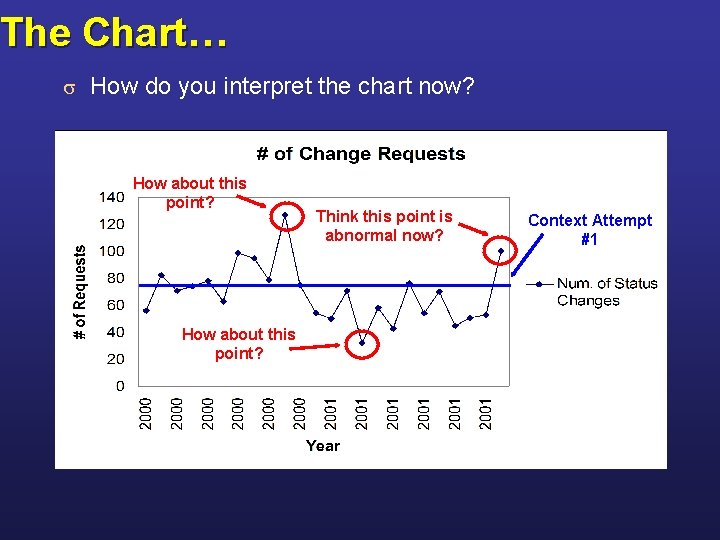
Let’s chart it out… s What do you think our chart tells us? Point of concern? ?
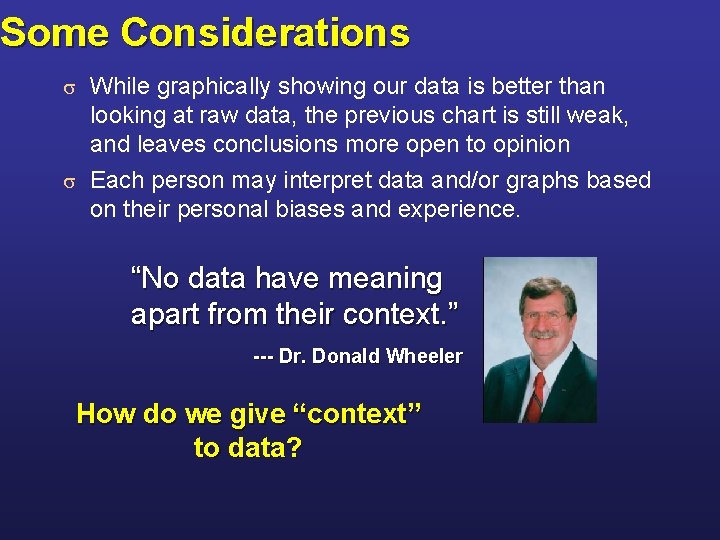
Some Considerations While graphically showing our data is better than looking at raw data, the previous chart is still weak, and leaves conclusions more open to opinion s Each person may interpret data and/or graphs based on their personal biases and experience. s “No data have meaning apart from their context. ” --- Dr. Donald Wheeler How do we give “context” to data?
The Chart… s How do you interpret the chart now? How about this point? Think this point is abnormal now? Context Attempt #1
What can we do? Statistical Process Control (SPC) is a way of bringing out the “context” of the data. s Statistical Process Control charts have also been called Process Behavior Charts. s Process Behavior Charts utilize all the data to develop historical “context” to allow evaluation within context rather than single point comparison to another point. s This “context” is more than comparing differences between one point and another, rather, it takes into consideration the variation of the data in the process under investigation. s Let’s find out what we can see when statistics are applied:
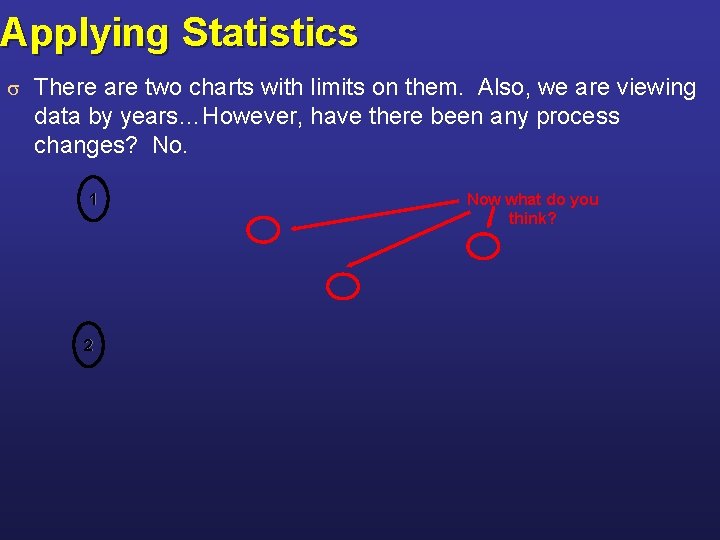
Applying Statistics s There are two charts with limits on them. Also, we are viewing data by years…However, have there been any process changes? No. 1 2 Now what do you think?
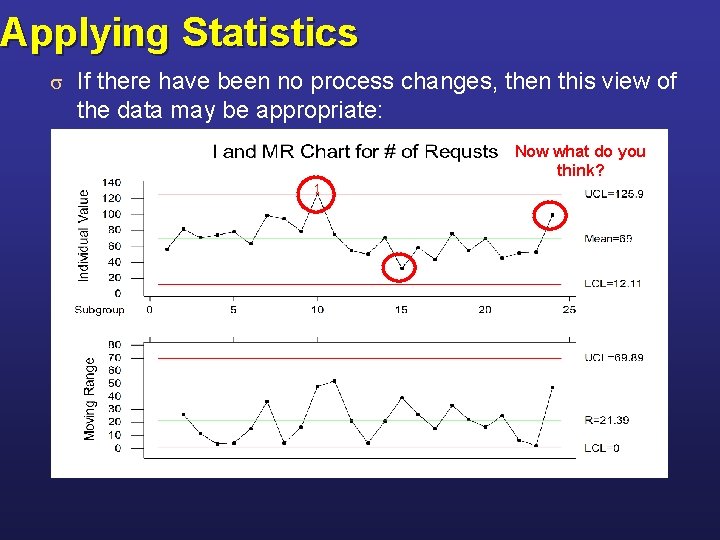
Applying Statistics s If there have been no process changes, then this view of the data may be appropriate: Now what do you think?
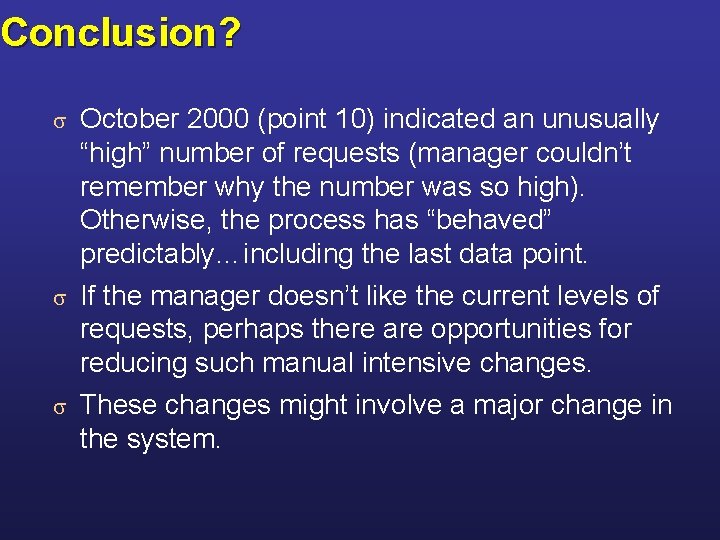
Conclusion? October 2000 (point 10) indicated an unusually “high” number of requests (manager couldn’t remember why the number was so high). Otherwise, the process has “behaved” predictably…including the last data point. s If the manager doesn’t like the current levels of requests, perhaps there are opportunities for reducing such manual intensive changes. s These changes might involve a major change in the system. s
“Managing a company by means of the monthly report is like trying to drive a car by watching the yellow line in the rear-view mirror. ” Dr. Myron Tribus
Case Study 2 Percentage On-Time Delivery
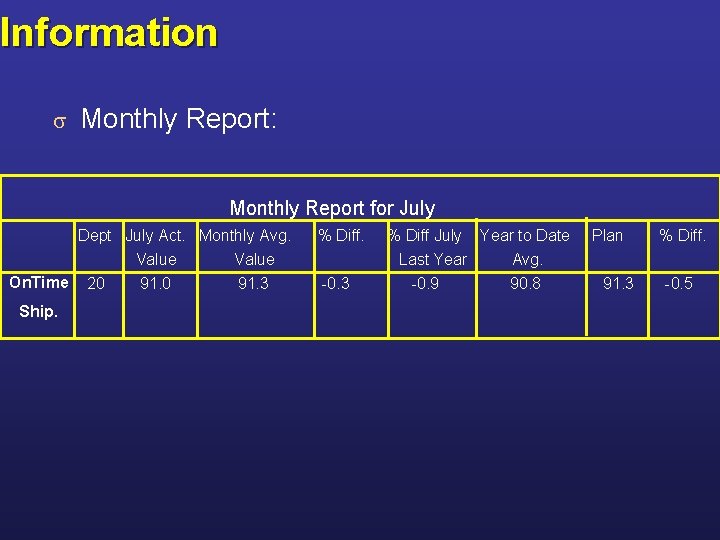
Background In a plant monthly report, the line with the smallest percent differences is percentage of on-time shipments. s In the data following, it would seem the level is at an expected level by management, and would get only a “cursory glance. ” s In July, 91. 0% of the shipments were shipped on time. This is 0. 3% below the historic average and 0. 9% below the value last July. s By traditional comparisons, the on-time shipments performance is slightly lower, but essentially unchanged from last year. s
Information s Monthly Report: Monthly Report for July Dept July Act. Monthly Avg. On. Time Ship. 20 Value 91. 0 91. 3 % Diff July Last Year -0. 3 -0. 9 Year to Date Plan % Diff. Avg. 90. 8 91. 3 -0. 5
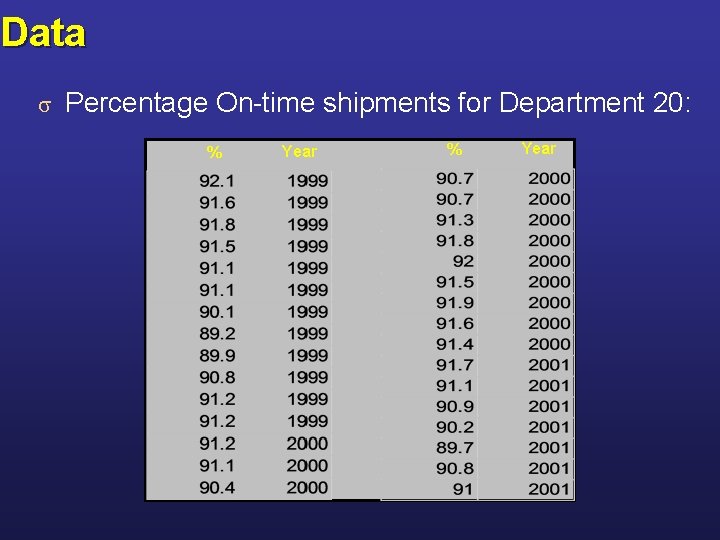
Data s Percentage On-time shipments for Department 20: % Year
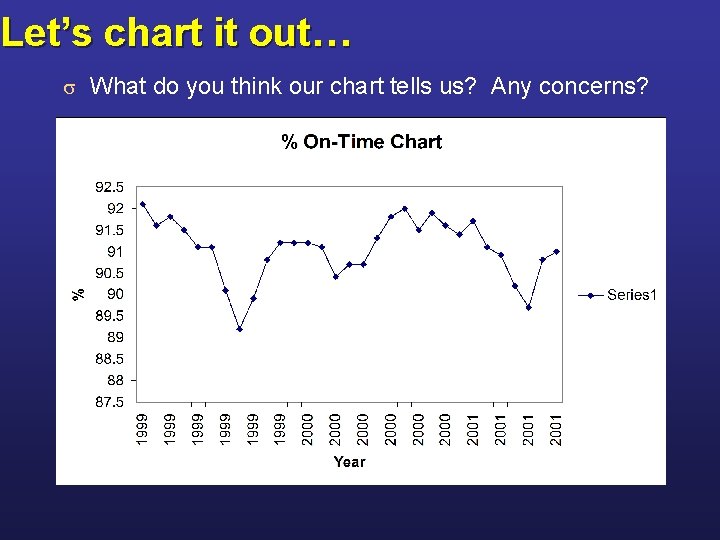
Let’s chart it out… s What do you think our chart tells us? Any concerns?
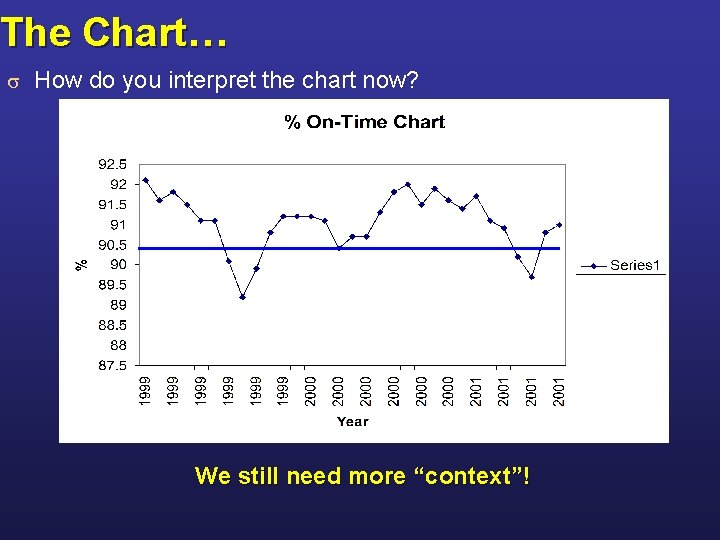
The Chart… s How do you interpret the chart now? We still need more “context”!
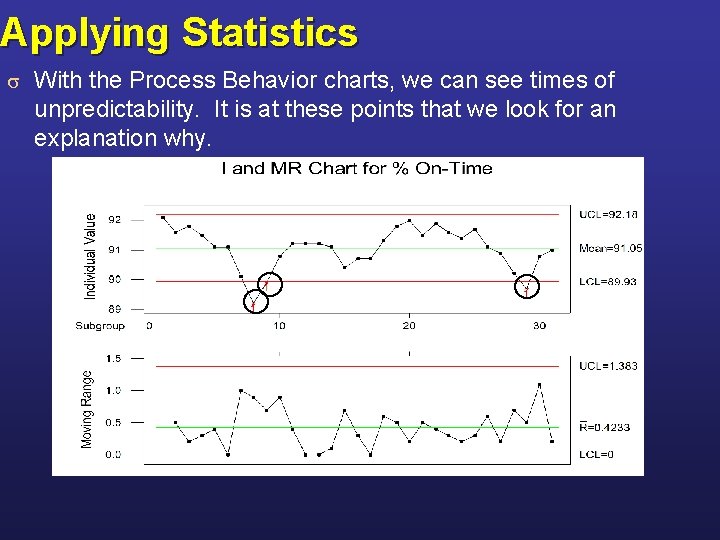
Applying Statistics s With the Process Behavior charts, we can see times of unpredictability. It is at these points that we look for an explanation why.
Conclusion? Three of the individual values fall outside the limits. Thus, there is too much variation in this time series to be due to chance alone. s The three values should be treated as signals, and investigations into the causes the percentage of on-time shipments dropped during these months. s Since the process is “unpredictable, ” it may happen again, only worse. s
Case Study 3 Regional Sales
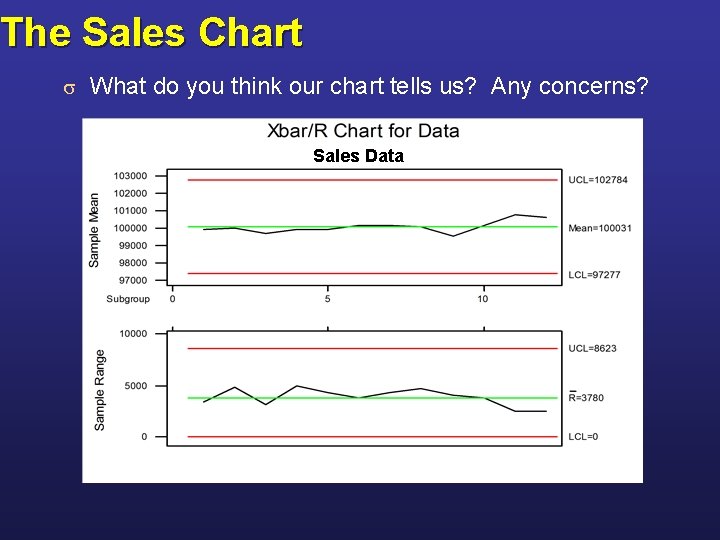
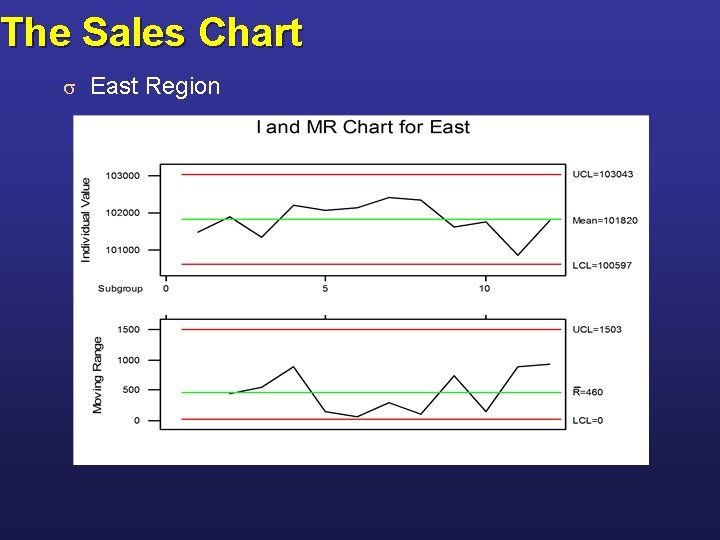
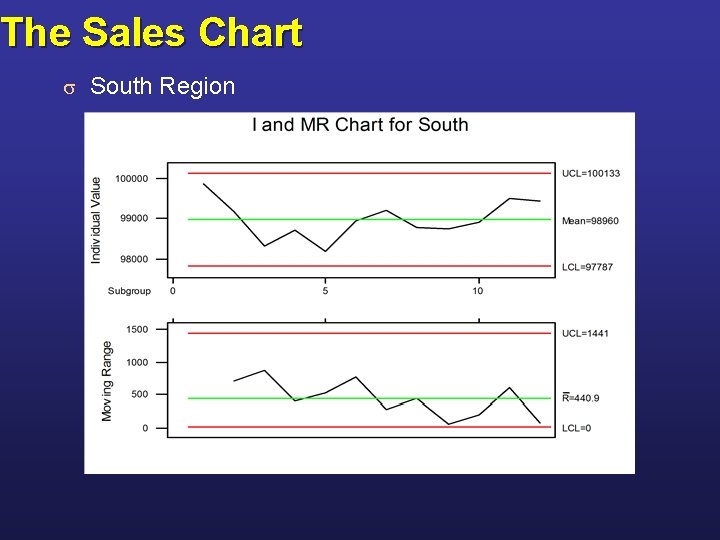
Background A sales manager who recently learned about Process Behavior charts decided to utilize this tools to put their regional sales data into “context. ” s The manager has plotted the data for the last 12 month’s and keeps the chart posted on their wall. The manager hopes this will also improve the monthly values over time for the monthly and quarterly reports. s While more sales are always wanted, the manager is pleased that the sales process is consistent. s s During one of their weekly meetings, you see the chart on the wall and notices something…
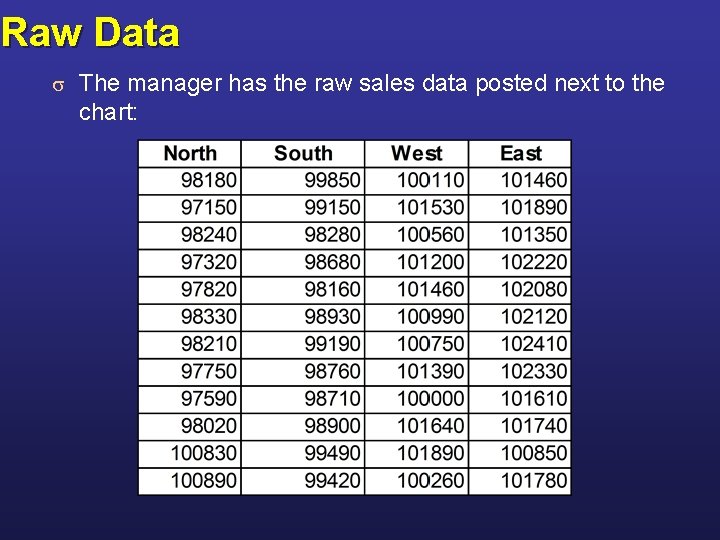
Raw Data s The manager has the raw sales data posted next to the chart:
The Sales Chart s What do you think our chart tells us? Any concerns? Sales Data
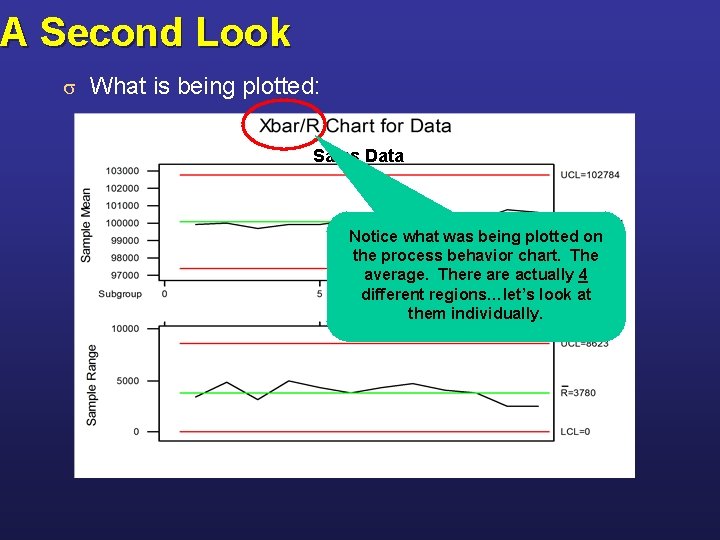
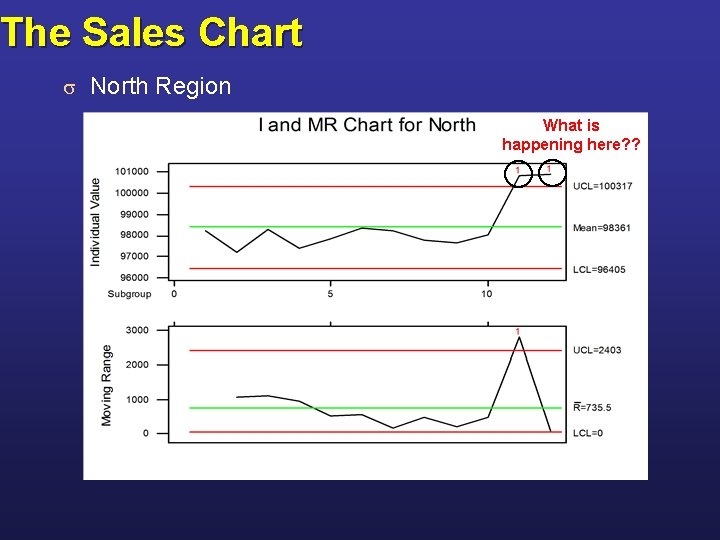
A Second Look s What is being plotted: Sales Data Notice what was being plotted on the process behavior chart. The average. There actually 4 different regions…let’s look at them individually.
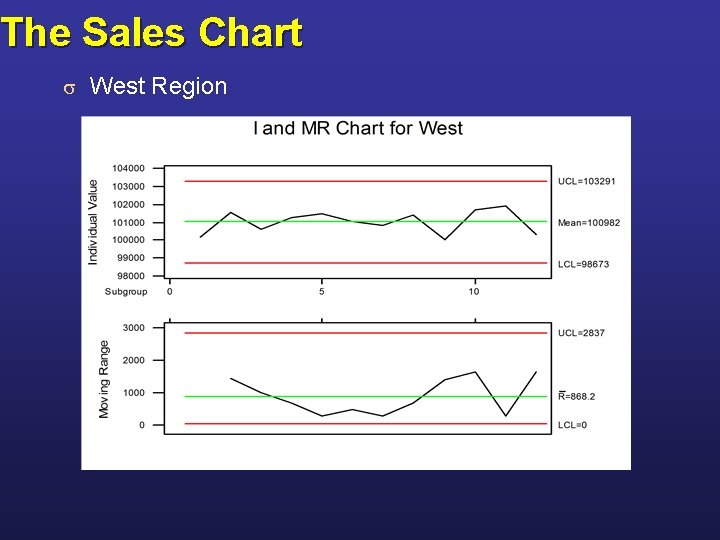
The Sales Chart s West Region
The Sales Chart s East Region
The Sales Chart s South Region
The Sales Chart s North Region What is happening here? ?
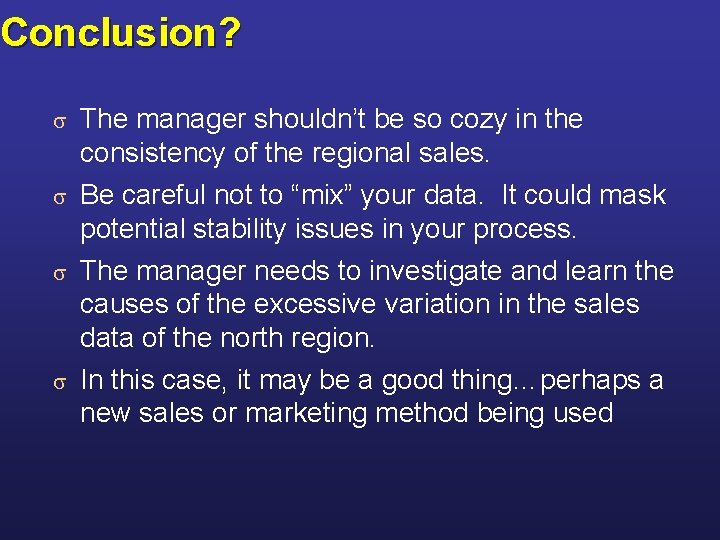
Conclusion? s The manager shouldn’t be so cozy in the consistency of the regional sales. Be careful not to “mix” your data. It could mask potential stability issues in your process. s The manager needs to investigate and learn the causes of the excessive variation in the sales data of the north region. s In this case, it may be a good thing…perhaps a new sales or marketing method being used s
Understanding Variation Six Sigma Foundations Continuous Improvement Training