
Understanding V 1 Saliency map and preattentive segmentation
- Slides: 56
Understanding V 1 --- Saliency map and preattentive segmentation Li Zhaoping University College London, Psychology www. gatsby. ucl. ac. uk/~zhaoping Lecture 2, at EU Advanced Course in Computational Neuroscience, Arcachon, France, Aug. 2006 Reading materials at www. gatsby. ucl. ac. uk/~zhaoping/Zhaoping. NReview 2006. pdf
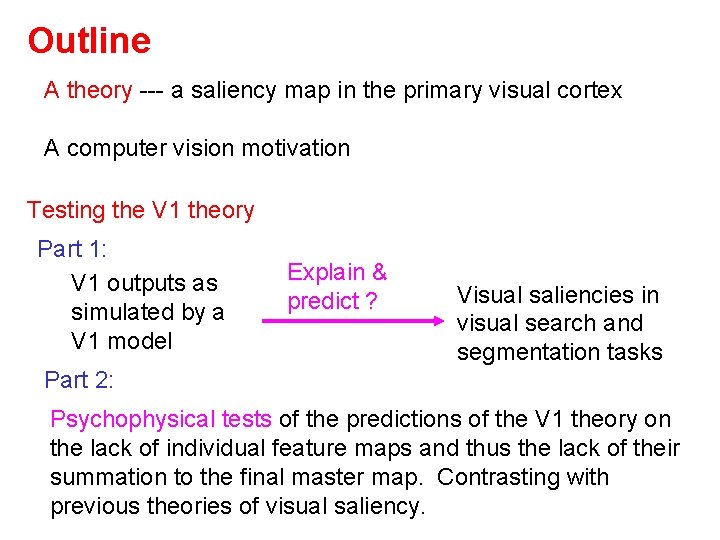
Outline A theory --- a saliency map in the primary visual cortex A computer vision motivation Testing the V 1 theory Part 1: V 1 outputs as simulated by a V 1 model Explain & predict ? Visual saliencies in visual search and segmentation tasks Part 2: Psychophysical tests of the predictions of the V 1 theory on the lack of individual feature maps and thus the lack of their summation to the final master map. Contrasting with previous theories of visual saliency.
First, theory A saliency map in primary visual cortex “A saliency map in primary visual cortex”, in Trends in Cognitive Sciences Vol 6, No. 1, page 9 -16, 2002,
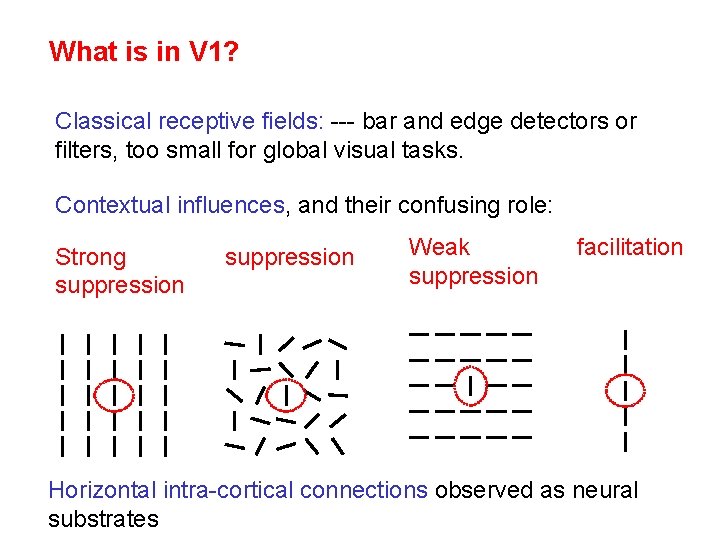
What is in V 1? Classical receptive fields: --- bar and edge detectors or filters, too small for global visual tasks. Contextual influences, and their confusing role: Strong suppression Weak suppression facilitation Horizontal intra-cortical connections observed as neural substrates
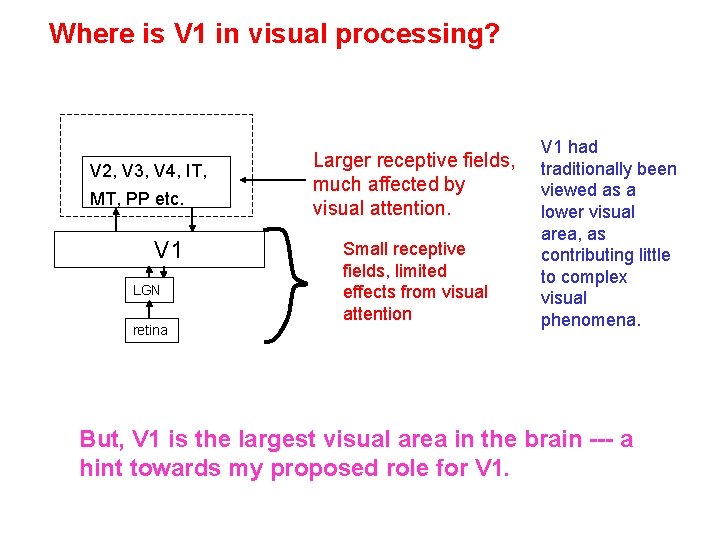
Where is V 1 in visual processing? V 2, V 3, V 4, IT, MT, PP etc. V 1 LGN retina Larger receptive fields, much affected by visual attention. Small receptive fields, limited effects from visual attention V 1 had traditionally been viewed as a lower visual area, as contributing little to complex visual phenomena. But, V 1 is the largest visual area in the brain --- a hint towards my proposed role for V 1.
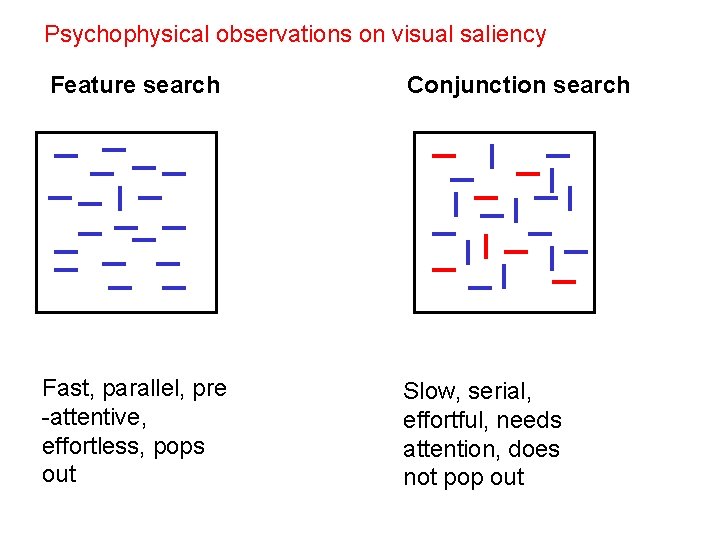
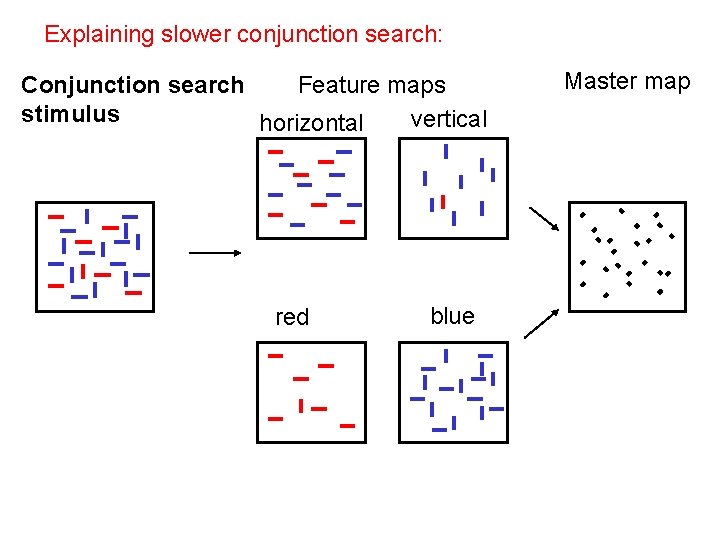
Psychophysical observations on visual saliency Feature search Fast, parallel, pre -attentive, effortless, pops out Conjunction search Slow, serial, effortful, needs attention, does not pop out
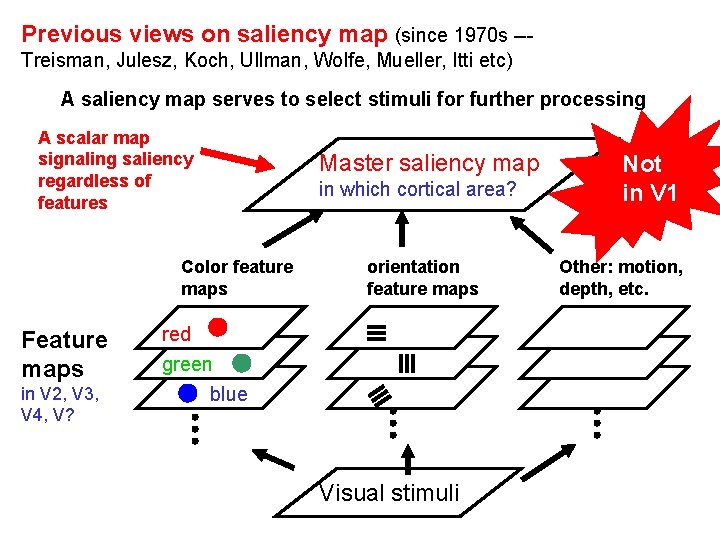
Previous views on saliency map (since 1970 s --Treisman, Julesz, Koch, Ullman, Wolfe, Mueller, Itti etc) A saliency map serves to select stimuli for further processing A scalar map signaling saliency regardless of features Color feature maps Feature maps in V 2, V 3, V 4, V? Master saliency map in which cortical area? orientation feature maps red greenblue Visual stimuli Not in V 1 Other: motion, depth, etc.
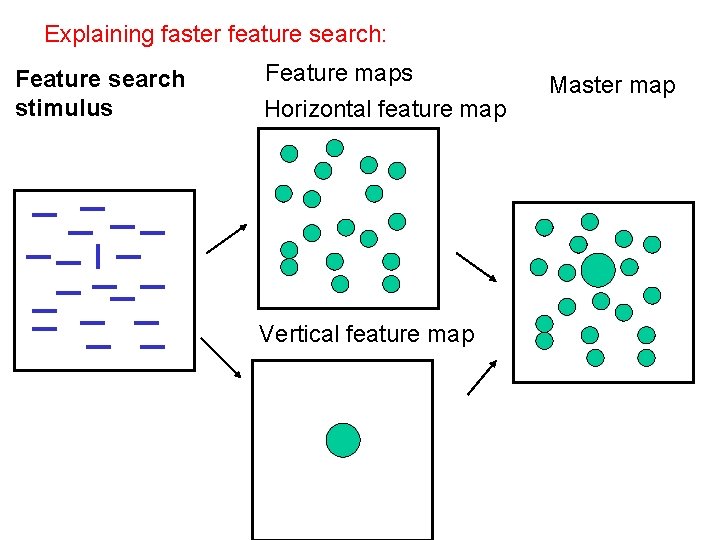
Explaining faster feature search: Feature search stimulus Feature maps Horizontal feature map Vertical feature map Master map
Explaining slower conjunction search: Conjunction search Feature maps stimulus vertical horizontal red blue Master map
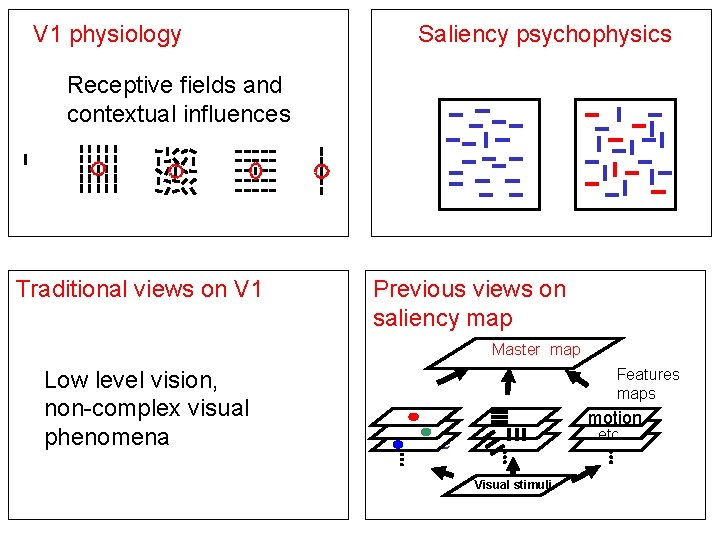
V 1 physiology Saliency psychophysics Receptive fields and contextual influences Traditional views on V 1 Previous views on saliency map Master map Low level vision, non-complex visual phenomena Features maps motion etc blue Visual stimuli
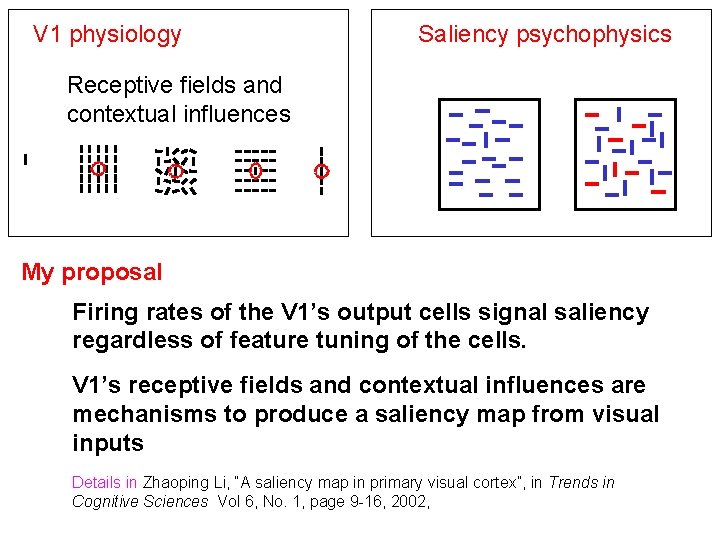
V 1 physiology Saliency psychophysics Receptive fields and contextual influences My proposal Firing rates of the V 1’s output cells signal saliency regardless of feature tuning of the cells. V 1’s receptive fields and contextual influences are mechanisms to produce a saliency map from visual inputs Details in Zhaoping Li, “A saliency map in primary visual cortex”, in Trends in Cognitive Sciences Vol 6, No. 1, page 9 -16, 2002,
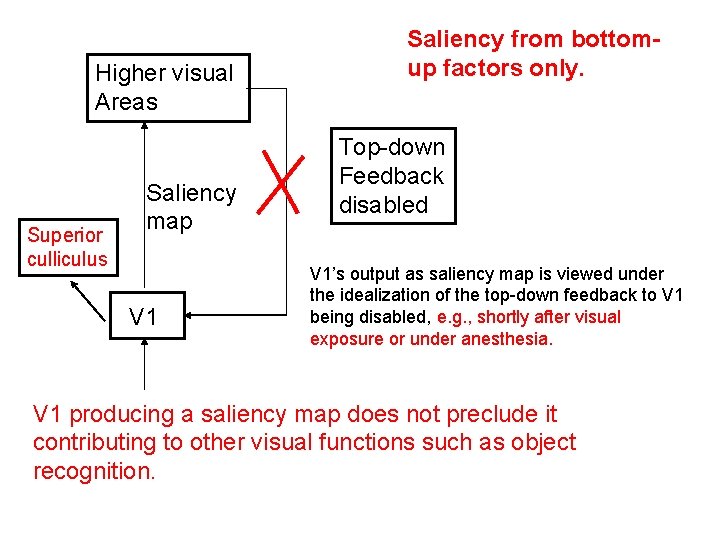
Higher visual Areas Superior culliculus Saliency map V 1 Saliency from bottomup factors only. Top-down Feedback disabled V 1’s output as saliency map is viewed under the idealization of the top-down feedback to V 1 being disabled, e. g. , shortly after visual exposure or under anesthesia. V 1 producing a saliency map does not preclude it contributing to other visual functions such as object recognition.
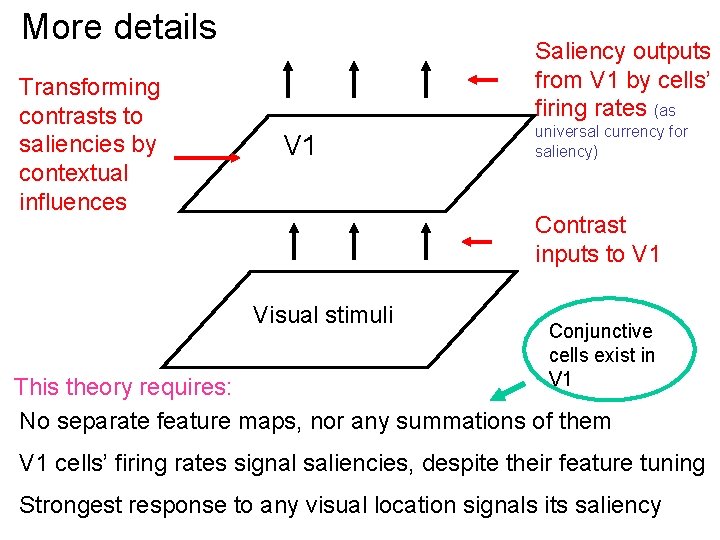
More details Transforming contrasts to saliencies by contextual influences Saliency outputs from V 1 by cells’ firing rates (as V 1 universal currency for saliency) Contrast inputs to V 1 Visual stimuli Conjunctive cells exist in V 1 This theory requires: No separate feature maps, nor any summations of them V 1 cells’ firing rates signal saliencies, despite their feature tuning Strongest response to any visual location signals its saliency
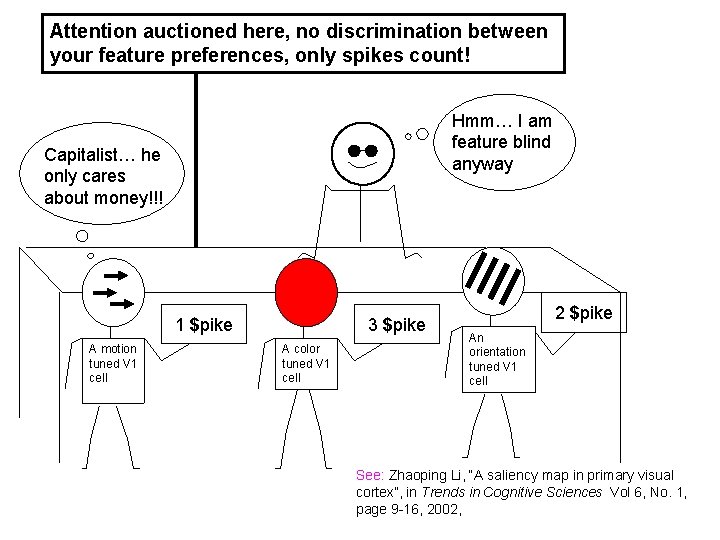
Attention auctioned here, no discrimination between your feature preferences, only spikes count! Hmm… I am feature blind anyway Capitalist… he only cares about money!!! 1 $pike A motion tuned V 1 cell 3 $pike A color tuned V 1 cell 2 $pike An orientation tuned V 1 cell See: Zhaoping Li, “A saliency map in primary visual cortex”, in Trends in Cognitive Sciences Vol 6, No. 1, page 9 -16, 2002,
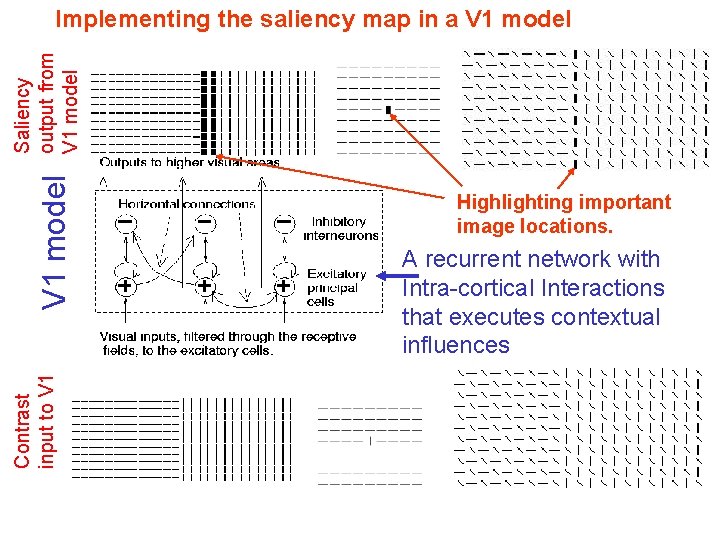
Contrast input to V 1 model Saliency output from V 1 model Implementing the saliency map in a V 1 model Highlighting important image locations. A recurrent network with Intra-cortical Interactions that executes contextual influences
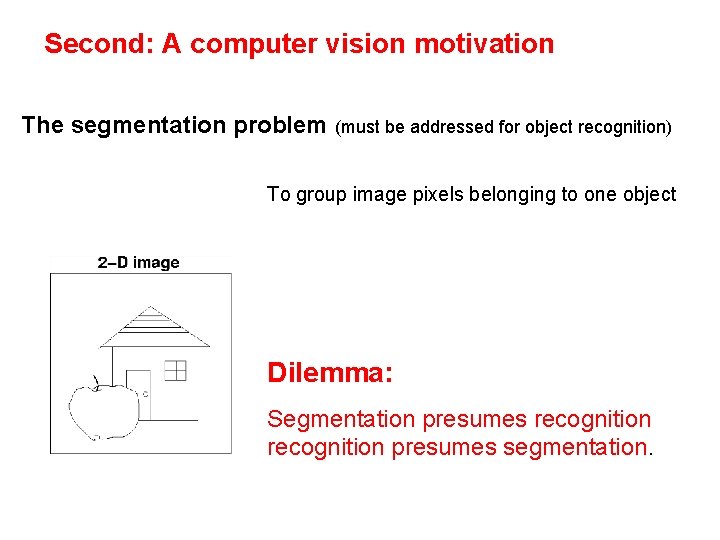
Second: A computer vision motivation The segmentation problem (must be addressed for object recognition) To group image pixels belonging to one object Dilemma: Segmentation presumes recognition presumes segmentation.
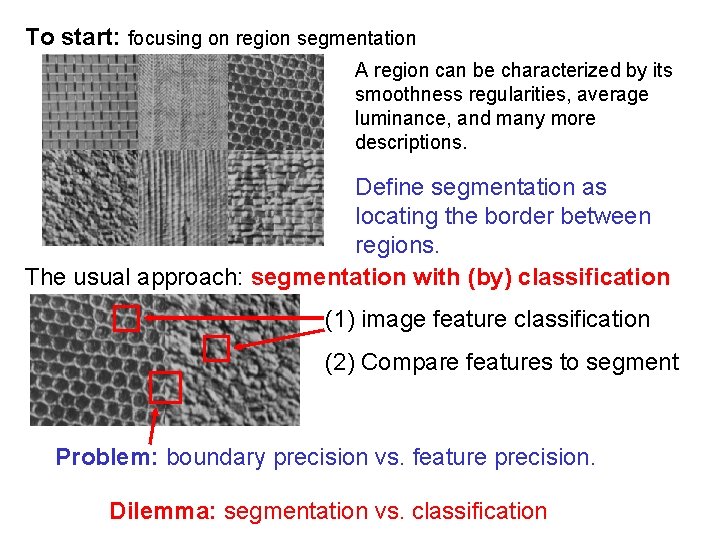
To start: focusing on region segmentation A region can be characterized by its smoothness regularities, average luminance, and many more descriptions. Define segmentation as locating the border between regions. The usual approach: segmentation with (by) classification (1) image feature classification (2) Compare features to segment Problem: boundary precision vs. feature precision. Dilemma: segmentation vs. classification
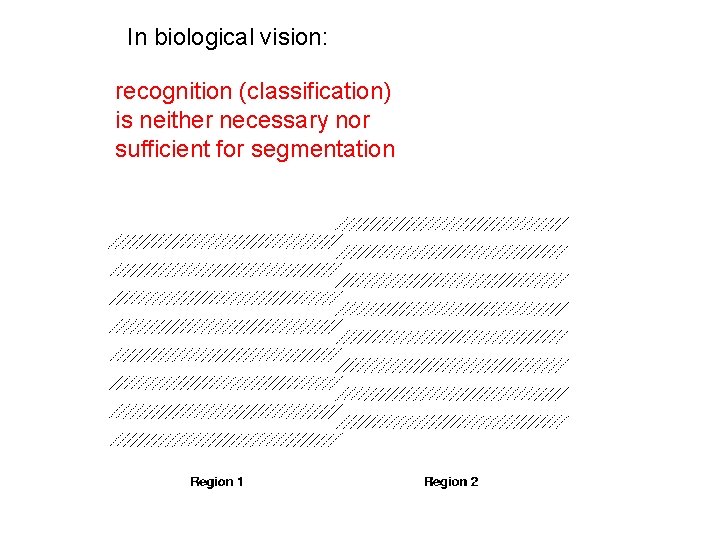
In biological vision: recognition (classification) is neither necessary nor sufficient for segmentation
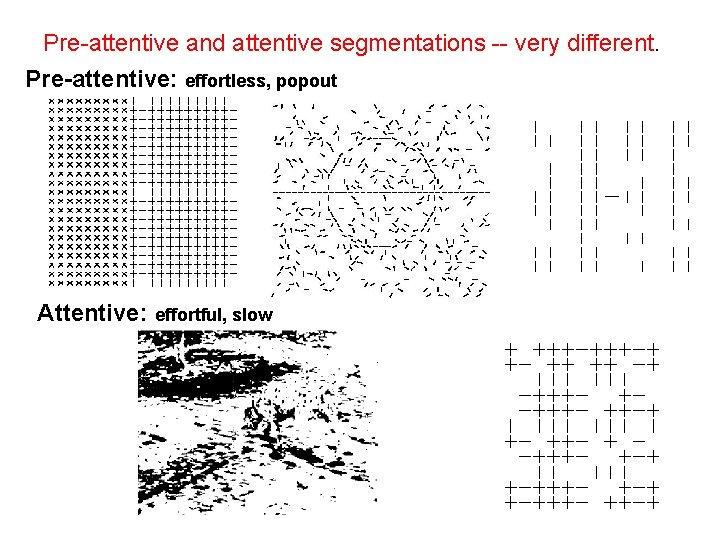
Pre-attentive and attentive segmentations -- very different. Pre-attentive: effortless, popout Attentive: effortful, slow
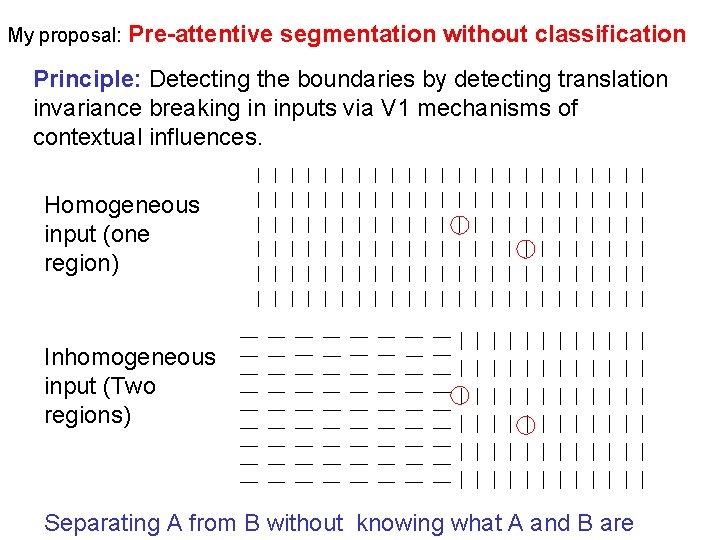
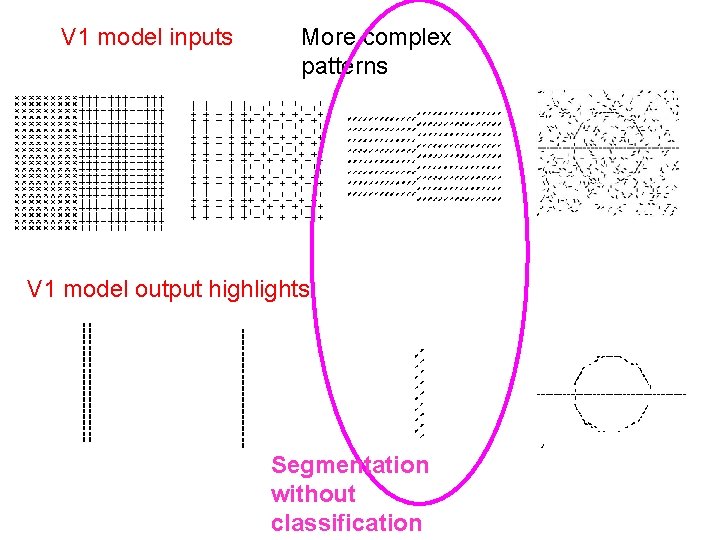
My proposal: Pre-attentive segmentation without classification Principle: Detecting the boundaries by detecting translation invariance breaking in inputs via V 1 mechanisms of contextual influences. Homogeneous input (one region) Inhomogeneous input (Two regions) Separating A from B without knowing what A and B are
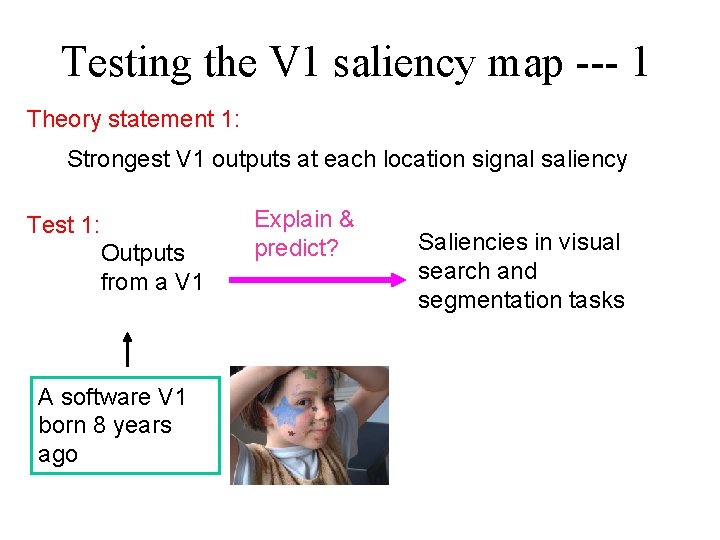
Testing the V 1 saliency map --- 1 Theory statement 1: Strongest V 1 outputs at each location signal saliency Test 1: Outputs from a V 1 A software V 1 born 8 years ago Explain & predict? Saliencies in visual search and segmentation tasks
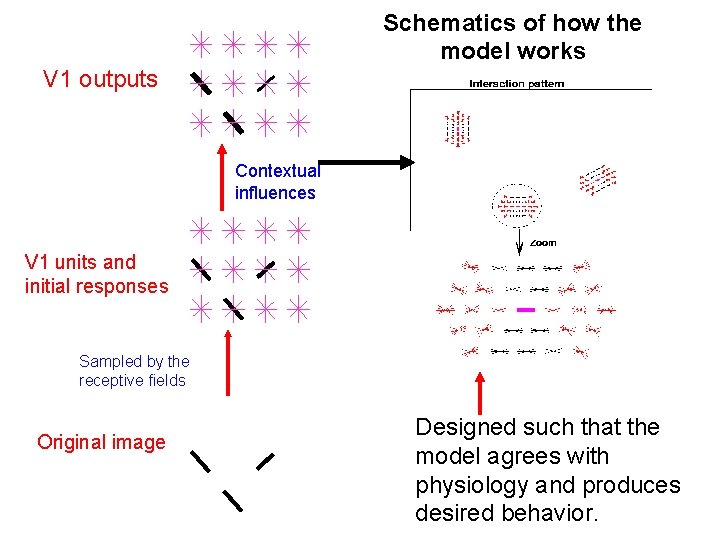
Schematics of how the model works V 1 outputs Contextual influences V 1 units and initial responses Sampled by the receptive fields Original image Designed such that the model agrees with physiology and produces desired behavior.
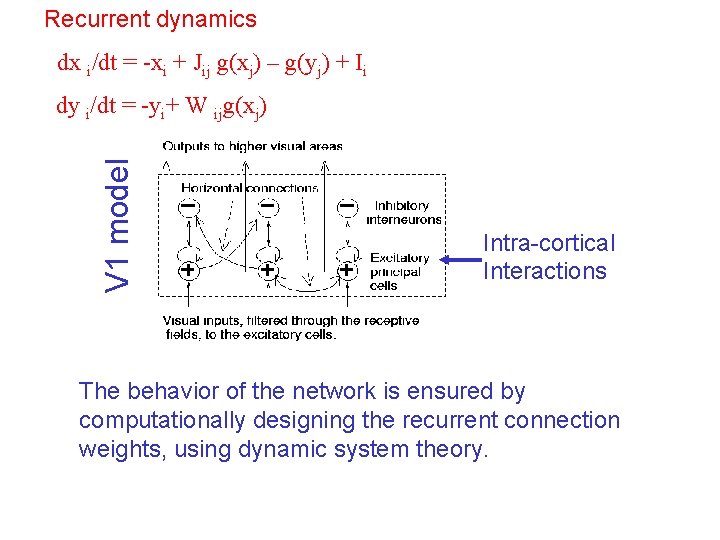
Recurrent dynamics dx i/dt = -xi + Jij g(xj) – g(yj) + Ii V 1 model dy i/dt = -yi+ W ijg(xj) Intra-cortical Interactions The behavior of the network is ensured by computationally designing the recurrent connection weights, using dynamic system theory.
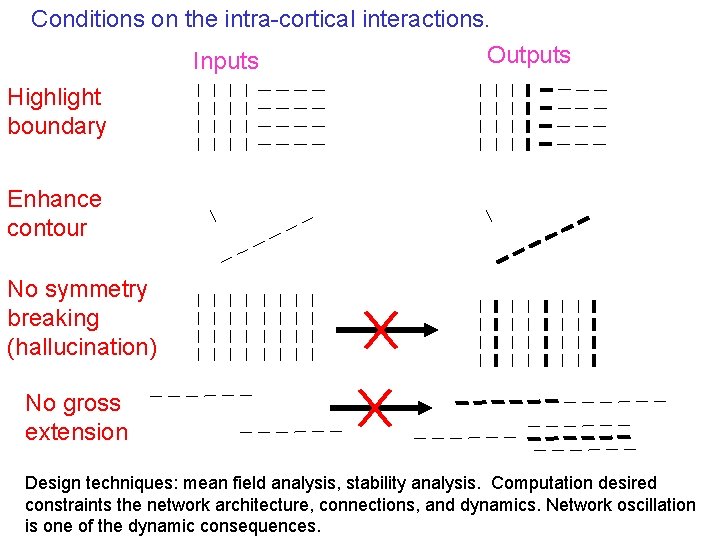
Conditions on the intra-cortical interactions. Outputs Inputs Highlight boundary Enhance contour No symmetry breaking (hallucination) No gross extension Design techniques: mean field analysis, stability analysis. Computation desired constraints the network architecture, connections, and dynamics. Network oscillation is one of the dynamic consequences.
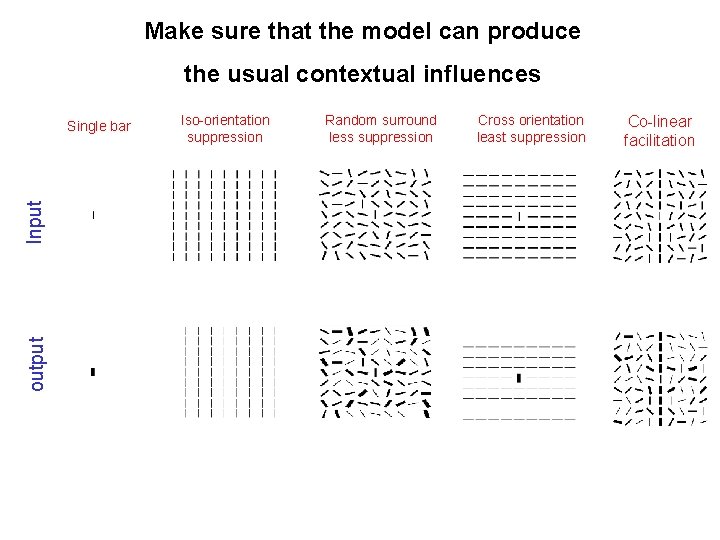
Make sure that the model can produce the usual contextual influences output Input Single bar Iso-orientation suppression Random surround less suppression Cross orientation least suppression Co-linear facilitation
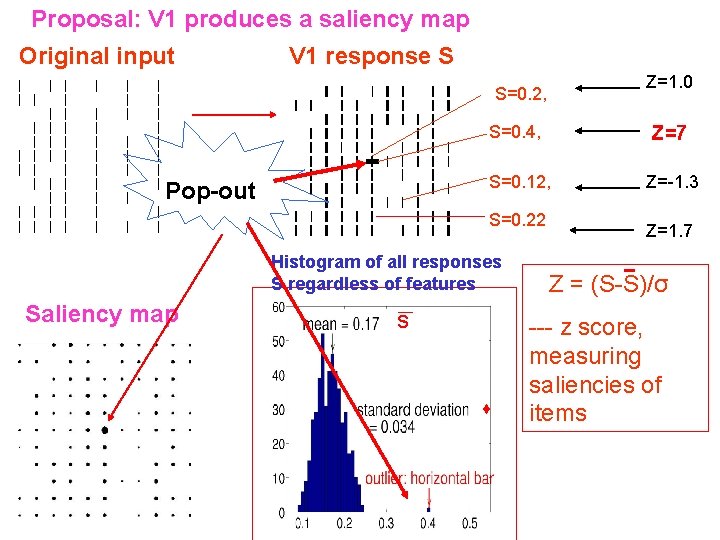
Proposal: V 1 produces a saliency map Original input V 1 response S Z=1. 0 S=0. 2, Pop-out S=0. 4, Z=7 S=0. 12, Z=-1. 3 S=0. 22 Histogram of all responses S regardless of features Saliency map s Z=1. 7 Z = (S-S)/σ --- z score, measuring saliencies of items
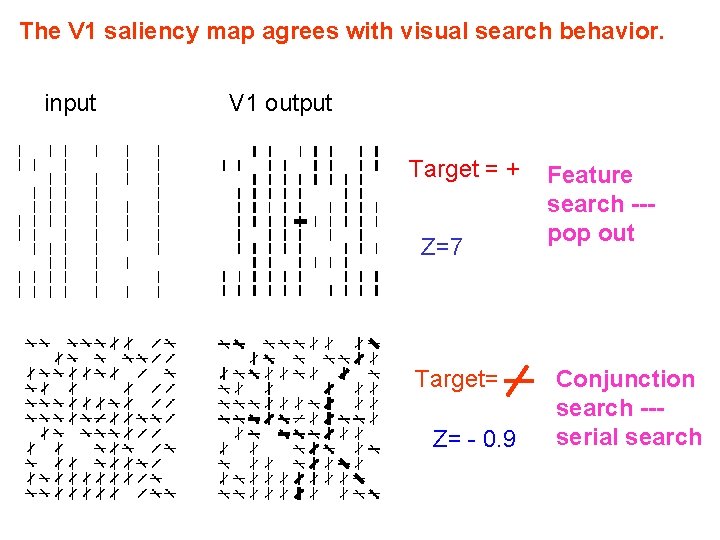
The V 1 saliency map agrees with visual search behavior. input V 1 output Target = + Z=7 Target= Z= - 0. 9 Feature search --pop out Conjunction search --serial search
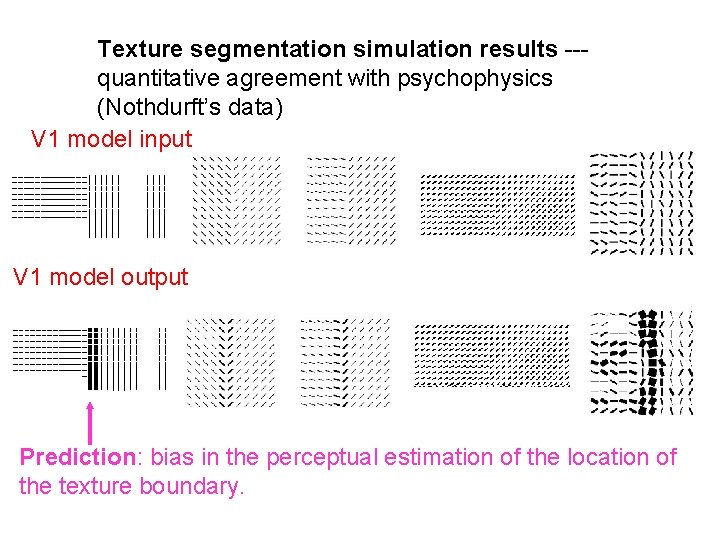
Texture segmentation simulation results --quantitative agreement with psychophysics (Nothdurft’s data) V 1 model input V 1 model output Prediction: bias in the perceptual estimation of the location of the texture boundary.
V 1 model inputs More complex patterns V 1 model output highlights Segmentation without classification
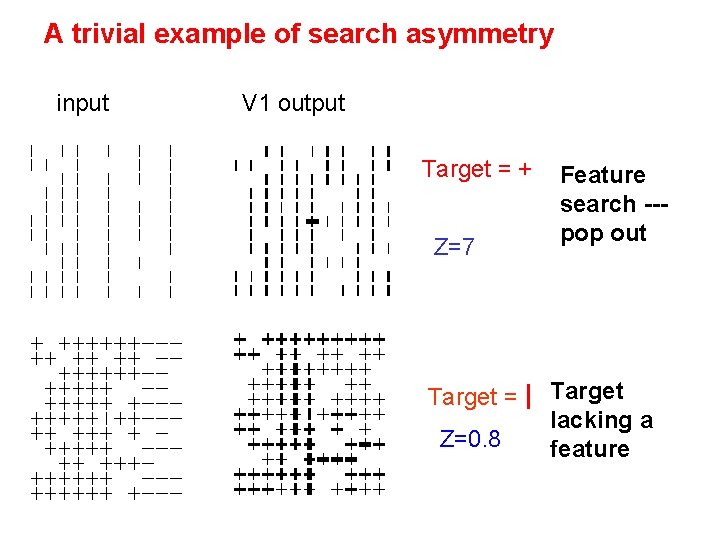
A trivial example of search asymmetry input V 1 output Target = + Z=7 Target = Z=0. 8 Feature search --pop out Target lacking a feature
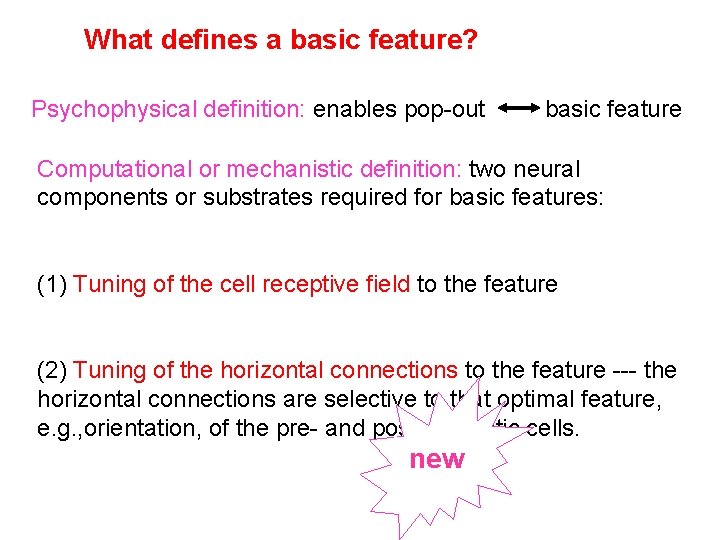
What defines a basic feature? Psychophysical definition: enables pop-out basic feature Computational or mechanistic definition: two neural components or substrates required for basic features: (1) Tuning of the cell receptive field to the feature (2) Tuning of the horizontal connections to the feature --- the horizontal connections are selective to that optimal feature, e. g. , orientation, of the pre- and post- synaptic cells. new
There should be a continuum from pop-out to serial searches The ease of search is measured by a graded number : z score Treisman’s original Feature Integration Theory may be seen as the discrete idealization of the search process.
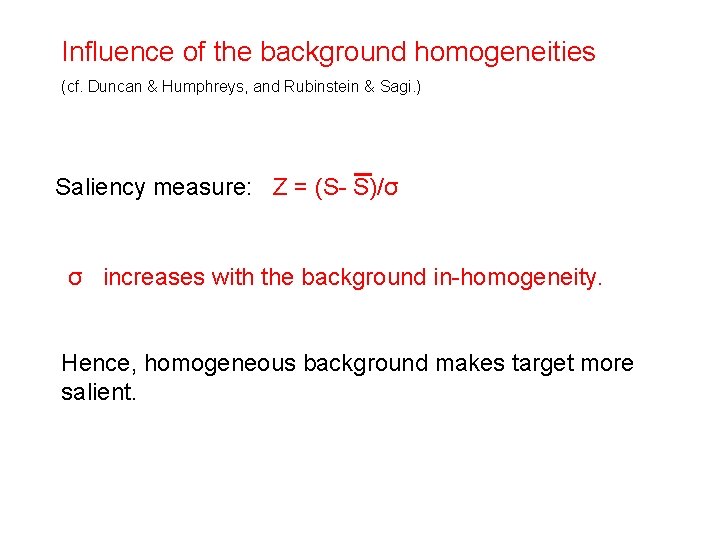
Influence of the background homogeneities (cf. Duncan & Humphreys, and Rubinstein & Sagi. ) Saliency measure: Z = (S- S)/σ σ increases with the background in-homogeneity. Hence, homogeneous background makes target more salient.
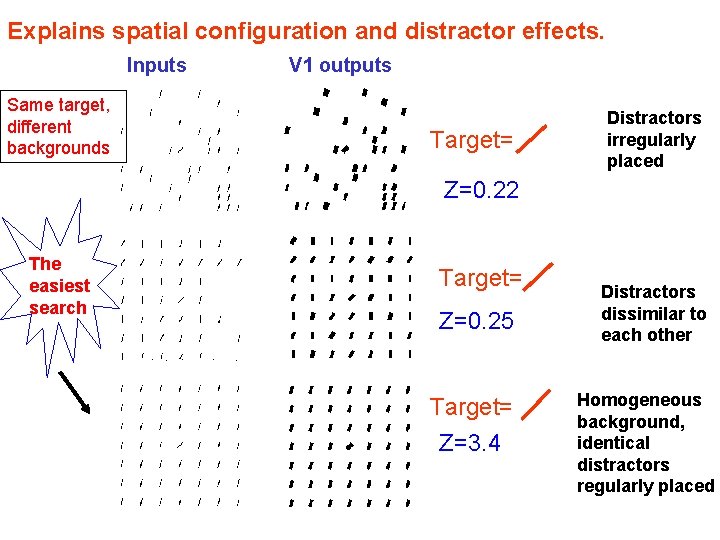
Explains spatial configuration and distractor effects. Inputs Same target, different backgrounds V 1 outputs Target= Distractors irregularly placed Z=0. 22 The easiest search Target= Z=0. 25 Target= Z=3. 4 Distractors dissimilar to each other Homogeneous background, identical distractors regularly placed
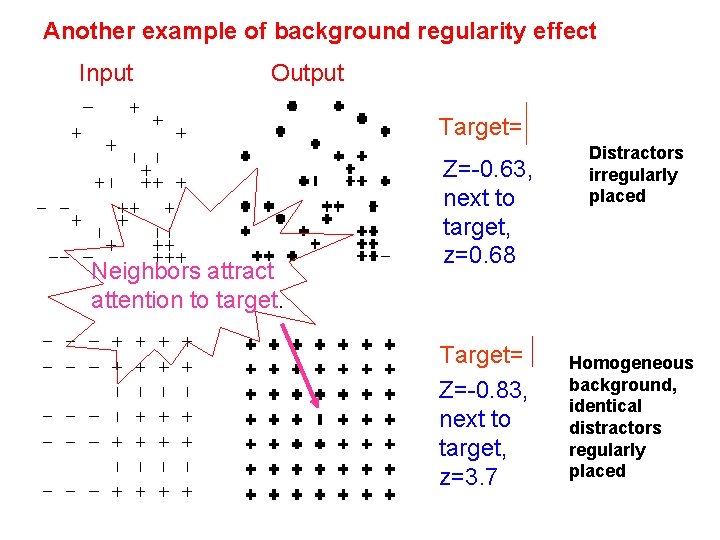
Another example of background regularity effect Input Output Target= Neighbors attract attention to target. Z=-0. 63, next to target, z=0. 68 Target= Z=-0. 83, next to target, z=3. 7 Distractors irregularly placed Homogeneous background, identical distractors regularly placed
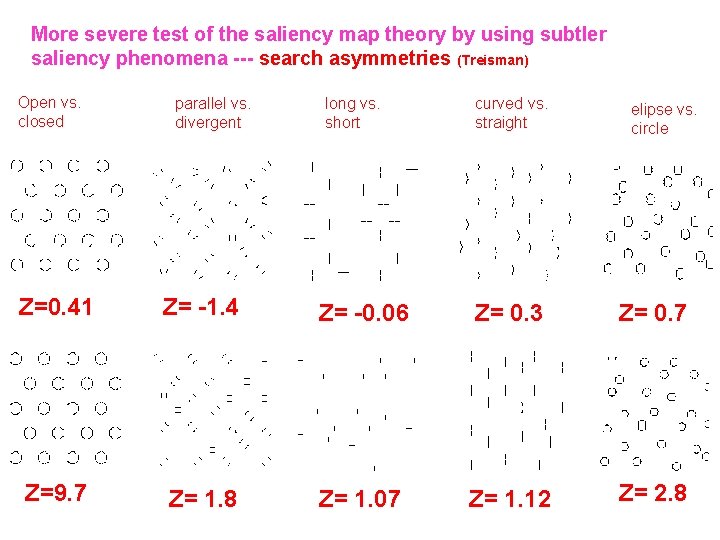
More severe test of the saliency map theory by using subtler saliency phenomena --- search asymmetries (Treisman) Open vs. closed parallel vs. divergent long vs. short curved vs. straight elipse vs. circle Z=0. 41 Z= -1. 4 Z= -0. 06 Z= 0. 3 Z= 0. 7 Z=9. 7 Z= 1. 8 Z= 1. 07 Z= 1. 12 Z= 2. 8
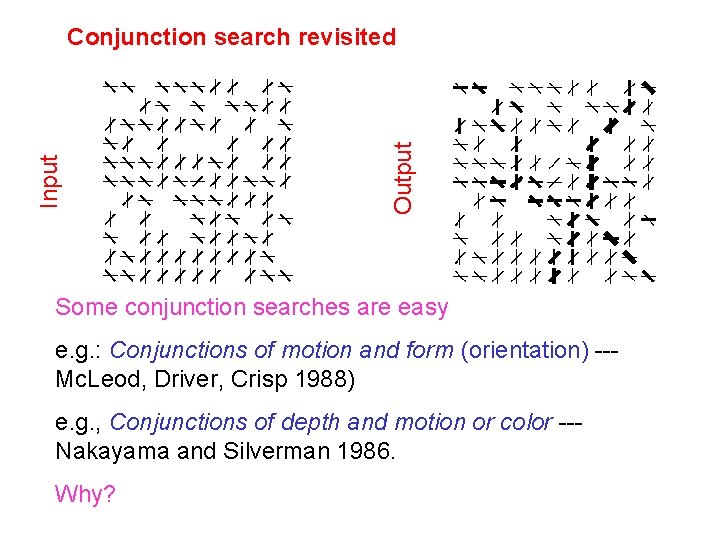
Output Input Conjunction search revisited Some conjunction searches are easy e. g. : Conjunctions of motion and form (orientation) --Mc. Leod, Driver, Crisp 1988) e. g. , Conjunctions of depth and motion or color --Nakayama and Silverman 1986. Why?
Recall the two neural components necessary for a basic feature (1) Tuning of the receptive field (CRF) (2) Tuning of the horizontal connections For a conjunction to be basic and pop-out: (1) Simultaneous or conjunctive tunings of the V 1 cells to both feature dimensions (e. g. , orientation & motion, orientation and depth, but not orientation and orientation) (2) Simultaneous or conjunctive tunings of the horizontal connections to the optimal features in both feature dimensions of the pre- and post- synaptic cells
Predicting from psychophysics to V 1 anatomy Since conjunctions of motion and orientation, and depth and motion or color, pop-out The horizontal connections must be selective simultaneously to both orientation & motion, and to both depth and motion (or color) --- can be tested Note that it is already know that V 1 cells can be simultaneously tuned to orientation, motion direction, depth (and even color sometimes)
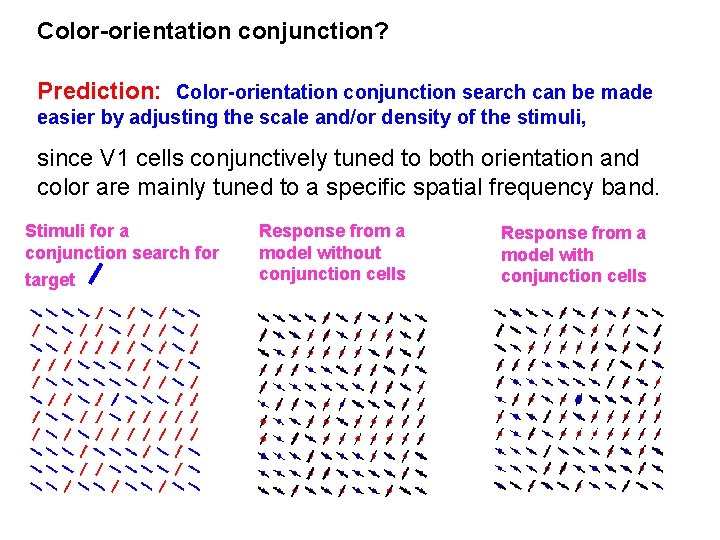
Color-orientation conjunction? Prediction: Color-orientation conjunction search can be made easier by adjusting the scale and/or density of the stimuli, since V 1 cells conjunctively tuned to both orientation and color are mainly tuned to a specific spatial frequency band. Stimuli for a conjunction search for target Response from a model without conjunction cells Response from a model with conjunction cells
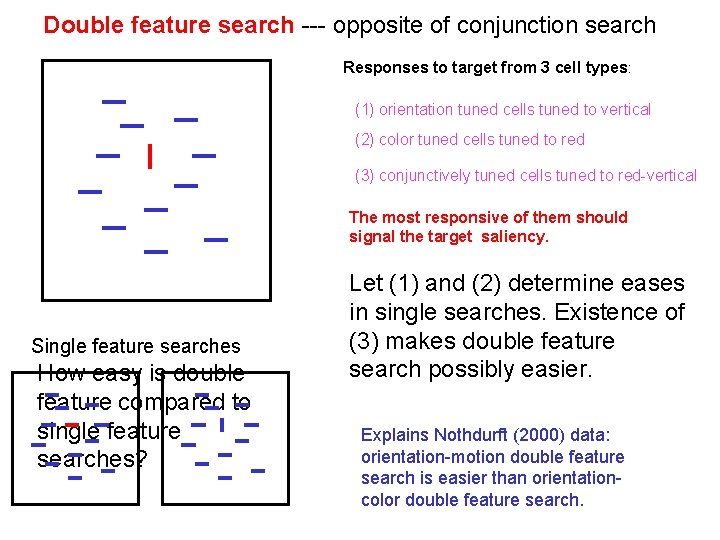
Double feature search --- opposite of conjunction search Responses to target from 3 cell types: (1) orientation tuned cells tuned to vertical (2) color tuned cells tuned to red (3) conjunctively tuned cells tuned to red-vertical The most responsive of them should signal the target saliency. Single feature searches How easy is double feature compared to single feature searches? Let (1) and (2) determine eases in single searches. Existence of (3) makes double feature search possibly easier. Explains Nothdurft (2000) data: orientation-motion double feature search is easier than orientationcolor double feature search.
Testing the V 1 saliency map --- 2 Theory statement 2: No separate feature maps, nor any summations of them, are needed. Simply, the strongest response at a location signal saliency. Contrast with previous theories: feature maps sum to get the master saliency map Test 2: (Joint work with Keith May) Test predictions from “strongest response” rule, contrast with predictions from feature map summation rule from previous theories/models.
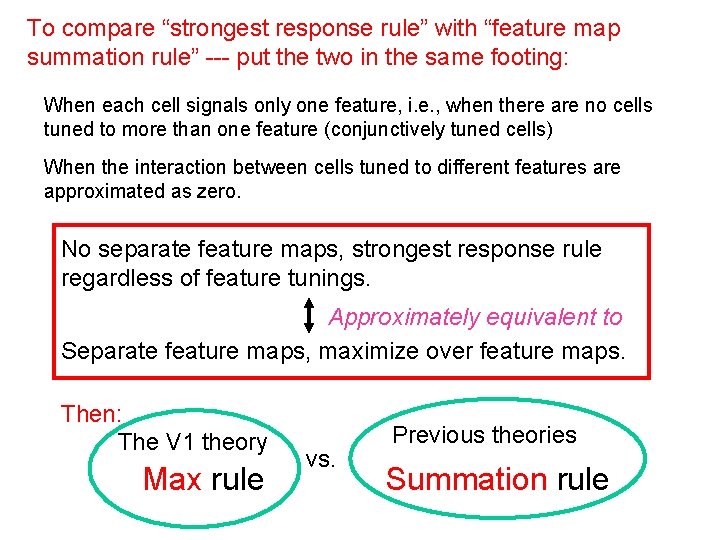
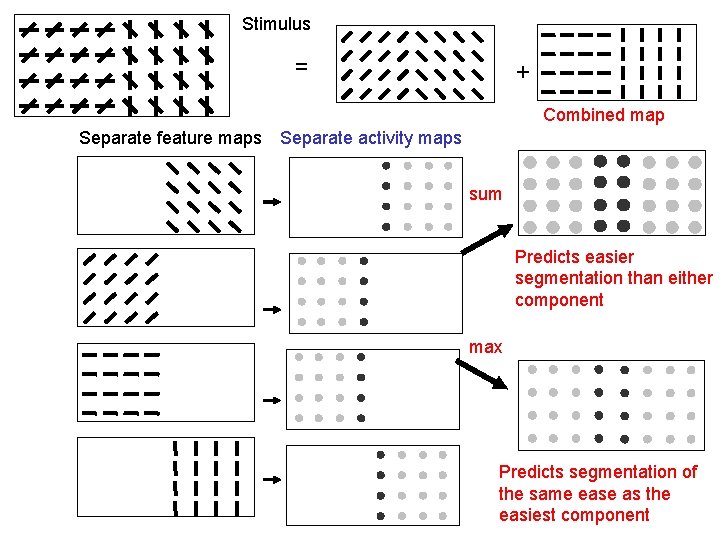
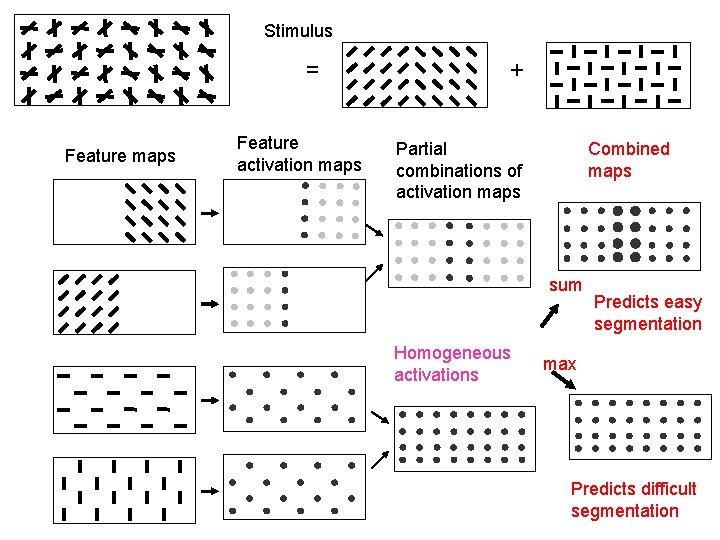
To compare “strongest response rule” with “feature map summation rule” --- put the two in the same footing: When each cell signals only one feature, i. e. , when there are no cells tuned to more than one feature (conjunctively tuned cells) When the interaction between cells tuned to different features are approximated as zero. No separate feature maps, strongest response rule regardless of feature tunings. Approximately equivalent to Separate feature maps, maximize over feature maps. Then: The V 1 theory Max rule vs. Previous theories Summation rule
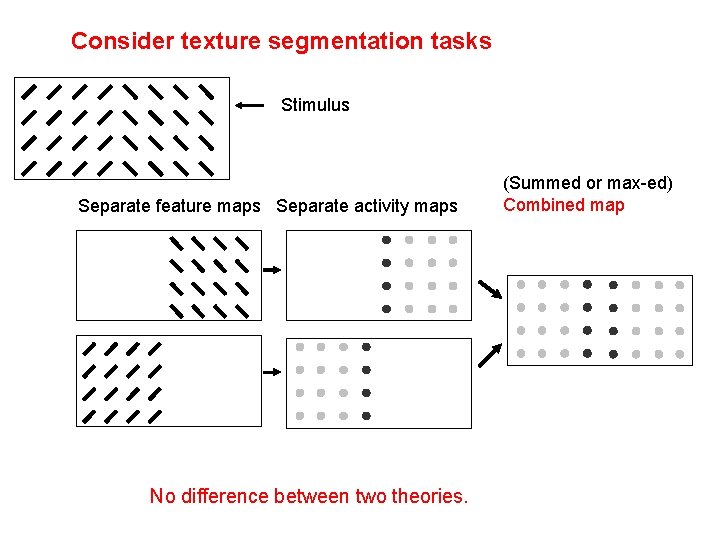
Consider texture segmentation tasks Stimulus Separate feature maps Separate activity maps No difference between two theories. (Summed or max-ed) Combined map
Stimulus = + Combined map Separate feature maps Separate activity maps sum Predicts easier segmentation than either component max Predicts segmentation of the same ease as the easiest component
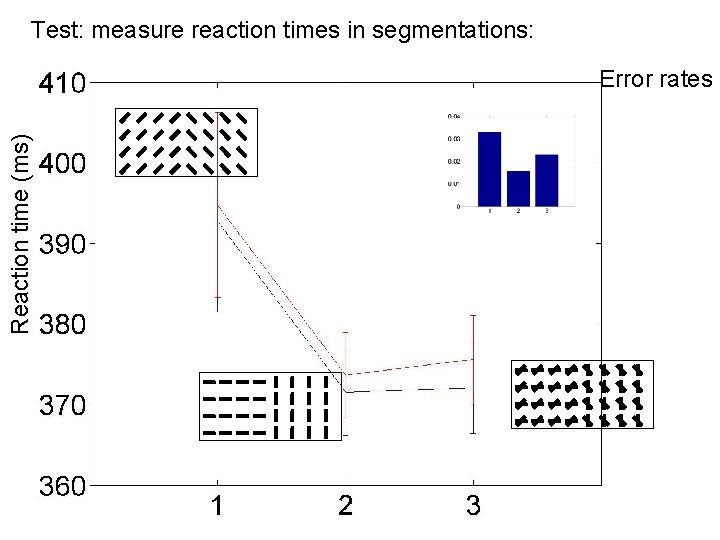
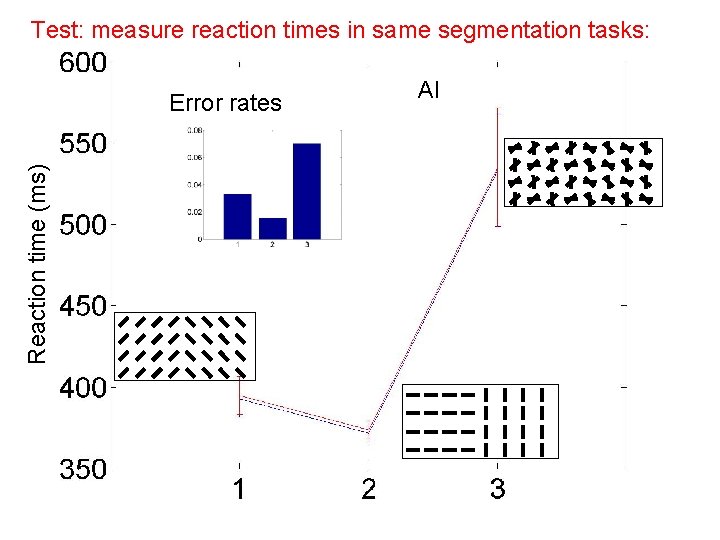
Test: measure reaction times in segmentations: Reaction time (ms) Task: subject answer whether the texture border is left or right Error rates
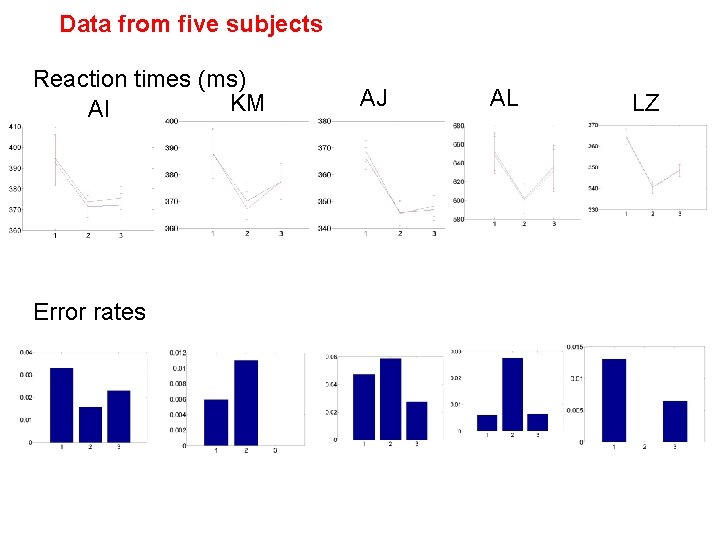
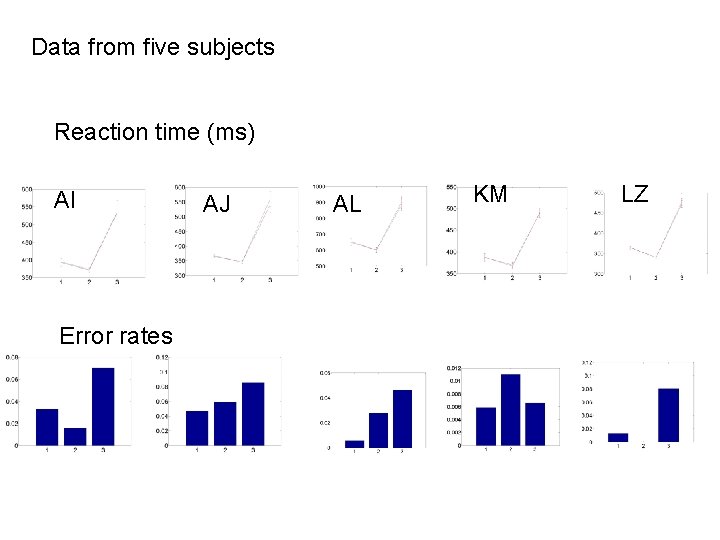
Data from five subjects Reaction times (ms) KM AI Error rates AJ AL LZ
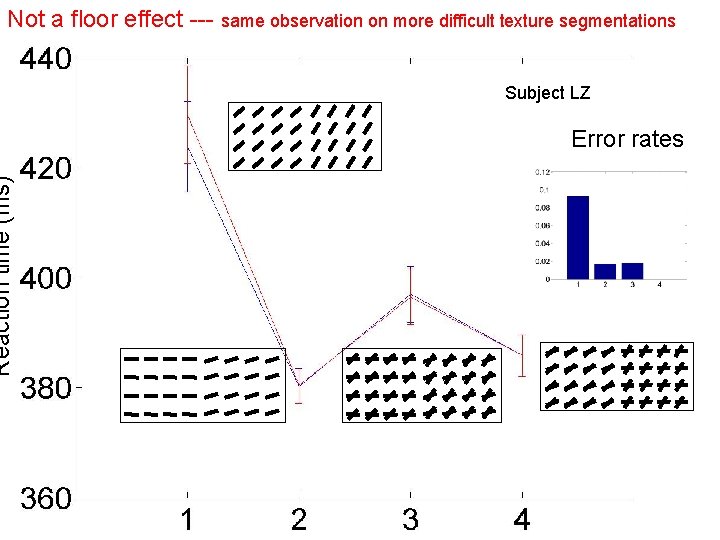
Reaction time (ms) Not a floor effect --- same observation on more difficult texture segmentations Subject LZ Error rates
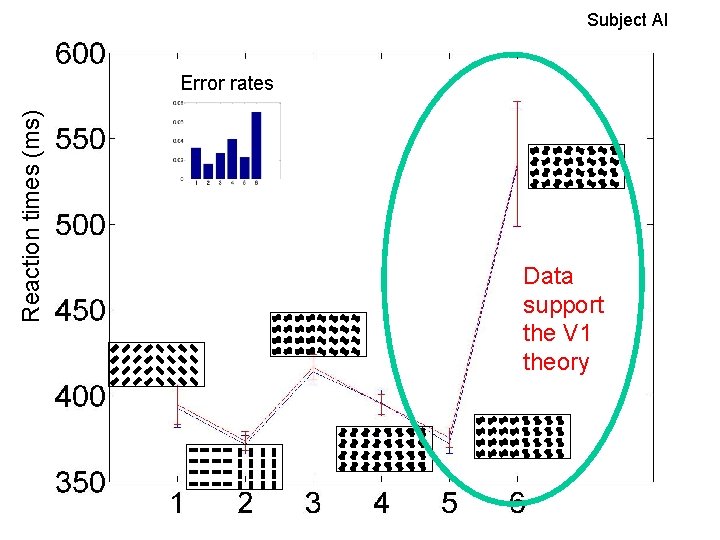
Stimulus = Feature maps Feature activation maps + Partial combinations of activation maps Combined maps sum Homogeneous activations Predicts easy segmentation max Predicts difficult segmentation
Test: measure reaction times in same segmentation tasks: Reaction time (ms) Error rates AI
Data from five subjects Reaction time (ms) AI Error rates AJ AL KM LZ
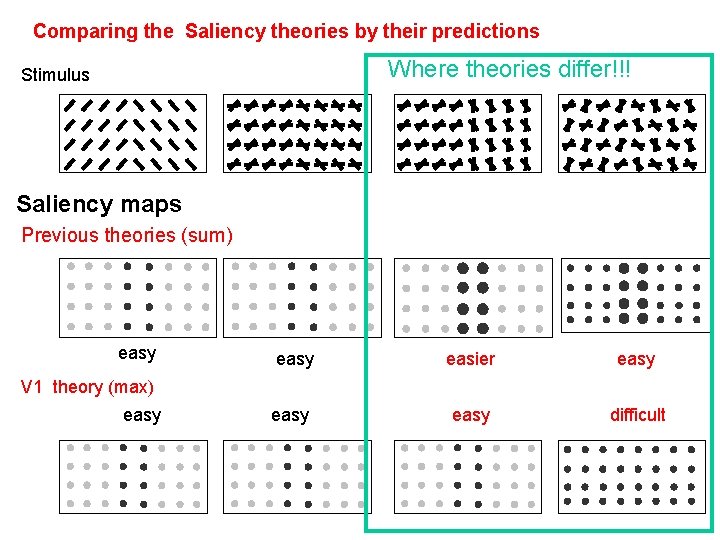
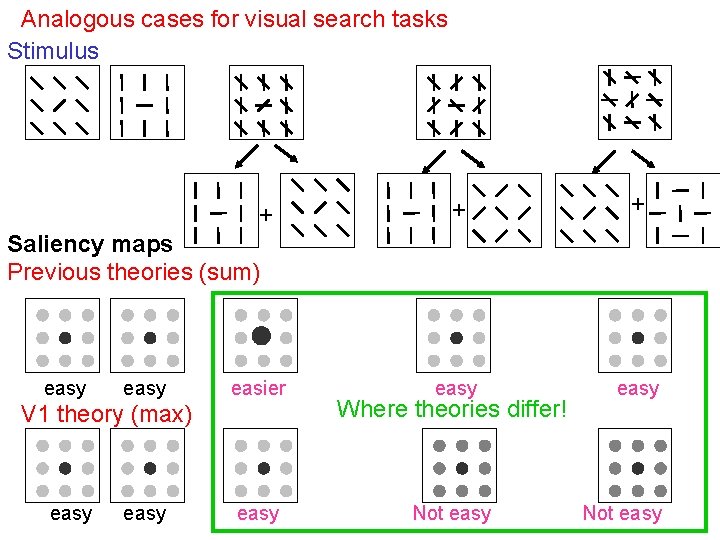
Comparing the Saliency theories by their predictions Where theories differ!!! Stimulus Saliency maps Previous theories (sum) easy easier easy difficult V 1 theory (max) easy
Subject AI Reaction times (ms) Error rates Data support the V 1 theory
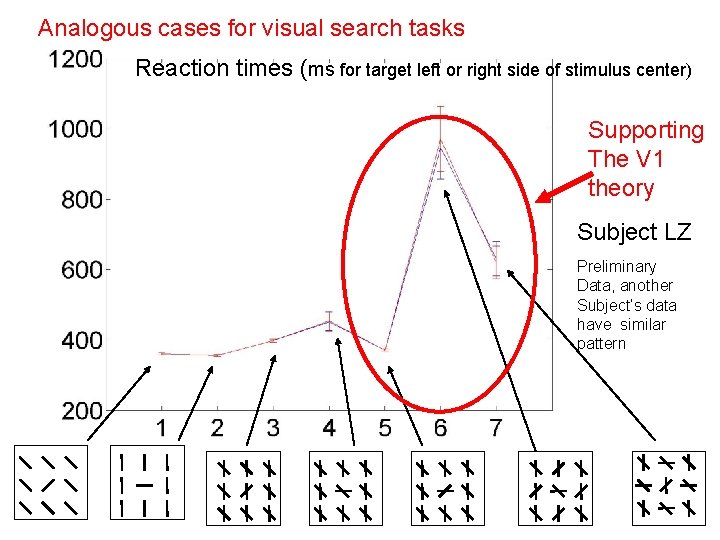
Analogous cases for visual search tasks Stimulus + + + easy Saliency maps Previous theories (sum) easy easier V 1 theory (max) easy Where theories differ! Not easy
Analogous cases for visual search tasks Reaction times (ms for target left or right side of stimulus center) Supporting The V 1 theory Subject LZ Preliminary Data, another Subject’s data have similar pattern
Summary: Theory: V 1 --- saliency map for pre-attentive segmentation. Linking physiology with psychophysics. Theory “tested” or demonstrated on an imtation V 1 (model) ---Recurrent network model: from local receptive fields to global behaviour for visual tasks. Tested psychophysically to contrast with previous frameworks of saliency map. Other predictions, some already confirmed, others to be tested. “A saliency map in primary visual cortex” by Zhaoping Li, published in Trends in Cognitive Sciences Vol 6, No. 1, page 9 -16, 2002, see http: //www. gatsby. ucl. ac. uk/~zhaoping/ for more information.