
Understanding Universal Screening for Social Emotional and Behavioral
Understanding Universal Screening for Social, Emotional, and Behavioral Risks and Strengths You will be muted during this session, except during breakouts. Need help? Type into the chat box Presented by the VTPBIS State Team This session will be recorded. If you’d like to access the recording, please email anne. dubie@uvm. edu. Materials can be found at:
Welcome! You will be muted during this session, except during breakouts. Need help? Type into the chat box You can show or hide your video. This session will be recorded. If you’d like to access the recording, please email anne. dubie@uvm. edu. Materials can be found at:
Acknowledgements
Agenda What is the context? What is screening? Why is it important? What does it look like? What are considerations? How do we get started?
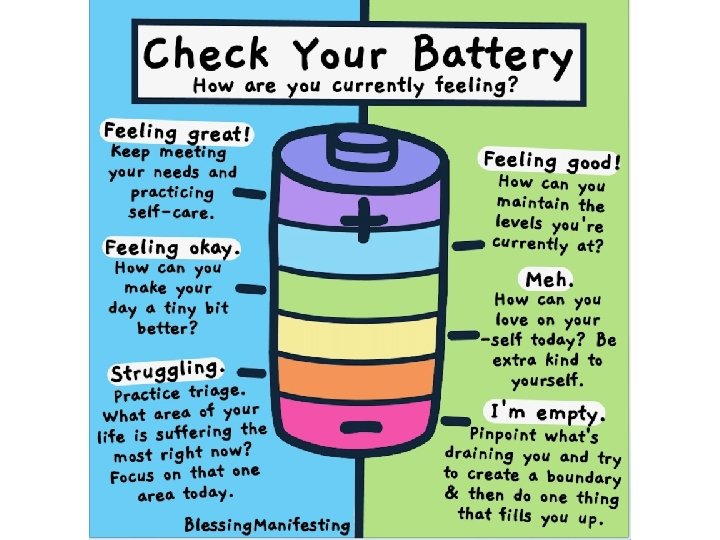
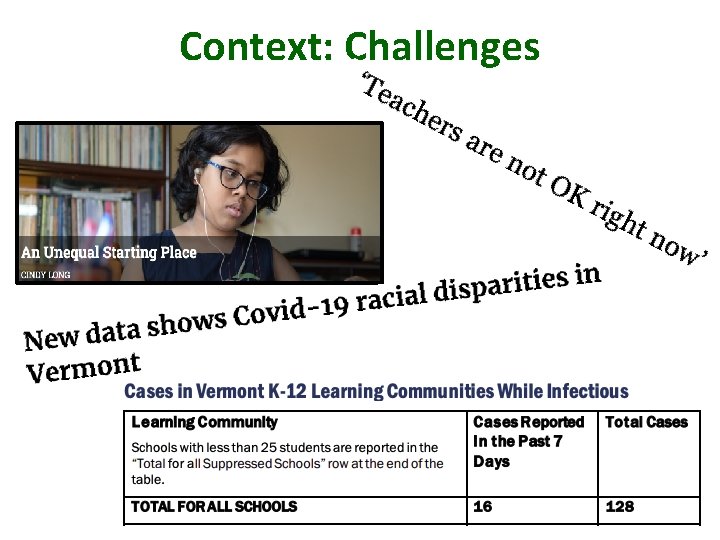
Context: Challenges
Context SUs/SDs and schools planning for students, staff, and families during COVID-19 must prioritize efforts to address social and emotional learning and mental and behavioral health needs.
A Strong and Healthy Start: Safety and Health Guidance for Vermont Schools “In partnership with mental health partners, develop and implement universal social and emotional screenings in order to identify students who need support” - Vermont Agency of Education AOE Document on Universal Screening Assessments
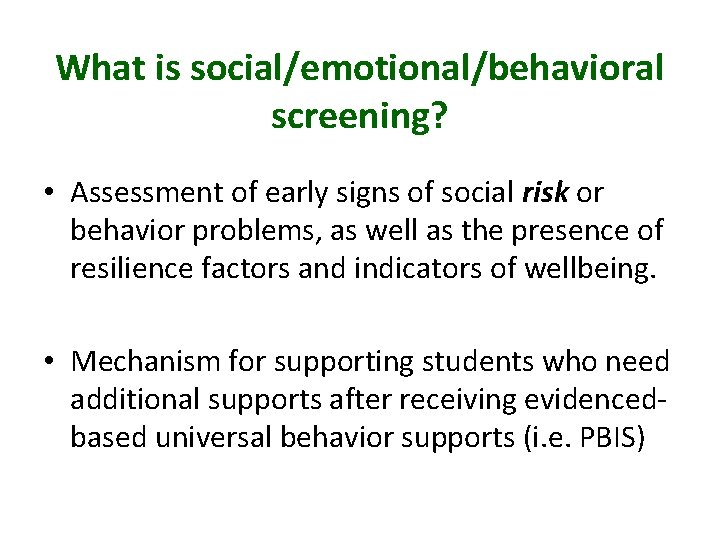
What is social/emotional/behavioral screening? • Assessment of early signs of social risk or behavior problems, as well as the presence of resilience factors and indicators of wellbeing. • Mechanism for supporting students who need additional supports after receiving evidencedbased universal behavior supports (i. e. PBIS)
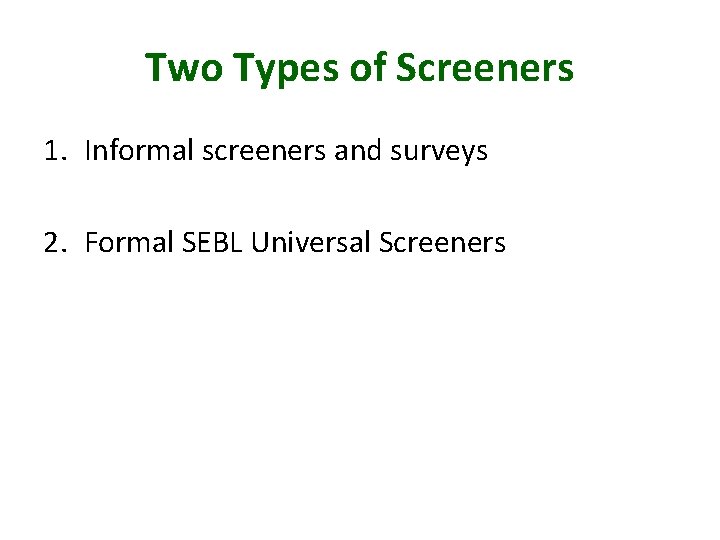
Two Types of Screeners 1. Informal screeners and surveys 2. Formal SEBL Universal Screeners
1. Informal Screeners and Surveys Ways to check-in with students frequently and with staff and families regularly to identify support needs as they emerge Can use other existing data to identify needs as well.
2. Formal Universal Screeners for SEBL Validated instruments that focus on social/emotional/behavioral risks and strengths. A reliable method for determining students with elevated levels of risk.
Informal Screeners and Surveys
Why Conduct Surveys or Screenings? • Students must feel physically and psychologically safe in order to actively engage in learning • Opportunity to invite voice and choice • To identify students or staff perhaps at higher risk for significant stress or trauma from COVID-19 • To determine most efficient and effective use of MH providers, school psychologists, school counselors, community partners • To understand develop adult well-being and capacity to support every student's social and emotional development
Methods of Screening • • Surveys Circles Phone calls Drive-by visits Advisories Video-chat/face-time Using existing data What else?
Please Type Into Chatbox Do you have an informal screening or survey at your school to assess for social/emotional/behavioral concerns? If so, what are you doing?
Informal Screeners and Surveys Examples
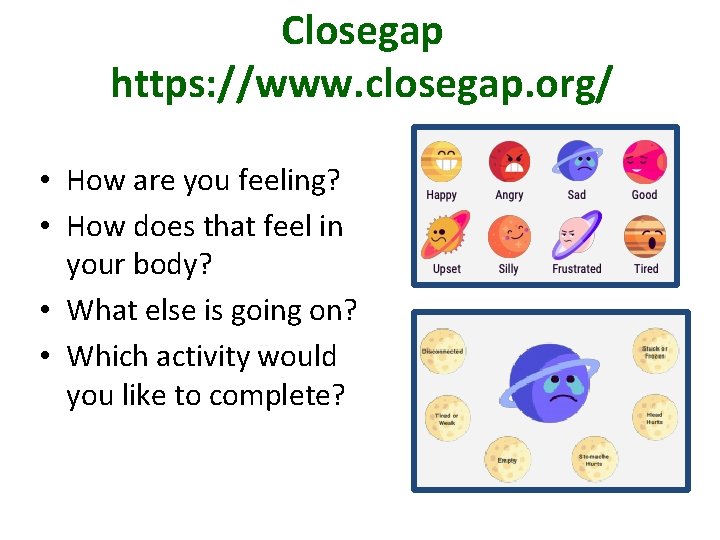
Closegap https: //www. closegap. org/ • How are you feeling? • How does that feel in your body? • What else is going on? • Which activity would you like to complete?
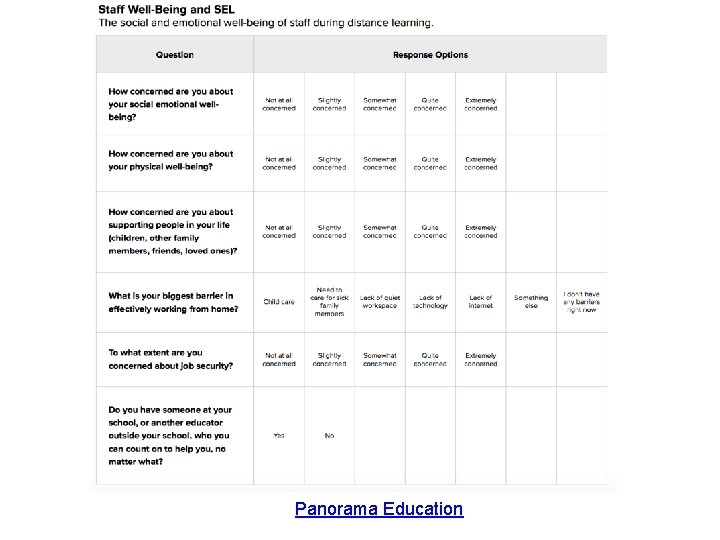
Panorama Education
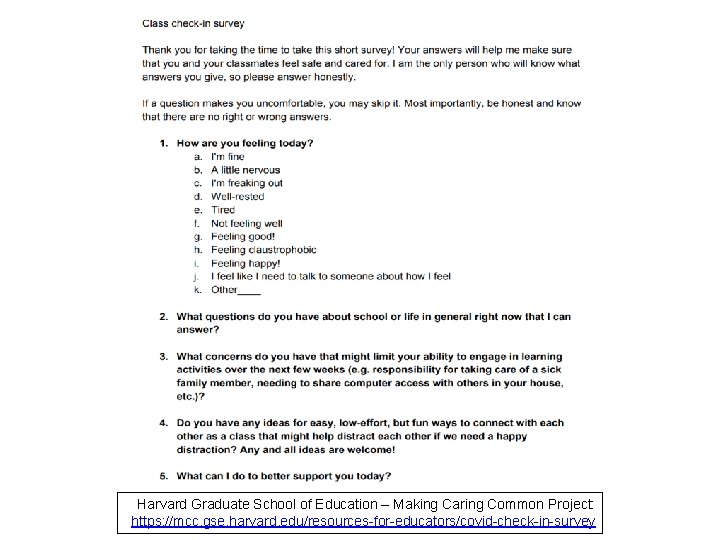
Harvard Graduate School of Education – Making Caring Common Project: https: //mcc. gse. harvard. edu/resources-for-educators/covid-check-in-survey
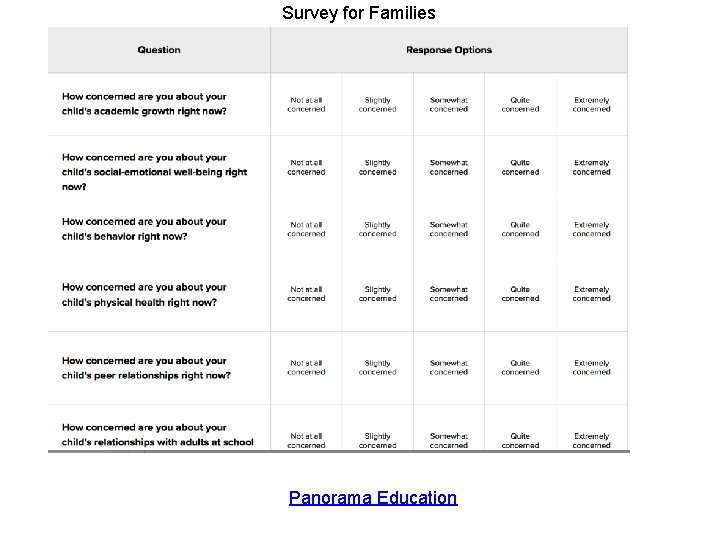
Survey for Families Panorama Education
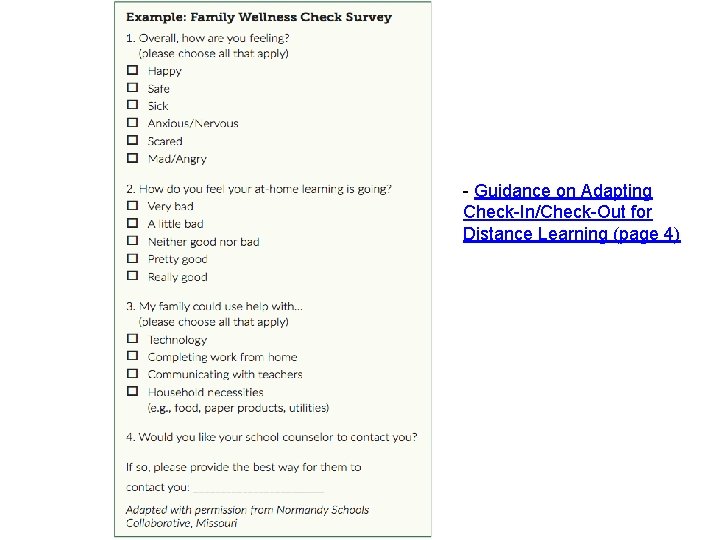
- Guidance on Adapting Check-In/Check-Out for Distance Learning (page 4)
Other SEBL Data to Consider • Behavior Data and Observation Form Referrals (Office Discipline Referrals, or ODRs) • Nurses visits • Suspension/expulsion • Student level of engagement in distance learning • Referrals (from staff, parents, other) • MH caseloads • Data Collection Questions
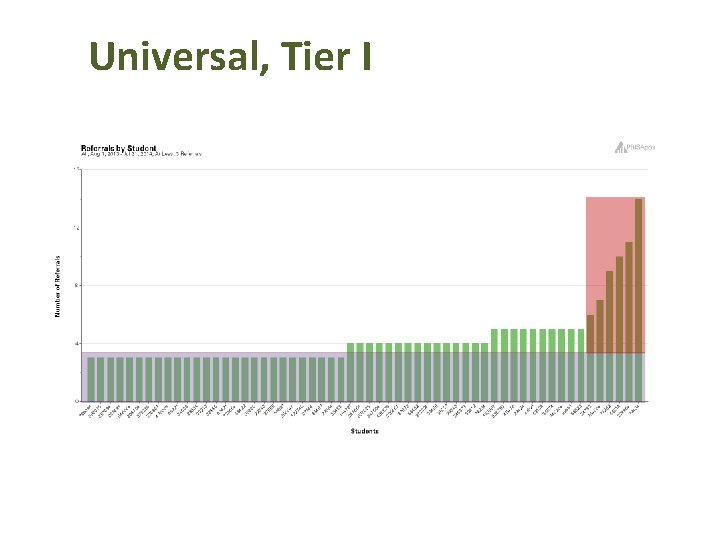
Universal, Tier I
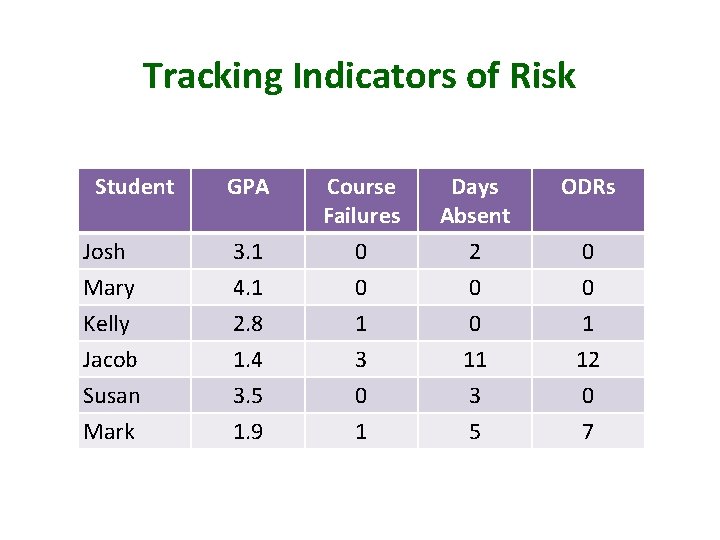
Tracking Indicators of Risk Student Josh Mary Kelly Jacob Susan Mark GPA 3. 1 4. 1 2. 8 1. 4 3. 5 1. 9 Course Failures 0 0 1 3 0 1 Days Absent 2 0 0 11 3 5 ODRs 0 0 1 12 0 7
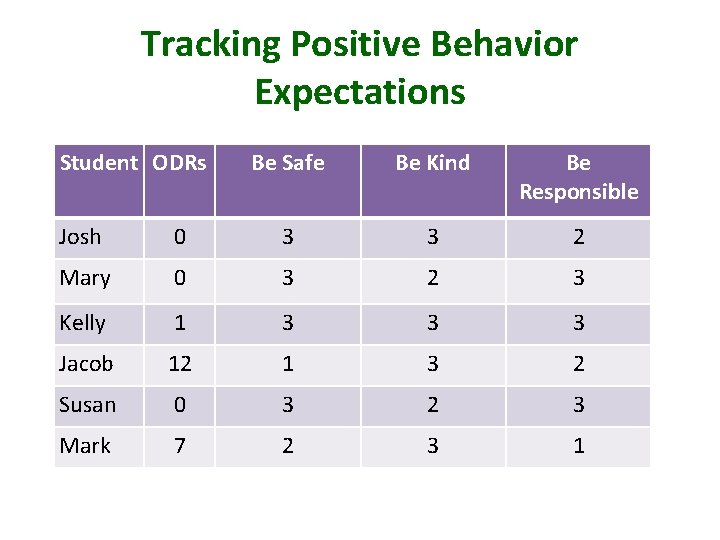
Tracking Positive Behavior Expectations Student ODRs Be Safe Be Kind Be Responsible Josh 0 3 3 2 Mary 0 3 2 3 Kelly 1 3 3 3 Jacob 12 1 3 2 Susan 0 3 2 3 Mark 7 2 3 1
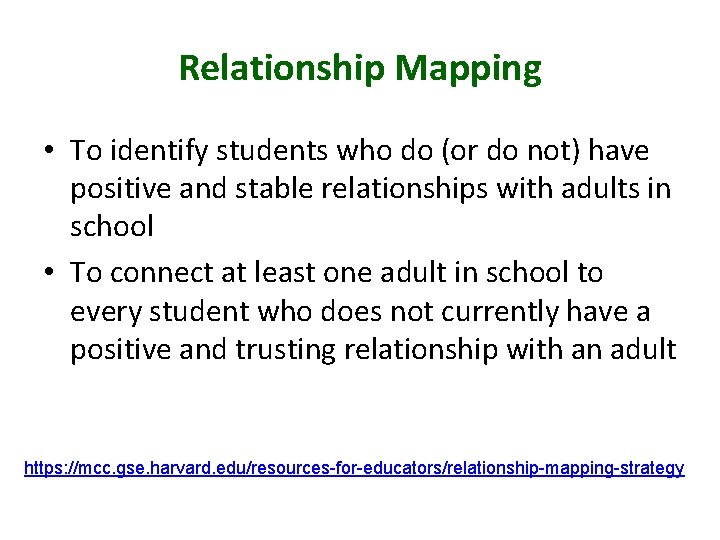
Relationship Mapping • To identify students who do (or do not) have positive and stable relationships with adults in school • To connect at least one adult in school to every student who does not currently have a positive and trusting relationship with an adult https: //mcc. gse. harvard. edu/resources-for-educators/relationship-mapping-strategy
Please Type Into Chatbox: What other data might your “team” look at to determine if supports are needed?
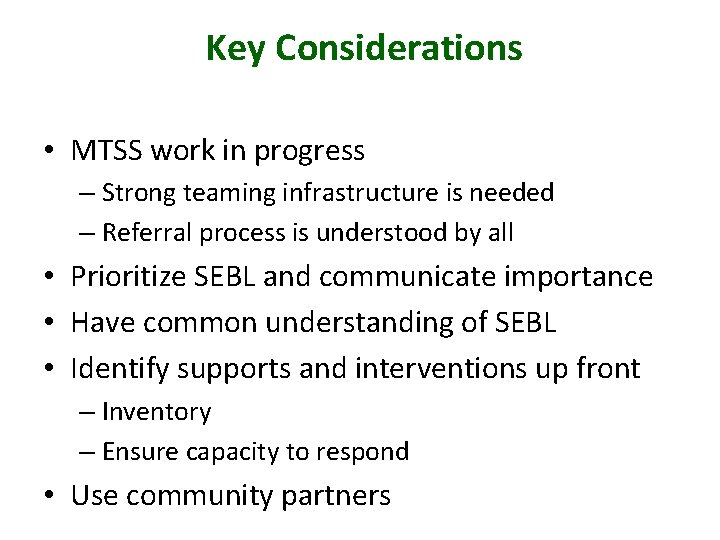
Key Considerations • MTSS work in progress – Strong teaming infrastructure is needed – Referral process is understood by all • Prioritize SEBL and communicate importance • Have common understanding of SEBL • Identify supports and interventions up front – Inventory – Ensure capacity to respond • Use community partners
Why (Formal) Universal Screening? • To find students whose problems are not immediately obvious. • To identify problems with a high degree of accuracy. • Early identification leads to early intervention. • To select interventions based on results of rating scales on the screening tools. This is most effective and efficient.
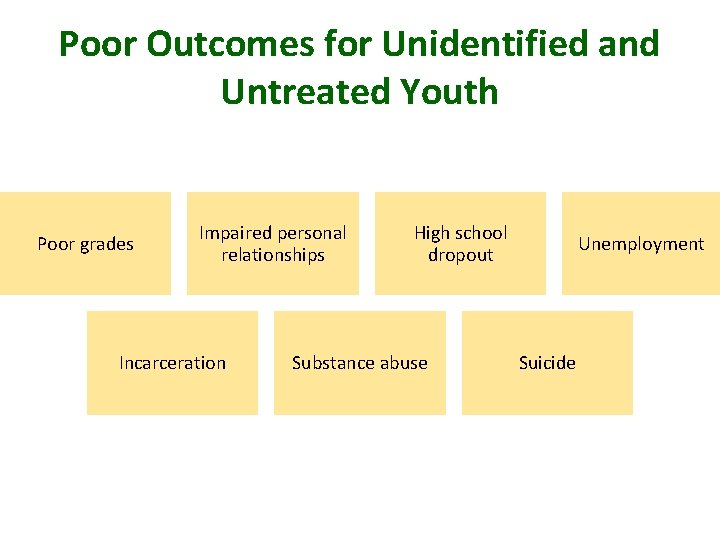
Poor Outcomes for Unidentified and Untreated Youth Poor grades Impaired personal relationships Incarceration High school dropout Substance abuse Unemployment Suicide
What does Universal SEBL Screening Look Like? Teachers (or others) complete a standardized questionnaire, behavior rating scale, or clinical assessment tool on every student to determine if they are experiencing or at-risk for some social, emotional, or behavioral problem (for example, trauma, stress, anxiety, depression, anger, or aggression).
Please Type Into Chatbox: Is your school implementing a Social/Emotional/Behavioral Screener? If so, what tool are you using?
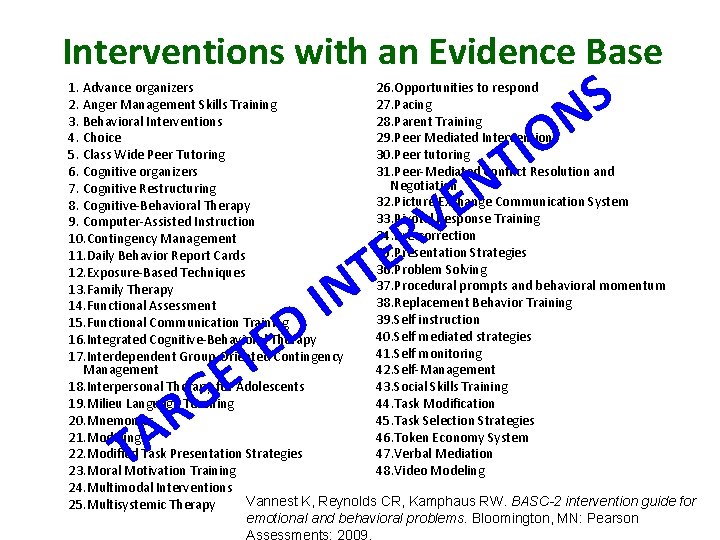
Interventions with an Evidence Base S N 1. Advance organizers 26. Opportunities to respond 2. Anger Management Skills Training 27. Pacing 28. Parent Training 3. Behavioral Interventions 29. Peer Mediated Interventions 4. Choice 30. Peer tutoring 5. Class Wide Peer Tutoring 31. Peer-Mediated Conflict Resolution and 6. Cognitive organizers Negotiation 7. Cognitive Restructuring 32. Picture Exchange Communication System 8. Cognitive-Behavioral Therapy 33. Pivotal Response Training 9. Computer-Assisted Instruction 34. Pre-correction 10. Contingency Management 35. Presentation Strategies 11. Daily Behavior Report Cards 36. Problem Solving 12. Exposure-Based Techniques 37. Procedural prompts and behavioral momentum 13. Family Therapy 38. Replacement Behavior Training 14. Functional Assessment 39. Self instruction 15. Functional Communication Training 40. Self mediated strategies 16. Integrated Cognitive-Behavioral Therapy 41. Self monitoring 17. Interdependent Group-Oriented Contingency 42. Self-Management 43. Social Skills Training 18. Interpersonal Therapy for Adolescents 44. Task Modification 19. Milieu Language Teaching 45. Task Selection Strategies 20. Mnemonics 46. Token Economy System 21. Modeling 47. Verbal Mediation 22. Modified Task Presentation Strategies 48. Video Modeling 23. Moral Motivation Training 24. Multimodal Interventions Vannest K, Reynolds CR, Kamphaus RW. BASC-2 intervention guide for 25. Multisystemic Therapy emotional and behavioral problems. Bloomington, MN: Pearson Assessments; 2009. N E O I T A T G R T E D E I T N V R E
When to Screen? • At least 6 -8 weeks into the school year – Need enough time for observation, interaction, and experience with a student so ratings are reliable and valid • You need to KNOW THE STUDENT! • If done too early and too quickly, the results will largely be invalid, the needed treatment directions will be unclear (or incorrectly focused),
Screening can help identify: Students with externalizing internalizing problems?
Multi-Stage & Multi-Gate Approach to Screening Stage 1 Stage 2 Stage 3 Universal Screen Not elevated? Done. Elevated? Screen #2 Elevated? Refer to team Not elevated? Done.
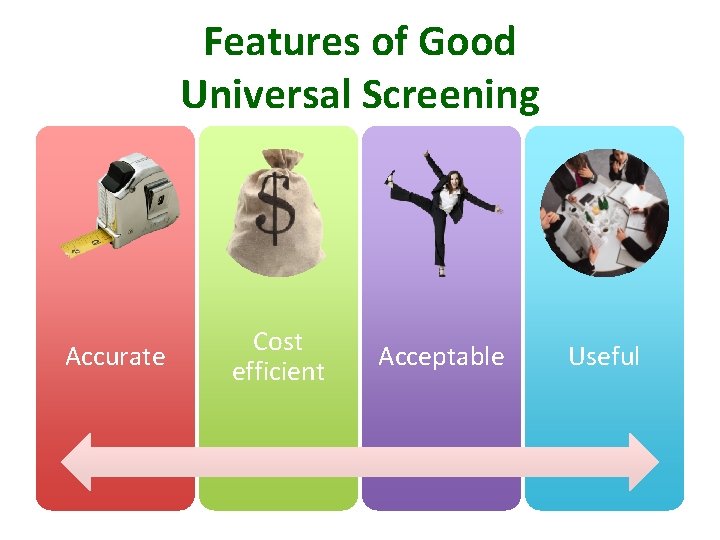
Features of Good Universal Screening Accurate Cost efficient Acceptable Useful
What Screening Tools are out There? http: //www. ci 3 t. org/screening
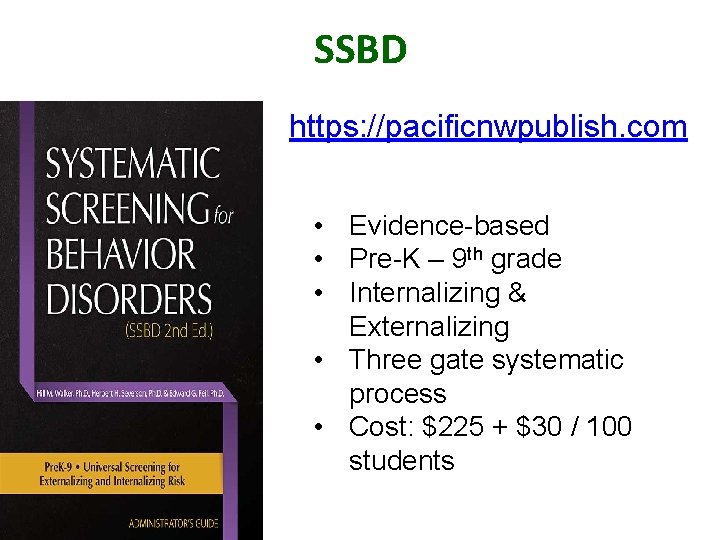
SSBD https: //pacificnwpublish. com _ • Evidence-based • Pre-K – 9 th grade • Internalizing & Externalizing • Three gate systematic process • Cost: $225 + $30 / 100 students
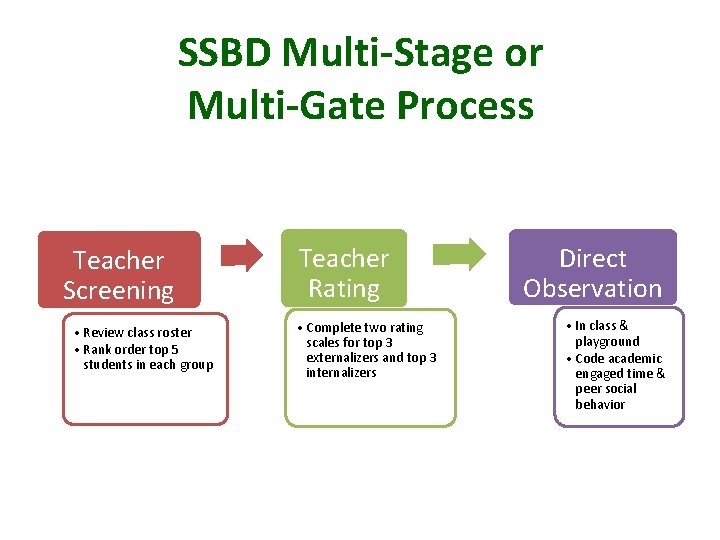
SSBD Multi-Stage or Multi-Gate Process Teacher Screening • Review class roster • Rank order top 5 students in each group Teacher Rating • Complete two rating scales for top 3 externalizers and top 3 internalizers Direct Observation • In class & playground • Code academic engaged time & peer social behavior
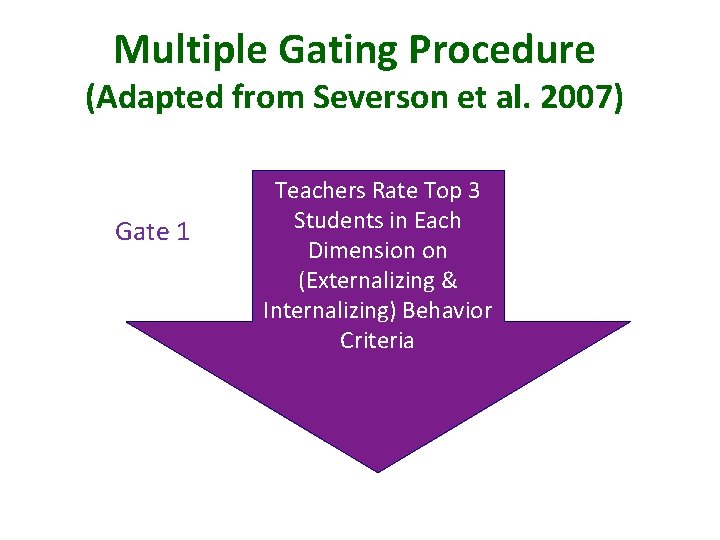
Multiple Gating Procedure (Adapted from Severson et al. 2007) Gate 1 Teachers Rate Top 3 Students in Each Dimension on (Externalizing & Internalizing) Behavior Criteria
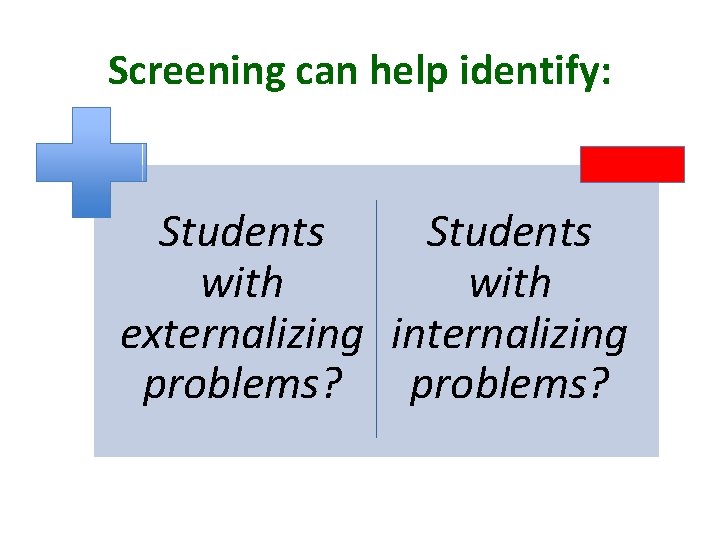
Externalizing refers to all behavior problems that are directed outwardly by the student toward the external social environment. Externalizing behavior problems usually involve behavioral excesses (i. e. , too much behavior) and are considered inappropriate by teachers and other school personnel. 47
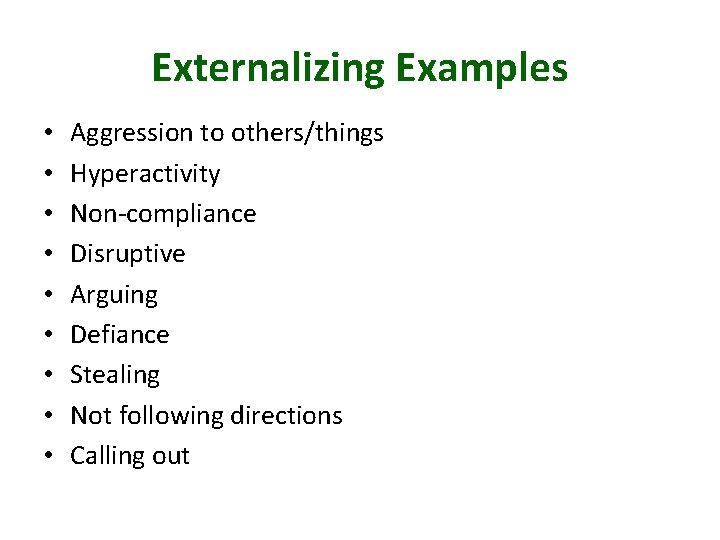
Externalizing Examples • • • Aggression to others/things Hyperactivity Non-compliance Disruptive Arguing Defiance Stealing Not following directions Calling out
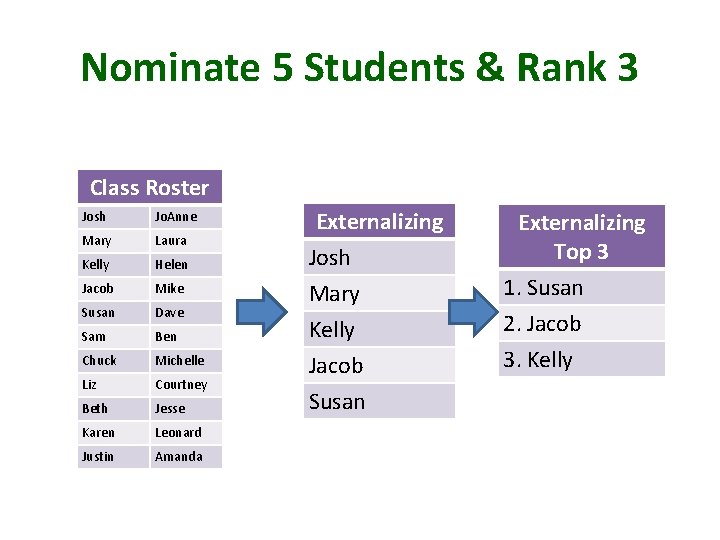
Nominate 5 Students & Rank 3 Class Roster Josh Jo. Anne Mary Laura Kelly Helen Jacob Mike Susan Dave Sam Ben Chuck Michelle Liz Courtney Beth Jesse Karen Leonard Justin Amanda Externalizing Josh Mary Kelly Jacob Susan Externalizing Top 3 1. Susan 2. Jacob 3. Kelly
Internalizing refers to all behavior problems that are directed inwardly (i. e. , away from the external social environment) and that represent problems with self. Internalizing behavior problems are often selfimposed and frequently involve behavioral deficits and patterns of social avoidance. 50
Internalizing Examples • • • Exhibits unusual sadness Sleeps a lot Is teased or bullied by peers Does not participate in games Very shy or timid Acts fearful Does not stand up for self Withdrawn Avoids social interactions
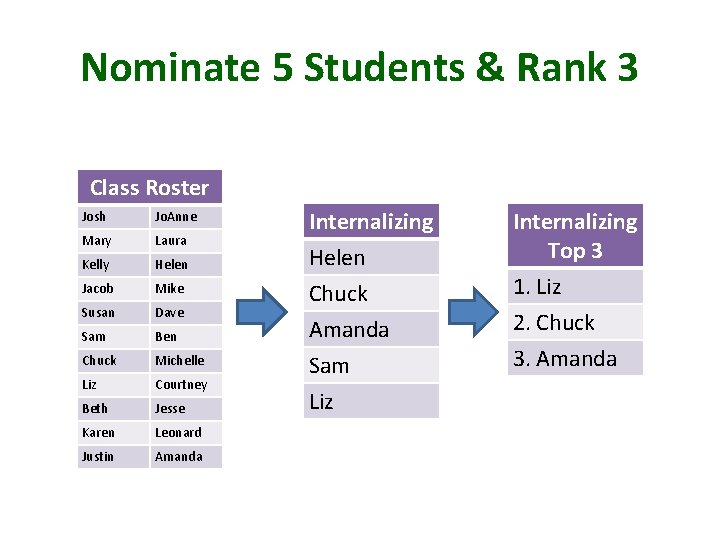
Nominate 5 Students & Rank 3 Class Roster Josh Jo. Anne Mary Laura Kelly Helen Jacob Mike Susan Dave Sam Ben Chuck Michelle Liz Courtney Beth Jesse Karen Leonard Justin Amanda Internalizing Helen Chuck Amanda Sam Liz Internalizing Top 3 1. Liz 2. Chuck 3. Amanda
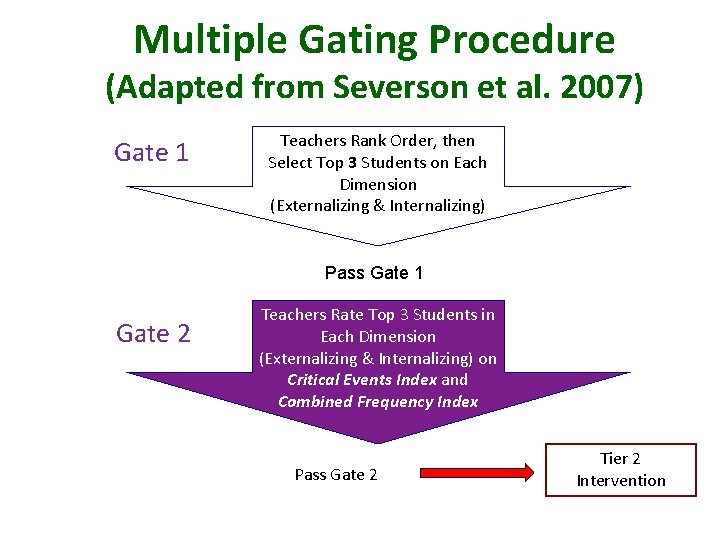
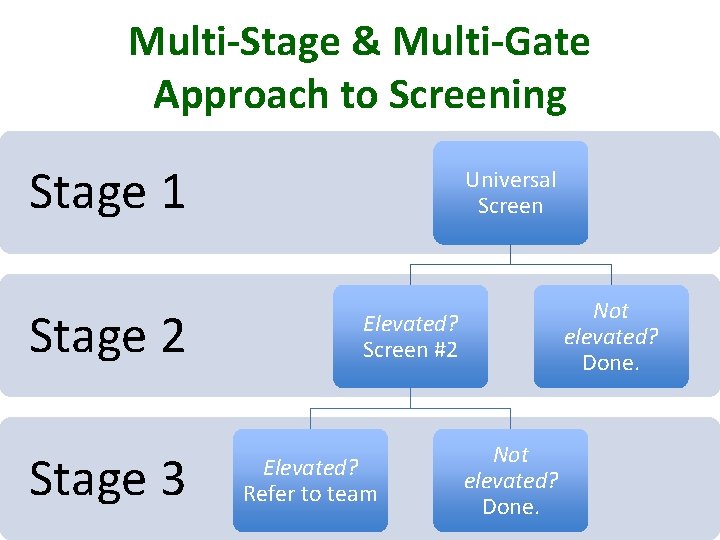
Multiple Gating Procedure (Adapted from Severson et al. 2007) Gate 1 Teachers Rank Order, then Select Top 3 Students on Each Dimension (Externalizing & Internalizing) Pass Gate 1 Gate 2 Teachers Rate Top 3 Students in Each Dimension (Externalizing & Internalizing) on Critical Events Index and Combined Frequency Index Pass Gate 2 Tier 2 Intervention
Scoring • Teachers complete Critical Events Index checklist and Combined Frequency Index for top three internalizers and externalizers – Internalizers with 4+ and externalizers with 5+ critical events immediately pass gate two and are eligible for a simple targeted intervention (i. e. CICO)
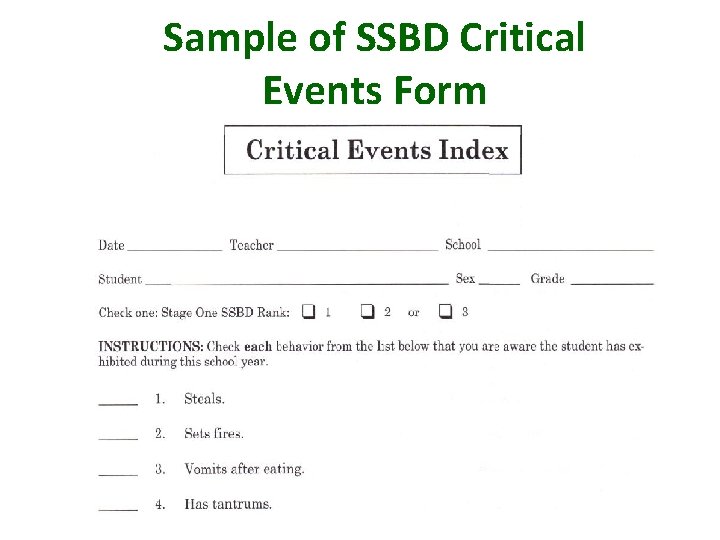
Sample of SSBD Critical Events Form
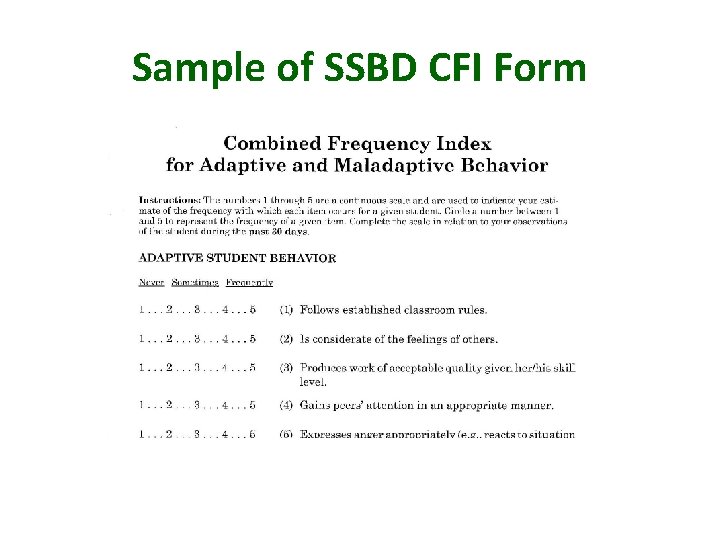
Sample of SSBD CFI Form
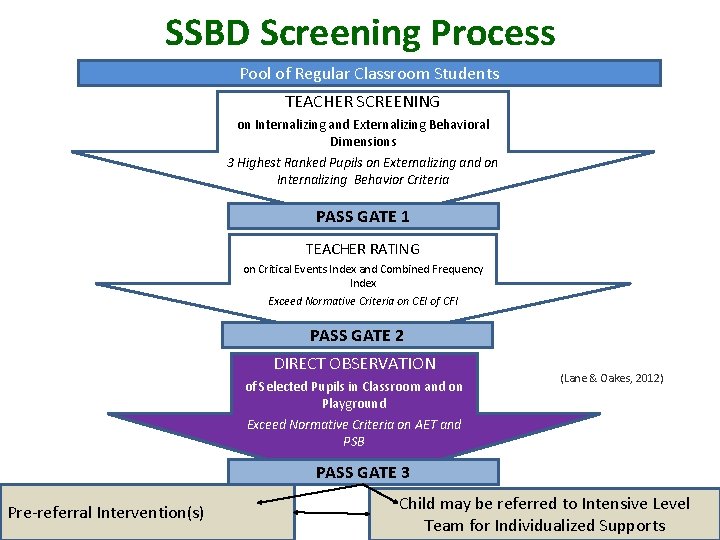
SSBD Screening Process Pool of Regular Classroom Students TEACHER SCREENING on Internalizing and Externalizing Behavioral Dimensions 3 Highest Ranked Pupils on Externalizing and on Internalizing Behavior Criteria PASS GATE 1 TEACHER RATING on Critical Events Index and Combined Frequency Index Exceed Normative Criteria on CEI of CFI PASS GATE 2 DIRECT OBSERVATION of Selected Pupils in Classroom and on Playground (Lane & Oakes, 2012) Exceed Normative Criteria on AET and PSB PASS GATE 3 Pre-referral Intervention(s) Child may be referred to Intensive Level Team for Individualized Supports
VT Example: Mt. Abe Union Supervisory District • Use the BESS and SSIS through Aimsweb • Screen 3 x per year • SEL Coordinator works with school PBIS coordinators to compile other relevant data (ODRs, nurses visits, absences) • Students with elevated risk are matched to interventions • SU Team views data from systems perspective • Grade-level teams view data for particular students
Systematic Screening: Considerations • Recommended 2 -3 times/year – October & February • Group administration of Stage 1 • Teachers should have known students for at least one month (longer this year) • Review definitions/examples of externalizing and internalizing problems
Systematic Screening: Systems Considerations • • • Teaming infrastructure Referral process Universal foundation in place Equity issues SEBL is a stated priority Time for training and coaching
So pretty simple, right? Well… • • • Family’s right to privacy (opt out option) Training & TA Availability of supports Policy and liability issues What else?
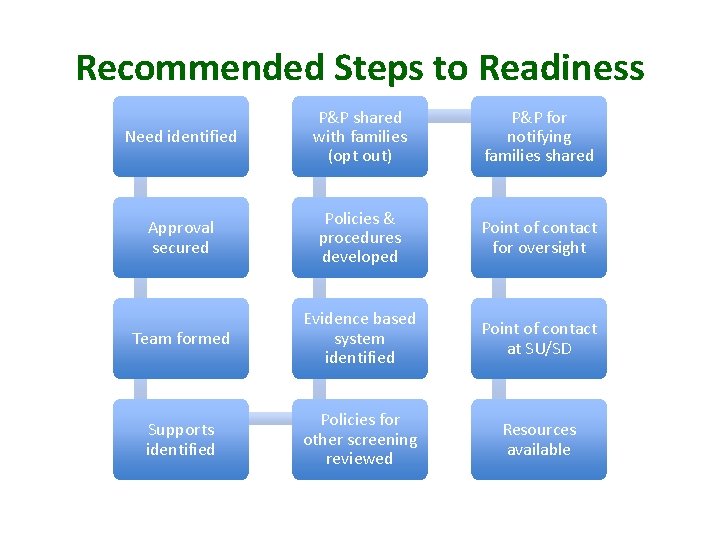
Recommended Steps to Readiness Need identified P&P shared with families (opt out) P&P for notifying families shared Approval secured Policies & procedures developed Point of contact for oversight Team formed Evidence based system identified Point of contact at SU/SD Supports identified Policies for other screening reviewed Resources available
How to Get Started Preparation for Screening Before actual screening–– • Have a solid Universal system (with interventions) already in place • Have an inventory of targeted interventions matched to function • Tie in to existing systems (integration, NOT add-on) • Identify your school’s risk factors, or other behavior indicators you will track • Create a calendar for when your screenings will occur
How to Get Started Preparation for Screening Select a Coordinator–– Someone with strong: • Organizational skills • Leadership skills • Experience with assessment tools
How to Get Started Preparation for Screening Before actual screening–– • Provide plan for seamless transition from screening to intervention • Provide teacher training • Provide parental notification of screening and parental consent to intervene with youth identified by screener
What’s Next? 1. Review Universal Screening Steps to Readiness 2. Determine where is your school in this process 3. Review and select tools

http: //www. ci 3 t. org/screening _

Another amazing resource! https: //smhcollaborative. org/wpcontent/uploads/2019/11/universalscreening. pdf _
Resources _ All resources can be found at www. pbisvermont. org _ _ What questions do you have? _ _
- Slides: 68