
Understanding Total Hip Replacement Brian J White MD
Understanding Total Hip Replacement Brian J. White MD Orthopaedic Specialist in Disorders of the Hip Western Orthopaedics – Denver, Colorado
Introduction l This is designed to provide you with a better understanding of: Anatomy of the Hip l Risks and Benefits of Total Hip Replacement l Expectations of the procedure l
My Training l Washington l BA Chemistry l Georgetown l and Lee University School of Medicine Medical Degree l NYU/Hospital l for Joint Diseases Orthopaedic Surgical Residency l Steadman-Philippon Research Institute: Vail, CO Sports Medicine Fellowship in Knee, Shoulder and Hip l Mentors: Dr. Steadman and Dr. Philippon l
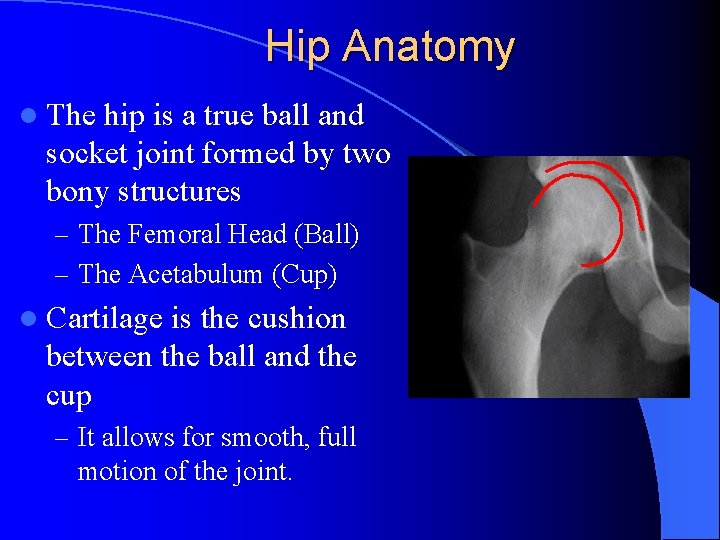
Hip Anatomy l The hip is a true ball and socket joint formed by two bony structures – The Femoral Head (Ball) – The Acetabulum (Cup) l Cartilage is the cushion between the ball and the cup – It allows for smooth, full motion of the joint.
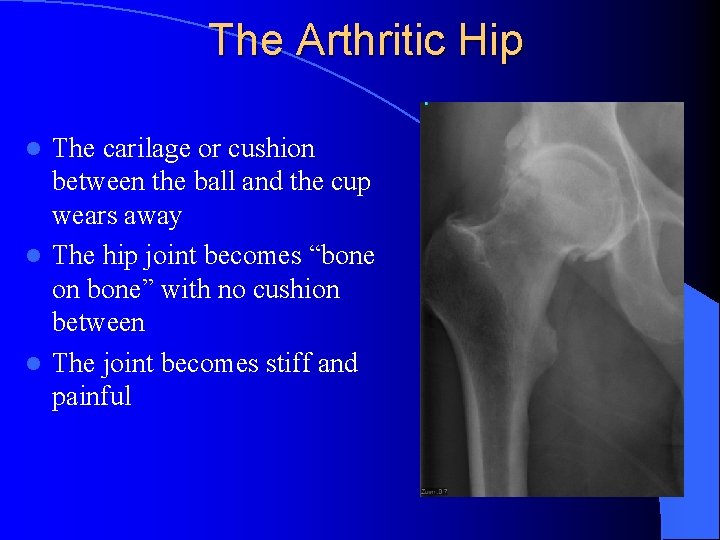
The Arthritic Hip The carilage or cushion between the ball and the cup wears away l The hip joint becomes “bone on bone” with no cushion between l The joint becomes stiff and painful l
Common Symptoms with an Arthritic Hip l Pain l with: Walking, twisting, pivoting and bending over l Difficulty l l Loss with: Putting on shoes and socks, shaving legs, getting out of a low chair of function and fun activities l Pain worsens with time and more use
Non-operative strategies for an arthritic hip NSAIDS as needed for pain l Modification of activity to avoid pain l Physical Therapy l Hip injections- typically not as helpful as they are in the shoulder or the knee, so I will rarely recommend them. They can be helpful though sometimes to try and get back to a more functional baseline if there has been an acute decline. l – They can not be given within 3 months of your total hip replacement because they can increase your risk of infection.
When is it time to have your hip replaced? l Your pain is experienced daily and getting worse l You have already modified your activity and lifestyle and are not happy with the restrictions that you have l You are getting upset because the pain and restrictions are getting to be too excessive l This is an elective procedure – YOU decide when it is time to move forward this

What type of hip replacement do I perform? l Posterior approach There has been no clinically proven benefit to other approaches. I believe this is the best approach. l This allows me to get your total hip in the most perfect position (this has been proven to affect the longevity and durability of your total hip replacement) l The anterior approach can create unfixable problems with tendons and nerves and is more often associated with incomplete incorporation of your femoral component and fracture of the femur l l NO METAL ON METAL components

Total Hip Components: l Biomet G 7 Osseo. Ti Cup l Smith and Nephew Synergy HA/Porous Stem or the Depuy Summit l Oxinium or Biolox Ceramic Head l Zimmer Vivacit-E ultra high molecular polyehylene liner l Screws to hold the cup in place while it incorporates

Dual Mobility Total Hip l Occasionally, I need to use this in patients with a higher risk for dislocation: – EDS, Extensive spinal fusion to pelvis, very flexible hip before surgery I use the same stem, cup and ball l The bearing is different: The ball is within the liner that moves inside of the cup giving a larger arc of motion l This may wear out faster than a standard total hip l Metal Liner l – I don’t use this in people who are highly sensitive or allergic to metals Standard Total Hip Replacement: The plastic liner locks into the cup. Dual Mobility: The plastic liner pops onto the ball and both the ball and the liner move within the cup.
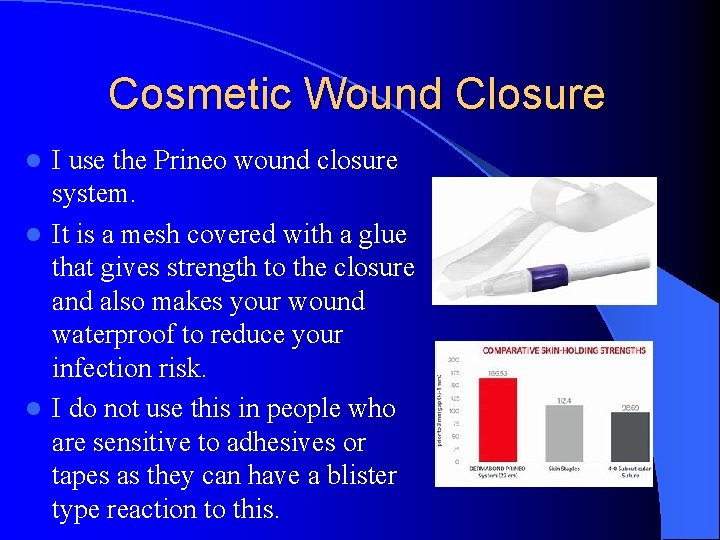
Cosmetic Wound Closure I use the Prineo wound closure system. l It is a mesh covered with a glue that gives strength to the closure and also makes your wound waterproof to reduce your infection risk. l I do not use this in people who are sensitive to adhesives or tapes as they can have a blister type reaction to this. l
Durability of a total hip replacement l 80 -90% should last 15 -25 years if used responsibly – Simulator studies may suggest 25 -30 years but they have been implanted in humans for only 15 years. l All of my chosen components have an excellent track record l Total hip replacement remains the best procedure we have in Orthopaedics l It very reliably takes away pain and improves function
What activity can you do after a total hip replacement? l Walking, elliptical, hiking l Aerobics, Yoga and Pilates l Cycling l Skiing l Golf, doubles tennis l I recommend against running
Complications of Total Hip Replacement l Infection l Leg length discepancy l Dislocation l Blood Clots l Fracture
Infection Rare, occurs in <1% of cases l Risk is increased with Diabetes, Smoking and Obesity l If it occurs, additional surgery is required combined with several months of IV antibiotics to try and retain your total hip replacement l Risk is reduced by: l l l Antibiotics before and after surgery and oral antibiotics after Sterile technique and clean hospital Antibiotic solution used during surgery Antibiotic powder placed behind your components After surgery: l l Take antibiotics before any medical, dental or surgical procedure to protect your hip ( I recommend this for life) • 2 grams of Amoxicillin 1 hour before Aggressively treat any infections in your body if they occur (ie: urinary tract, skin infections, mouth infections) so that your hip does not get infected secondarily
Leg Length Discrepancy l An arthritic hip typically shortens that leg because of the loss of cartilage thickness and deformity to the femoral head l A total hip will typically lengthen the hip to its original length l I use a computer program to plan your procedure to minimize the potential of over lengthening your leg l My goal is symmetry when this is possible
Dislocation l This can occur because with a total hip replacement the ball is smaller than your original ball (femoral head) l Occurs in 2% of total hip replacements, this can be higher if you are not fully arthritic preoperatively as you have more baseline motion l The following positions are avoided for 6 -8 weeks after your hip is replaced to ensure stability: Hip Flexion more than 90 degrees l Crossing your hip across the midline l Internally rotating your hip l l After 6 -8 weeks, 1 or 2 of these positions can be combined but all 3 at once should be avoided
Blood Clots 1 -2% of total hip replacements l I use Aspirin 325 mg 2 times per day for 4 weeks and leg pumps for 4 weeks after surgery to minimize this risk l If you have a predisposition to blood clots or have had one in the past, please let me know as I may make some changes to your postoperative medications and use more aggressive blood thinning medications. – There is a balance-if the blood is too thin you can get a hematoma, which is a collection of blood around your hip that can increase your risk of infection. l
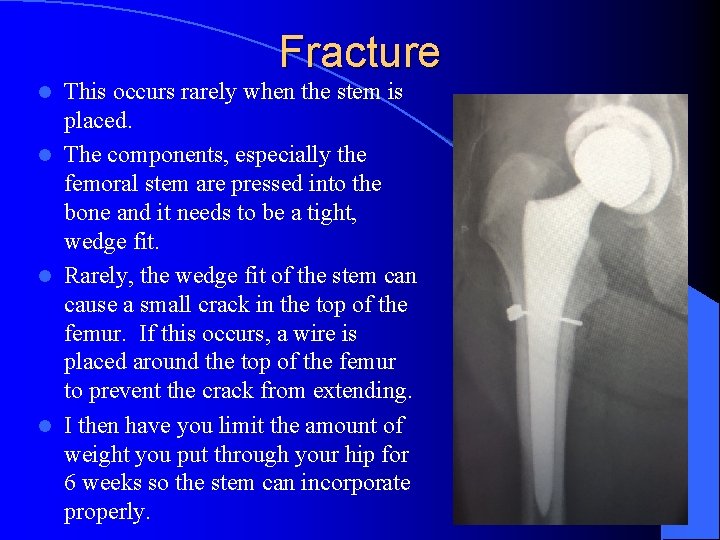
Fracture This occurs rarely when the stem is placed. l The components, especially the femoral stem are pressed into the bone and it needs to be a tight, wedge fit. l Rarely, the wedge fit of the stem can cause a small crack in the top of the femur. If this occurs, a wire is placed around the top of the femur to prevent the crack from extending. l I then have you limit the amount of weight you put through your hip for 6 weeks so the stem can incorporate properly. l
Hospitalization I perform my surgeries at Porter Adventist Hospital l I do not like surgery centers for this operation. I do not believe total hip replacements should be sent home the same day. It can be too overwhelming for you and your family. l All are performed on Monday or Tuesday l Patients go home or to a skilled nursing facility between Wednesday and Friday l l This determination is made in the hospital based on how you do and what you have for your support at home. I am flexible. You will not feel rushed to go home-I truly want you to feel safe and comfortable before you leave the hospital.
Things to do before your total hip l Raised toilet seat l Shower chair or bench l Get your body weight to an ideal position 4 -5 times your body weight is put through your hip with use l Losing weight will improve the longevity of your hip and allow you to get around better immediately after surgery l It will also allow for a smaller incision and reduce your risk of infection l l Take l care of any dental procedures before If you have any loose or diseased teeth, these must be pulled or treated before your total hip – this represents a significant risk factor for infection
What to expect l Full weight bearing as you tolerate l Crutches, cane or walker for 2 -4 weeks as you need for balance and support l Return to work in 3 -6 weeks depending on you and your work (more manual or heavy work will take longer) l Normal daily function by 2 months l Full recovery by 4 -6 months
Physical Therapy l Physical therapy after your total hip replacement is critical to get the full benefit of this procedure l At home therapy is arranged in the hospital for 1 -2 weeks until you are mobile enough for outpatient physical therapy (if you need it) l Outpatient PT- my office can make recommendations for you if you do not already have a therapist l This can last for 2 -6 months depending on individual needs and goals
Post-opertive Followup l 2 weeks l 8 weeks l 6 months l 1 year and then every year after to check your x-ray and prosthesis
My Commitment l When a patient decides to have surgery with me, I take that responsibility very seriously. I put everything I have into every surgery that I perform to ensure that my patients have the best possible outcome.
Thank you l. I hope this has allowed you to better understand your diagnosis and what total hip replacement could do for you. l Total hip replacement remains the best and most predictable surgery we have in Orthopaedics l Please feel free to call us if you have any further questions. 303 -321 -1333
- Slides: 27