
Understanding the world around us through the Scientific

- Slides: 18
Understanding the world around us through the Scientific Method
Scientific Method Notes Goals of science: • To investigate, understand, and explain the natural world • To predict future events using explanations
Scientific Method Notes Scientific Method 1. Observation: use of the five senses to gather information (data) a. quantitative: characteristic that involves numbers (counting or measuring) b. qualitative: characteristic that is descriptive (does not involve numbers)
2 Types of Observations Qualitative Observation: an observation that is descriptive. ● The cat ran quickly. ● The plant appeared to be shriveled. ● The road is long. Quantitative Observation: an observation that is based on measurement. ● The cat weighs 4 pounds. ● The plant is 45 mm tall. ● The road is 5 km long.
Agree/disagree? 1. Given the same set of evidence, most scientists will arrive at the same conclusion. 2. Every scientific question has a single correct answer.
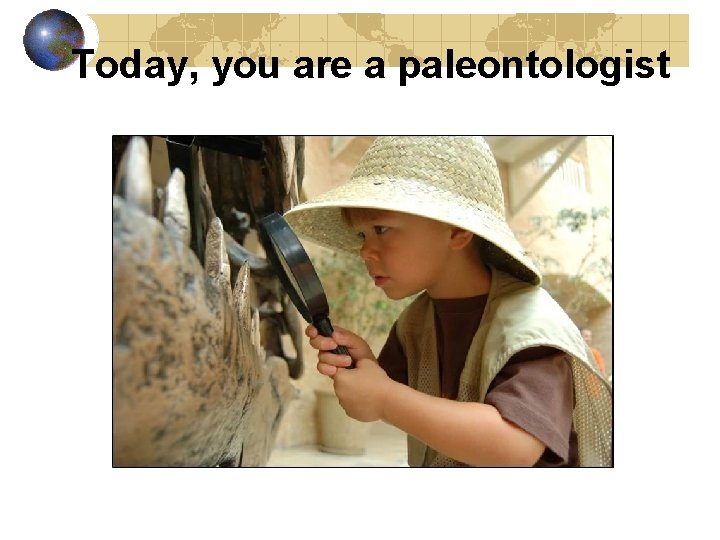
Today, you are a paleontologist
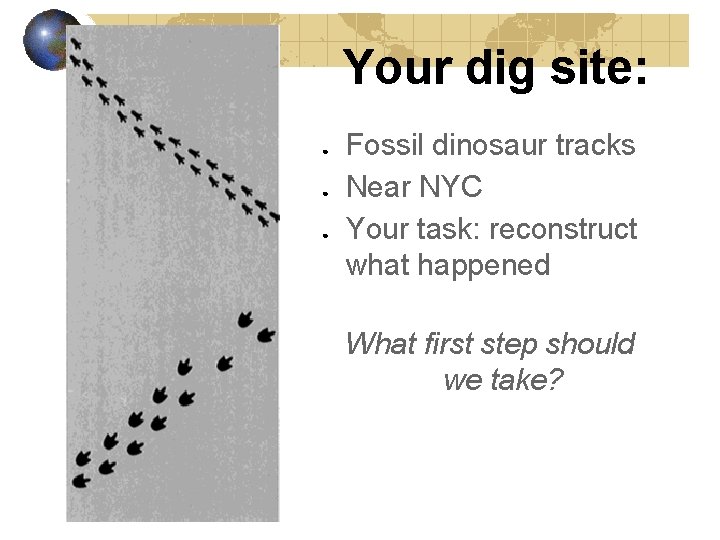
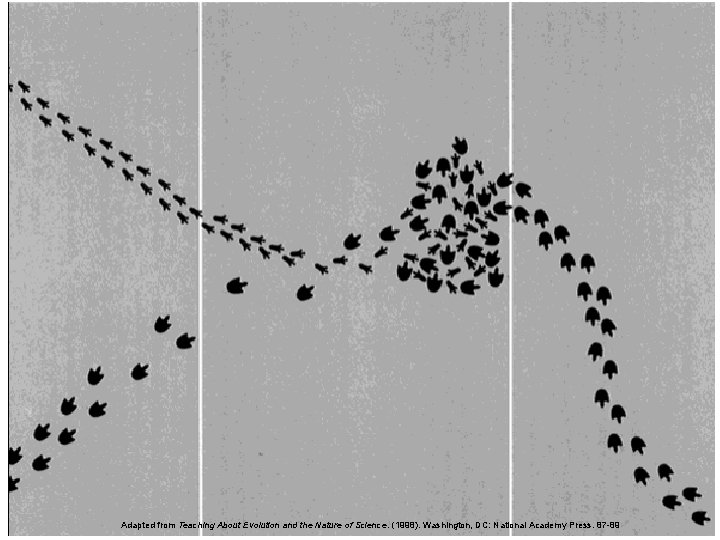
Your dig site: ● ● ● Fossil dinosaur tracks Near NYC Your task: reconstruct what happened What first step should we take?
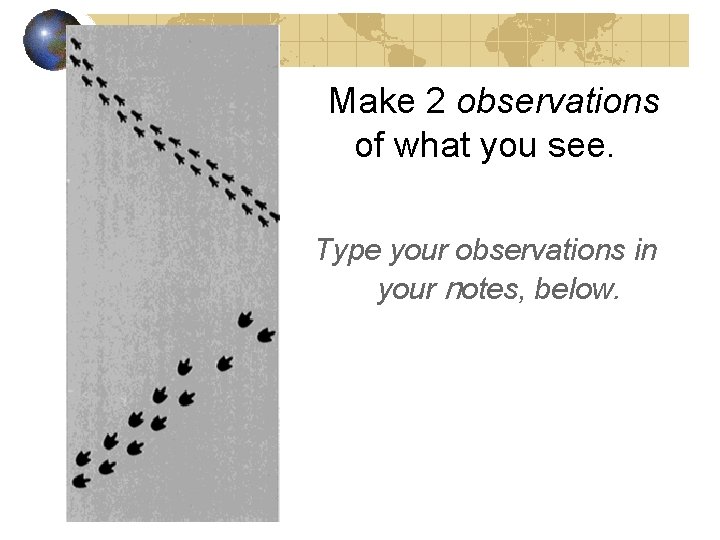
Make 2 observations of what you see. Type your observations in your notes, below.
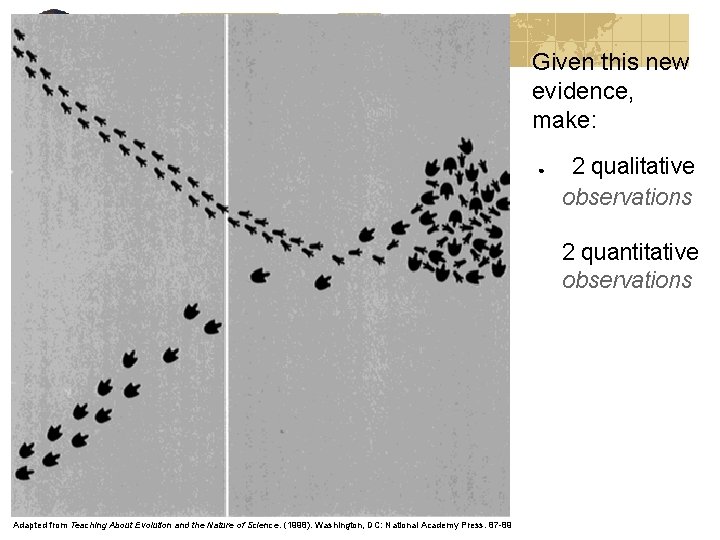
Given this new evidence, make: ● 2 qualitative observations 2 quantitative observations Adapted from Teaching About Evolution and the Nature of Science. (1998). Washington, DC: National Academy Press. 87 -89
Adapted from Teaching About Evolution and the Nature of Science. (1998). Washington, DC: National Academy Press. 87 -89
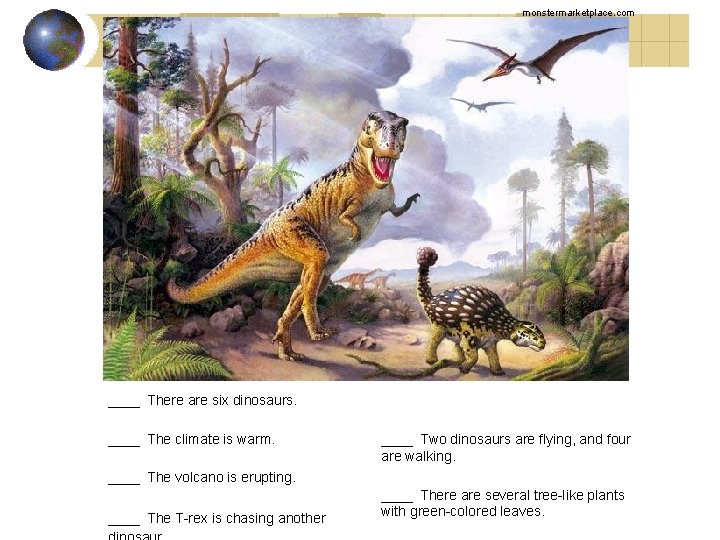
monstermarketplace. com ____ There are six dinosaurs. ____ The climate is warm. ____ Two dinosaurs are flying, and four are walking. ____ The volcano is erupting. ____ The T-rex is chasing another ____ There are several tree-like plants with green-colored leaves.
Scientific Method Notes 2. hypothesis: possible explanation for a set of observations; possible answer to a scientific question
Scientific Method Notes 3. experiment: test of a hypothesis a. control: experimental factor that stays the same in all tests b. variable: experimental factor that changes between tests c. Change only one variable at a time!
Scientific Method Notes 4. results: written record of observations and measurements (data) from an experiment Example: notes, graphs, tables and charts
Scientific Method Notes 5. Conclusion: uses results to show that the hypothesis was supported (correct) or rejected (incorrect) Includes error analysis A good scientist would repeat his/her experiment several times and then publish the results so other scientists can repeat it as well!
Scientific Method Notes 6. Theory: hypothesis that is supported by evidence from many experiments • Allows scientists to make predictions about future events • NOT a fact – it may be revised or replaced
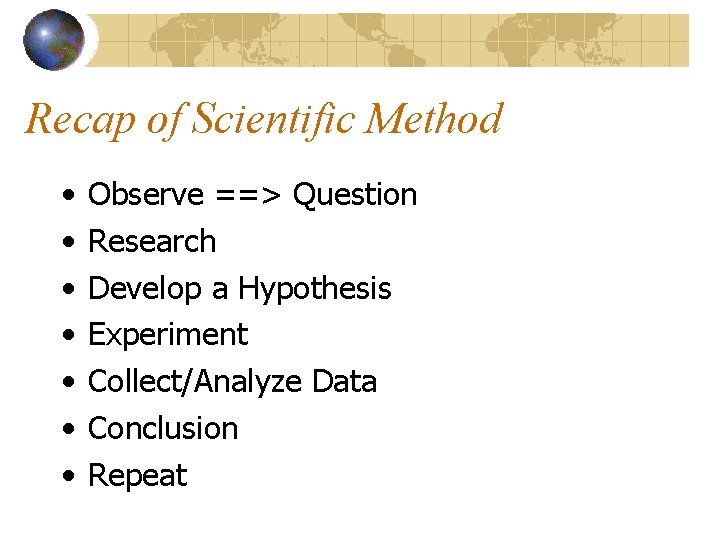
Recap of Scientific Method • • Observe ==> Question Research Develop a Hypothesis Experiment Collect/Analyze Data Conclusion Repeat
Turn to you’re A/B partner • Explain the steps of the Scientific Method to your neighbor. • A goes first. • Then B.