
Understanding the Washington Group Measures Distinguishing disability status
Understanding the Washington Group Measures: Distinguishing disability status from response error
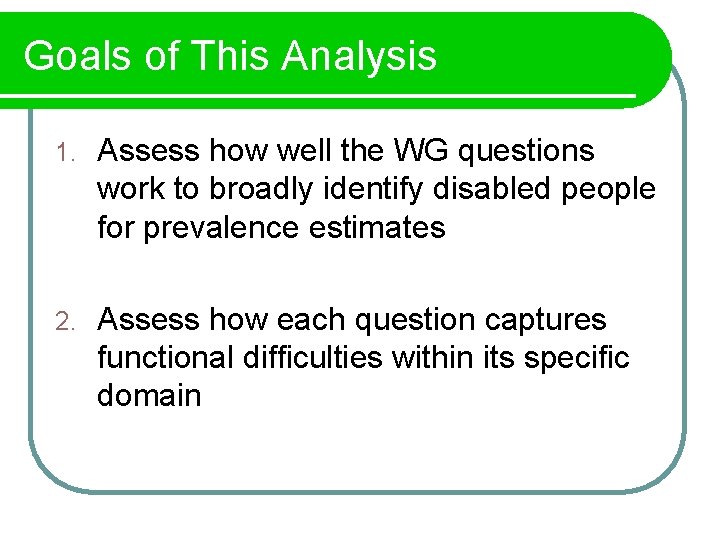
Goals of This Analysis 1. Assess how well the WG questions work to broadly identify disabled people for prevalence estimates 2. Assess how each question captures functional difficulties within its specific domain
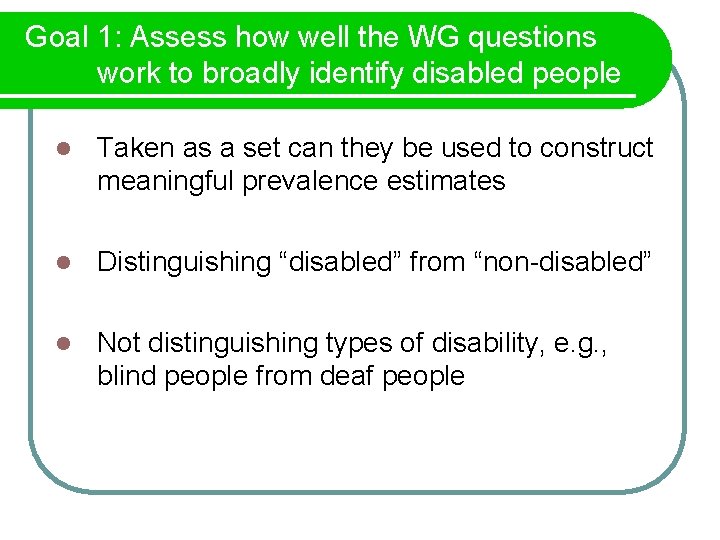
Goal 1: Assess how well the WG questions work to broadly identify disabled people l Taken as a set can they be used to construct meaningful prevalence estimates l Distinguishing “disabled” from “non-disabled” l Not distinguishing types of disability, e. g. , blind people from deaf people
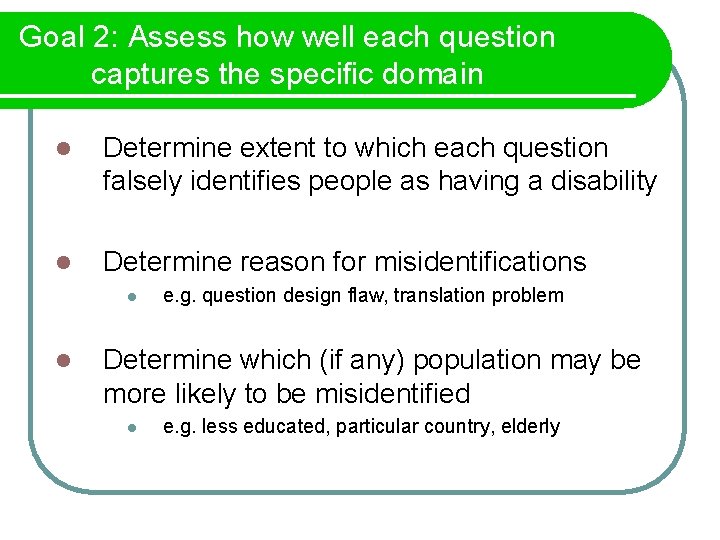
Goal 2: Assess how well each question captures the specific domain l Determine extent to which each question falsely identifies people as having a disability l Determine reason for misidentifications l l e. g. question design flaw, translation problem Determine which (if any) population may be more likely to be misidentified l e. g. less educated, particular country, elderly
Outline of Presentation l Background information Purpose of cognitive test l Instrument and method for collecting data l Brief review of initial pattern analysis l l Goal 1 Analysis -- “prevalence” l Goal 2 Analysis – “false positives”

Purpose of Cognitive Testing l Interviews: Designed to examine the stages of the question response process l Comprehension, retrieval, judgment, response l Analysis: Identify potential response errors l Identify patterns of interpretation l

Cognitive Interview Protocol I. Demographic Section: Country, language, gender, age, II. Question Testing Sections SES A. B. C. D. E. Core Question Interviewer Coding Open-ended Follow-up Probe Cognitive Follow-up Probe Functioning Follow-up Probe III. Health Questions: subjective health, chronic condition list IV. Interviewer Debriefing

Data Collection for Cognitive Test l 15 Countries: South & Central American, Asia, Africa l Country roles: l l l Trained interviewers (with prepared materials) Conducted interviews Entered data l l l Prepared Excel spreadsheet Performed quality check Performed initial analysis Sent data to WG for larger, combined analysis Total Sample: N=1290
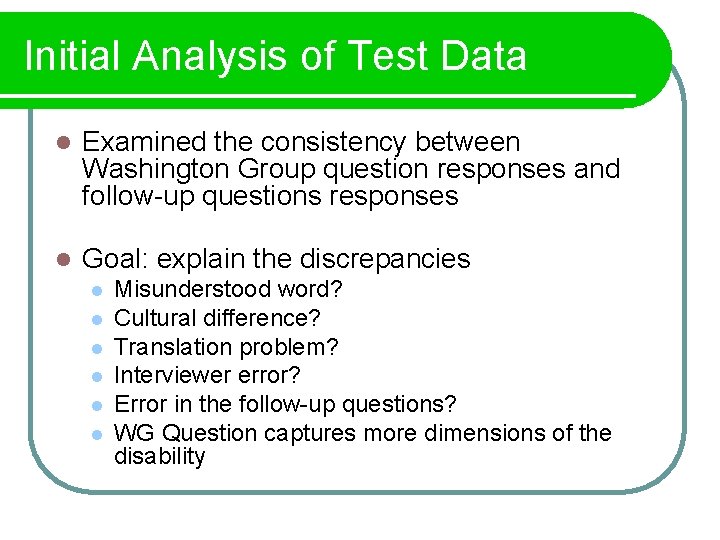
Initial Analysis of Test Data l Examined the consistency between Washington Group question responses and follow-up questions responses l Goal: explain the discrepancies l l l Misunderstood word? Cultural difference? Translation problem? Interviewer error? Error in the follow-up questions? WG Question captures more dimensions of the disability

Initial Analysis: Problematic Responses Inconsistencies between the WG question and follow-up questions Do you have difficulty seeing, even if wearing glasses? No Do you have difficulty seeing and recognizing a person you know from 7 meters (20 feet) away? A lot of difficulty Do you have difficulty seeing the print in a map, newspaper or book? Some difficulty
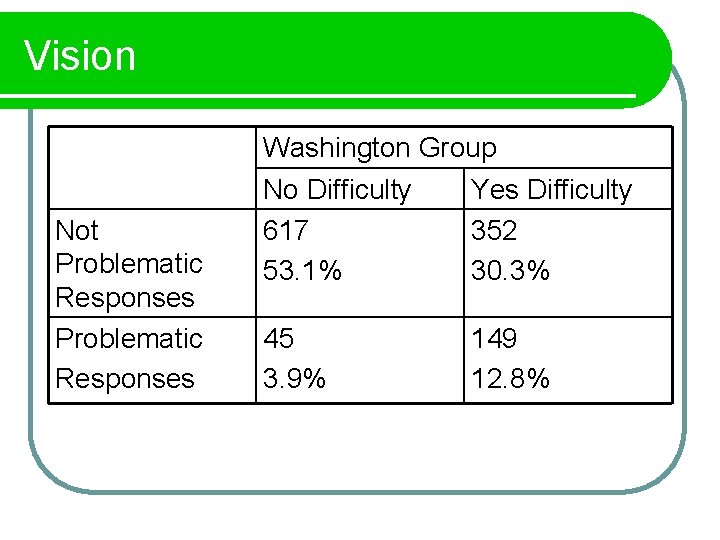
Vision Not Problematic Responses Washington Group No Difficulty Yes Difficulty 617 352 53. 1% 30. 3% 45 3. 9% 149 12. 8%

Vision Response Patterns Pattern WG Disability No No Wears Glasses No Yes Follow-up Disability No No (corrected) A B C D Yes, disability No Yes E F G Yes, disability No Yes H No No Yes (not corrected) No (corrected) No Yes (not corrected) Yes

Reasons for inconsistency 1. True response error (in WG or follow -ups)—potential for Bias 2. Characteristic of respondent’s disability not captured in follow-up questions 3. Data entry/Interviewer error

Hearing Response Patterns Pattern WG Disability Aid Missed Words Functioning Problem A No No B Yes No Yes C No No Yes No D No No No Yes E Yes No No Yes F Yes No G No No Yes H Yes No No No I No Yes Yes J Yes Yes K No Yes No No L Yes No Yes M Yes Yes No N No Yes O No Yes No P Yes No No
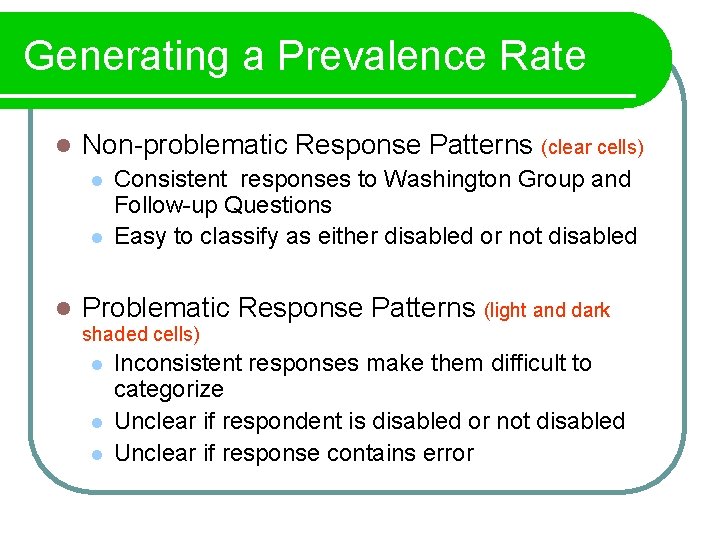
Generating a Prevalence Rate l Non-problematic Response Patterns (clear cells) l l l Consistent responses to Washington Group and Follow-up Questions Easy to classify as either disabled or not disabled Problematic Response Patterns (light and dark shaded cells) l l l Inconsistent responses make them difficult to categorize Unclear if respondent is disabled or not disabled Unclear if response contains error
How to work with problematic cases: l Goal 1: Assess whether the problematic cases matter when combining 6 questions to create 1 prevalence rate l Goal 2: Conduct more analysis to identify the cases of “true response error”
Analysis Goal 1 Assess how well the WG questions work to broadly identify disabled people for prevalence estimates
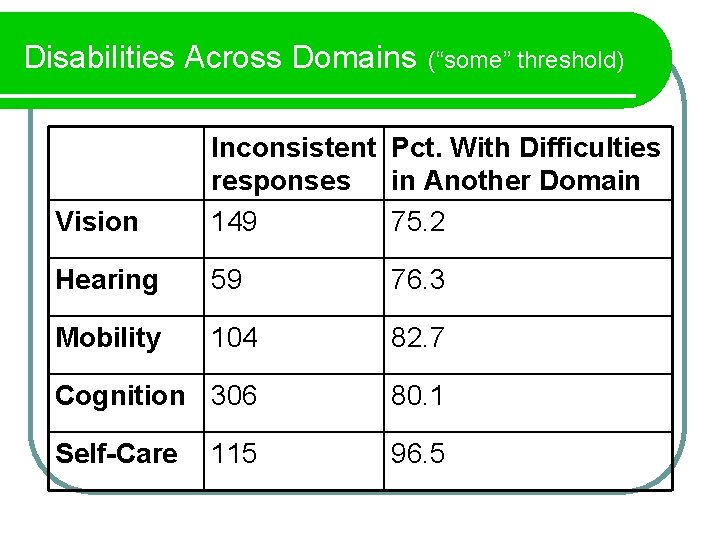
Disabilities Across Domains (“some” threshold) Vision Inconsistent Pct. With Difficulties responses in Another Domain 149 75. 2 Hearing 59 76. 3 Mobility 104 82. 7 Cognition 306 80. 1 Self-Care 96. 5 115
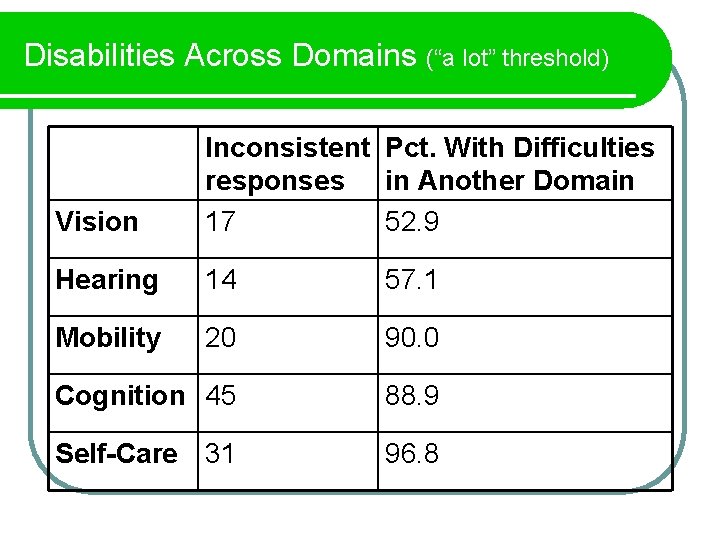
Disabilities Across Domains (“a lot” threshold) Vision Inconsistent Pct. With Difficulties responses in Another Domain 17 52. 9 Hearing 14 57. 1 Mobility 20 90. 0 Cognition 45 88. 9 Self-Care 31 96. 8
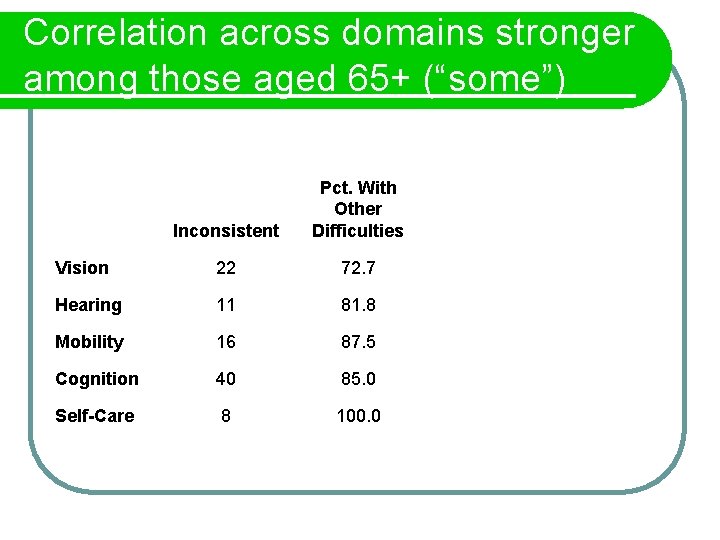
Correlation across domains stronger among those aged 65+ (“some”) Inconsistent Pct. With Other Difficulties Vision 22 72. 7 Hearing 11 81. 8 Mobility 16 87. 5 Cognition 40 85. 0 Self-Care 8 100. 0

Vision: Breakdown by Pattern and Difficulty Threshold “Some” “A Lot” Inconsistent 29. 7 9. 2 Somewhat inconsistent 0. 0 Not Problematic 70. 3 90. 8
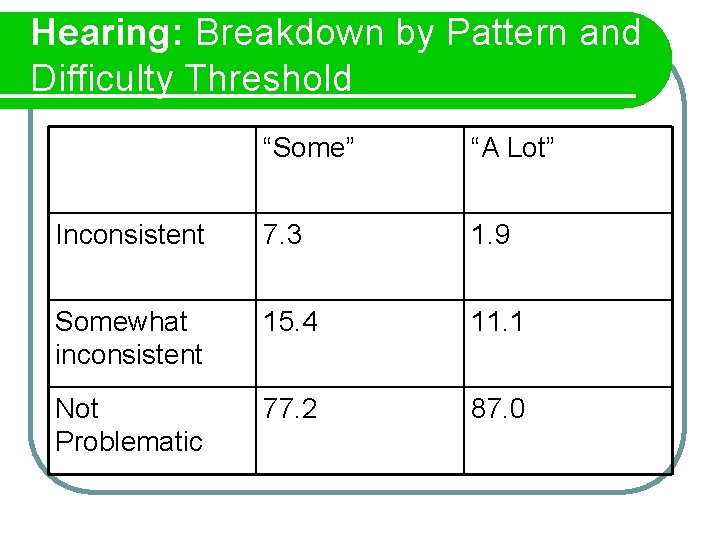
Hearing: Breakdown by Pattern and Difficulty Threshold “Some” “A Lot” Inconsistent 7. 3 1. 9 Somewhat inconsistent 15. 4 11. 1 Not Problematic 77. 2 87. 0
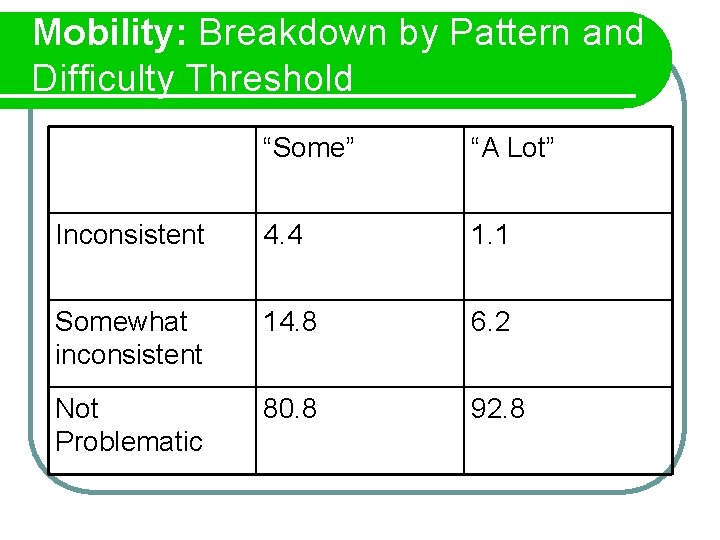
Mobility: Breakdown by Pattern and Difficulty Threshold “Some” “A Lot” Inconsistent 4. 4 1. 1 Somewhat inconsistent 14. 8 6. 2 Not Problematic 80. 8 92. 8
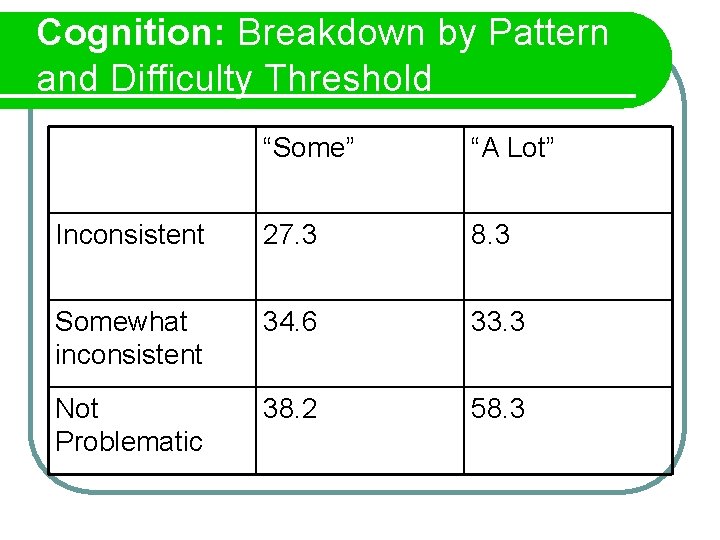
Cognition: Breakdown by Pattern and Difficulty Threshold “Some” “A Lot” Inconsistent 27. 3 8. 3 Somewhat inconsistent 34. 6 33. 3 Not Problematic 38. 2 58. 3
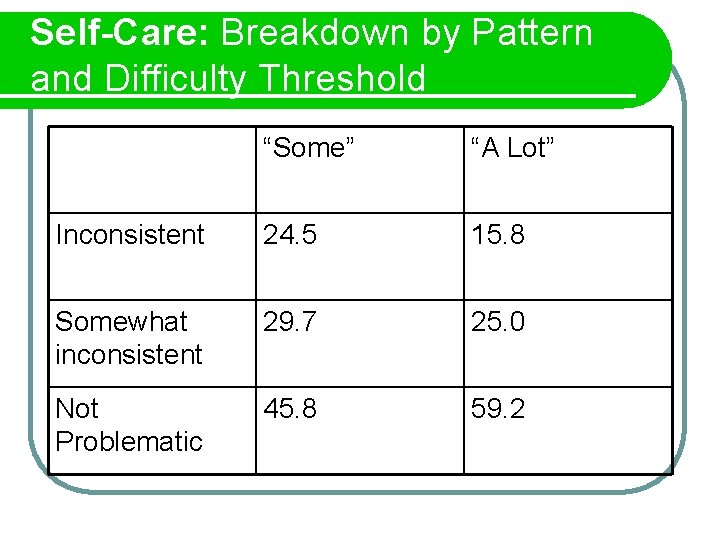
Self-Care: Breakdown by Pattern and Difficulty Threshold “Some” “A Lot” Inconsistent 24. 5 15. 8 Somewhat inconsistent 29. 7 25. 0 Not Problematic 45. 8 59. 2
Prevalence and Equalization of Opportunities l Using the WG questions together gives us a good methodology for dividing the population up into those with and without disabilities l But can we delve deeper into the reasons behind the response errors?
Analysis Goal 2 Assess how each question captures functional difficulties within its specific domain
Goal 2: Assess how well each question captures the specific domain Determine extent to which each question falsely identifies people as having a disability Determine reason for misidentifications Determine which (if any) population may be more likely to be misidentified l l l Analytically, this means we must examine the problematic cases l l l Which cases are true response error? (Should not include in measure) Which cases are characteristics of disability? (Should include in measure)
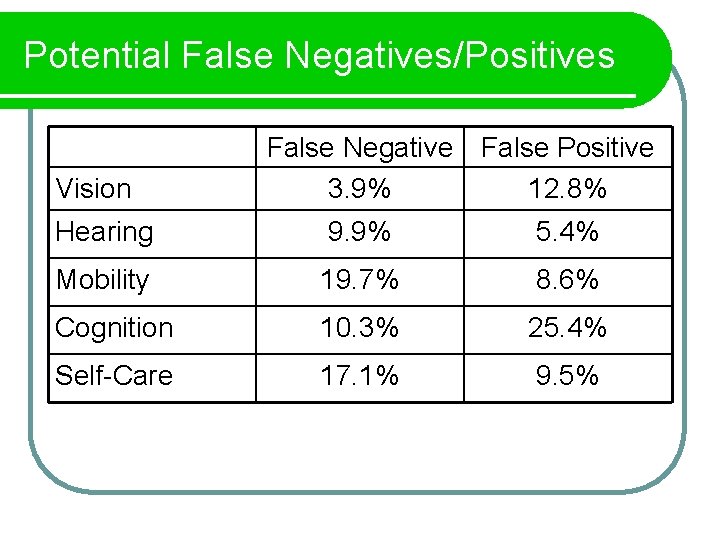
Potential False Negatives/Positives Vision False Negative False Positive 3. 9% 12. 8% Hearing 9. 9% 5. 4% Mobility 19. 7% 8. 6% Cognition 10. 3% 25. 4% Self-Care 17. 1% 9. 5%
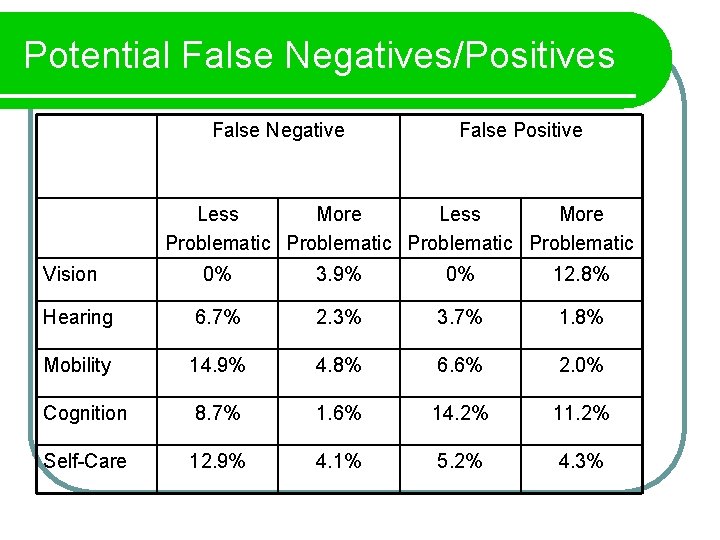
Potential False Negatives/Positives False Negative False Positive Less More Problematic Vision 0% 3. 9% 0% 12. 8% Hearing 6. 7% 2. 3% 3. 7% 1. 8% Mobility 14. 9% 4. 8% 6. 6% 2. 0% Cognition 8. 7% 1. 6% 14. 2% 11. 2% Self-Care 12. 9% 4. 1% 5. 2% 4. 3%
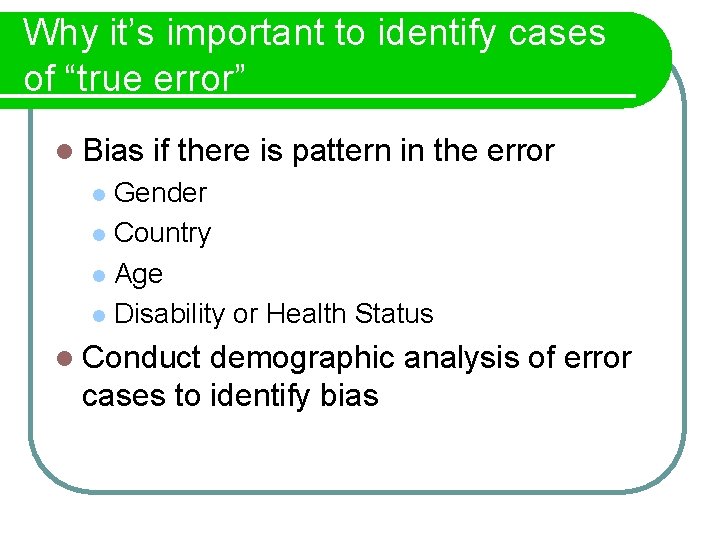
Why it’s important to identify cases of “true error” l Bias if there is pattern in the error Gender l Country l Age l Disability or Health Status l l Conduct demographic analysis of error cases to identify bias
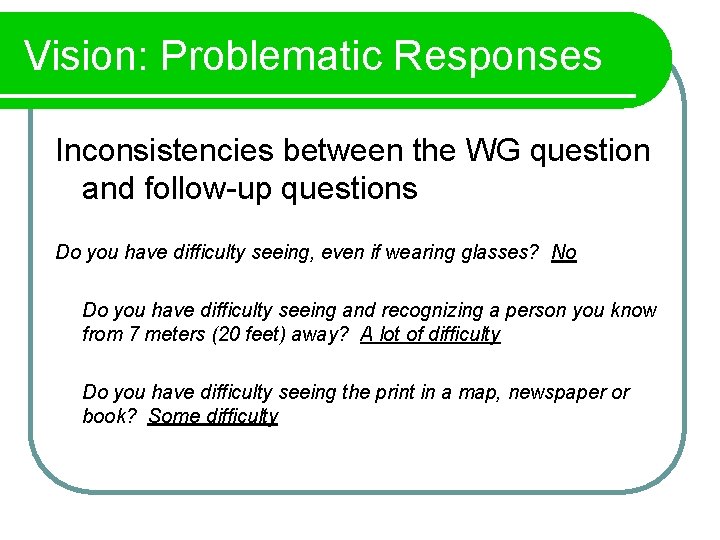
Vision: Problematic Responses Inconsistencies between the WG question and follow-up questions Do you have difficulty seeing, even if wearing glasses? No Do you have difficulty seeing and recognizing a person you know from 7 meters (20 feet) away? A lot of difficulty Do you have difficulty seeing the print in a map, newspaper or book? Some difficulty
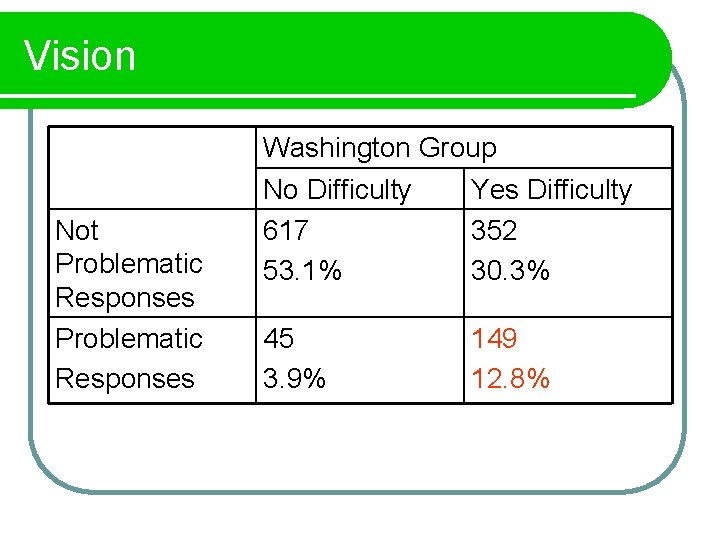
Vision Not Problematic Responses Washington Group No Difficulty Yes Difficulty 617 352 53. 1% 30. 3% 45 3. 9% 149 12. 8%
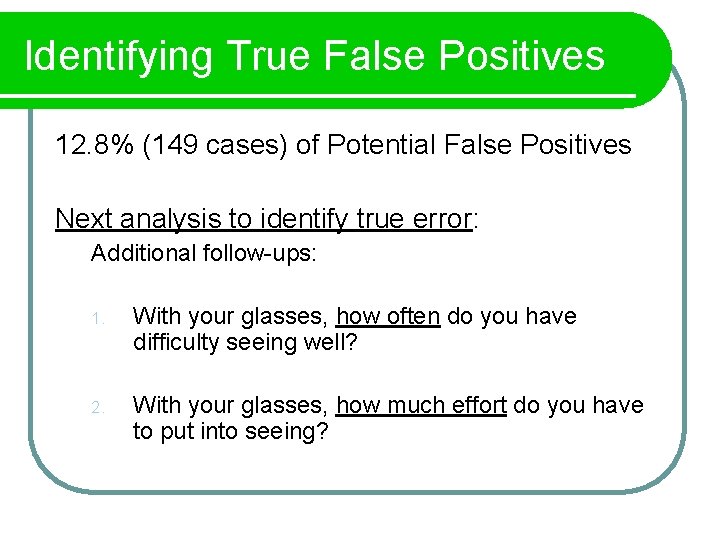
Identifying True False Positives 12. 8% (149 cases) of Potential False Positives Next analysis to identify true error: Additional follow-ups: 1. With your glasses, how often do you have difficulty seeing well? 2. With your glasses, how much effort do you have to put into seeing?
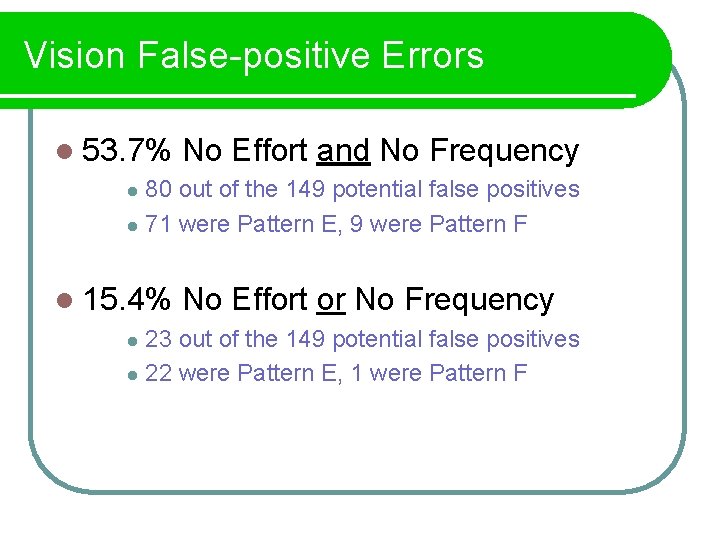
Vision False-positive Errors l 53. 7% No Effort and No Frequency 80 out of the 149 potential false positives l 71 were Pattern E, 9 were Pattern F l l 15. 4% No Effort or No Frequency 23 out of the 149 potential false positives l 22 were Pattern E, 1 were Pattern F l
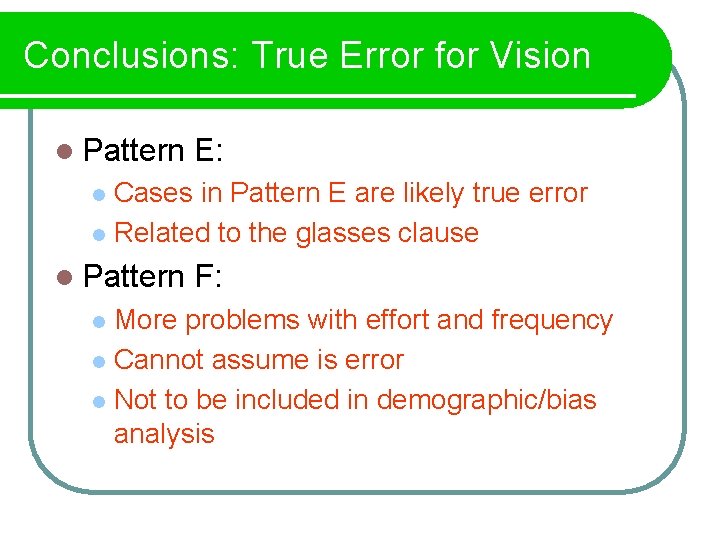
Conclusions: True Error for Vision l Pattern E: Cases in Pattern E are likely true error l Related to the glasses clause l l Pattern F: More problems with effort and frequency l Cannot assume is error l Not to be included in demographic/bias analysis l
Vision: Demographic/Bias Analysis l Does Pattern E occur more often among specific subgroups? l Country l Age l Gender l Disability Status
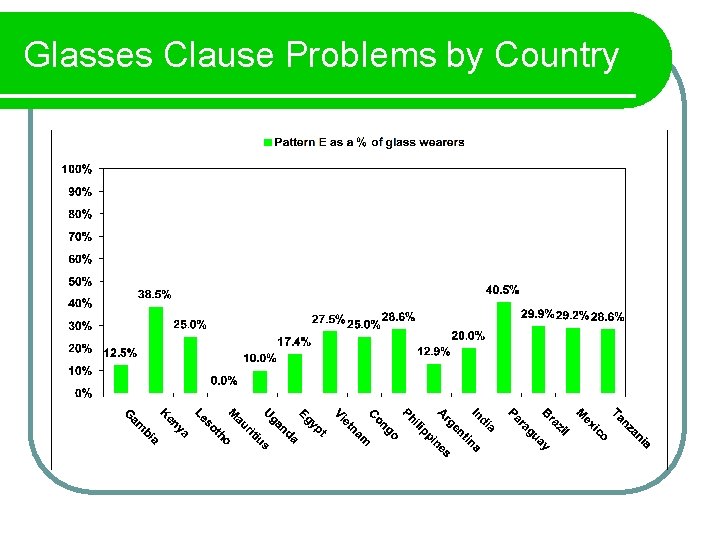
Glasses Clause Problems by Country
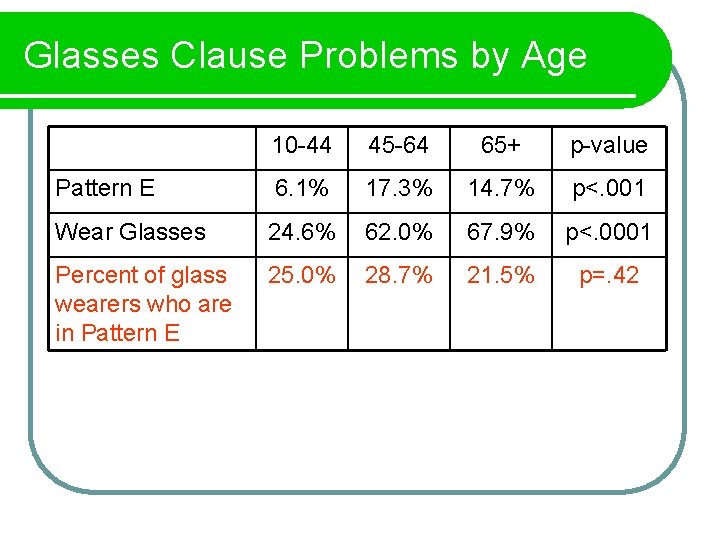
Glasses Clause Problems by Age 10 -44 45 -64 65+ p-value Pattern E 6. 1% 17. 3% 14. 7% p<. 001 Wear Glasses 24. 6% 62. 0% 67. 9% p<. 0001 Percent of glass wearers who are in Pattern E 25. 0% 28. 7% 21. 5% p=. 42
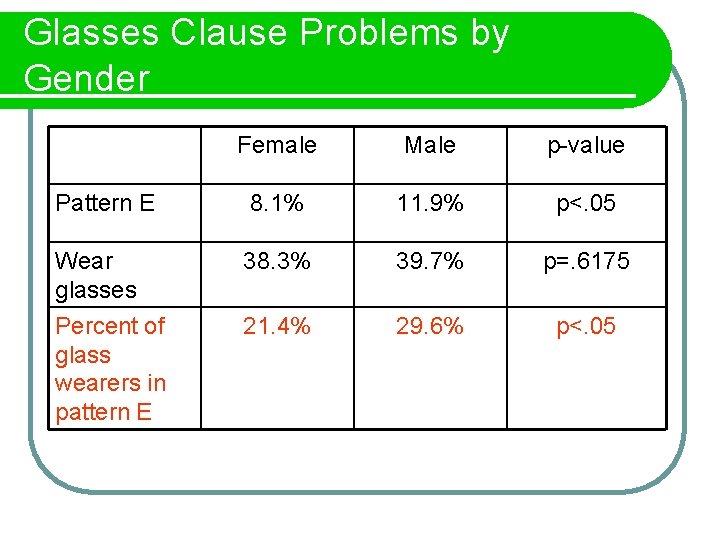
Glasses Clause Problems by Gender Female Male p-value Pattern E 8. 1% 11. 9% p<. 05 Wear glasses 38. 3% 39. 7% p=. 6175 Percent of glass wearers in pattern E 21. 4% 29. 6% p<. 05
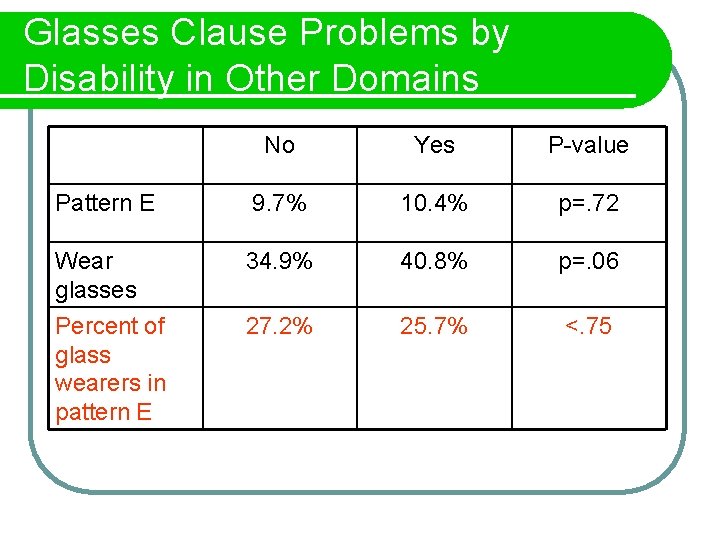
Glasses Clause Problems by Disability in Other Domains No Yes P-value Pattern E 9. 7% 10. 4% p=. 72 Wear glasses 34. 9% 40. 8% p=. 06 Percent of glass wearers in pattern E 27. 2% 25. 7% <. 75

Cognition: Do you have difficulty remembering or concentrating? Do you have difficulty remembering the names of people or places? Do you have difficulty remembering appointments? Do you have difficulty remembering how to get to familiar places? Do you have difficulty remembering important tasks, like taking medications or paying bills? Do you have difficulty concentrating on doing something for ten minutes? Do you have difficulty learning a new task, for example, learning how to get to a new place? Do you have difficulty finding solutions to problems in day to day life?
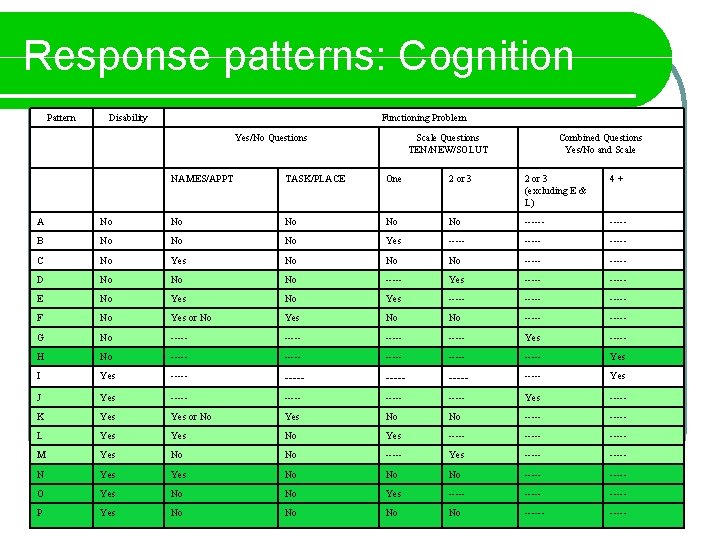
Response patterns: Cognition Pattern Disability Functioning Problem Yes/No Questions Scale Questions TEN/NEW/SOLUT Combined Questions Yes/No and Scale NAMES/APPT TASK/PLACE One 2 or 3 (excluding E & L) 4+ A No No No ------ B No No No Yes ----- C No Yes No No No ----- D No No No ----- Yes ----- E No Yes ----- F No Yes or No Yes No No ----- G No ----- Yes ----- H No ----- ----- Yes I Yes ----- ----- Yes J Yes ----- Yes ----- K Yes or No Yes No No ----- L Yes No Yes ----- M Yes No No ----- Yes ----- N Yes No No No ----- O Yes No No Yes ----- P Yes No No ------

Cognition Not Problematic Responses Washington Group No Difficulty Yes Difficulty 586 189 48. 6% 15. 7% 124 10. 3% 306 25. 4%
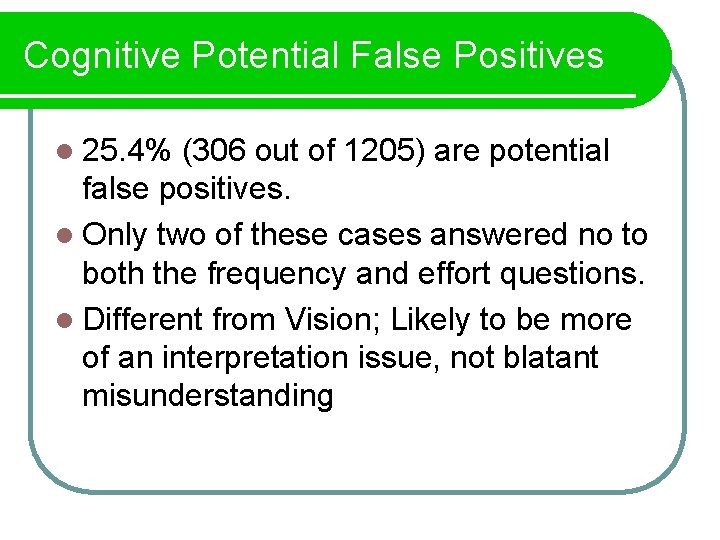
Cognitive Potential False Positives l 25. 4% (306 out of 1205) are potential false positives. l Only two of these cases answered no to both the frequency and effort questions. l Different from Vision; Likely to be more of an interpretation issue, not blatant misunderstanding
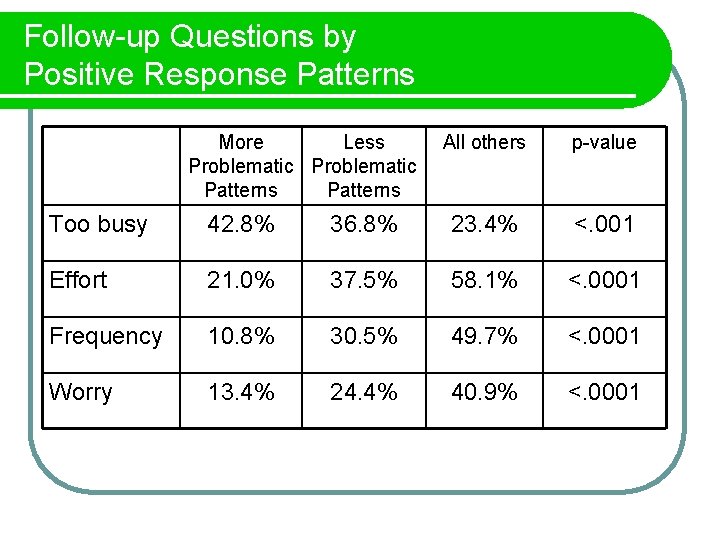
Follow-up Questions by Positive Response Patterns More Less Problematic Patterns All others p-value Too busy 42. 8% 36. 8% 23. 4% <. 001 Effort 21. 0% 37. 5% 58. 1% <. 0001 Frequency 10. 8% 30. 5% 49. 7% <. 0001 Worry 13. 4% 24. 4% 40. 9% <. 0001
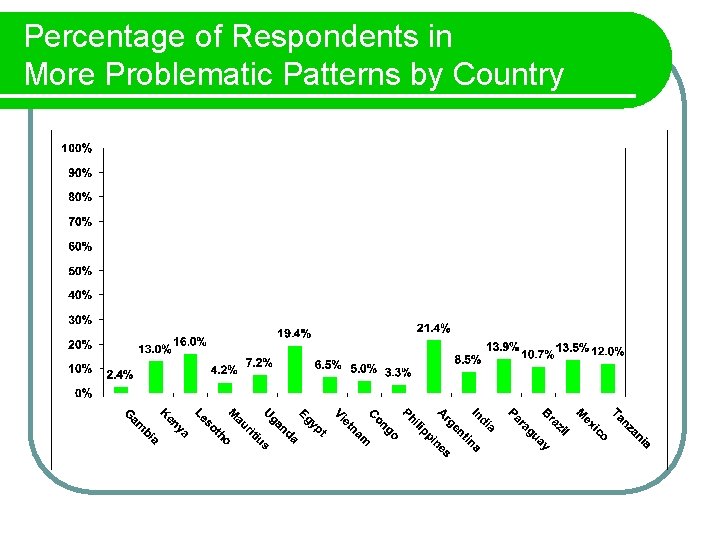
Percentage of Respondents in More Problematic Patterns by Country
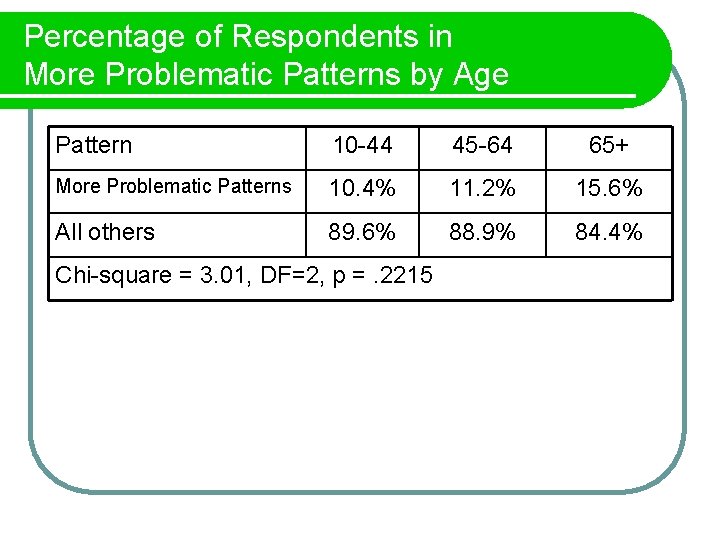
Percentage of Respondents in More Problematic Patterns by Age Pattern 10 -44 45 -64 65+ More Problematic Patterns 10. 4% 11. 2% 15. 6% All others 89. 6% 88. 9% 84. 4% Chi-square = 3. 01, DF=2, p =. 2215
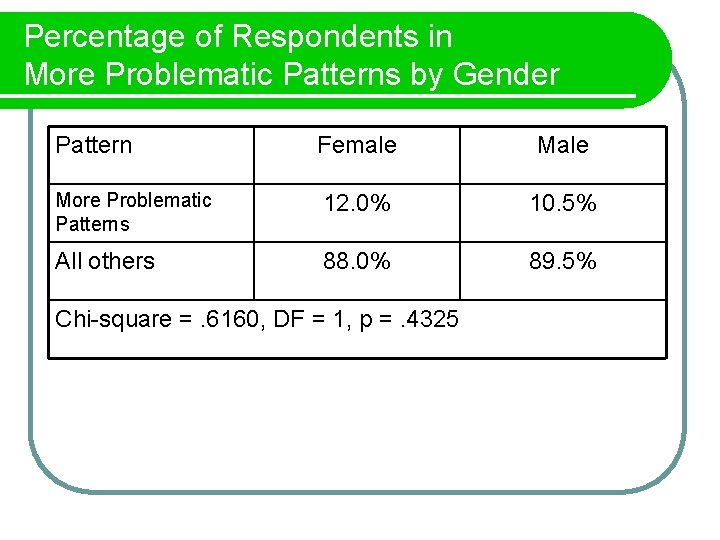
Percentage of Respondents in More Problematic Patterns by Gender Pattern Female More Problematic Patterns 12. 0% 10. 5% All others 88. 0% 89. 5% Chi-square =. 6160, DF = 1, p =. 4325
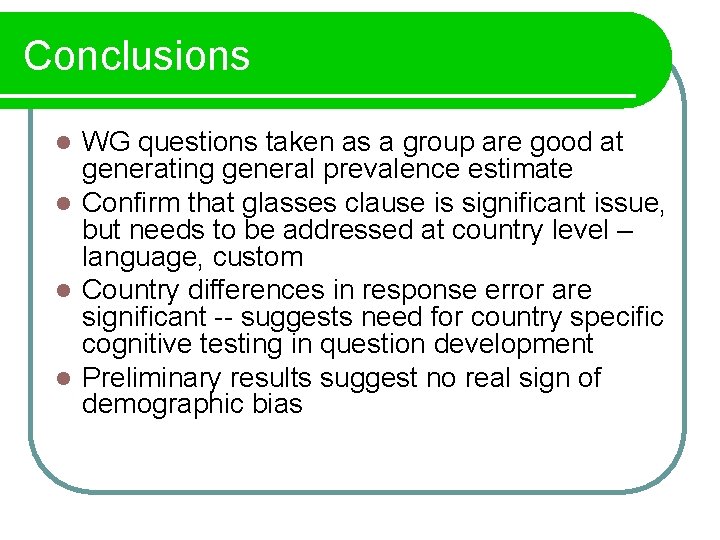
Conclusions WG questions taken as a group are good at generating general prevalence estimate l Confirm that glasses clause is significant issue, but needs to be addressed at country level – language, custom l Country differences in response error are significant -- suggests need for country specific cognitive testing in question development l Preliminary results suggest no real sign of demographic bias l
- Slides: 50