
Understanding the structure A critique of the Certificate
- Slides: 17
Understanding the structure A critique of the Certificate IV in Allied Health Assistance Curriculum David Schmidt Health Education and Training Institute – Rural and Remote Portfolio
Acknowledgements Ron Kerr Gale Cowled Deb Stead HEALTH EDUCATION & TRAINING INSTITUTE
Overview A snapshot of the qualification Educational philosophy and curriculum model Integration of theory and practice Meeting needs of learners and teachers Outcomes of the curriculum Is the curriculum effective? An eye to the future HEALTH EDUCATION & TRAINING INSTITUTE
Certificate IV in Allied Health Assistance – a snapshot What is it? Who is it for? Who provides the training? How is the training provided? Who needs to understand the curriculum? HEALTH EDUCATION & TRAINING INSTITUTE
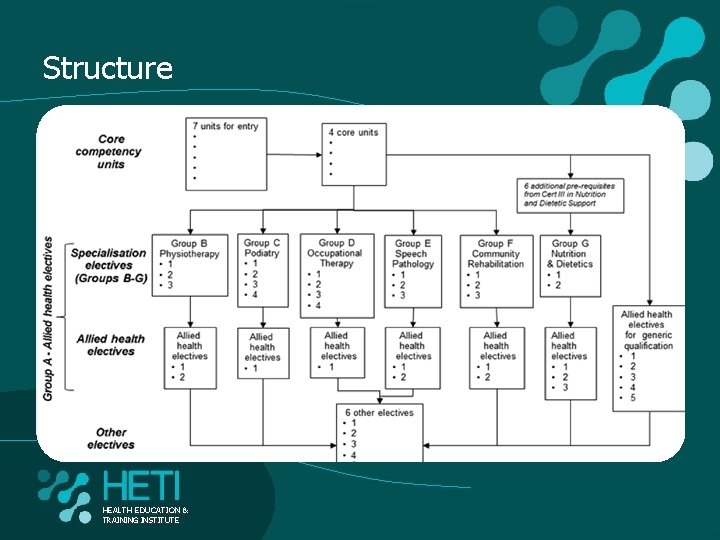
Structure HEALTH EDUCATION & TRAINING INSTITUTE
Curriculum “A clear and coordinated approach to teaching and learning throughout the qualification” HEALTH EDUCATION & TRAINING INSTITUTE
Foundations of the curriculum: educational philosophy “…vocational training is based on the philosophy that analysis of the job. . . [determines] what is to be learned, and it is from analysis that the objectives are derived… There is no alternative to mastering the skills required on the job if the training is to be relevant” (Mc. Beath 1997) HEALTH EDUCATION & TRAINING INSTITUTE
Curriculum model choice Complex modular construct Product / objective model (although external degree model for RPL) Competency based assessments to demonstrate attainment of pre-determined educational objectives Tension between rigidity and flexibility HEALTH EDUCATION & TRAINING INSTITUTE
Curriculum congruence: integrating theory and practice Contains theory and practical components Competency-based assessment relies on practical application Allows for experiential, informal and opportunistic workplace-based learning Relies on experienced educators within the workplace HEALTH EDUCATION & TRAINING INSTITUTE
Assessing progression: how learning is demonstrated Structured assessments u workplace-based u via distance learning u portfolio of evidence Direct observation of workplace performance and skills application against the predetermined competency standards. Building of skills inhibited by modular construct HEALTH EDUCATION & TRAINING INSTITUTE
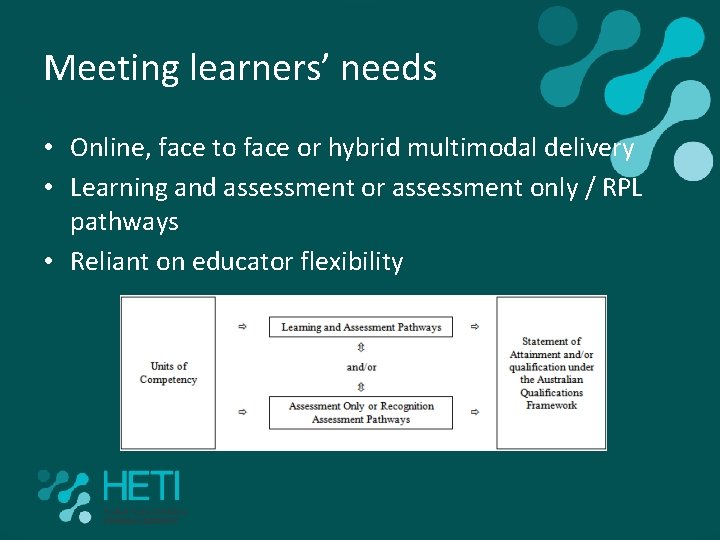
Meeting learners’ needs • Online, face to face or hybrid multimodal delivery • Learning and assessment or assessment only / RPL pathways • Reliant on educator flexibility
Flexibility: allow for different teaching methods Framework dictates what must be taught, but not how Constructivist methods encouraged (vs instructivist) Balance between formal and informal learning strategies dependent u needs of the workplace u type of skill being taught u capabilities of educator HEALTH EDUCATION & TRAINING INSTITUTE
Understanding curriculum outcomes: how the curriculum is assessed Large body of information within the curriculum documents on how students are assessed Information on how the curriculum itself is assessed and reviewed is limited Learning resources undergo review and validation from end users HEALTH EDUCATION & TRAINING INSTITUTE
Empowering learners Learners can self-direct learning through: ‘Pick and mix’ opportunity to match the course to selfassessed learning needs Opportunity to apply their own scenarios to learning examples and to assessment tasks. RPL pathway emphasises the learner guiding the assessment process, establishing their own brief of evidence and taking a lead role in the demonstration of their skillbase HEALTH EDUCATION & TRAINING INSTITUTE
Effectiveness of the curriculum Congruence to the matching of philosophy, model and means of integrating theory and practice Rigid, competency-based structure Reliance on the skill-base of the teacher Flexibility in teaching opportunities HEALTH EDUCATION & TRAINING INSTITUTE
An eye to the future: through an emancipatory lens Cert IV AHA meets needs of existing workforce Reinforces existing power relationships Supervisory skills is a growing issue Recent research focuses on cooperative rather than supervisory relationships Does the RN / EN relationship provide a model? HEALTH EDUCATION & TRAINING INSTITUTE
Conclusions The curriculum for the Certificate IV in Allied Health Assistance appears complex and contradictory Prescriptive framework coupled with minimal guidance for educators Limited information available on outcomes Validation through end-user feedback is essential HEALTH EDUCATION & TRAINING INSTITUTE