
Understanding the Standards for Mathematical Practice A Daily

- Slides: 35
Understanding the Standards for Mathematical Practice: A Daily Approach August 7, 2012
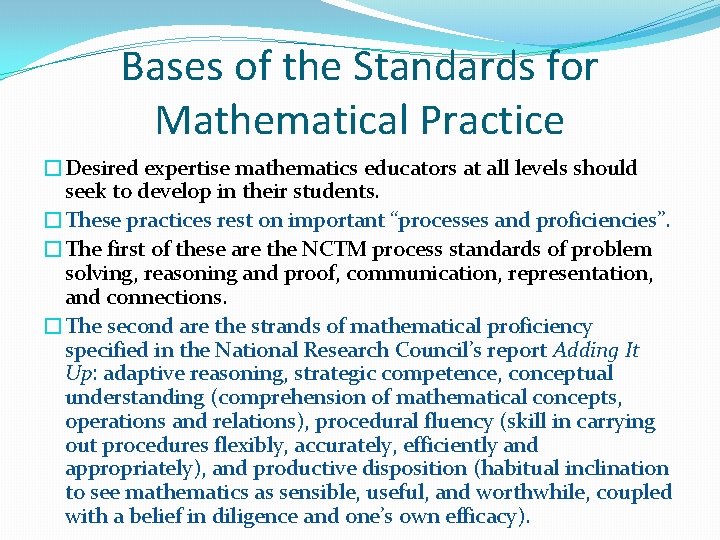
Bases of the Standards for Mathematical Practice �Desired expertise mathematics educators at all levels should seek to develop in their students. �These practices rest on important “processes and proficiencies”. �The first of these are the NCTM process standards of problem solving, reasoning and proof, communication, representation, and connections. �The second are the strands of mathematical proficiency specified in the National Research Council’s report Adding It Up: adaptive reasoning, strategic competence, conceptual understanding (comprehension of mathematical concepts, operations and relations), procedural fluency (skill in carrying out procedures flexibly, accurately, efficiently and appropriately), and productive disposition (habitual inclination to see mathematics as sensible, useful, and worthwhile, coupled with a belief in diligence and one’s own efficacy).
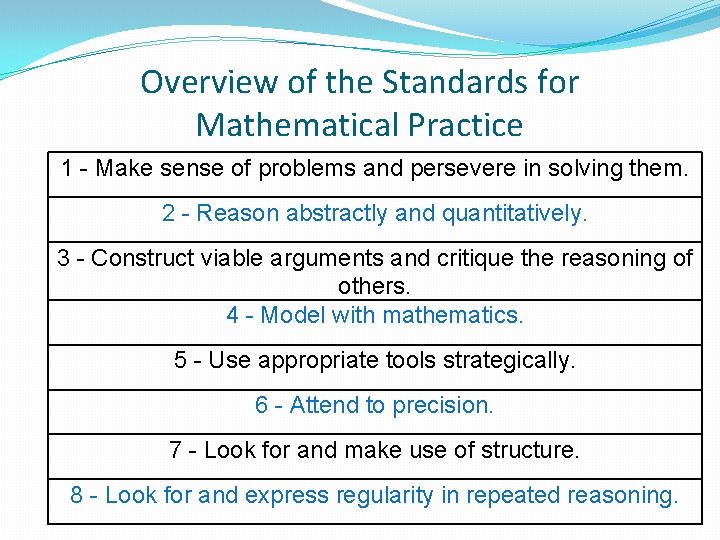
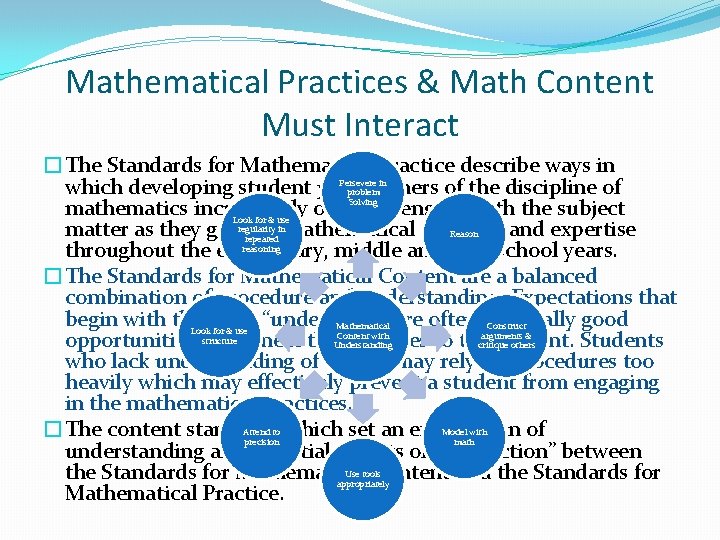
Overview of the Standards for Mathematical Practice 1 - Make sense of problems and persevere in solving them. 2 - Reason abstractly and quantitatively. 3 - Construct viable arguments and critique the reasoning of others. 4 - Model with mathematics. 5 - Use appropriate tools strategically. 6 - Attend to precision. 7 - Look for and make use of structure. 8 - Look for and express regularity in repeated reasoning.
How can we get students over their fear of word problems?
1 - Make sense of problems and persevere in solving them. � Start by explaining to themselves the meaning of a problem and looking for entry points to its solution. � Analyze givens, constraints, relationships, and goals. � Make conjectures about the form and meaning of the solution and plan a solution pathway rather than simply jumping into a solution attempt. � Consider analogous problems, and try special cases and simpler forms of the original problem in order to gain insight into its solution. � Monitor and evaluate their progress and change course if necessary. � Explain correspondences between equations, verbal descriptions, tables, and graphs or draw diagrams of important features and relationships, graph data, and search for regularity or trends. � Check their answers to problems using a different method, and they continually ask themselves, “Does this make sense? ” � Understand the approaches of others to solving complex problems and identify correspondences between different approaches.
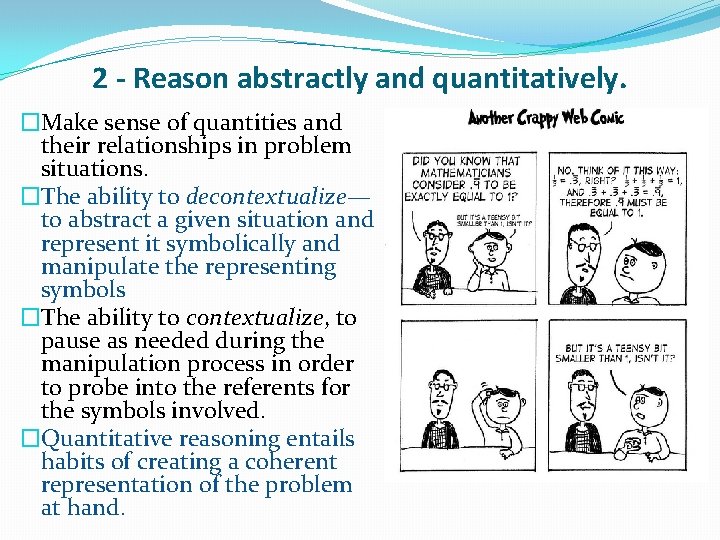
2 - Reason abstractly and quantitatively. �Make sense of quantities and their relationships in problem situations. �The ability to decontextualize— to abstract a given situation and represent it symbolically and manipulate the representing symbols �The ability to contextualize, to pause as needed during the manipulation process in order to probe into the referents for the symbols involved. �Quantitative reasoning entails habits of creating a coherent representation of the problem at hand.
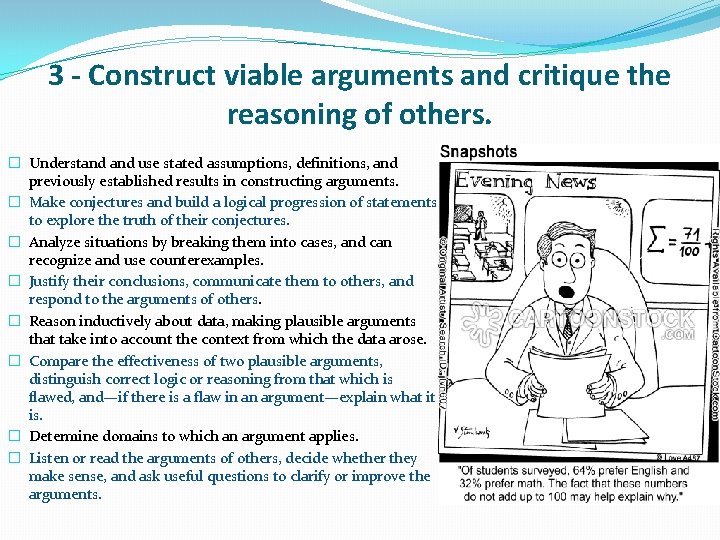
3 - Construct viable arguments and critique the reasoning of others. � Understand use stated assumptions, definitions, and previously established results in constructing arguments. � Make conjectures and build a logical progression of statements to explore the truth of their conjectures. � Analyze situations by breaking them into cases, and can recognize and use counterexamples. � Justify their conclusions, communicate them to others, and respond to the arguments of others. � Reason inductively about data, making plausible arguments that take into account the context from which the data arose. � Compare the effectiveness of two plausible arguments, distinguish correct logic or reasoning from that which is flawed, and—if there is a flaw in an argument—explain what it is. � Determine domains to which an argument applies. � Listen or read the arguments of others, decide whether they make sense, and ask useful questions to clarify or improve the arguments.
4 - Model with mathematics. �Apply the mathematics they know to solve problems arising in everyday life, society, and the workplace. �Comfortable making assumptions and approximations to simplify a complicated situation, realizing that these may need revision later. �Identify important quantities in a practical situation and map their relationships using such tools as diagrams, twoway tables, graphs, flowcharts and formulas. �Analyze those relationships mathematically to draw conclusions. �Routinely interpret their mathematical results in the context of the situation and reflect on whether the results make sense, possibly improving the model
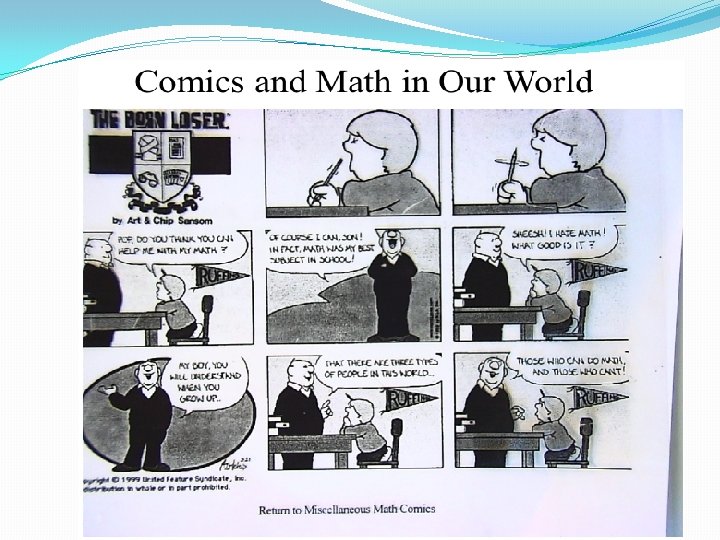
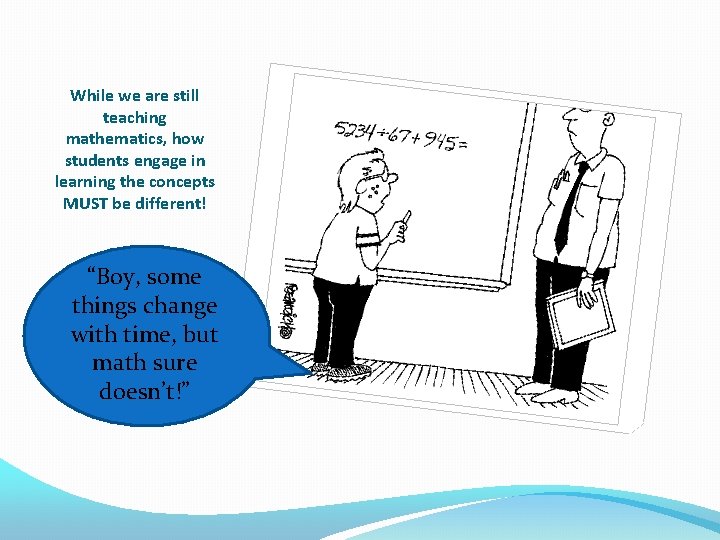
While we are still teaching mathematics, how students engage in learning the concepts MUST be different! “Boy, some things change with time, but math sure doesn’t!”
5 - Use appropriate tools strategically � Consider the available tools when solving a mathematical problem tools might include pencil and paper, concrete models, a ruler, a protractor, a calculator, a spreadsheet, a computer algebra system, a statistical package, or dynamic geometry software. � Sufficiently familiar with tools appropriate for their grade or course to make sound decisions about when each of these tools might be helpful, recognizing both the insight to be gained and their limitations. � Detect possible errors by strategically using estimation and other mathematical knowledge. � Know that technology can enable them to visualize the results of varying assumptions, explore consequences, and compare predictions with data. � Identify relevant external mathematical resources, such as digital content located on a website, and use them to pose or solve problems. � Use technological tools to explore and deepen their understanding of concepts.
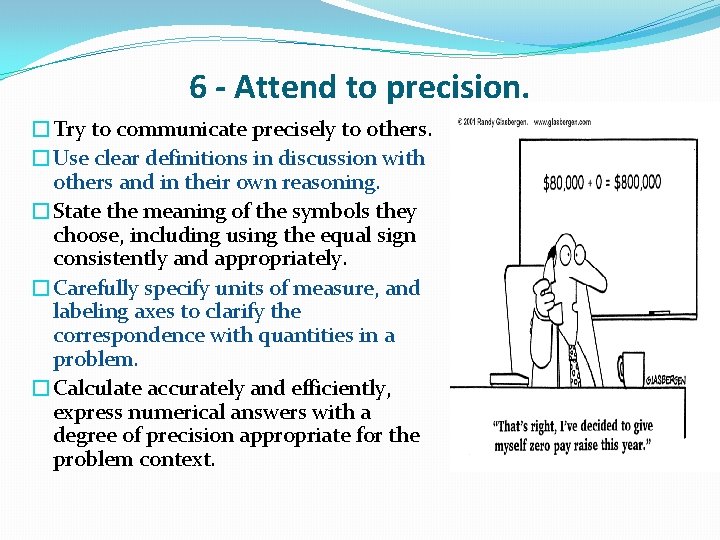
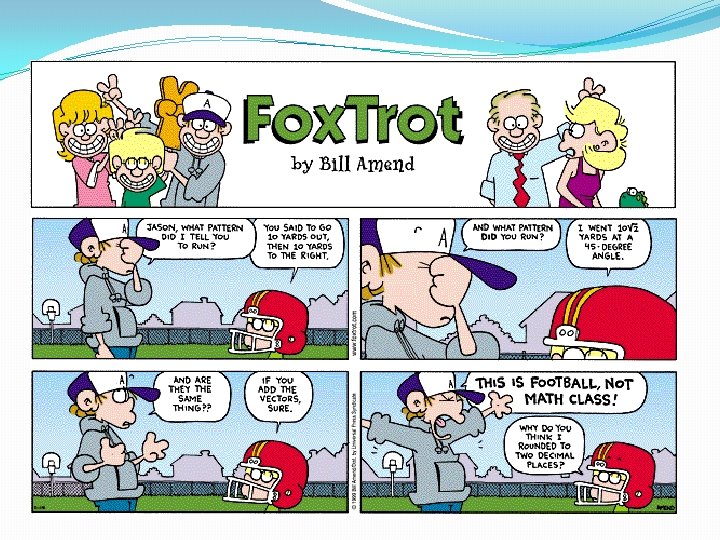
6 - Attend to precision. �Try to communicate precisely to others. �Use clear definitions in discussion with others and in their own reasoning. �State the meaning of the symbols they choose, including using the equal sign consistently and appropriately. �Carefully specify units of measure, and labeling axes to clarify the correspondence with quantities in a problem. �Calculate accurately and efficiently, express numerical answers with a degree of precision appropriate for the problem context.
7 - Look for and make use of structure. �Look closely to discern a pattern or structure. �Young students group figures with same number of sides. �Students see 9 X 8 equals the remembered 5 X 8 + 4 X 8 when learning the distributive property �Older students recognize 9 as 7 + 2 and 14 as 7 X 2 in the expression x 2 + 9 x + 14, when learning to factor trinomials �Recognize the significance of an existing line in a geometric figure and can use the strategy of drawing an auxiliary line for solving problems. �Can step back for an overview and shift perspective. �See complicated things, such as some algebraic expressions, as single objects or as being composed of several objects.
8 - Look for and express regularity in repeated reasoning. � Notice if calculations are repeated, and look both for general methods and for shortcuts. � Upper elementary students might notice when dividing 25 by 11 that they are repeating the same calculations over and over again, and conclude they have a repeating decimal. � By paying attention to the calculation of slope as they repeatedly check whether points are on the line through (1, 2) with slope 3, middle school students might abstract the equation (y – 2)/(x– 1) = 3. � Noticing the regularity in the way terms cancel when expanding (x – 1)(x + 1), (x – 1)(x 2 + x+ 1), and (x – 1)(x 3 + x 2 + x + 1) might lead them to the general formula for the sum of a geometric series. � Maintain oversight of the process, while attending to the details as they work to solve a problem. � Continually evaluate the reasonableness of their intermediate results.
A variety of activities and/or problems are on the tables for you to review v. Read each problem or activity v. Consider a possible solution to the problem(s) v. Discuss which standard(s) for mathematical practice may be reinforced as students work through the problem/activity v. Use a sticky note to record the number of the standard on the solution chart v. We will discuss overall approaches to developing these skills in students
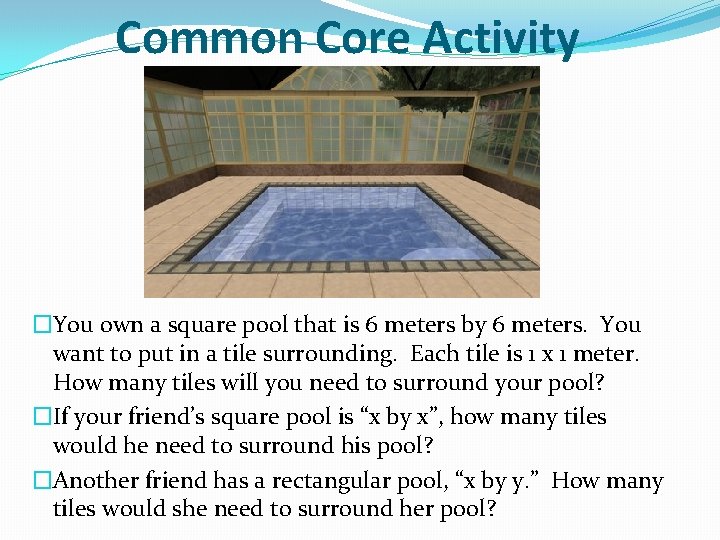
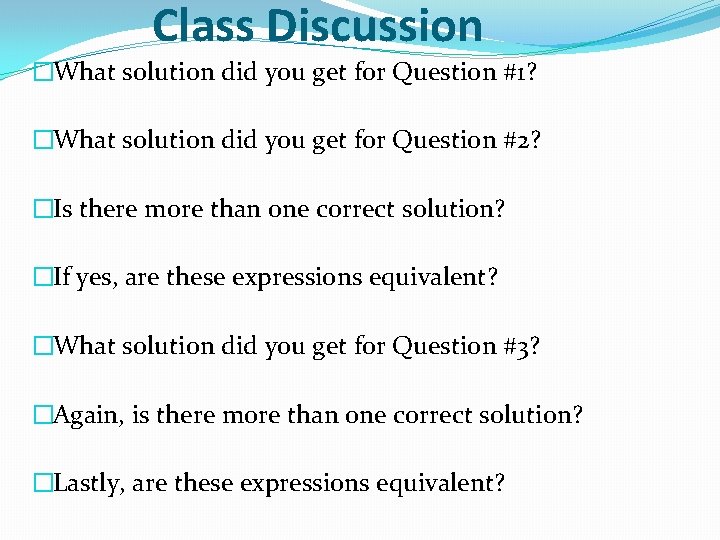
Common Core Activity �You own a square pool that is 6 meters by 6 meters. You want to put in a tile surrounding. Each tile is 1 x 1 meter. How many tiles will you need to surround your pool? �If your friend’s square pool is “x by x”, how many tiles would he need to surround his pool? �Another friend has a rectangular pool, “x by y. ” How many tiles would she need to surround her pool?
Class Discussion �What solution did you get for Question #1? �What solution did you get for Question #2? �Is there more than one correct solution? �If yes, are these expressions equivalent? �What solution did you get for Question #3? �Again, is there more than one correct solution? �Lastly, are these expressions equivalent?
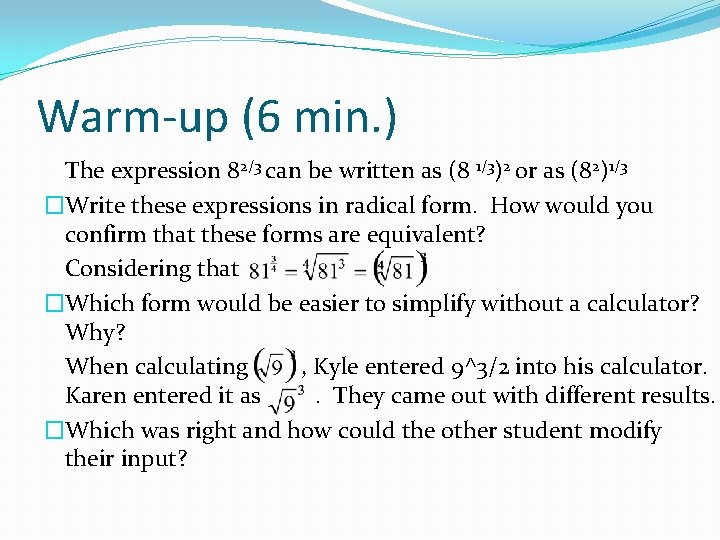
Warm-up (6 min. ) The expression 82/3 can be written as (8 1/3)2 or as (82)1/3 �Write these expressions in radical form. How would you confirm that these forms are equivalent? Considering that �Which form would be easier to simplify without a calculator? Why? When calculating , Kyle entered 9^3/2 into his calculator. Karen entered it as. They came out with different results. �Which was right and how could the other student modify their input?
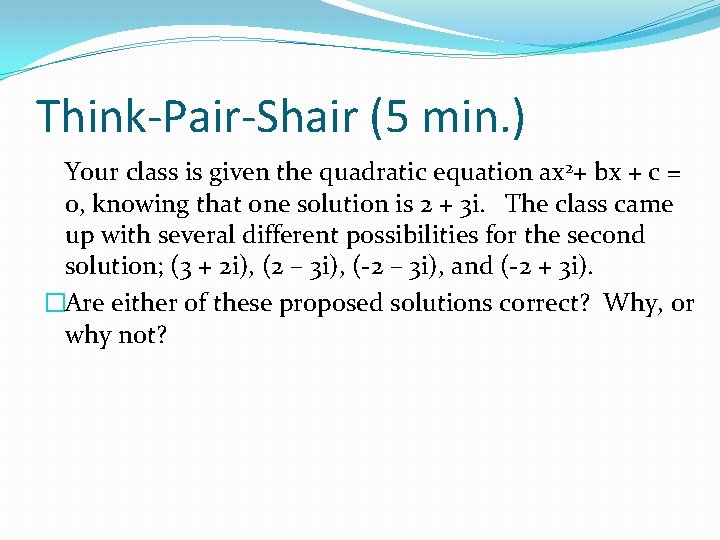
Think-Pair-Shair (5 min. ) Your class is given the quadratic equation ax 2+ bx + c = 0, knowing that one solution is 2 + 3 i. The class came up with several different possibilities for the second solution; (3 + 2 i), (2 – 3 i), (-2 – 3 i), and (-2 + 3 i). �Are either of these proposed solutions correct? Why, or why not?
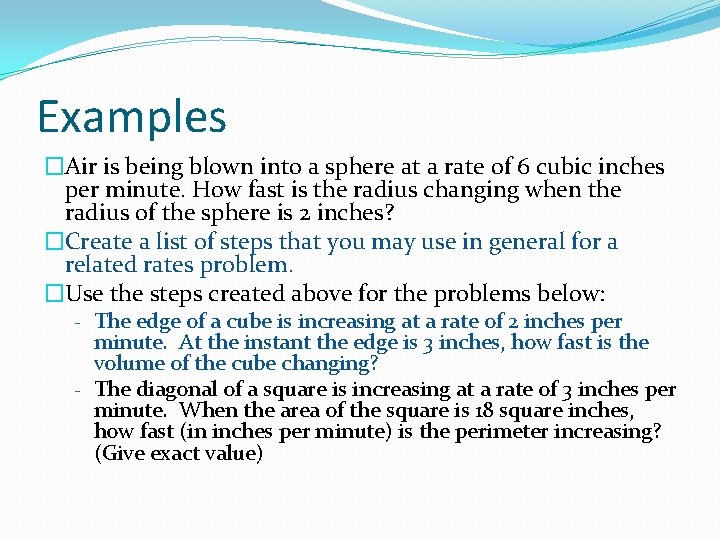
Examples �Air is being blown into a sphere at a rate of 6 cubic inches per minute. How fast is the radius changing when the radius of the sphere is 2 inches? �Create a list of steps that you may use in general for a related rates problem. �Use the steps created above for the problems below: - The edge of a cube is increasing at a rate of 2 inches per minute. At the instant the edge is 3 inches, how fast is the volume of the cube changing? - The diagonal of a square is increasing at a rate of 3 inches per minute. When the area of the square is 18 square inches, how fast (in inches per minute) is the perimeter increasing? (Give exact value)
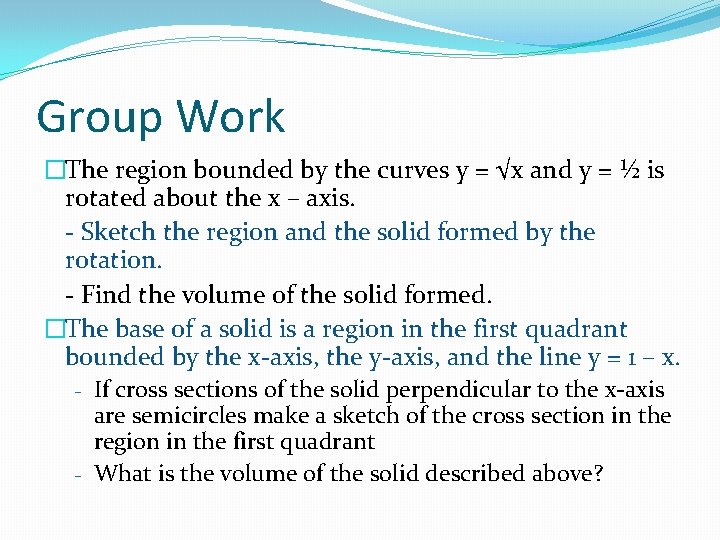
Group Work �The region bounded by the curves y = √x and y = ½ is rotated about the x – axis. - Sketch the region and the solid formed by the rotation. - Find the volume of the solid formed. �The base of a solid is a region in the first quadrant bounded by the x-axis, the y-axis, and the line y = 1 – x. - If cross sections of the solid perpendicular to the x-axis are semicircles make a sketch of the cross section in the region in the first quadrant - What is the volume of the solid described above?
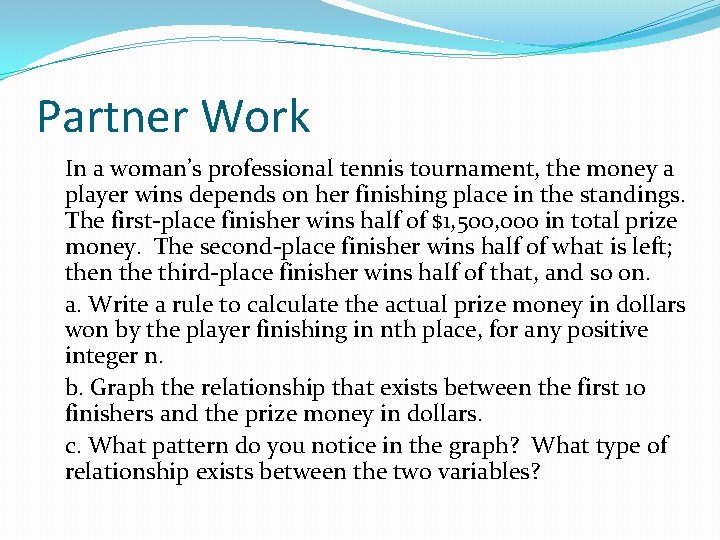
Partner Work In a woman’s professional tennis tournament, the money a player wins depends on her finishing place in the standings. The first-place finisher wins half of $1, 500, 000 in total prize money. The second-place finisher wins half of what is left; then the third-place finisher wins half of that, and so on. a. Write a rule to calculate the actual prize money in dollars won by the player finishing in nth place, for any positive integer n. b. Graph the relationship that exists between the first 10 finishers and the prize money in dollars. c. What pattern do you notice in the graph? What type of relationship exists between the two variables?
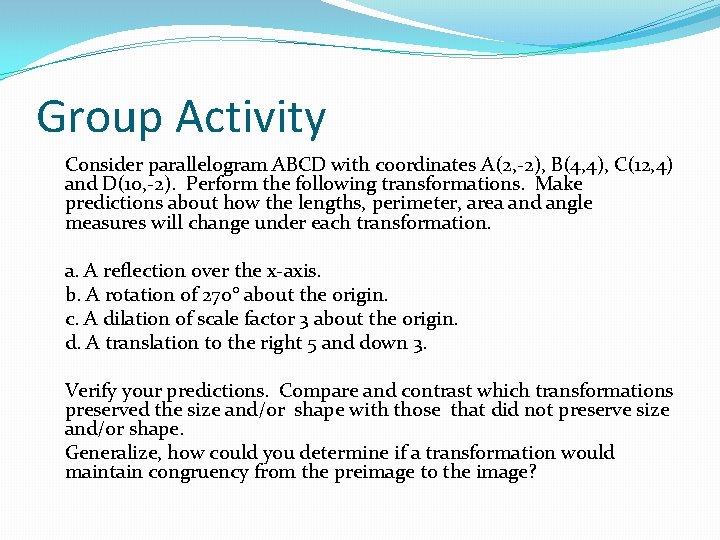
Group Activity Consider parallelogram ABCD with coordinates A(2, -2), B(4, 4), C(12, 4) and D(10, -2). Perform the following transformations. Make predictions about how the lengths, perimeter, area and angle measures will change under each transformation. a. A reflection over the x-axis. b. A rotation of 270° about the origin. c. A dilation of scale factor 3 about the origin. d. A translation to the right 5 and down 3. Verify your predictions. Compare and contrast which transformations preserved the size and/or shape with those that did not preserve size and/or shape. Generalize, how could you determine if a transformation would maintain congruency from the preimage to the image?
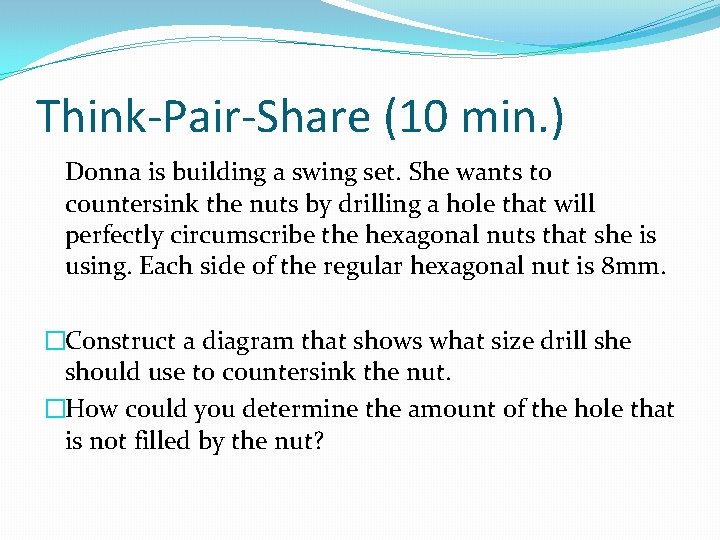
Think-Pair-Share (10 min. ) Donna is building a swing set. She wants to countersink the nuts by drilling a hole that will perfectly circumscribe the hexagonal nuts that she is using. Each side of the regular hexagonal nut is 8 mm. �Construct a diagram that shows what size drill she should use to countersink the nut. �How could you determine the amount of the hole that is not filled by the nut?
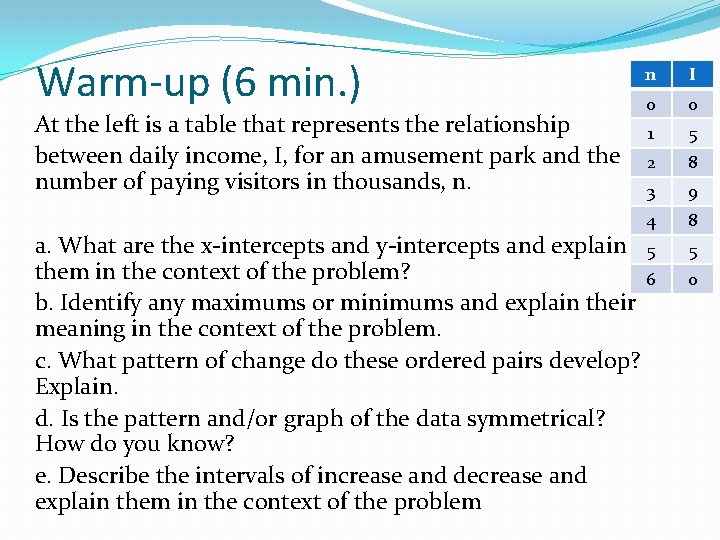
Warm-up (6 min. ) At the left is a table that represents the relationship between daily income, I, for an amusement park and the number of paying visitors in thousands, n. n I 0 0 1 5 2 8 3 9 4 8 a. What are the x-intercepts and y-intercepts and explain 5 them in the context of the problem? 6 b. Identify any maximums or minimums and explain their meaning in the context of the problem. c. What pattern of change do these ordered pairs develop? Explain. d. Is the pattern and/or graph of the data symmetrical? How do you know? e. Describe the intervals of increase and decrease and explain them in the context of the problem 5 0
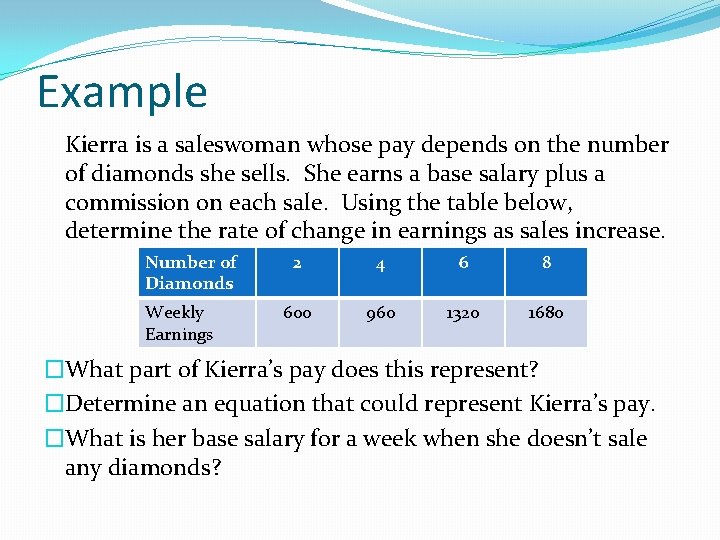
Example Kierra is a saleswoman whose pay depends on the number of diamonds she sells. She earns a base salary plus a commission on each sale. Using the table below, determine the rate of change in earnings as sales increase. Number of Diamonds Weekly Earnings 2 4 6 8 600 960 1320 1680 �What part of Kierra’s pay does this represent? �Determine an equation that could represent Kierra’s pay. �What is her base salary for a week when she doesn’t sale any diamonds?
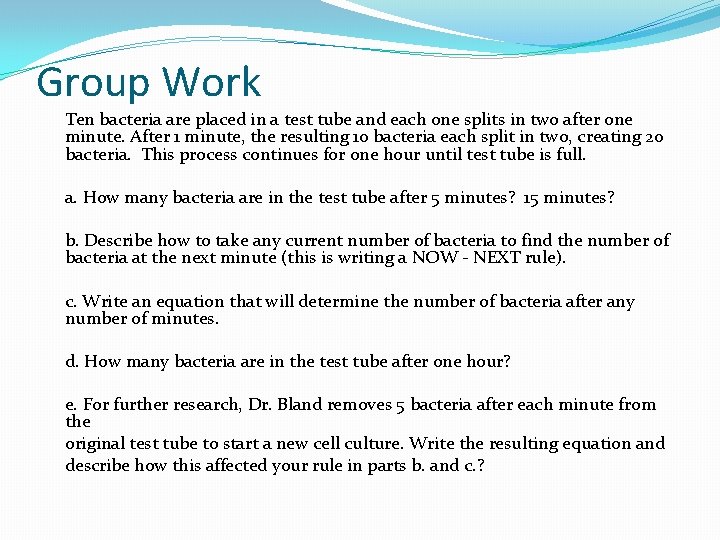
Group Work Ten bacteria are placed in a test tube and each one splits in two after one minute. After 1 minute, the resulting 10 bacteria each split in two, creating 20 bacteria. This process continues for one hour until test tube is full. a. How many bacteria are in the test tube after 5 minutes? 15 minutes? b. Describe how to take any current number of bacteria to find the number of bacteria at the next minute (this is writing a NOW - NEXT rule). c. Write an equation that will determine the number of bacteria after any number of minutes. d. How many bacteria are in the test tube after one hour? e. For further research, Dr. Bland removes 5 bacteria after each minute from the original test tube to start a new cell culture. Write the resulting equation and describe how this affected your rule in parts b. and c. ?
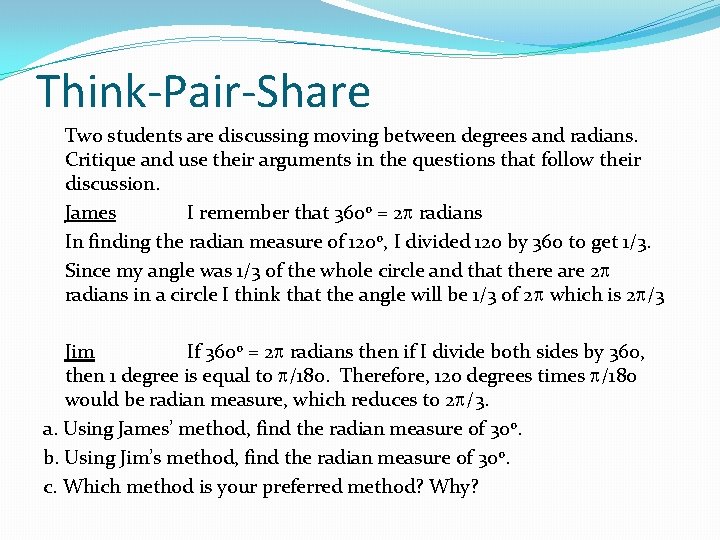
Think-Pair-Share Two students are discussing moving between degrees and radians. Critique and use their arguments in the questions that follow their discussion. James I remember that 360 o = 2 p radians In finding the radian measure of 120 o, I divided 120 by 360 to get 1/3. Since my angle was 1/3 of the whole circle and that there are 2 p radians in a circle I think that the angle will be 1/3 of 2 p which is 2 p/3 Jim If 3600 = 2 p radians then if I divide both sides by 360, then 1 degree is equal to p/180. Therefore, 120 degrees times p/180 would be radian measure, which reduces to 2 p/3. a. Using James’ method, find the radian measure of 300. b. Using Jim’s method, find the radian measure of 300. c. Which method is your preferred method? Why?
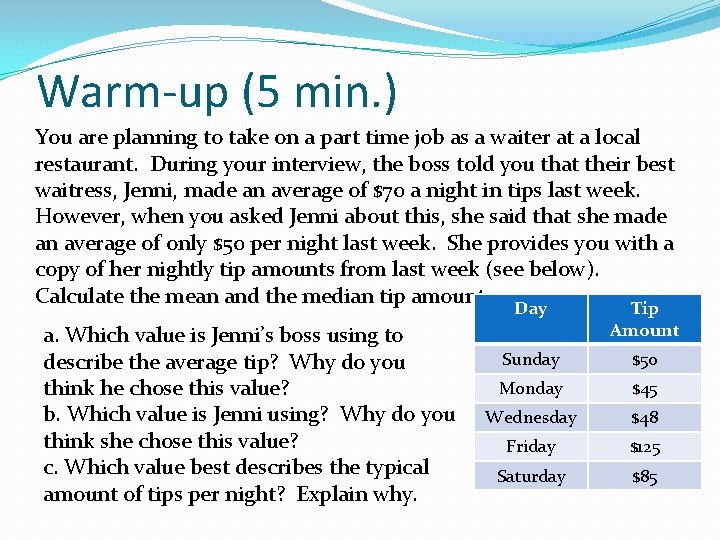
Warm-up (5 min. ) You are planning to take on a part time job as a waiter at a local restaurant. During your interview, the boss told you that their best waitress, Jenni, made an average of $70 a night in tips last week. However, when you asked Jenni about this, she said that she made an average of only $50 per night last week. She provides you with a copy of her nightly tip amounts from last week (see below). Calculate the mean and the median tip amount. a. Which value is Jenni’s boss using to describe the average tip? Why do you think he chose this value? b. Which value is Jenni using? Why do you think she chose this value? c. Which value best describes the typical amount of tips per night? Explain why. Day Tip Amount Sunday $50 Monday $45 Wednesday $48 Friday $125 Saturday $85
Partner Work �Describe the following subset of outcomes for choosing one card from a standard deck of cards as the intersection of two events: {queen of hearts, queen of diamonds}. �Create and prove two events are independent from drawing a card from a standard deck �Create and prove two events are dependent from drawing a card from a standard deck
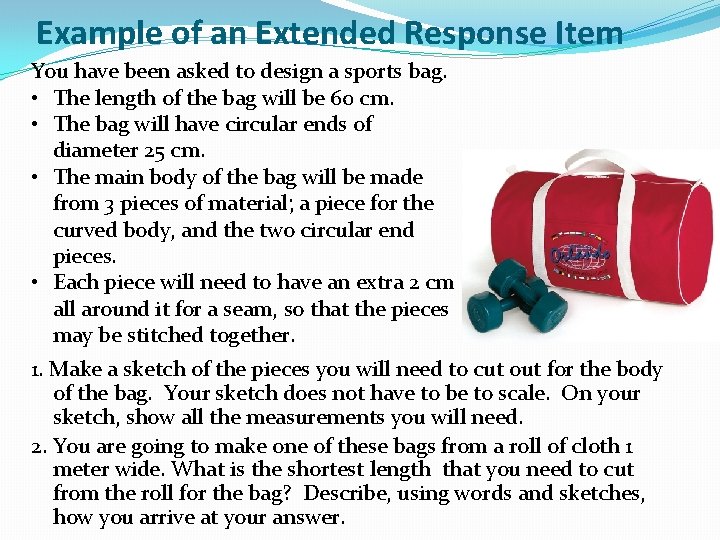
Example of an Extended Response Item You have been asked to design a sports bag. • The length of the bag will be 60 cm. • The bag will have circular ends of diameter 25 cm. • The main body of the bag will be made from 3 pieces of material; a piece for the curved body, and the two circular end pieces. • Each piece will need to have an extra 2 cm all around it for a seam, so that the pieces may be stitched together. 1. Make a sketch of the pieces you will need to cut out for the body of the bag. Your sketch does not have to be to scale. On your sketch, show all the measurements you will need. 2. You are going to make one of these bags from a roll of cloth 1 meter wide. What is the shortest length that you need to cut from the roll for the bag? Describe, using words and sketches, how you arrive at your answer.
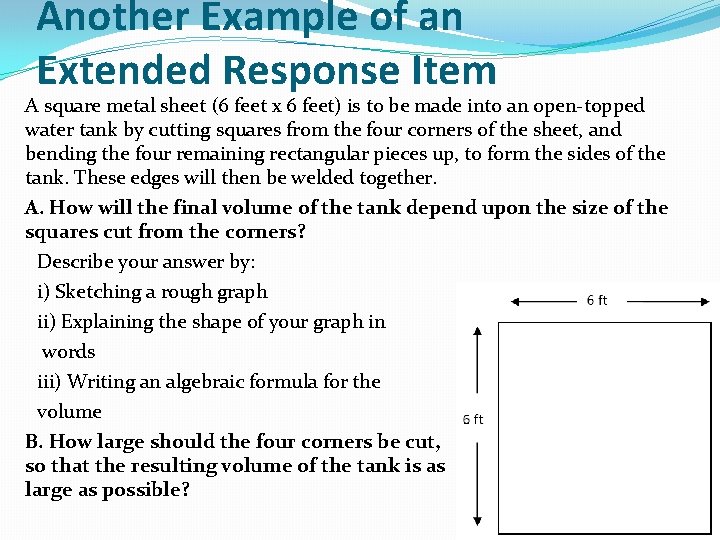
Another Example of an Extended Response Item A square metal sheet (6 feet x 6 feet) is to be made into an open-topped water tank by cutting squares from the four corners of the sheet, and bending the four remaining rectangular pieces up, to form the sides of the tank. These edges will then be welded together. A. How will the final volume of the tank depend upon the size of the squares cut from the corners? Describe your answer by: i) Sketching a rough graph ii) Explaining the shape of your graph in words iii) Writing an algebraic formula for the volume B. How large should the four corners be cut, so that the resulting volume of the tank is as large as possible?
Mathematical Practices & Math Content Must Interact �The Standards for Mathematical Practice describe ways in Persevere in which developing student practitioners of the discipline of problem Solving mathematics increasingly ought to engage with the subject Look for & use regularity matter as they grow ininmathematical maturity and expertise Reason repeated reasoning throughout the elementary, middle and high school years. �The Standards for Mathematical Content are a balanced combination of procedure and understanding. Expectations that begin with the word “understand” good Mathematical are often especially Construct Look for & use Content with arguments & structure opportunities to connect the. Understanding practices to the content. Students critique others who lack understanding of a topic may rely on procedures too heavily which may effectively prevent a student from engaging in the mathematical practices. Attend to which set an expectation Model with �The content standards of precision math understanding are potential “points of intersection” between Use tools the Standards for Mathematical Content and the Standards for appropriately Mathematical Practice.
Resources �http: //www. dpi. state. nc. us/acre/standards/commoncore/ �http: //maccss. ncdpi. wikispaces. net �http: //www. corestandards. org/Math/Practice