
Understanding the School Quality and Student Success Indicator
- Slides: 27
Understanding the School Quality and Student Success Indicator in the ESSA School Index April 6, 2018
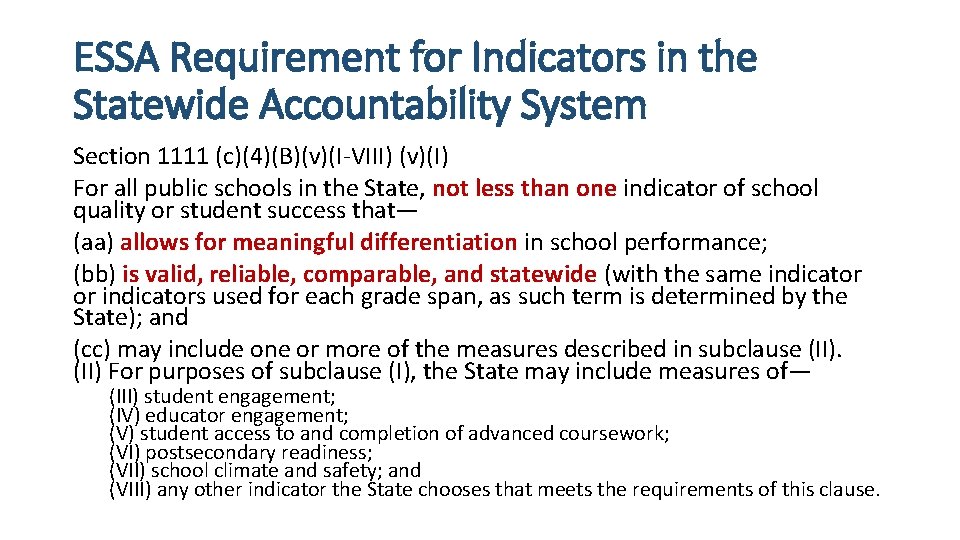
ESSA Requirement for Indicators in the Statewide Accountability System Section 1111 (c)(4)(B)(v)(I-VIII) (v)(I) For all public schools in the State, not less than one indicator of school quality or student success that— (aa) allows for meaningful differentiation in school performance; (bb) is valid, reliable, comparable, and statewide (with the same indicator or indicators used for each grade span, as such term is determined by the State); and (cc) may include one or more of the measures described in subclause (II) For purposes of subclause (I), the State may include measures of— (III) student engagement; (IV) educator engagement; (V) student access to and completion of advanced coursework; (VI) postsecondary readiness; (VII) school climate and safety; and (VIII) any other indicator the State chooses that meets the requirements of this clause.
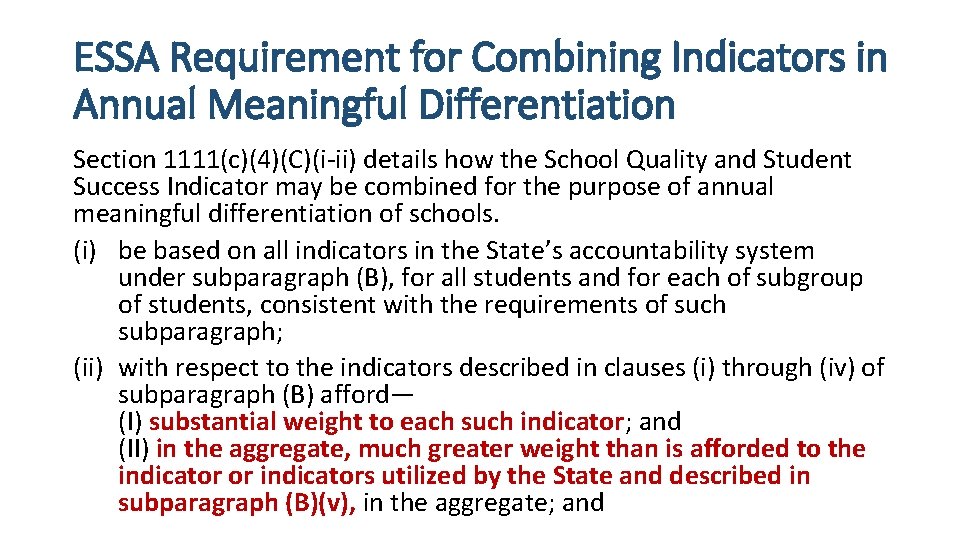
ESSA Requirement for Combining Indicators in Annual Meaningful Differentiation Section 1111(c)(4)(C)(i-ii) details how the School Quality and Student Success Indicator may be combined for the purpose of annual meaningful differentiation of schools. (i) be based on all indicators in the State’s accountability system under subparagraph (B), for all students and for each of subgroup of students, consistent with the requirements of such subparagraph; (ii) with respect to the indicators described in clauses (i) through (iv) of subparagraph (B) afford— (I) substantial weight to each such indicator; and (II) in the aggregate, much greater weight than is afforded to the indicator or indicators utilized by the State and described in subparagraph (B)(v), in the aggregate; and
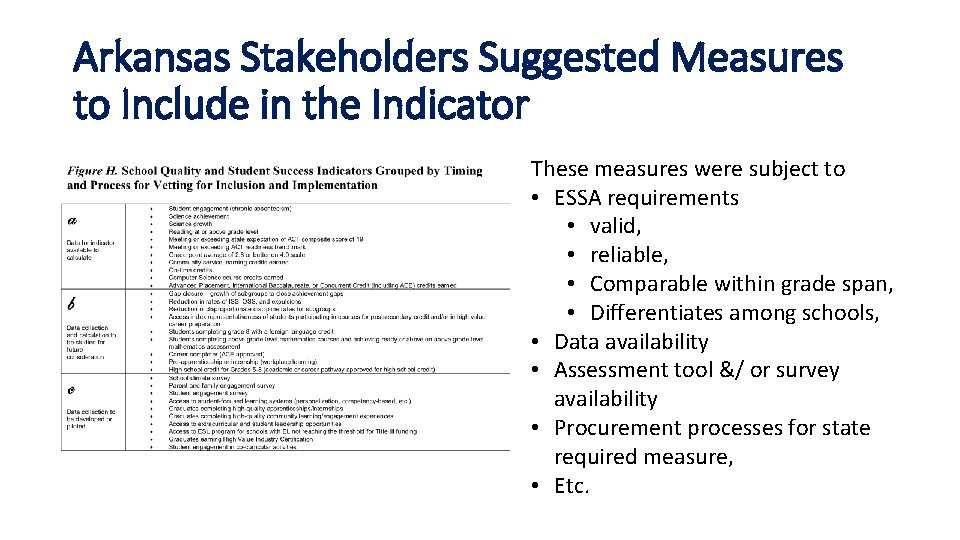
Arkansas Stakeholders Suggested Measures to Include in the Indicator These measures were subject to • ESSA requirements • valid, • reliable, • Comparable within grade span, • Differentiates among schools, • Data availability • Assessment tool &/ or survey availability • Procurement processes for state required measure, • Etc.
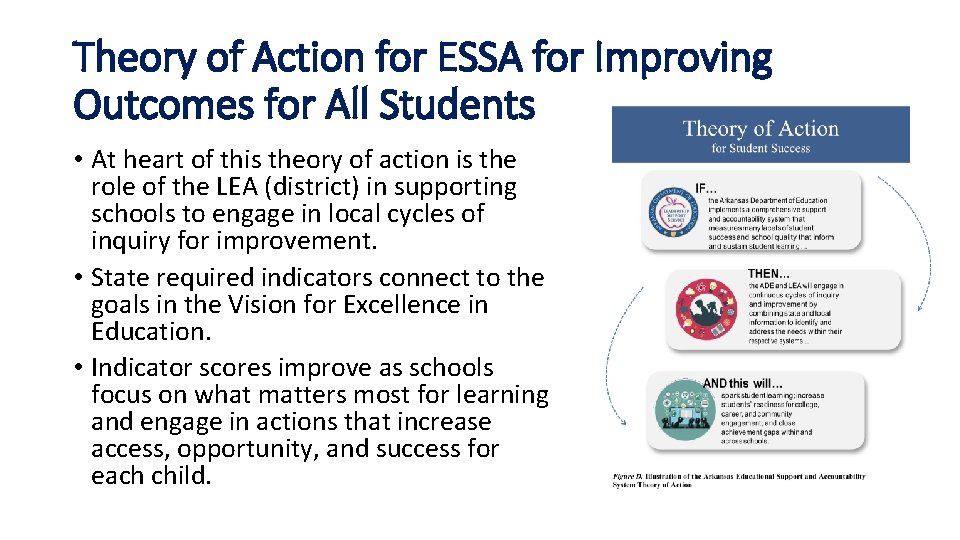
Theory of Action for ESSA for Improving Outcomes for All Students • At heart of this theory of action is the role of the LEA (district) in supporting schools to engage in local cycles of inquiry for improvement. • State required indicators connect to the goals in the Vision for Excellence in Education. • Indicator scores improve as schools focus on what matters most for learning and engage in actions that increase access, opportunity, and success for each child.
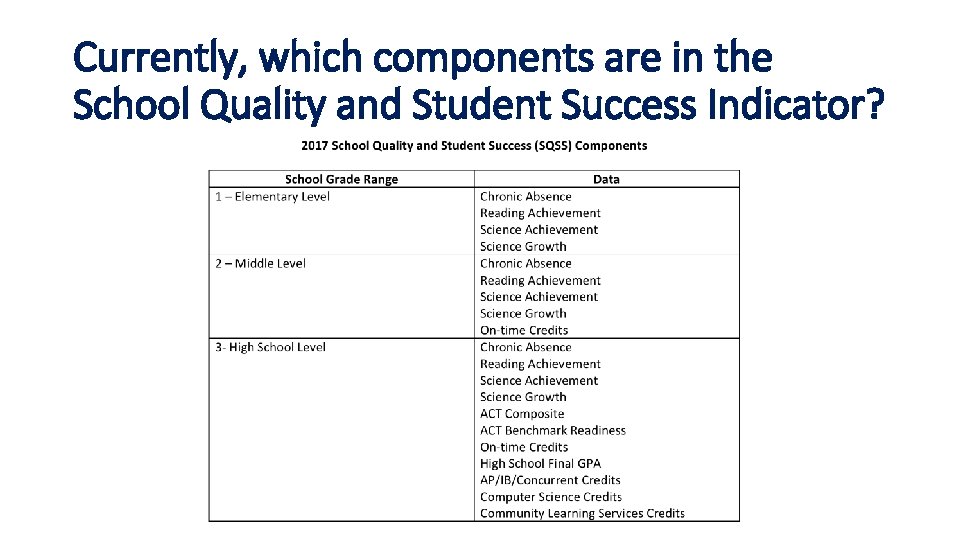
Currently, which components are in the School Quality and Student Success Indicator?
Schools that serve grade levels that cross the grade spans may have some components for the grade span, based on the grade range of the school. Which components should schools expect to have in their SQSS? • Schools that have any grades 3 -10 will have reading achievement scores. • Schools that have any grades 3 -10 will have science achievement scores. • Schools that have any grades 4 -10 will have science growth scores. • Schools that have a grade 9, 10, and/or 11 in them (middle or high school grade span) will have on-time credits. • Schools that have a grade 12 will have ACT Composite, ACT College Readiness Benchmark, state cumulative GPA, AP/IB. CC points, Computer science points, and Community Service Learning Points.
Examples Grades 5 – 9, 6 – 9, or 7 – 9 schools • This school will be in the middle school grade span (6 -8) • Components will include reading achievement, science growth, and on-time credits • On-time credits will apply to the grade 9 students in the school. Grades 8 – 9, 9, 9 – 10, or 10 11 schools • These schools will be in the high school grade span (9 -12) • Components include reading achievement, science growth, on -time credits • These schools will not have the components calculated using the grade 12 enrollment.
How is each component calculated? From what sources are the data drawn? When are the data drawn?
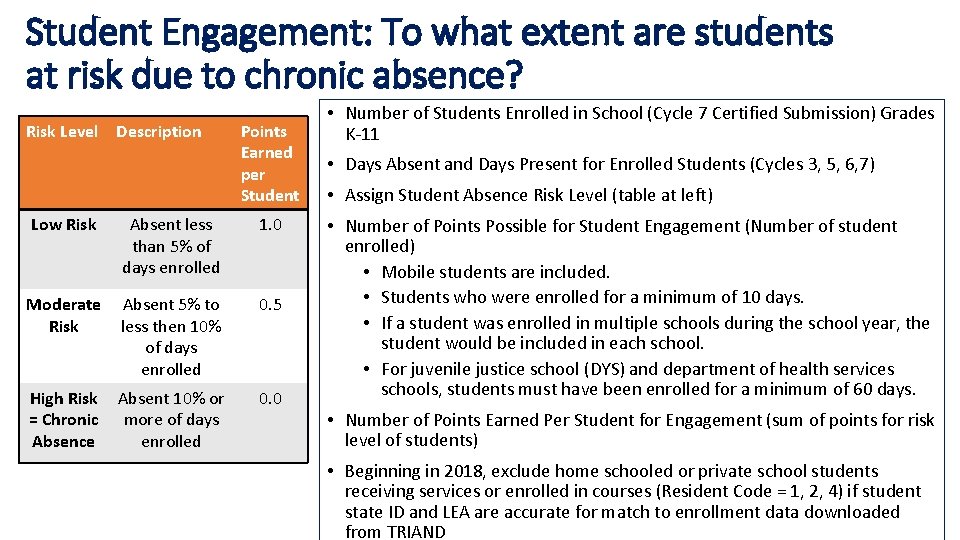
Student Engagement: To what extent are students at risk due to chronic absence? Risk Level Description Points Earned per Student Low Risk Absent less than 5% of days enrolled 1. 0 Moderate Risk Absent 5% to less then 10% of days enrolled 0. 5 High Risk = Chronic Absence Absent 10% or more of days enrolled 0. 0 • Number of Students Enrolled in School (Cycle 7 Certified Submission) Grades K-11 • Days Absent and Days Present for Enrolled Students (Cycles 3, 5, 6, 7) • Assign Student Absence Risk Level (table at left) • Number of Points Possible for Student Engagement (Number of student enrolled) • Mobile students are included. • Students who were enrolled for a minimum of 10 days. • If a student was enrolled in multiple schools during the school year, the student would be included in each school. • For juvenile justice school (DYS) and department of health services schools, students must have been enrolled for a minimum of 60 days. • Number of Points Earned Per Student for Engagement (sum of points for risk level of students) • Beginning in 2018, exclude home schooled or private school students receiving services or enrolled in courses (Resident Code = 1, 2, 4) if student state ID and LEA are accurate for match to enrollment data downloaded from TRIAND
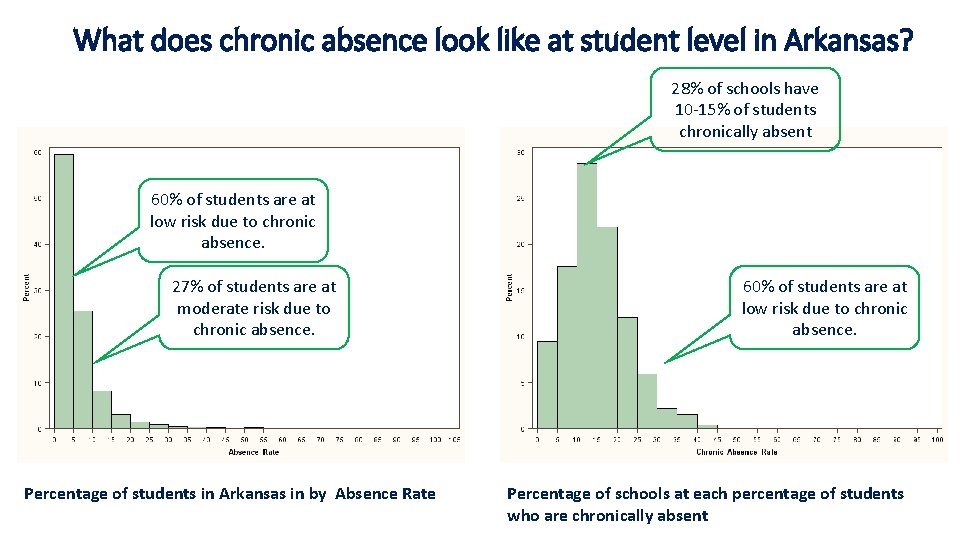
What does chronic absence look like at student level in Arkansas? 28% of schools have 10 -15% of students chronically absent 60% of students are at low risk due to chronic absence. 27% of students are at moderate risk due to chronic absence. Percentage of students in Arkansas in by Absence Rate 60% of students are at low risk due to chronic absence. Percentage of schools at each percentage of students who are chronically absent
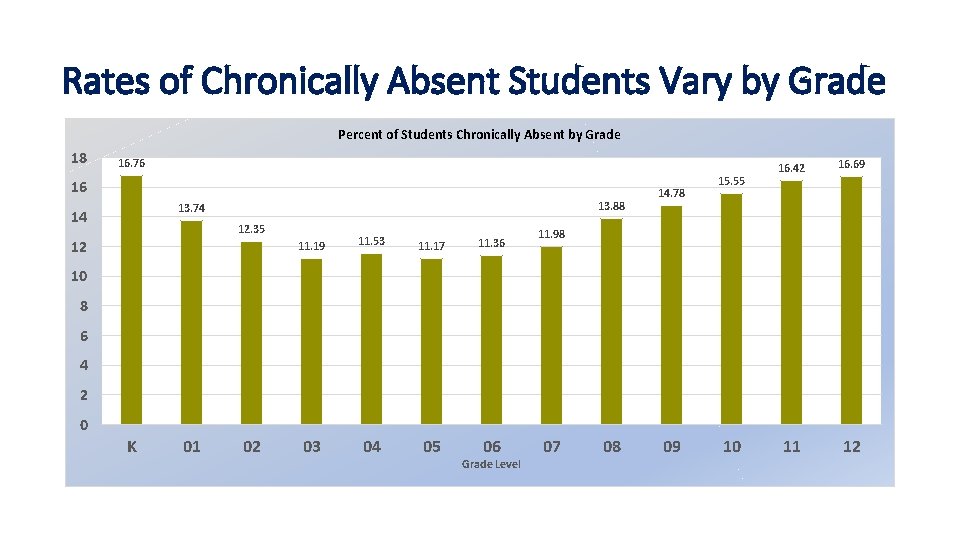
Rates of Chronically Absent Students Vary by Grade Percent of Students Chronically Absent by Grade 18 16. 76 16 13. 88 13. 74 14 12. 35 12 11. 19 11. 53 11. 17 11. 36 03 04 05 06 14. 78 15. 55 16. 42 16. 69 11 12 11. 98 10 8 6 4 2 0 K 01 02 Grade Level 07 08 09 10
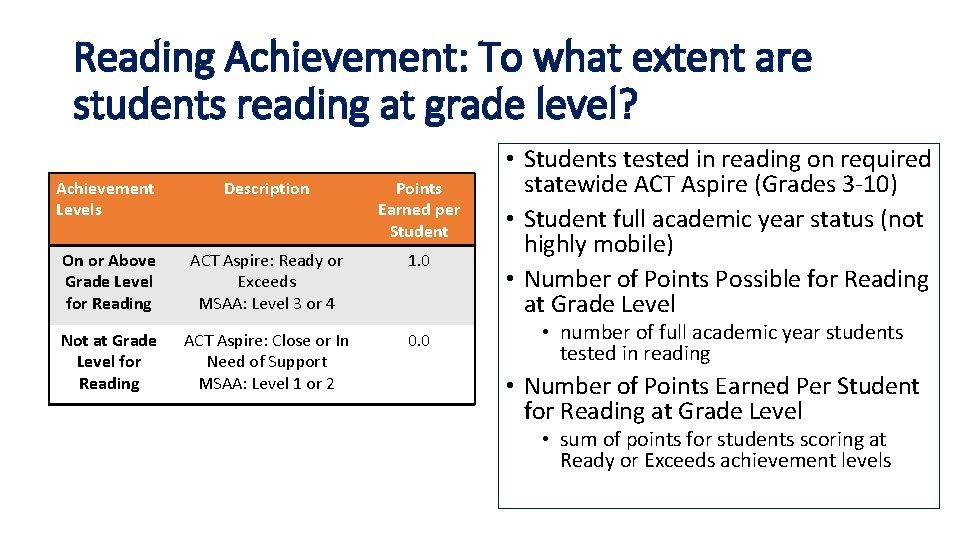
Reading Achievement: To what extent are students reading at grade level? Achievement Levels Description Points Earned per Student On or Above Grade Level for Reading ACT Aspire: Ready or Exceeds MSAA: Level 3 or 4 1. 0 Not at Grade Level for Reading ACT Aspire: Close or In Need of Support MSAA: Level 1 or 2 0. 0 • Students tested in reading on required statewide ACT Aspire (Grades 3 -10) • Student full academic year status (not highly mobile) • Number of Points Possible for Reading at Grade Level • number of full academic year students tested in reading • Number of Points Earned Per Student for Reading at Grade Level • sum of points for students scoring at Ready or Exceeds achievement levels
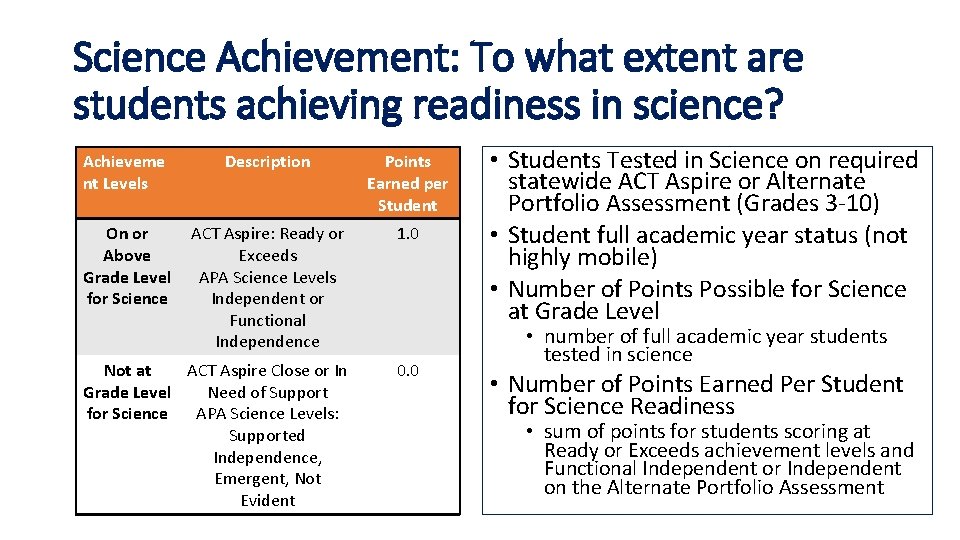
Science Achievement: To what extent are students achieving readiness in science? Achieveme nt Levels Description Points Earned per Student On or Above Grade Level for Science ACT Aspire: Ready or Exceeds APA Science Levels Independent or Functional Independence 1. 0 Not at ACT Aspire Close or In Grade Level Need of Support for Science APA Science Levels: Supported Independence, Emergent, Not Evident 0. 0 • Students Tested in Science on required statewide ACT Aspire or Alternate Portfolio Assessment (Grades 3 -10) • Student full academic year status (not highly mobile) • Number of Points Possible for Science at Grade Level • number of full academic year students tested in science • Number of Points Earned Per Student for Science Readiness • sum of points for students scoring at Ready or Exceeds achievement levels and Functional Independent or Independent on the Alternate Portfolio Assessment
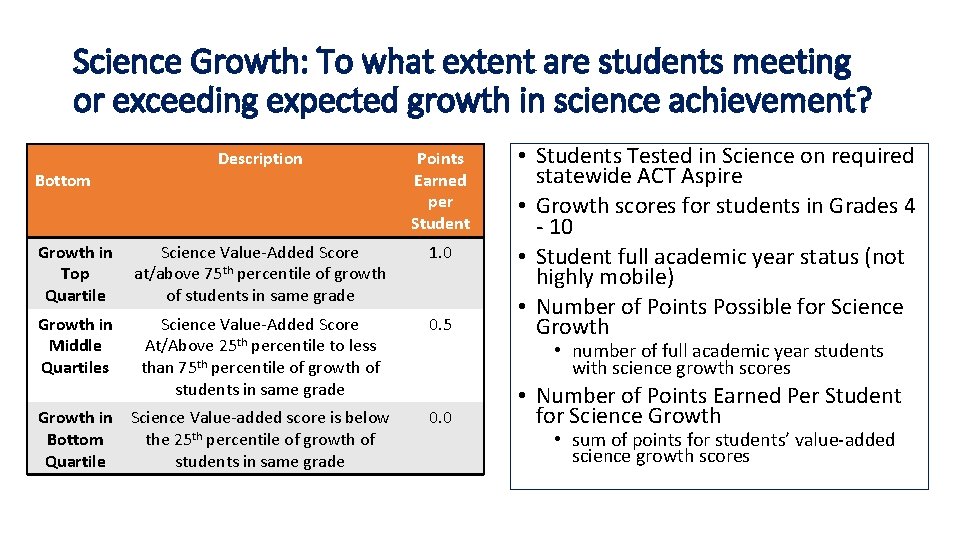
Science Growth: To what extent are students meeting or exceeding expected growth in science achievement? Description Points Earned per Student Growth in Top Quartile Science Value-Added Score at/above 75 th percentile of growth of students in same grade 1. 0 Growth in Middle Quartiles Science Value-Added Score At/Above 25 th percentile to less than 75 th percentile of growth of students in same grade 0. 5 Bottom Growth in Science Value-added score is below Bottom the 25 th percentile of growth of Quartile students in same grade • Students Tested in Science on required statewide ACT Aspire • Growth scores for students in Grades 4 - 10 • Student full academic year status (not highly mobile) • Number of Points Possible for Science Growth • number of full academic year students with science growth scores 0. 0 • Number of Points Earned Per Student for Science Growth • sum of points for students’ value-added science growth scores
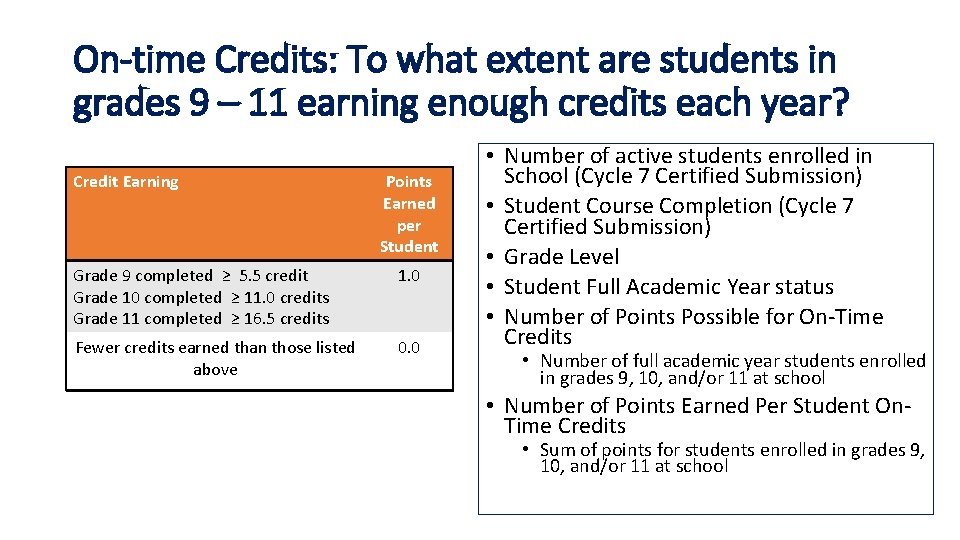
On-time Credits: To what extent are students in grades 9 – 11 earning enough credits each year? Credit Earning Points Earned per Student Grade 9 completed ≥ 5. 5 credit Grade 10 completed ≥ 11. 0 credits Grade 11 completed ≥ 16. 5 credits 1. 0 Fewer credits earned than those listed above 0. 0 • Number of active students enrolled in School (Cycle 7 Certified Submission) • Student Course Completion (Cycle 7 Certified Submission) • Grade Level • Student Full Academic Year status • Number of Points Possible for On-Time Credits • Number of full academic year students enrolled in grades 9, 10, and/or 11 at school • Number of Points Earned Per Student On. Time Credits • Sum of points for students enrolled in grades 9, 10, and/or 11 at school
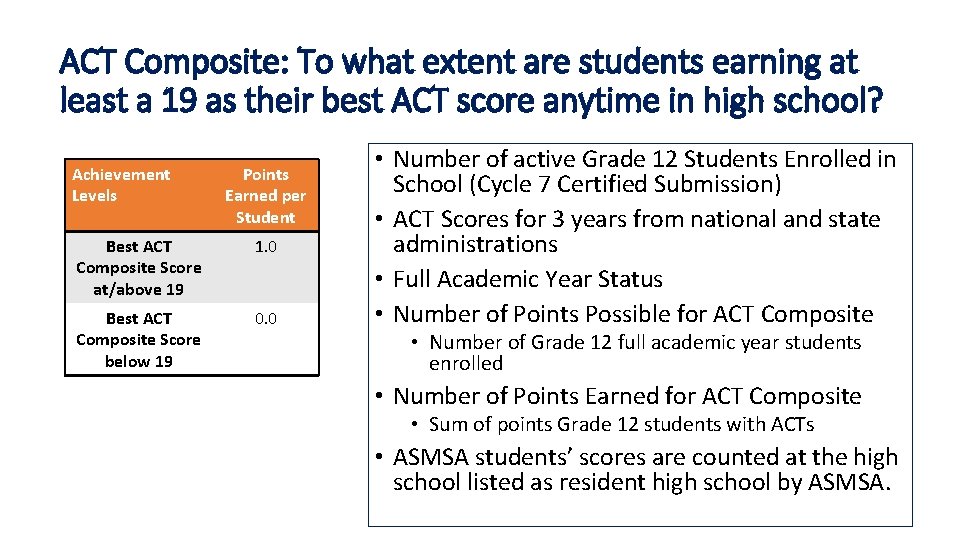
ACT Composite: To what extent are students earning at least a 19 as their best ACT score anytime in high school? Achievement Levels Points Earned per Student Best ACT Composite Score at/above 19 1. 0 Best ACT Composite Score below 19 0. 0 • Number of active Grade 12 Students Enrolled in School (Cycle 7 Certified Submission) • ACT Scores for 3 years from national and state administrations • Full Academic Year Status • Number of Points Possible for ACT Composite • Number of Grade 12 full academic year students enrolled • Number of Points Earned for ACT Composite • Sum of points Grade 12 students with ACTs • ASMSA students’ scores are counted at the high school listed as resident high school by ASMSA.
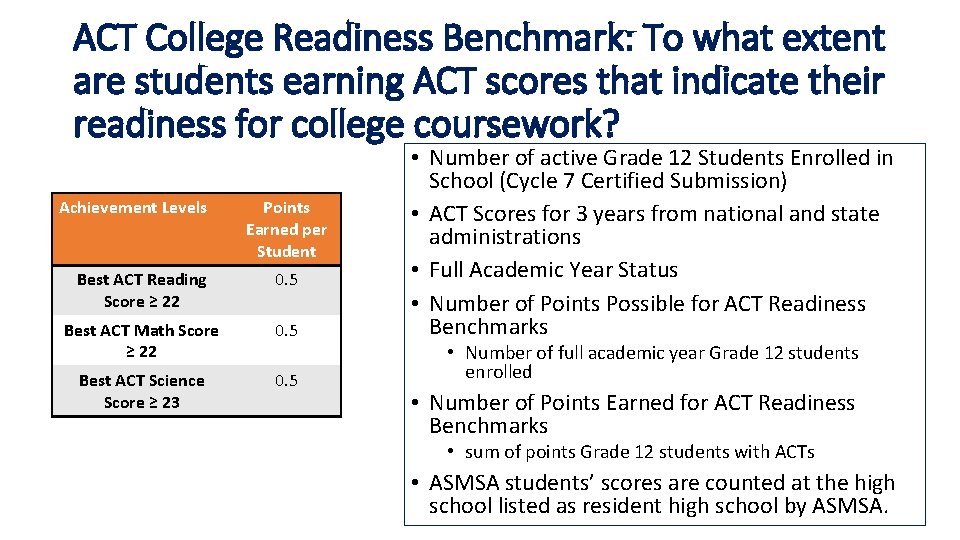
ACT College Readiness Benchmark: To what extent are students earning ACT scores that indicate their readiness for college coursework? Achievement Levels Points Earned per Student Best ACT Reading Score ≥ 22 0. 5 Best ACT Math Score ≥ 22 0. 5 Best ACT Science Score ≥ 23 0. 5 • Number of active Grade 12 Students Enrolled in School (Cycle 7 Certified Submission) • ACT Scores for 3 years from national and state administrations • Full Academic Year Status • Number of Points Possible for ACT Readiness Benchmarks • Number of full academic year Grade 12 students enrolled • Number of Points Earned for ACT Readiness Benchmarks • sum of points Grade 12 students with ACTs • ASMSA students’ scores are counted at the high school listed as resident high school by ASMSA.
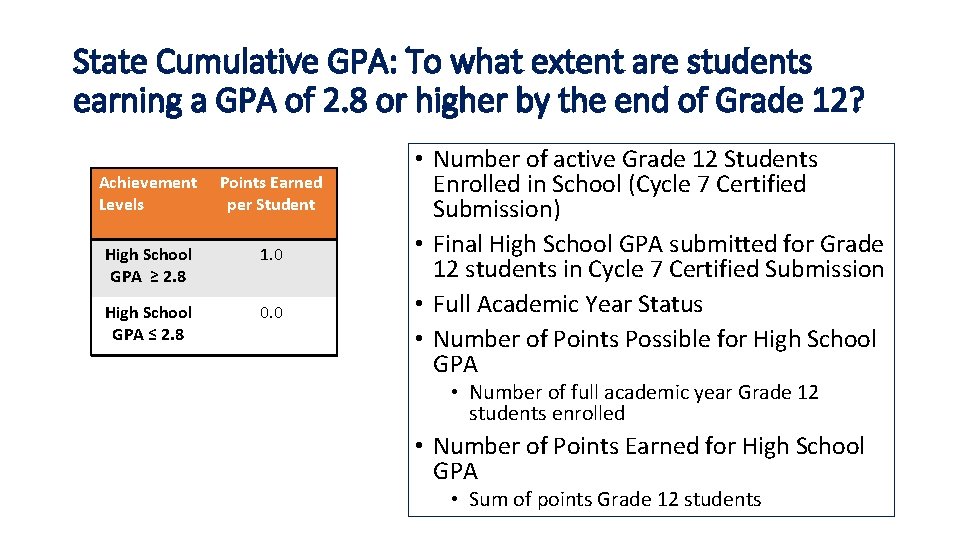
State Cumulative GPA: To what extent are students earning a GPA of 2. 8 or higher by the end of Grade 12? Achievement Levels Points Earned per Student High School GPA ≥ 2. 8 1. 0 High School GPA ≤ 2. 8 0. 0 • Number of active Grade 12 Students Enrolled in School (Cycle 7 Certified Submission) • Final High School GPA submitted for Grade 12 students in Cycle 7 Certified Submission • Full Academic Year Status • Number of Points Possible for High School GPA • Number of full academic year Grade 12 students enrolled • Number of Points Earned for High School GPA • Sum of points Grade 12 students
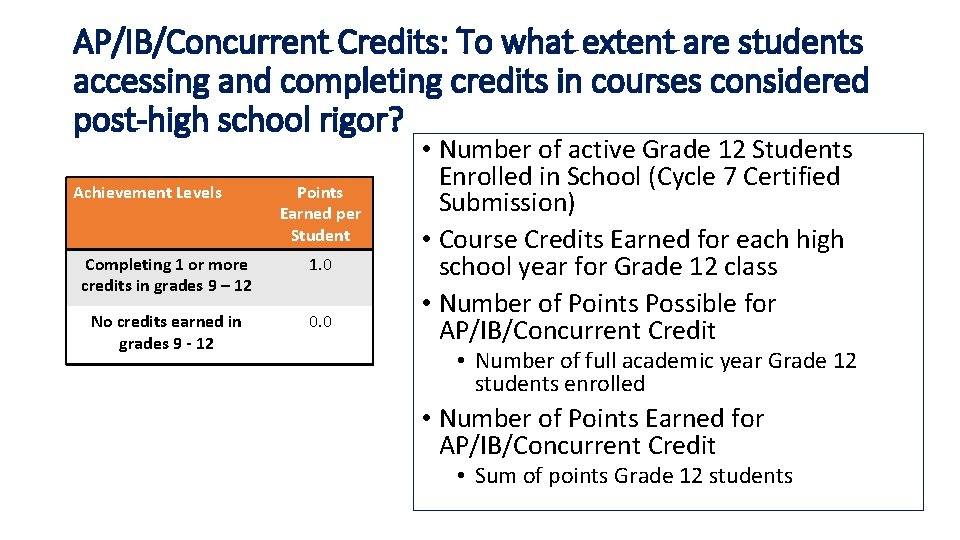
AP/IB/Concurrent Credits: To what extent are students accessing and completing credits in courses considered post-high school rigor? Achievement Levels Points Earned per Student Completing 1 or more credits in grades 9 – 12 1. 0 No credits earned in grades 9 - 12 0. 0 • Number of active Grade 12 Students Enrolled in School (Cycle 7 Certified Submission) • Course Credits Earned for each high school year for Grade 12 class • Number of Points Possible for AP/IB/Concurrent Credit • Number of full academic year Grade 12 students enrolled • Number of Points Earned for AP/IB/Concurrent Credit • Sum of points Grade 12 students
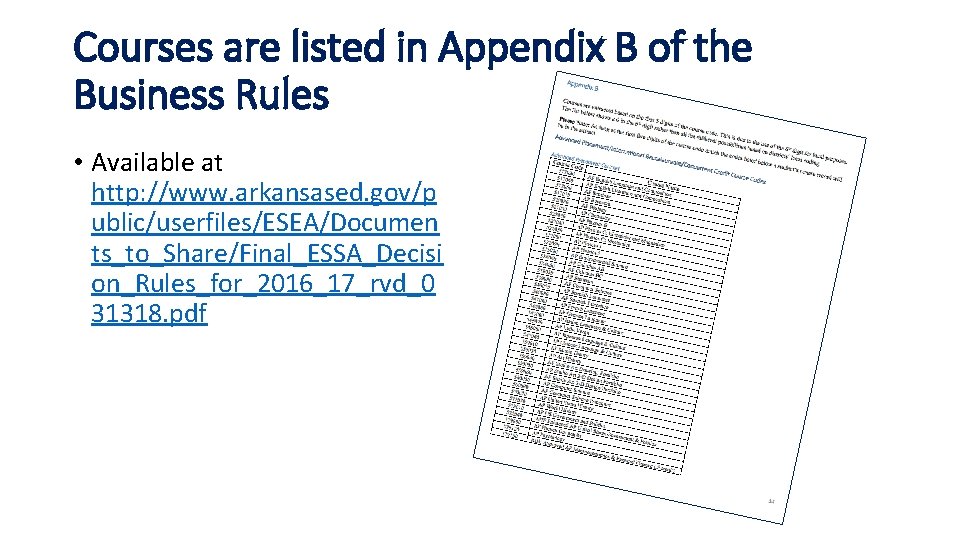
Courses are listed in Appendix B of the Business Rules • Available at http: //www. arkansased. gov/p ublic/userfiles/ESEA/Documen ts_to_Share/Final_ESSA_Decisi on_Rules_for_2016_17_rvd_0 31318. pdf
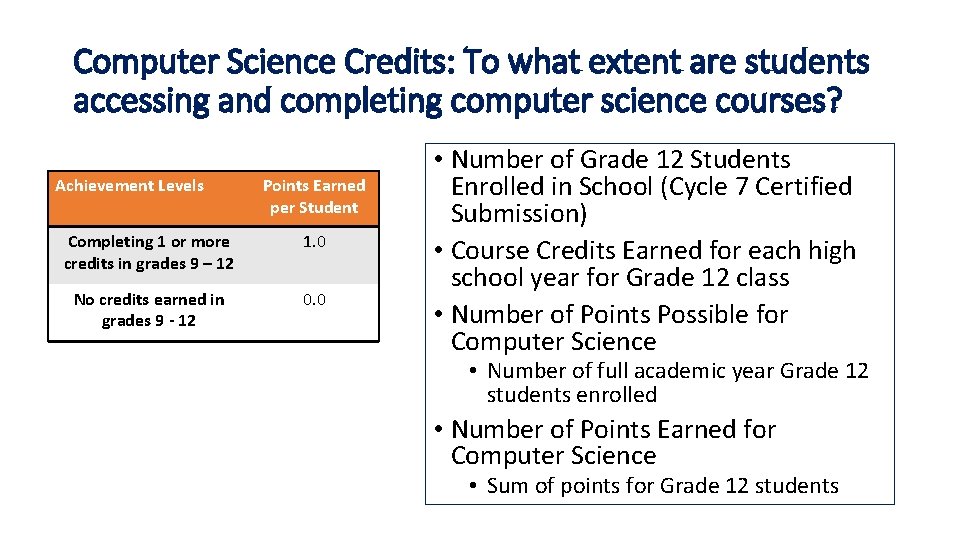
Computer Science Credits: To what extent are students accessing and completing computer science courses? Achievement Levels Points Earned per Student Completing 1 or more credits in grades 9 – 12 1. 0 No credits earned in grades 9 - 12 0. 0 • Number of Grade 12 Students Enrolled in School (Cycle 7 Certified Submission) • Course Credits Earned for each high school year for Grade 12 class • Number of Points Possible for Computer Science • Number of full academic year Grade 12 students enrolled • Number of Points Earned for Computer Science • Sum of points for Grade 12 students
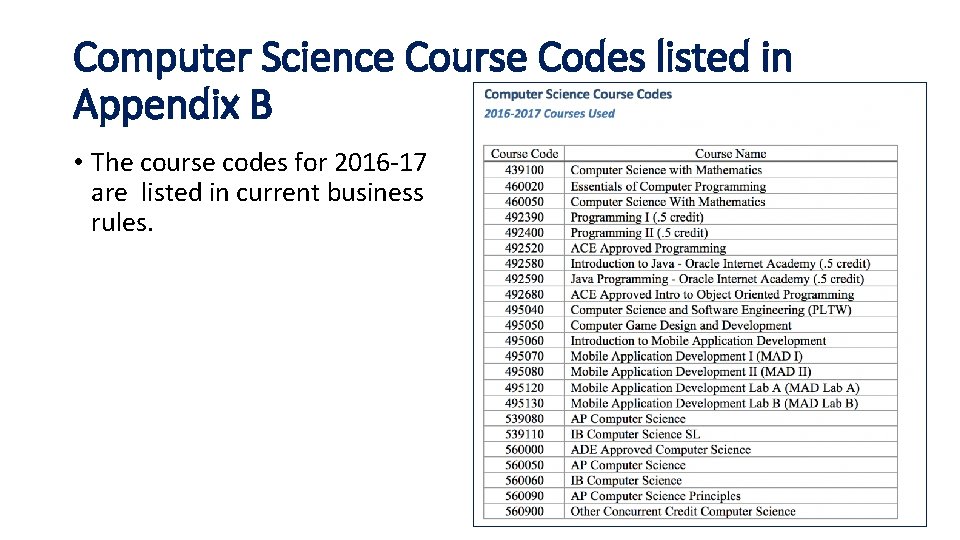
Computer Science Course Codes listed in Appendix B • The course codes for 2016 -17 are listed in current business rules.
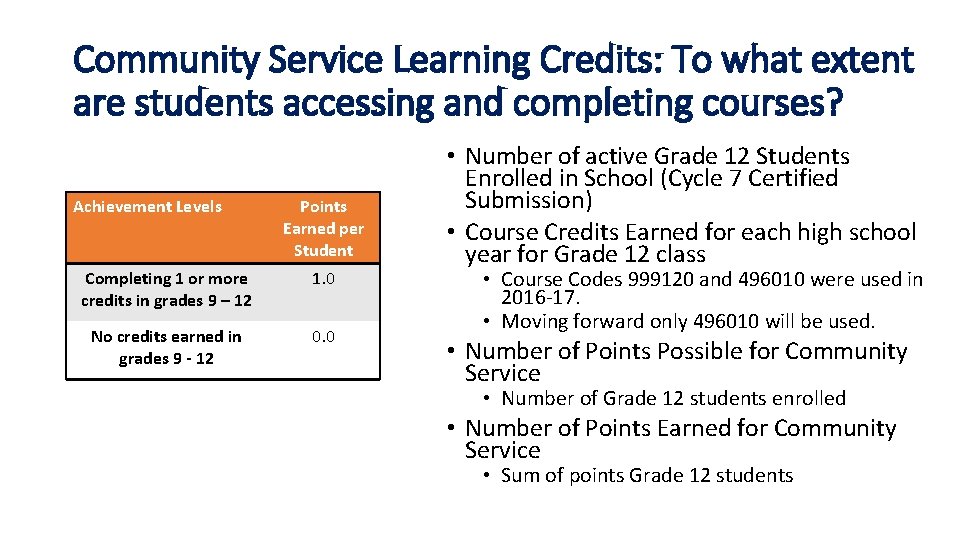
Community Service Learning Credits: To what extent are students accessing and completing courses? Achievement Levels Points Earned per Student Completing 1 or more credits in grades 9 – 12 1. 0 No credits earned in grades 9 - 12 0. 0 • Number of active Grade 12 Students Enrolled in School (Cycle 7 Certified Submission) • Course Credits Earned for each high school year for Grade 12 class • Course Codes 999120 and 496010 were used in 2016 -17. • Moving forward only 496010 will be used. • Number of Points Possible for Community Service • Number of Grade 12 students enrolled • Number of Points Earned for Community Service • Sum of points Grade 12 students
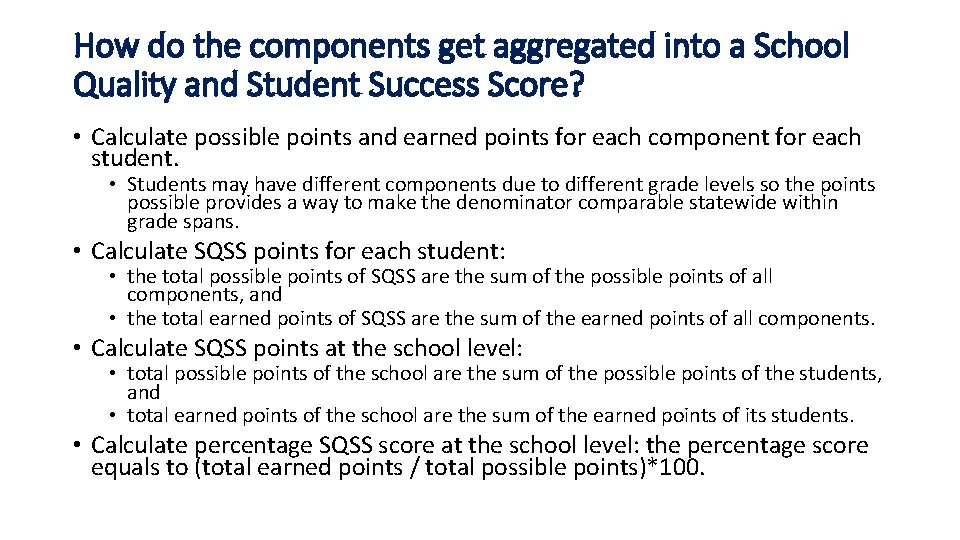
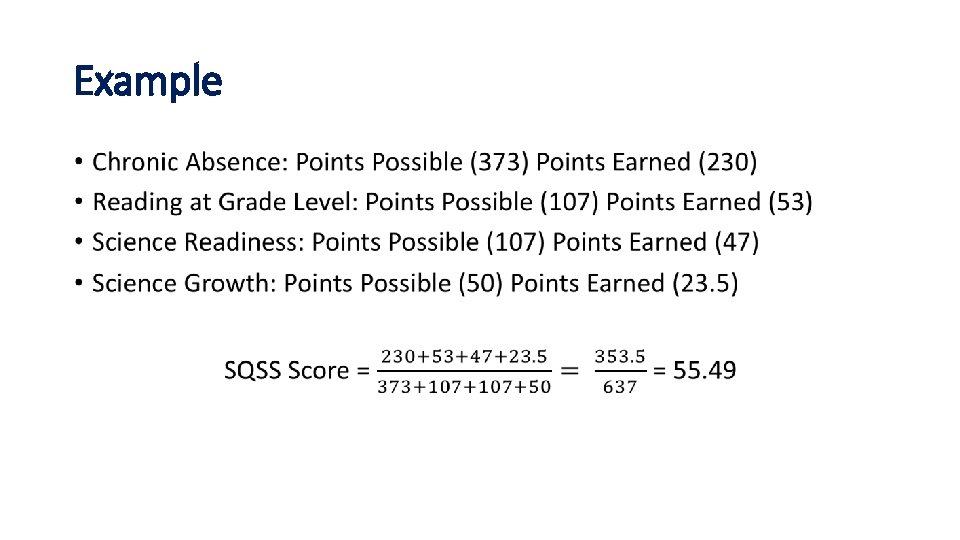
How do the components get aggregated into a School Quality and Student Success Score? • Calculate possible points and earned points for each component for each student. • Students may have different components due to different grade levels so the points possible provides a way to make the denominator comparable statewide within grade spans. • Calculate SQSS points for each student: • the total possible points of SQSS are the sum of the possible points of all components, and • the total earned points of SQSS are the sum of the earned points of all components. • Calculate SQSS points at the school level: • total possible points of the school are the sum of the possible points of the students, and • total earned points of the school are the sum of the earned points of its students. • Calculate percentage SQSS score at the school level: the percentage score equals to (total earned points / total possible points)*100.
Example •
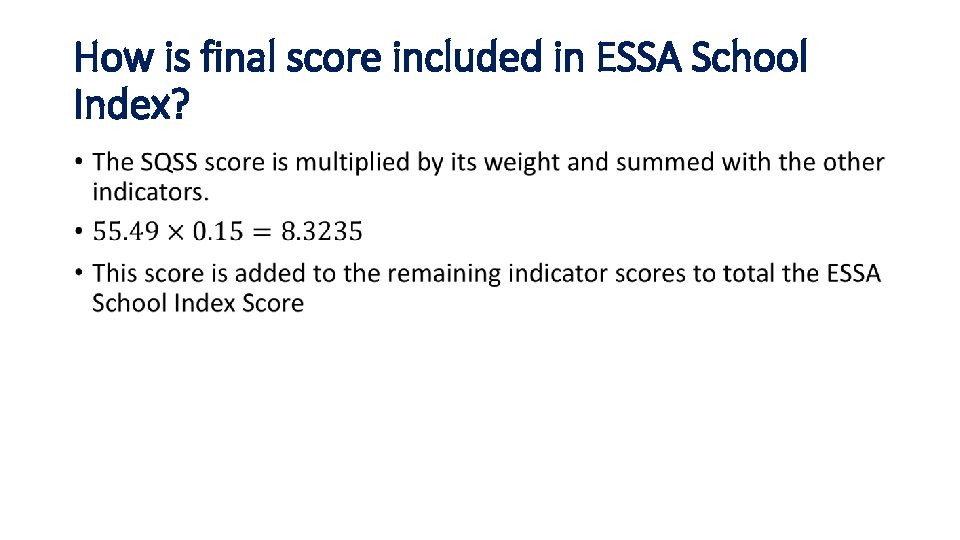
How is final score included in ESSA School Index? •