
Understanding the Role of Phonemic Proficiency in Boosting
Understanding the Role of Phonemic Proficiency in Boosting Reading Skills in Struggling Readers Arkansas Literacy Association November 15, 2019 David A. Kilpatrick, Ph. D State University of New York, College at Cortland kilpatrickd@cortland. edu
Today’s Objectives are to learn about and understand. . . 1 Common misunderstandings regarding phonemic awareness 2 The two levels of word reading 3 The three types of learning required for word-level reading 4 The four classical approaches to teaching reading 5 How we remember the words we read 6 The phonemic proficiency hypothesis 7 The difference between phoneme TASKS and SKILLS
Common Misunderstandings About Phonemic Awareness and Reading
Common Misunderstandings � PA is not important after first grade � Thought to only relate to early learning of CVC words � Not thought to be involved in sight word acquisition � PA cannot be learned after third (or whatever) grade � PA is best taught using letters ◦ A common misunderstanding of the National Reading Panel’s findings � PA is simply a by-product of reading, not a cause
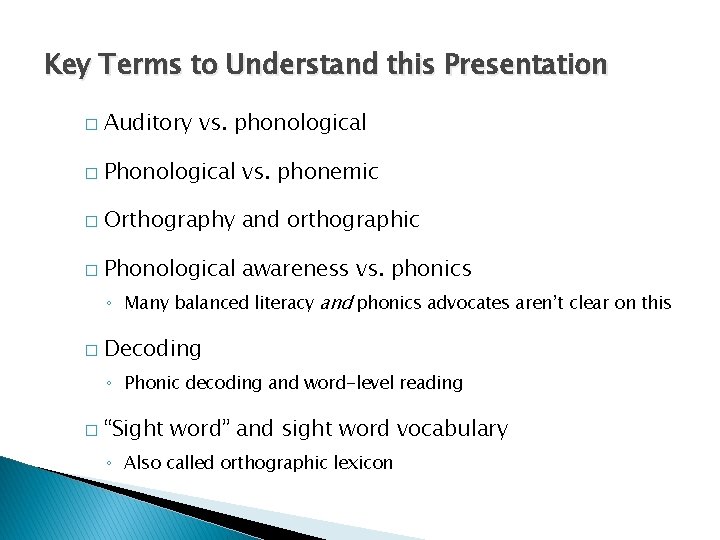
Key Terms to Understand this Presentation � Auditory vs. phonological � Phonological vs. phonemic � Orthography and orthographic � Phonological awareness vs. phonics ◦ Many balanced literacy and phonics advocates aren’t clear on this � Decoding ◦ Phonic decoding and word-level reading � “Sight word” and sight word vocabulary ◦ Also called orthographic lexicon
The Two Levels of Skilled Word Reading
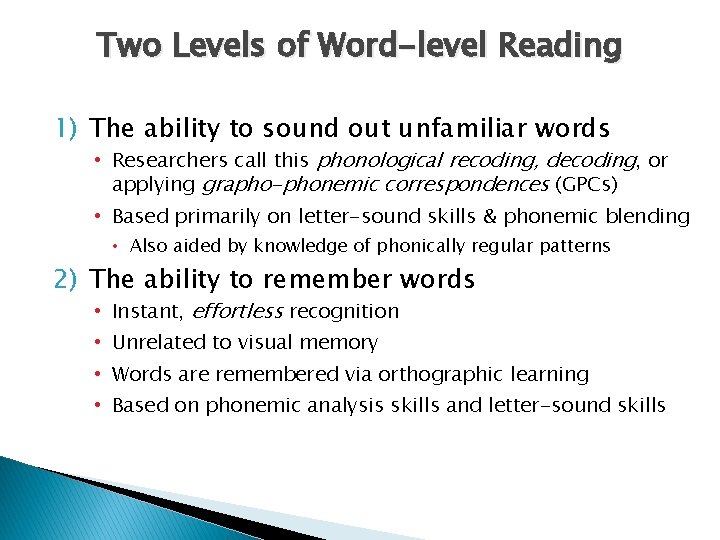
Two Levels of Word-level Reading 1) The ability to sound out unfamiliar words • Researchers call this phonological recoding, decoding, or applying grapho-phonemic correspondences (GPCs) • Based primarily on letter-sound skills & phonemic blending • Also aided by knowledge of phonically regular patterns 2) The ability to remember words • Instant, effortless recognition • Unrelated to visual memory • Words are remembered via orthographic learning • Based on phonemic analysis skills and letter-sound skills
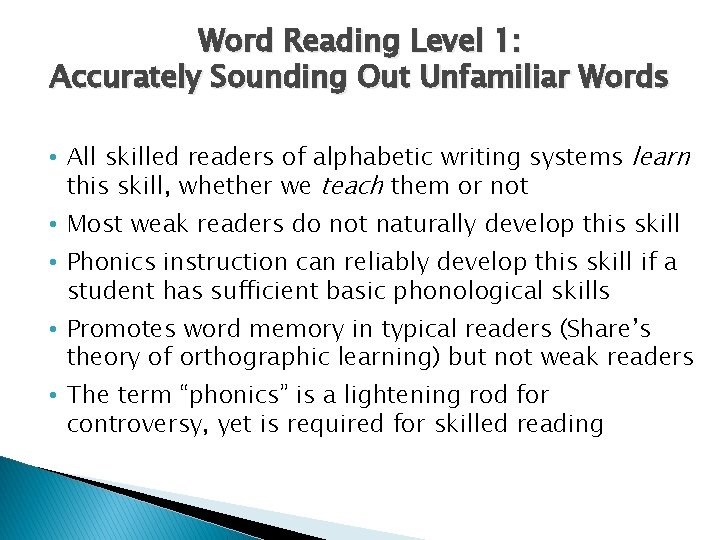
Word Reading Level 1: Accurately Sounding Out Unfamiliar Words • All skilled readers of alphabetic writing systems learn this skill, whether we teach them or not • Most weak readers do not naturally develop this skill • Phonics instruction can reliably develop this skill if a student has sufficient basic phonological skills • Promotes word memory in typical readers (Share’s theory of orthographic learning) but not weak readers • The term “phonics” is a lightening rod for controversy, yet is required for skilled reading
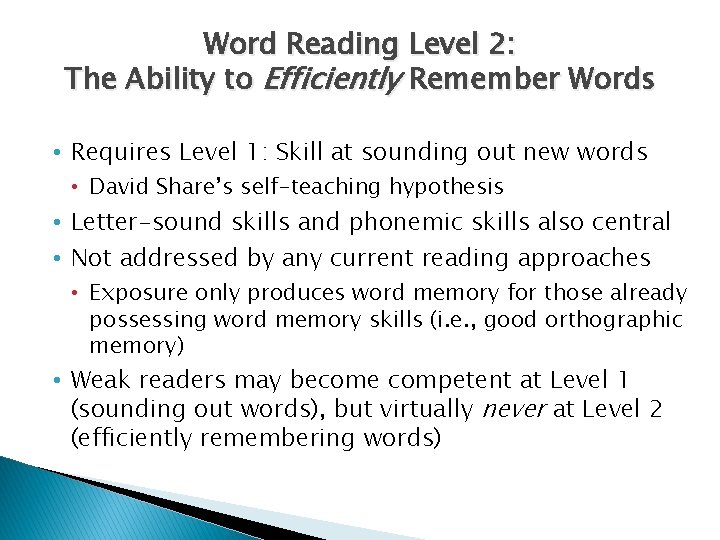
Word Reading Level 2: The Ability to Efficiently Remember Words • Requires Level 1: Skill at sounding out new words • David Share’s self-teaching hypothesis • Letter-sound skills and phonemic skills also central • Not addressed by any current reading approaches • Exposure only produces word memory for those already possessing word memory skills (i. e. , good orthographic memory) • Weak readers may become competent at Level 1 (sounding out words), but virtually never at Level 2 (efficiently remembering words)
Skilled Word Reading Requires Three Types of Learning
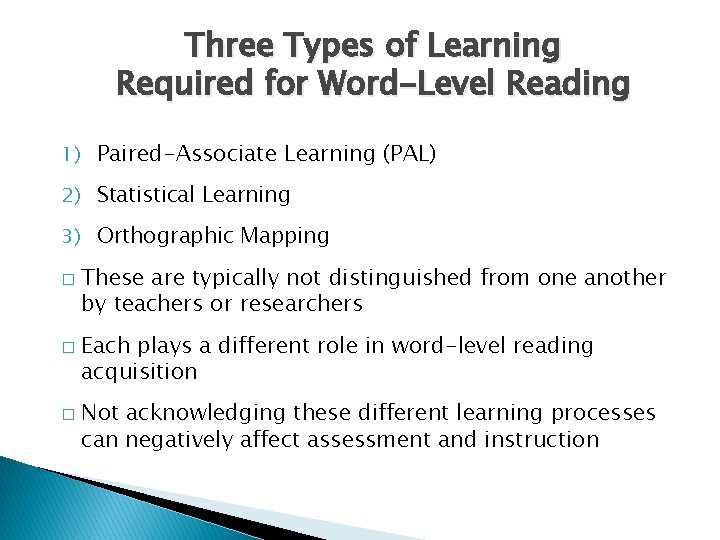
Three Types of Learning Required for Word-Level Reading 1) Paired-Associate Learning (PAL) 2) Statistical Learning 3) Orthographic Mapping � � � These are typically not distinguished from one another by teachers or researchers Each plays a different role in word-level reading acquisition Not acknowledging these different learning processes can negatively affect assessment and instruction

Paired-Associate Learning (PAL) � Involves associating two things so that the presence of one activates the other ◦ Language/labeling involves verbal PAL � Foundational for learning letter names and sounds ◦ Letter learning involves visual-phonological PAL ◦ The visual half of that equation is not the problem � Not the basis for written word learning ◦ Yet many teaching methods seem to presume this � Learning � Dozens is explicit (i. e. , conscious learning) to hundreds of exposures needed for accuracy-based mastery, hundreds to thousands for automaticity
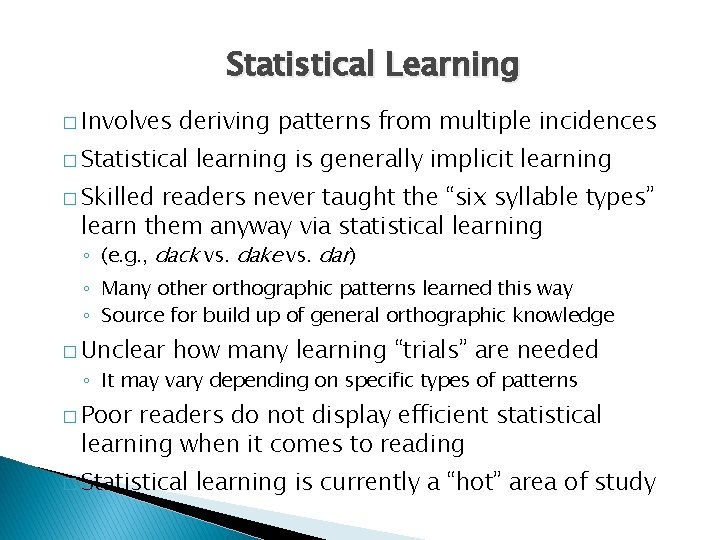
Statistical Learning � Involves deriving patterns from multiple incidences � Statistical learning is generally implicit learning � Skilled readers never taught the “six syllable types” learn them anyway via statistical learning ◦ (e. g. , dack vs. dake vs. dar) ◦ Many other orthographic patterns learned this way ◦ Source for build up of general orthographic knowledge � Unclear how many learning “trials” are needed ◦ It may vary depending on specific types of patterns � Poor readers do not display efficient statistical learning when it comes to reading � Statistical learning is currently a “hot” area of study
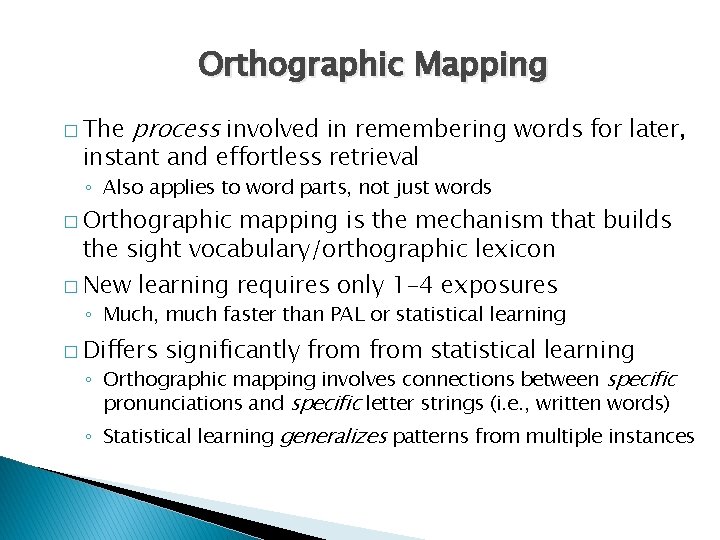
Orthographic Mapping � The process involved in remembering words for later, instant and effortless retrieval ◦ Also applies to word parts, not just words � Orthographic mapping is the mechanism that builds the sight vocabulary/orthographic lexicon � New learning requires only 1 -4 exposures ◦ Much, much faster than PAL or statistical learning � Differs significantly from statistical learning ◦ Orthographic mapping involves connections between specific pronunciations and specific letter strings (i. e. , written words) ◦ Statistical learning generalizes patterns from multiple instances
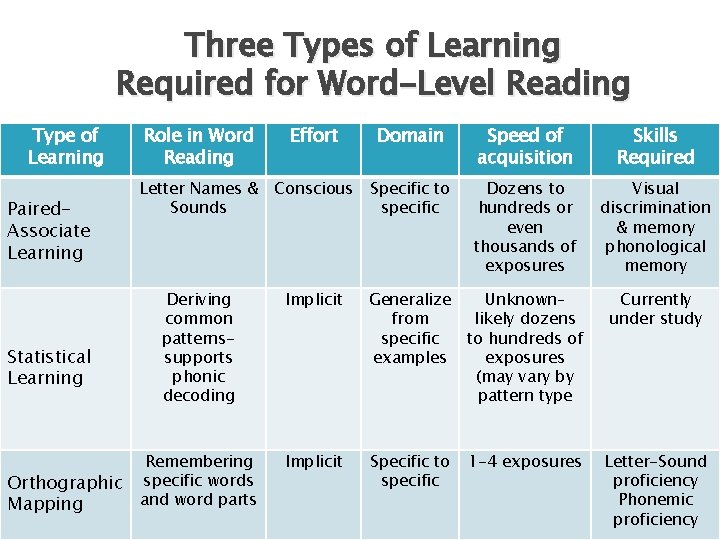
Three Types of Learning Required for Word-Level Reading Type of Learning Paired. Associate Learning Statistical Learning Orthographic Mapping Role in Word Reading Effort Letter Names & Conscious Sounds Domain Speed of acquisition Skills Required Specific to specific Dozens to hundreds or even thousands of exposures Visual discrimination & memory phonological memory Deriving common patternssupports phonic decoding Implicit Generalize from specific examples Unknown– likely dozens to hundreds of exposures (may vary by pattern type Currently under study Remembering specific words and word parts Implicit Specific to specific 1 -4 exposures Letter-Sound proficiency Phonemic proficiency
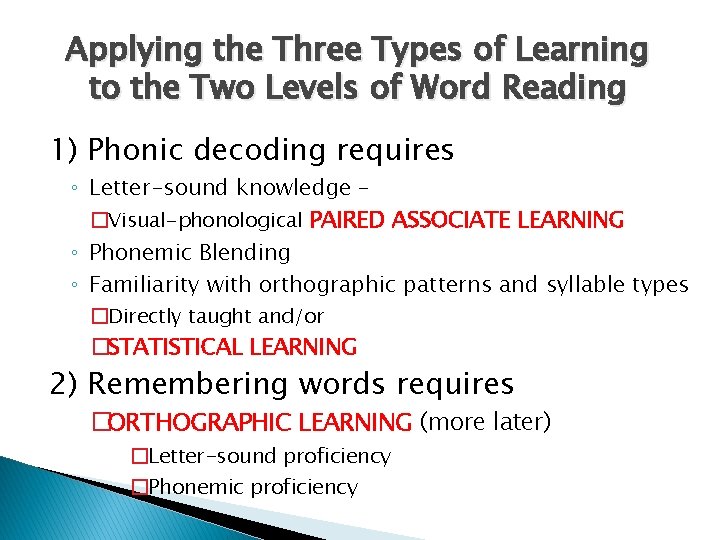
Applying the Three Types of Learning to the Two Levels of Word Reading 1) Phonic decoding requires ◦ Letter-sound knowledge – �Visual-phonological PAIRED ASSOCIATE LEARNING ◦ Phonemic Blending ◦ Familiarity with orthographic patterns and syllable types �Directly taught and/or �STATISTICAL LEARNING 2) Remembering words requires �ORTHOGRAPHIC LEARNING (more later) �Letter-sound proficiency �Phonemic proficiency
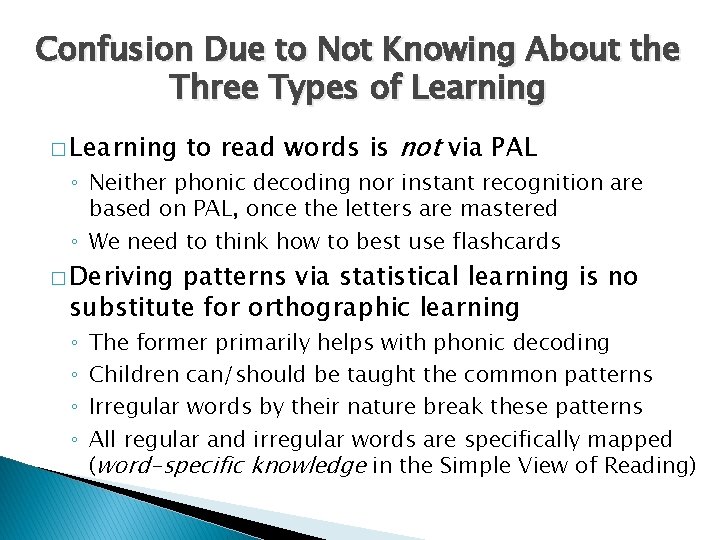
Confusion Due to Not Knowing About the Three Types of Learning � Learning to read words is not via PAL ◦ Neither phonic decoding nor instant recognition are based on PAL, once the letters are mastered ◦ We need to think how to best use flashcards � Deriving patterns via statistical learning is no substitute for orthographic learning ◦ ◦ The former primarily helps with phonic decoding Children can/should be taught the common patterns Irregular words by their nature break these patterns All regular and irregular words are specifically mapped (word-specific knowledge in the Simple View of Reading)
The Four Classic Approaches to Teaching Reading And why they do not help weak readers
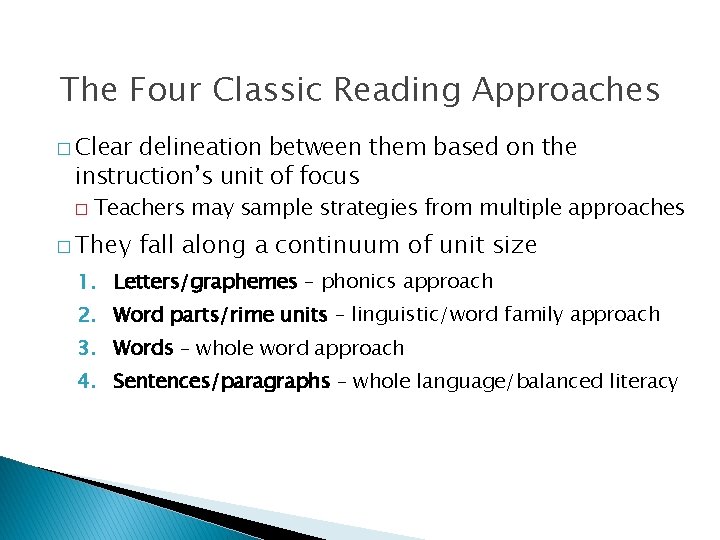
The Four Classic Reading Approaches � Clear delineation between them based on the instruction’s unit of focus � Teachers may sample strategies from multiple approaches � They fall along a continuum of unit size 1. Letters/graphemes – phonics approach 2. Word parts/rime units – linguistic/word family approach 3. Words – whole word approach 4. Sentences/paragraphs – whole language/balanced literacy
The Four Classic Reading Approaches � In every study I’ve seen, one has the best results � In every study I’ve seen, one has the weakest results � What they share in common ◦ -None adequately addresses both levels of word-level reading
How We Remember the Words We Read
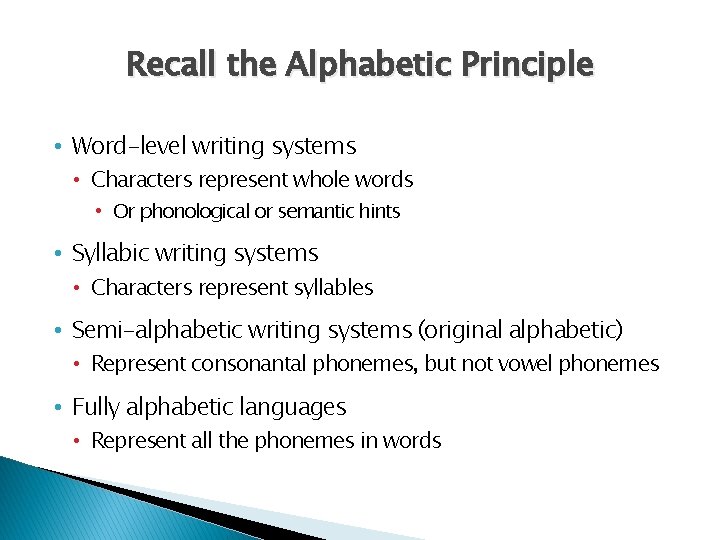
Recall the Alphabetic Principle • Word-level writing systems • Characters represent whole words • Or phonological or semantic hints • Syllabic writing systems • Characters represent syllables • Semi-alphabetic writing systems (original alphabetic) • Represent consonantal phonemes, but not vowel phonemes • Fully alphabetic languages • Represent all the phonemes in words
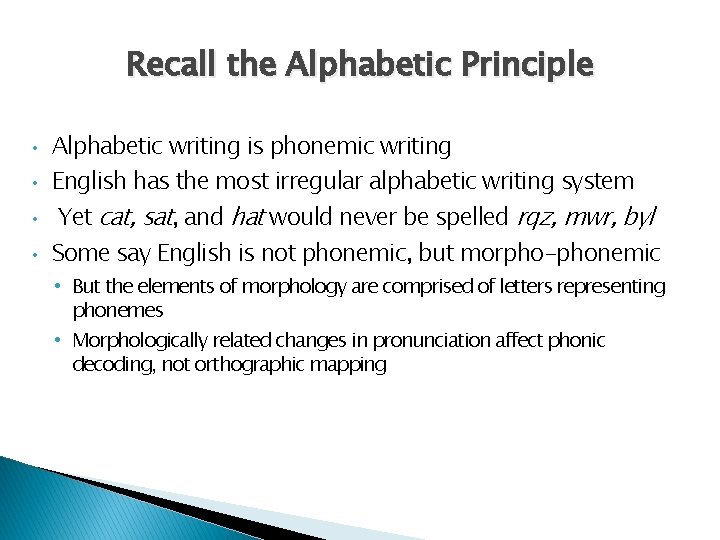
Recall the Alphabetic Principle • • Alphabetic writing is phonemic writing English has the most irregular alphabetic writing system Yet cat, sat, and hat would never be spelled rqz, mwr, byl Some say English is not phonemic, but morpho-phonemic • But the elements of morphology are comprised of letters representing phonemes • Morphologically related changes in pronunciation affect phonic decoding, not orthographic mapping
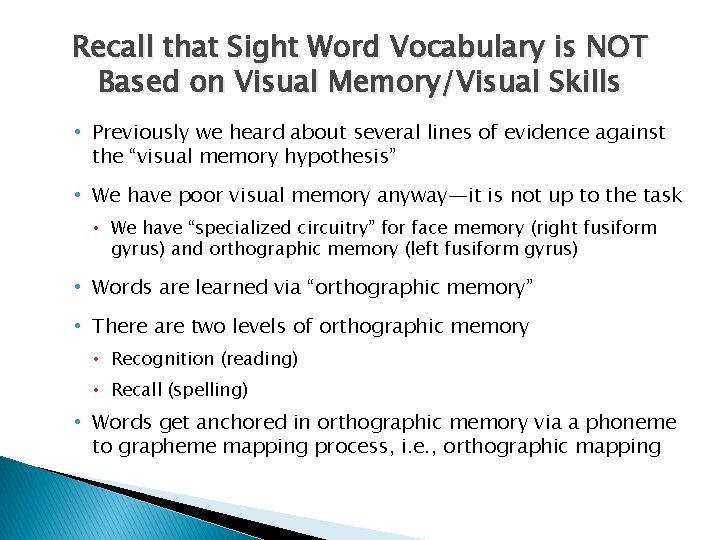
Recall that Sight Word Vocabulary is NOT Based on Visual Memory/Visual Skills • Previously we heard about several lines of evidence against the “visual memory hypothesis” • We have poor visual memory anyway—it is not up to the task • We have “specialized circuitry” for face memory (right fusiform gyrus) and orthographic memory (left fusiform gyrus) • Words are learned via “orthographic memory” • There are two levels of orthographic memory • Recognition (reading) • Recall (spelling) • Words get anchored in orthographic memory via a phoneme to grapheme mapping process, i. e. , orthographic mapping
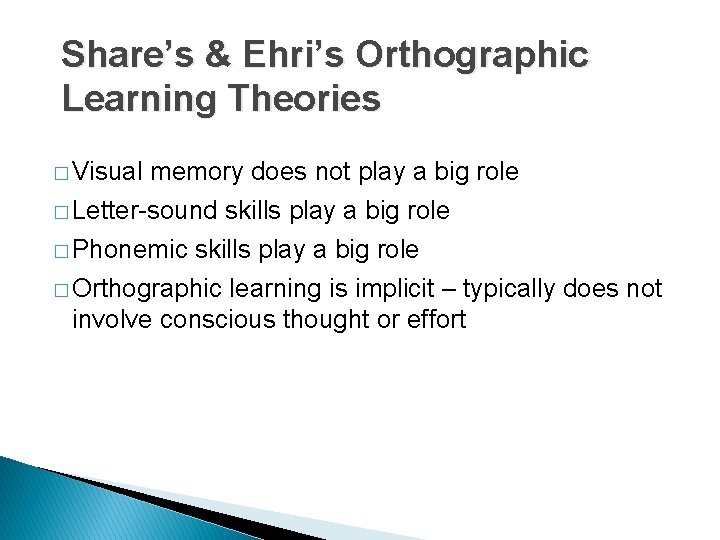
Share’s & Ehri’s Orthographic Learning Theories � Visual memory does not play a big role � Letter-sound � Phonemic skills play a big role � Orthographic learning is implicit – typically does not involve conscious thought or effort
Let’s Review the Skills Required for Efficient Orthographic Memory � Letter-sound � Phonemic proficiency ◦ This goes well beyond what is tested on universal screeners � The ability to establish a relationship between sounds and letters unconsciously while reading
The Phonemic Proficiency Hypothesis of Orthographic Learning
The Origin of the Phonemic Proficiency Hypothesis � 1997 to October 2001 PA assessment with Mc. Innis’ Phonological Processing Assessment; based upon Rosner & Simon’s 1974 Auditory Analysis Test � 4 th, 5 th, and 6 th grade poor readers � October 2001 screened a third grade class
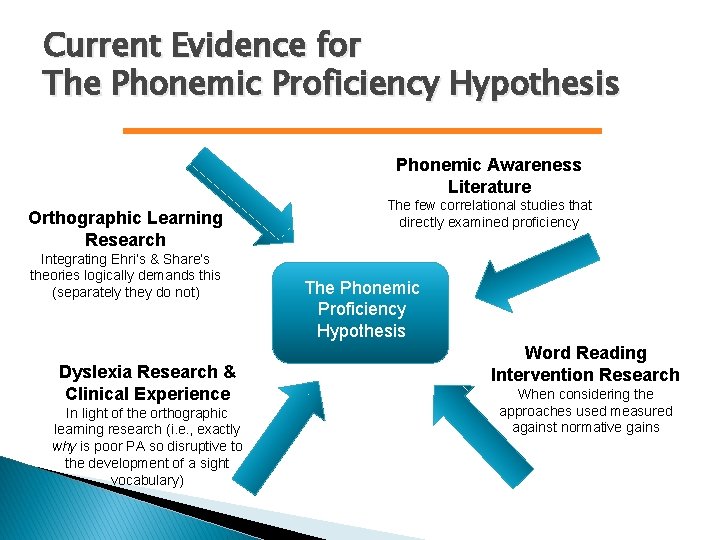
Current Evidence for The Phonemic Proficiency Hypothesis Phonemic Awareness Literature Orthographic Learning Research Integrating Ehri’s & Share’s theories logically demands this (separately they do not) Dyslexia Research & Clinical Experience In light of the orthographic learning research (i. e. , exactly why is poor PA so disruptive to the development of a sight vocabulary) The few correlational studies that directly examined proficiency The Phonemic Proficiency Hypothesis Word Reading Intervention Research When considering the approaches used measured against normative gains
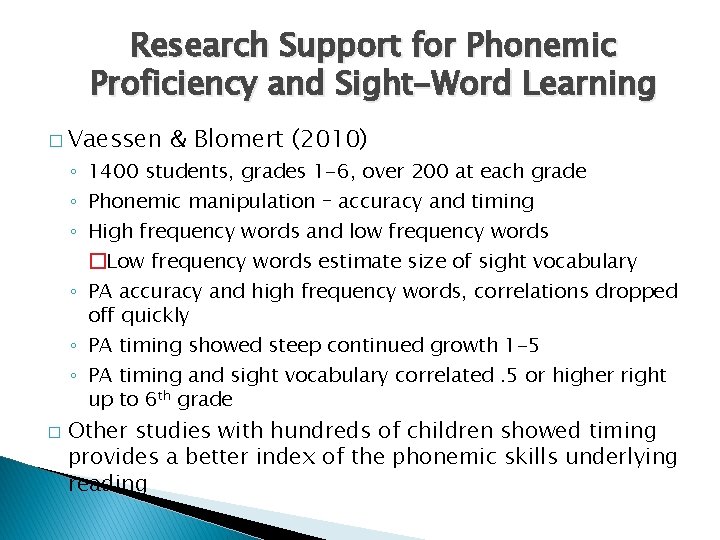
Research Support for Phonemic Proficiency and Sight-Word Learning � Vaessen & Blomert (2010) ◦ 1400 students, grades 1 -6, over 200 at each grade ◦ Phonemic manipulation – accuracy and timing ◦ High frequency words and low frequency words �Low frequency words estimate size of sight vocabulary ◦ PA accuracy and high frequency words, correlations dropped off quickly ◦ PA timing showed steep continued growth 1 -5 ◦ PA timing and sight vocabulary correlated. 5 or higher right up to 6 th grade � Other studies with hundreds of children showed timing provides a better index of the phonemic skills underlying reading
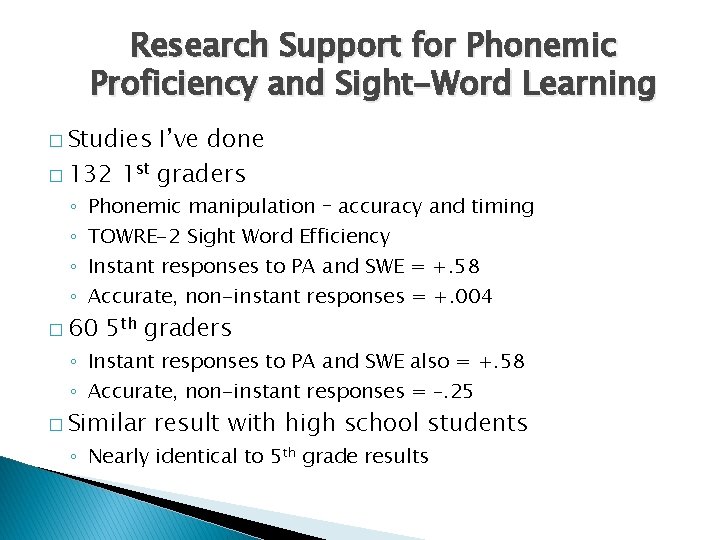
Research Support for Phonemic Proficiency and Sight-Word Learning � Studies I’ve done � 132 1 st graders ◦ ◦ Phonemic manipulation – accuracy and timing TOWRE-2 Sight Word Efficiency Instant responses to PA and SWE = +. 58 Accurate, non-instant responses = +. 004 � 60 5 th graders ◦ Instant responses to PA and SWE also = +. 58 ◦ Accurate, non-instant responses = –. 25 � Similar result with high school students ◦ Nearly identical to 5 th grade results
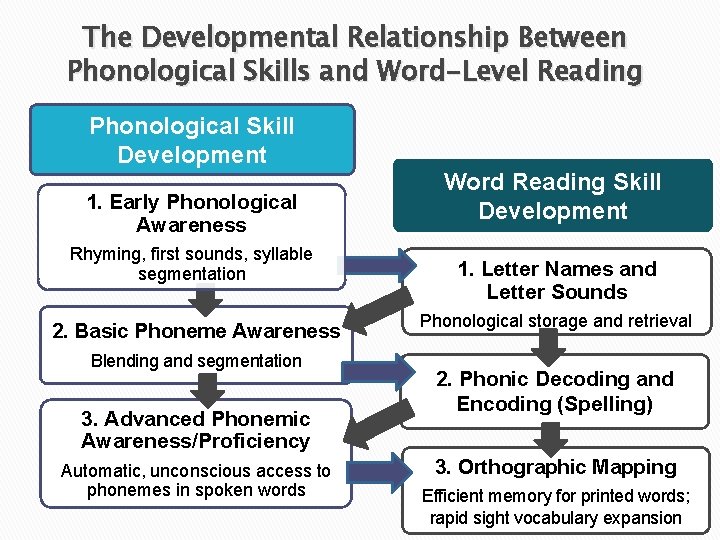
The Developmental Relationship Between Phonological Skills and Word-Level Reading Phonological Skill Development 1. Early Phonological Awareness Rhyming, first sounds, syllable segmentation 2. Basic Phoneme Awareness Blending and segmentation 3. Advanced Phonemic Awareness/Proficiency Automatic, unconscious access to phonemes in spoken words Word Reading Skill Development 1. Letter Names and Letter Sounds Phonological storage and retrieval 2. Phonic Decoding and Encoding (Spelling) 3. Orthographic Mapping Efficient memory for printed words; rapid sight vocabulary expansion
Phonemic Tasks vs. Phonemic Skills
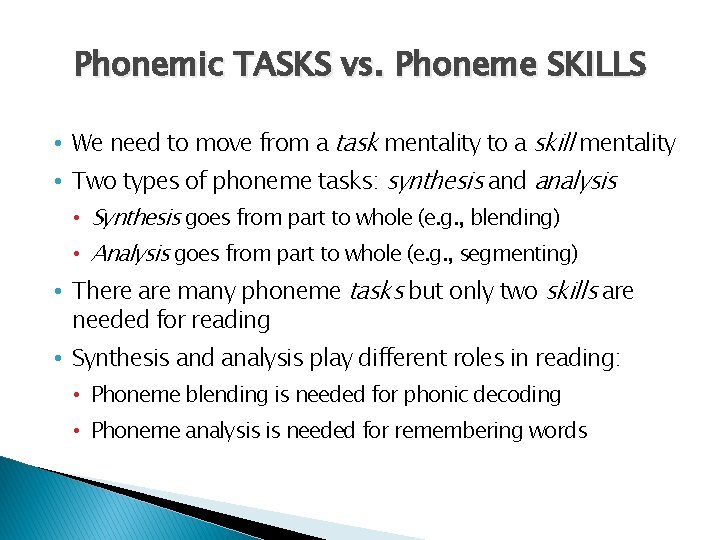
Phonemic TASKS vs. Phoneme SKILLS • We need to move from a task mentality to a skill mentality • Two types of phoneme tasks: synthesis and analysis • Synthesis goes from part to whole (e. g. , blending) • Analysis goes from part to whole (e. g. , segmenting) • There are many phoneme tasks but only two skills are needed for reading • Synthesis and analysis play different roles in reading: • Phoneme blending is needed for phonic decoding • Phoneme analysis is needed for remembering words
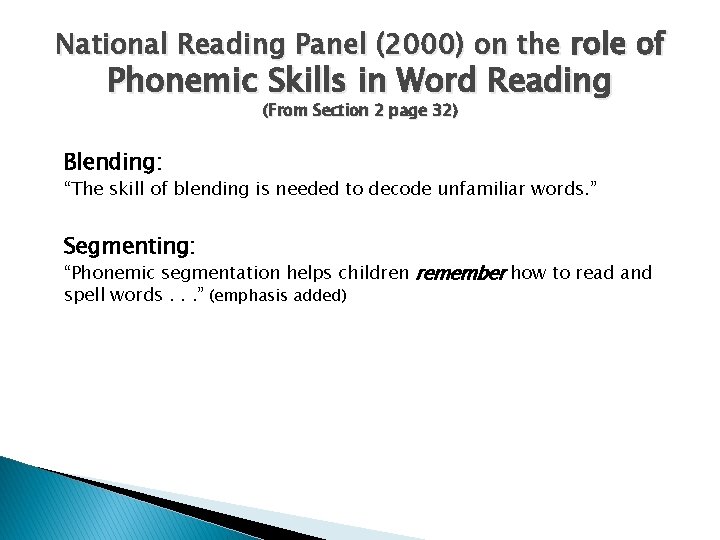
National Reading Panel (2000) on the role of Phonemic Skills in Word Reading (From Section 2 page 32) Blending: “The skill of blending is needed to decode unfamiliar words. ” Segmenting: “Phonemic segmentation helps children remember how to read and spell words. . . ” (emphasis added)
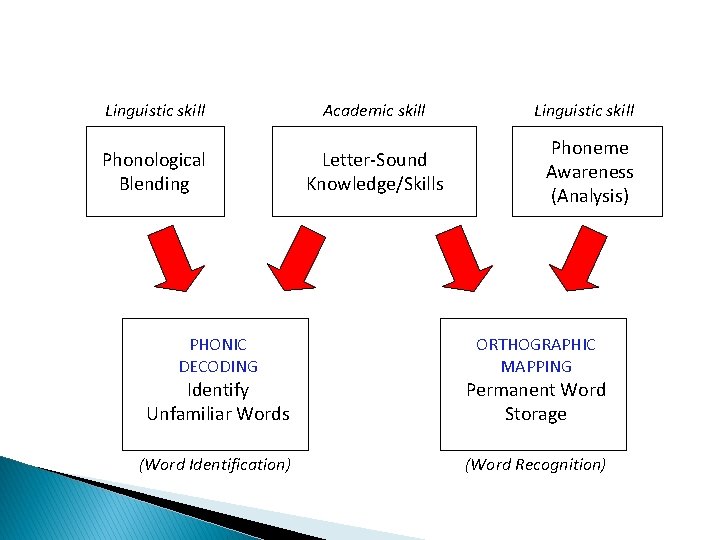
Linguistic skill Academic skill Phonological Blending Letter-Sound Knowledge/Skills PHONIC DECODING Linguistic skill Phoneme Awareness (Analysis) ORTHOGRAPHIC MAPPING Identify Unfamiliar Words Permanent Word Storage (Word Identification) (Word Recognition)
The Phonological Awareness Screening Test (PAST)
The PAST Assessment � Phonological Awareness Screening Test (PAST) ◦ Acronym has double meaning � Based on Rosner & Simon (1971) ◦ Reworked and improved by Mc. Innis ◦ It is “third generation Rosner” ◦ CTOPP Elision is “first cousin once removed” � Outstanding correlation with reading ◦. 6 to. 8 elementary students; . 5 adults
The PAST Assessment www. thepasttest. com � Not to be confused with another online test with the same acronym ◦ “Phonological awareness Skills Test” � � � � Based on phonological manipulation ◦ Uses segmentation, isolation, & blending Assesses the automaticity of PA Multiple versions for progress assessment Great supplement for CTOPP Requires some training Instructions available on website Free to use Not normed – criterion based

Summary
Summary � Many misunderstanding about PA float about � Word reading involves two levels ◦ Identifying new words and remembering words � Word reading requires three different types of learning ◦ Paired-associate learning, statistical learning, and orthographic learning � The four classic reading approaches are limited � We remember words via orthographic learning ◦ Requires letter-sound proficiency and phonemic proficiency � The phonemic proficiency hypothesis is well supported � Phoneme tasks do not necessarily = phoneme skills � The PAST assesses phonemic proficiency
- Slides: 41