
Understanding the Results Chain and Developing Logical Frameworks
- Slides: 29
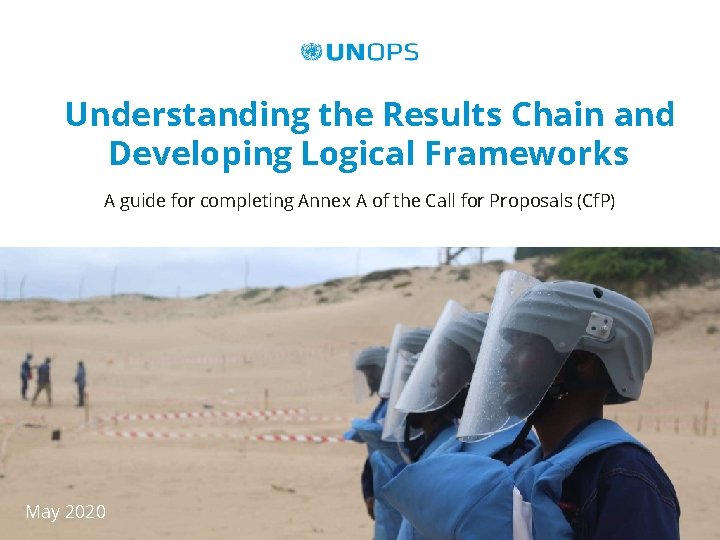
Understanding the Results Chain and Developing Logical Frameworks A guide for completing Annex A of the Call for Proposals (Cf. P) May 2020
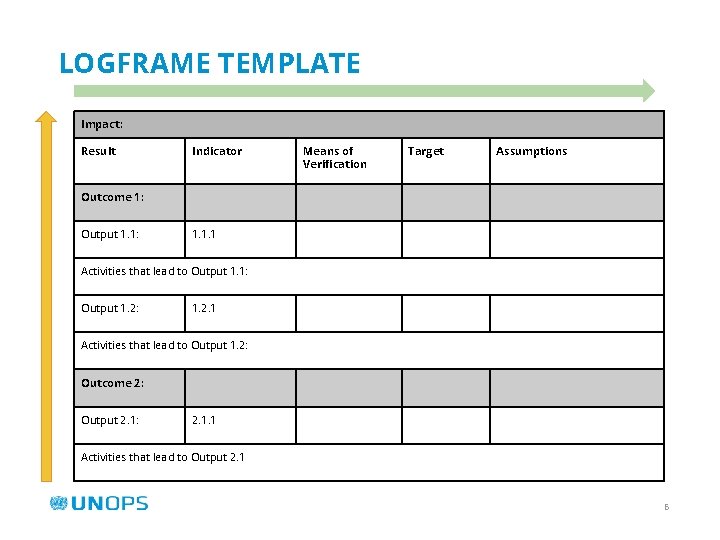
WHAT IS A LOGICAL FRAMEWORK? ● An important project planning and management tool; ● Provides a visual summary of the project and success indicators; ○ Establish a hierarchy of results and summarise the logical relationship between planned activities, deliverables (outputs) and desired changes (outcomes and impact); ○ Makes important planning assumptions clear; ○ Establishes how outputs and outcomes might best be monitored; ● Comprises part of the agreement signed between UNOPS and the grantee. 2
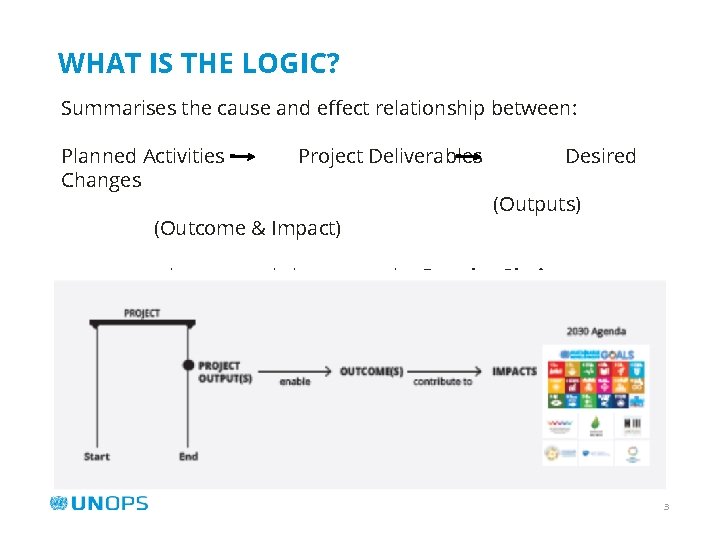
WHAT IS THE LOGIC? Summarises the cause and effect relationship between: Planned Activities Changes Project Deliverables (Outcome & Impact) Desired (Outputs) is commonly known as the Results Chain. 3
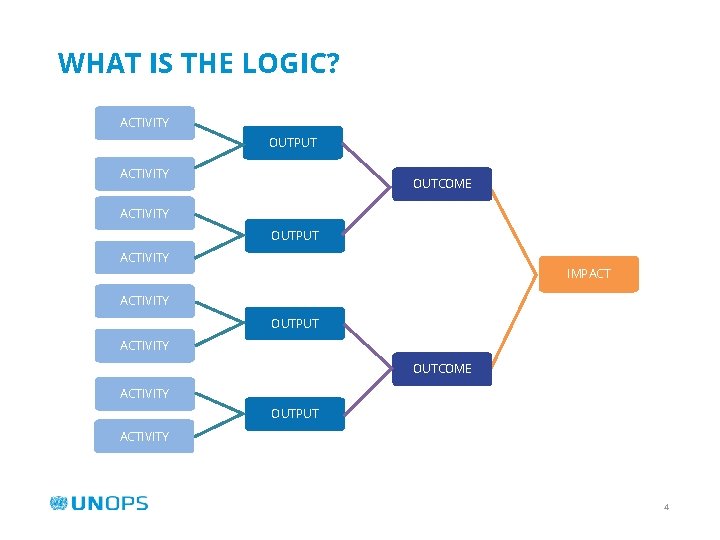
WHAT IS THE LOGIC? ACTIVITY OUTPUT ACTIVITY OUTCOME ACTIVITY OUTPUT ACTIVITY IMPACT ACTIVITY OUTPUT ACTIVITY OUTCOME ACTIVITY OUTPUT ACTIVITY 4
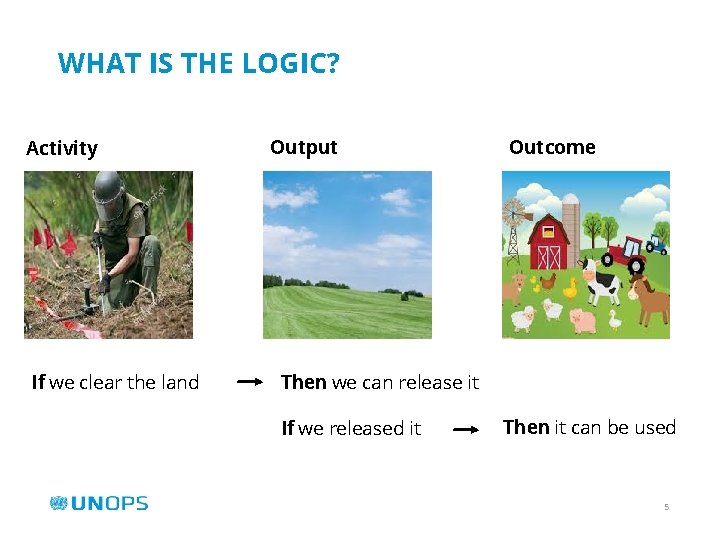
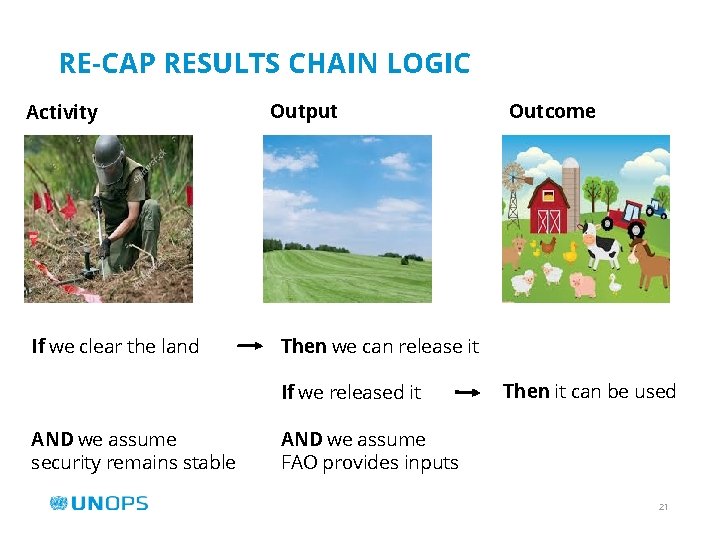
WHAT IS THE LOGIC? Activity If we clear the land Output Outcome Then we can release it If we released it Then it can be used 5
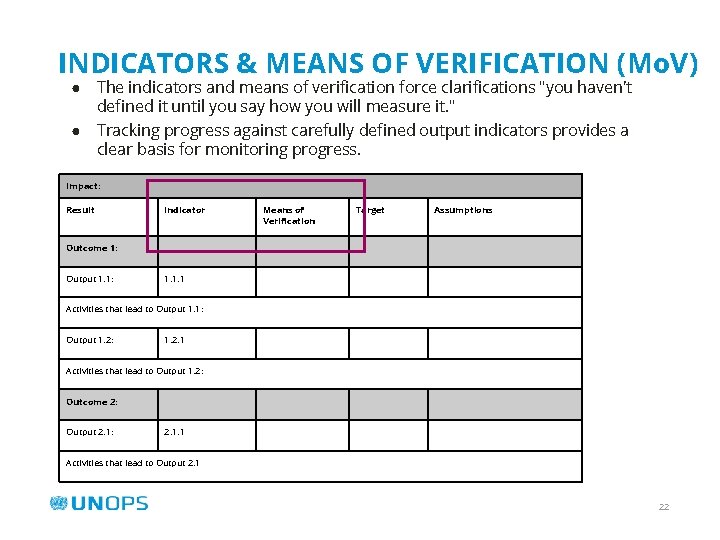
LOGFRAME TEMPLATE Impact: Result Indicator Means of Verification Target Assumptions Outcome 1: Output 1. 1: 1. 1. 1 Activities that lead to Output 1. 1: Output 1. 2: 1. 2. 1 Activities that lead to Output 1. 2: Outcome 2: Output 2. 1: 2. 1. 1 Activities that lead to Output 2. 1 6
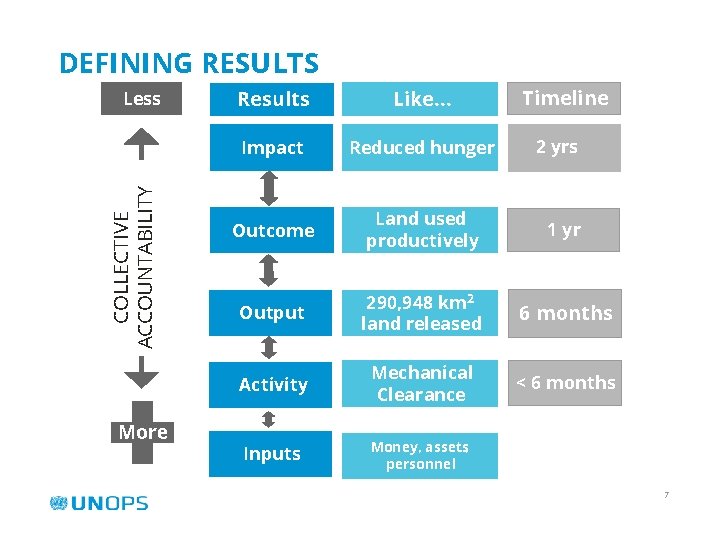
DEFINING RESULTS COLLECTIVE ACCOUNTABILITY Less More Timeline Results Like… Impact Reduced hunger Outcome Land used productively 1 yr Output 290, 948 km 2 land released 6 months Activity Mechanical Clearance < 6 months Inputs Money, assets, personnel 2 yrs 7
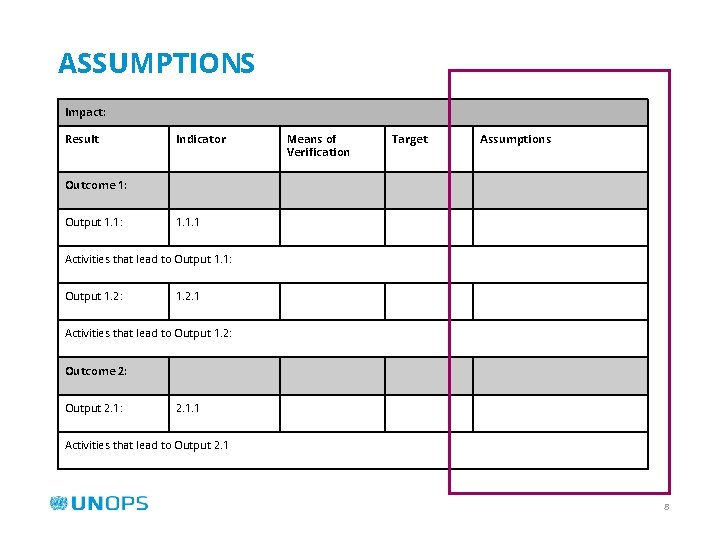
ASSUMPTIONS Impact: Result Indicator Means of Verification Target Assumptions Outcome 1: Output 1. 1: 1. 1. 1 Activities that lead to Output 1. 1: Output 1. 2: 1. 2. 1 Activities that lead to Output 1. 2: Outcome 2: Output 2. 1: 2. 1. 1 Activities that lead to Output 2. 1 8
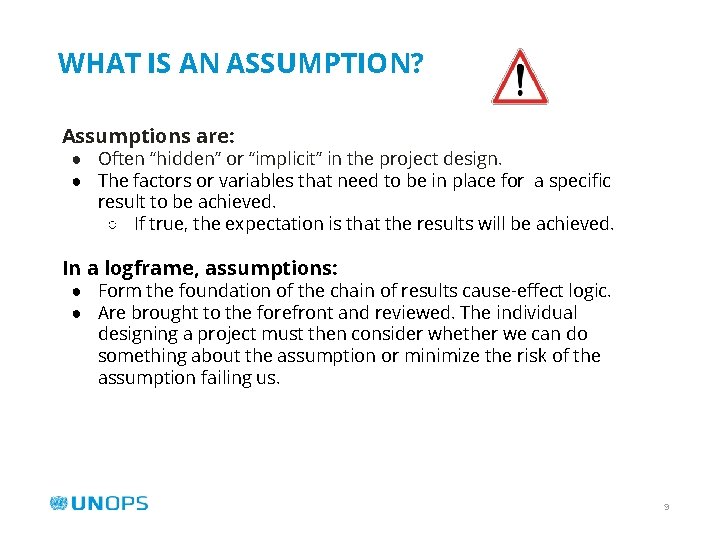
WHAT IS AN ASSUMPTION? Assumptions are: ● Often “hidden” or “implicit” in the project design. ● The factors or variables that need to be in place for a specific result to be achieved. ○ If true, the expectation is that the results will be achieved. In a logframe, assumptions: ● Form the foundation of the chain of results cause-effect logic. ● Are brought to the forefront and reviewed. The individual designing a project must then consider whether we can do something about the assumption or minimize the risk of the assumption failing us. 9
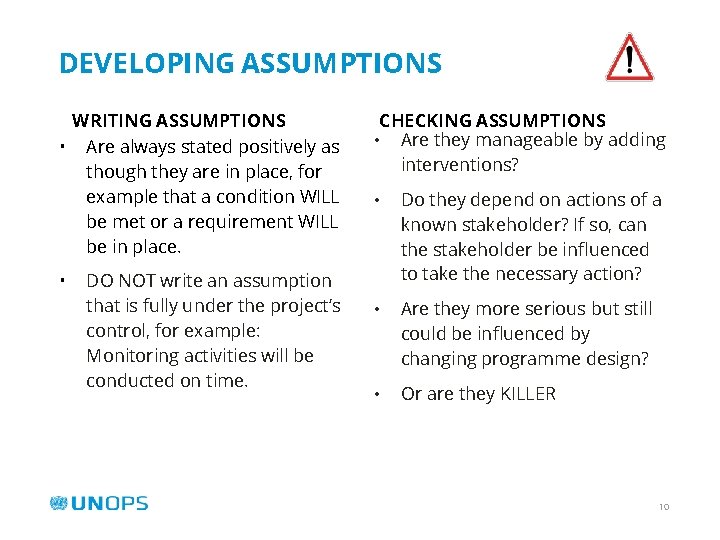
DEVELOPING ASSUMPTIONS WRITING ASSUMPTIONS • Are always stated positively as though they are in place, for example that a condition WILL be met or a requirement WILL be in place. • DO NOT write an assumption that is fully under the project’s control, for example: Monitoring activities will be conducted on time. CHECKING ASSUMPTIONS • Are they manageable by adding interventions? • Do they depend on actions of a known stakeholder? If so, can the stakeholder be influenced to take the necessary action? • Are they more serious but still could be influenced by changing programme design? • Or are they KILLER 10
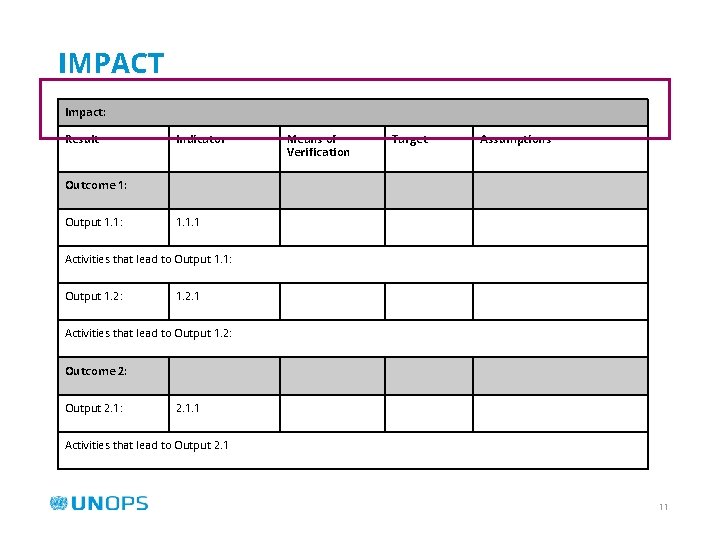
IMPACT Impact: Result Indicator Means of Verification Target Assumptions Outcome 1: Output 1. 1: 1. 1. 1 Activities that lead to Output 1. 1: Output 1. 2: 1. 2. 1 Activities that lead to Output 1. 2: Outcome 2: Output 2. 1: 2. 1. 1 Activities that lead to Output 2. 1 11
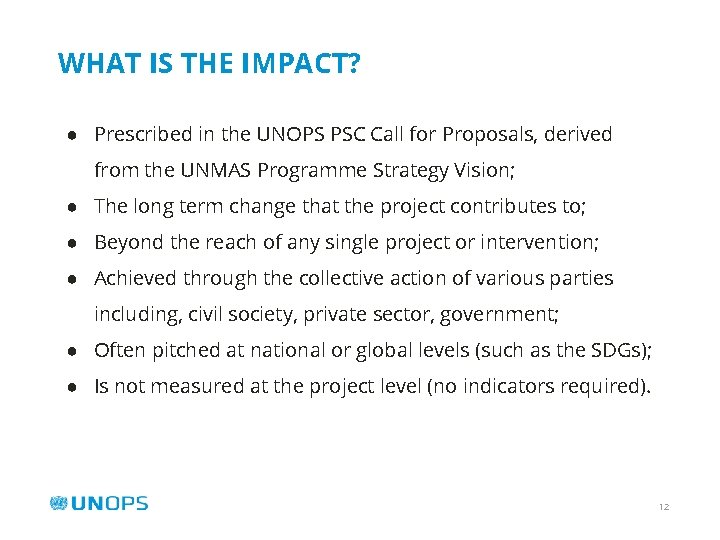
WHAT IS THE IMPACT? ● Prescribed in the UNOPS PSC Call for Proposals, derived from the UNMAS Programme Strategy Vision; ● The long term change that the project contributes to; ● Beyond the reach of any single project or intervention; ● Achieved through the collective action of various parties including, civil society, private sector, government; ● Often pitched at national or global levels (such as the SDGs); ● Is not measured at the project level (no indicators required). 12
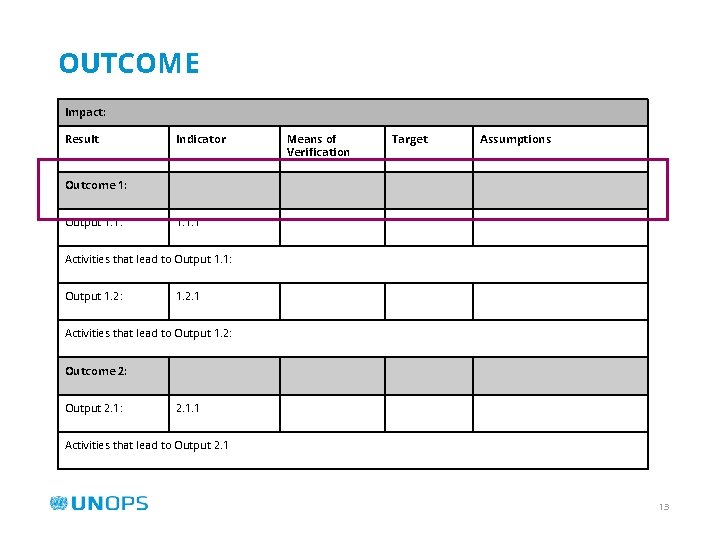
OUTCOME Impact: Result Indicator Means of Verification Target Assumptions Outcome 1: Output 1. 1: 1. 1. 1 Activities that lead to Output 1. 1: Output 1. 2: 1. 2. 1 Activities that lead to Output 1. 2: Outcome 2: Output 2. 1: 2. 1. 1 Activities that lead to Output 2. 1 13
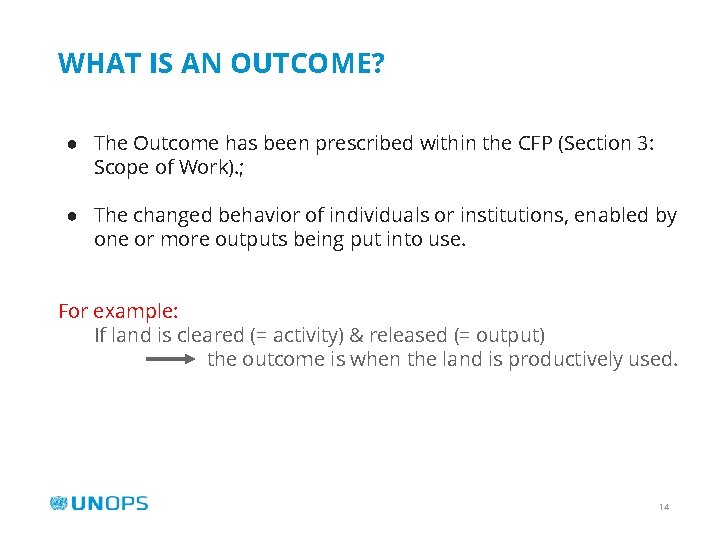
WHAT IS AN OUTCOME? ● The Outcome has been prescribed within the CFP (Section 3: Scope of Work). ; ● The changed behavior of individuals or institutions, enabled by one or more outputs being put into use. For example: If land is cleared (= activity) & released (= output) the outcome is when the land is productively used. 14
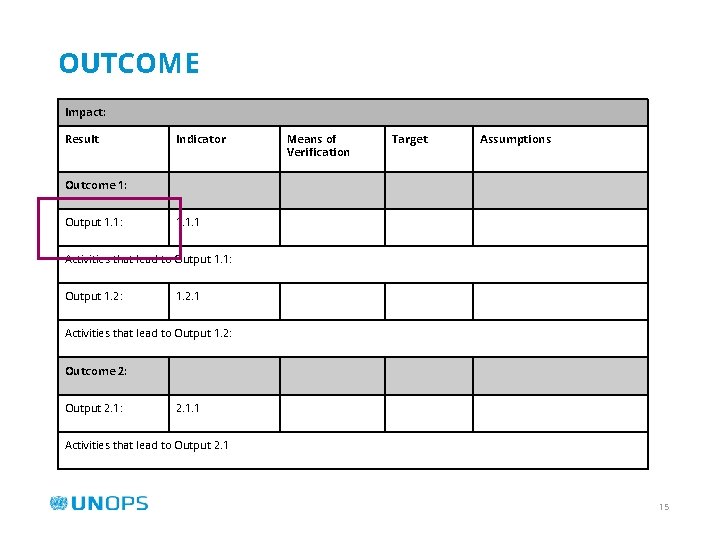
OUTCOME Impact: Result Indicator Means of Verification Target Assumptions Outcome 1: Output 1. 1: 1. 1. 1 Activities that lead to Output 1. 1: Output 1. 2: 1. 2. 1 Activities that lead to Output 1. 2: Outcome 2: Output 2. 1: 2. 1. 1 Activities that lead to Output 2. 1 15
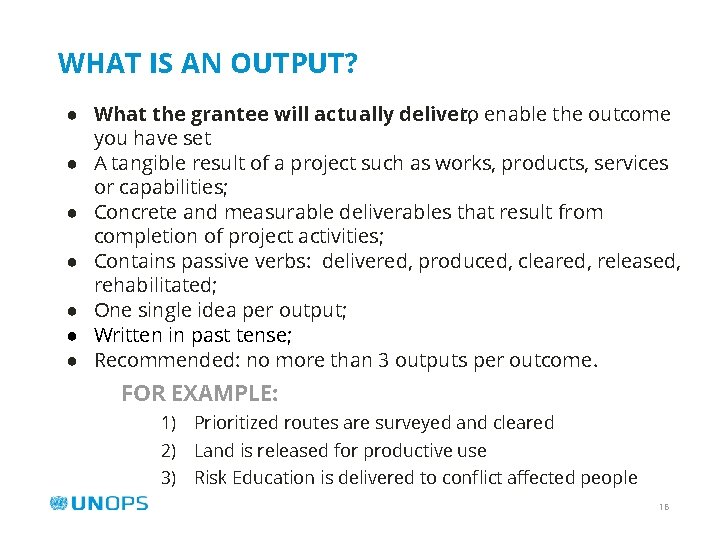
WHAT IS AN OUTPUT? ● What the grantee will actually deliver, to enable the outcome you have set ● A tangible result of a project such as works, products, services or capabilities; ● Concrete and measurable deliverables that result from completion of project activities; ● Contains passive verbs: delivered, produced, cleared, released, rehabilitated; ● One single idea per output; ● Written in past tense; ● Recommended: no more than 3 outputs per outcome. FOR EXAMPLE: 1) Prioritized routes are surveyed and cleared 2) Land is released for productive use 3) Risk Education is delivered to conflict affected people 16
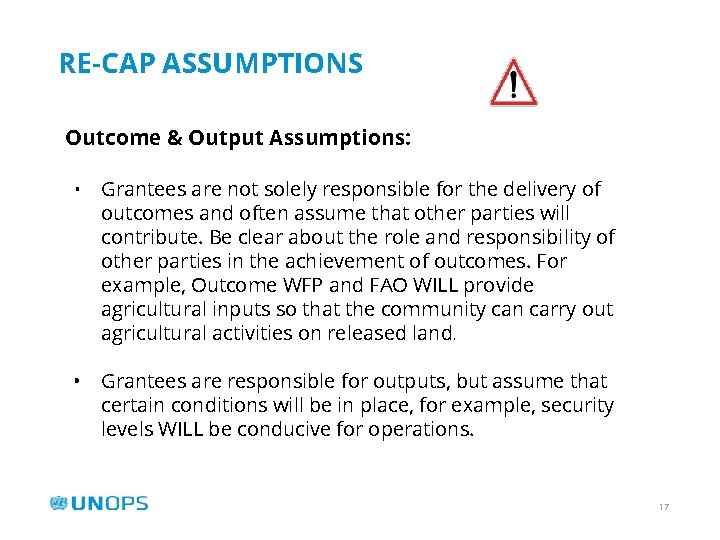
RE-CAP ASSUMPTIONS Outcome & Output Assumptions: • Grantees are not solely responsible for the delivery of outcomes and often assume that other parties will contribute. Be clear about the role and responsibility of other parties in the achievement of outcomes. For example, Outcome WFP and FAO WILL provide agricultural inputs so that the community can carry out agricultural activities on released land. • Grantees are responsible for outputs, but assume that certain conditions will be in place, for example, security levels WILL be conducive for operations. 17
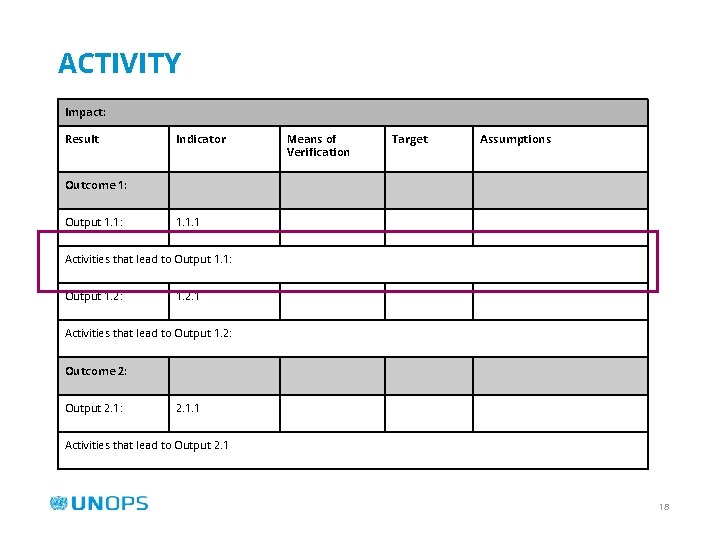
ACTIVITY Impact: Result Indicator Means of Verification Target Assumptions Outcome 1: Output 1. 1: 1. 1. 1 Activities that lead to Output 1. 1: Output 1. 2: 1. 2. 1 Activities that lead to Output 1. 2: Outcome 2: Output 2. 1: 2. 1. 1 Activities that lead to Output 2. 1 18
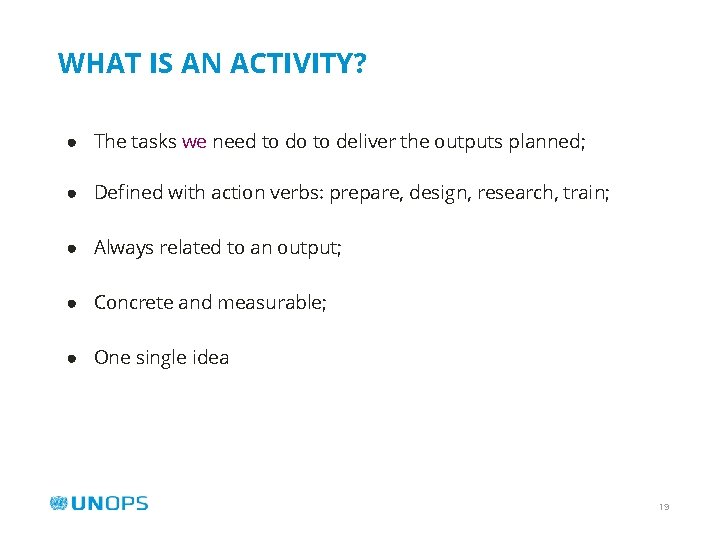
WHAT IS AN ACTIVITY? ● The tasks we need to do to deliver the outputs planned; ● Defined with action verbs: prepare, design, research, train; ● Always related to an output; ● Concrete and measurable; ● One single idea 19
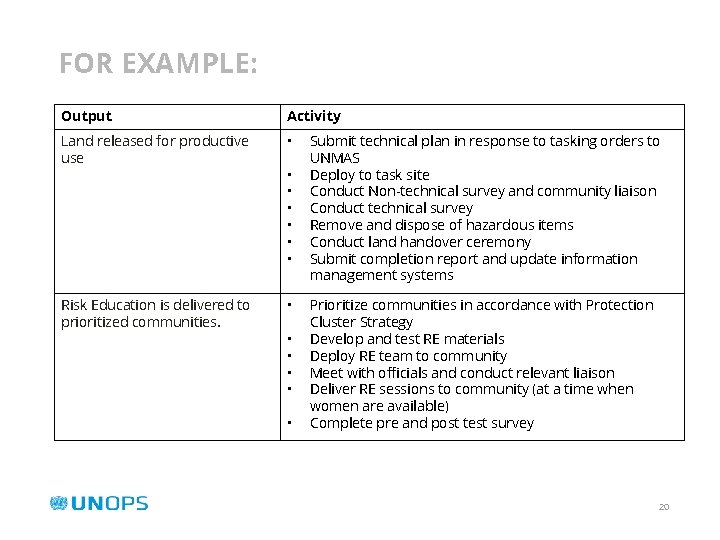
FOR EXAMPLE: Output Activity Land released for productive use • Risk Education is delivered to prioritized communities. • • • Submit technical plan in response to tasking orders to UNMAS Deploy to task site Conduct Non-technical survey and community liaison Conduct technical survey Remove and dispose of hazardous items Conduct land handover ceremony Submit completion report and update information management systems Prioritize communities in accordance with Protection Cluster Strategy Develop and test RE materials Deploy RE team to community Meet with officials and conduct relevant liaison Deliver RE sessions to community (at a time when women are available) Complete pre and post test survey 20
RE-CAP RESULTS CHAIN LOGIC Activity If we clear the land Output Then we can release it If we released it AND we assume security remains stable Outcome Then it can be used AND we assume FAO provides inputs 21
INDICATORS & MEANS OF VERIFICATION (Mo. V) ● ● The indicators and means of verification force clarifications "you haven't defined it until you say how you will measure it. " Tracking progress against carefully defined output indicators provides a clear basis for monitoring progress. Impact: Result Indicator Means of Verification Target Assumptions Outcome 1: Output 1. 1: 1. 1. 1 Activities that lead to Output 1. 1: Output 1. 2: 1. 2. 1 Activities that lead to Output 1. 2: Outcome 2: Output 2. 1: 2. 1. 1 Activities that lead to Output 2. 1 22
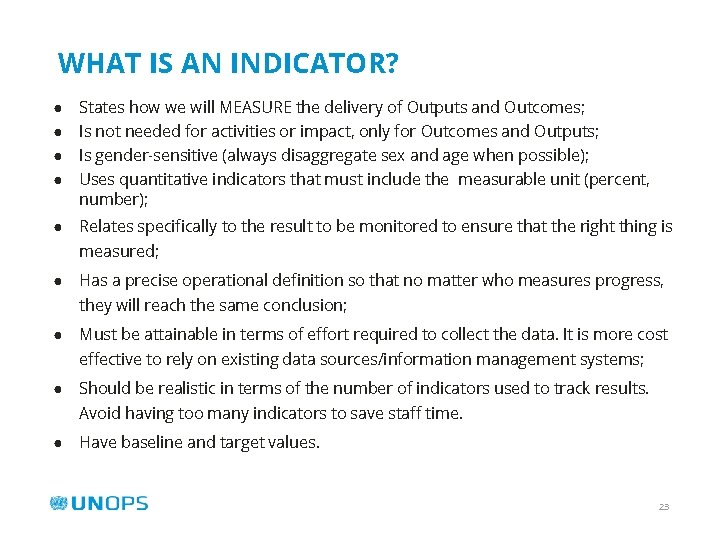
WHAT IS AN INDICATOR? ● ● ● States how we will MEASURE the delivery of Outputs and Outcomes; Is not needed for activities or impact, only for Outcomes and Outputs; Is gender-sensitive (always disaggregate sex and age when possible); ● Uses quantitative indicators that must include the measurable unit (percent, number); ● Relates specifically to the result to be monitored to ensure that the right thing is measured; ● Has a precise operational definition so that no matter who measures progress, they will reach the same conclusion; ● Must be attainable in terms of effort required to collect the data. It is more cost effective to rely on existing data sources/information management systems; ● Should be realistic in terms of the number of indicators used to track results. Avoid having too many indicators to save staff time. ● Have baseline and target values. 23
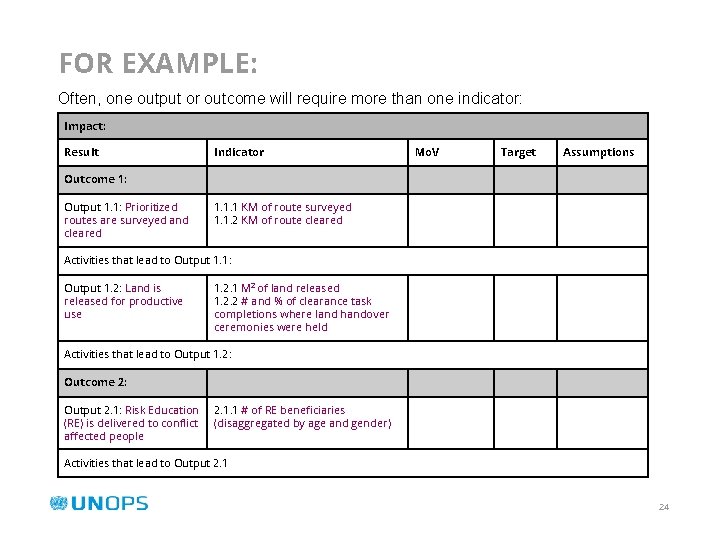
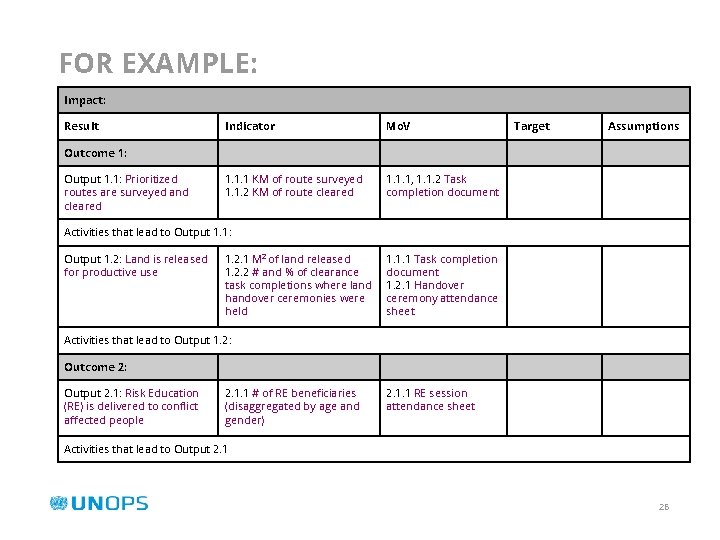
FOR EXAMPLE: Often, one output or outcome will require more than one indicator: Impact: Result Indicator Mo. V Target Assumptions Outcome 1: Output 1. 1: Prioritized routes are surveyed and cleared 1. 1. 1 KM of route surveyed 1. 1. 2 KM of route cleared Activities that lead to Output 1. 1: Output 1. 2: Land is released for productive use 1. 2. 1 M 2 of land released 1. 2. 2 # and % of clearance task completions where land handover ceremonies were held Activities that lead to Output 1. 2: Outcome 2: Output 2. 1: Risk Education (RE) is delivered to conflict affected people 2. 1. 1 # of RE beneficiaries (disaggregated by age and gender) Activities that lead to Output 2. 1 24
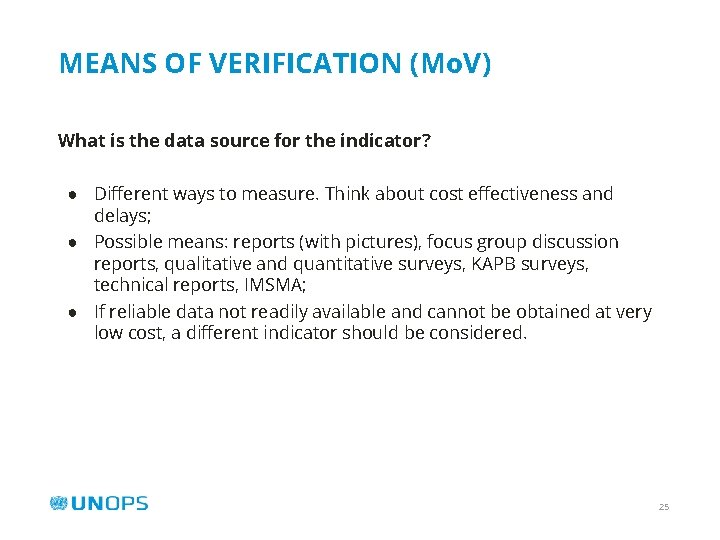
MEANS OF VERIFICATION (Mo. V) What is the data source for the indicator? ● Different ways to measure. Think about cost effectiveness and delays; ● Possible means: reports (with pictures), focus group discussion reports, qualitative and quantitative surveys, KAPB surveys, technical reports, IMSMA; ● If reliable data not readily available and cannot be obtained at very low cost, a different indicator should be considered. 25
FOR EXAMPLE: Impact: Result Indicator Mo. V 1. 1. 1 KM of route surveyed 1. 1. 2 KM of route cleared 1. 1. 1, 1. 1. 2 Task completion document Target Assumptions Outcome 1: Output 1. 1: Prioritized routes are surveyed and cleared Activities that lead to Output 1. 1: Output 1. 2: Land is released for productive use 1. 2. 1 M 2 of land released 1. 2. 2 # and % of clearance task completions where land handover ceremonies were held 1. 1. 1 Task completion document 1. 2. 1 Handover ceremony attendance sheet Activities that lead to Output 1. 2: Outcome 2: Output 2. 1: Risk Education (RE) is delivered to conflict affected people 2. 1. 1 # of RE beneficiaries (disaggregated by age and gender) 2. 1. 1 RE session attendance sheet Activities that lead to Output 2. 1 26
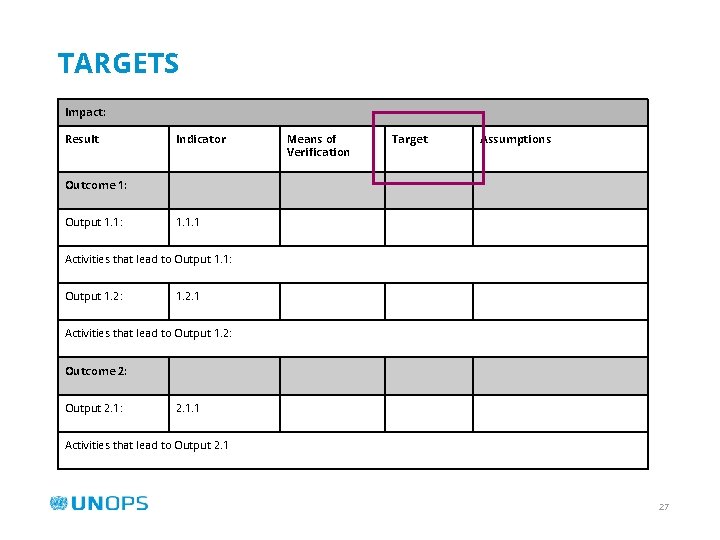
TARGETS Impact: Result Indicator Means of Verification Target Assumptions Outcome 1: Output 1. 1: 1. 1. 1 Activities that lead to Output 1. 1: Output 1. 2: 1. 2. 1 Activities that lead to Output 1. 2: Outcome 2: Output 2. 1: 2. 1. 1 Activities that lead to Output 2. 1 27
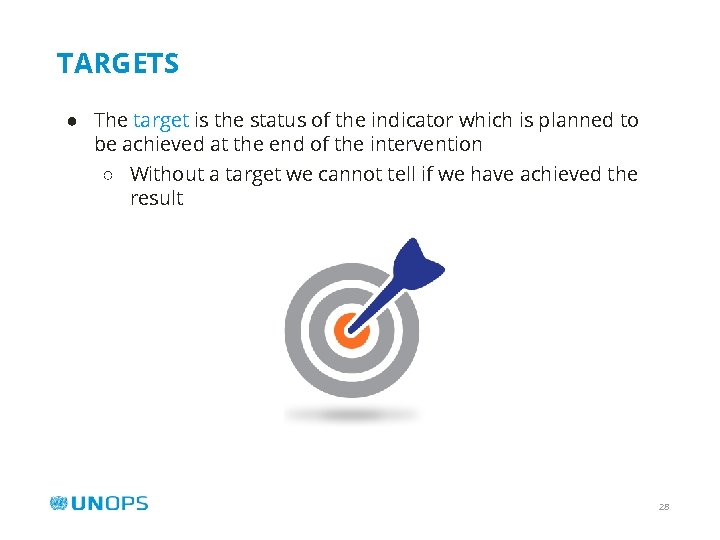
TARGETS ● The target is the status of the indicator which is planned to be achieved at the end of the intervention ○ Without a target we cannot tell if we have achieved the result 28
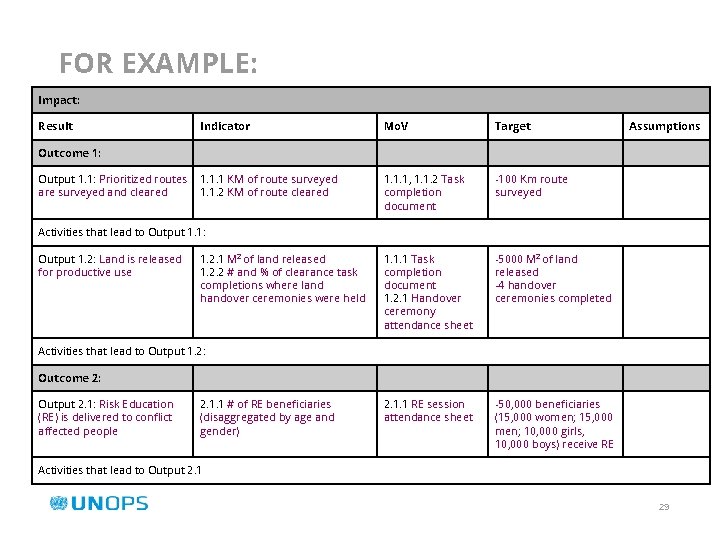
FOR EXAMPLE: Impact: Result Indicator Mo. V Target 1. 1. 1 KM of route surveyed 1. 1. 2 KM of route cleared 1. 1. 1, 1. 1. 2 Task completion document -100 Km route surveyed 1. 1. 1 Task completion document 1. 2. 1 Handover ceremony attendance sheet -5000 M 2 of land released -4 handover ceremonies completed 2. 1. 1 RE session attendance sheet -50, 000 beneficiaries (15, 000 women; 15, 000 men; 10, 000 girls, 10, 000 boys) receive RE Assumptions Outcome 1: Output 1. 1: Prioritized routes are surveyed and cleared Activities that lead to Output 1. 1: Output 1. 2: Land is released for productive use 1. 2. 1 M 2 of land released 1. 2. 2 # and % of clearance task completions where land handover ceremonies were held Activities that lead to Output 1. 2: Outcome 2: Output 2. 1: Risk Education (RE) is delivered to conflict affected people 2. 1. 1 # of RE beneficiaries (disaggregated by age and gender) Activities that lead to Output 2. 1 29