
Understanding the Requirements for Open Source Software Development
- Slides: 35
Understanding the Requirements for Open Source Software Development Walt Scacchi Institute for Software Research University of California, Irvine, CA 92697 -3425 Wscacchi@ics. uci. edu http: //www. ics. uci. edu/~wscacchi/Presentations/OSS-Requirements 1
Overview • • Research methodology Community characteristics Software Requirements process Open source processes for Requirements Software Informalisms Implications Conclusions 2
Research methodology • Prior empirical (case) studies of Open Source Software Development (OSSD) Projects – Mockus, Fielding, Herbsleb, 2000, 2002, Apache httpd server – Reis and Fortes, 2002, Mozilla Web browser – Schach et al. , 2002; Holt et al. , 2000, Linux Kernel – Koch and Schneider 2001; German 2002, GNOME User Interface – Jorgensen, 2001, Free. BSD operating system – Garg et al. , 2002, OSSD (“progressive open source”) within HP 3
Research methodology • Individual case studies: significant details, but limited (and premature) generalization, little/no comparative analysis – Halloran and Scherlis, 2002, comparative study of software tools and code volume in eleven OSSD projects, all in one domain (Internet infrastructure) • No studies that examine multiple OSSD projects in multiple domains – Such studies would offer higher degree of comparative analyses and generalization of results 4
Research methodology • Comparative case studies – Multiple open software development projects • Across four communities – Two research oriented – Two development oriented • Qualitative (“grounded theory”) techniques • Analyzing and modeling – development processes – work practices – community structures 5
Community characteristics • According to Steve Ballmer (CEO, Microsoft) – "We have to compete with free software, on value, but in a smart way. We cannot price at zero, so we need to justify our posture and pricing. Linux isn't going to go away--our job is to provide a better product in the marketplace. " – "Linux is not about free software, it is about community”(emphasis added). – London, 24 September 2002, speaking on MS, its “Most Valued Professionals” (MVPs), and “shared source” vs. “open source” 6
Community characteristics • Development oriented domains – Networked computer games – Internet infrastructure • Research oriented domains – Astrophysics/deep space imaging – Academic software design 7
Software Requirements process • Classic Requirements Engineering Process – Elicitation – Analysis – Specification and modeling – Validation – Communicating and managing 8
Open source processes for Requirements • • • Post-hoc assertion of requirements+design Reading, sense-making, accountability Continually emerging webs of discourse Condensing and hardening discourse Global access to discourse 9
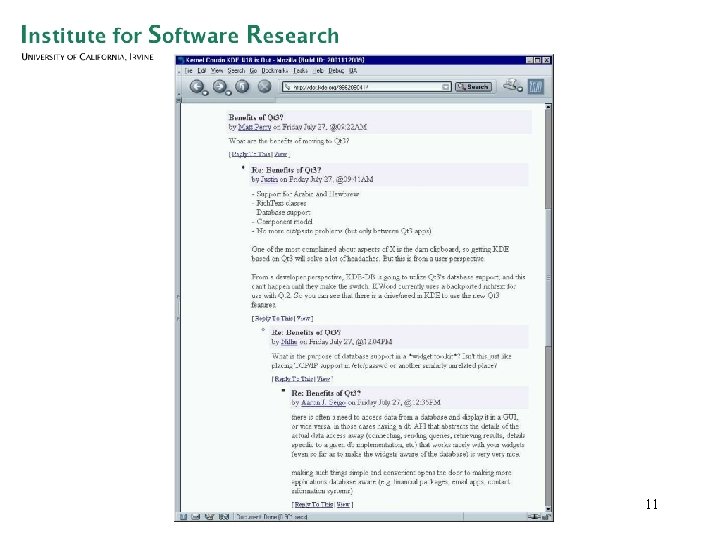
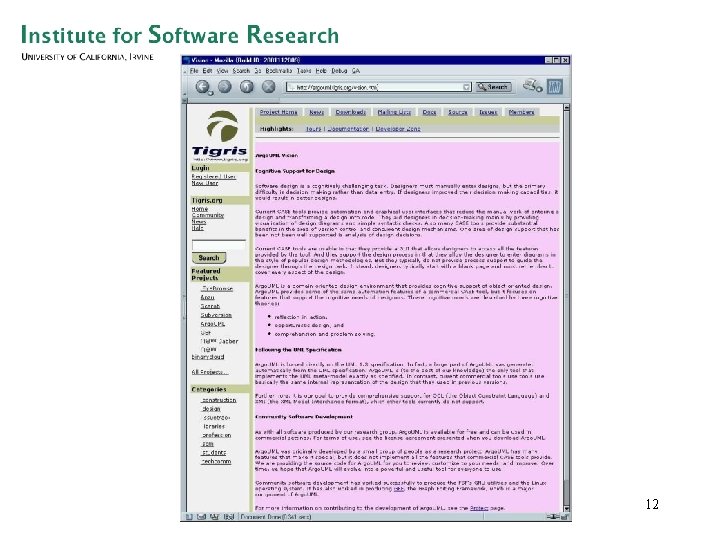
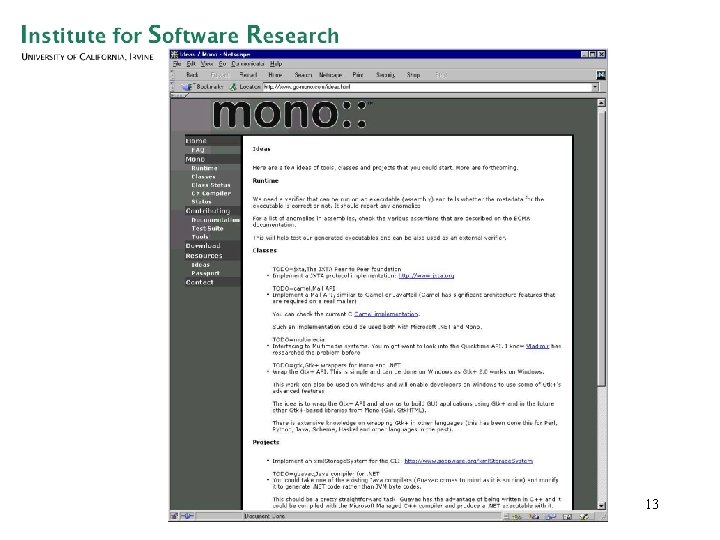
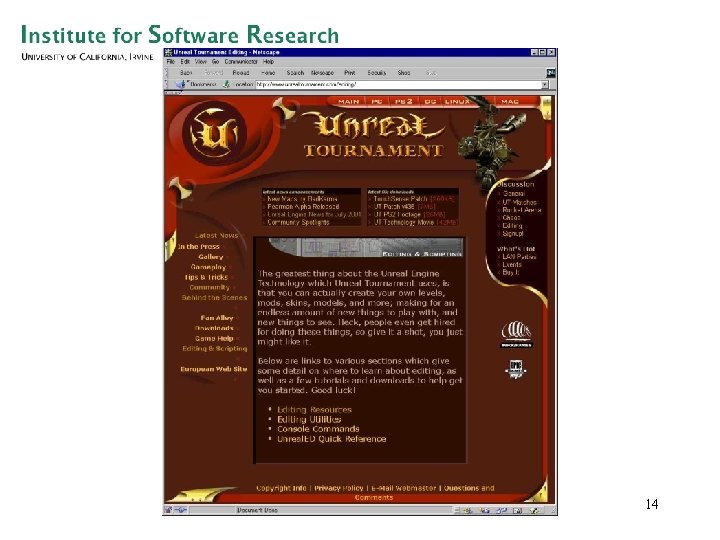
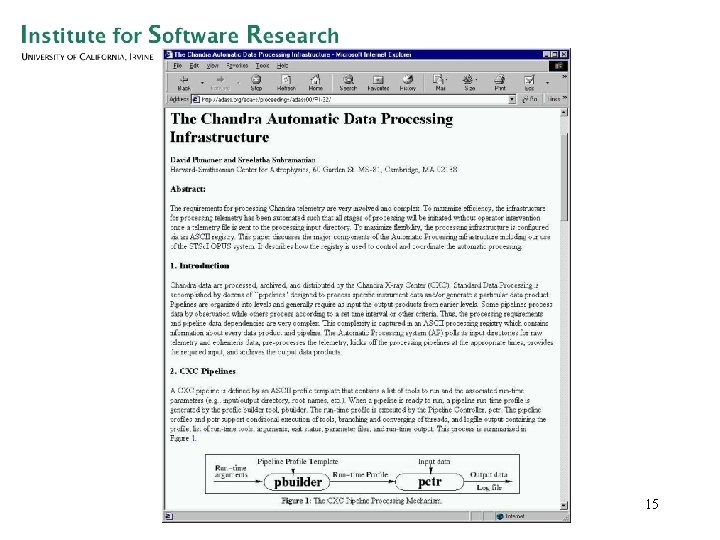
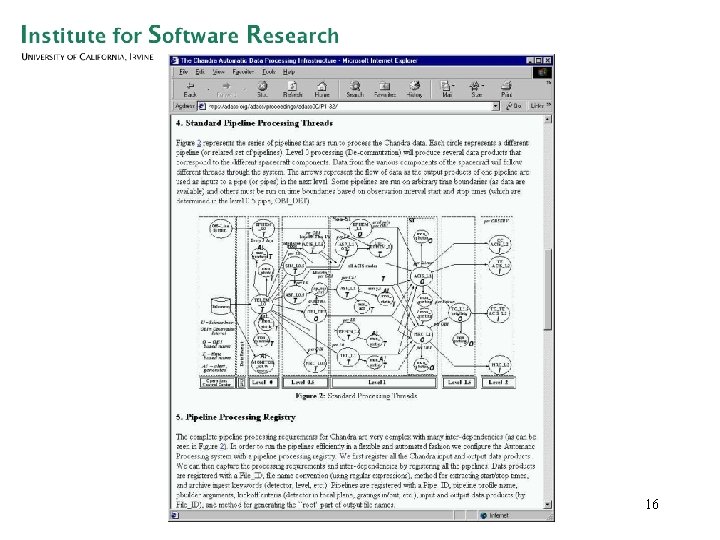
Open source processes for Requirements • OSS Requirements are – not explicit – not formal • QED, OSS Requirements embedded within “informalisms” • Example OSS informalisms follow 10
11
12
13
14
15
16
Open source processes for Requirements • Elicitation • Analysis • Specification and modeling • Validation • Communicating and managing • Post-hoc assertion • Reading, sensemaking, accountability • Continually emerging webs of discourse • Condensing and hardening discourse • Global access to discourse 17
Software Informalisms • Community communications – Threaded discussion forums – Email (list servers) – Newsgroups – IRChat/Instant messages – Community digests (“Kernel Cousins”) 18
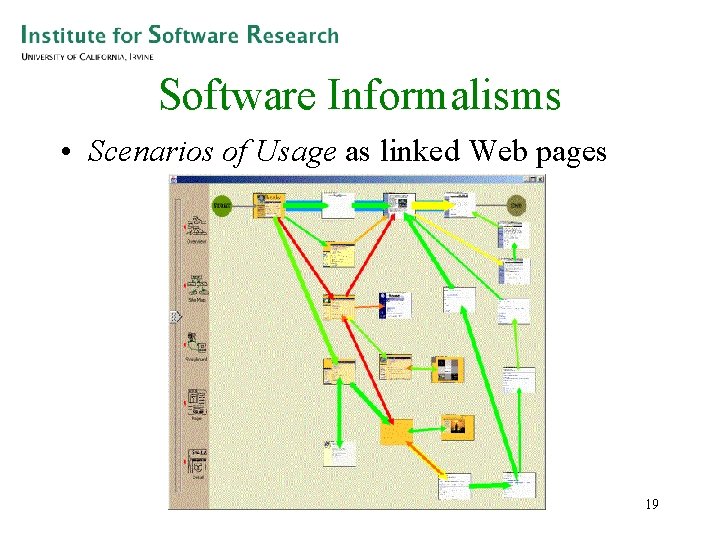
Software Informalisms • Scenarios of Usage as linked Web pages 19
Software Informalisms • How-To guides, To-Do lists, FAQs • Traditional software user documentation – Unix/Linux man pages • External publications – trade articles – scholarly research papers – books (cf. O’Reilly Books) 20
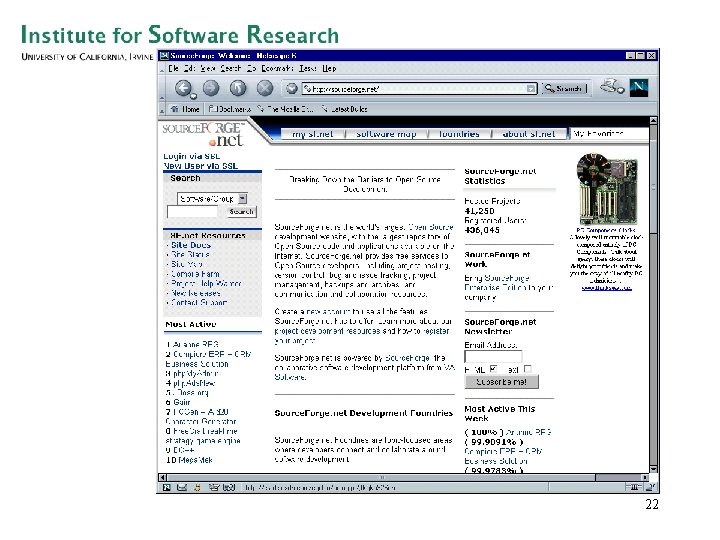
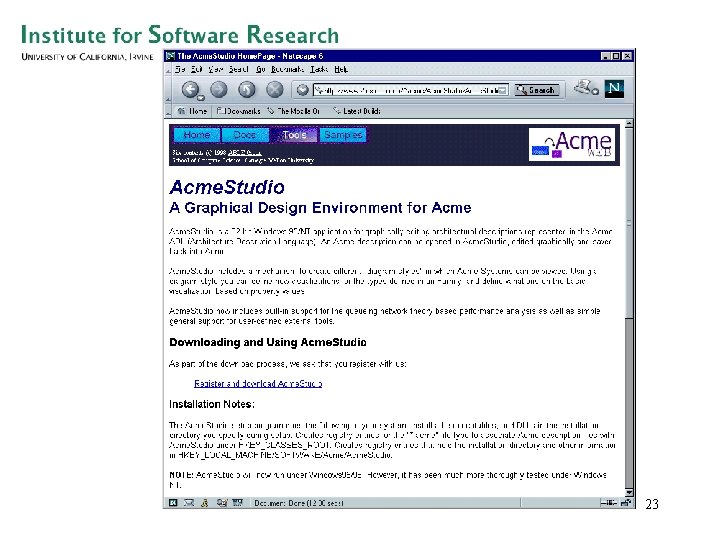
Software Informalisms • Open Software Web Sites – Community Web sites – Community Software Web sites – Project Web sites – Source code Webs/Directories 21
22
23
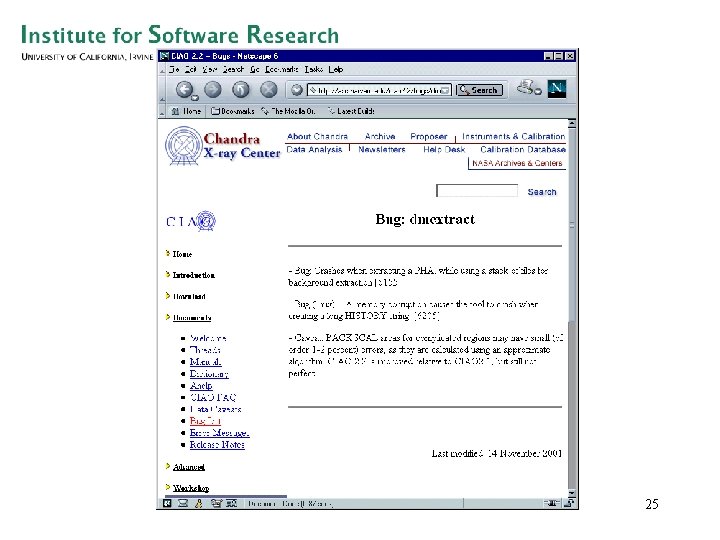
Software Informalisms • Software bug reports – Ad hoc report Web – Bugzilla (database tracking) • Issue tracking – Issuezilla 24
25
Software Informalisms • Software extension mechanisms – Inter-application scripting • Csh, Perl, Python, Tcl, scripting • Pipelines (cf. CXCDS) – Intra-application scripting (e. g. , Unreal. Script) – Plug-in architectures • Apache server architecture 26
Software Informalisms • Open source software licenses – GNU Public License (GPL) – Lesser/Library GPL (LGPL) – Artistic License – Mozilla Public License (MPL) – SUN Public License (SPL) – and 25 more (http: //opensource. org) – “Creative Commons” Project at Stanford Law School developing public license framework 27
Implications • Software informalisms are the media of software requirements • Software informalisms are the subject of software requirements • OSS Requirements are implied activities or capabilities • (Re)reading and reviewing informalisms is a prerequisite to writing open software 28
Implications • Developing open software requirements is a community building process – not just a technical development process – open source peer reviewing creates a community of peers • OSSD processes often iterate daily versus infrequent singular (milestone) SLC events – frequent, rapid cycle time (easier to improve) vs. infrequent, slow cycle time (hard to improve) 29
Implications • Determining the quality of open software requirements: – not targeted to consistency, completeness, correctness – instead focusing attention to community building, freedom of expression, ease of informalism navigation (traceability), implicit vs. explicit informalism structuring 30
Conclusions • Developing open software requirements is different than requirements engineering – not better, not worse, but different and new – more social, more accessible, more convivial • Open source software systems need but may not want the “benefits” of classic software requirements engineering. 31
Conclusions • Need to integrate OSSD with SE – development infrastructure (tools and environments) – development processes – developer community – across multiple domains • Scientific research • Commercial development 32
Conclusions • People use OSS development tools to create, update, distribute, or browse OSS informalisms • OSSD tool taxonomy: – Seven level hierarchy; more than 40 tool types – http: //www. ics. uci. edu/~wscacchi/Software. Process/Open-Software-Process-Models/Open. Source-Software-Tools. html 33
Acknowledgements • Project collaborators: – Mark Ackerman, UMichigan, – Margaret Ellliot, Ph. D. , Mark Bergman, Xiaobin Li, UCI-ISR – Julia Watson, The Ohio State University • Funding support: – National Science Foundation, IIS#-0083075, ITR##0205679 – Defense Acquisition University, N 487650 -27803 34
References • • W. Scacchi, Understanding the Requirements for Developing Open Source Software, IEE Proceedings--Software, 149(1), 24 -39, 2002. http: //www. ics. uci. edu/~wscacchi/Papers/New/Understanding-OSRequirements. pdf W. Scacchi, Exploring Open Source System Acquisition Processes and Architectures, Final Report, June 2002, http: //www. ics. uci. edu/~wscacchi/Project. Reports/DAU-Final-Report-2002. pdf W. Scacchi, Open EC/B: A Case Study in Electronic Commerce and Open Source Software Development, Final Report, July 2002, http: //www. ics. uci. edu/~wscacchi/Project. Reports/CRITO-Final-Report-2002. pdf W. Scacchi, Is Open Source Software Development Faster, Better, and Cheaper than Software Engineering? , 2 nd Workshop on Open Source Software Engineering, Orlando, FL, May 2002, http: //www. ics. uci. edu/~wscacchi/Papers/New/ICSE 02 -Workshop-Scacchi 01. pdf 35