
Understanding the Replacement Reserve What You Need to

- Slides: 13
Understanding the Replacement Reserve What You Need to Know CANADA MORTGAGE AND HOUSING CORPORATION
The Replacement Reserve is a fund used to replace or repair capital items. CANADA MORTGAGE AND HOUSING CORPORATION
What are Capital Items ? • There are different kinds of capital items in a housing project, and most of them have long life spans. They consist of: • • major building and property components, services and systems; project facilities and equipment; and items that require major repairs or renovations. The useful life of capital items end when repairs or maintenance will not significantly extend their useful life. For more information, please refer to the checklist Replacement Guidelines and Average Useful Life of Building Components. CANADA MORTGAGE AND HOUSING CORPORATION 3
How is the replacement reserve funded? • The replacement reserve is funded through an annual or monthly transfer from a First Nation’s operating budget. • Money for the replacement reserve, along with accumulated interest, must be held in a separate bank account and/or invested only in accounts or instruments insured by the Canada Deposit Insurance Corporation or as mutually agreed upon by the First Nation and CMHC. CANADA MORTGAGE AND HOUSING CORPORATION 4
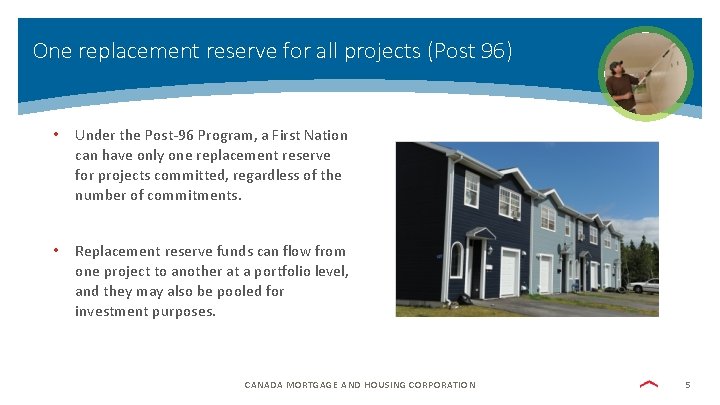
One replacement reserve for all projects (Post 96) • Under the Post-96 Program, a First Nation can have only one replacement reserve for projects committed, regardless of the number of commitments. • Replacement reserve funds can flow from one project to another at a portfolio level, and they may also be pooled for investment purposes. CANADA MORTGAGE AND HOUSING CORPORATION 5
How much money should be contributed to the replacement reserve? • The amount to be transferred, which is an eligible operating expense, is the amount set out in the operating agreement, or another amount approved by CMHC. • The replacement reserve allocation may be increased at the discretion of the First Nation, within subsidy limits, taking into account viability considerations. CANADA MORTGAGE AND HOUSING CORPORATION 6
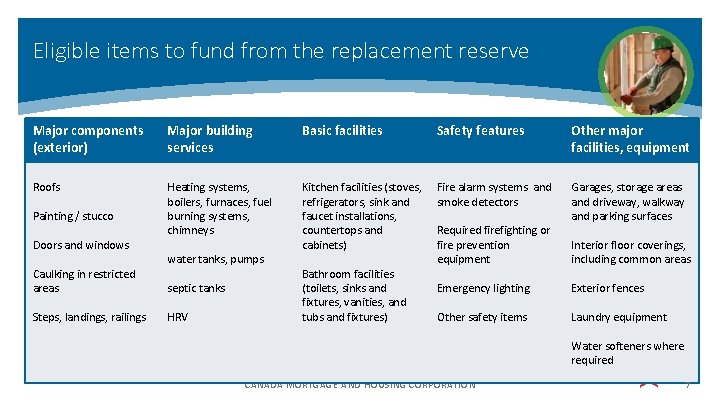
Eligible items to fund from the replacement reserve Major components (exterior) Major building services Basic facilities Safety features Other major facilities, equipment Roofs Heating systems, boilers, furnaces, fuel burning systems, chimneys Kitchen facilities (stoves, refrigerators, sink and faucet installations, countertops and cabinets) Fire alarm systems and smoke detectors Garages, storage areas and driveway, walkway and parking surfaces Painting / stucco Doors and windows Caulking in restricted areas Steps, landings, railings water tanks, pumps septic tanks HRV Bathroom facilities (toilets, sinks and fixtures, vanities, and tubs and fixtures) Required firefighting or fire prevention equipment Interior floor coverings, including common areas Emergency lighting Exterior fences Other safety items Laundry equipment Water softeners where required CANADA MORTGAGE AND HOUSING CORPORATION 7
Eligible Extensions to the Standard List • repairing foundations or significant sections of foundations • structural components such as wall, floor and roof framing • brickwork • retaining walls • plumbing systems • electrical installations, including project transformers and emergency generators • balconies CANADA MORTGAGE AND HOUSING CORPORATION 8
When should a capital item be replaced? • A capital item should be replaced when: • • It is no longer performing or operating as it was meant to; It is no longer cost-effective to maintain; or It is no longer safe (represents a health or safety hazard A capital item should also be replaced when a change introduced through a bylaw, building code, safety standard or other requirement introduced by the First Nation makes it so that the capital item no longer meets requirements. CANADA MORTGAGE AND HOUSING CORPORATION 9
Replacing Capital Items • Capital items should be replaced with items of equivalent quality, standards of performance and expected useful life, unless: • A higher-quality replacement is more cost-effective because it is expected to last longer or have lower maintenance or operating costs. In this case, higher costs should be recoverable within five years. • The capital item being replaced was not appropriate due to climatic, geographic or other factors. CANADA MORTGAGE AND HOUSING CORPORATION 10
What costs cannot be paid using funds from the replacement reserve? • Costs related to routine and preventive maintenance or repairs to keep housing in good operating condition and to preserve the expected useful life of capital items. These should be funded out of the maintenance component of the annual operating budget. • Capital items that have been damaged or destroyed from abuse or vandalism. • Costs related to replacing building components or mechanical services that are still functioning well, meet all regulatory requirements, but would not meet building regulations and codes for new construction. CANADA MORTGAGE AND HOUSING CORPORATION 11
What are the reporting requirements? • Replacement reserve funds must be audited annually and reported in the annual financial statements. • Once the loan has been paid in full, or upon expiry of the amortization period, the project operating agreement will end. Any replacement reserve funds will remain with the First Nation to be used for the continued benefit of the housing portfolio. • Adjustments to the required replacement reserve fund balance are to be made and reported in the annual audited financial statements. CANADA MORTGAGE AND HOUSING CORPORATION 12
Thank You . filled in by CMHC To be staff – contact info, etc. CANADA MORTGAGE AND HOUSING CORPORATION 13