
Understanding the Preference Fine Dining vs Fast Food





- Slides: 24
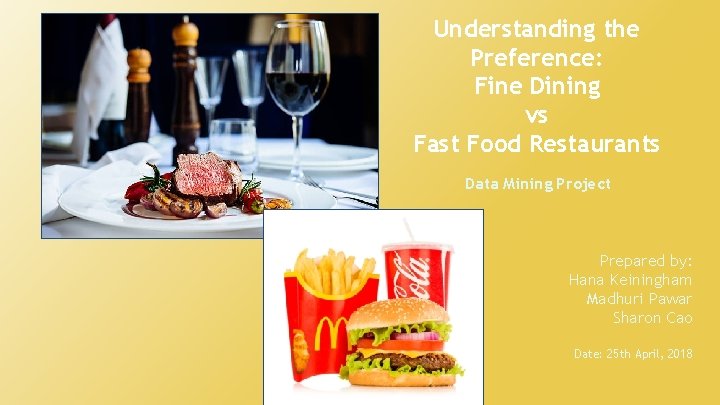
Understanding the Preference: Fine Dining vs Fast Food Restaurants Data Mining Project Prepared by: Hana Keiningham Madhuri Pawar Sharon Cao Date: 25 th April, 2018
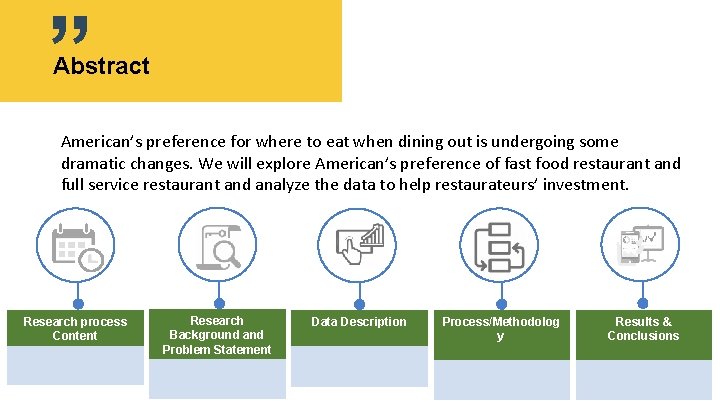
” Abstract XXX American’s preference for where to eat when dining out is undergoing some dramatic changes. We will explore American’s preference of fast food restaurant and full service restaurant and analyze the data to help restaurateurs’ investment. Research process Content Research Background and Problem Statement Data Description Process/Methodolog y Results & Conclusions
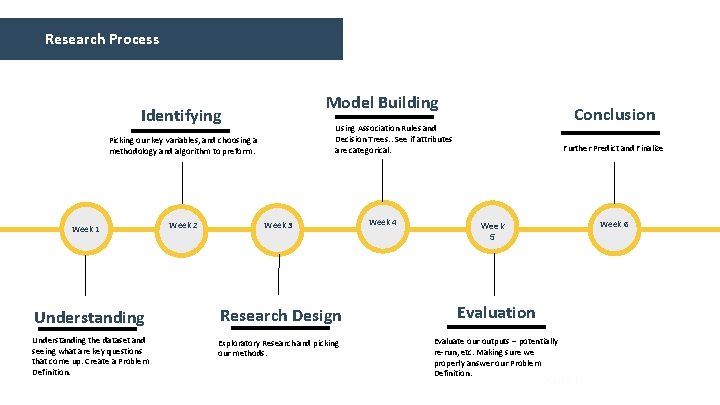
Research Process Model Building Identifying Picking our key variables, and choosing a methodology and algorithm to preform. Week 1 3 Week 2 Week 3 Understanding Research Design Understanding the dataset and seeing what are key questions that come up. Create a Problem Definition. Exploratory Research and picking our methods. © 2015 Ipsos. Conclusion Using Association Rules and Decision Trees. . See if attributes are categorical. Week 4 Further Predict and Finalize Week 5 Evaluation Evaluate our outputs – potentially re-run, etc. Making sure we properly answer our Problem Definition. Week 6
” Study Background & Research
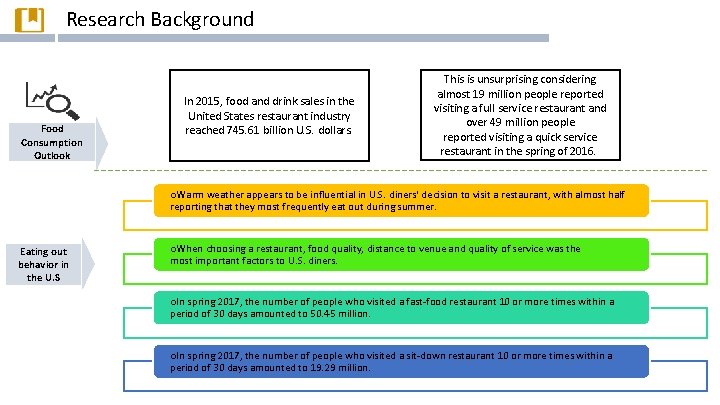
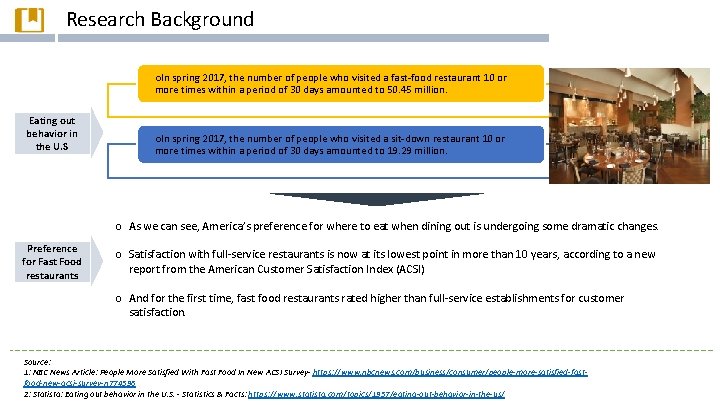
Research Background Food Consumption Outlook In 2015, food and drink sales in the United States restaurant industry reached 745. 61 billion U. S. dollars. This is unsurprising considering almost 19 million people reported visiting a full service restaurant and over 49 million people reported visiting a quick service restaurant in the spring of 2016. o. Warm weather appears to be influential in U. S. diners' decision to visit a restaurant, with almost half reporting that they most frequently eat out during summer. Eating out behavior in the U. S o. When choosing a restaurant, food quality, distance to venue and quality of service was the most important factors to U. S. diners. o. In spring 2017, the number of people who visited a fast-food restaurant 10 or more times within a period of 30 days amounted to 50. 45 million. o. In spring 2017, the number of people who visited a sit-down restaurant 10 or more times within a period of 30 days amounted to 19. 29 million.
Research Background o. In spring 2017, the number of people who visited a fast-food restaurant 10 or more times within a period of 30 days amounted to 50. 45 million. Eating out behavior in the U. S o. In spring 2017, the number of people who visited a sit-down restaurant 10 or more times within a period of 30 days amounted to 19. 29 million. o As we can see, America’s preference for where to eat when dining out is undergoing some dramatic changes. Preference for Fast Food restaurants o Satisfaction with full-service restaurants is now at its lowest point in more than 10 years, according to a new report from the American Customer Satisfaction Index (ACSI) o And for the first time, fast food restaurants rated higher than full-service establishments for customer satisfaction. Source: 1: NBC News Article: People More Satisfied With Fast Food In New ACSI Survey- https: //www. nbcnews. com/business/consumer/people-more-satisfied-fastfood-new-acsi-survey-n 774596 2: Statista: Eating out behavior in the U. S. - Statistics & Facts: https: //www. statista. com/topics/1957/eating-out-behavior-in-the-us/
” Need for Research “Lower customer satisfaction is a major threat to the restaurant business, ” Looking ahead Therefore, It is imperative to better understand the peculiarities of the market and the characteristics of the customers and provide services for better adoption and acceptability
Proposal Hence, we propose to understand the expenditures at Full Service Restaurants vs. Fast food outlets, by taking three important criteria’s Number of Full Service vs. Fast Food Outlets and their performance This will help evaluate how has fast food and full-service restaurants number increased over the years and understand its performance in terms of expenditures per capita State and US Region wise preference This will help understand the preferences of fast food and full-service restaurants in different regions and states of US Preference by demographic characteristics which includes: Race, Age and Income levels To understand if there is a correlation between demographic factors in different states and regions and the preferences for fast-food and full-service restaurants
” Data Description o Our data set is below: o Demographic Data o Ranging from 2005 to 2010 o Restaurant Data o Ranging from 2007 to 2012 o Geographic Data o Income Data
” Variables We Will Use o. State o. Resident o. Household Income o. Ethnicity
” Methodology: o o Data Collection Data Pre-Processing Model Building Evaluation
” Data Collection The United States Department of Agriculture, Economic Research Service document provides: - Over 275 variables - Access to food information - Finance for food information - Past information - Demographic information - Geographic information
” Process We aggregated the united states department of agriculture, economic research service document because the information is vast and we were only focusing on full service restaurant and fast food restaurant. Once the data was aggregated, we built used association rule and Decision Tree Model
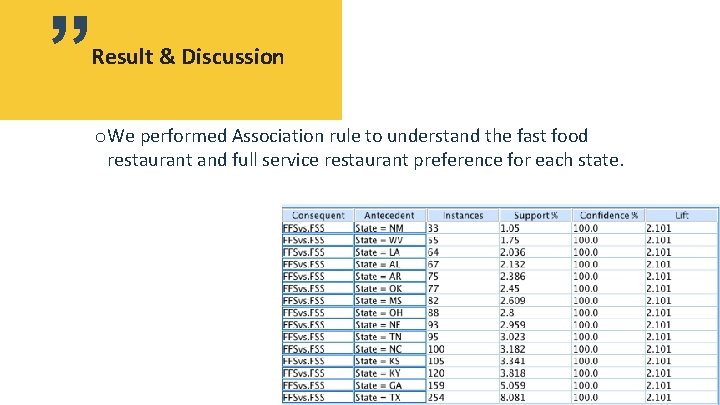
” Model Building We used the association rule to determine each State’s food preference (FFR vs. FSR). We decided to use Decision Tree because of it is easy to understand explain to a manager. We also use association rule to determine what variable correlate with one another
” Model Evaluation o In the STATE Model Evaluation Accuracy, the accuracy is 100% for both full service and fast food preference in training and testing data o In the removal of STATE and focus on training data, the accuracy is 89% for full service restaurant (code 0) choice prediction and 84% for fast food restaurant prediction. o In the removal of STATE and focus on testing data, the accuracy is 75% for full service restaurant (code 0) choice prediction and 68% for fast food restaurant prediction. o In focusing on income, city, and whites, the training data accuracy is 85% for full service restaurant prediction in comparison to 45% for fast food restaurant prediction o In focusing on income, city, and whites, the testing data accuracy is 83% for full service restaurant prediction in comparison to 45% for fast food restaurant prediction
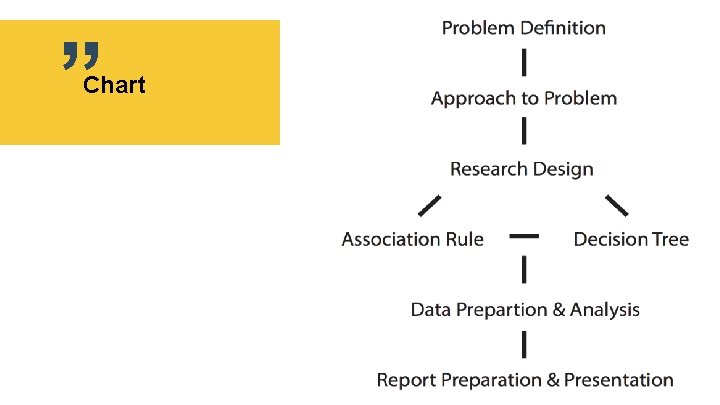
” Chart 16 © 2015 Ipsos.
” Result & Discussion o. We performed Association rule to understand the fast food restaurant and full service restaurant preference for each state.
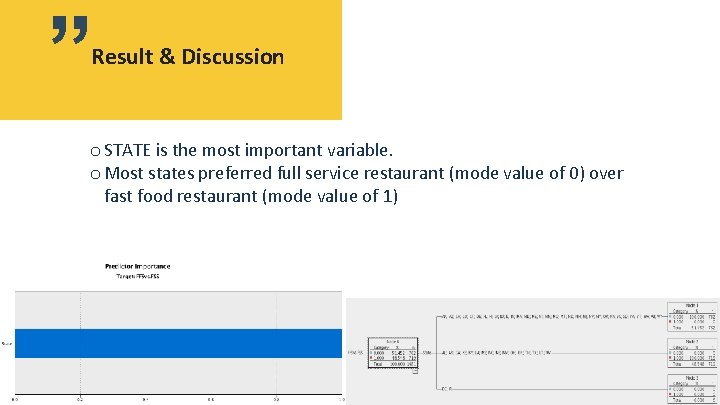
” Result & Discussion o STATE is the most important variable. o Most states preferred full service restaurant (mode value of 0) over fast food restaurant (mode value of 1)
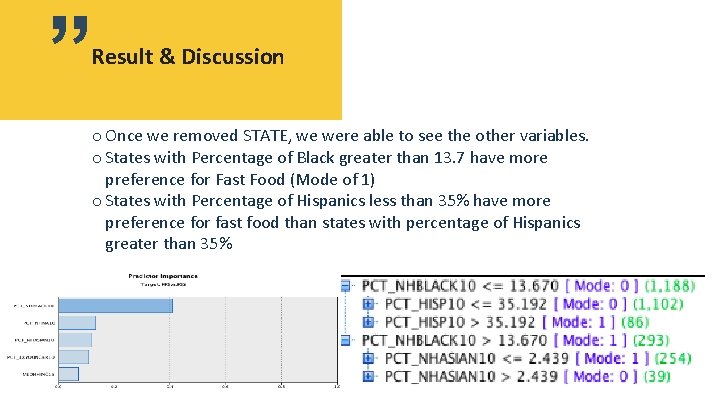
” Result & Discussion o Once we removed STATE, we were able to see the other variables. o States with Percentage of Black greater than 13. 7 have more preference for Fast Food (Mode of 1) o States with Percentage of Hispanics less than 35% have more preference for fast food than states with percentage of Hispanics greater than 35%
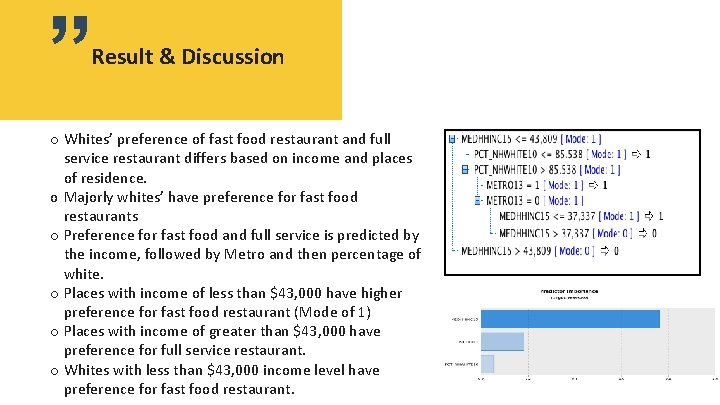
” Additional Analysis In order to understand the preference for Food and Full Service restaurant in a specific group, we chose Income, % of White and Metro vs. Non Metro as the input variable; and we used Fast food and Full service as the target. Reason: As White form the major part of the population and the preference may differ based on their income and their place of residence, we decided to use these as the variable.
” Result & Discussion o Whites’ preference of fast food restaurant and full service restaurant differs based on income and places of residence. o Majorly whites’ have preference for fast food restaurants o Preference for fast food and full service is predicted by the income, followed by Metro and then percentage of white. o Places with income of less than $43, 000 have higher preference for fast food restaurant (Mode of 1) o Places with income of greater than $43, 000 have preference for full service restaurant. o Whites with less than $43, 000 income level have preference for fast food restaurant.
” Result & Discussion o Certain States preferred fast food restaurant over full service restaurant o Resident area (city or suburban) o City prefer full service restaurant o Suburban prefer fast food restaurant o Income o City has a higher income than suburban o Demographic o Most whites have a preference of fast food restaurant over full service restaurant o People of color tend to prefer full service restaurant over fast food restaurant
” Recommendations & Conclusions o. In conclusion, there is a preference of fast food restaurant and full service restaurant based on state, resident area, income and demographic. o. Full Service Restaurants would find more success in certain states residing in a urban area filled with a diverse demographics. o. Fast Food Restaurants would find more success in certain states residing in suburban area filled with whites. o. There is more income wealth in cities than suburban area.
THANK YOU