
Understanding the Perceptions of Threats and Risks People
- Slides: 1
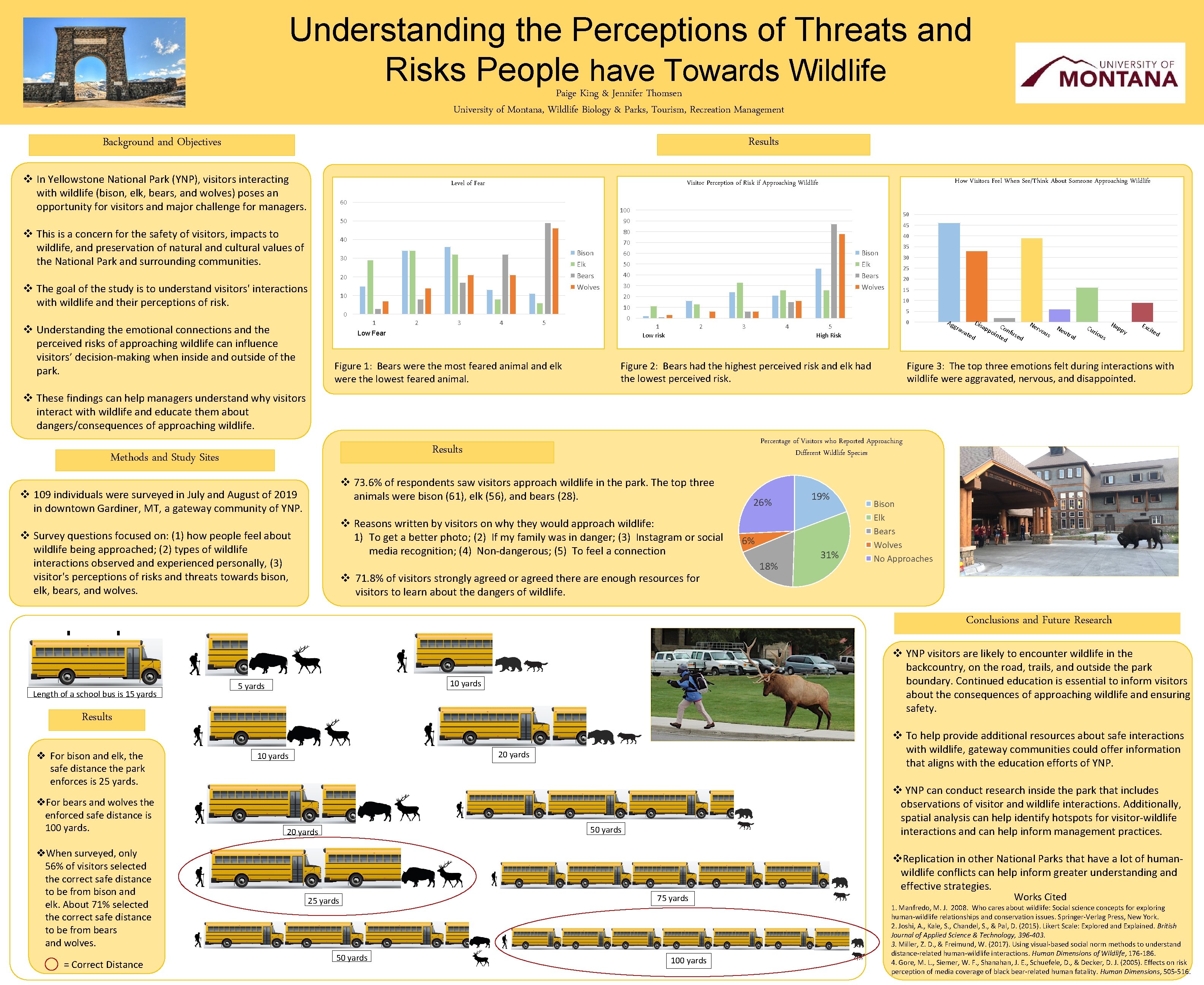
Understanding the Perceptions of Threats and Risks People have Towards Wildlife Paige King & Jennifer Thomsen University of Montana, Wildlife Biology & Parks, Tourism, Recreation Management Results Background and Objectives v In Yellowstone National Park (YNP), visitors interacting with wildlife (bison, elk, bears, and wolves) poses an opportunity for visitors and major challenge for managers. 60 100 50 v This is a concern for the safety of visitors, impacts to wildlife, and preservation of natural and cultural values of the National Park and surrounding communities. 45 80 40 70 Bison Elk Bears Wolves 30 20 10 35 Bison Elk Bears Wolves 60 50 40 30 30 25 20 10 10 0 v Understanding the emotional connections and the perceived risks of approaching wildlife can influence visitors’ decision‐making when inside and outside of the park. 50 90 40 v The goal of the study is to understand visitors' interactions with wildlife and their perceptions of risk. How Visitors Feel When See/Think About Someone Approaching Wildlife Visitor Perception of Risk if Approaching Wildlife Level of Fear 1 2 3 4 0 5 Low Fear Figure 1: Bears were the most feared animal and elk were the lowest feared animal. 5 1 Low risk 2 3 4 0 5 High Risk Ag gra v Dis C po onfu int ed sed ate ap d Ne rvo us Ne utr al Cu rio Ha us pp y Exc ite d Figure 3: The top three emotions felt during interactions with wildlife were aggravated, nervous, and disappointed. Figure 2: Bears had the highest perceived risk and elk had the lowest perceived risk. v These findings can help managers understand why visitors interact with wildlife and educate them about dangers/consequences of approaching wildlife. Percentage of Visitors who Reported Approaching Different Wildlife Species Results Methods and Study Sites v 73. 6% of respondents saw visitors approach wildlife in the park. The top three animals were bison (61), elk (56), and bears (28). v 109 individuals were surveyed in July and August of 2019 in downtown Gardiner, MT, a gateway community of YNP. v Reasons written by visitors on why they would approach wildlife: 1) To get a better photo; (2) If my family was in danger; (3) Instagram or social media recognition; (4) Non‐dangerous; (5) To feel a connection v Survey questions focused on: (1) how people feel about wildlife being approached; (2) types of wildlife interactions observed and experienced personally, (3) visitor's perceptions of risks and threats towards bison, elk, bears, and wolves. v 71. 8% of visitors strongly agreed or agreed there are enough resources for visitors to learn about the dangers of wildlife. 26% 19% 6% 18% 31% Bison Elk Bears Wolves No Approaches Conclusions and Future Research Length of a school bus is 15 yards v YNP visitors are likely to encounter wildlife in the backcountry, on the road, trails, and outside the park boundary. Continued education is essential to inform visitors about the consequences of approaching wildlife and ensuring safety. 10 yards 5 yards Results v For bison and elk, the safe distance the park enforces is 25 yards. v. For bears and wolves the enforced safe distance is 100 yards. v. When surveyed, only 56% of visitors selected the correct safe distance to be from bison and elk. About 71% selected the correct safe distance to be from bears and wolves. = Correct Distance v To help provide additional resources about safe interactions with wildlife, gateway communities could offer information that aligns with the education efforts of YNP. 20 yards 10 yards v YNP can conduct research inside the park that includes observations of visitor and wildlife interactions. Additionally, spatial analysis can help identify hotspots for visitor‐wildlife interactions and can help inform management practices. 50 yards 25 yards 50 yards 75 yards 100 yards v. Replication in other National Parks that have a lot of human‐ wildlife conflicts can help inform greater understanding and effective strategies. Works Cited 1. Manfredo, M. J. 2008. Who cares about wildlife: Social science concepts for exploring human‐wildlife relationships and conservation issues. Springer‐Verlag Press, New York. 2. Joshi, A. , Kale, S. , Chandel, S. , & Pal, D. (2015). Likert Scale: Explored and Explained. British Journal of Applied Science & Technology, 396 -403. 3. Miller, Z. D. , & Freimund, W. (2017). Using visual‐based social norm methods to understand distance‐related human‐wildlife interactions. Human Dimensions of Wildlife, 176‐ 186. 4. Gore, M. L. , Siemer, W. F. , Shanahan, J. E. , Schuefele, D. , & Decker, D. J. (2005). Effects on risk perception of media coverage of black bear‐related human fatality. Human Dimensions, 505‐ 516.