
Understanding the past Manuscripts are old books that
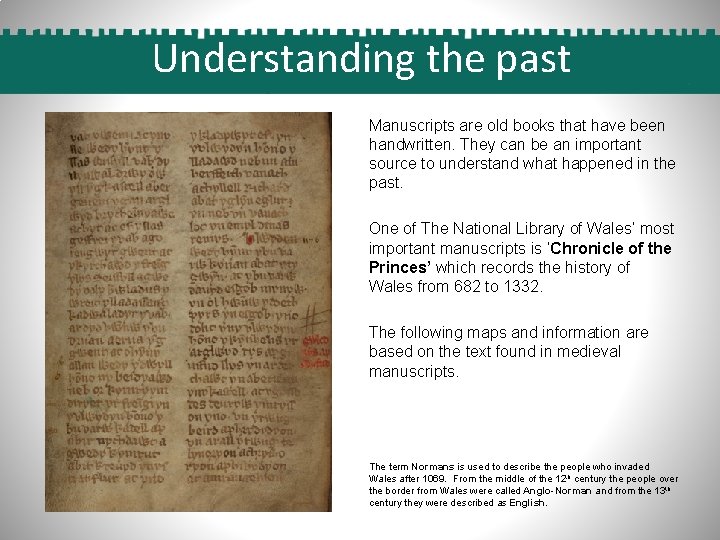
Understanding the past Manuscripts are old books that have been handwritten. They can be an important source to understand what happened in the past. One of The National Library of Wales’ most important manuscripts is ‘Chronicle of the Princes’ which records the history of Wales from 682 to 1332. The following maps and information are based on the text found in medieval manuscripts. The term Normans is used to describe the people who invaded Wales after 1069. From the middle of the 12 th century the people over the border from Wales were called Anglo-Norman and from the 13 th century they were described as English.
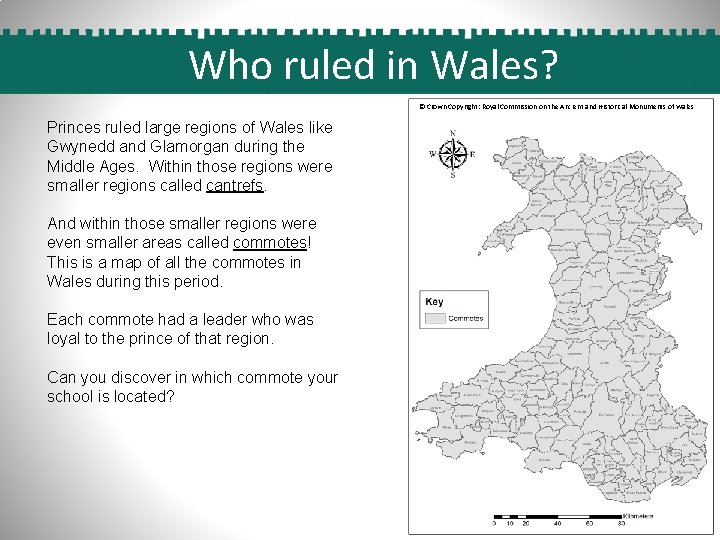
Who ruled in Wales? © Crown Copyright: Royal Commission on the Ancient and Historical Monuments of Wales Princes ruled large regions of Wales like Gwynedd and Glamorgan during the Middle Ages. Within those regions were smaller regions called cantrefs. And within those smaller regions were even smaller areas called commotes! This is a map of all the commotes in Wales during this period. Each commote had a leader who was loyal to the prince of that region. Can you discover in which commote your school is located?
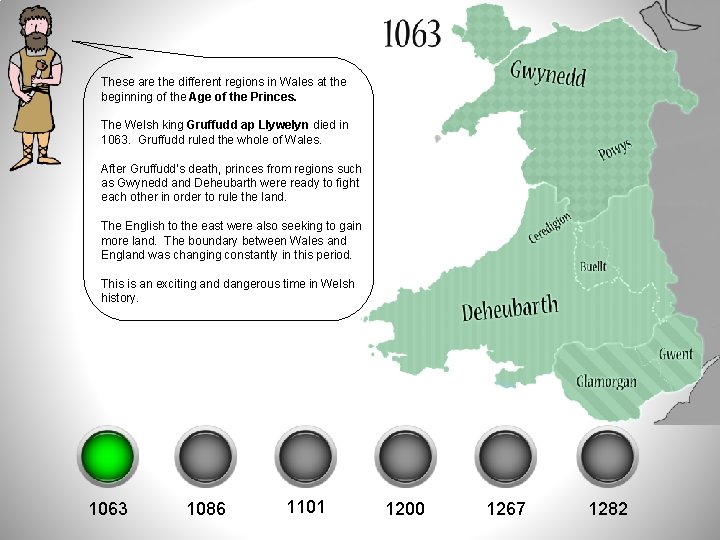
These are the different regions in Wales at the beginning of the Age of the Princes. The Welsh king Gruffudd ap Llywelyn died in 1063. Gruffudd ruled the whole of Wales. After Gruffudd’s death, princes from regions such as Gwynedd and Deheubarth were ready to fight each other in order to rule the land. The English to the east were also seeking to gain more land. The boundary between Wales and England was changing constantly in this period. This is an exciting and dangerous time in Welsh history. 1063 1086 1101 1200 1267 1282
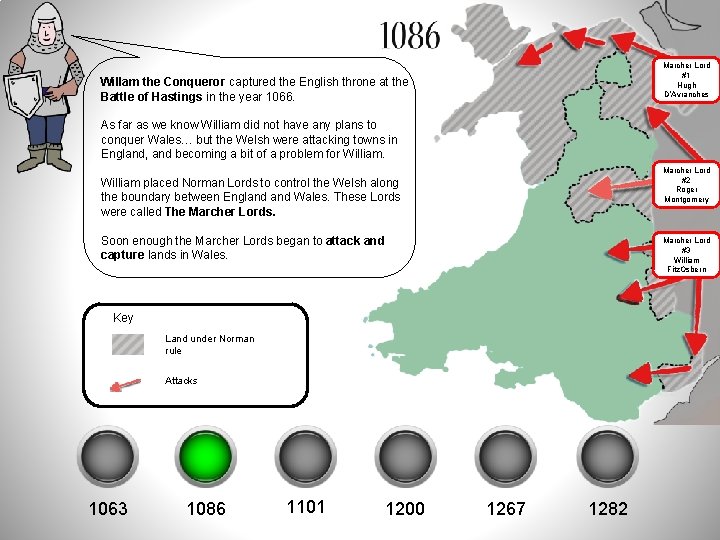
Marcher Lord #1 Hugh D’Avranches Willam the Conqueror captured the English throne at the Battle of Hastings in the year 1066. As far as we know William did not have any plans to conquer Wales… but the Welsh were attacking towns in England, and becoming a bit of a problem for William. Marcher Lord #2 Roger Montgomery William placed Norman Lords to control the Welsh along the boundary between England Wales. These Lords were called The Marcher Lords. Soon enough the Marcher Lords began to attack and capture lands in Wales. Marcher Lord #3 William Fitz. Osbern Key Land under Norman rule Attacks 1063 1086 1101 1200 1267 1282
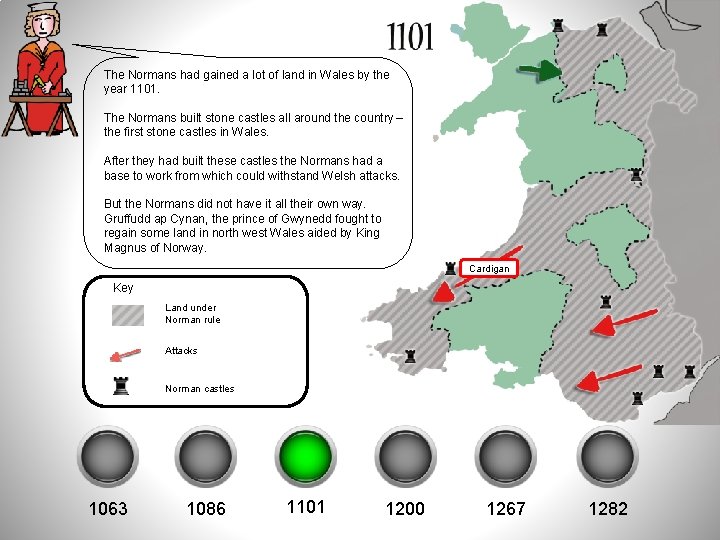
The Normans had gained a lot of land in Wales by the year 1101. The Normans built stone castles all around the country – the first stone castles in Wales. After they had built these castles the Normans had a base to work from which could withstand Welsh attacks. But the Normans did not have it all their own way. Gruffudd ap Cynan, the prince of Gwynedd fought to regain some land in north west Wales aided by King Magnus of Norway. Cardigan Key Land under Norman rule Attacks Norman castles 1063 1086 1101 1200 1267 1282
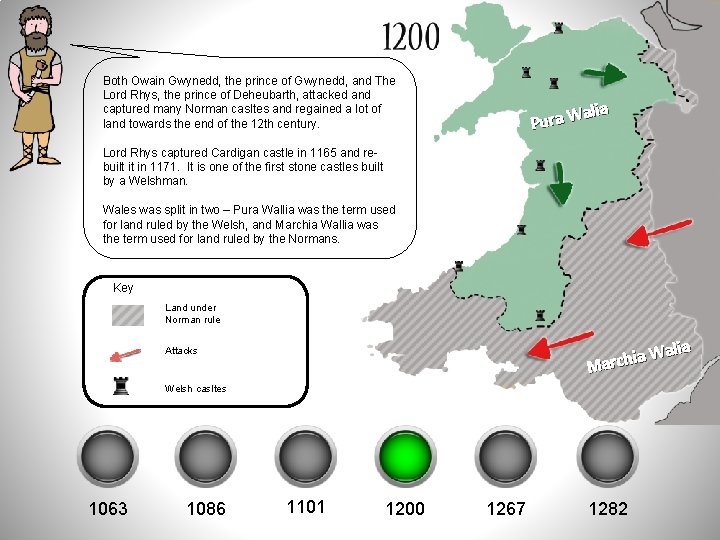
Both Owain Gwynedd, the prince of Gwynedd, and The Lord Rhys, the prince of Deheubarth, attacked and captured many Norman casltes and regained a lot of land towards the end of the 12 th century. alia W a r u P Lord Rhys captured Cardigan castle in 1165 and rebuilt it in 1171. It is one of the first stone castles built by a Welshman. Wales was split in two – Pura Wallia was the term used for land ruled by the Welsh, and Marchia Wallia was the term used for land ruled by the Normans. Key Land under Norman rule Walia a i h c r Ma Attacks Welsh casltes 1063 1086 1101 1200 1267 1282
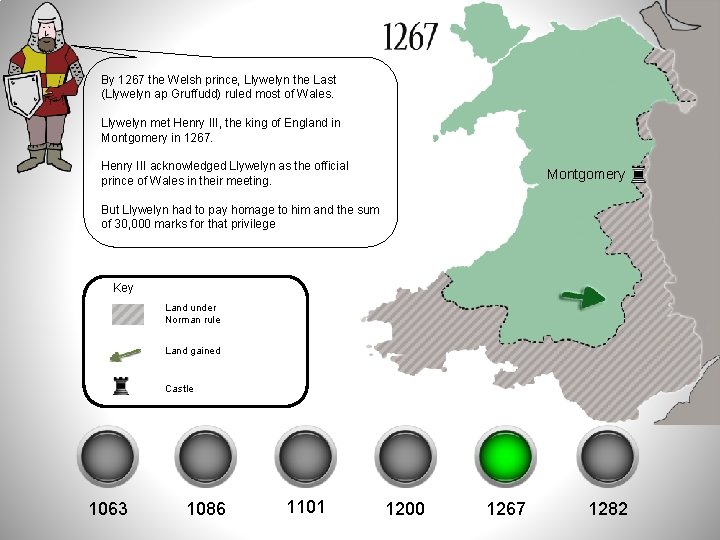
By 1267 the Welsh prince, Llywelyn the Last (Llywelyn ap Gruffudd) ruled most of Wales. Llywelyn met Henry III, the king of England in Montgomery in 1267. Henry III acknowledged Llywelyn as the official prince of Wales in their meeting. Montgomery But Llywelyn had to pay homage to him and the sum of 30, 000 marks for that privilege Key Land under Norman rule Land gained Castle 1063 1086 1101 1200 1267 1282
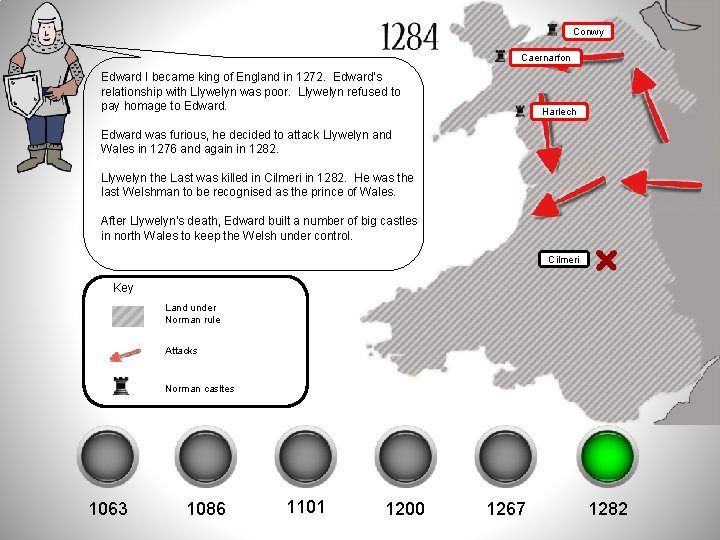
Conwy Caernarfon Edward I became king of England in 1272. Edward’s relationship with Llywelyn was poor. Llywelyn refused to pay homage to Edward. Harlech Edward was furious, he decided to attack Llywelyn and Wales in 1276 and again in 1282. Llywelyn the Last was killed in Cilmeri in 1282. He was the last Welshman to be recognised as the prince of Wales. After Llywelyn’s death, Edward built a number of big castles in north Wales to keep the Welsh under control. Cilmeri Key Land under Norman rule Attacks Norman casltes 1063 1086 1101 1200 1267 1282
- Slides: 8