
Understanding the Oregon rural healthcare landscape Rural Health





- Slides: 54
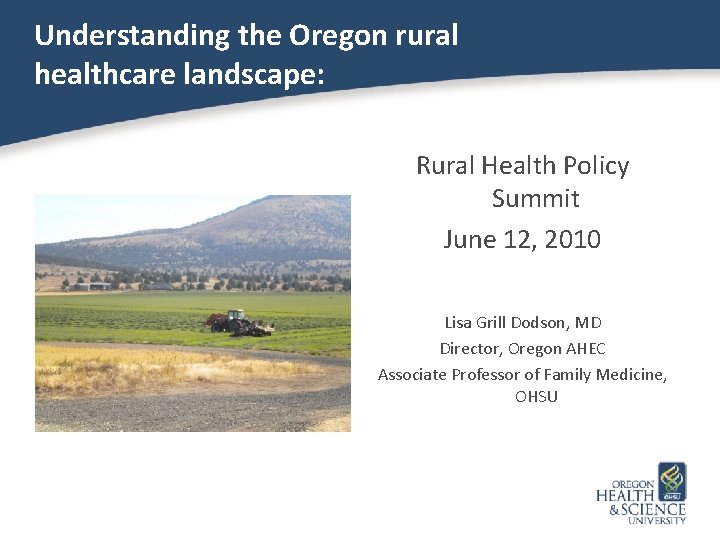
Understanding the Oregon rural healthcare landscape: Rural Health Policy Summit June 12, 2010 Lisa Grill Dodson, MD Director, Oregon AHEC Associate Professor of Family Medicine, OHSU
Goals • Identify supply side issues in rural healthcare workforce • Identify demand side issues in rural healthcare workforce • Identify key population and community characteristics related to healthcare workforce • Understand the economic impact of the healthcare workforce on rural communities • Outline potential strategies to address the rural healthcare shortfalls
Healthcare Access vs. Availability § In the I-5 corridor the question is access § In rural Oregon, the question is availability § Maldistribution of health care providers that is going to get worse
Too few physicians or too many urban physicians? • Maldistribution by specialty and geography (MD, DO, NP, PA, RN, allied health) • Rural areas have fared less well in the past in recruitment and retention of health providers • This will likely worsen in the future – Increased demand – Rural infrastructure issues – changes in provider demographic and expectation
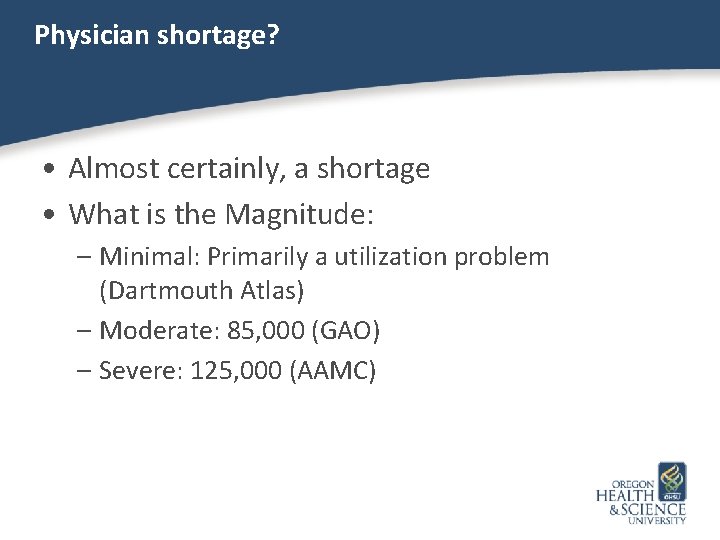
Physician shortage? • Almost certainly, a shortage • What is the Magnitude: – Minimal: Primarily a utilization problem (Dartmouth Atlas) – Moderate: 85, 000 (GAO) – Severe: 125, 000 (AAMC)
DATA
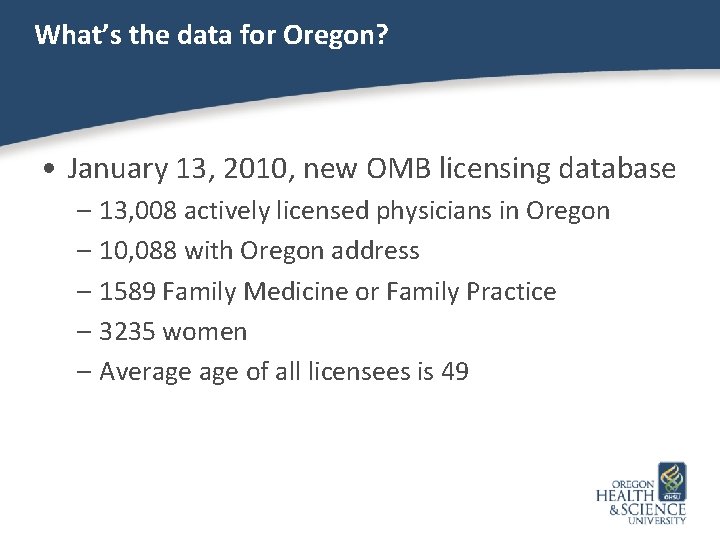
What’s the data for Oregon? • January 13, 2010, new OMB licensing database – 13, 008 actively licensed physicians in Oregon – 10, 088 with Oregon address – 1589 Family Medicine or Family Practice – 3235 women – Average of all licensees is 49
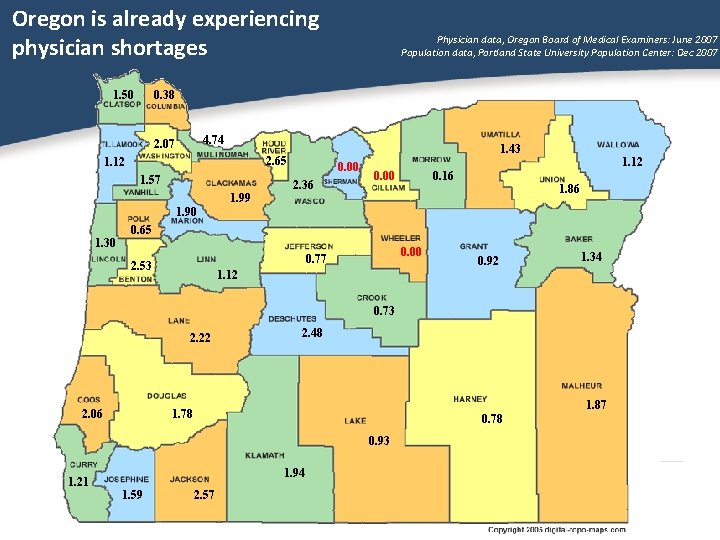
Oregon is already experiencing physician shortages 1. 50 Physician data, Oregon Board of Medical Examiners: June 2007 Population data, Portland State University Population Center: Dec 2007 0. 38 4. 74 2. 07 1. 43 2. 65 1. 12 1. 57 0. 00 2. 36 1. 12 0. 00 0. 16 1. 86 1. 99 1. 90 0. 65 1. 30 0. 00 0. 77 2. 53 0. 92 1. 34 1. 12 0. 73 2. 22 2. 06 2. 48 1. 87 1. 78 0. 93 1. 94 1. 21 1. 59 2. 57
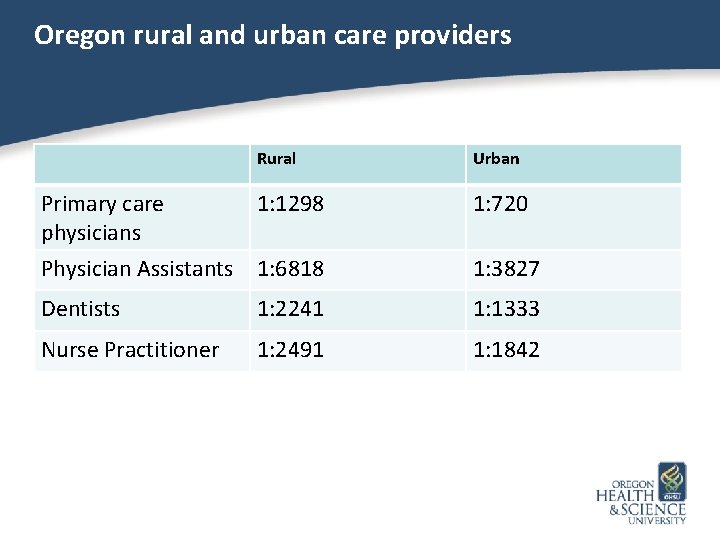
Oregon rural and urban care providers Primary care physicians Rural Urban 1: 1298 1: 720 Physician Assistants 1: 6818 1: 3827 Dentists 1: 2241 1: 1333 Nurse Practitioner 1: 2491 1: 1842
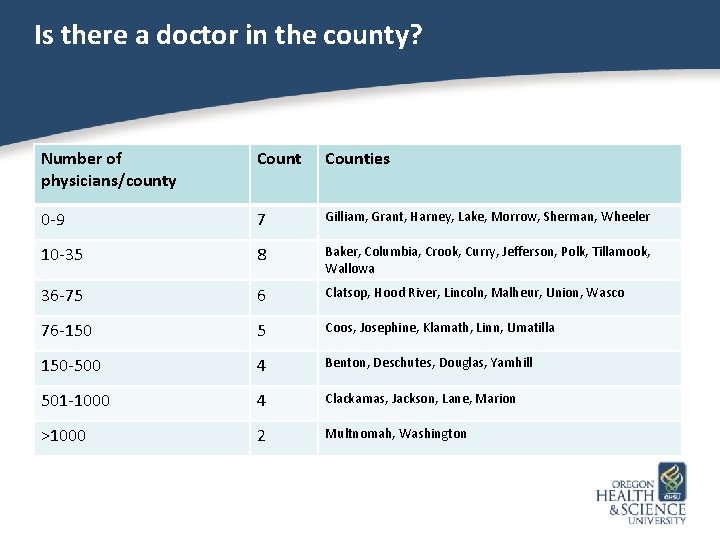
Is there a doctor in the county? Number of physicians/county Counties 0 -9 7 Gilliam, Grant, Harney, Lake, Morrow, Sherman, Wheeler 10 -35 8 Baker, Columbia, Crook, Curry, Jefferson, Polk, Tillamook, Wallowa 36 -75 6 Clatsop, Hood River, Lincoln, Malheur, Union, Wasco 76 -150 5 Coos, Josephine, Klamath, Linn, Umatilla 150 -500 4 Benton, Deschutes, Douglas, Yamhill 501 -1000 4 Clackamas, Jackson, Lane, Marion >1000 2 Multnomah, Washington
DEMAND
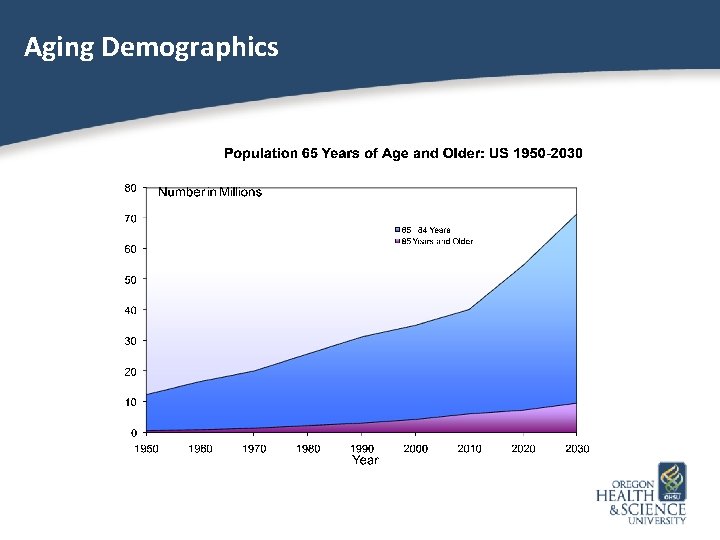
Aging Demographics
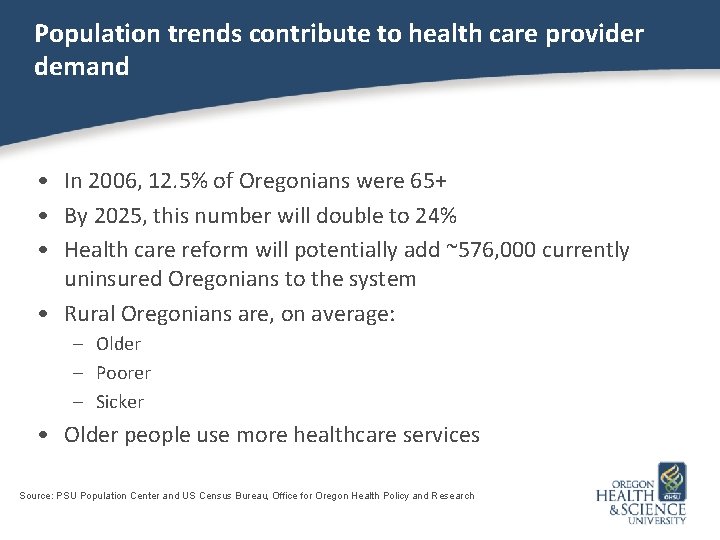
Population trends contribute to health care provider demand • In 2006, 12. 5% of Oregonians were 65+ • By 2025, this number will double to 24% • Health care reform will potentially add ~576, 000 currently uninsured Oregonians to the system • Rural Oregonians are, on average: – Older – Poorer – Sicker • Older people use more healthcare services Source: PSU Population Center and US Census Bureau, Office for Oregon Health Policy and Research
Supply side
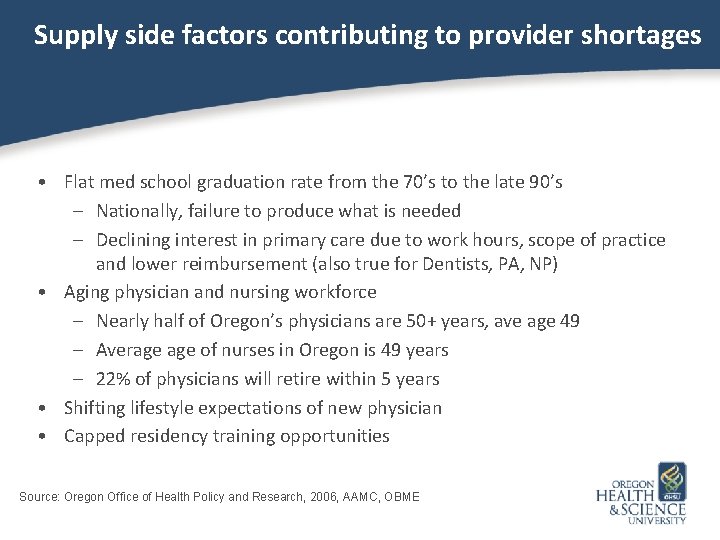
Supply side factors contributing to provider shortages • Flat med school graduation rate from the 70’s to the late 90’s – Nationally, failure to produce what is needed – Declining interest in primary care due to work hours, scope of practice and lower reimbursement (also true for Dentists, PA, NP) • Aging physician and nursing workforce – Nearly half of Oregon’s physicians are 50+ years, ave age 49 – Average of nurses in Oregon is 49 years – 22% of physicians will retire within 5 years • Shifting lifestyle expectations of new physician • Capped residency training opportunities Source: Oregon Office of Health Policy and Research, 2006, AAMC, OBME
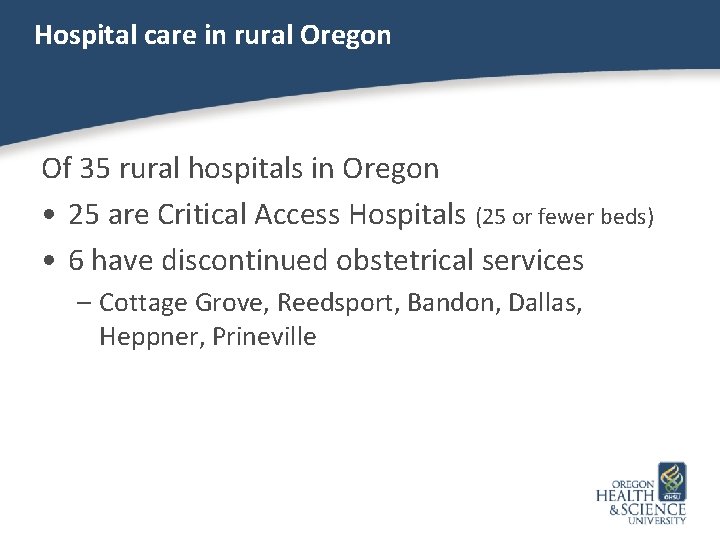
Hospital care in rural Oregon Of 35 rural hospitals in Oregon • 25 are Critical Access Hospitals (25 or fewer beds) • 6 have discontinued obstetrical services – Cottage Grove, Reedsport, Bandon, Dallas, Heppner, Prineville
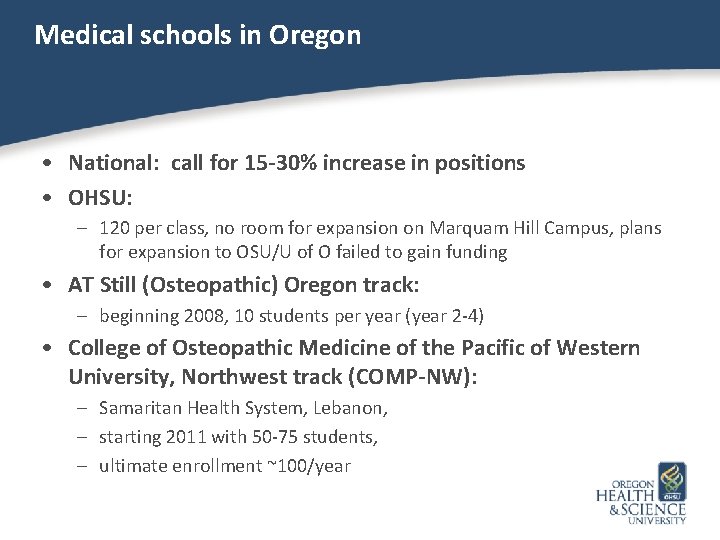
Medical schools in Oregon • National: call for 15 -30% increase in positions • OHSU: – 120 per class, no room for expansion on Marquam Hill Campus, plans for expansion to OSU/U of O failed to gain funding • AT Still (Osteopathic) Oregon track: – beginning 2008, 10 students per year (year 2 -4) • College of Osteopathic Medicine of the Pacific of Western University, Northwest track (COMP-NW): – Samaritan Health System, Lebanon, – starting 2011 with 50 -75 students, – ultimate enrollment ~100/year
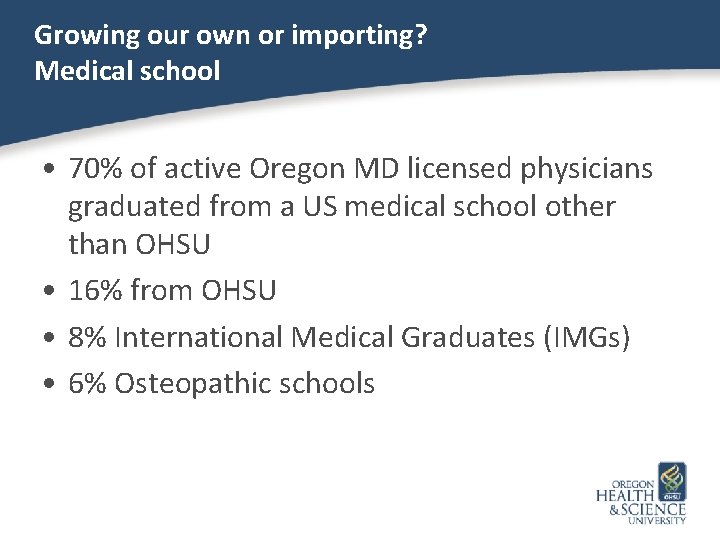
Growing our own or importing? Medical school • 70% of active Oregon MD licensed physicians graduated from a US medical school other than OHSU • 16% from OHSU • 8% International Medical Graduates (IMGs) • 6% Osteopathic schools
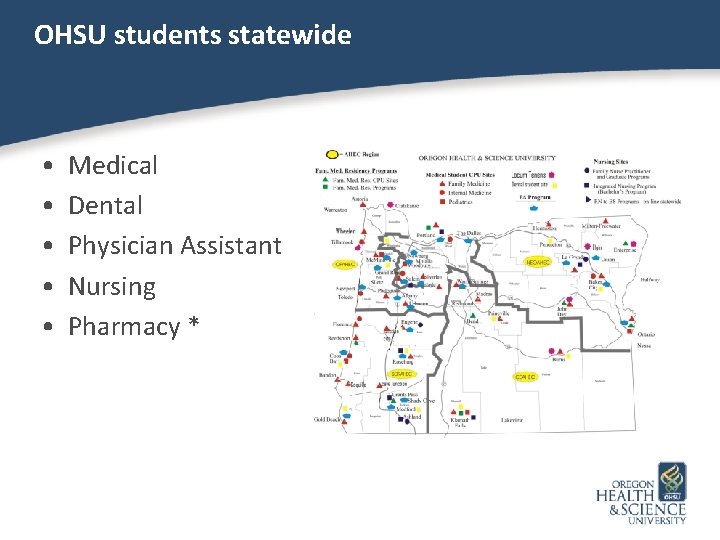
OHSU students statewide • • • Medical Dental Physician Assistant Nursing Pharmacy *
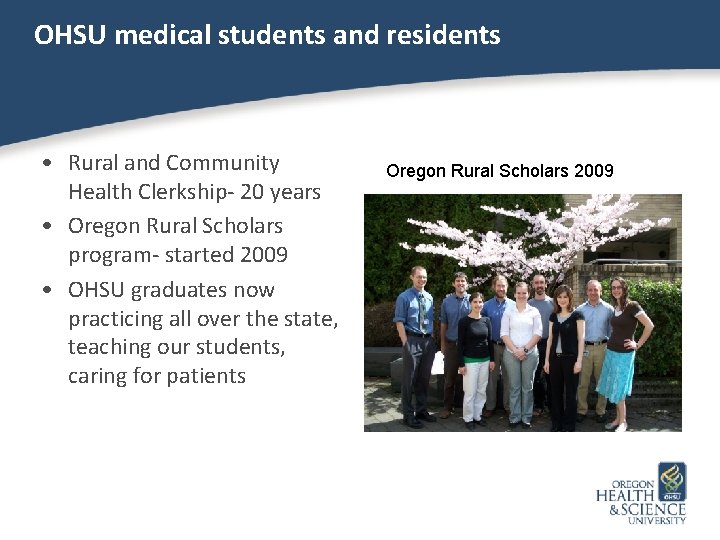
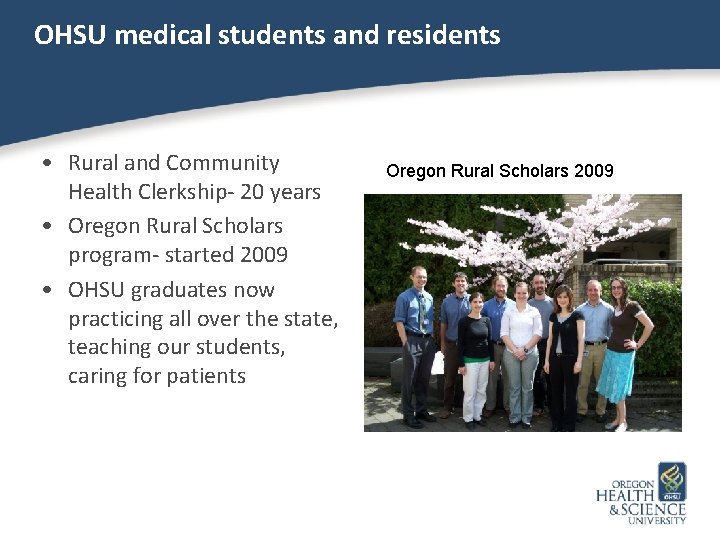
OHSU medical students and residents • Rural and Community Health Clerkship- 20 years • Oregon Rural Scholars program- started 2009 • OHSU graduates now practicing all over the state, teaching our students, caring for patients Oregon Rural Scholars 2009
Growing our own or importing? Residency training • 68% of active Oregon licensed physicians received residency training outside Oregon • 25% received residency training in Oregon • 18% received residency training at OHSU • 7% received training in Oregon, but not at OHSU (majority Providence and Legacy) • More than 50% of residents remain in Oregon for practice
Residency training (Graduate Medical Education) GME • Subject to “caps” on federal assistance with resident training since BBA of 1997. • Caps based on existing levels of resident positions. No federal assistance on positions above the cap. • New programs have 3 years to establish their cap. • New programs in Oregon at Samaritan Health Systems, DO only.
Graduate Medical Education (residency) • Oregon Family Medicine: 3 residencies, 27 slots – OHSU: 12 slots/yr – Providence Milwaukie: 7 slots/yr – Cascades East( Klamath Falls): 8 slots/yr • Comparison: WWAMI – Washington: 10 residencies, 80 slots (plus 2 Military FM residencies, ~20 additional) – – Wyoming: 2 residencies, 14 slots Alaska: 1 residency, 12 slots Montana: 1 residency, 6 slots Idaho: 2 residencies, 18 slots
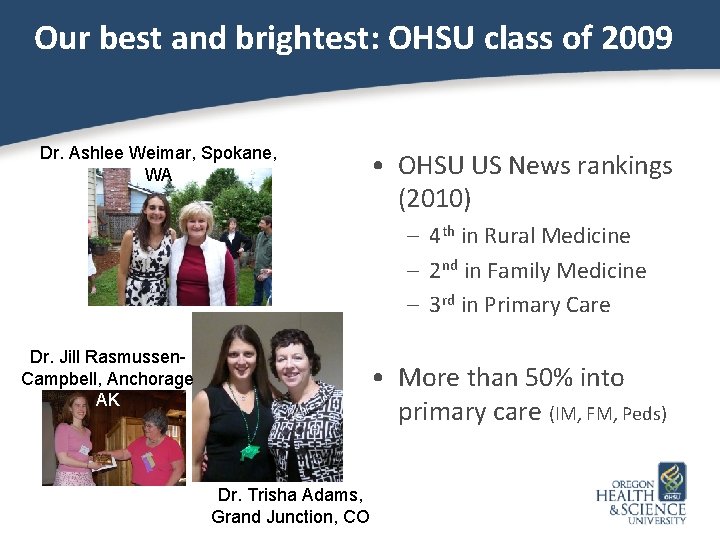
Our best and brightest: OHSU class of 2009 Dr. Ashlee Weimar, Spokane, WA • OHSU US News rankings (2010) – 4 th in Rural Medicine – 2 nd in Family Medicine – 3 rd in Primary Care Dr. Jill Rasmussen. Campbell, Anchorage AK • More than 50% into primary care (IM, FM, Peds) Dr. Trisha Adams, Grand Junction, CO
Build on Oregon’s GME success: • OHSU Family Medicine ranks in top 5 nationally • Cascades East: – Top 15 programs in rural output – 85% of graduates practice in towns with population 25, 000 or fewer • Providence Milwaukie: care to urban underserved populations
GME expansion • Support development of a consortium for new graduate medical education programs, especially in primary care, and in non-Portland settings • Bridge funds for GME startups (3 years for federal funds to flow)
Role of primary care
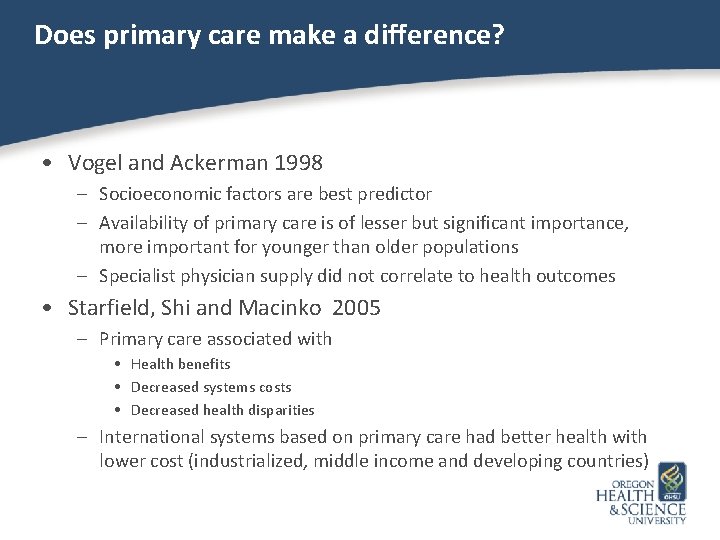
Does primary care make a difference? • Vogel and Ackerman 1998 – Socioeconomic factors are best predictor – Availability of primary care is of lesser but significant importance, more important for younger than older populations – Specialist physician supply did not correlate to health outcomes • Starfield, Shi and Macinko 2005 – Primary care associated with • Health benefits • Decreased systems costs • Decreased health disparities – International systems based on primary care had better health with lower cost (industrialized, middle income and developing countries)
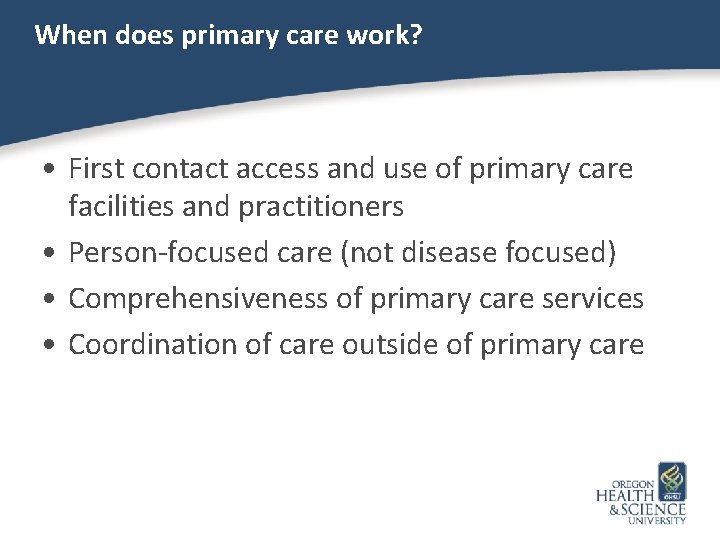
When does primary care work? • First contact access and use of primary care facilities and practitioners • Person-focused care (not disease focused) • Comprehensiveness of primary care services • Coordination of care outside of primary care
Pipeline/growing our own
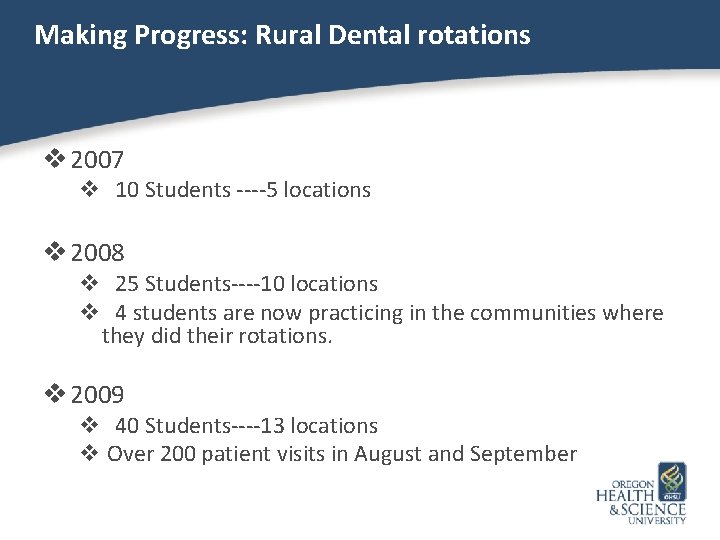
Making Progress: Rural Dental rotations v 2007 v 10 Students ----5 locations v 2008 v 25 Students----10 locations v 4 students are now practicing in the communities where they did their rotations. v 2009 v 40 Students----13 locations v Over 200 patient visits in August and September
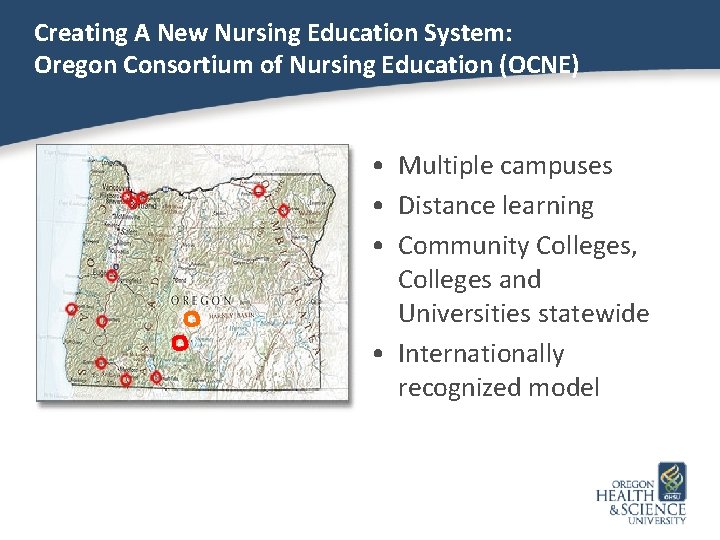
Creating A New Nursing Education System: Oregon Consortium of Nursing Education (OCNE) • Multiple campuses • Distance learning • Community Colleges, Colleges and Universities statewide • Internationally recognized model
The pipeline we want
The pipeline we’ve got:
Hopefully, not this one:
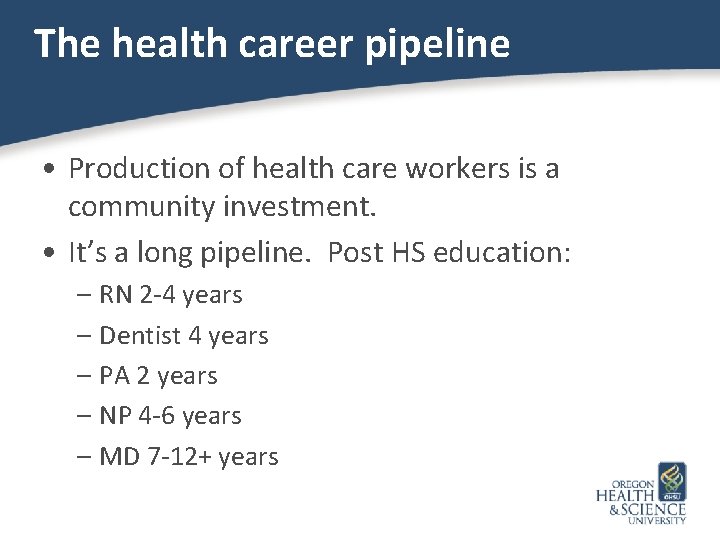
The health career pipeline • Production of health care workers is a community investment. • It’s a long pipeline. Post HS education: – RN 2 -4 years – Dentist 4 years – PA 2 years – NP 4 -6 years – MD 7 -12+ years
Rebuilding the healthcare workforce pipeline • K-12 – Giving rural and disadvantaged kids a level academic playing field – Maintaining interest in math and science though middle school and high scool – Giving teachers the tools they need to help kids succeed • Community college, College, professions training – Mentoring and support
Changes in provider demographics and expectations • Fewer rural kids being admitted – Less well prepared in HS for college (4 day week in most rural schools) – Less exposure to health careers/mentors – Sticker shock: OHSU Medical (instate) >$35, 000 – Fewer being admitted to med/dental school (slightly less problem with nursing due to community college system and OCNE) – Leads to a smaller pool with rural expectation/aptitude
Changes in provider demographics and expectation • More women in medicine and dentistry • Generational expectations of both women and men – More time for family/travel/other interests – Reduced work hours – Curtailed after hours care (“on-call”)
Changes in provider demographics and expectation • Expect to be connected (EMR, telemed, CME) • Expect community amenities – Schools/ educational opportunities – Fitness – Social outlets • 2 career couples • Willing to trade (some) salary for lifestyle • Scope of practice issues (+/- for rural)
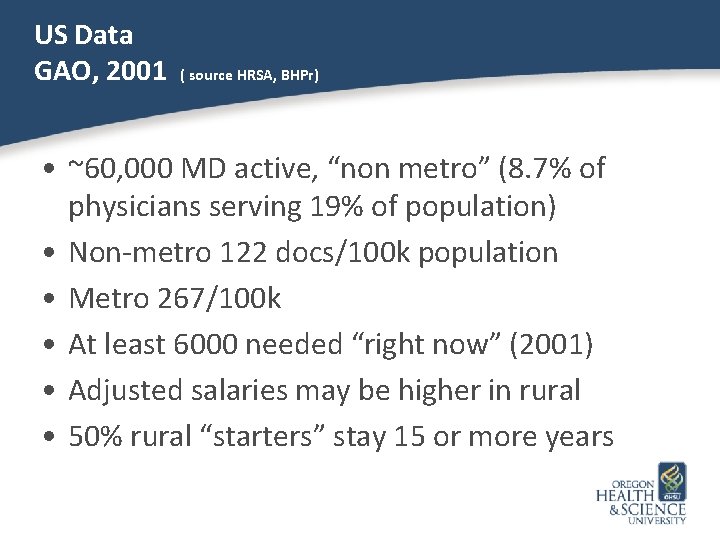
US Data GAO, 2001 ( source HRSA, BHPr) • ~60, 000 MD active, “non metro” (8. 7% of physicians serving 19% of population) • Non-metro 122 docs/100 k population • Metro 267/100 k • At least 6000 needed “right now” (2001) • Adjusted salaries may be higher in rural • 50% rural “starters” stay 15 or more years
Economics
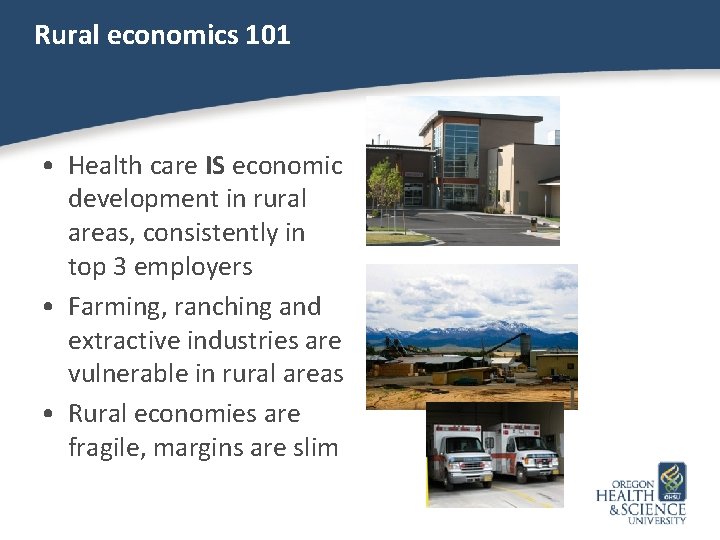
Rural economics 101 • Health care IS economic development in rural areas, consistently in top 3 employers • Farming, ranching and extractive industries are vulnerable in rural areas • Rural economies are fragile, margins are slim
Physicians and economics • “Physicians occupy an unusual spot in the social structure of rural communities. From an economic standpoint, they are successful entrepreneurs, wellpaid business people similar to bankers and lawyers. On the other hand, they are also social servants like policemen or teachers, just as essential to the welfare and functioning of the community but paid for through a fee-for-service mechanism outside of local community control. This anomalous status requires some fairly innovative interpersonal and structural relationships to strike a workable balance. ” – Rosenblatt and Moscovice, 1982
Oregon Healthcare Workforce Institute: IMPLAN data (preliminary): Coos, Curry, Douglas Physicians contributed 6 -11% of jobs (18 -21 direct jobs/physician, 22 -27 total) Total economic output per physician: $2. 08$2. 46 million (Multnomah ~$1 million) Estimated Tax contribution related to physicians: 80 -100 K per physician Full report available at OHWI website: www. oregonhwi. org
So what do we need ? • Improve K-12 math, science, health careers programs • College scholarships, mentoring, programs • Control of tuition at all levels • Health training scholarships and loan forgiveness
• Increase enrollment of rural and underrepresented minorities in health professions training • Expand residency training, in non-Portland based sites • DATA • Support for practicing physicians
OHSU medical students and residents • Rural and Community Health Clerkship- 20 years • Oregon Rural Scholars program- started 2009 • OHSU graduates now practicing all over the state, teaching our students, caring for patients Oregon Rural Scholars 2009
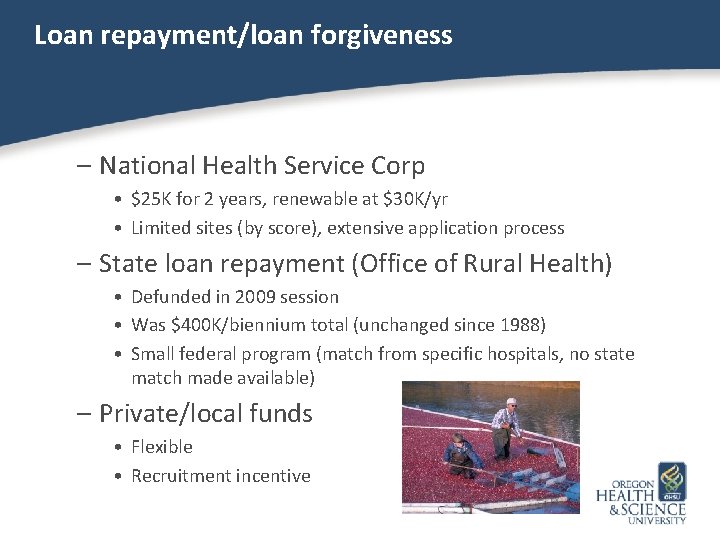
Loan repayment/loan forgiveness – National Health Service Corp • $25 K for 2 years, renewable at $30 K/yr • Limited sites (by score), extensive application process – State loan repayment (Office of Rural Health) • Defunded in 2009 session • Was $400 K/biennium total (unchanged since 1988) • Small federal program (match from specific hospitals, no state match made available) – Private/local funds • Flexible • Recruitment incentive
Support for practicing physicians, especially in rural areas • • • Preventing burnout Ensuring 24/7 coverage Quality assurance/practice improvement Teaching Continuing education
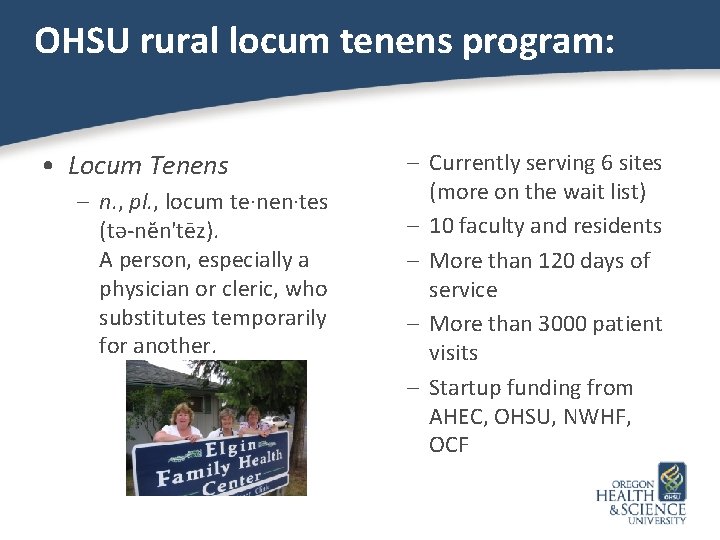
OHSU rural locum tenens program: • Locum Tenens – n. , pl. , locum te·nen·tes (tə-nĕn'tēz). A person, especially a physician or cleric, who substitutes temporarily for another. – Currently serving 6 sites (more on the wait list) – 10 faculty and residents – More than 120 days of service – More than 3000 patient visits – Startup funding from AHEC, OHSU, NWHF, OCF
Rural Community assessment and technical support: Office of Rural Health • Rural communities poorly prepared to compete effectively in a competitive market • Need to assess and understand their stengths and weaknesses for recruiting • Need to engage existing providers for retention • Need to be able to address the entire pipeline • Need to be able to quickly mobilize
OHSU: helping rural communities help themselves • • Recruitment of health professionals Health professional retention activities K-12 math/science enrichment Health occupations training/activities College scholarships Health professions student training/GME Community health literacy/health promotion projects
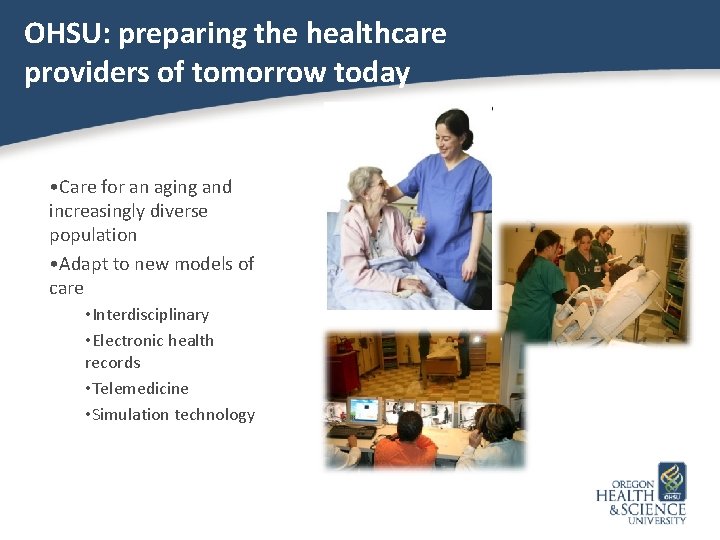
OHSU: preparing the healthcare providers of tomorrow today • Care for an aging and increasingly diverse population • Adapt to new models of care • Interdisciplinary • Electronic health records • Telemedicine • Simulation technology