
Understanding the longterm concentration flux composition and processing
- Slides: 1
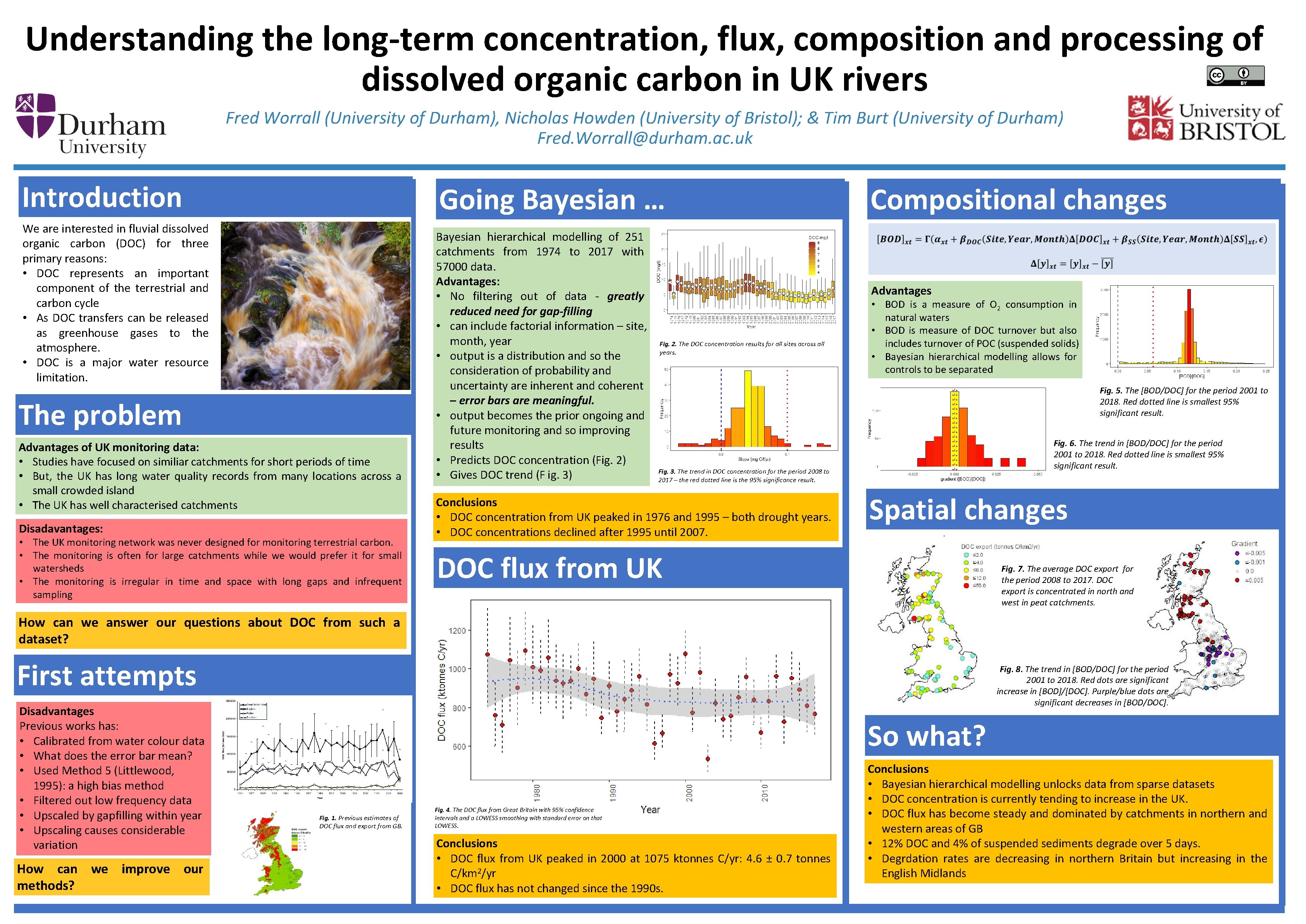
Understanding the long-term concentration, flux, composition and processing of dissolved organic carbon in UK rivers j Fred Worrall (University of Durham), Nicholas Howden (University of Bristol); & Tim Burt (University of Durham) Fred. Worrall@durham. ac. uk Introduction Going Bayesian … We are interested in fluvial dissolved organic carbon (DOC) for three primary reasons: • DOC represents an important component of the terrestrial and carbon cycle • As DOC transfers can be released as greenhouse gases to the atmosphere. • DOC is a major water resource limitation. The problem Advantages of UK monitoring data: • Studies have focused on similiar catchments for short periods of time • But, the UK has long water quality records from many locations across a small crowded island • The UK has well characterised catchments Disadavantages: • The UK monitoring network was never designed for monitoring terrestrial carbon. • The monitoring is often for large catchments while we would prefer it for small watersheds • The monitoring is irregular in time and space with long gaps and infrequent sampling Bayesian hierarchical modelling of 251 catchments from 1974 to 2017 with 57000 data. Advantages: • No filtering out of data - greatly reduced need for gap-filling • can include factorial information – site, month, year • output is a distribution and so the consideration of probability and uncertainty are inherent and coherent – error bars are meaningful. • output becomes the prior ongoing and future monitoring and so improving results • Predicts DOC concentration (Fig. 2) • Gives DOC trend (F ig. 3) Compositional changes Advantages Fig. 2. The DOC concentration results for all sites across all years. • BOD is a measure of O 2 consumption in natural waters • BOD is measure of DOC turnover but also includes turnover of POC (suspended solids) • Bayesian hierarchical modelling allows for controls to be separated Fig. 5. The [BOD/DOC] for the period 2001 to 2018. Red dotted line is smallest 95% significant result. Fig. 6. The trend in [BOD/DOC] for the period 2001 to 2018. Red dotted line is smallest 95% significant result. Fig. 3. The trend in DOC concentration for the period 2008 to 2017 – the red dotted line is the 95% significance result. Conclusions • DOC concentration from UK peaked in 1976 and 1995 – both drought years. • DOC concentrations declined after 1995 until 2007. Spatial changes DOC flux from UK Fig. 7. The average DOC export for the period 2008 to 2017. DOC export is concentrated in north and west in peat catchments. How can we answer our questions about DOC from such a dataset? First attempts Disadvantages Previous works has: • Calibrated from water colour data • What does the error bar mean? • Used Method 5 (Littlewood, 1995): a high bias method • Filtered out low frequency data • Upscaled by gapfilling within year • Upscaling causes considerable variation How can we improve our methods? Fig. 8. The trend in [BOD/DOC] for the period 2001 to 2018. Red dots are significant increase in [BOD]/[DOC]. Purple/blue dots are significant decreases in [BOD/DOC]. So what? Fig. 1. Previous estimates of DOC flux and export from GB. Fig. 4. The DOC flux from Great Britain with 95% confidence intervals and a LOWESS smoothing with standard error on that LOWESS. Conclusions • DOC flux from UK peaked in 2000 at 1075 ktonnes C/yr: 4. 6 ± 0. 7 tonnes C/km 2/yr • DOC flux has not changed since the 1990 s. Conclusions • Bayesian hierarchical modelling unlocks data from sparse datasets • DOC concentration is currently tending to increase in the UK. • DOC flux has become steady and dominated by catchments in northern and western areas of GB • 12% DOC and 4% of suspended sediments degrade over 5 days. • Degrdation rates are decreasing in northern Britain but increasing in the English Midlands