
Understanding the Human Network Martin Kruger martin kruger
- Slides: 16
Understanding the Human Network Martin Kruger martin. kruger 1@navy. mil LCDR Jodie Gooby Johanna. gooby@navy. mil November 2008
Program Goal • Develop and then translate models of “who, where, how, when, why” to suggestion of action
Areas of Emphasis (1/2) • • • Advanced Sensors – development of high information content sensors that can detect, classify, identify and/or geolocate actors or behaviors of interest at the sensor. Biometrics – development of capabilities that enable person identity dominance 24/7 over large areas. Tagging, Tracking and Location (TTL) – development of capabilities enabling the persistent tracking of actors or objects of interest and the classification of collected track data. Urban Situational Awareness – development of sensors to enable through structure situational awareness and the development of capabilities enabling structure classification. Wide Area Surveillance – the development of a tier-2 wide area surveillance payload, with supporting communications and the development of processing services that can translate persistent surveillance to actionable intelligence Sensor Planning and Management – development of decision aids that help the warfighter understand what to look for, where to look and how to look for it.
Areas of Emphasis (2/2) • Determining Intent – development of software applications that expose the intent of irregular actors in clutter (who/where). • Expose Enemy Structure & Decision Modeling – development of capabilities that can automatically expose enemy modus operandi with respect to their network structure or decision processes (how, why, when). • Cultural Intelligence – development of the capabilities required to make cultural intelligence tactically actionable. • Cognitive Information Operations– development of warfighter decision aids based on high resolution models, which enable decision space shaping or exploitation (proactive action). • ISR to C 2 – development of capabilities related to the complete integration of ISR into current tactical operations.
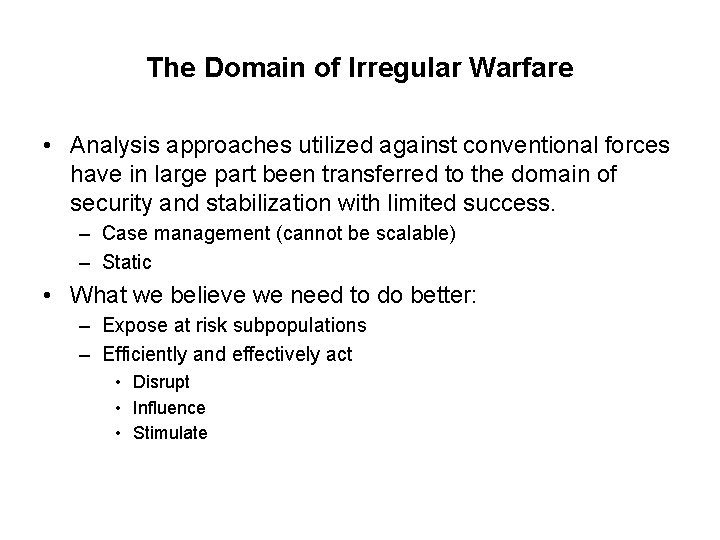
The Domain of Irregular Warfare • Analysis approaches utilized against conventional forces have in large part been transferred to the domain of security and stabilization with limited success. – Case management (cannot be scalable) – Static • What we believe we need to do better: – Expose at risk subpopulations – Efficiently and effectively act • Disrupt • Influence • Stimulate
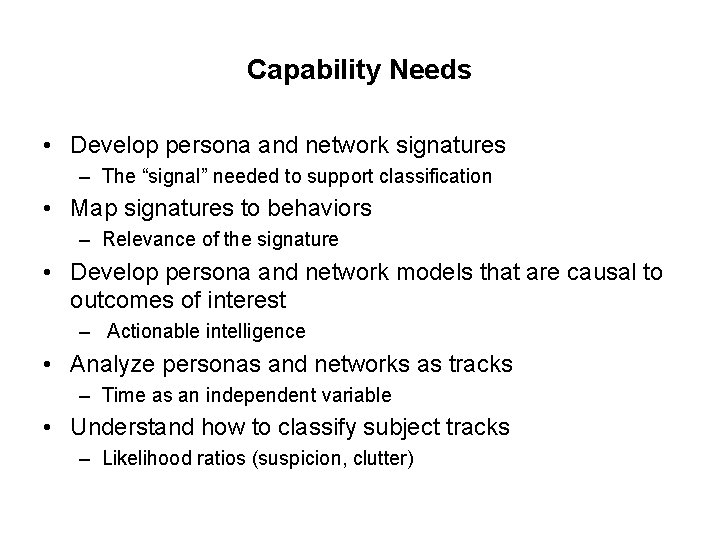
Capability Needs • Develop persona and network signatures – The “signal” needed to support classification • Map signatures to behaviors – Relevance of the signature • Develop persona and network models that are causal to outcomes of interest – Actionable intelligence • Analyze personas and networks as tracks – Time as an independent variable • Understand how to classify subject tracks – Likelihood ratios (suspicion, clutter)
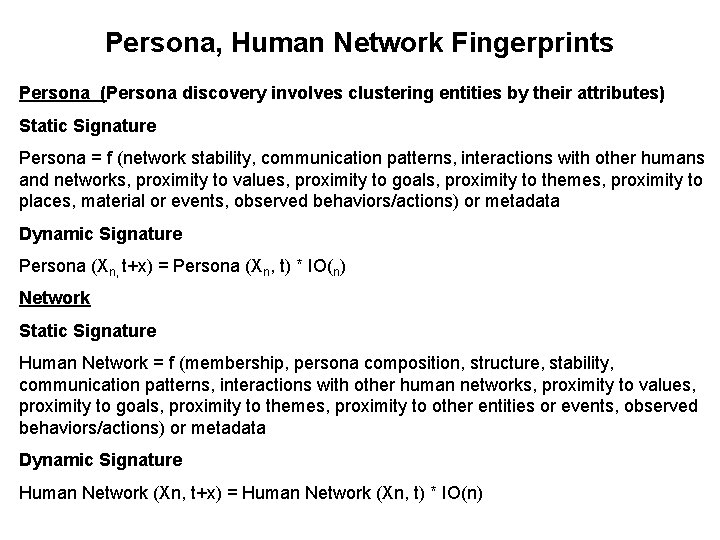
Persona, Human Network Fingerprints Persona (Persona discovery involves clustering entities by their attributes) Static Signature Persona = f (network stability, communication patterns, interactions with other humans and networks, proximity to values, proximity to goals, proximity to themes, proximity to places, material or events, observed behaviors/actions) or metadata Dynamic Signature Persona (Xn, t+x) = Persona (Xn, t) * IO(n) Network Static Signature Human Network = f (membership, persona composition, structure, stability, communication patterns, interactions with other human networks, proximity to values, proximity to goals, proximity to themes, proximity to other entities or events, observed behaviors/actions) or metadata Dynamic Signature Human Network (Xn, t+x) = Human Network (Xn, t) * IO(n)
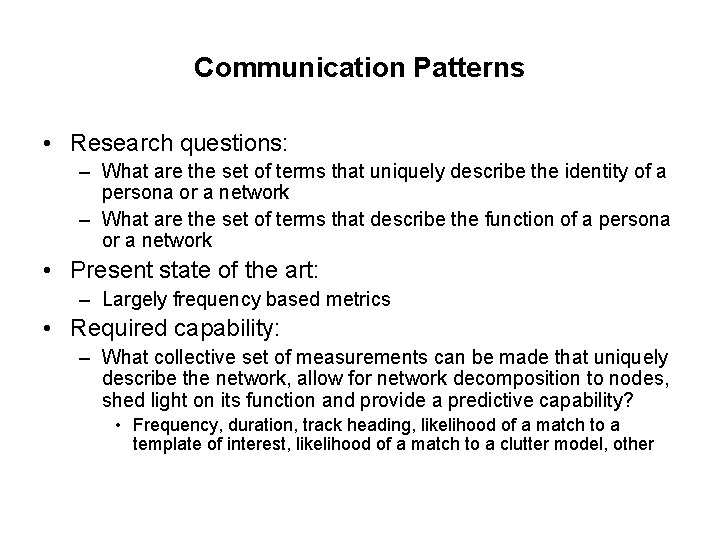
Communication Patterns • Research questions: – What are the set of terms that uniquely describe the identity of a persona or a network – What are the set of terms that describe the function of a persona or a network • Present state of the art: – Largely frequency based metrics • Required capability: – What collective set of measurements can be made that uniquely describe the network, allow for network decomposition to nodes, shed light on its function and provide a predictive capability? • Frequency, duration, track heading, likelihood of a match to a template of interest, likelihood of a match to a clutter model, other
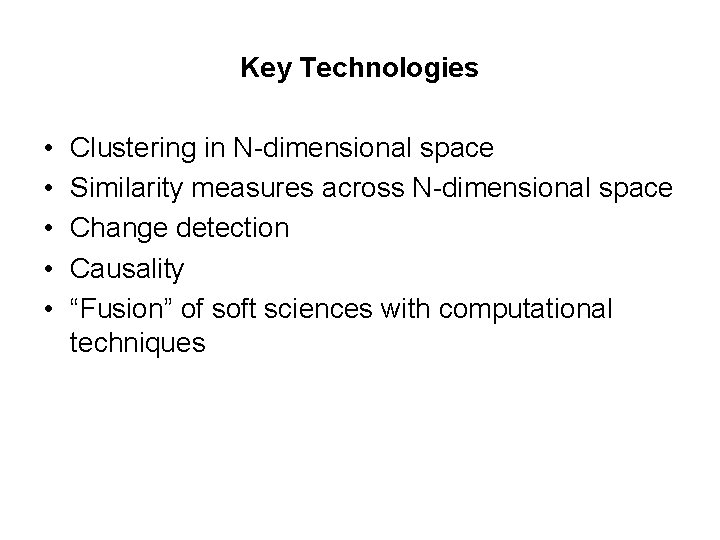
Key Technologies • • • Clustering in N-dimensional space Similarity measures across N-dimensional space Change detection Causality “Fusion” of soft sciences with computational techniques
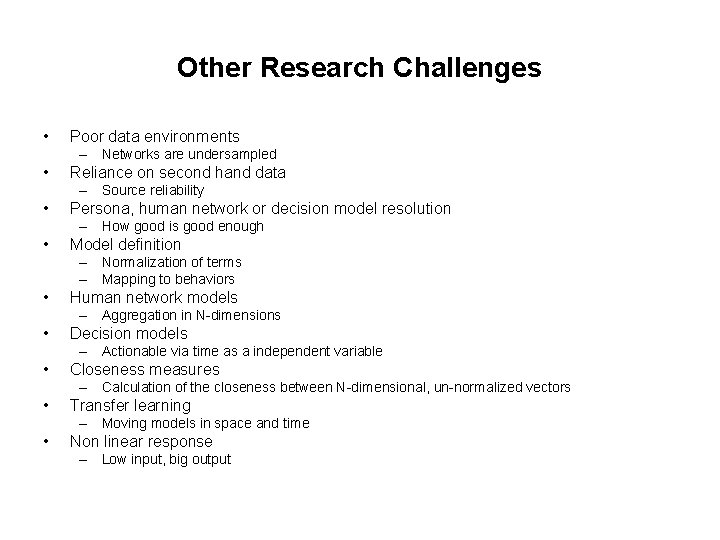
Other Research Challenges • Poor data environments – Networks are undersampled • Reliance on second hand data – Source reliability • Persona, human network or decision model resolution – How good is good enough • Model definition – Normalization of terms – Mapping to behaviors • Human network models – Aggregation in N-dimensions • Decision models – Actionable via time as a independent variable • Closeness measures – Calculation of the closeness between N-dimensional, un-normalized vectors • Transfer learning – Moving models in space and time • Non linear response – Low input, big output
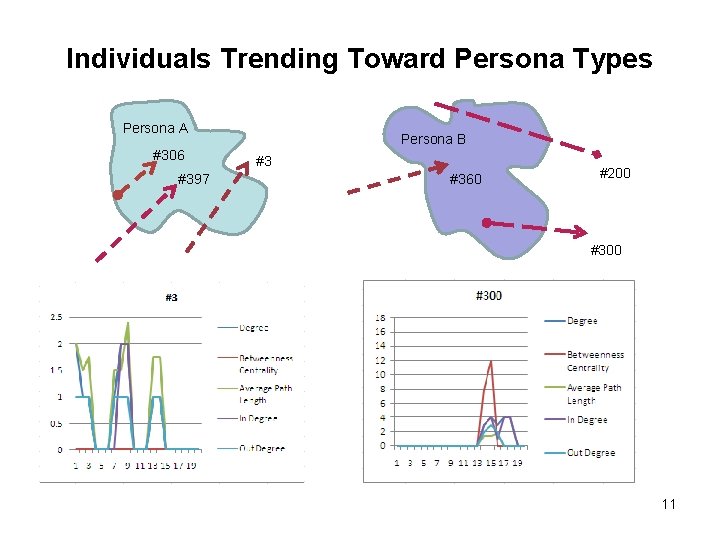
Individuals Trending Toward Persona Types Persona A #306 #397 Persona B #3 #360 #200 #300 11
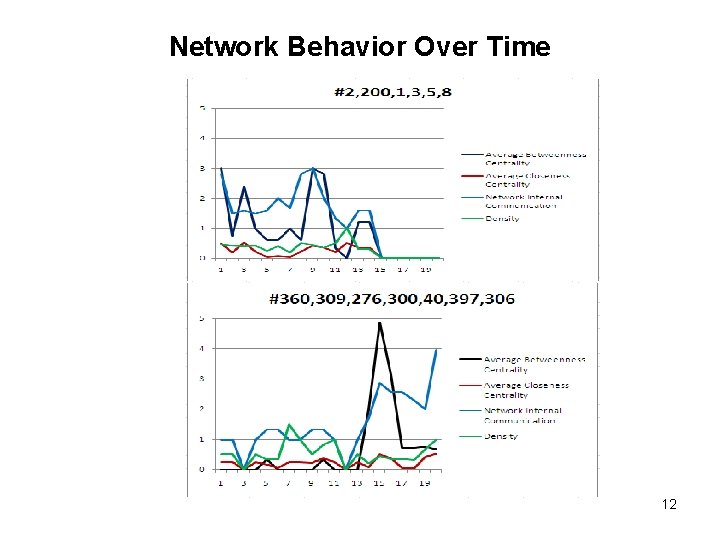
Network Behavior Over Time 12
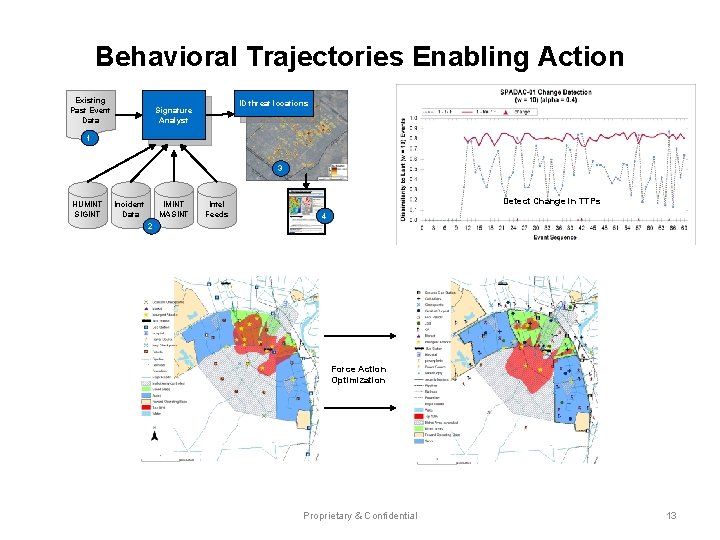
Behavioral Trajectories Enabling Action Existing Past Event Data ID threat locations Signature Analyst 1 3 HUMINT SIGINT Incident Data IMINT MASINT Intel Feeds Detect Change in TTPs 4 2 Force Action Optimization Proprietary & Confidential 13
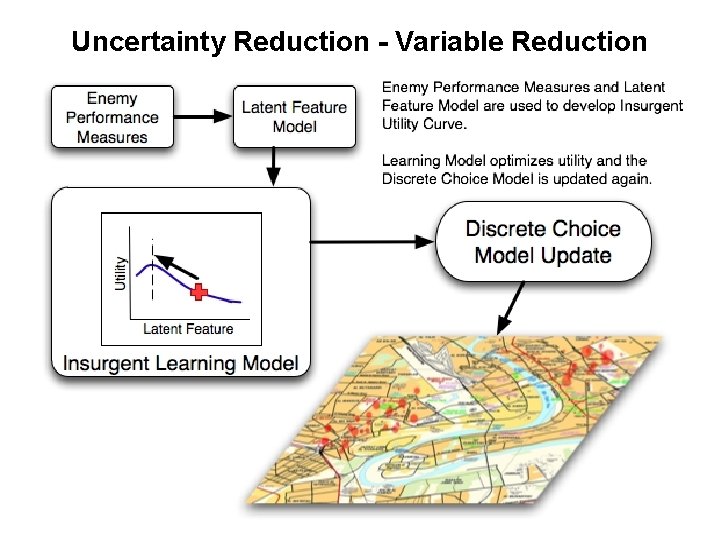
Uncertainty Reduction - Variable Reduction
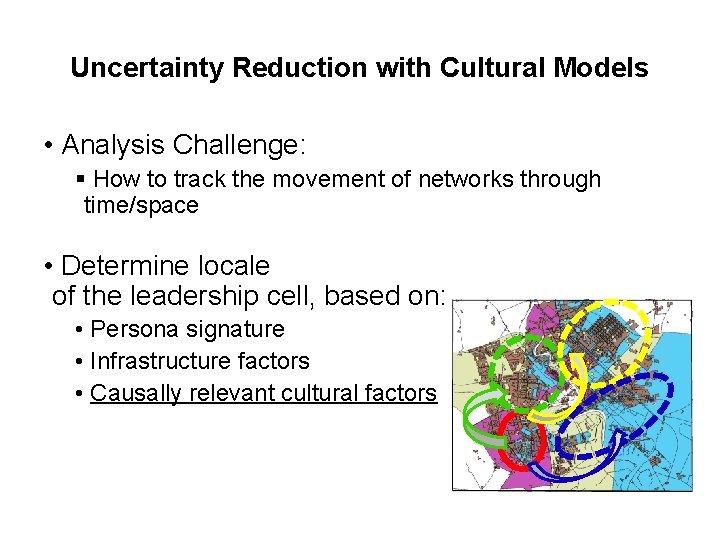
Uncertainty Reduction with Cultural Models • Analysis Challenge: § How to track the movement of networks through time/space • Determine locale of the leadership cell, based on: • Persona signature • Infrastructure factors • Causally relevant cultural factors SPADAC Proprietary 15
Summary • Human network and persona signatures can be used to understand the human terrain and to model IO effects. • Higher resolution decision modeling enables own force action optimization