
UNDERSTANDING THE GRANTS PROCESS FOR FIRSTNET PROJECTS Part


- Slides: 30
UNDERSTANDING THE GRANTS PROCESS FOR FIRSTNET PROJECTS (Part 3 of 3) Presented by:
Overview This Webinar is Part 3 in a series of 3 webinars. These webinars are intended to simplify and provide a methodical approach in applying for grant funds in support of your First. Net project. In Part 3 we will discuss the administrative side of grants management that will include the following topics: �Grant Management Staff �Segregation of Duty �Required Registrations (DUNS and SAM) �CFR’s and OMB’s �Single Audit Act �Cash Management Improvement Act (CMIA) �Common Subrecipient Requirements �Webinar Series Overview
Grant Management Staff For purposes of administrative and program accountability, as well as fiduciary responsibility there should be a minimum of four (4) personnel assigned to properly administer a grant. These personnel include the following: �Primary Point of Contact (POC) – This individual is commonly the program/project manager. �Secondary POC – This individual acts as a back up to the Primary POC.
Grant Management Staff (Cont. ) �Authorized Official – This is an individual who is authorized to enter into legal contracts on behalf of the applicant agency. The Authorized Official must be a person other than the program/project manager (POC) or the financial officer. �Financial Officer – This individual is ultimately responsible for the accounting, management of funds, verification of expenditures, and grant financial reporting. This must be an individual other than the Program/Project Manager or Authorized Official.
Segregation of Duty WHAT IS SEGREGATION OF DUTY? One of the key concepts in placing internal controls over assets is segregation of duties. Segregation of duties serves two key purposes: �It ensures that there is oversight and review to catch errors. �It helps to prevent fraud or theft because it requires a minimum of two people to collude in order to hide a transaction. Ensuring that proper segregation of duties is implemented serves to protect all parties involved in the management of grants.
Questions?
Required Registrations Grant recipients are required to have the following: �DUNS Number �SAM Registration �Grants. gov Registration You need to know who in your agency/organization is responsible for obtaining and renewing these registrations.
Required Registrations (Cont. ) WHAT IS A “DUNS” NUMBER? Dun & Bradstreet (D&B) provides a D-U-N-S Number, a unique nine (9) digit identification number, for each physical location of your business. D-U-N-S Number assignment is FREE for all entities required to register with the US Federal government for contracts or grants. To apply for a DUNS number, you can go to the following website: https: //www. grants. gov/web/grants/applicants/organization-registration/step-1 -obtainduns-number. html
Required Registrations (Cont. ) WHAT IS A SAM REGISTRATION? Registering with the System for Award Management (SAM) is a required step in order for your organization to be able to apply for federal grants. To register with SAM you can go to the following website: https: //www. grants. gov/web/grants/applicants/organization-registration/step-2 -registerwith-sam. html You will need the following information to complete the SAM registration: �DUNS number �Taxpayer Identification Number (TIN) or Employer Identification Number (EIN)
Required Registrations (Cont. ) WHAT IS A GRANTS. GOV REGISTRATION? Before applying for a funding opportunity, you need to register an account with Grants. gov. Whether you are an applicant for an organization or an individual applying for grants on your own, you only need to register one account on Grants. gov. The Grants. gov registration process can be completed in minutes at the following website: https: //www. grants. gov/web/grants/applicants/registration. html
Questions?
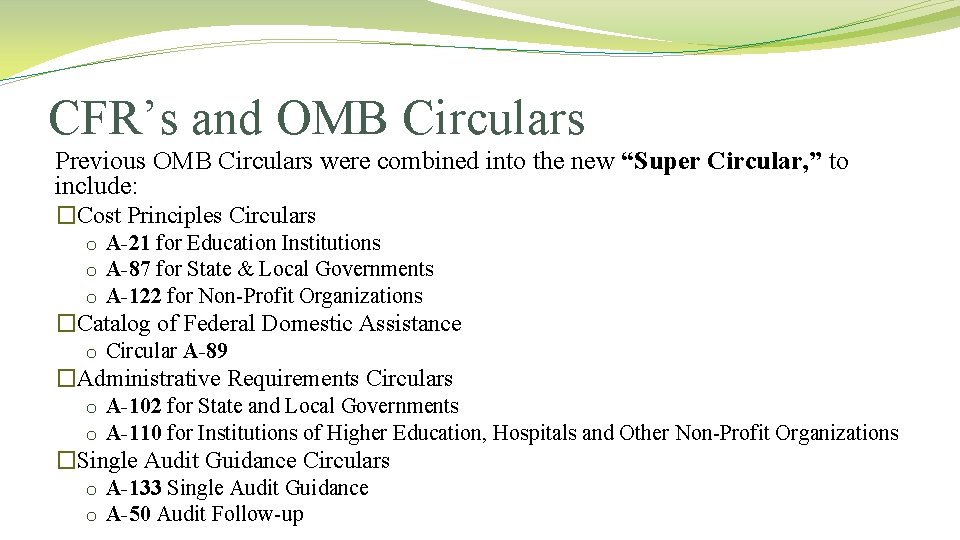
CFR’s and OMB Circulars Previous OMB Circulars were combined into the new “Super Circular, ” to include: �Cost Principles Circulars o A-21 for Education Institutions o A-87 for State & Local Governments o A-122 for Non-Profit Organizations �Catalog of Federal Domestic Assistance o Circular A-89 �Administrative Requirements Circulars o A-102 for State and Local Governments o A-110 for Institutions of Higher Education, Hospitals and Other Non-Profit Organizations �Single Audit Guidance Circulars o A-133 Single Audit Guidance o A-50 Audit Follow-up
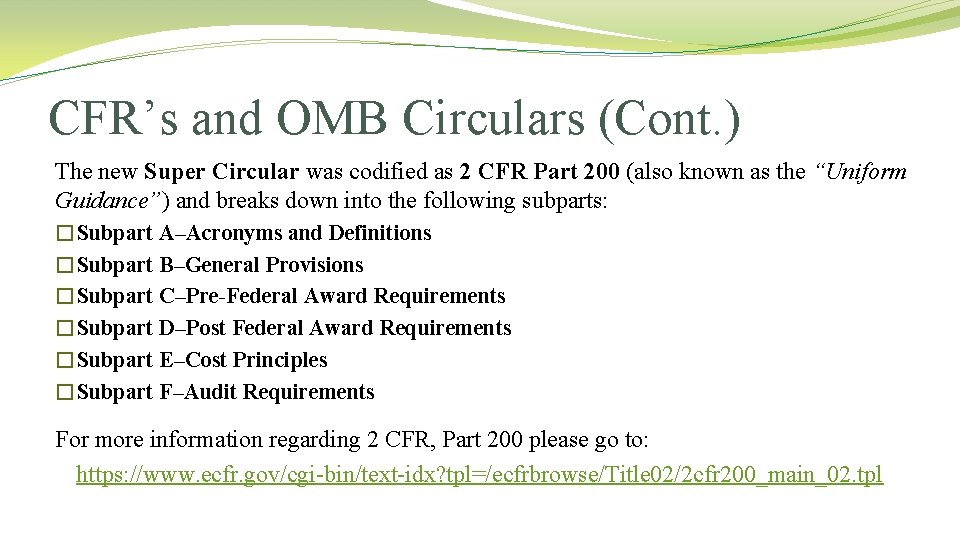
CFR’s and OMB Circulars (Cont. ) The new Super Circular was codified as 2 CFR Part 200 (also known as the “Uniform Guidance”) and breaks down into the following subparts: �Subpart A–Acronyms and Definitions �Subpart B–General Provisions �Subpart C–Pre-Federal Award Requirements �Subpart D–Post Federal Award Requirements �Subpart E–Cost Principles �Subpart F–Audit Requirements For more information regarding 2 CFR, Part 200 please go to: https: //www. ecfr. gov/cgi-bin/text-idx? tpl=/ecfrbrowse/Title 02/2 cfr 200_main_02. tpl
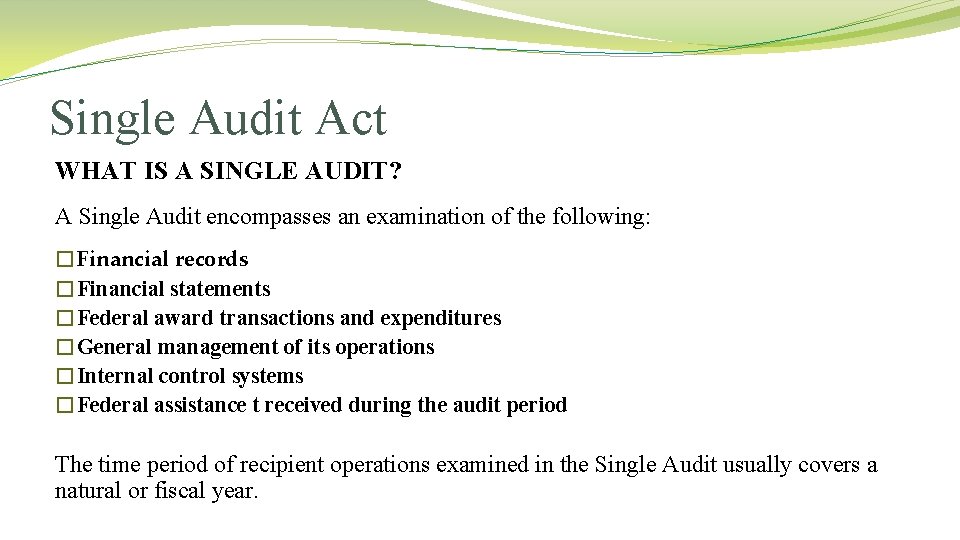
Single Audit Act WHAT IS A SINGLE AUDIT? A Single Audit encompasses an examination of the following: �Financial records �Financial statements �Federal award transactions and expenditures �General management of its operations �Internal control systems �Federal assistance t received during the audit period The time period of recipient operations examined in the Single Audit usually covers a natural or fiscal year.
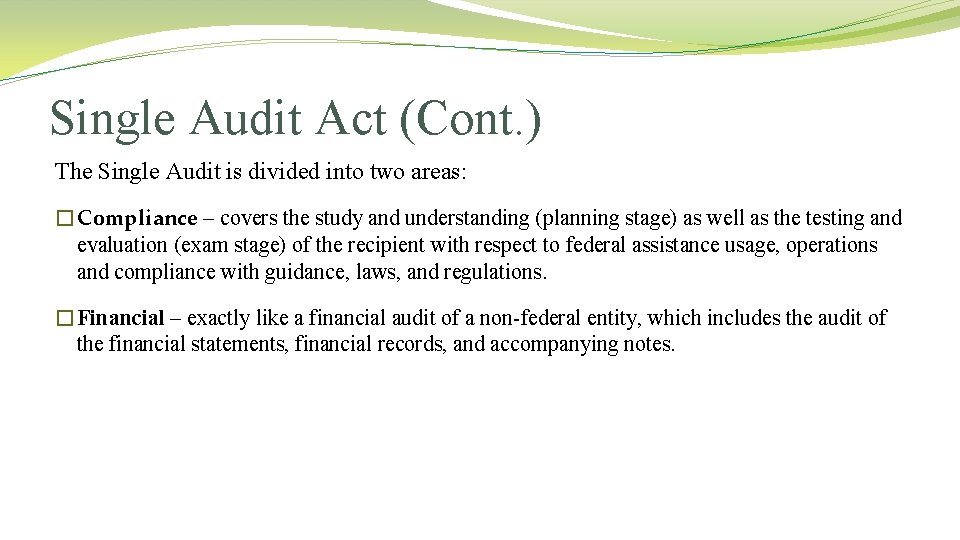
Single Audit Act (Cont. ) The Single Audit is divided into two areas: �Compliance – covers the study and understanding (planning stage) as well as the testing and evaluation (exam stage) of the recipient with respect to federal assistance usage, operations and compliance with guidance, laws, and regulations. �Financial – exactly like a financial audit of a non-federal entity, which includes the audit of the financial statements, financial records, and accompanying notes.
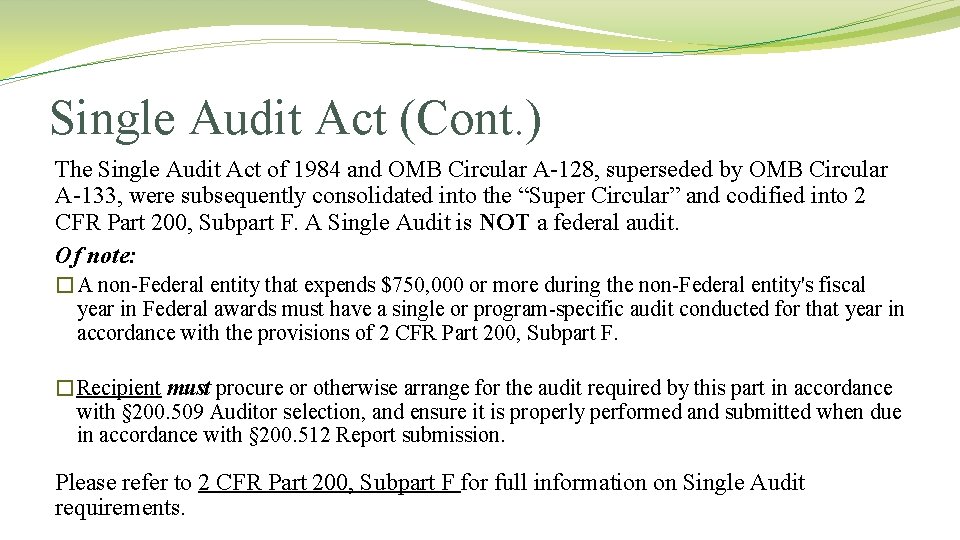
Single Audit Act (Cont. ) The Single Audit Act of 1984 and OMB Circular A-128, superseded by OMB Circular A-133, were subsequently consolidated into the “Super Circular” and codified into 2 CFR Part 200, Subpart F. A Single Audit is NOT a federal audit. Of note: �A non-Federal entity that expends $750, 000 or more during the non-Federal entity's fiscal year in Federal awards must have a single or program-specific audit conducted for that year in accordance with the provisions of 2 CFR Part 200, Subpart F. �Recipient must procure or otherwise arrange for the audit required by this part in accordance with § 200. 509 Auditor selection, and ensure it is properly performed and submitted when due in accordance with § 200. 512 Report submission. Please refer to 2 CFR Part 200, Subpart F for full information on Single Audit requirements.
Questions?
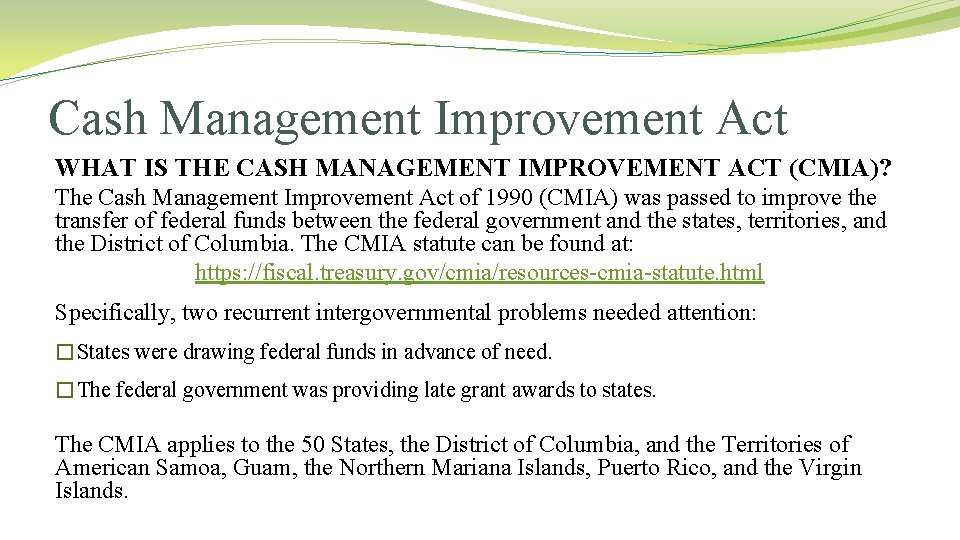
Cash Management Improvement Act WHAT IS THE CASH MANAGEMENT IMPROVEMENT ACT (CMIA)? The Cash Management Improvement Act of 1990 (CMIA) was passed to improve the transfer of federal funds between the federal government and the states, territories, and the District of Columbia. The CMIA statute can be found at: https: //fiscal. treasury. gov/cmia/resources-cmia-statute. html Specifically, two recurrent intergovernmental problems needed attention: �States were drawing federal funds in advance of need. �The federal government was providing late grant awards to states. The CMIA applies to the 50 States, the District of Columbia, and the Territories of American Samoa, Guam, the Northern Mariana Islands, Puerto Rico, and the Virgin Islands.
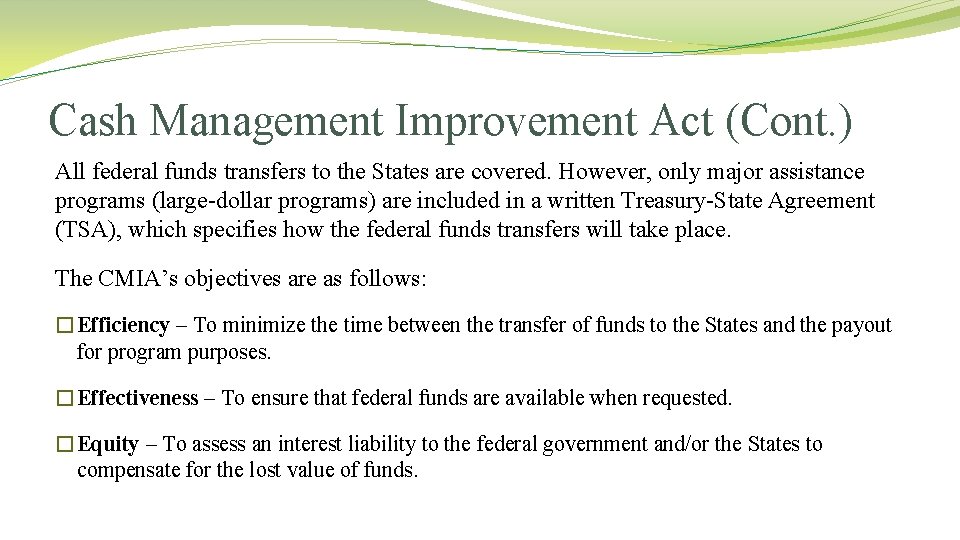
Cash Management Improvement Act (Cont. ) All federal funds transfers to the States are covered. However, only major assistance programs (large-dollar programs) are included in a written Treasury-State Agreement (TSA), which specifies how the federal funds transfers will take place. The CMIA’s objectives are as follows: �Efficiency – To minimize the time between the transfer of funds to the States and the payout for program purposes. �Effectiveness – To ensure that federal funds are available when requested. �Equity – To assess an interest liability to the federal government and/or the States to compensate for the lost value of funds.
Questions?
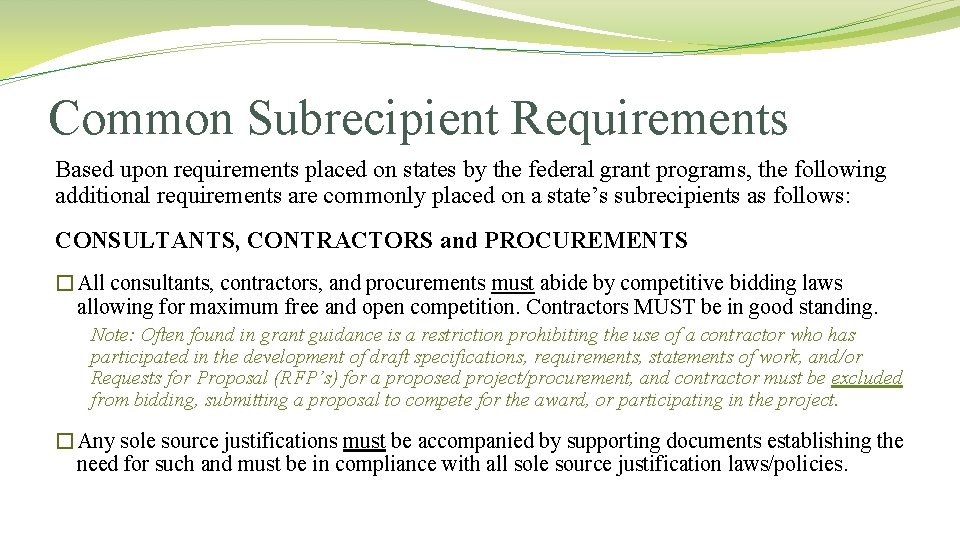
Common Subrecipient Requirements Based upon requirements placed on states by the federal grant programs, the following additional requirements are commonly placed on a state’s subrecipients as follows: CONSULTANTS, CONTRACTORS and PROCUREMENTS �All consultants, contractors, and procurements must abide by competitive bidding laws allowing for maximum free and open competition. Contractors MUST be in good standing. Note: Often found in grant guidance is a restriction prohibiting the use of a contractor who has participated in the development of draft specifications, requirements, statements of work, and/or Requests for Proposal (RFP’s) for a proposed project/procurement, and contractor must be excluded from bidding, submitting a proposal to compete for the award, or participating in the project. �Any sole source justifications must be accompanied by supporting documents establishing the need for such and must be in compliance with all sole source justification laws/policies.
Common Subrecipient Requirements (Cont. ) CONTRACTUAL SERVICES – Subrecipients purchasing contractual services should ensure that: �Records of the procurement process are maintained �All contracted services are supported by a valid, signed contract and time is limited to the period of performance of the grant �Records of contractor time and activity are maintained in the project file �Contractor is not receiving payment from more than one source for the same work performed LOBBYING – All subrecipients are required to comply with the provisions of Common Rule on Restrictions pertaining to Lobbying.
Common Subrecipient Requirements (Cont. ) INVENTORY – Inventory of any equipment purchased by subrecipient must be performed at intervals as prescribed by the state or subrecipients policies, whichever are more stringent. CONFLICTS OF INTEREST – Individuals involved in the procurement of goods and services must be free of any conflicts of interest. SEGREGATION OF DUTIES – One person cannot serve in multiple positions of authority relative to grant program or financial activities to mitigate the risk of errors and fraud. QUARTERLY and FINANCIAL/PROGRAM REPORTS – All reports must be timely and the final Financial Report cannot include unpaid obligations.
Common Subrecipient Requirements (Cont. ) RECORDS RETENTION – Financial records, supporting documents, statistical records, and all other non-Federal entity records pertinent to a Federal award must be retained for a period of three (3) years from the date of submission of the final expenditure report or, for Federal awards that are renewed quarterly or annually, from the date of the submission of the quarterly or annual financial report, respectively, as reported to the Federal awarding agency or pass-through entity in the case of a subrecipient. Federal awarding agencies and pass-through entities must not impose any other record retention requirements upon non-Federal entities. AUDIT – In an award of funds to a subrecipient, States will reserve the right to access any pertinent books, documents, papers, or other records as are pertinent and deemed necessary for the purposes of auditing the expenditure of award funds.
Common Subrecipient Requirements (Cont. ) AUDIT (Cont. ) – Examples of financial audit findings include: �Recipient has no written procedures �Lack of documentation �Inadequate/untimely submission of reports �Inventory management deficiencies �Inadequate monitoring �Period of Performance expiration without approval of extension �Inadequate time and effort records
Questions?
Webinar Series Overview In this three part webinar series, we have addressed the following: PART 1 of 3 �Defining a Project �Conducting the Project Needs Assessment �Researching Funding �Application Planning and Research PART 2 of 3 �Applying for a Grant �Receiving a Grant Award �Executing the Project �Closeout of Grant
Webinar Series Overview (Cont. ) PART 3 of 3 �Grant Management Staff �Segregation of Duty �Required Registrations (DUNS and SAM) �CFR’s and OMB’s �Single Audit Act �Cash Management Improvement Act (CMIA) �Common Subrecipient Requirements
In Closing… All webinars (audio and slide decks) and supporting documents can be found at: www. allthingsfirstnet. com/grants If you have any questions, or need further information, please send email to: info@allthingsfirstnet. com
Thank you!