
Understanding the Folding of a Small RNA Hairpin
- Slides: 1
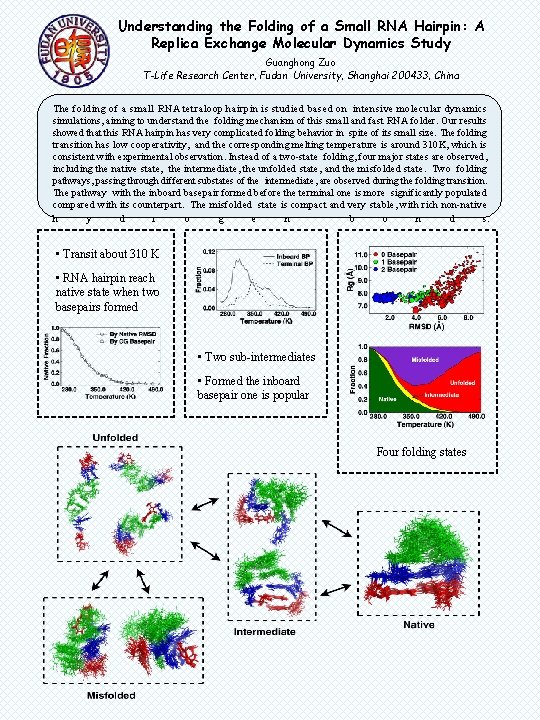
Understanding the Folding of a Small RNA Hairpin: A Replica Exchange Molecular Dynamics Study Guanghong Zuo T-Life Research Center, Fudan University, Shanghai 200433, China The folding of a small RNA tetraloop hairpin is studied based on intensive molecular dynamics simulations, aiming to understand the folding mechanism of this small and fast RNA folder. Our results showed that this RNA hairpin has very complicated folding behavior in spite of its small size. The folding transition has low cooperativity, and the corresponding melting temperature is around 310 K, which is consistent with experimental observation. Instead of a two-state folding, four major states are observed, including the native state, the intermediate, the unfolded state, and the misfolded state. Two folding pathways, passing through different substates of the intermediate, are observed during the folding transition. The pathway with the inboard basepair formed before the terminal one is more significantly populated compared with its counterpart. The misfolded state is compact and very stable, with rich non-native h y d r o g e n b o n d s. • Transit about 310 K • RNA hairpin reach native state when two basepairs formed • Two sub-intermediates • Formed the inboard basepair one is popular Four folding states