
Understanding the Fitness Components A Tutorial By Amy
Understanding the Fitness Components A Tutorial By Amy Merritt Click on the right pink button to go to the next page Click on the left pink button to go back to the previous page
Cardio-respiratory Endurance Defined as…the bodies ability to be able to exchange oxygen and carbon dioxide between the atmosphere and the cells of body during exercise. This allows a person to be able to continuously move over a period of time. NEXT

Click on the pictures you think are CARDIORESPIRATORY activities or exercises. INCORRECT! In. Correct You constantly move when jogging or walking There is not enough constant movement in Golf In. Correct There is too much standing around in Softball / Baseball There is too much resting between each lift CORRECT! You constantly move when playing basketball
Muscular Endurance Defined as…the ability to continue a physical performance over a period of time The physical performance could either be a muscle resistance (free weights, exercise machine, dumbbells) or callisthenic-type exercise The resistance or exercise must be light enough in weight to allow for many repetitions (more than 12) to be completed NEXT

Muscular Strength Defined as…the amount of muscular force that can be exerted against an object The object could be any type of resistance equipment (examples: free weights, exercise machines, dumbbells, your own body weight, etc. ) The resistance or exercise must be heavy enough in weight to only allow for a few number of repetitions (less than 8) to be completed NEXT

Compare & Contrast Muscular Endurance vs. Muscular Strength Directions: Read each statement, typing your answer in the box, and decide whether it is a characteristic or activity of Muscular Endurance (ME), Muscular Strength (MS), or (BOTH). Then, click on the button to check your answers. Use of free weights _____ Push ups ______ Lift less than 8 repetitions _____ Dumbbells _____ Lift a light amount of weight_____ Jumping Jacks_____ Lift a really heavy box _____ Squats _______ Use of exercise machines _____ Sit ups _______ Lift more than 10 repetitions _____ Lift a heavy amount of weight _____ Check Answers
Flexibility Defined as…the range of motion around a joint. The greater the range in the joint, the easier it is for you to move and be active. It also helps in decreasing the chance of injury with increased flexibility Being flexible allows for easier daily movement (bending, twisting, striding, etc. ), as well as improved movement while exercising or during sports (throwing, flexing, extending, etc. ) NEXT
Flexibility There are two main types of ways to stretch to prepare for various types of activities as well as increase a persons flexibility 1. Static stretching - stretching a muscle to its farthest point and then maintaining or holding that position for 10 seconds; best to use after working out 2. Static stretch examples 3. 2. Dynamic stretching – involves moving parts of your body, gradually increasing reach, speed of movement, or both; best type of stretching prior to activities or exercising – Dynamic stretch examples NEXT
Flexibility Directions: Read each statement, typing in ‘T’ for TRUE and ‘F’ for FALSE statements in each box. Then, click on the button to check your answers. The best time to static stretch is before you workout. _____ Being more flexible will help decrease your chances of getting injured. _____ Each static stretch should be held for a minimum of 30 seconds. _____ After working out, static stretching is the best type of stretching. _____ You can improve your flexibility by using stretching exercises. _____ Dynamic stretching should be used during warm up, not static stretching. _____ Static stretches prepare you for activity more than dynamic stretching. _____ Stretching helps reduce soreness that comes with being active. _____ Check Answers
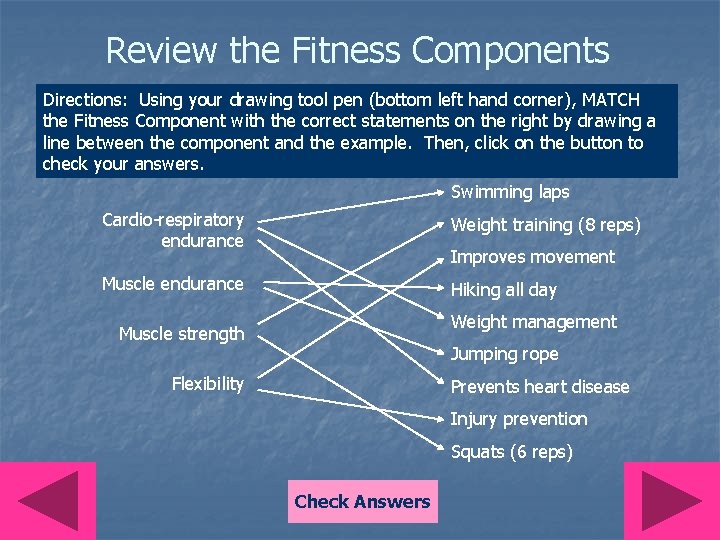
Review the Fitness Components Directions: Using your drawing tool pen (bottom left hand corner), MATCH the Fitness Component with the correct statements on the right by drawing a line between the component and the example. Then, click on the button to check your answers. Swimming laps Cardio-respiratory endurance Weight training (8 reps) Muscle endurance Hiking all day Improves movement Weight management Muscle strength Jumping rope Flexibility Prevents heart disease Injury prevention Squats (6 reps) Check Answers

- Slides: 11