
UNDERSTANDING THE FIM Functional Independent Measure Part 2
- Slides: 30
UNDERSTANDING THE FIM Functional Independent Measure Part 2
Scoring of Activities
Important Reminders l l l You must understand the definition of the each item in order to document accurately Do NOT merge tasks Do not rate simulations, clinical judgments NEVER copy and paste from a previous document because your FIM scores will not be recorded Each FIM item MUST be scored every 24 hours
Important Reminders l l l A number does not support a number! (You must supply detailed documentation within the document. ) Min, Mod or Max does not support a number. (You must document why the need the assistance, i. e. , decreased balance, decreased strength) “More than reasonable time” to complete a task independently is defined as 3 times the norm and would be scored as modified independence (6).
Important Reminders l l If in a hurry & don’t have time to allow the patient to do a task & therapist/nurse does it for the pt, this is max assist. Consider: How much assist did the pt require in this point in time? Who performed the task? Do not modify the assist in order to factor in how busy you are. If you do perform the task for a patient due to your time constraints, document the assistance and the reason (i. e. time constraints) this level was needed to perform the task.
Important Reminders l Plan the care you provide by allowing adequate time for the patient to perform the task versus performing the task for the patient. This is rehab, doing the task for the patient should be a rare occurrence.
Eating - Definition l l l The ability to use suitable utensils to bring the food to the mouth. The ability to chew & swallow the food (once the meal is presented in the customary manner on a table or tray). The ability to use a cup or glass to bring to the mouth, and the liquids are swallowed. (The patient performs this activity safely. )
Eating - Considerations l l Placing a tray/table next to the patient is NOT assist If food consistency is the only modification this is not considered assistance and is rated a 6 If food consistency is modified and assist is needed, highest possible score is a 5 If the patient is using a PEG, G, or NG tube and eating, both must be scored.
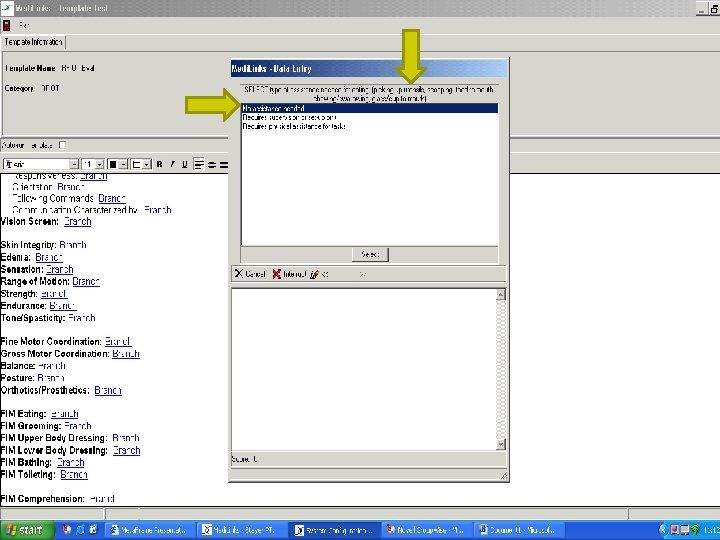
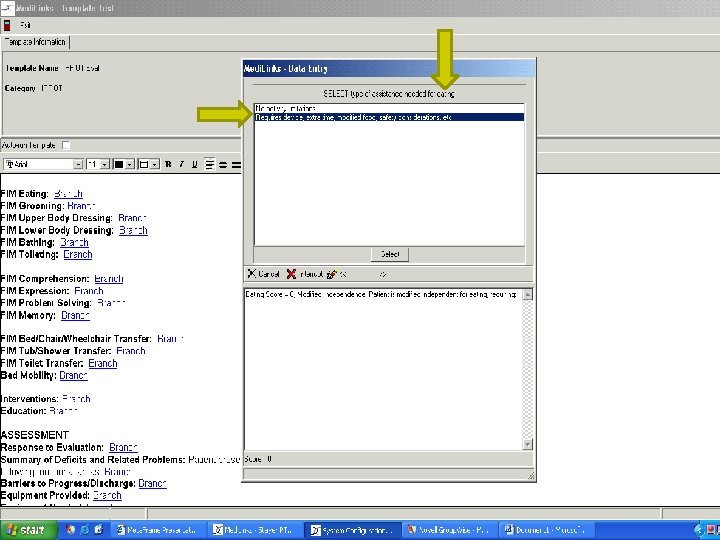
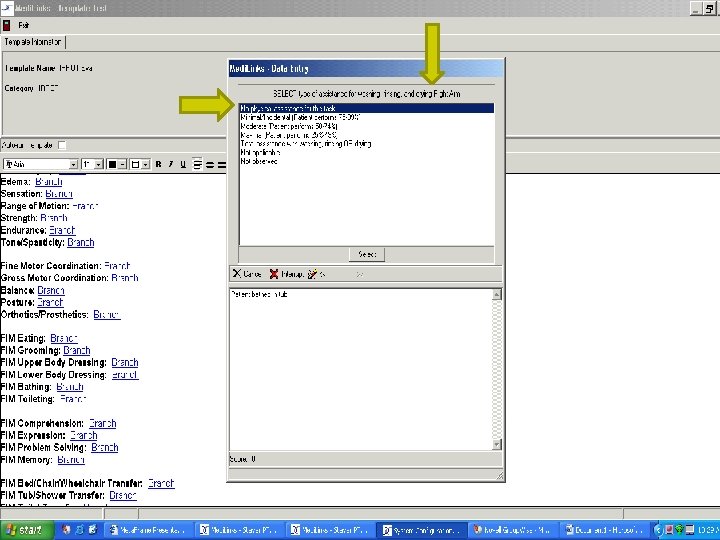
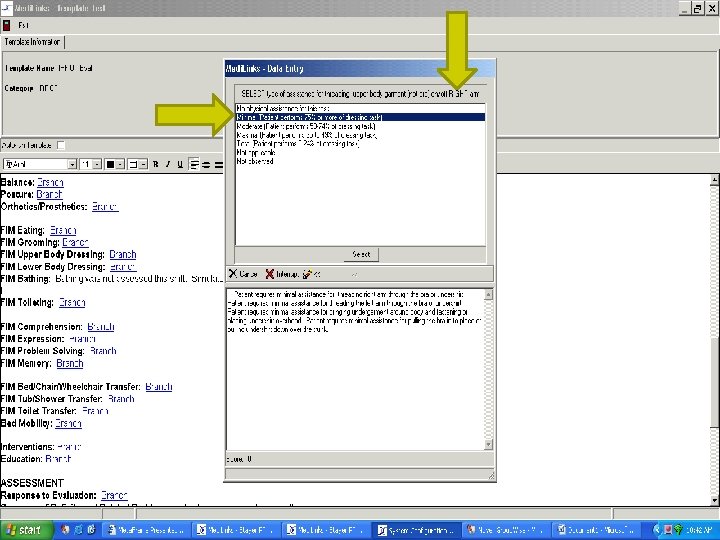
Eating consistency modified – How to score in Medilinks FIM l l l Choose “no assistance needed” if patient does not require any form of cuing or assistance Choose “requires device, extra time, modified food, safety considerations, etc. Dentures are an assistive device Select requirements from list in medilinks branch This will provide a score of 6 (as noted in next 2 slides)
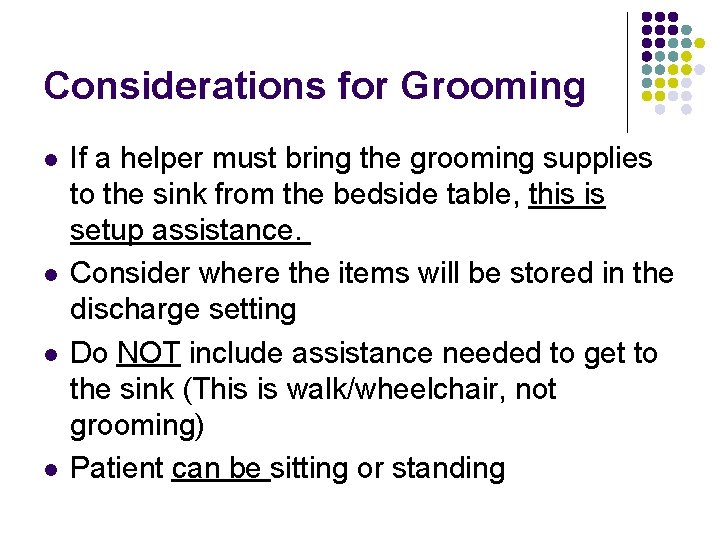
Grooming - Definition l Includes oral care, hair grooming (combing & brushing), washing, rinsing, and drying the hands & face, & either shaving or applying make-up. If the patient neither shaves nor applies make-up, grooming includes only the first four tasks. The patient performs this activity safely. This item INCLUDES obtaining the articles necessary for grooming.
Considerations for Grooming l l If a helper must bring the grooming supplies to the sink from the bedside table, this is setup assistance. Consider where the items will be stored in the discharge setting Do NOT include assistance needed to get to the sink (This is walk/wheelchair, not grooming) Patient can be sitting or standing
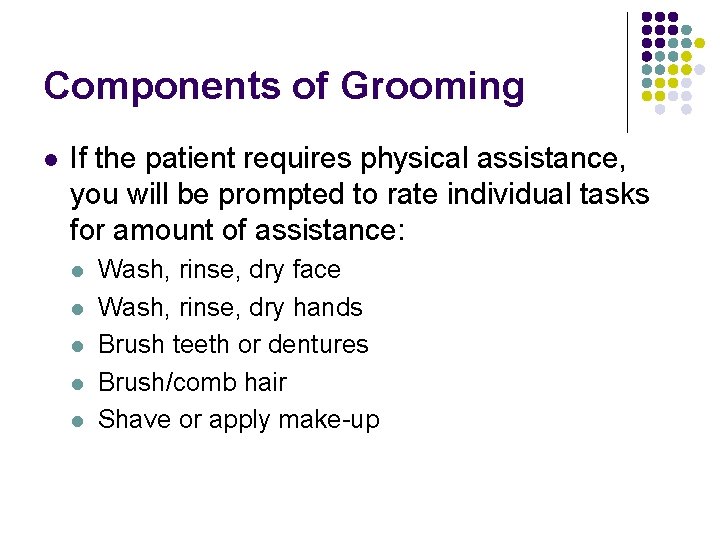
Components of Grooming l If the patient requires physical assistance, you will be prompted to rate individual tasks for amount of assistance: l l l Wash, rinse, dry face Wash, rinse, dry hands Brush teeth or dentures Brush/comb hair Shave or apply make-up
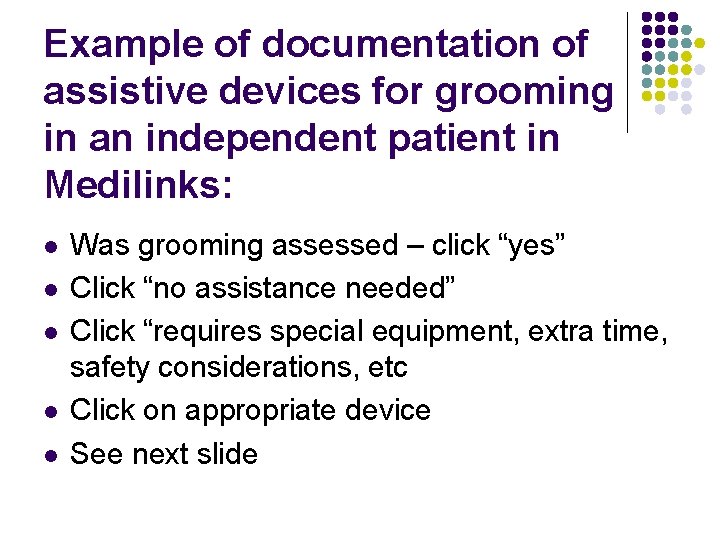
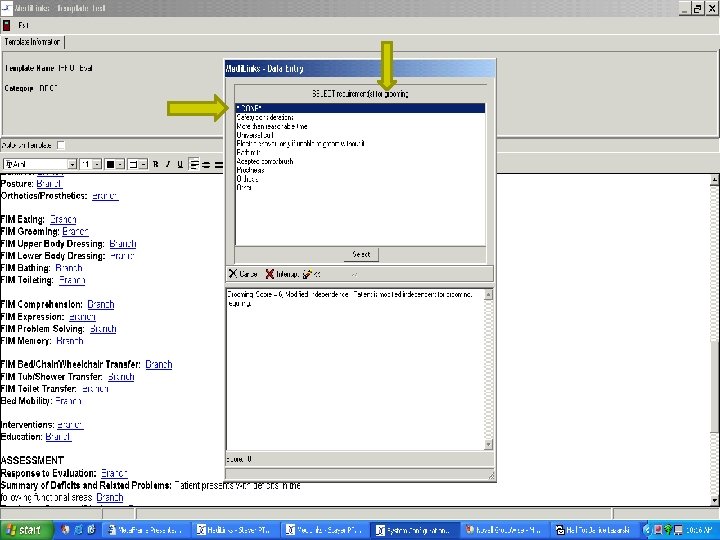
Example of documentation of assistive devices for grooming in an independent patient in Medilinks: l l l Was grooming assessed – click “yes” Click “no assistance needed” Click “requires special equipment, extra time, safety considerations, etc Click on appropriate device See next slide
Bathing - Definition l Includes washing, rinsing & drying the body from the neck down (excluding the neck & back) in either a tub, shower, or sponge/bed bath. The patient performs the activity safely.
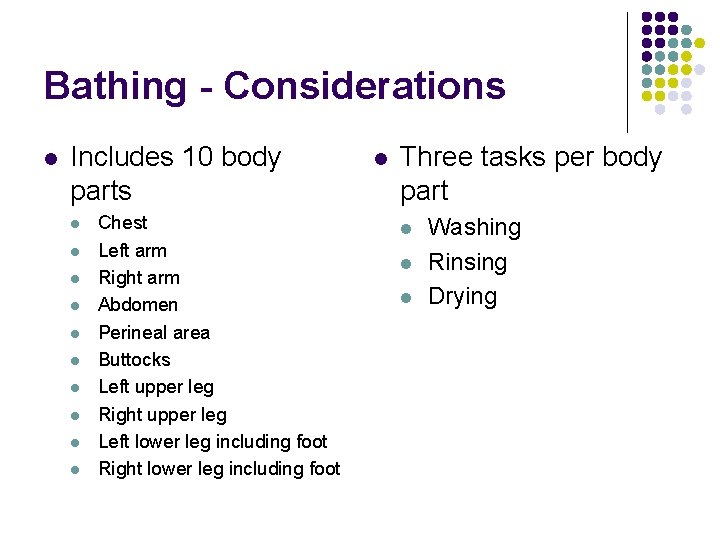
Bathing - Considerations l Includes 10 body parts l l l l l Chest Left arm Right arm Abdomen Perineal area Buttocks Left upper leg Right upper leg Left lower leg including foot Right lower leg including foot l Three tasks per body part l l l Washing Rinsing Drying
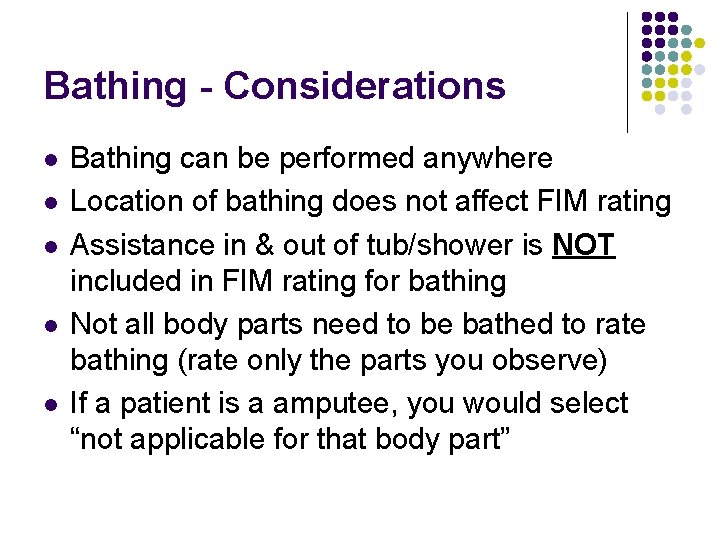
Bathing - Considerations l l l Bathing can be performed anywhere Location of bathing does not affect FIM rating Assistance in & out of tub/shower is NOT included in FIM rating for bathing Not all body parts need to be bathed to rate bathing (rate only the parts you observe) If a patient is a amputee, you would select “not applicable for that body part”
Upper Body (UB) Dressing – Definition: l Includes dressing and undressing above the waist, as well as applying & removing a prosthesis or orthosis when applicable. The patient performs the activity safely.
Lower Body (LB) Dressing Definition l Includes dressing and undressing from the waist down, as well as applying & removing a prosthesis or orthosis when applicable. The patient performs the activity safely.
UB and LB Dressing Considerations l l l Clothing must include clothing appropriate to be worn in public Includes patient obtaining clothes from customary places (drawers or closet) Putting on and taking off scrubs may be appropriate for purposes of assessment HOWEVER, BEST PRACTICE is utilizing clothing that will be worn in the discharge setting
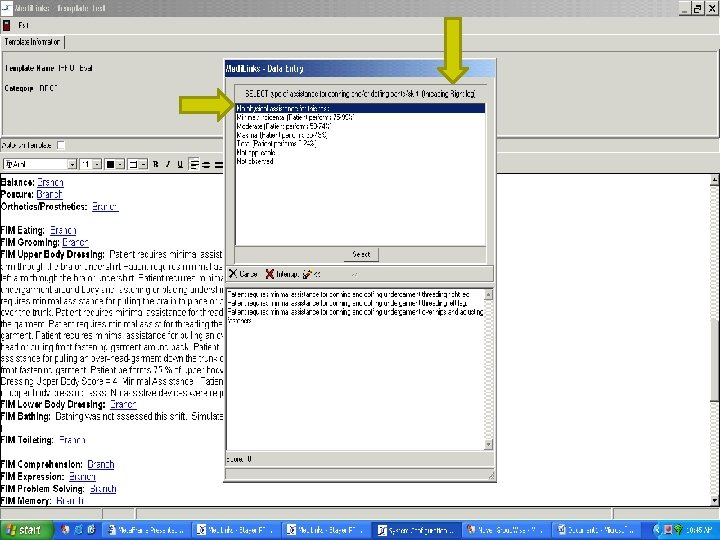
UB and LB Dressing Considerations l l l You will be prompted to rate assistance for each step for each article of clothing Diapers, pull-ups and Depends are assistive devices NOT underwear. Do not score the on and off of these, as this will be scored in bowel and bladder management. Do not score TEDS as socks (they are orthotics).
UB & LB - Considerations l l Incidental help – Assistance with buttons, zippers or snaps only. BE CAREFUL – this means help with one zipper or one set of snaps or buttons. If help is needed on every article of clothing, it is NOT incidental help.
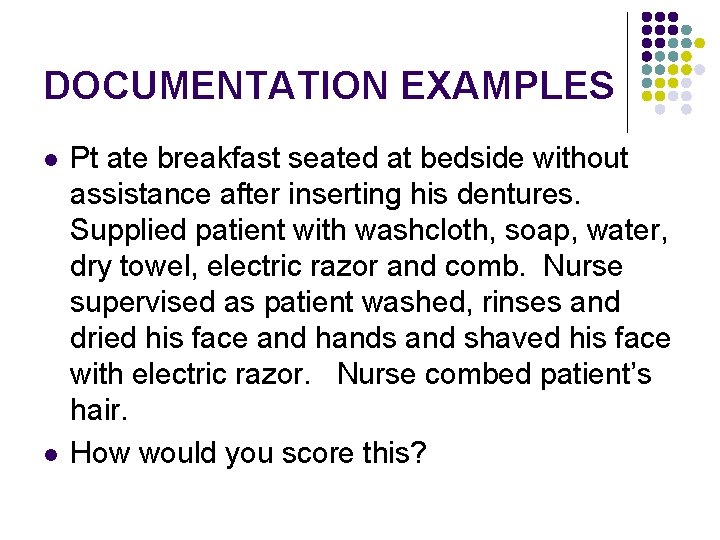
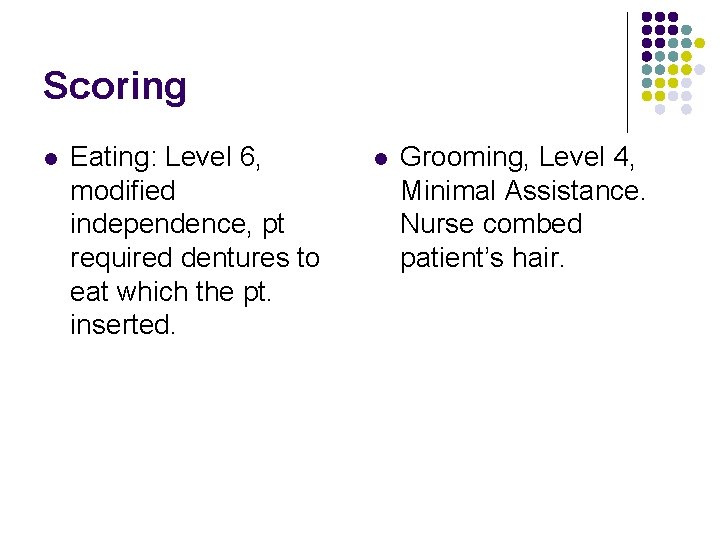
DOCUMENTATION EXAMPLES l l Pt ate breakfast seated at bedside without assistance after inserting his dentures. Supplied patient with washcloth, soap, water, dry towel, electric razor and comb. Nurse supervised as patient washed, rinses and dried his face and hands and shaved his face with electric razor. Nurse combed patient’s hair. How would you score this?
Scoring l Eating: Level 6, modified independence, pt required dentures to eat which the pt. inserted. l Grooming, Level 4, Minimal Assistance. Nurse combed patient’s hair.
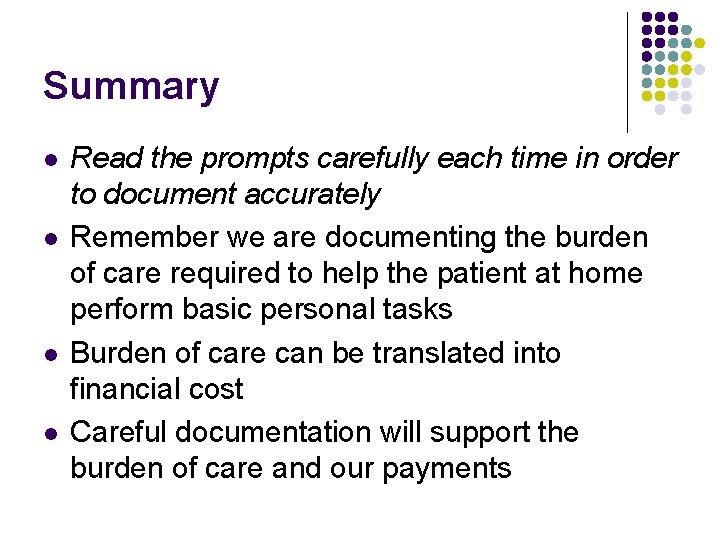
Summary l l Read the prompts carefully each time in order to document accurately Remember we are documenting the burden of care required to help the patient at home perform basic personal tasks Burden of care can be translated into financial cost Careful documentation will support the burden of care and our payments