
Understanding the Effects of Light Pollution on Wildlife

- Slides: 27
Understanding the Effects of Light Pollution on Wildlife Johnny Noles, Biologist Chesapeake Bay mysids@aol. com
INTRODUCTION This presentation was created to provide International Dark Skies Association (IDA) members and concerned citizens a general information resource for discussion of light pollution problems with emphasis on the effects on wildlife. Feel free to use the whole or parts of the presentation for educational outreach. Beginning with the contents on the following slide, The presentation begins with a pictorial introduction highlighting outdoor lighting and the basic effects of outdoor lighting on wildlife. It further goes on to compare light pollution with chemical pollution. It emphasizes the shortcomings of government regulations governing pollution. It provides an example of how environmental agencies are even responsible for the introduction of light pollution through public environmental regulatory programs. In the absence of light pollution regulations, it identifies public interest actions that have been initiated in the interest of wildlife conservation. The presentation concludes with general recommendations for environmental agencies.
CONTENTS I. Introduction Pictorial Identification of Problem Wildlife and Habitat Impact Issues II. Understanding Light Pollution Definition of Pollution Observed Effects of Pollution Comparing Light Pollution with Chemical Pollution Light Pollution Regulation III. Examples of How Environmental Agencies are Impacting the Environment with Light Pollution IV. Public Action Precedents in Wildlife Conservation and Light Pollution V. Recommendations for Public Agencies
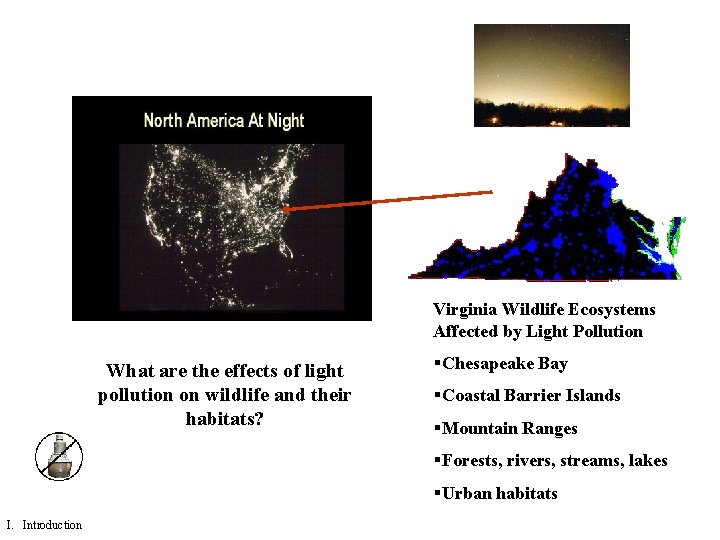
Virginia Wildlife Ecosystems Affected by Light Pollution What are the effects of light pollution on wildlife and their habitats? §Chesapeake Bay §Coastal Barrier Islands §Mountain Ranges §Forests, rivers, streams, lakes §Urban habitats I. Introduction
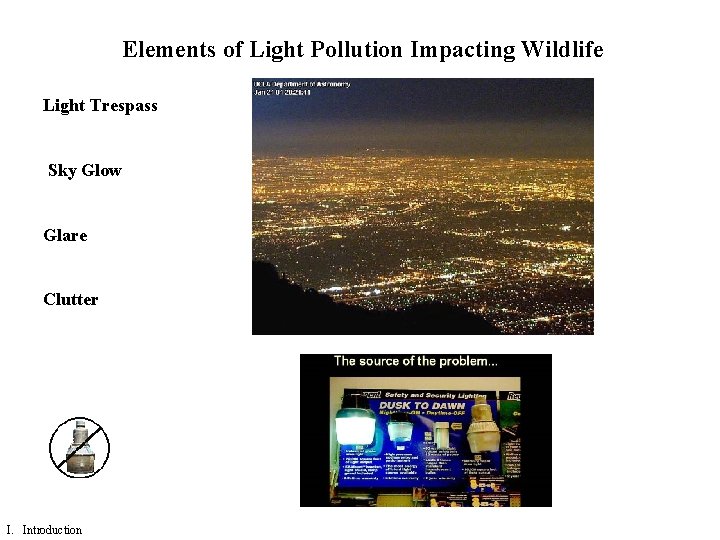
Elements of Light Pollution Impacting Wildlife Light Trespass Sky Glow Glare Clutter I. Introduction
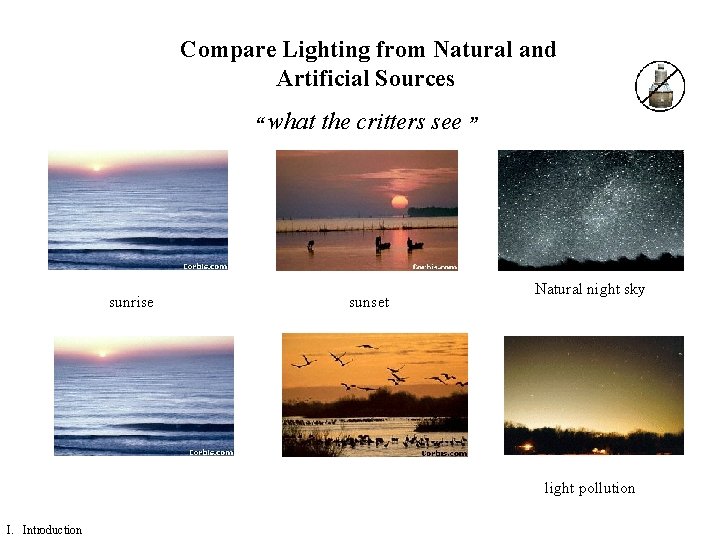
Compare Lighting from Natural and Artificial Sources “ what sunrise the critters see ” sunset Natural night sky light pollution I. Introduction
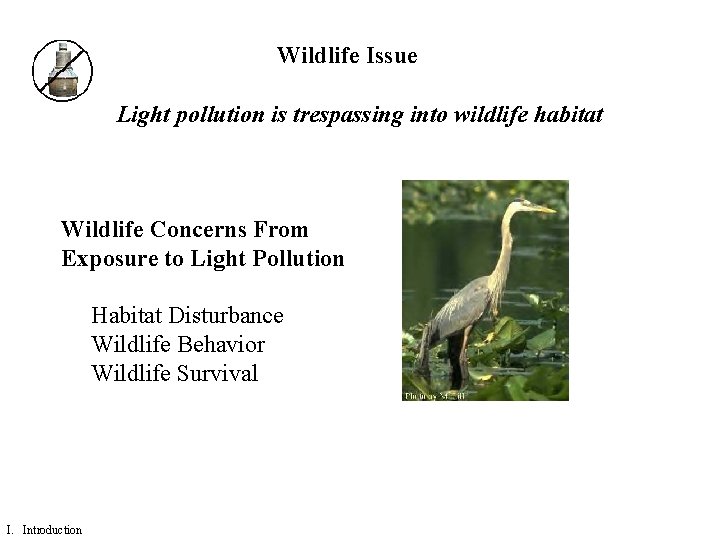
Wildlife Issue Light pollution is trespassing into wildlife habitat Wildlife Concerns From Exposure to Light Pollution Habitat Disturbance Wildlife Behavior Wildlife Survival I. Introduction
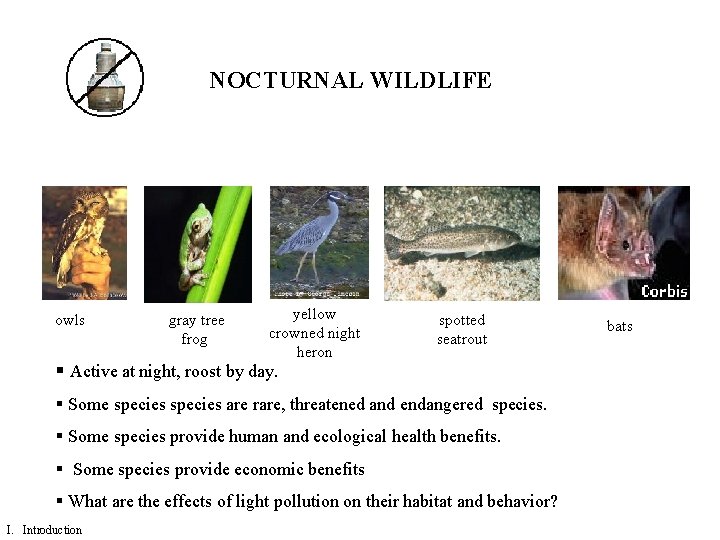
NOCTURNAL WILDLIFE owls gray tree frog yellow crowned night heron spotted seatrout § Active at night, roost by day. § Some species are rare, threatened and endangered species. § Some species provide human and ecological health benefits. § Some species provide economic benefits § What are the effects of light pollution on their habitat and behavior? I. Introduction bats
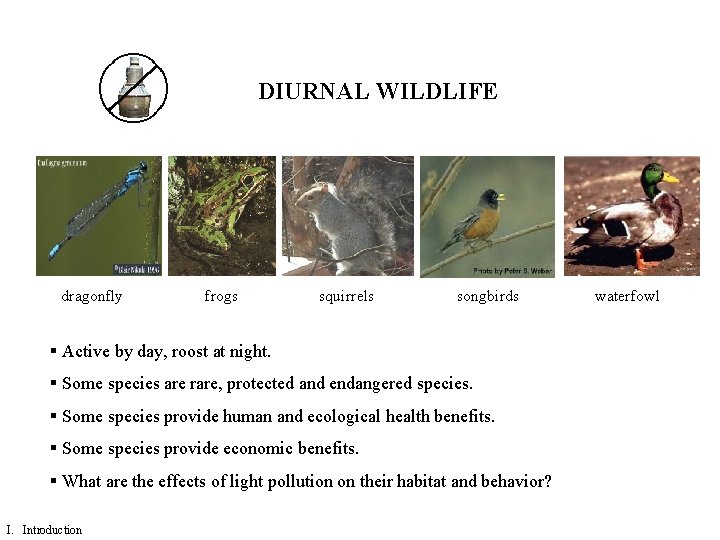
DIURNAL WILDLIFE dragonfly frogs squirrels songbirds § Active by day, roost at night. § Some species are rare, protected and endangered species. § Some species provide human and ecological health benefits. § Some species provide economic benefits. § What are the effects of light pollution on their habitat and behavior? I. Introduction waterfowl
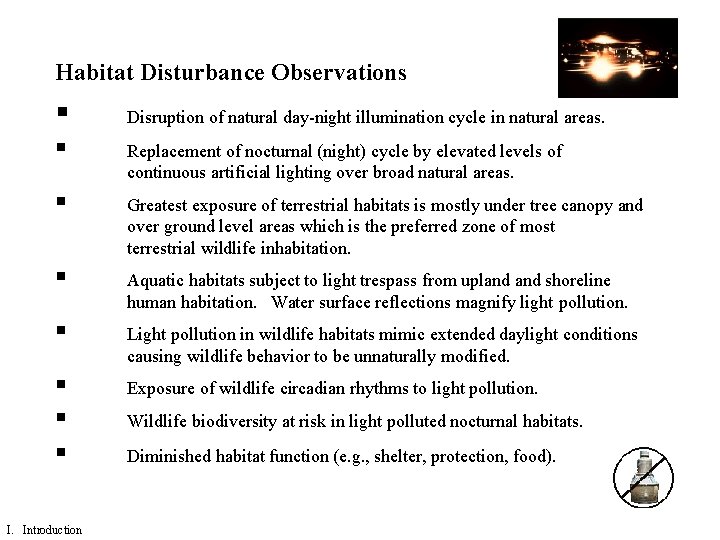
Habitat Disturbance Observations § § § § I. Introduction Disruption of natural day-night illumination cycle in natural areas. Replacement of nocturnal (night) cycle by elevated levels of continuous artificial lighting over broad natural areas. Greatest exposure of terrestrial habitats is mostly under tree canopy and over ground level areas which is the preferred zone of most terrestrial wildlife inhabitation. Aquatic habitats subject to light trespass from upland shoreline human habitation. Water surface reflections magnify light pollution. Light pollution in wildlife habitats mimic extended daylight conditions causing wildlife behavior to be unnaturally modified. Exposure of wildlife circadian rhythms to light pollution. Wildlife biodiversity at risk in light polluted nocturnal habitats. Diminished habitat function (e. g. , shelter, protection, food).
Understanding Light Pollution II. § Does it fit the definition of a pollutant? § What are the common effects of pollutants? § What similarities do chemical and light pollutants have in common? Understanding Light Pollution
DICTIONARY DEFINITION OF “POLLUTANT” § Pollute - to make unfit for or harmful to living things. § Pollutant - something that pollutes; a waste material that contaminates air, soil, or water. § Pollution - Contamination of air, soil, or water by the discharge of harmful substances. Forms of pollutants and examples Gas – carbon monoxide Liquid - oil Solid - asbestos Light – streetlights Noise – loud machinery II. Understanding Light Pollution
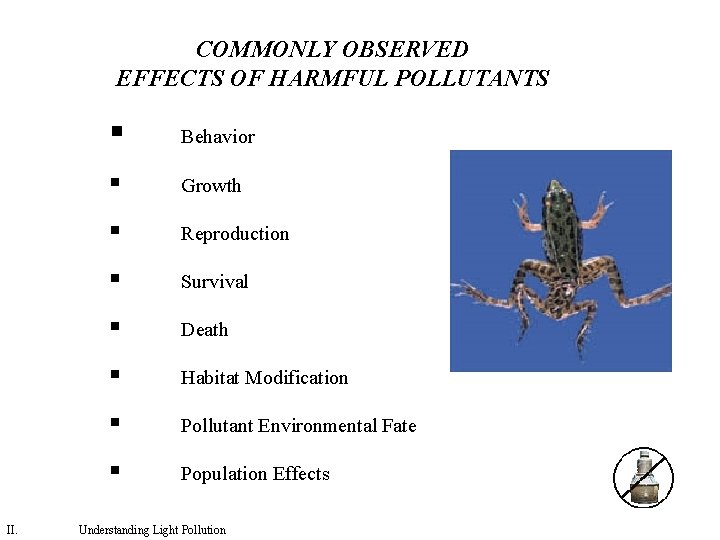
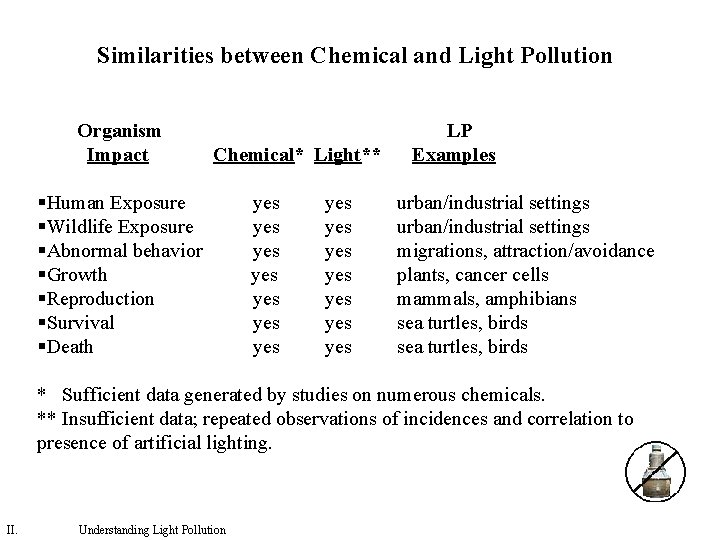
COMMONLY OBSERVED EFFECTS OF HARMFUL POLLUTANTS II. § Behavior § Growth § Reproduction § Survival § Death § Habitat Modification § Pollutant Environmental Fate § Population Effects Understanding Light Pollution
Similarities between Chemical and Light Pollution Organism Impact Chemical* Light** §Human Exposure §Wildlife Exposure §Abnormal behavior §Growth §Reproduction §Survival §Death yes yes yes yes LP Examples urban/industrial settings migrations, attraction/avoidance plants, cancer cells mammals, amphibians sea turtles, birds * Sufficient data generated by studies on numerous chemicals. ** Insufficient data; repeated observations of incidences and correlation to presence of artificial lighting. II. Understanding Light Pollution
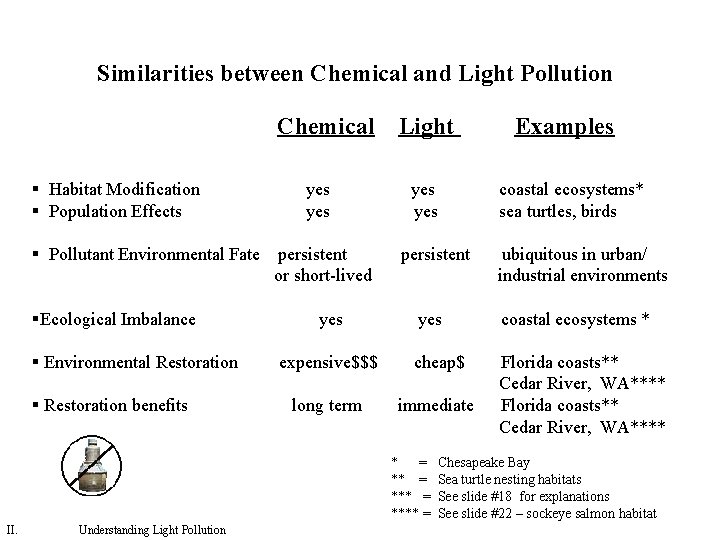
Similarities between Chemical and Light Pollution Chemical § Habitat Modification § Population Effects yes § Pollutant Environmental Fate persistent or short-lived §Ecological Imbalance § Environmental Restoration § Restoration benefits yes Light yes persistent Understanding Light Pollution coastal ecosystems* sea turtles, birds ubiquitous in urban/ industrial environments yes coastal ecosystems * expensive$$$ cheap$ long term immediate Florida coasts** Cedar River, WA**** * = **** = II. Examples Chesapeake Bay Sea turtle nesting habitats See slide #18 for explanations See slide #22 – sockeye salmon habitat
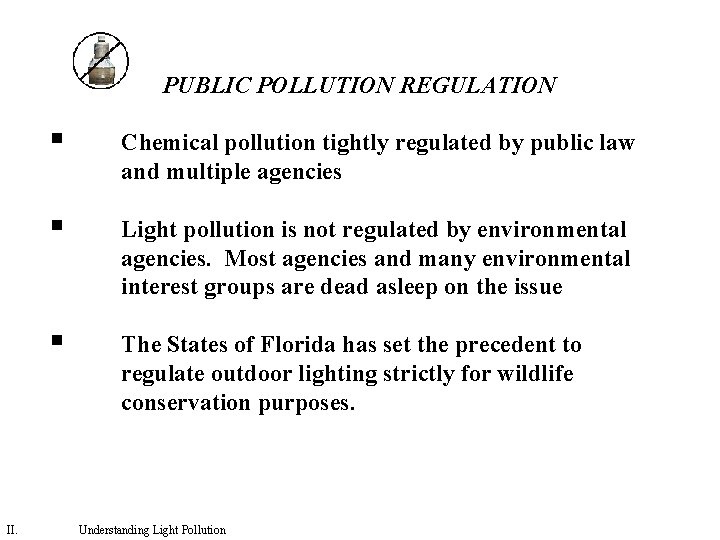
PUBLIC POLLUTION REGULATION II. § Chemical pollution tightly regulated by public law and multiple agencies § Light pollution is not regulated by environmental agencies. Most agencies and many environmental interest groups are dead asleep on the issue § The States of Florida has set the precedent to regulate outdoor lighting strictly for wildlife conservation purposes. Understanding Light Pollution
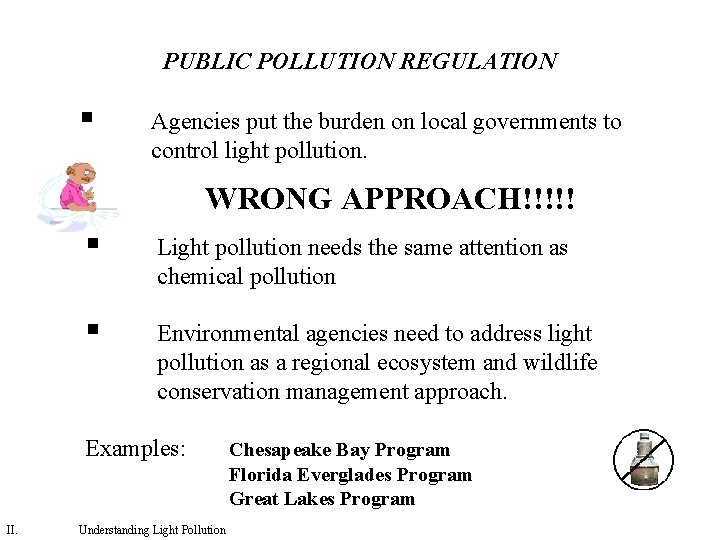
PUBLIC POLLUTION REGULATION § Agencies put the burden on local governments to control light pollution. WRONG APPROACH!!!!! § Light pollution needs the same attention as chemical pollution § Environmental agencies need to address light pollution as a regional ecosystem and wildlife conservation management approach. Examples: II. Understanding Light Pollution Chesapeake Bay Program Florida Everglades Program Great Lakes Program
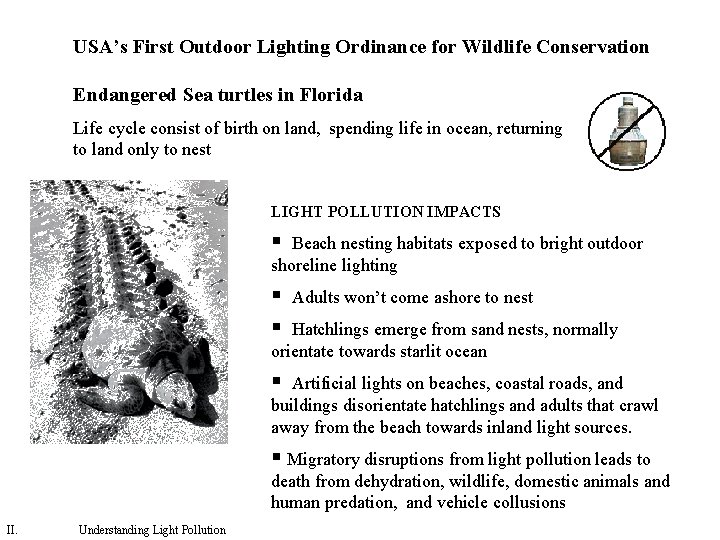
USA’s First Outdoor Lighting Ordinance for Wildlife Conservation Endangered Sea turtles in Florida Life cycle consist of birth on land, spending life in ocean, returning to land only to nest LIGHT POLLUTION IMPACTS § Beach nesting habitats exposed to bright outdoor shoreline lighting § § Adults won’t come ashore to nest Hatchlings emerge from sand nests, normally orientate towards starlit ocean § Artificial lights on beaches, coastal roads, and buildings disorientate hatchlings and adults that crawl away from the beach towards inland light sources. § Migratory disruptions from light pollution leads to death from dehydration, wildlife, domestic animals and human predation, and vehicle collusions II. Understanding Light Pollution
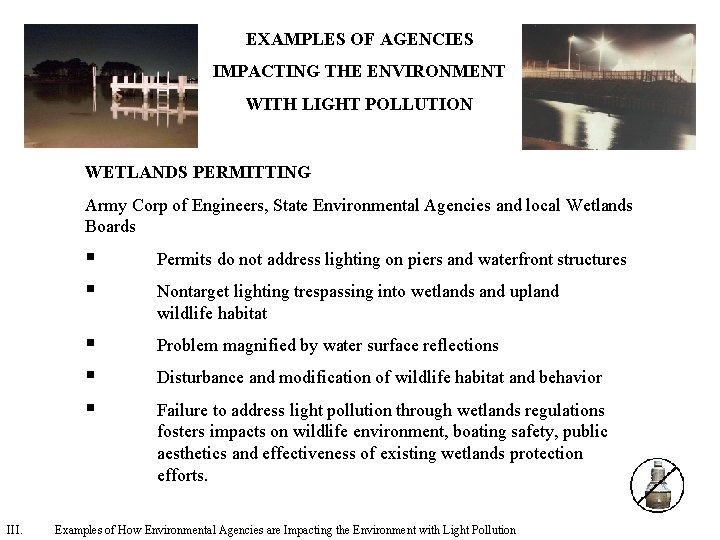
EXAMPLES OF AGENCIES IMPACTING THE ENVIRONMENT WITH LIGHT POLLUTION WETLANDS PERMITTING Army Corp of Engineers, State Environmental Agencies and local Wetlands Boards III. § § Permits do not address lighting on piers and waterfront structures § § § Problem magnified by water surface reflections Nontarget lighting trespassing into wetlands and upland wildlife habitat Disturbance and modification of wildlife habitat and behavior Failure to address light pollution through wetlands regulations fosters impacts on wildlife environment, boating safety, public aesthetics and effectiveness of existing wetlands protection efforts. Examples of How Environmental Agencies are Impacting the Environment with Light Pollution
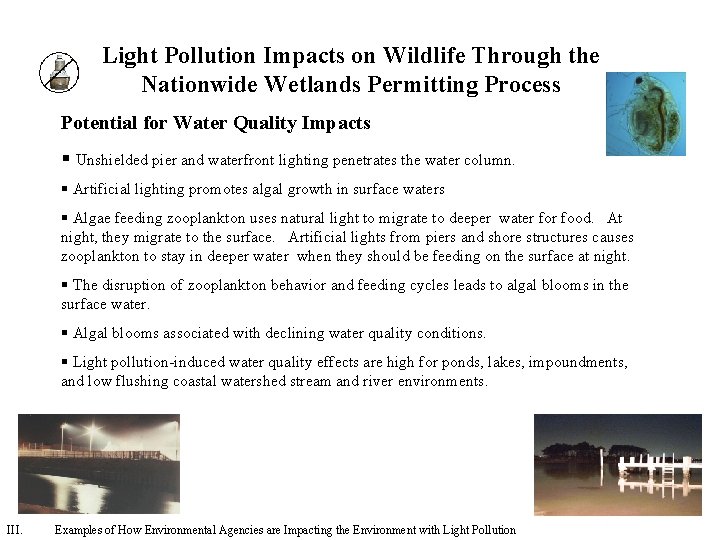
Light Pollution Impacts on Wildlife Through the Nationwide Wetlands Permitting Process Potential for Water Quality Impacts § Unshielded pier and waterfront lighting penetrates the water column. § Artificial lighting promotes algal growth in surface waters § Algae feeding zooplankton uses natural light to migrate to deeper water food. At night, they migrate to the surface. Artificial lights from piers and shore structures causes zooplankton to stay in deeper water when they should be feeding on the surface at night. § The disruption of zooplankton behavior and feeding cycles leads to algal blooms in the surface water. § Algal blooms associated with declining water quality conditions. § Light pollution-induced water quality effects are high for ponds, lakes, impoundments, and low flushing coastal watershed stream and river environments. III. Examples of How Environmental Agencies are Impacting the Environment with Light Pollution
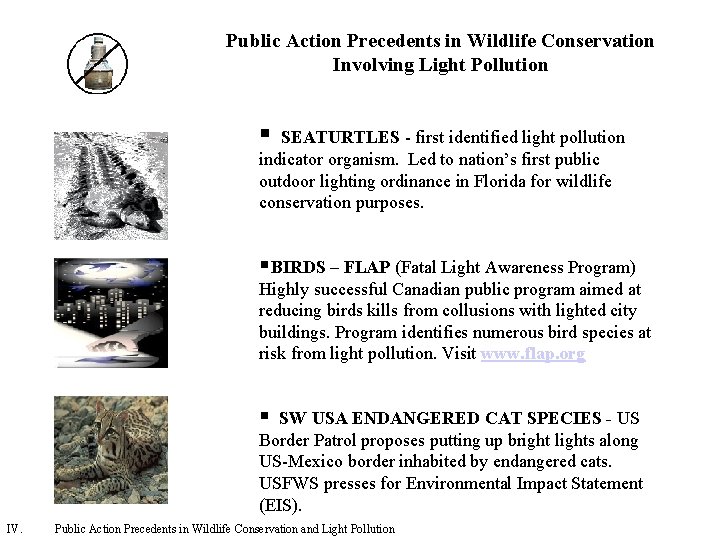
Public Action Precedents in Wildlife Conservation Involving Light Pollution § SEATURTLES - first identified light pollution indicator organism. Led to nation’s first public outdoor lighting ordinance in Florida for wildlife conservation purposes. §BIRDS – FLAP (Fatal Light Awareness Program) Highly successful Canadian public program aimed at reducing birds kills from collusions with lighted city buildings. Program identifies numerous bird species at risk from light pollution. Visit www. flap. org § SW USA ENDANGERED CAT SPECIES - US Border Patrol proposes putting up bright lights along US-Mexico border inhabited by endangered cats. USFWS presses for Environmental Impact Statement (EIS). IV. Public Action Precedents in Wildlife Conservation and Light Pollution
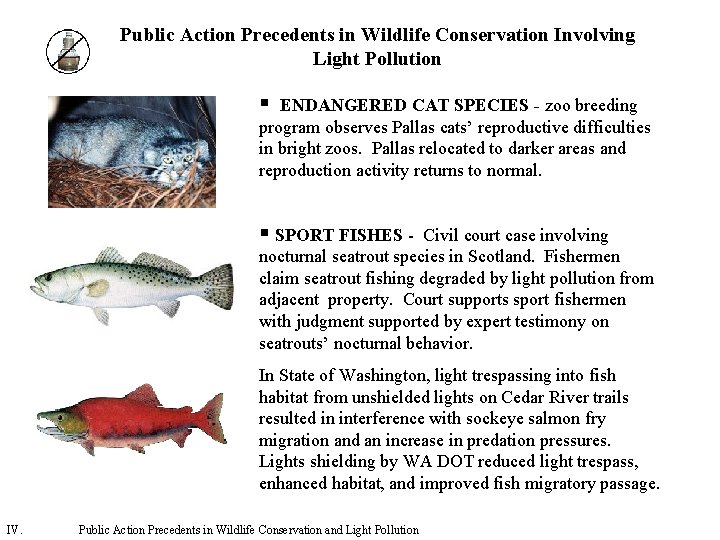
Public Action Precedents in Wildlife Conservation Involving Light Pollution § ENDANGERED CAT SPECIES - zoo breeding program observes Pallas cats’ reproductive difficulties in bright zoos. Pallas relocated to darker areas and reproduction activity returns to normal. § SPORT FISHES - Civil court case involving nocturnal seatrout species in Scotland. Fishermen claim seatrout fishing degraded by light pollution from adjacent property. Court supports sport fishermen with judgment supported by expert testimony on seatrouts’ nocturnal behavior. In State of Washington, light trespassing into fish habitat from unshielded lights on Cedar River trails resulted in interference with sockeye salmon fry migration and an increase in predation pressures. Lights shielding by WA DOT reduced light trespass, enhanced habitat, and improved fish migratory passage. IV. Public Action Precedents in Wildlife Conservation and Light Pollution
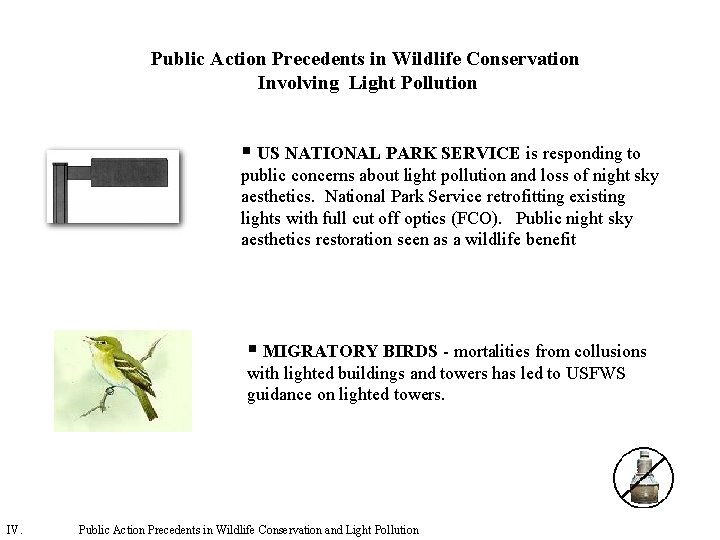
Public Action Precedents in Wildlife Conservation Involving Light Pollution § US NATIONAL PARK SERVICE is responding to public concerns about light pollution and loss of night sky aesthetics. National Park Service retrofitting existing lights with full cut off optics (FCO). Public night sky aesthetics restoration seen as a wildlife benefit § MIGRATORY BIRDS - mortalities from collusions with lighted buildings and towers has led to USFWS guidance on lighted towers. IV. Public Action Precedents in Wildlife Conservation and Light Pollution
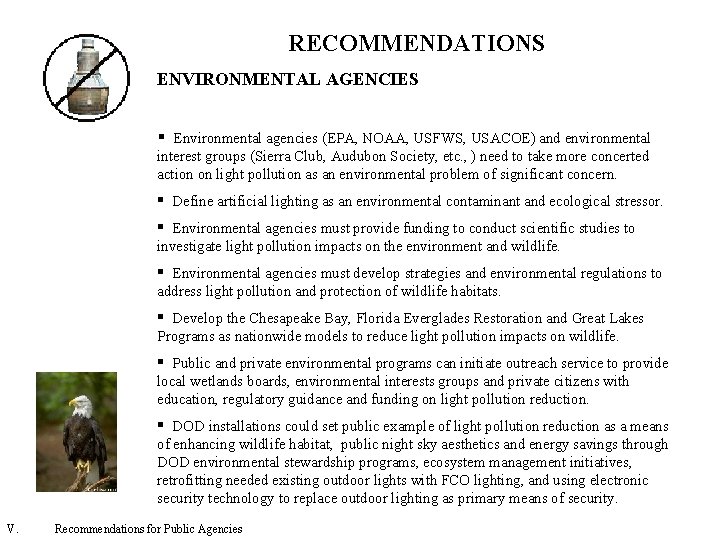
RECOMMENDATIONS ENVIRONMENTAL AGENCIES § Environmental agencies (EPA, NOAA, USFWS, USACOE) and environmental interest groups (Sierra Club, Audubon Society, etc. , ) need to take more concerted action on light pollution as an environmental problem of significant concern. § Define artificial lighting as an environmental contaminant and ecological stressor. § Environmental agencies must provide funding to conduct scientific studies to investigate light pollution impacts on the environment and wildlife. § Environmental agencies must develop strategies and environmental regulations to address light pollution and protection of wildlife habitats. § Develop the Chesapeake Bay, Florida Everglades Restoration and Great Lakes Programs as nationwide models to reduce light pollution impacts on wildlife. § Public and private environmental programs can initiate outreach service to provide local wetlands boards, environmental interests groups and private citizens with education, regulatory guidance and funding on light pollution reduction. § DOD installations could set public example of light pollution reduction as a means of enhancing wildlife habitat, public night sky aesthetics and energy savings through DOD environmental stewardship programs, ecosystem management initiatives, retrofitting needed existing outdoor lights with FCO lighting, and using electronic security technology to replace outdoor lighting as primary means of security. V. Recommendations for Public Agencies
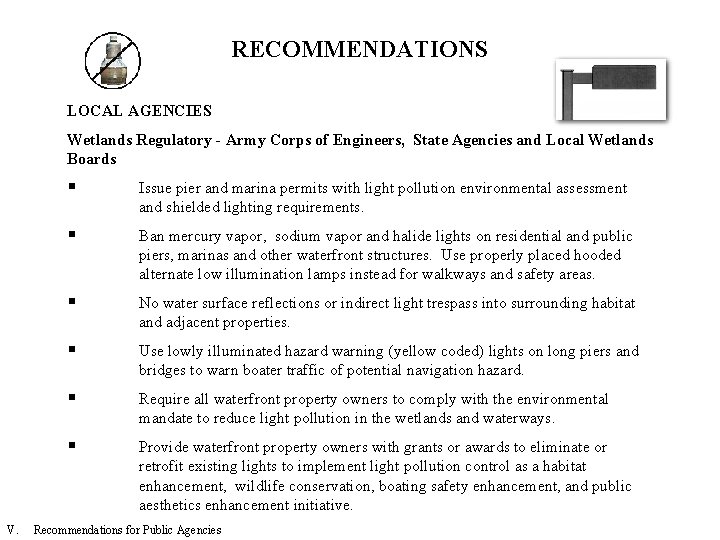
RECOMMENDATIONS LOCAL AGENCIES Wetlands Regulatory - Army Corps of Engineers, State Agencies and Local Wetlands Boards V. § Issue pier and marina permits with light pollution environmental assessment and shielded lighting requirements. § Ban mercury vapor, sodium vapor and halide lights on residential and public piers, marinas and other waterfront structures. Use properly placed hooded alternate low illumination lamps instead for walkways and safety areas. § No water surface reflections or indirect light trespass into surrounding habitat and adjacent properties. § Use lowly illuminated hazard warning (yellow coded) lights on long piers and bridges to warn boater traffic of potential navigation hazard. § Require all waterfront property owners to comply with the environmental mandate to reduce light pollution in the wetlands and waterways. § Provide waterfront property owners with grants or awards to eliminate or retrofit existing lights to implement light pollution control as a habitat enhancement, wildlife conservation, boating safety enhancement, and public aesthetics enhancement initiative. Recommendations for Public Agencies
END of PRESENTATION