
Understanding the Diversity of Moral Beliefs Relativism Absolutism
Understanding the Diversity of Moral Beliefs: Relativism Absolutism Pluralism
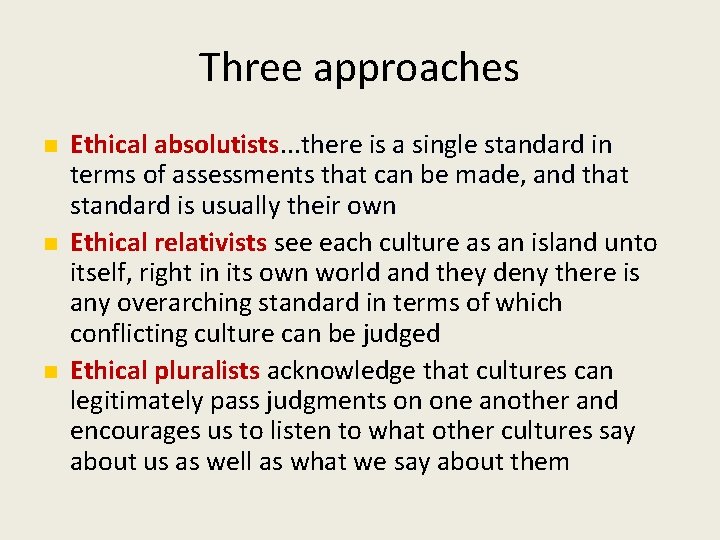
Three approaches Ethical absolutists. . . there is a single standard in terms of assessments that can be made, and that standard is usually their own Ethical relativists see each culture as an island unto itself, right in its own world and they deny there is any overarching standard in terms of which conflicting culture can be judged Ethical pluralists acknowledge that cultures can legitimately pass judgments on one another and encourages us to listen to what other cultures say about us as well as what we say about them
Two forms of ethical relativism: • Cultural ethical relativism • Individual ethical relativism
I know that _______ is wrong. I know that _______ is right.
How / Why do I know these things? Are these absolute truths or do they have some flexibility?
Travel to an Exotic Land You are the guest of a tribe that practices a ritual of killing a child to kill each year in order to please the gods and assure health and prosperity for the coming year. It is considered a great honor to be chosen to be killed or to do the killing. Since you are an honored guest, you are offered the spear to kill the child. Would it be morally wrong for you to participate?
Moral in USA • Eating Beef • Drinking alcohol, Gambling • Women in school or business • Women wearing shorts, face uncovered Immoral in • India • Middle Eastern Islamic Countries • Afghanistan • Iran, Saudi Arabia, Sudan
Immoral in USA • Killing newborn females • Female genital mutilation • Family kills a female family member who is raped Moral or Acceptable • China, India • Many African nations • Somalia, Sudan (“Honor Killing”)
Two levels of moral conflict Concrete conflicts Clitoridectomies (female circumcision; female genital mutilation) Forced marriage of underage girls What happens when something that is legally and morally permissible in one culture is illegal and immoral in another?
Ethical relativist—Each culture is right unto itself, so such practices would be morally permissible in some countries and morally wrong in the US Ethical absolutists—there is a single moral truth in terms of which all cultures and individuals are to be judged Pluralists try to find some middle ground (in some situations this practice may make sense, less judgmental

These three ethical positions provide a rich context for understanding the variation of all ethical theories Divine command —we ought to do whatever God wills Issue is whose God? and does God speak differently to each of us? or do we interpret the messages differently? Egoism—each person should act selfishly to maximize self interest

Fundamental Intuitions of Ethical Pluralism Principle of understanding Principle of tolerance Principle of standing up against evil Principle of fallibility
How different cultures have different moral codes Different cultures have different moral codes. What is right within one group maybe abhorrent to another Treatment of the dead Polygamy Sharing of wives among Eskimos Infanticide
What is our reaction to such “Strange or different” customs? Label them as backward, uneducated or natives Primitive Heathens Non-Christians Poke fun of them…discriminate or harass Convert them to “our” custom or thought

Cultural Relativism What are some examples of Cultural Relativism? Hasidic Jews in Postville Amish lifestyles Religious traditions—baptisms, communion services Celebrations—Santa Claus, Easter Bunny, Halloween Parties: when, where and how Issues of privacy Housing style Personal hygiene Role of children
Examples where ethical/moral ideas have changed over the years Divorce, Living together, Mixed race marriages, Allowing same sex marriages Gambling, casinos, internet poker Internet dating Women in the workforce, women operating farm equipment, firewomen, truck drivers Spanking/punishment of children Acceptance of cremation for the dead Competition vs cooperation in farming, relying on neighbors help vs outbidding the neighbor Animal welfare, recognizing that animals have certain rights Natural resource protection Taming “mother nature” vs “living with nature”

Cultural Relativism “Different cultures have different moral codes” often is used as a key to understanding morality. Proponents argue that there is not as universal truth in ethics; there are only the various cultural codes and nothing more. The customs of different societies is all that exist. Proponents would argue that customs can not be judged as correct or incorrect. Our own code of ethics has no special status, it is merely one among many
Cultural relativism Challenges our ordinary belief in the objectivity and universality of moral truths. It says in effect that there is no such thing as a universal truth in ethics, there are only cultural codes and nothing more Your own code of ethics offers nothing special, it is merely one among many

Claims of Cultural Relativists 1. 2. 3. 4. 5. 6. Different societies have different moral codes The moral code of a society determines what is right within that society There is no objective standard that can be used to judge one societies code as better than another The moral code of our society offers nothing special There is no universal truth in ethics… It is arrogant to judge the conduct of other societies, we should adopt an attitude of tolerance
The Cultural Differences Argument Is a theory about the nature of morality At the heart of the Cultural Relativism is the form of their argument. They argue from facts about differences between cultural outlooks to making conclusions about the status of morality
For example: Premises: 1. Different cultures have different moral codes 2. Therefore, there are no objective truth in morality. Right and wrong are only matters of opinion, and opinions vary from culture to culture. This is cultural differences argument.
The Unsoundness of the Cultural Differences Argument The trouble is that the conclusion does not follow from the premise—that is even if the premise is true, the conclusion might be false. WHY? The premise concerns what people believe; some believe one way and others believe another but the conclusion concerns what really is the case
An example: Society “A” believes the world is flat and Society “B” believes the world to be round. Just because these two societies disagree, there is objective truth about the shape of the earth. We can verify that members of the flat earth society are simply mistaken, uneducated or failed geography in middle school.
The Consequences of Accepting Cultural Relativism 1. We could no longer say that custom of other societies are morally inferior to others. (This is one of the main points of Cultural Relativism) We would have to stop condemning other societies merely because they are different. Tolerance towards slavery, anti Semitism, hatred towards ethnic groups, or minorities, kiddy porn, sex slave trade---if we took the cultural relativism seriously we would have to regard these behaviors as immune from criticism
If we accept Cultural Relativism 2. We could decide whether actions are right or wrong just by consulting the standards of our society. In Colonial America slavery was OK, women were not allowed to vote or own property, primogeniture was practiced, etc and therefore these things were right. This position requires that we accept moral codes as proper and can not be improved.
If we accept Cultural Relativism 3. The idea of moral progress is called into doubt Progress implies doing things better, but cultural relativism rejects making judgments about past eras. Reform movements such as rights to women and minorities that implies modern society is better is a judgment that is impossible to make.
As a result, most thinkers reject the cultural relativism arguments. 1. It makes sense to condemn some practices wherever they occur 2. It makes sense to acknowledge that our society while imperfect has made moral progress 3. Because Cultural Relativism implies these judgments make no sense, the argument goes, it cannot be right.
There is less disagreement than it seems There are differences across societies but the differences are often over-stated Need to explore not particular practices or values but the belief systems that lie behind the practices. The differences are often in the belief system.
Source of Customs Beliefs—religious beliefs Physical circumstances of the society Just because customs differ, there may be less disagreement on basic values Example: Eskimos infanticide “drastic measures are sometimes needed to ensure the family’s survival” The Eskimos values are not all that different than our own. . It is only that life forces upon them choices that we do not have to make”
What are some other customs that differ from our own? Marriage vows Church attendance Neighboring Role of women Burial and funerals Eating habits Rites of passage of children becoming adults
Universal Values in Societies 1. 2. 3. Value of protecting the young Truth telling Prohibition of murder “There are some moral rules that all societies must have in common, because those rules are necessary for society to exist. ”
What other universal values or moral rules can you think of? Prohibition against incest Personal responsibility The proper role of government is to take care of its citizens Everyone should serve their country Everyone should obey the law
Judging a cultural practice to be undesirable Ex. In 1996 a 17 year old girl from Togo a West African country arrived in the US and asked for asylum to avoid “ excision”, a practice referred to as “female circumcision” or “female genital mutilation”. According to the WHO, the practice is widespread in 26 African countries and 2 million girls are excised each year. Reaction in the New York Times, encouraged the idea that excision was a barbaric practice and should be condemned.
Young girls often look forward to this because it a acceptance into adulthood. It is an accepted practice in many villages. Consequences of excision painful, results in permanent loss of sexual pleasure, hemorrhage, tetanus, septicemia, death, chronic infections, hinder walking, chronic pain Apparent no social benefits, not a matter of religious beliefs
Rationale for the practice Women are incapable of sexual pleasure and less likely to be promiscuous Fewer unwanted pregnancies in unmarried women Women will be more faithful to their husbands Un-excised women are viewed as unclean and immature Arguments for this practice is that it benefits men, women, families and children
Is excision, harmful or helpful? Cultural Relativist would conclude that excision has been practiced for centuries and we should not intervene and change ancient ways.
We may ask whether a practice promotes or hinders the welfare of the people whose lives are affected by it. And as a corollary, Is there an alternative set of social arrangements that would do a better job of promoting their welfare. If so, we may conclude that the existing practice is deficient.
Reluctance to Criticize Many thoughtful people have been reluctant to criticize what many view as a barbaric practice because: 1. Interfering with the social customs of other people. (Europeans and Americans have been criticized for destroying other cultures, Native Americans)
2. Acceptance of strange practices (tolerance) toward others. 3. Reluctance to criticize other societies, do not want to express contempt
Lessons From Cultural Relativism 1. 2. 3. Rests on invalid argument Although it enjoys much appeal Two important lessons 1. Warns us about the dangers of assuming that our preferences are based upon some absolute rational standard. They are not. Many of our practices are merely particular to our society and it is easy to forget this.
Other examples of social conventions that we think of as “right” or “wrong” that are really nothing more than social conventions. Women covering their breasts, separate restrooms for men and women, men opening the door for women, No shoes, no shirt, no service Dear _____ Fathers giving their daughters away in wedding ceremony, wearing a wedding band on the fourth finger of the left hand, swearing, drinking, gambling, etc
2. Keep an open mind— Maybe our feelings about practices, values and beliefs are merely social conventions— example homosexuality. Maybe our feelings are not necessarily perceptions of the truth…they may be nothing more than cultural conditioning
There is a certain appeal to cultural relativism, but there are some major shortcomings to the theory. Many of the practices and attitudes that we think as natural law are really only cultural products. Need to keep this in mind if we are to avoid being arrogant and have open minds

Some attempts to come up with a universal morality: • Four Directives of the Parliament of the World Religions • United Nations Universal Declaration on Human Rights • Nuremberg Code • Geneva Conventions
Declaration of the Parliament of the World’s Religions (1993) Four Irrevocable Directives 1. Commitment to a culture of non-violence and respect for life 2. Commitment to a culture of solidarity and a just economic order 3. Commitment to a culture of tolerance and a life of truthfulness 4. Commitment to a culture of equal rights and partnership between men and women.
- Slides: 45