
Understanding the Constitution The Federal System The Federal

- Slides: 17
Understanding the Constitution
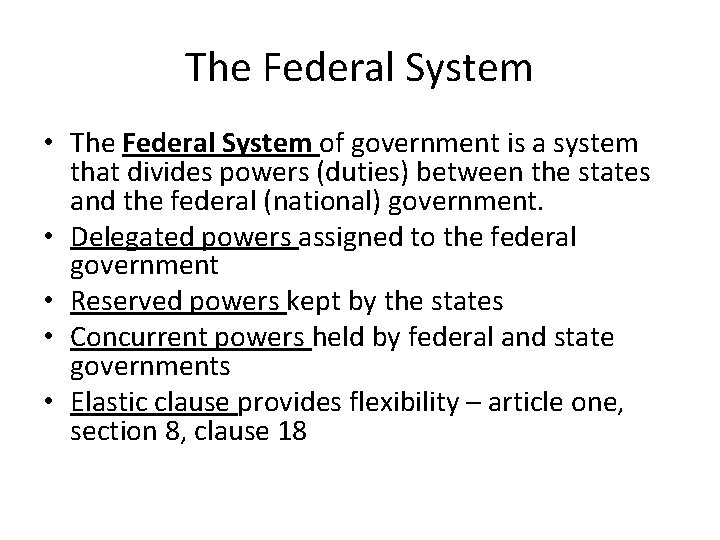
The Federal System • The Federal System of government is a system that divides powers (duties) between the states and the federal (national) government. • Delegated powers assigned to the federal government • Reserved powers kept by the states • Concurrent powers held by federal and state governments • Elastic clause provides flexibility – article one, section 8, clause 18
Branches of Government • Legislative Branch (Congress) – Makes laws – Duties defined in Article I • Executive Branch – Enforces laws passed by Congress – Duties defined in Article II • Judicial Branch – Interprets the Constitution and other laws – Duties defined in Article III
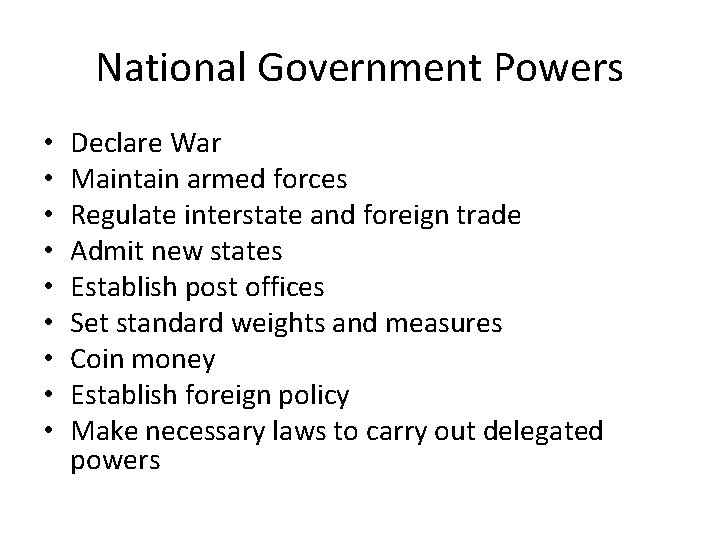
National Government Powers • • • Declare War Maintain armed forces Regulate interstate and foreign trade Admit new states Establish post offices Set standard weights and measures Coin money Establish foreign policy Make necessary laws to carry out delegated powers
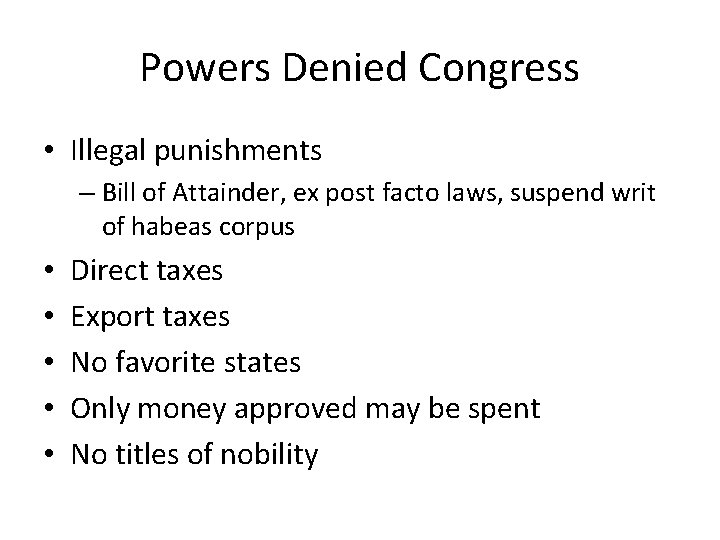
Powers Denied Congress • Illegal punishments – Bill of Attainder, ex post facto laws, suspend writ of habeas corpus • • • Direct taxes Export taxes No favorite states Only money approved may be spent No titles of nobility
State Government Powers • • • Establish and maintain schools Establish local governments Regulate business within the state Make marriage laws Provide for public safety Assume other powers not delegated to the national government nor prohibited to the states
Powers Denied The States • • • Enter into treaties or alliances Coin money Illegal punishments defined to Congress No export or import taxes Wage war Keep troops in time of peace
Shared or Concurrent Powers • • • Maintain law and order Levy taxes Borrow money Charter banks Establish courts Provide for public welfare
Legislative Branch • House of Representatives – 435 members, number doesn’t change – Census every ten years determines number of representative per state – Members must be at least 25 years old – Must live in the state where they were elected – Been a US citizen for seven years before elected – Serve two year terms – All tax bills start in the House of Representatives
Legislative Branch • The Senate – Called the upper house – Two members from each state – Must be 30 years old – Been a US citizen for nine years – Must live in the state they represent – Serve six year terms
Legislative Branch • Members usually belong to a political party – Most members is the majority party – Fewer members in the minority party • Sessions or meetings start in January • Much work in done in committees in both houses of Congress
Executive Branch • Powers listed under Article II • Enforces laws passed by Congress • President and Vice-President – Must be native born American US citizen – Must be 35 – Must be a resident for 14 years – Elected every four years, for two terms • Limited by the 22 nd amendment
Executive Branch • Can be impeached by Congress for serious crimes – Impeached by House, tried in the Senate • President can veto bills passed by Congress – Needs 2/3 vote to override • Can issue executive orders – Have the power of law • Can also pardons for crimes
Other Executive Branch Duties • Commands the armed forces – Can call out troops for emergencies • Only Congress can declare war • Conducting foreign relations and make treaties • Must be approved by Congress • Executive departments to most of the work • Department heads are called cabinet heads • Heads approved by the Senate • Fifteen departments
Judicial Branch • Duties defined in Article III of the Constitution • Can strike down or cancel a law that is unconstitutional – Congress can then revise the law • Constitution created the Supreme Court • Judiciary Act of 1789 created other federal courts • Duties different from state courts
Other Federal Courts • All judges appointed by the president for life • District Courts – 94 district courts – Organized by the types of cases they hear • Court of Appeals – 13 courts of appeals – Hear appeals from District Courts
Supreme Court • Hear appeals from Courts of Appeals – Thousands of cases go to Supreme Court every year – Only hear about 100 • Important constitutional or public policy issues – Court of Appeals decision is final if not heard • Nine justices – Thurgood Marshall was first African American – Sandra Day O-Connor was the first women