
Understanding the Client and General Planning Auditing Concepts
- Slides: 29
Understanding the Client and General Planning Auditing Concepts and Methods Chapter 5 - Transparency 5 - 1
Client Acceptance n Quality control policies and procedures n Communication with predecessor auditor n Engagement letters n Conferences with client personnel Auditing Concepts and Methods Chapter 5 - Transparency 5 - 2
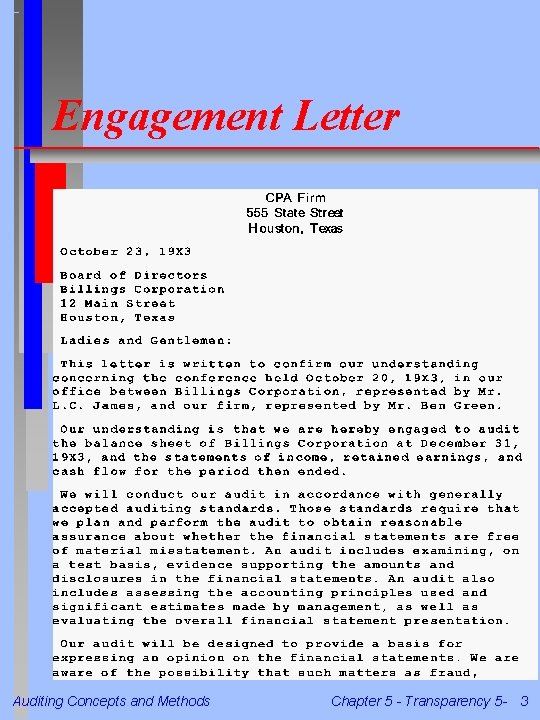
Engagement Letter Auditing Concepts and Methods Chapter 5 - Transparency 5 - 3
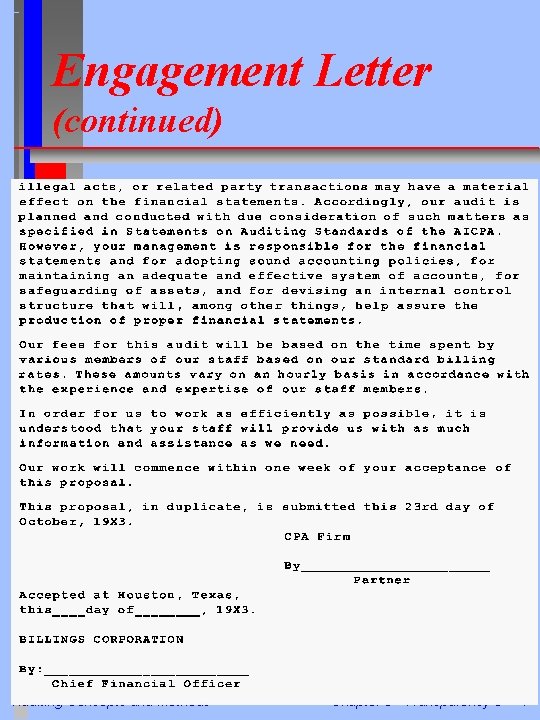
Engagement Letter (continued) Auditing Concepts and Methods Chapter 5 - Transparency 5 - 4
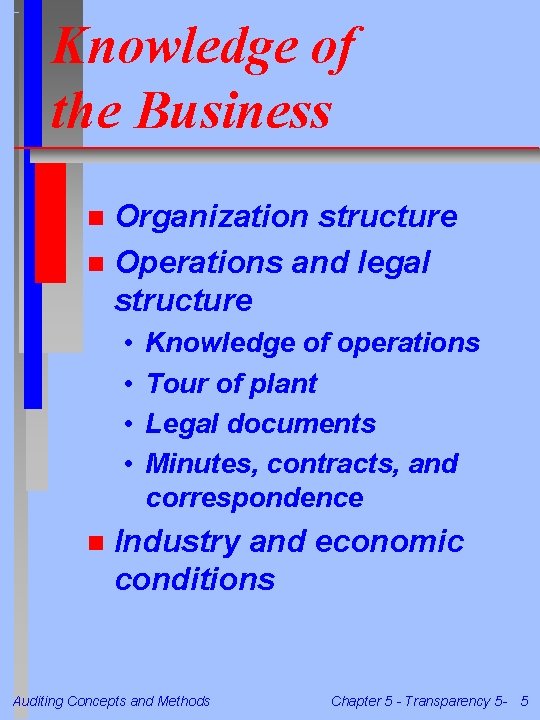
Knowledge of the Business Organization structure n Operations and legal structure n • • n Knowledge of operations Tour of plant Legal documents Minutes, contracts, and correspondence Industry and economic conditions Auditing Concepts and Methods Chapter 5 - Transparency 5 - 5
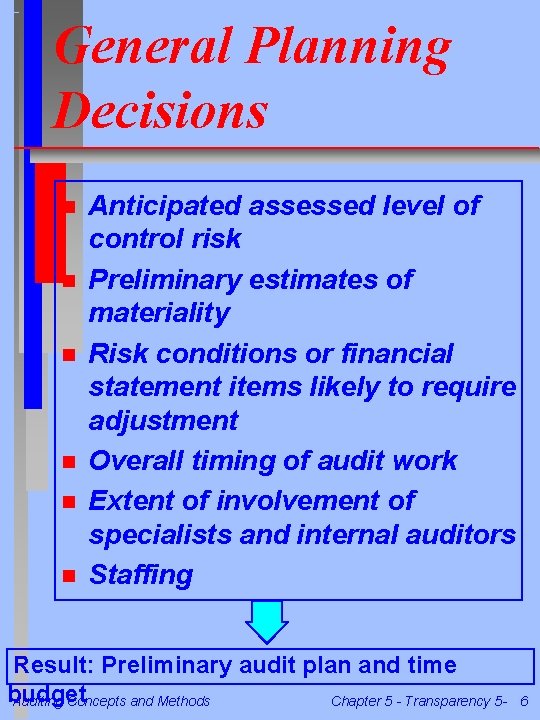
General Planning Decisions n n n Anticipated assessed level of control risk Preliminary estimates of materiality Risk conditions or financial statement items likely to require adjustment Overall timing of audit work Extent of involvement of specialists and internal auditors Staffing Result: Preliminary audit plan and time budget Auditing Concepts and Methods Chapter 5 - Transparency 5 - 6
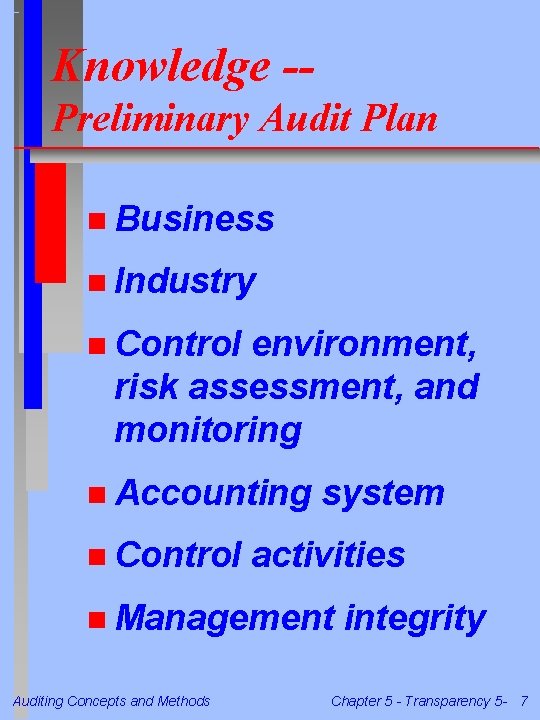
Knowledge -Preliminary Audit Plan n Business n Industry n Control environment, risk assessment, and monitoring n Accounting n Control system activities n Management Auditing Concepts and Methods integrity Chapter 5 - Transparency 5 - 7
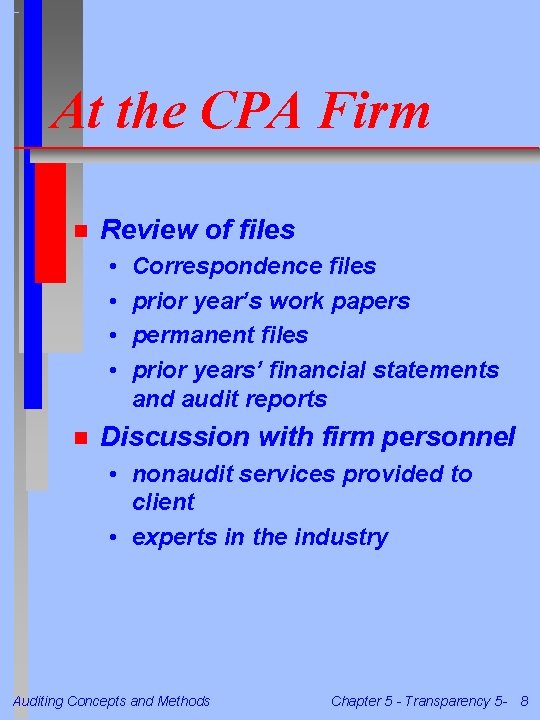
At the CPA Firm n Review of files • • n Correspondence files prior year’s work papers permanent files prior years’ financial statements and audit reports Discussion with firm personnel • nonaudit services provided to client • experts in the industry Auditing Concepts and Methods Chapter 5 - Transparency 5 - 8
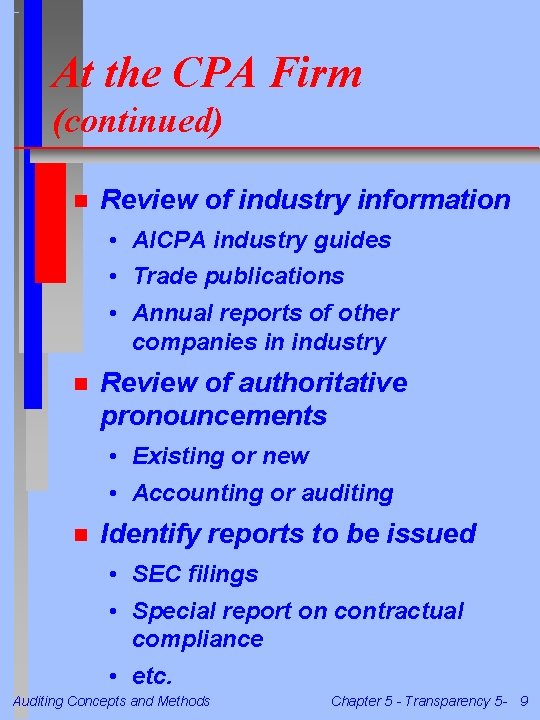
At the CPA Firm (continued) n Review of industry information • AICPA industry guides • Trade publications • Annual reports of other companies in industry n Review of authoritative pronouncements • Existing or new • Accounting or auditing n Identify reports to be issued • SEC filings • Special report on contractual compliance • etc. Auditing Concepts and Methods Chapter 5 - Transparency 5 - 9
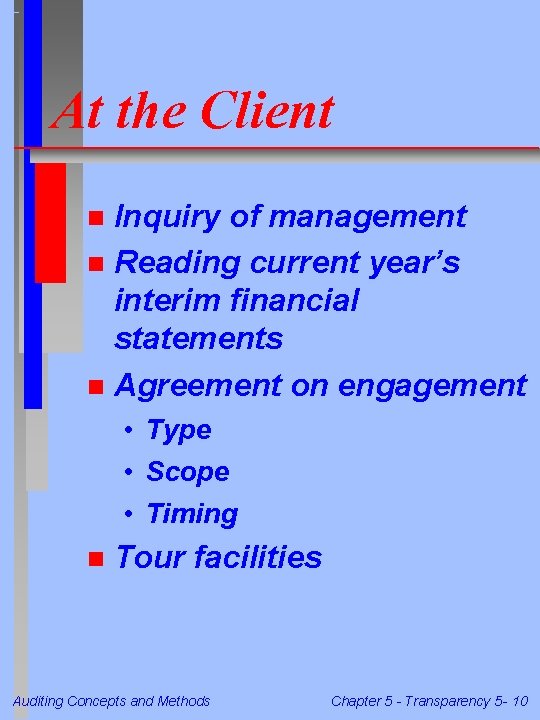
At the Client Inquiry of management n Reading current year’s interim financial statements n Agreement on engagement n • Type • Scope • Timing n Tour facilities Auditing Concepts and Methods Chapter 5 - Transparency 5 - 10
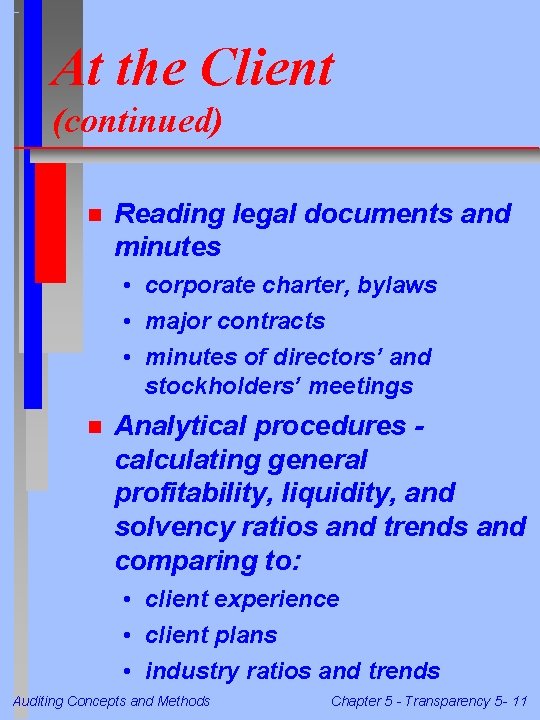
At the Client (continued) n Reading legal documents and minutes • corporate charter, bylaws • major contracts • minutes of directors’ and stockholders’ meetings n Analytical procedures calculating general profitability, liquidity, and solvency ratios and trends and comparing to: • client experience • client plans • industry ratios and trends Auditing Concepts and Methods Chapter 5 - Transparency 5 - 11
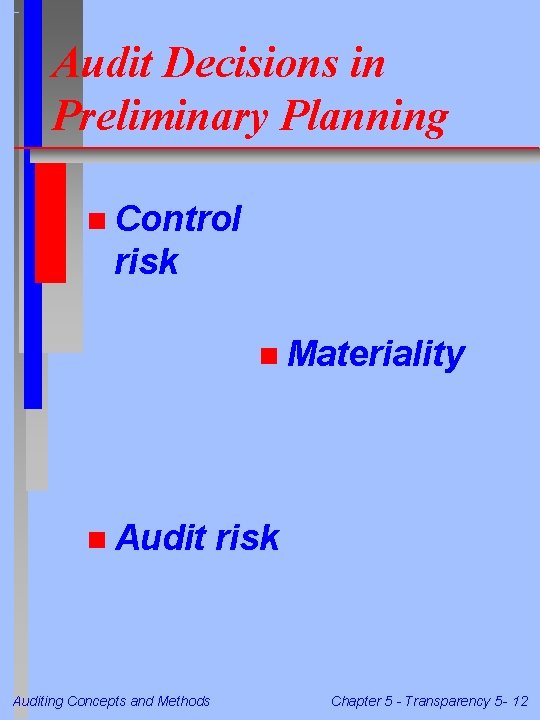
Audit Decisions in Preliminary Planning n Control risk n Materiality n Auditing Concepts and Methods risk Chapter 5 - Transparency 5 - 12
Materiality The magnitude of an omission or misstatement of accounting information that in the light of surrounding circumstances, makes it probable that the judgment of a reasonable person relying on the information would have been changed or influenced by the omission or misstatement Auditing Concepts and Methods Chapter 5 - Transparency 5 - 13
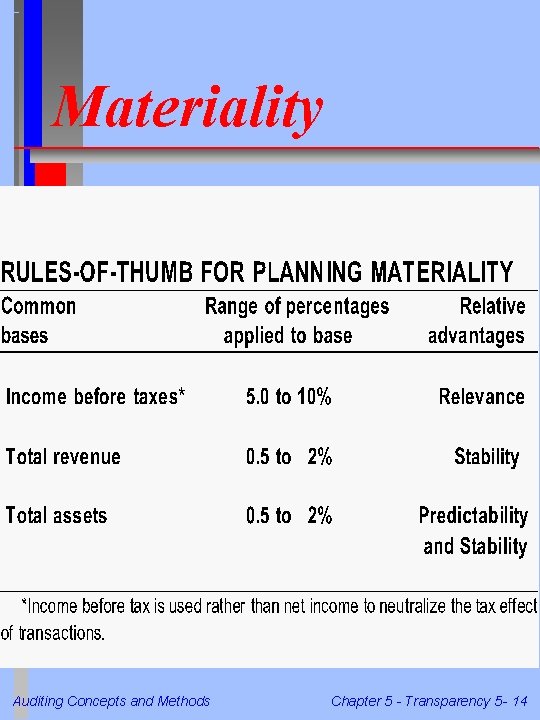
Materiality Auditing Concepts and Methods Chapter 5 - Transparency 5 - 14
Audit Risk The risk that the auditor may unknowingly fail to appropriately modify his or her opinion on financial statements that are materially misstated Auditing Concepts and Methods Chapter 5 - Transparency 5 - 15
Special Audit Risks n Management fraud n Related-party transactions Auditing Concepts and Methods n Illegal acts n Business failure Chapter 5 - Transparency 5 - 16
Fraud - Terminology n Errors n Irregularities n Management fraud n Employee fraud n Red flags Auditing Concepts and Methods Chapter 5 - Transparency 5 - 17
Red Flags n Management Characteristics • Management operating and financing decisions are dominated by a single person. • Management’s attitude toward financial reporting is unduly aggressive. • Management (particularly senior accounting personnel) turnover is high. • Management places undue emphasis on meeting earnings projections. • Management’s reputation in the business community is poor. Auditing Concepts and Methods Chapter 5 - Transparency 5 - 18
Red Flags (continued) n Operating and Industry Characteristics: • Profitability of entity relative to its industry is inadequate or inconsistent. • Sensitivity of operating results to economic factors (inflation, interest rates, unemployment, etc. ) is high. • Rate of change in entity’s industry is rapid. Auditing Concepts and Methods Chapter 5 - Transparency 5 - 19
Red Flags (continued) n Operating and Industry Characteristics (continued): • Direction of change in entity’s industry is declining with many business failures. • Organization is decentralized without adequate monitoring. • Internal or external matters that raise substantial doubt about the entity’s ability to continue as a going concern are present. Auditing Concepts and Methods Chapter 5 - Transparency 5 - 20
Red Flags (continued) n Engagement Characteristics: • Many contentious or difficult accounting issues are present. • Significant difficult-to-audit transactions or balances are present. • Significant and unusual related-party transactions not in the ordinary course of business are present. Auditing Concepts and Methods Chapter 5 - Transparency 5 - 21
Red Flags (continued) n Engagement Characteristics (continued): • Nature, cause (if known), or the amount of known and likely misstatements detected in the audit or prior period’s financial statements is significant. • It is a new client with no prior audit history or sufficient information is not available from the predecessor auditor. Auditing Concepts and Methods Chapter 5 - Transparency 5 - 22
Related-Party Transactions Identify related parties n Identify material transactions n Examine identified material related-party transactions n Evaluate disclosure n Auditing Concepts and Methods Chapter 5 - Transparency 5 - 23
Illegal Acts n SAS 53 vs. SAS 54 “direct and material effect on the determination of a financial statement line item amount” n Violations with indirect effects • loss contingencies • effect on audit n Communication responsibilities Auditing Concepts and Methods Chapter 5 - Transparency 5 - 24
Business Failure Auditing Concepts and Methods Chapter 5 - Transparency 5 - 25
Engagement Timing Basic time segments n Efficiency and effectiveness in timing n Timing decisions n Auditing Concepts and Methods Chapter 5 - Transparency 5 - 26
Involving Specialists Engaged or employed by client n CPA firm industry specialists n CPA firm functional specialists n CPA firm technical specialists n Auditing Concepts and Methods Chapter 5 - Transparency 5 - 27
Analytical Procedures n In planning the audit* • To understand the client and industry • To identify transactions and events since the last audit date • To identify a risk requiring more than normal audit attention To plan the nature, timing, and extent of other audit procedures. *Required by SAS No. 56 Auditing Concepts and Methods Chapter 5 - Transparency 5 - 28
Analytical Procedures (continued) n As substantive tests To obtain evidential matter about assertions n In overall review at end* • Identify any unusual or unexpected balances not previously noted • Consider going concern status To assess the conclusions the auditor has reached To evaluate overall financial statement presentation * Required by SAS No. 56 Auditing Concepts and Methods Chapter 5 - Transparency 5 - 29