
Understanding the Civil Engineering Implications of Climate Change
- Slides: 36
Understanding the Civil Engineering Implications of Climate Change in the Western U. S. Alan F. Hamlet, Philip W. Mote, Dennis P. Lettenmaier • JISAO/CSES Climate Impacts Group • Dept. of Civil and Environmental Engineering University of Washington
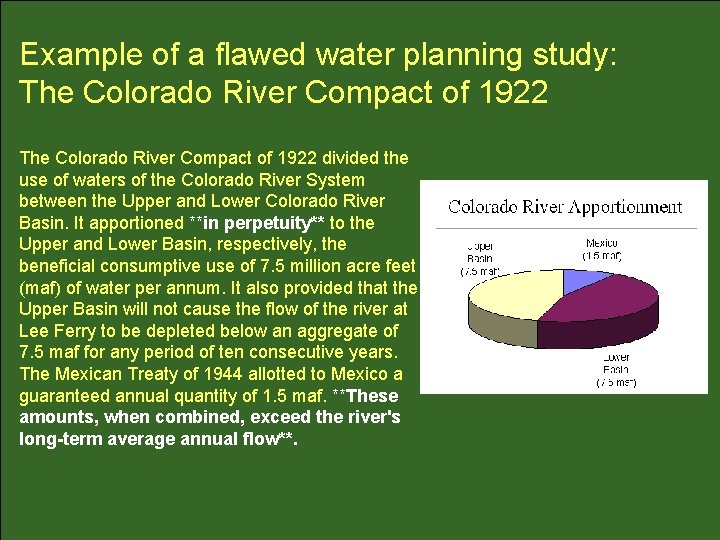
Example of a flawed water planning study: The Colorado River Compact of 1922 divided the use of waters of the Colorado River System between the Upper and Lower Colorado River Basin. It apportioned **in perpetuity** to the Upper and Lower Basin, respectively, the beneficial consumptive use of 7. 5 million acre feet (maf) of water per annum. It also provided that the Upper Basin will not cause the flow of the river at Lee Ferry to be depleted below an aggregate of 7. 5 maf for any period of ten consecutive years. The Mexican Treaty of 1944 allotted to Mexico a guaranteed annual quantity of 1. 5 maf. **These amounts, when combined, exceed the river's long-term average annual flow**.
What’s the Problem? Despite a general awareness of these issues in the water planning community, there is growing evidence that future climate variability will not look like the past and that current planning activities, which frequently use a limited observed streamflow record to represent climate variability, are in danger of repeating the same kind of mistakes made more than 80 years ago in forging the Colorado River Compact. Long-term planning and specific agreements influenced by this planning (such as long-term transboundary agreements) should be informed by the best and most complete climate information available, but frequently they are not.
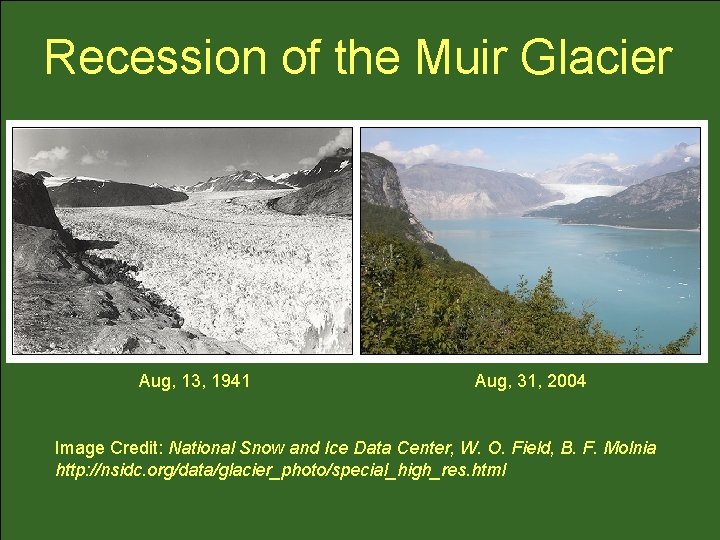
Recession of the Muir Glacier Aug, 13, 1941 Aug, 31, 2004 Image Credit: National Snow and Ice Data Center, W. O. Field, B. F. Molnia http: //nsidc. org/data/glacier_photo/special_high_res. html
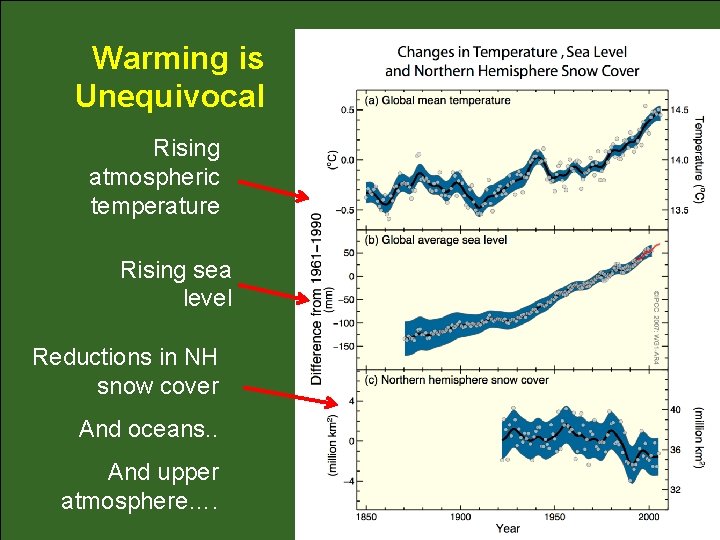
Warming is Unequivocal Rising atmospheric temperature Rising sea level Reductions in NH snow cover And oceans. . And upper atmosphere….
Global Climate Change Scenarios and Hydrologic Impacts for the PNW
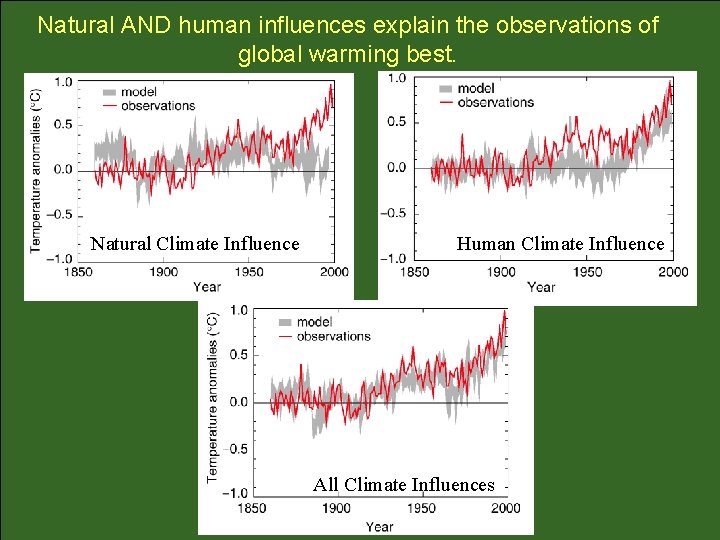
Natural AND human influences explain the observations of global warming best. Natural Climate Influence Human Climate Influence All Climate Influences
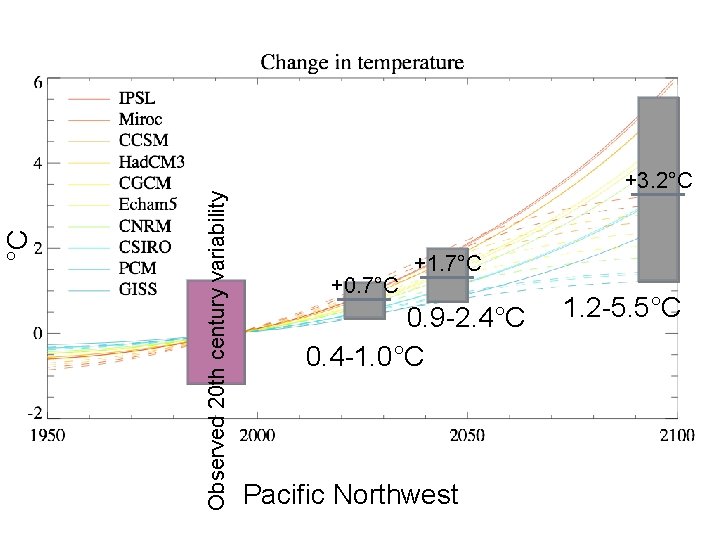
Observed 20 th century variability °C +3. 2°C +0. 7°C +1. 7°C 0. 9 -2. 4°C 0. 4 -1. 0°C Pacific Northwest 1. 2 -5. 5°C
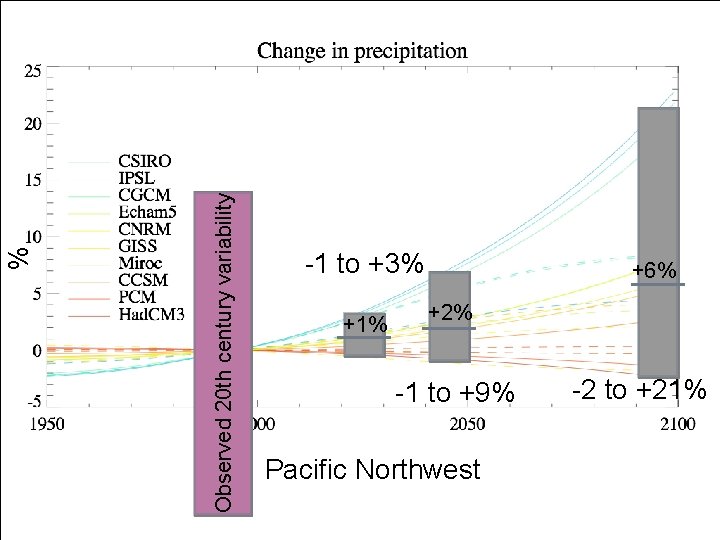
Observed 20 th century variability % -1 to +3% +1% +6% +2% -1 to +9% Pacific Northwest -2 to +21%
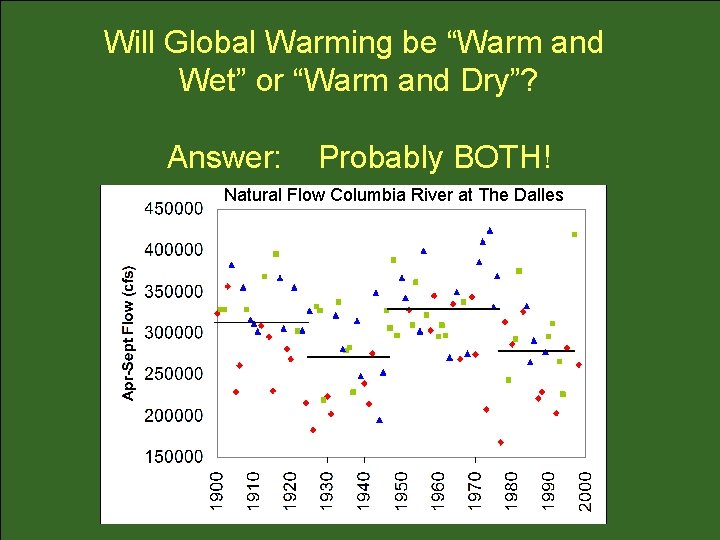
Will Global Warming be “Warm and Wet” or “Warm and Dry”? Answer: Probably BOTH! Natural Flow Columbia River at The Dalles
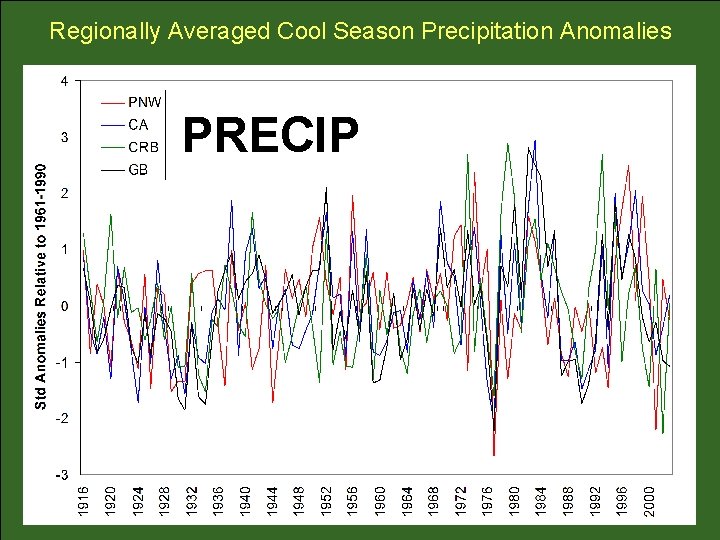
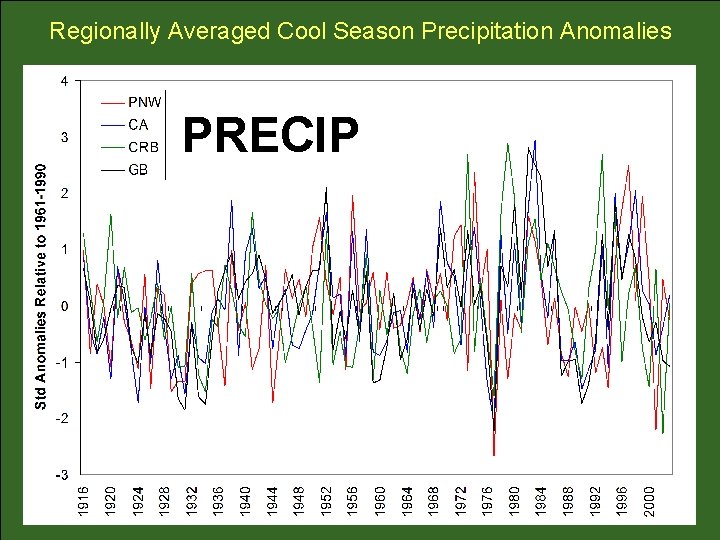
Regionally Averaged Cool Season Precipitation Anomalies PRECIP
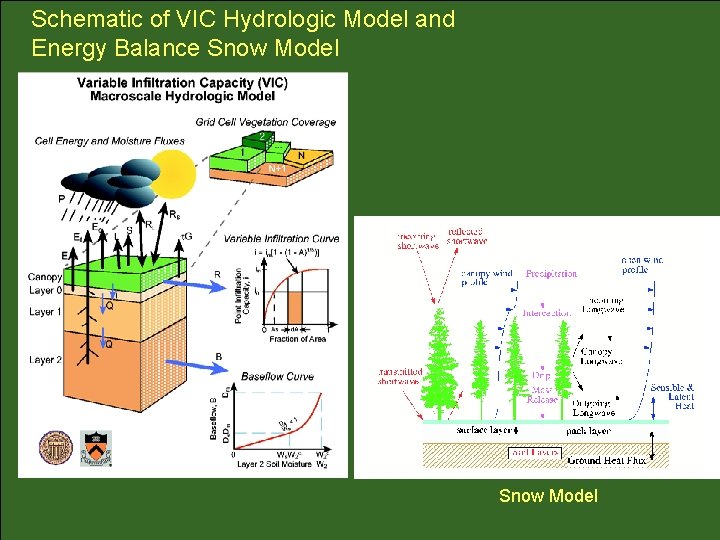
Schematic of VIC Hydrologic Model and Energy Balance Snow Model
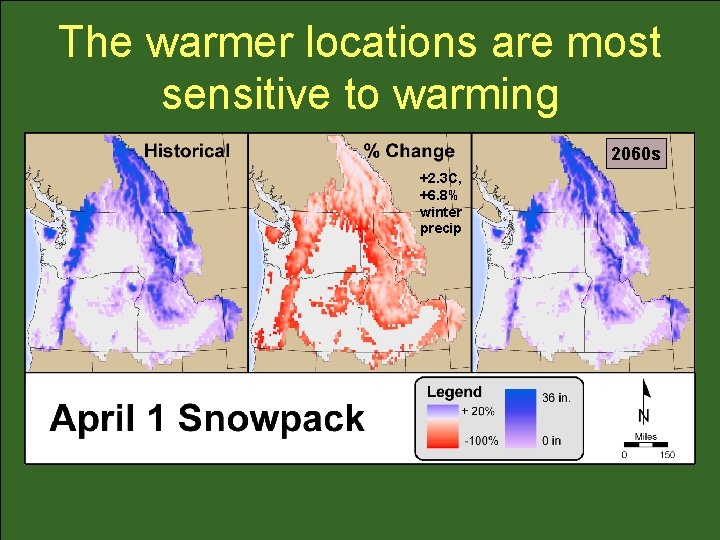
The warmer locations are most sensitive to warming 2060 s +2. 3 C, +6. 8% winter precip
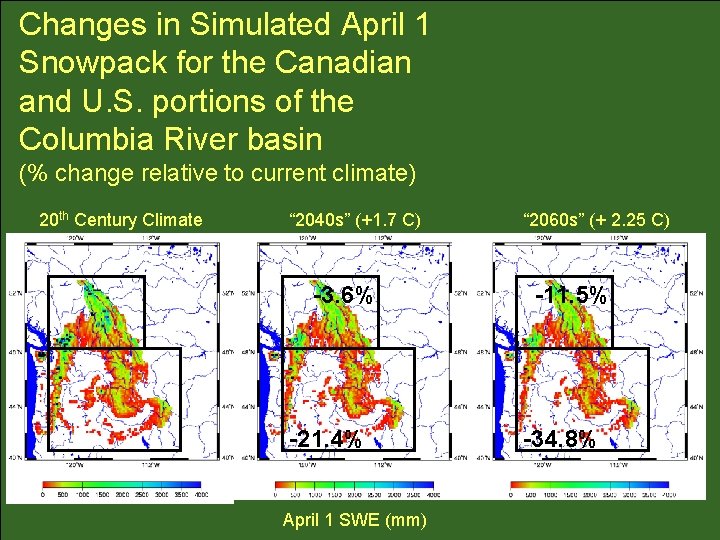
Changes in Simulated April 1 Snowpack for the Canadian and U. S. portions of the Columbia River basin (% change relative to current climate) 20 th Century Climate “ 2040 s” (+1. 7 C) -3. 6% -21. 4% April 1 SWE (mm) “ 2060 s” (+ 2. 25 C) -11. 5% -34. 8%
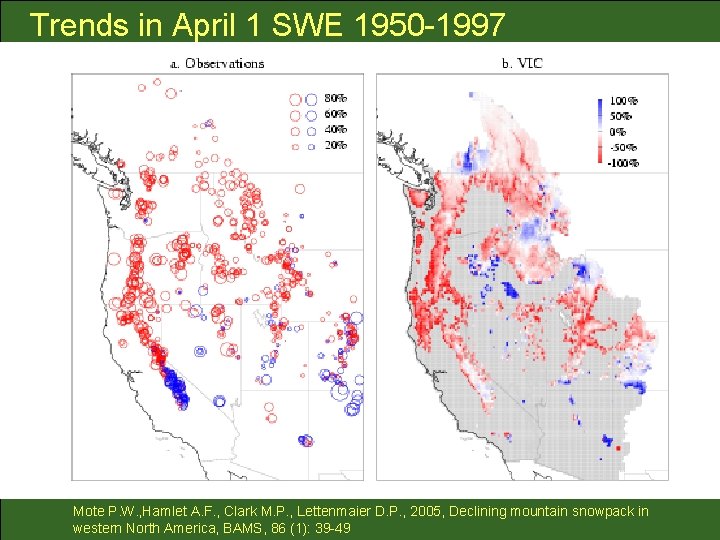
Trends in April 1 SWE 1950 -1997 Mote P. W. , Hamlet A. F. , Clark M. P. , Lettenmaier D. P. , 2005, Declining mountain snowpack in western North America, BAMS, 86 (1): 39 -49
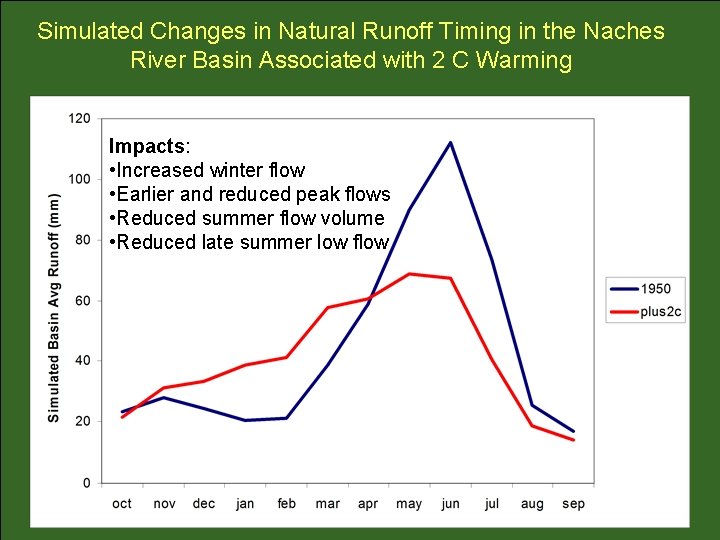
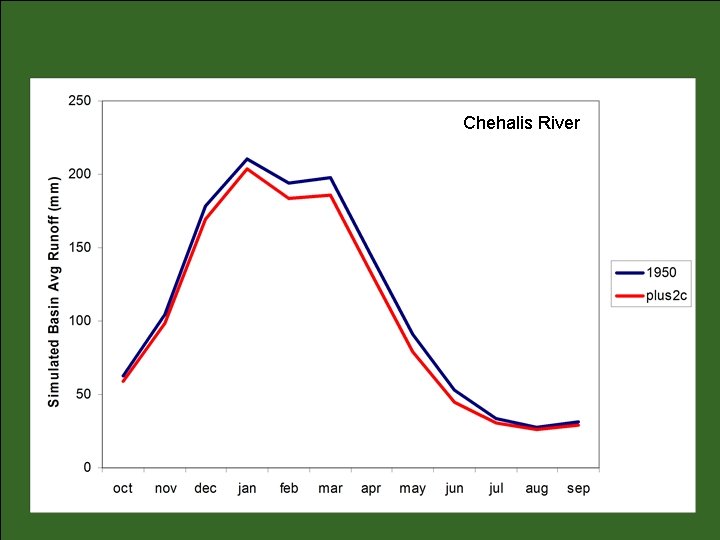
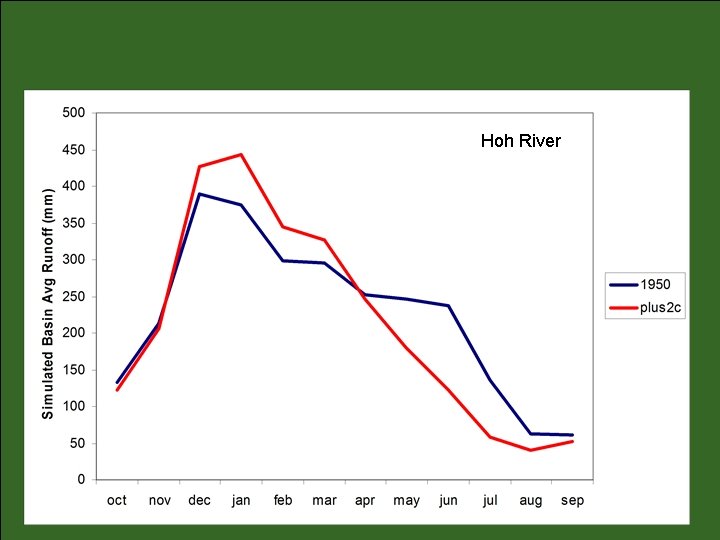
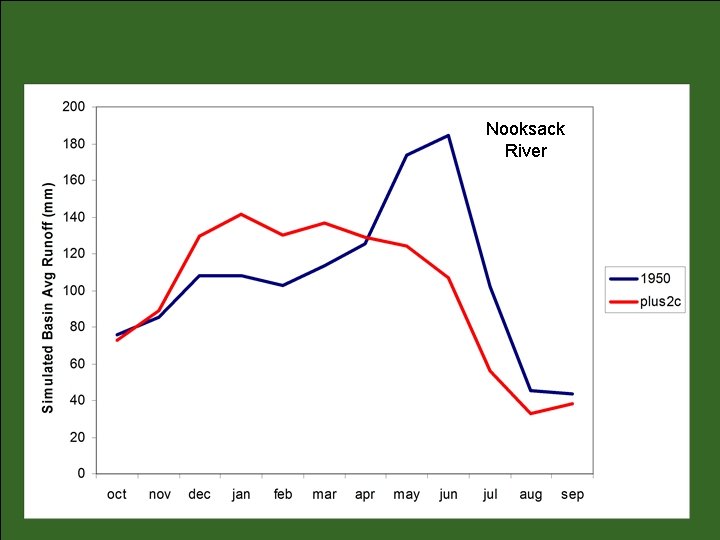
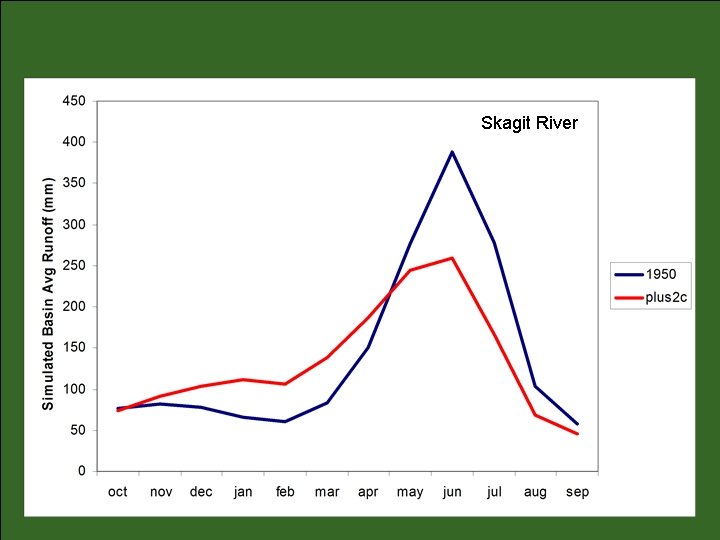
Simulated Changes in Natural Runoff Timing in the Naches River Basin Associated with 2 C Warming Impacts: • Increased winter flow • Earlier and reduced peak flows • Reduced summer flow volume • Reduced late summer low flow
Chehalis River
Hoh River
Nooksack River
Skagit River
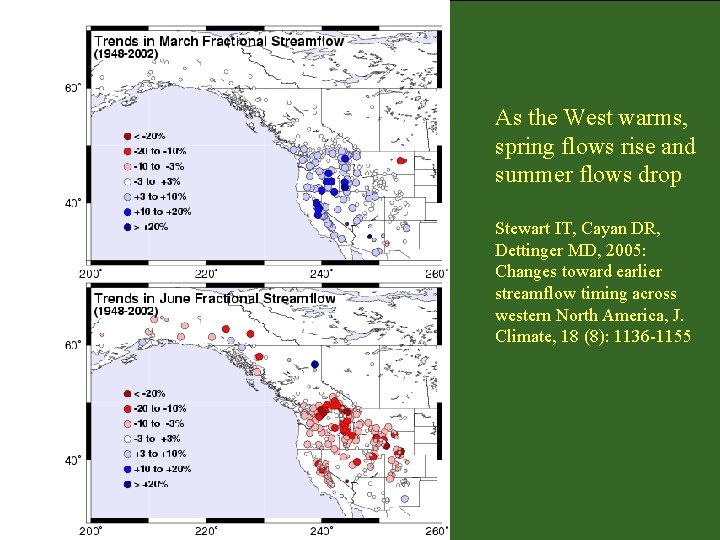
As the West warms, spring flows rise and summer flows drop Stewart IT, Cayan DR, Dettinger MD, 2005: Changes toward earlier streamflow timing across western North America, J. Climate, 18 (8): 1136 -1155
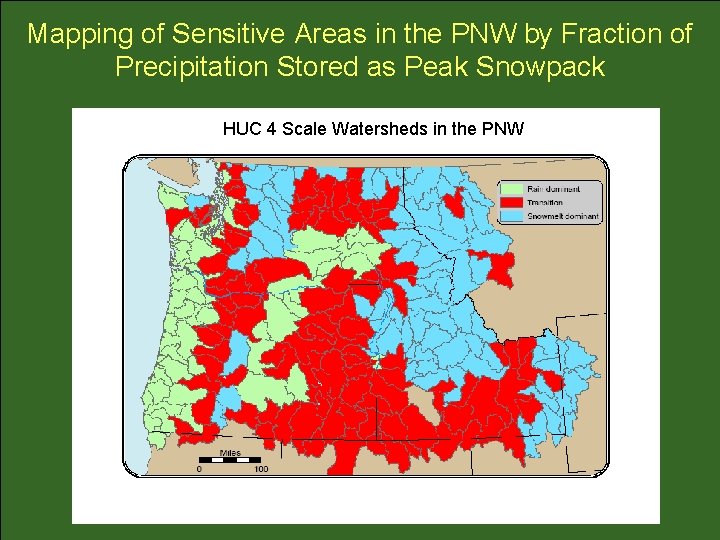
Mapping of Sensitive Areas in the PNW by Fraction of Precipitation Stored as Peak Snowpack HUC 4 Scale Watersheds in the PNW
Changes in Flood Risk in the Western U. S.
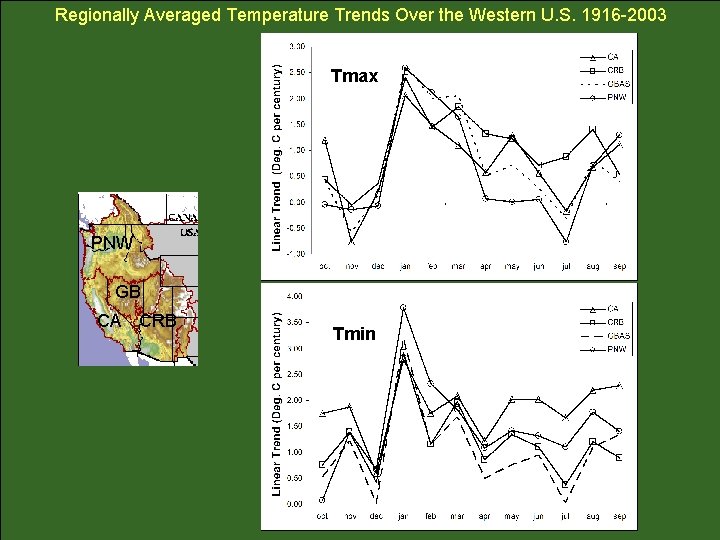
Regionally Averaged Temperature Trends Over the Western U. S. 1916 -2003 Tmax PNW GB CA CRB Tmin
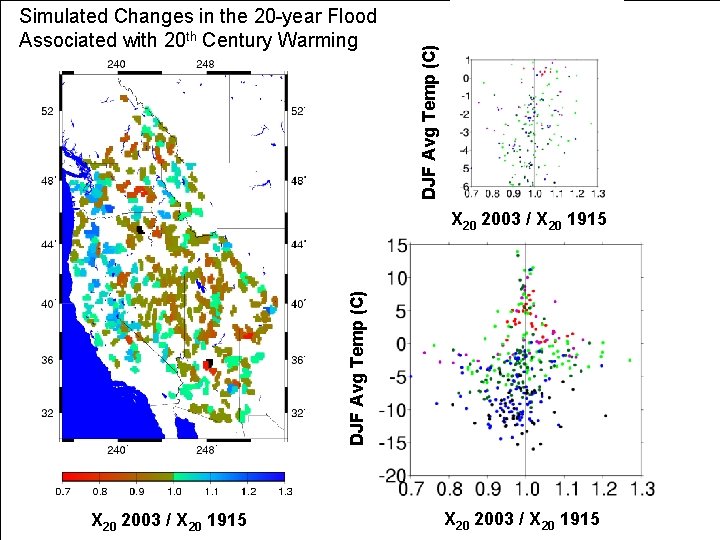
DJF Avg Temp (C) Simulated Changes in the 20 -year Flood Associated with 20 th Century Warming DJF Avg Temp (C) X 20 2003 / X 20 1915
Regionally Averaged Cool Season Precipitation Anomalies PRECIP
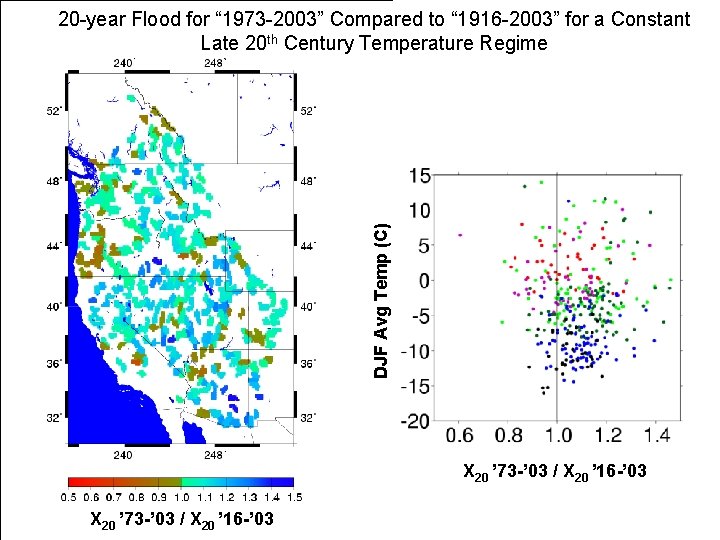
DJF Avg Temp (C) 20 -year Flood for “ 1973 -2003” Compared to “ 1916 -2003” for a Constant Late 20 th Century Temperature Regime X 20 ’ 73 -’ 03 / X 20 ’ 16 -’ 03
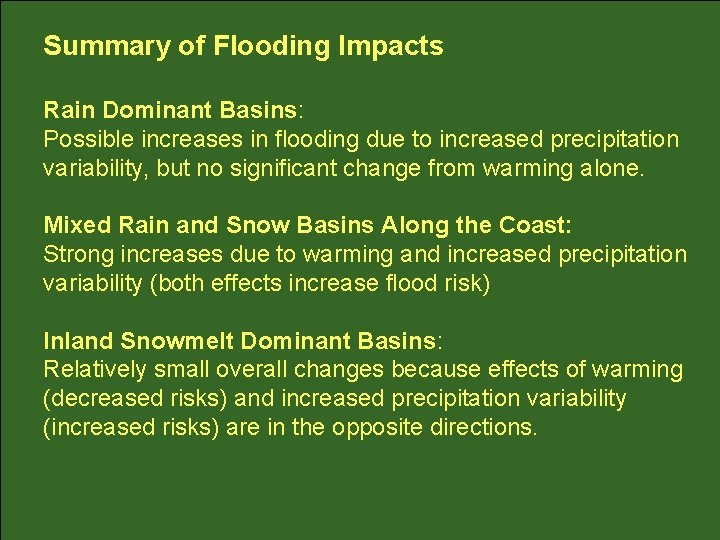
Summary of Flooding Impacts Rain Dominant Basins: Possible increases in flooding due to increased precipitation variability, but no significant change from warming alone. Mixed Rain and Snow Basins Along the Coast: Strong increases due to warming and increased precipitation variability (both effects increase flood risk) Inland Snowmelt Dominant Basins: Relatively small overall changes because effects of warming (decreased risks) and increased precipitation variability (increased risks) are in the opposite directions.
Ecosystem Impacts
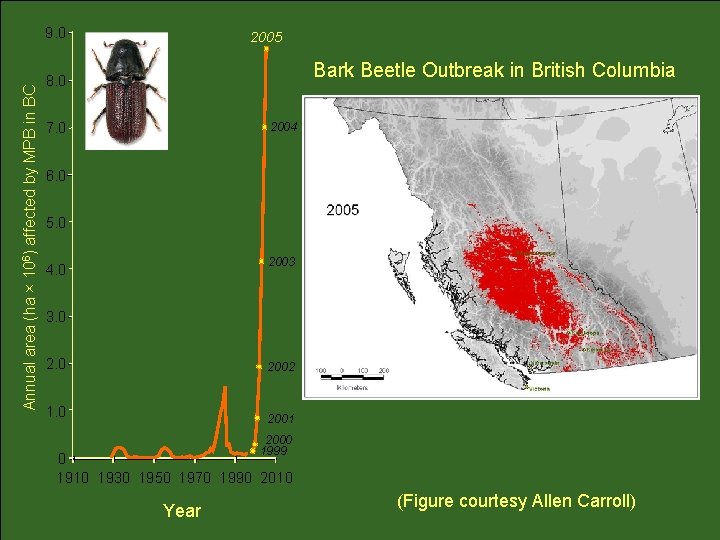
Annual area (ha × 106) affected by MPB in BC 9. 0 2005 Bark Beetle Outbreak in British Columbia 8. 0 7. 0 2004 6. 0 5. 0 2003 4. 0 3. 0 2002 1. 0 2001 2000 1999 0 1910 1930 1950 1970 1990 2010 Year (Figure courtesy Allen Carroll)
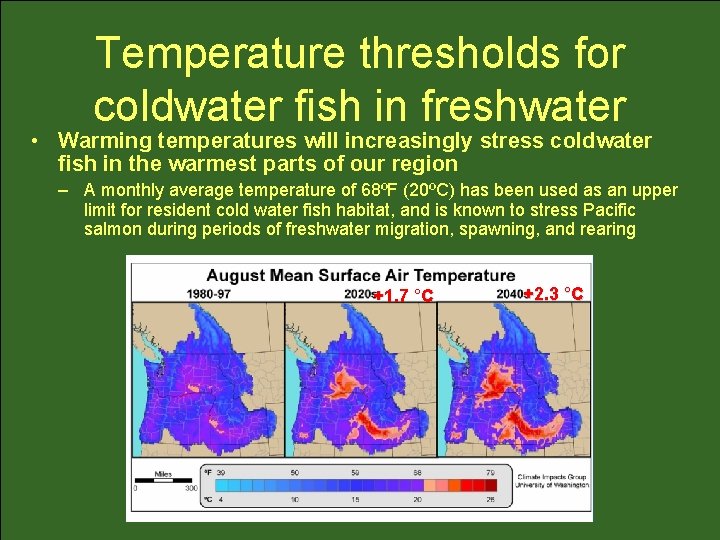
Temperature thresholds for coldwater fish in freshwater • Warming temperatures will increasingly stress coldwater fish in the warmest parts of our region – A monthly average temperature of 68ºF (20ºC) has been used as an upper limit for resident cold water fish habitat, and is known to stress Pacific salmon during periods of freshwater migration, spawning, and rearing +1. 7 °C +2. 3 °C
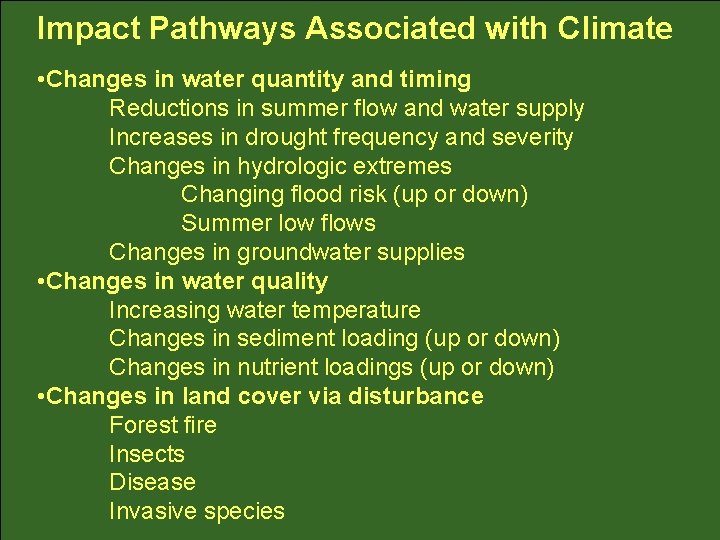
Impact Pathways Associated with Climate • Changes in water quantity and timing Reductions in summer flow and water supply Increases in drought frequency and severity Changes in hydrologic extremes Changing flood risk (up or down) Summer low flows Changes in groundwater supplies • Changes in water quality Increasing water temperature Changes in sediment loading (up or down) Changes in nutrient loadings (up or down) • Changes in land cover via disturbance Forest fire Insects Disease Invasive species
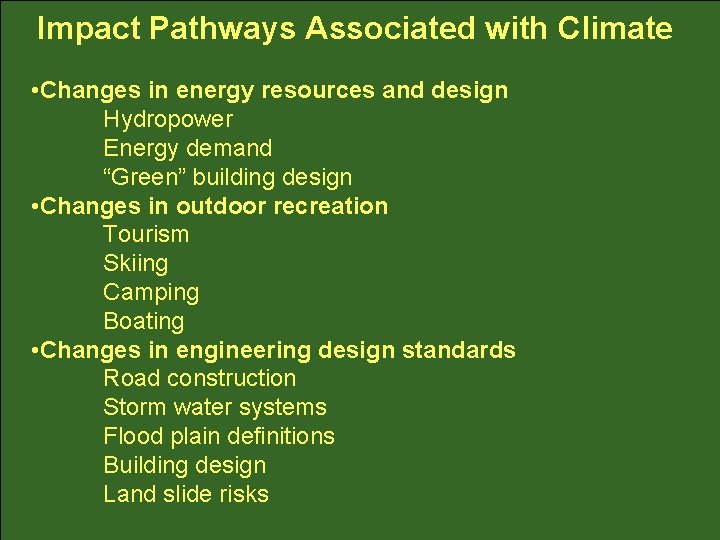
Impact Pathways Associated with Climate • Changes in energy resources and design Hydropower Energy demand “Green” building design • Changes in outdoor recreation Tourism Skiing Camping Boating • Changes in engineering design standards Road construction Storm water systems Flood plain definitions Building design Land slide risks
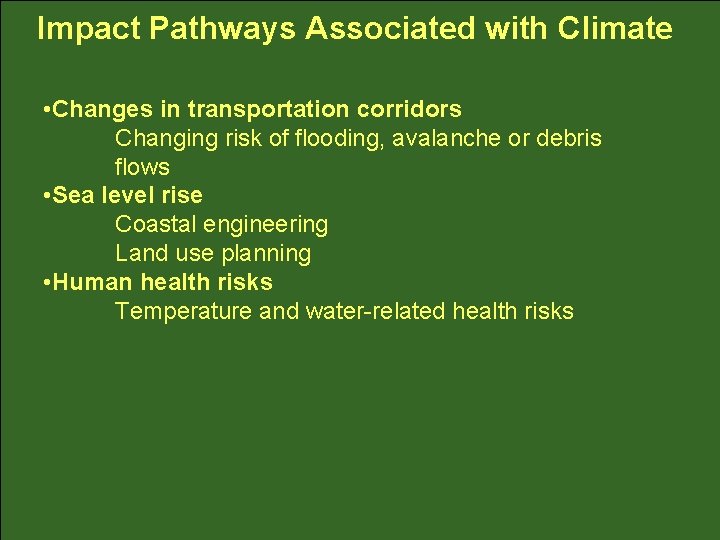
Impact Pathways Associated with Climate • Changes in transportation corridors Changing risk of flooding, avalanche or debris flows • Sea level rise Coastal engineering Land use planning • Human health risks Temperature and water-related health risks
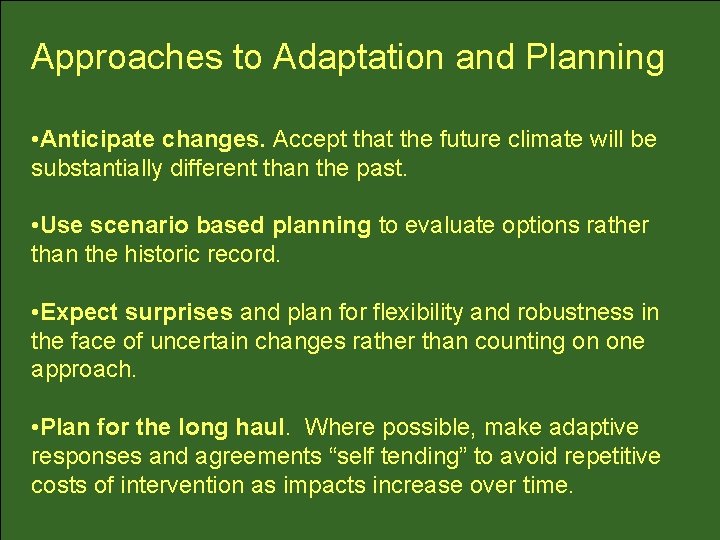
Approaches to Adaptation and Planning • Anticipate changes. Accept that the future climate will be substantially different than the past. • Use scenario based planning to evaluate options rather than the historic record. • Expect surprises and plan for flexibility and robustness in the face of uncertain changes rather than counting on one approach. • Plan for the long haul. Where possible, make adaptive responses and agreements “self tending” to avoid repetitive costs of intervention as impacts increase over time.
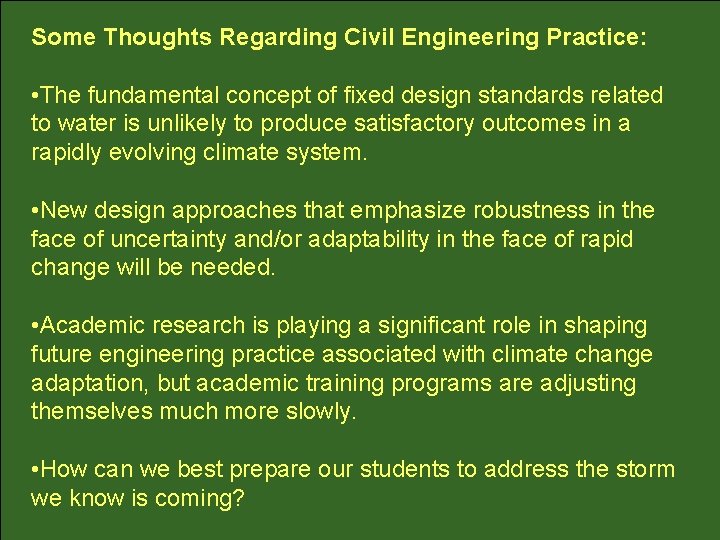
Some Thoughts Regarding Civil Engineering Practice: • The fundamental concept of fixed design standards related to water is unlikely to produce satisfactory outcomes in a rapidly evolving climate system. • New design approaches that emphasize robustness in the face of uncertainty and/or adaptability in the face of rapid change will be needed. • Academic research is playing a significant role in shaping future engineering practice associated with climate change adaptation, but academic training programs are adjusting themselves much more slowly. • How can we best prepare our students to address the storm we know is coming?