
Understanding the Brain The ways it shapes how
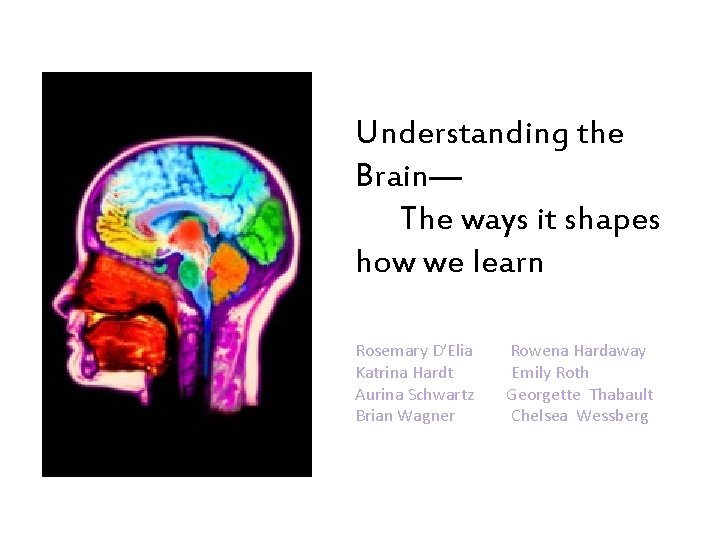
Understanding the Brain— The ways it shapes how we learn Rosemary D’Elia Katrina Hardt Aurina Schwartz Brian Wagner Rowena Hardaway Emily Roth Georgette Thabault Chelsea Wessberg
Brainstem and Cerebellum are the ‘first sub-brain” • Evolved earlier – houses older memories that have become permanent circuits • Neural clusters in this area have stronger synaptic connections and are used more often • Function under subconscious control and have no conscious centers: reflexes for survival and immediate action; rudimentary, automatic muscular actions are directed by the brainstem and the cerebellum – primitive responses. Involuntary nervous system – automatically sustains life, internal order and health
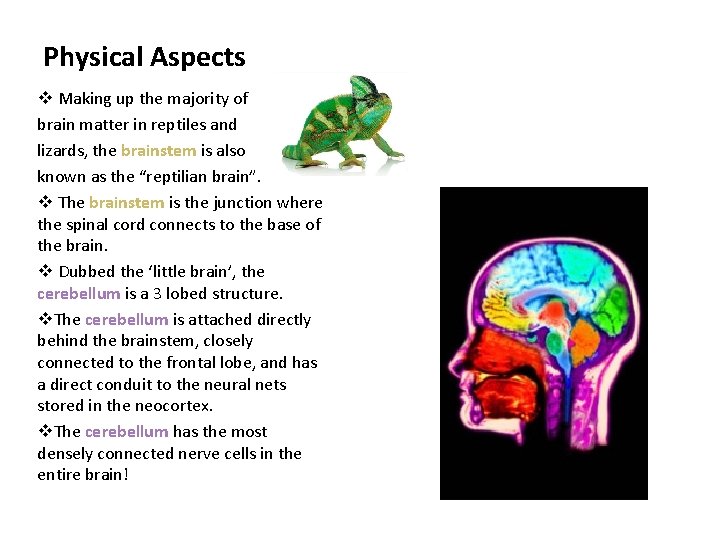
Physical Aspects v Making up the majority of brain matter in reptiles and lizards, the brainstem is also known as the “reptilian brain”. v The brainstem is the junction where the spinal cord connects to the base of the brain. v Dubbed the ‘little brain’, the cerebellum is a 3 lobed structure. v. The cerebellum is attached directly behind the brainstem, closely connected to the frontal lobe, and has a direct conduit to the neural nets stored in the neocortex. v. The cerebellum has the most densely connected nerve cells in the entire brain!
Functions of the Brainstem • Controls basic life/primitive functions: – Maintains and controls heart rate – Regulates levels of wakefulness and sleep – Respiratory rate and breathing – Blood pressure – Swallowing
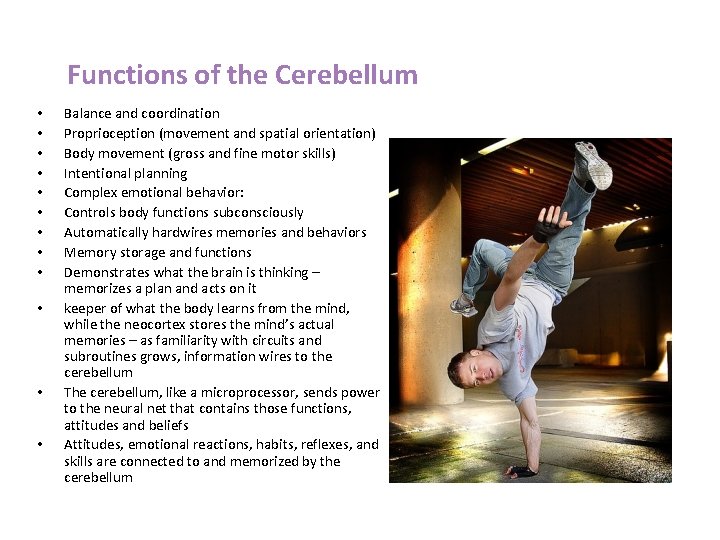
Functions of the Cerebellum • • • Balance and coordination Proprioception (movement and spatial orientation) Body movement (gross and fine motor skills) Intentional planning Complex emotional behavior: Controls body functions subconsciously Automatically hardwires memories and behaviors Memory storage and functions Demonstrates what the brain is thinking – memorizes a plan and acts on it keeper of what the body learns from the mind, while the neocortex stores the mind’s actual memories – as familiarity with circuits and subroutines grows, information wires to the cerebellum The cerebellum, like a microprocessor, sends power to the neural net that contains those functions, attitudes and beliefs Attitudes, emotional reactions, habits, reflexes, and skills are connected to and memorized by the cerebellum
The Midbrain Aka The Limbic System (limbus = forming a border around an edge or ring; pertains to something that is at a junction between structures) Aka The Mammalian Brain Aka The Chemical Brain Aka The Emotional Brain
Brainstem + Cerebellum + Midbrain = The Subconscious Mind & The Objective Consciousness
Home of the Autonomic Nervous System The Parasympathetic Nervous System, The Sympathetic Nervous System, and the Four Fs
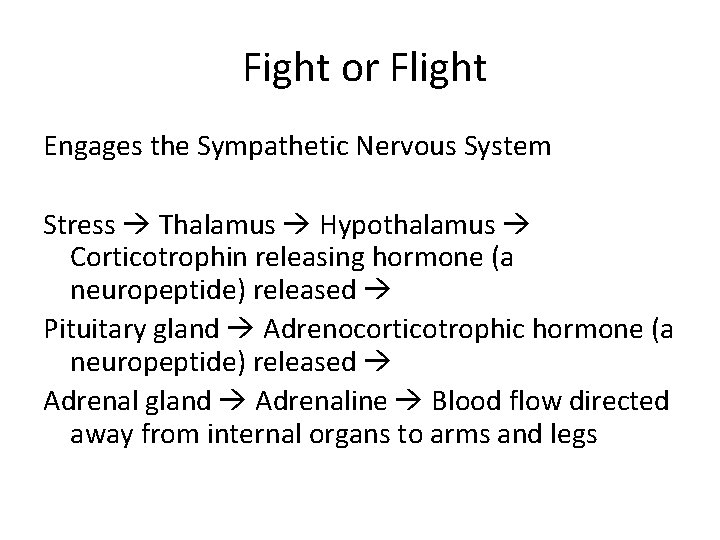
Fight or Flight Engages the Sympathetic Nervous System Stress Thalamus Hypothalamus Corticotrophin releasing hormone (a neuropeptide) released Pituitary gland Adrenocorticotrophic hormone (a neuropeptide) released Adrenal gland Adrenaline Blood flow directed away from internal organs to arms and legs
Feeding Engages the Parasympathetic Nervous System Slows down heart rate Relaxes body Prepares for digestion Blood flows to internal organs
Fornicating Engages the Parasympathetic Nervous System when getting “in the mood” and engages the Sympathetic Nervous System when excited
The Thalamus handles external stimuli • Greek for “inner chamber” • Oldest and largest part of midbrain • The “switchboard”; the meeting point for almost all nerves that connect parts of the brain and the brain to the body 1) Sensory organs send messages to thalamus 2) Thalamus identifies and sorts the input 3) Transmits data to appropriate place in neocortex, midbrain, cerebellum, or brain stem “There is not one signal from the environment that does not pass through the thalamus. ”
The Hypothalamus handles internal affairs Greek for “under the thalamus” The “chemical factory” Manufactures chemicals that create emotions Maintains homeostasis: regulates and balances thirst, hunger, wakefulness, sex drive, temperature, heart rate, blood sugar, hormonal balance, immune system, metabolism, etc. • Makes neuropeptides (chemical messengers) • Many of its chemical and electrical signals are sent to the pituitary gland • •
The Pituitary Gland • “The Master Gland” • Pear-shaped; hangs of hypothalamus • Glands= Organs of specialized groups of cells that separate elements from the blood and secrete them in a form the body can use or eliminate easily • Secrete chemicals that activate hormones • Hormones= Complex chemicals that initiate or regulate the activity of an organ or group of cells • Hormones are then secreted by the adrenal gland, thyroid gland, reproductive organs, etc.
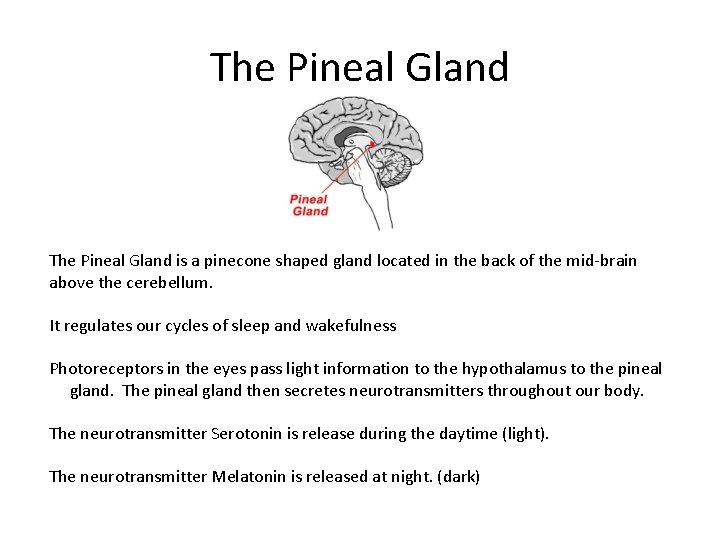
The Pineal Gland is a pinecone shaped gland located in the back of the mid-brain above the cerebellum. It regulates our cycles of sleep and wakefulness Photoreceptors in the eyes pass light information to the hypothalamus to the pineal gland. The pineal gland then secretes neurotransmitters throughout our body. The neurotransmitter Serotonin is release during the daytime (light). The neurotransmitter Melatonin is released at night. (dark)
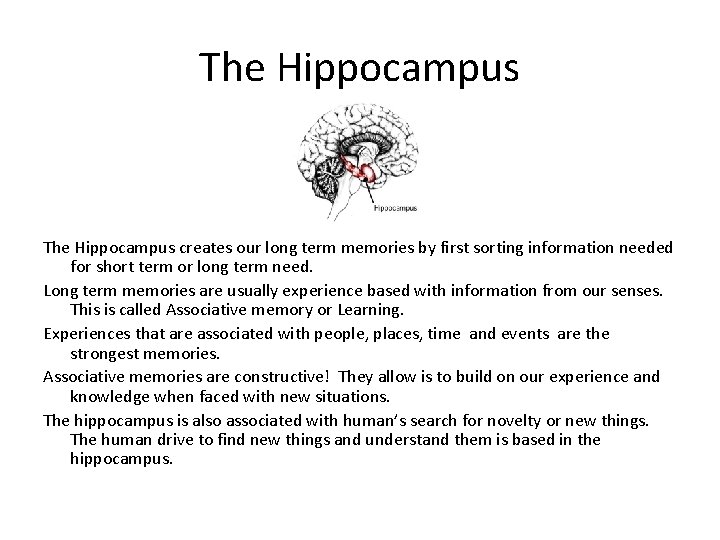
The Hippocampus creates our long term memories by first sorting information needed for short term or long term need. Long term memories are usually experience based with information from our senses. This is called Associative memory or Learning. Experiences that are associated with people, places, time and events are the strongest memories. Associative memories are constructive! They allow is to build on our experience and knowledge when faced with new situations. The hippocampus is also associated with human’s search for novelty or new things. The human drive to find new things and understand them is based in the hippocampus.
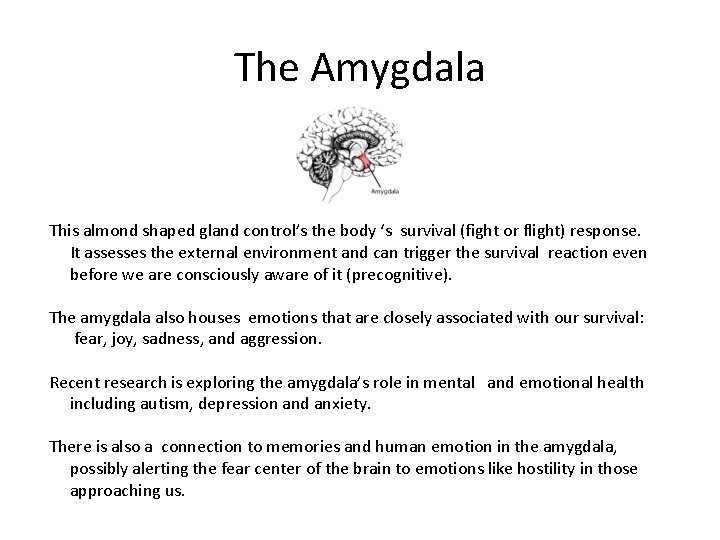
The Amygdala This almond shaped gland control’s the body ‘s survival (fight or flight) response. It assesses the external environment and can trigger the survival reaction even before we are consciously aware of it (precognitive). The amygdala also houses emotions that are closely associated with our survival: fear, joy, sadness, and aggression. Recent research is exploring the amygdala’s role in mental and emotional health including autism, depression and anxiety. There is also a connection to memories and human emotion in the amygdala, possibly alerting the fear center of the brain to emotions like hostility in those approaching us.
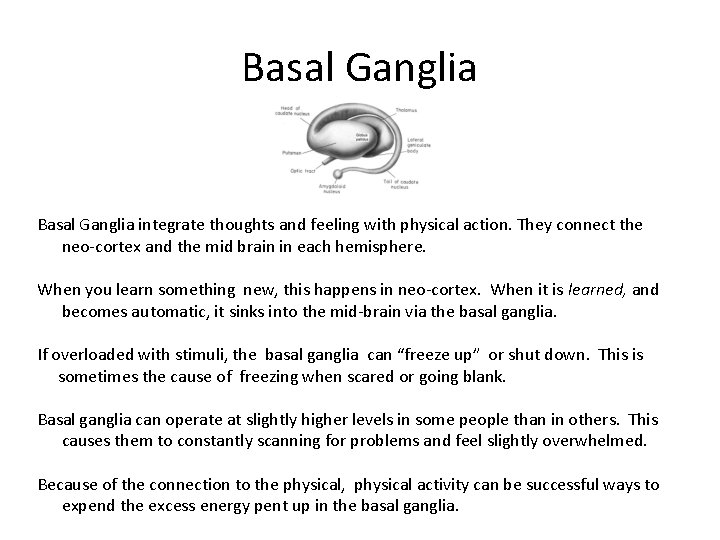
Basal Ganglia integrate thoughts and feeling with physical action. They connect the neo-cortex and the mid brain in each hemisphere. When you learn something new, this happens in neo-cortex. When it is learned, and becomes automatic, it sinks into the mid-brain via the basal ganglia. If overloaded with stimuli, the basal ganglia can “freeze up” or shut down. This is sometimes the cause of freezing when scared or going blank. Basal ganglia can operate at slightly higher levels in some people than in others. This causes them to constantly scanning for problems and feel slightly overwhelmed. Because of the connection to the physical, physical activity can be successful ways to expend the excess energy pent up in the basal ganglia.
The Chemical Brain Better Living Through Chemistry
Purpose and Function of Chemicals • Act as messengers of thoughts • Thoughts produce chemicals in brain • Every thought produced matches a feeling in your body (i. e. , neurotransmitter – dopamine) • All systems in body are controlled by chemical reactions initiated by the Midbrain
Where do Chemicals Come From? • Midbrain is Mission Control – Automatic regulation occurs – Chemical balance is maintained • Hypothalamus – Chemically regulates bodies internal environment (homeostasis) like body temperature, blood sugar level, hormone levels, and emotional reactions • Pituitary Gland- The Chemical Bartender – Gets commands form hypothalamus – Secretes hormones (peptides) which activate different tissues, glands, and organs. • Pineal Gland – Chemically regulates sleep as well as cyclic rhythms like procreation and mating

Never Ending Loop • Negative Feedback Loop – Hypothalamus sends out chemicals (peptides) to body – Organs, tissues, and cells release hormones back to the brain – Hypothalamus measures incoming hormones and adjusts peptide level This loop is continuously monitoring chemical level and adjusts for happenings in our environment.
Dopamine Glutamate Types of Chemicals • Neurotransmitters – Chemical messengers between nerve cells. Coordinate a specific function. – – Examples: Glutamate- most abundant neurotransmitter- involved in cognitive functions Dopamine – functions include cognition, motor activity, motivation, and reward Serotonin – functions include modulating anger, aggression, body temp, sleep, sexuality, and metabolism – Melatonin – “Hormone of Darkness”. Chemcially regulates drowsiness and lowers body temperature for sleep. Also important as an anti-oxidant. – Epinephrine (Adrenalin) – Flight or Fight. Boosts oxygen and glucose to brain and muscles, suppresses other processes like digestion. Adrenalin Serotonin Melatonin
Types of Chemicals ACTH • Peptides – Composed of amino acids (building blocks of proteins). Crucial role in regulating life processes and facilitate sending messages between the brain and body. – Gluthianone – Anti-oxidant. Protects cells from free radicals – Corticotrophin (CRH)- Hormone that activates the adrenal gland – Adrenocortiotrophic hormone (ACTH)- See CRH – Cortisol – Stress hormone. Increases blood pressure and blood sugar. Controlled by CRH production. Has many functions for restoring homeostatis after stress.
The Neocortex AKA Cerebral Cortex • The center of higher functions, thinking and reasoning part of the brain that allows us to learn and modify our actions. • It is comprised of two hemispheres; the right and left. Each hemisphere has four lobes. • The two hemispheres differ in size and function, not mirror images of each other. • If we didn’t have it we wouldn’t be able to act on our senses.
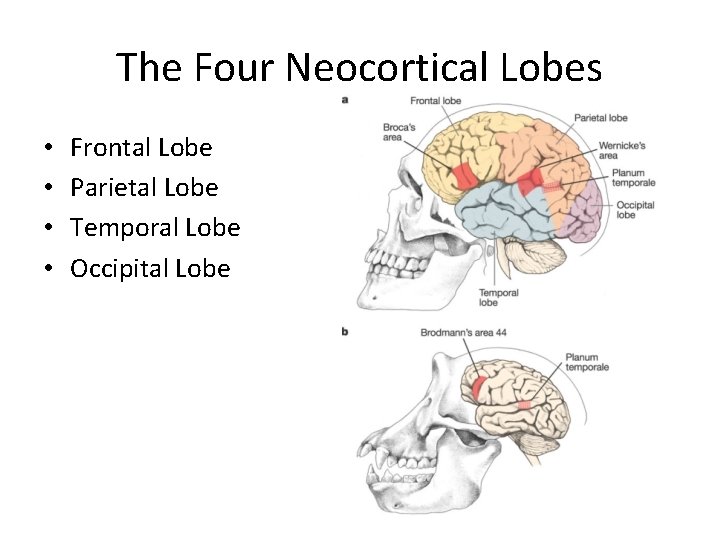
The Four Neocortical Lobes • • Frontal Lobe Parietal Lobe Temporal Lobe Occipital Lobe
Frontal Lobe Center of conscious awareness. Freewill comes from. Focus attention. Coordinate nearly all the functions in the rest of the brain. • The motor cortex and language center • The last part of the brain to develop (mid-20’s). • •
Parietal Lobe • Deals with sensations related to touch, taste, and feeling, visual-spatial tasks, body orientation, also coordinates some language functions. • Somatosensory center of the brain. • Homunculus AKA “little man” is a map of the specific motor and sensory areas as they relate to specific parts of the body. • Proprioception center. • More cortical tissue is designated for areas of the body with more sensitivity.

Temporal Lobe • Process sounds, perception, learning, language, and memory. • The center that processes smell. • Interprets sounds into language. • Involved in some memory processes and helps make long term memories. • Links what we see to our emotions and memories.
Occipital Lobe • Manages visual information • AKA Visual Cortex. • Has six distinct layers associated with light, movement, form, shape, depth, and color.
Brain Waves: The measure of brain activity
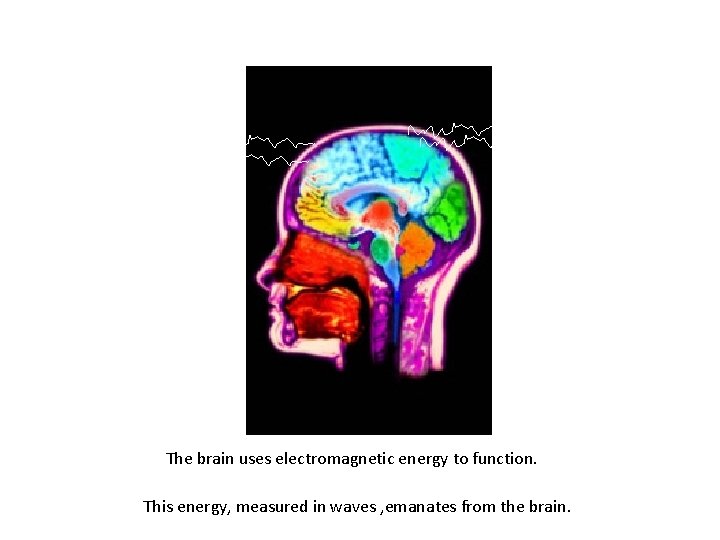
The brain uses electromagnetic energy to function. This energy, measured in waves , emanates from the brain.
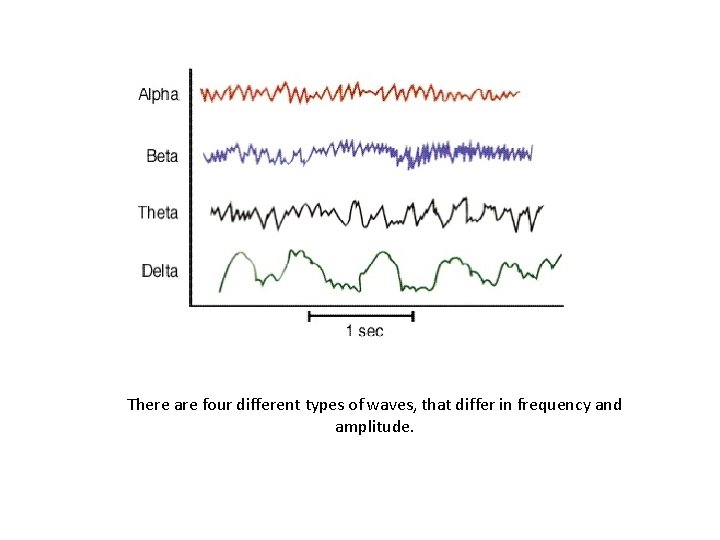
There are four different types of waves, that differ in frequency and amplitude.
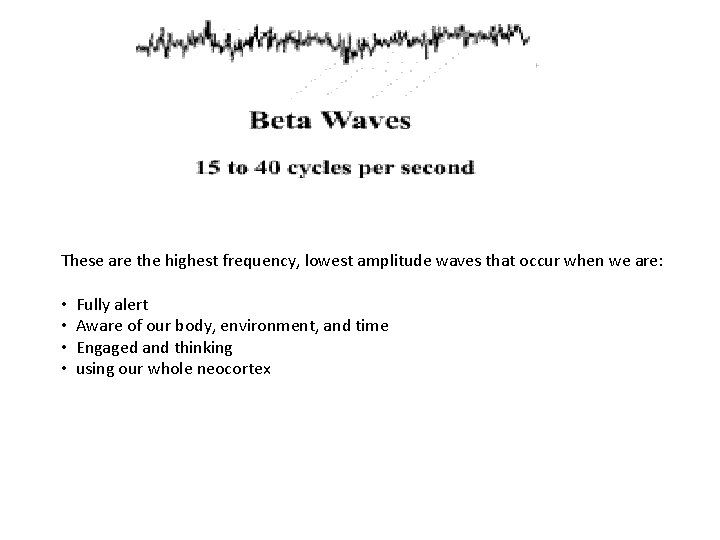
These are the highest frequency, lowest amplitude waves that occur when we are: • • Fully alert Aware of our body, environment, and time Engaged and thinking using our whole neocortex
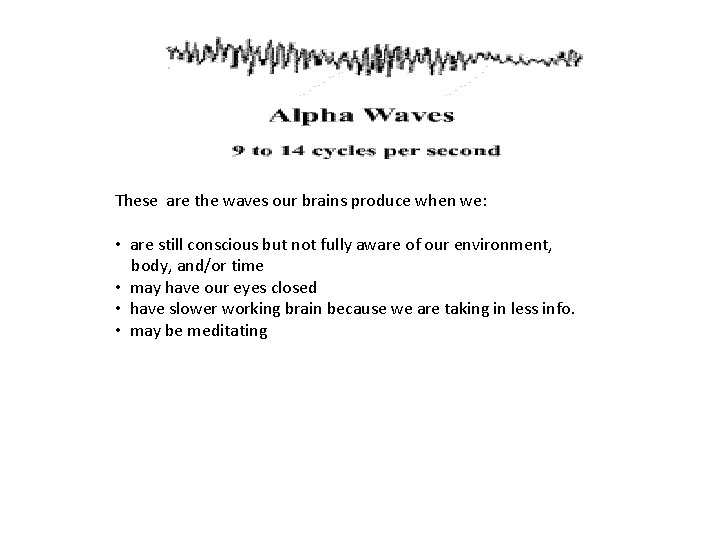
These are the waves our brains produce when we: • are still conscious but not fully aware of our environment, body, and/or time • may have our eyes closed • have slower working brain because we are taking in less info. • may be meditating
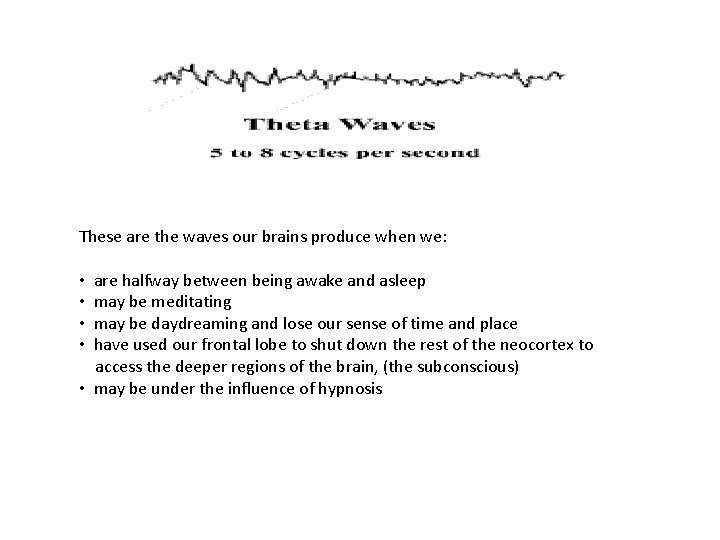
These are the waves our brains produce when we: are halfway between being awake and asleep may be meditating may be daydreaming and lose our sense of time and place have used our frontal lobe to shut down the rest of the neocortex to access the deeper regions of the brain, (the subconscious) • may be under the influence of hypnosis • •
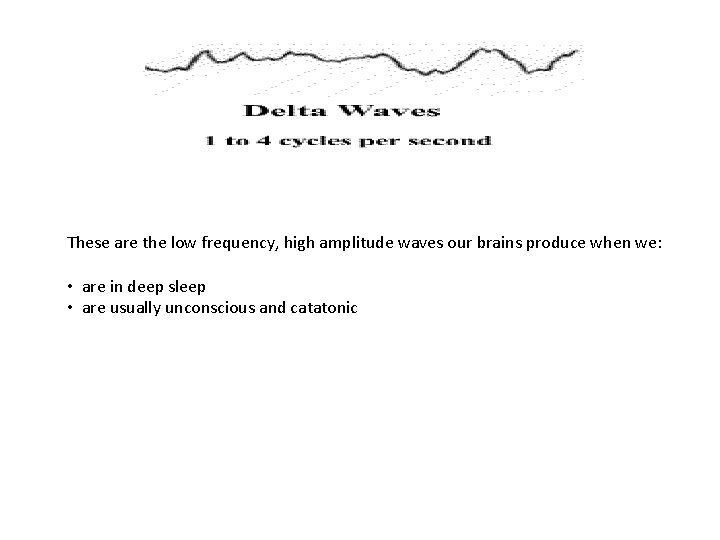
These are the low frequency, high amplitude waves our brains produce when we: • are in deep sleep • are usually unconscious and catatonic
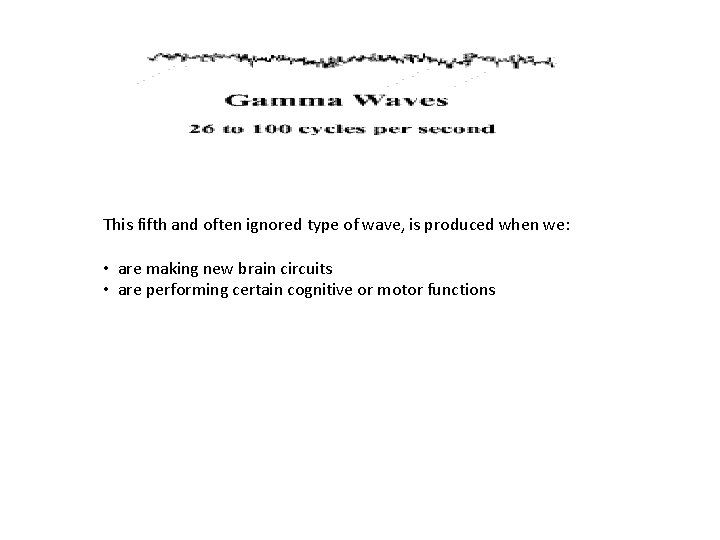
This fifth and often ignored type of wave, is produced when we: • are making new brain circuits • are performing certain cognitive or motor functions
How can our knowledge of these waves help us “Evolve our Brains”? If we can gain control over our waves, presumably through a meditative-like state, we can use our conscious mind to access our subconscious mind, (where our behaviors, habits etc. are held). When doing this, we would be in a theta state.
- Slides: 39