
Understanding The Brain Mind Psychoactive Substance Misuse Dr
Understanding The Brain, Mind, & Psychoactive Substance Misuse Dr. Audrey Begun, MSW, Ph. D The Ohio State University May, 2020 *Funded in part by the Substance Abuse and Mental Health Services Administration
Acknowledgement This presentation is part of a 2019 grant awarded to CSWE from the Substance Abuse and Mental Health Services Administration to expand substance use disorder (SUD) practitioner education in social work. During the 2 -year project, Expansion of Practitioner Education (Prac-Ed), CSWE will implement a high-quality standardized SUD curriculum, which will strengthen the preparation of future social work practitioners to deliver effective, evidence-based SUD prevention, treatment, and recovery services. 2 12/22/2021 Council on Social Work Education www. cswe. org
Outline • Psychoactive substances & the brainmind-behavior interface • Understanding neurons & neurotransmitters • Understanding functional areas of the brain • Understanding cravings • Understanding basic pharmacokinetics • Implications of the brain, mind, and substance misuse 3 12/22/2021 Council on Social Work Education www. cswe. org
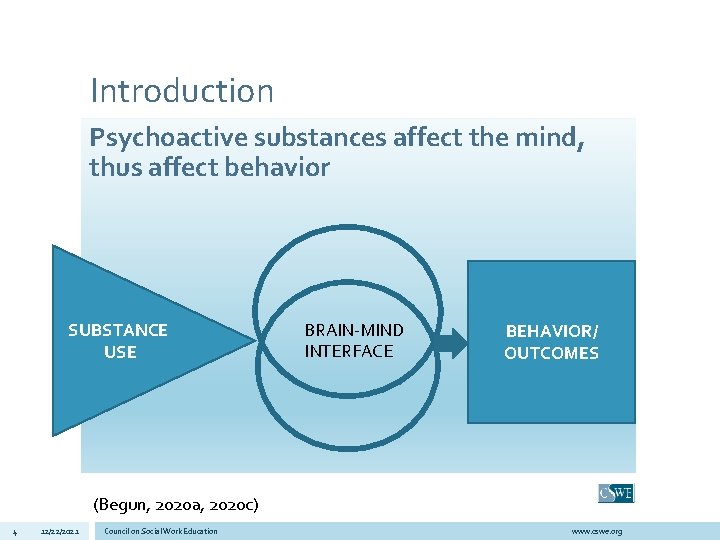
Introduction Psychoactive substances affect the mind, thus affect behavior SUBSTANCE USE BRAIN-MIND INTERFACE BEHAVIOR/ OUTCOMES (Begun, 2020 a, 2020 c) 4 12/22/2021 Council on Social Work Education www. cswe. org
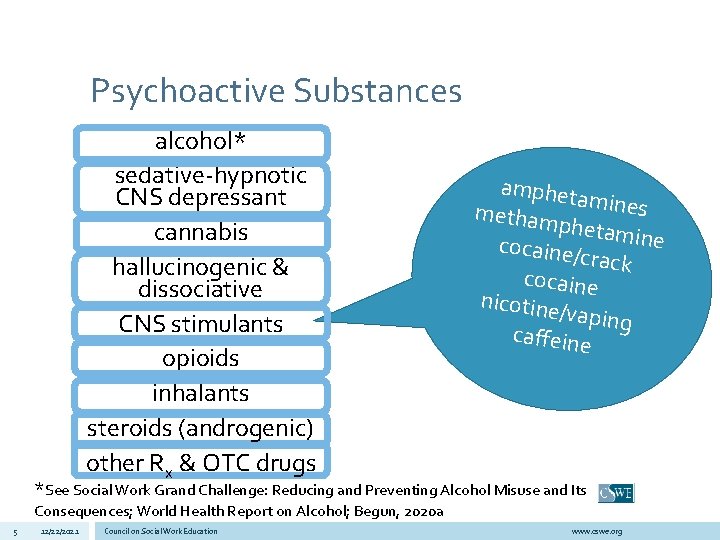
Psychoactive Substances alcohol* sedative-hypnotic CNS depressant cannabis hallucinogenic & dissociative CNS stimulants opioids inhalants steroids (androgenic) other Rx & OTC drugs amphet a metham mines phetam ine cocaine/ crack cocaine nicotine /vaping caffeine *See Social Work Grand Challenge: Reducing and Preventing Alcohol Misuse and Its Consequences; World Health Report on Alcohol; Begun, 2020 a 5 12/22/2021 Council on Social Work Education www. cswe. org
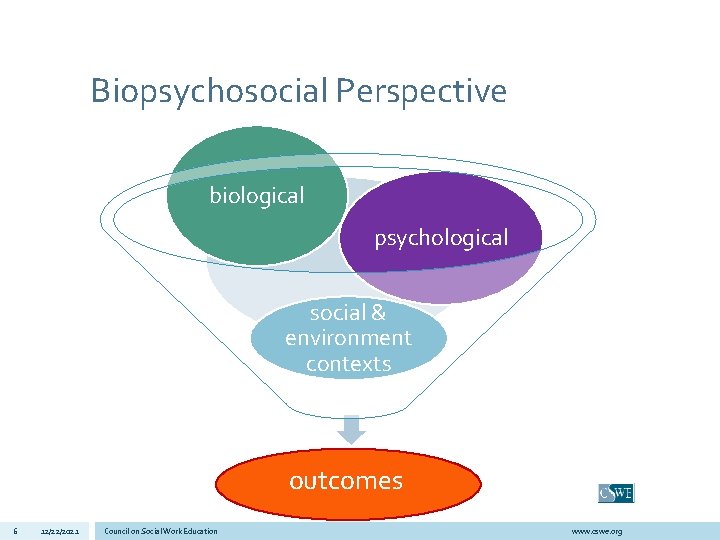
Biopsychosocial Perspective biological psychological social & environment contexts outcomes 6 12/22/2021 Council on Social Work Education www. cswe. org
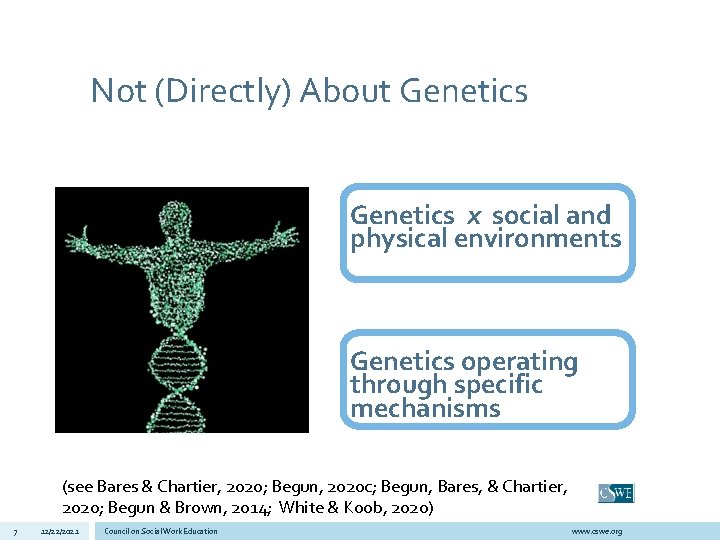
Not (Directly) About Genetics x social and physical environments Genetics operating through specific mechanisms (see Bares & Chartier, 2020; Begun, 2020 c; Begun, Bares, & Chartier, 2020; Begun & Brown, 2014; White & Koob, 2020) 7 12/22/2021 Council on Social Work Education www. cswe. org
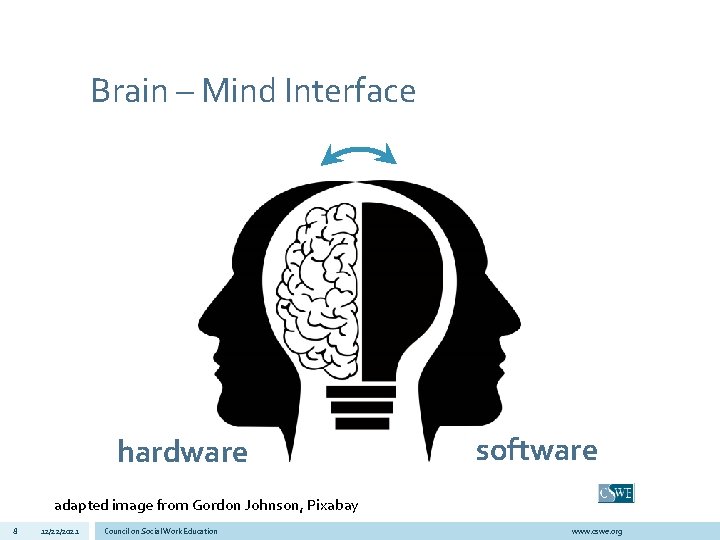
Brain – Mind Interface hardware software adapted image from Gordon Johnson, Pixabay 8 12/22/2021 Council on Social Work Education www. cswe. org
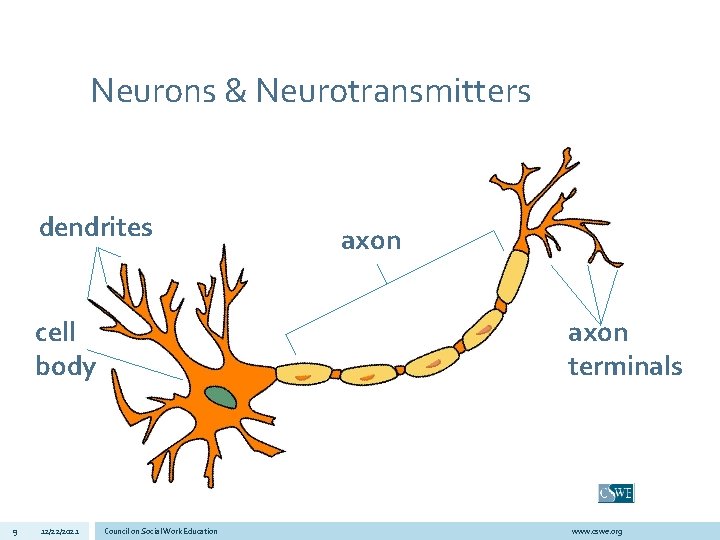
Neurons & Neurotransmitters dendrites cell body 9 12/22/2021 axon terminals Council on Social Work Education www. cswe. org
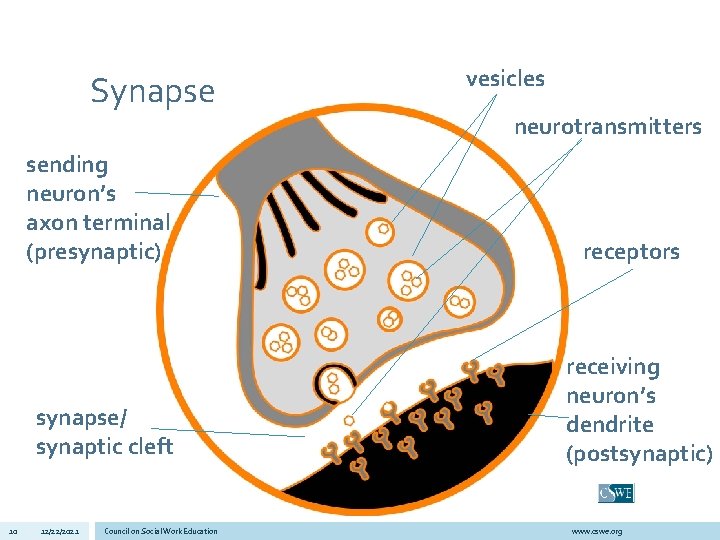
Synapse sending neuron’s axon terminal (presynaptic) synapse/ synaptic cleft 10 12/22/2021 Council on Social Work Education vesicles neurotransmitters receptors receiving neuron’s dendrite (postsynaptic) www. cswe. org
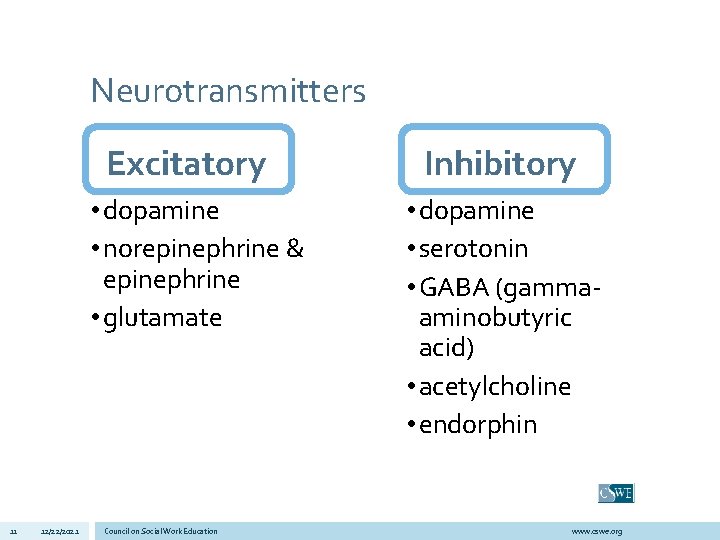
Neurotransmitters Excitatory • dopamine • norepinephrine & epinephrine • glutamate 11 12/22/2021 Council on Social Work Education Inhibitory • dopamine • serotonin • GABA (gammaaminobutyric acid) • acetylcholine • endorphin www. cswe. org
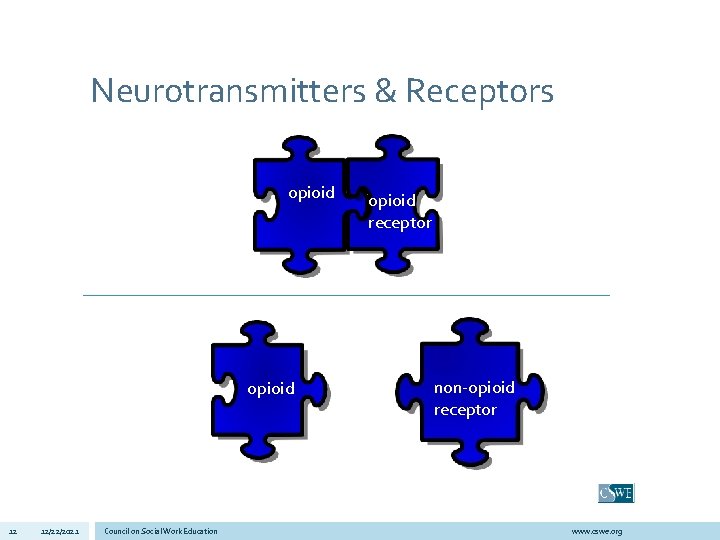
Neurotransmitters & Receptors opioid receptor methadone opioid non-opioid receptor opioid 12 12/22/2021 Council on Social Work Education www. cswe. org
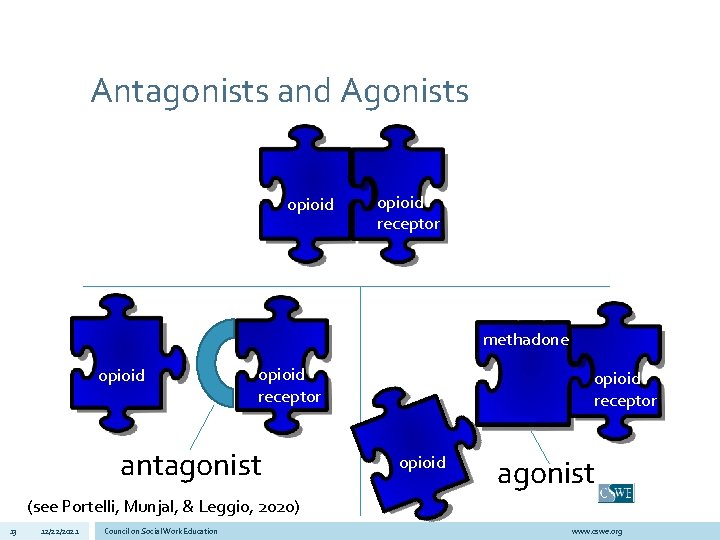
Antagonists and Agonists opioid receptor methadone opioid receptor antagonist opioid receptor opioid agonist (see Portelli, Munjal, & Leggio, 2020) 13 12/22/2021 Council on Social Work Education www. cswe. org

Endogenous vs Exogenous Sources (image from NIDA 2018 Drugs, Brain and Behavior: The science of addiction) 14 12/22/2021 Council on Social Work Education www. cswe. org
Functional Regions of The Brain According to the National Institute on Drug Abuse (NIDA, 2018), addiction: “… is considered a brain disorder because it involves functional changes to brain circuits involved in reward, stress, and self-control, and those changes may last a long time after a person has stopped taking drugs. ” 15 12/22/2021 Council on Social Work Education www. cswe. org
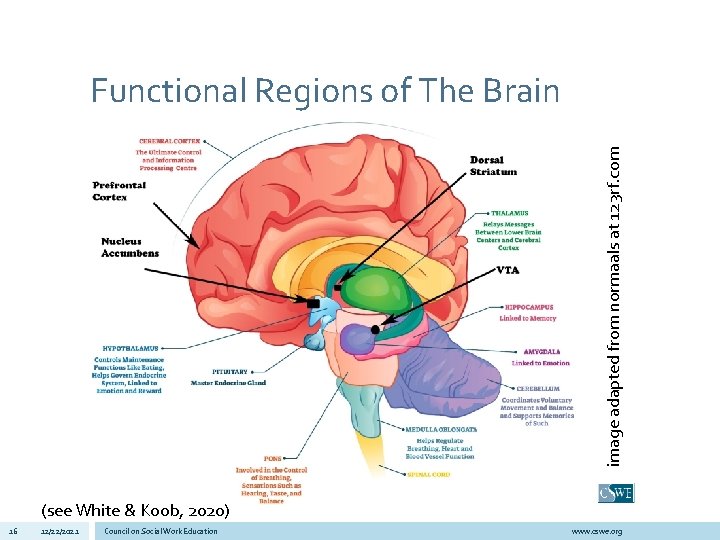
image adapted from normaals at 123 rf. com Functional Regions of The Brain (see White & Koob, 2020) 16 12/22/2021 Council on Social Work Education www. cswe. org
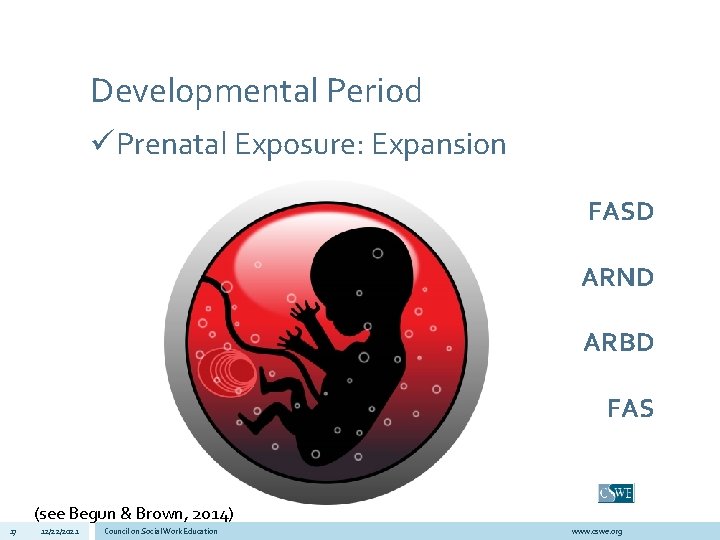
Developmental Period üPrenatal Exposure: Expansion FASD ARND ARBD FAS (see Begun & Brown, 2014) 17 12/22/2021 Council on Social Work Education www. cswe. org
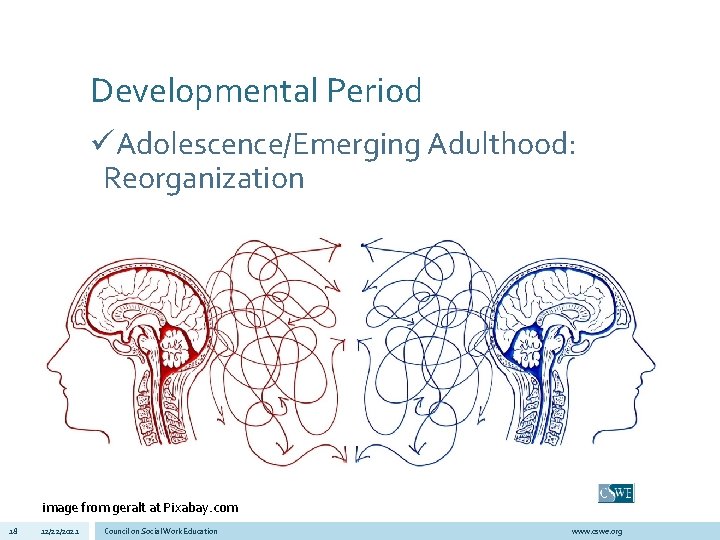
Developmental Period üAdolescence/Emerging Adulthood: Reorganization image from geralt at Pixabay. com 18 12/22/2021 Council on Social Work Education www. cswe. org
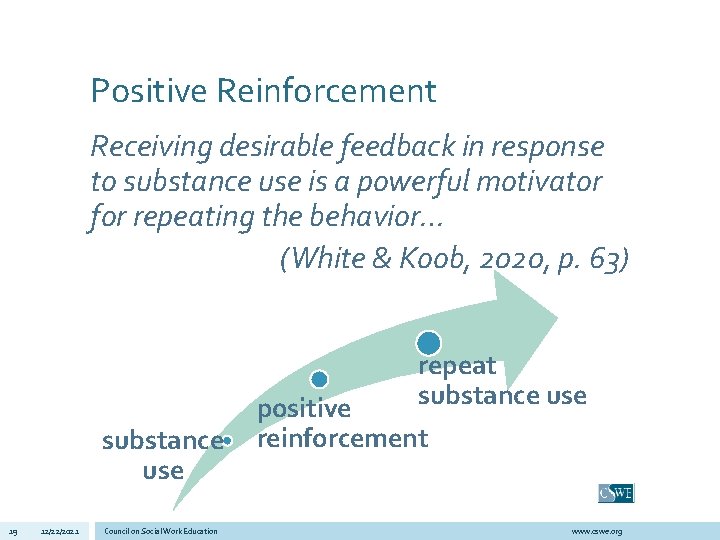
Positive Reinforcement Receiving desirable feedback in response to substance use is a powerful motivator for repeating the behavior… (White & Koob, 2020, p. 63) repeat substance use 19 12/22/2021 Council on Social Work Education positive reinforcement www. cswe. org
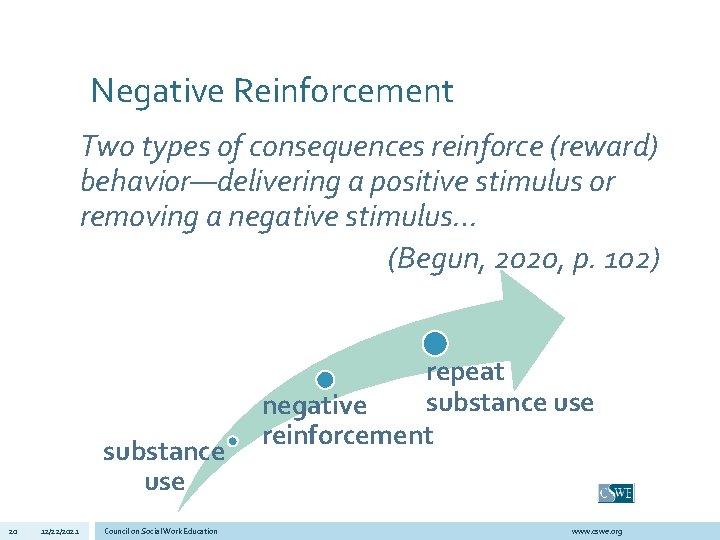
Negative Reinforcement Two types of consequences reinforce (reward) behavior—delivering a positive stimulus or removing a negative stimulus… (Begun, 2020, p. 102) substance use 20 12/22/2021 Council on Social Work Education repeat substance use negative reinforcement www. cswe. org
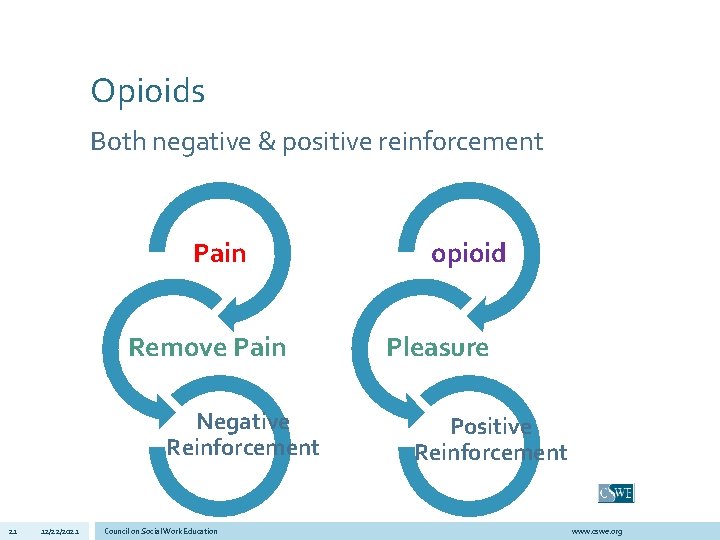
Opioids Both negative & positive reinforcement Pain Remove Pain Negative Reinforcement 21 12/22/2021 Council on Social Work Education opioid Pleasure Positive Reinforcement www. cswe. org
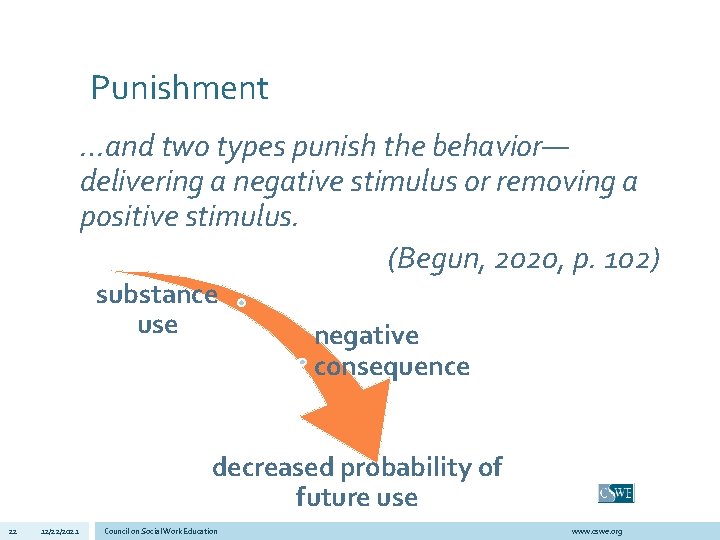
Punishment …and two types punish the behavior— delivering a negative stimulus or removing a positive stimulus. (Begun, 2020, p. 102) substance use negative consequence decreased probability of future use 22 12/22/2021 Council on Social Work Education www. cswe. org
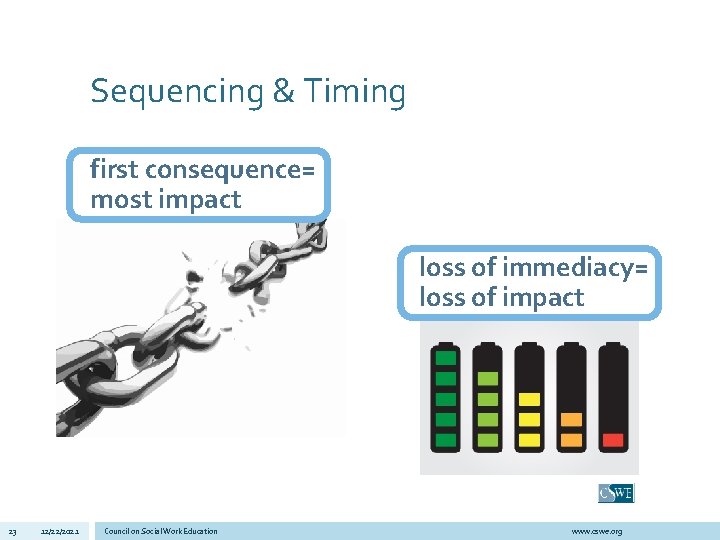
Sequencing & Timing first consequence= most impact loss of immediacy= loss of impact 23 12/22/2021 Council on Social Work Education www. cswe. org
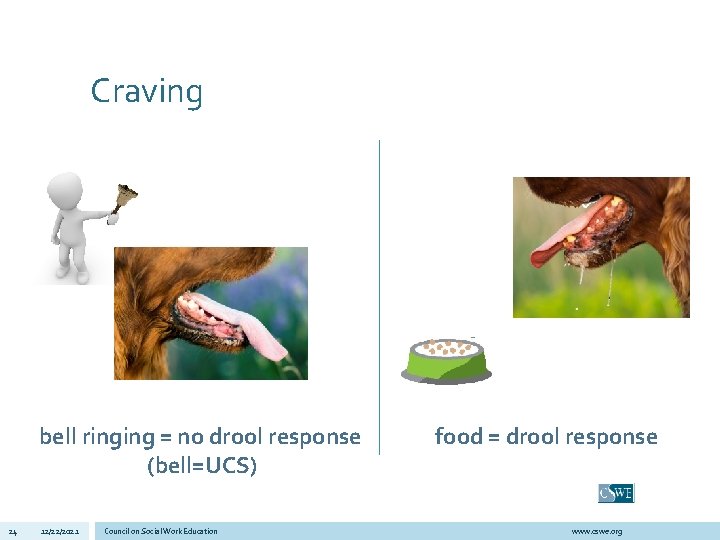
Craving bell ringing = no drool response (bell=UCS) 24 12/22/2021 Council on Social Work Education food = drool response www. cswe. org
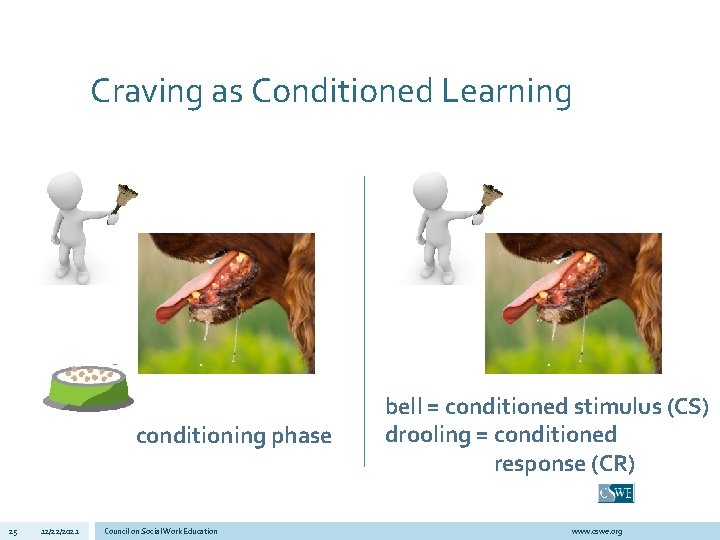
Craving as Conditioned Learning conditioning phase 25 12/22/2021 Council on Social Work Education bell = conditioned stimulus (CS) drooling = conditioned response (CR) www. cswe. org
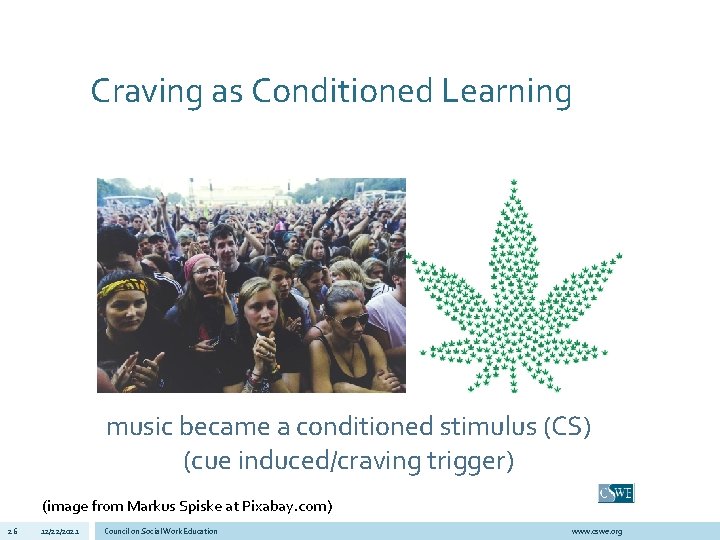
Craving as Conditioned Learning music became a conditioned stimulus (CS) (cue induced/craving trigger) (image from Markus Spiske at Pixabay. com) 26 12/22/2021 Council on Social Work Education www. cswe. org
“But all such facts are remote and unsubstantial compared with the near, felt fact of a craving, here and now, for release or sedation, for a drink or a smoke. ” -Aldous Huxley image from Stefan Keller at Pixabay. com Craving Experience (see Edguer & Taylor, 2020; Zweben & West, 2020) 27 12/22/2021 Council on Social Work Education www. cswe. org
Pharmacokinetic Principles speed and intensity short- vs long-acting tolerance & sensitization withdrawal symptoms image from Lara Arh @123 rf. com 28 12/22/2021 Council on Social Work Education www. cswe. org
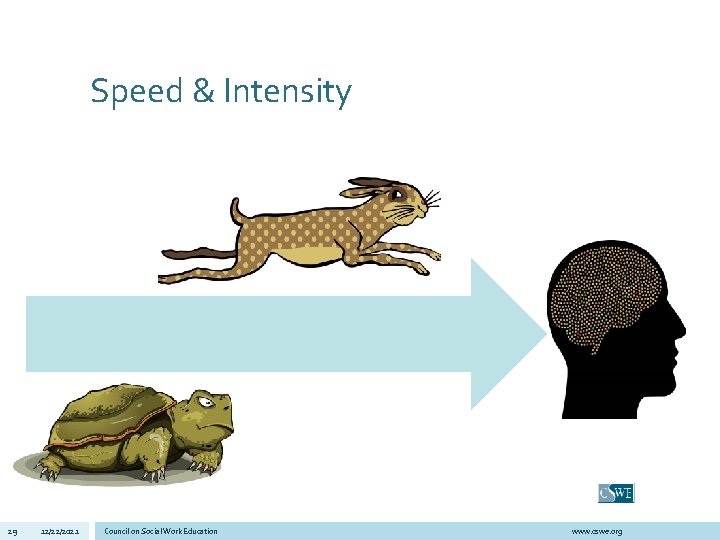
Speed & Intensity 29 12/22/2021 Council on Social Work Education www. cswe. org
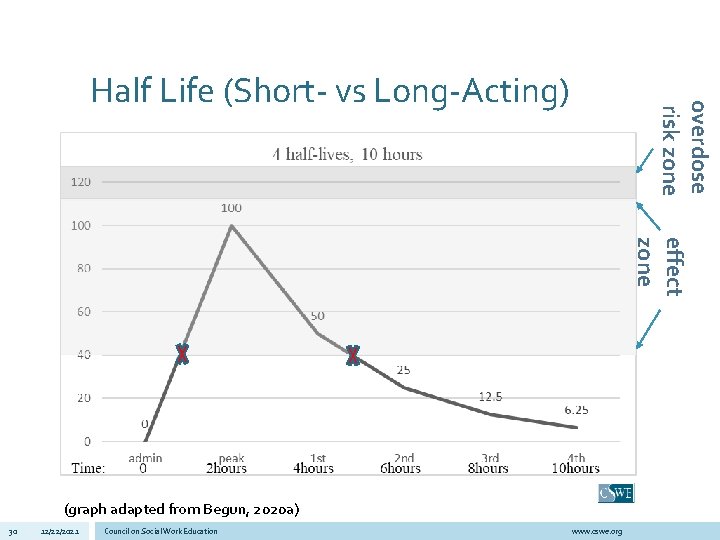
overdose risk zone Half Life (Short- vs Long-Acting) effect zone (graph adapted from Begun, 2020 a) 30 12/22/2021 Council on Social Work Education www. cswe. org
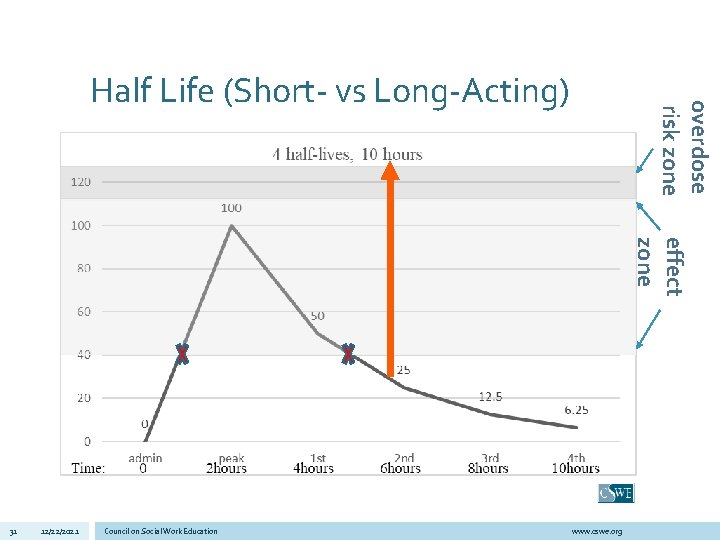
overdose risk zone Half Life (Short- vs Long-Acting) effect zone 31 12/22/2021 Council on Social Work Education www. cswe. org
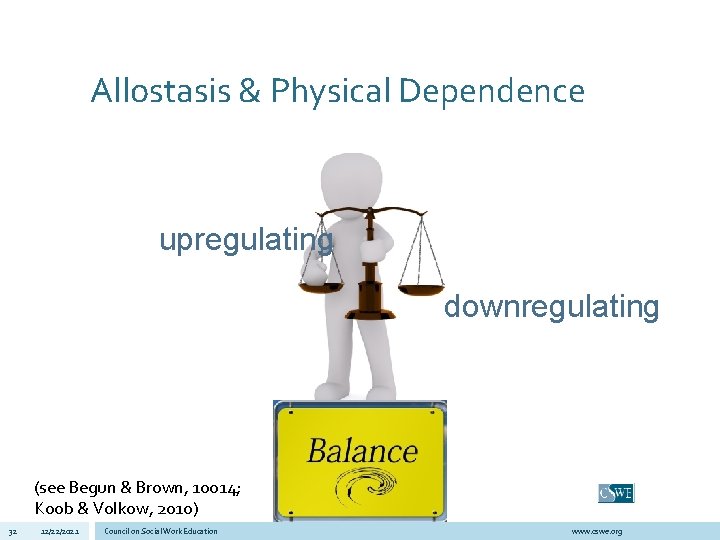
Allostasis & Physical Dependence upregulating downregulating (see Begun & Brown, 10014; Koob & Volkow, 2010) 32 12/22/2021 Council on Social Work Education www. cswe. org
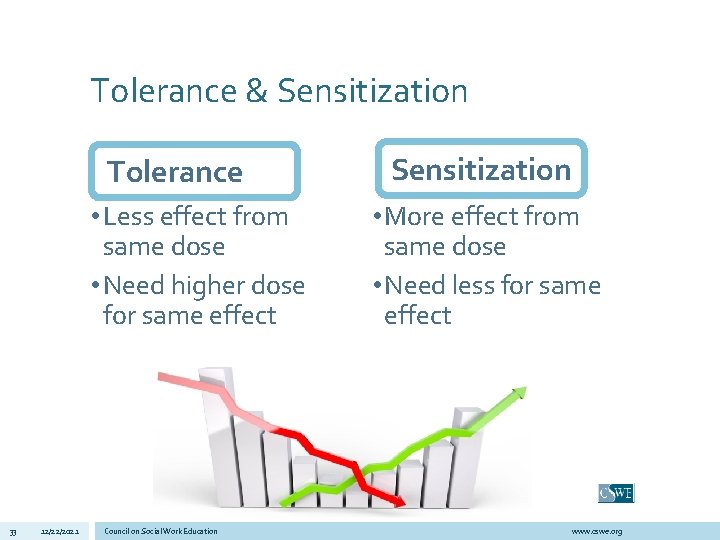
Tolerance & Sensitization Tolerance • Less effect from same dose • Need higher dose for same effect 33 12/22/2021 Council on Social Work Education Sensitization • More effect from same dose • Need less for same effect www. cswe. org
Tolerance, Dependence, & Withdrawal Drugs excite the parts of the brain that make you feel good. But after you take a drug for a while, the feel-good parts of your brain get used to it. Then you need to take more of the drug to get the same good feeling. Soon, your brain and body musts have the drug to just feel normal. You feel sick, awful, anxious, and irritable without the drug. You no longer have the good feelings that you had when you first used the drug. -NIDA, 2017 34 12/22/2021 Council on Social Work Education www. cswe. org
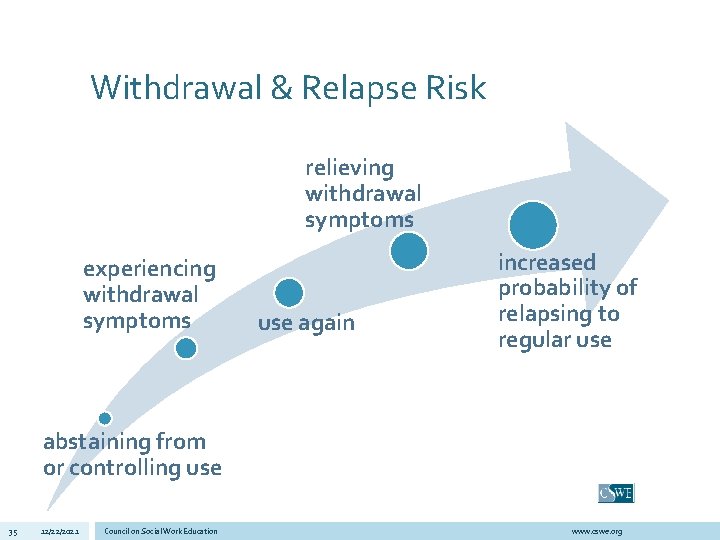
Withdrawal & Relapse Risk relieving withdrawal symptoms experiencing withdrawal symptoms use again increased probability of relapsing to regular use abstaining from or controlling use 35 12/22/2021 Council on Social Work Education www. cswe. org
Risky Withdrawal • substance-specific symptoms • DSM-5 & ICD-11 diagnostic criteria • medically managed detoxification 36 12/22/2021 Council on Social Work Education www. cswe. org
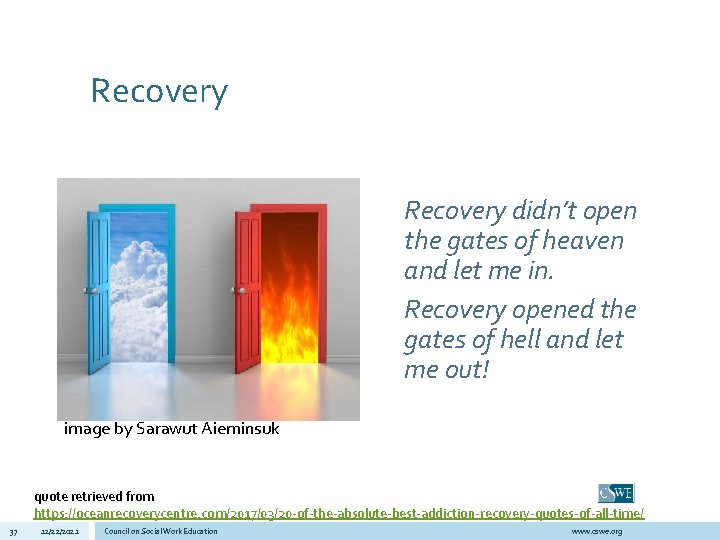
Recovery didn’t open the gates of heaven and let me in. Recovery opened the gates of hell and let me out! image by Sarawut Aieminsuk quote retrieved from https: //oceanrecoverycentre. com/2017/03/20 -of-the-absolute-best-addiction-recovery-quotes-of-all-time/ 37 12/22/2021 Council on Social Work Education www. cswe. org
Wrap-up • Psychoactive substances & the brain-mindbehavior interface • Understanding neurons & neurotransmitters • Understanding functional areas of the brain • Understanding cravings • Understanding basic pharmacokinetics • Implications
References • Andrews, T. M. (2017). Nelsan Ellis died of alcohol withdrawal. Family hopes his death will be a ‘cautionary tale. ’ Washington Post, July 11. Retrieved from https: //www. washingtonpost. com/news/morning- mix/wp/2017/07/11/nelsan-ellis-died-from-alcohol-withdrawal-family-hopeshis-death-will-be-a-cautionary-tale/ • Bares, C. B. , & Chartier, K. G. (2020). The role of genes and environment in shaping substance misuse. In A. L. Begun & M. M. Murray, (Eds. ), The Routledge handbook of social work and addictive behaviors, (78 -94). NY: Routledge. • Begun, A. L. (2020 a). Introduction to psychoactive substances. In A. L. Begun & M. M. Murray, (Eds. ), The Routledge handbook of social work and addictive behaviors, (18 -38). NY: Routledge. • Begun, A. L. (2020 b). Psychological models of addictive behavior. In A. L. Begun & M. M. Murray, (Eds. ), The Routledge handbook of social work and addictive behaviors, (95 -109). NY: Routledge. • Begun, A. L. (2020 c). Theories and biological basis of substance misuse. Open Educational Resource. Retrieved from https: //ohiostate. pressbooks. pub/substancemisusepart 1/ and https: //ohiostate. pressbooks. pub/substancemisusepart 2/ 39 12/22/2021 Council on Social Work Education www. cswe. org
References (continued) • Begun, A. L. , & Brown, S. (2014). Neurobiology of substance use disorders and implications for treatment. In S. L. A. Straussner, (Ed. ), Clinical work with substance abusing clients, 3 rd edition, (pp. 39 -66). NY: Guilford Press. • Begun, A. L. , Clapp, J. , & The Alcohol Misuse Grand Challenge Collective. (2015). Reducing and preventing alcohol misuse and its consequences: A Grand Challenge for social work. Cleveland, OH: American Academy of Social Work & Social Welfare. Retrieved from https: //grandchallengesforsocialwork. org/wpcontent/uploads/2015/12/WP 14 -with-cover. pdf • Edguer, M. , & Taylor, L. (2020). Mindfulness practices in addictive behavior prevention, treatment, and recovery. In A. L. Begun & M. M. Murray, (Eds. ), The Routledge handbook of social work and addictive behaviors, (p. 355 -365). NY: Routledge. • Koob, G. F. , & Volkow, N. D. (2010). Neurocircuitry of addiction. Neuropharmacology, 35, 217 -238. 40 12/22/2021 Council on Social Work Education www. cswe. org
References (continued) • National Institute on Drug Abuse (NIDA). (2018). Drugs, brains, and behavior: The science of addiction. Retrieved from https: //www. drugabuse. gov/publications/drugs-brains-behaviorscience-addiction/preface • Portelli, J. , Munjal, V. , & Leggio, L. (2020). Current and emerging pharmacotherapies for addiction treatment. In A. L. Begun & M. M. Murray, (Eds. ), The Routledge handbook of social work and addictive behaviors, (p. 321 -342). NY: Routledge. • White, A. M. & Koob, G. F. (2020). Overview of addiction and the brain. In A. L. Begun & M. M. Murray, (Eds. ), The Routledge handbook of social work and addictive behaviors, (p. 58 -77). NY: Routledge. • Zweben, A. , & West, B. S. (2020). Intervening around addictive behaviors. In A. L. Begun & M. M. Murray, (Eds. ), The Routledge handbook of social work and addictive behaviors, (p. 298 -320). NY: Routledge. 41 12/22/2021 Council on Social Work Education www. cswe. org
Credits Unless otherwise noted, images were created by Audrey Begun for this presentation or retrieved (and possibly edited) from Creative Commons license on Pixabay. com. • Image of cranium brain/mind retrieved from Pixabay: Image by <a href="https: //pixabay. com/users/GDJ-1086657/? utm_source=linkattribution& utm_medium=referral& utm_campaign=im age& utm_content=2099128">Gordon Johnson</a> from <a href="https: //pixabay. com/? utm_source=linkattribution& utm_medium=referral& utm_campaign=im age& utm_content=2099128">Pixabay</a> • Image of brain areas adapted from normaals at 123 rf. com, image #139354775 • Dog mouth images from reddogs at 123 rf. com #35796303 and #8170259 • Dog food dish image edited from yupiramos at 123 rf. com #92281120 42 12/22/2021 Council on Social Work Education www. cswe. org
Credits (continued) • image of doors to heaven and hell copyright to Sarawut Aiemsinsuk, retrieved from 123 rf. com license, image #63520042 • Quote retrieved from Ocean Recovery Centre https: //oceanrecoverycentre. com/2017/03/20 -of-the-absolutebest-addiction-recovery-quotes-of-all-time/ • Image of shadow monster from Stefan Keller at Pixabay. com • Quote from Aldous Huxley from The doors of perception & Heaven and hell, retrieved from https: //www. goodreads. com/quotes/search? page=106&q=aldo us+huxley 43 12/22/2021 Council on Social Work Education www. cswe. org
Thank you!
- Slides: 44