
UNDERSTANDING THE BEHAVIOR ACADEMIC DISHONESTY No one can
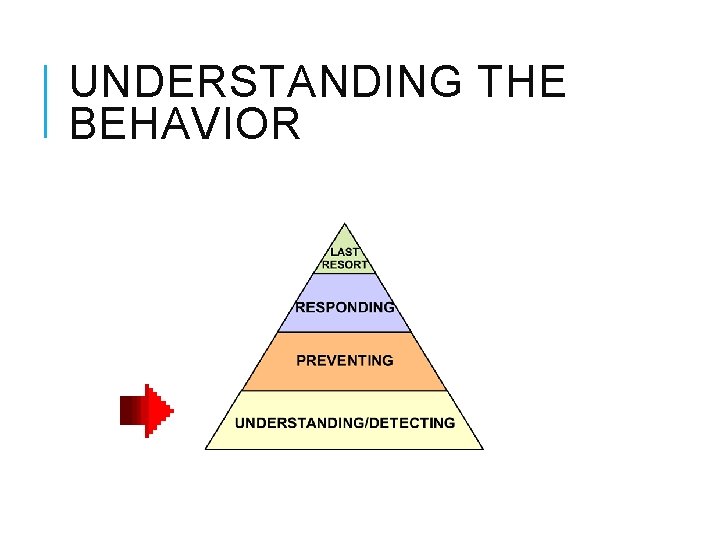
UNDERSTANDING THE BEHAVIOR
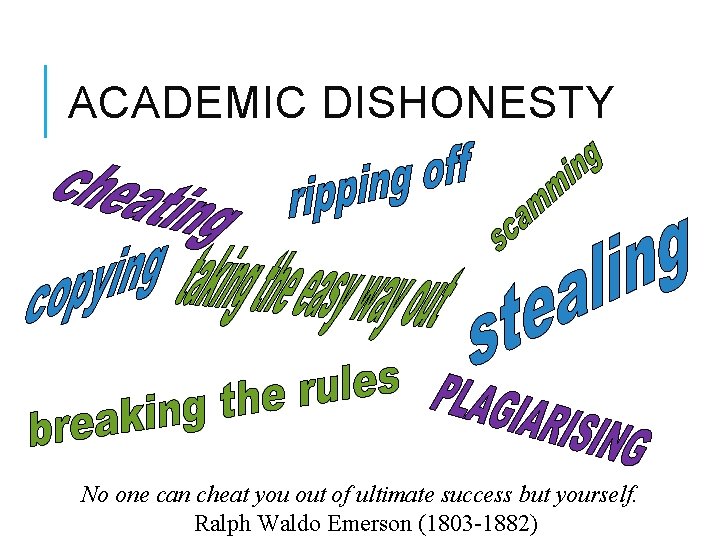
ACADEMIC DISHONESTY No one can cheat you out of ultimate success but yourself. Ralph Waldo Emerson (1803 -1882)

UNDERSTANDING ACADEMIC DISHONESTY OR CHEATING • Copying homework • Copying answers during a test • Sharing test questions with someone in another class before that person takes the test • Collaborating on an assignment that is supposed to be independent • Plagiarism
WHICH OF THE FOLLOWING ARE NOT CONSIDERED TO BE EXAMPLES OF ACADEMIC DISHONESTY? 1. Downloading a text and handing it 7. Copying a friend’s homework in 8. Working on an assignment with 2. Getting a friend’s old assignment others when it was assigned as and handing it in individual work 3. Handing in an assignment that 9. Copying one sentence from an you already did for another class internet site without citation 4. Giving somebody an assignment 10. Using another person’s ideas to copy as your own 5. Copying from one of your peers on a test, quiz or exam 6. Getting your parents, family or friends to write some of your work for you 11. Changing the words around to make it yours, but not citing the source of the information

THEY ARE ALL EXAMPLES OF ACADEMIC DISHONESTY 1. Downloading a text and handing it in 7. Copying a friend’s homework 2. Getting a friend’s old assignment and handing it in 8. Working on an assignment with others when it was assigned as individual work 3. Handing in an assignment that you already did for another class 9. Copying one sentence from an internet site without citation 4. Giving somebody an assignment to copy 10. Using another person’s ideas as your own 5. Copying from one of your peers on a test, quiz or exam 11. Changing the words around to make it yours, but not citing the source of the information 6. Getting your parents, family or friends to write some of your work for you

DEFINITION OF PLAGIARISM It is using other's ideas and words without c acknowledging the source of that informatio Definition taken from http: //www. indiana. edu/~wts/plagiarism. html
UNDERSTANDING WHAT IT IS Pre-test Your Knowledge “Pre-test Your Knowledge of Plagiarism. ” University Libraries. The University of Southern Mississippi. N. d. Web. 04 September 2014.
ST. LUKE SCHOOL WANTS YOU TO LEARN: • Honesty and Integrity… “Feel proud about your accomplishments rather than guilty about your dishonesty. ” • Fairness… “How is your cheating fair to your peers who are also trying to succeed? ” • Legality… “In the workplace, people could get fired or sued for plagiarism. ”
ST. LUKE SCHOOL WANTS YOU TO LEARN: • Content and curriculum… “If you use other people’s work you aren’t learning the material. ” • Organizational skills… “Don’t leave things to the last minute and you won’t need to panic and plagiarize. ” • “Give CREDIT where CREDIT is DUE!”
HERE AT ST. LUKE SCHOOL WE HAVE AN HONOR CODE. LET’S READ IT… Honor Code The students at St. Luke are expected to display integrity both academically and socially while in school and while participating in activities outside school. To uphold good character, students are expected to be honest to God, themselves, teachers, coaches, administrators, and each other. Academic honesty is a vital part of St. Luke’s beliefs in providing an excellent academic education that is faith-based. St. Luke students are expected to demonstrate honesty in all that they do by:
HONOR CODE CONTINUED… Completing their own work to the best of their ability without assistance from anyone else, whether it is classwork, homework, AR or AM diagnostics or tests, research papers and essays, or quizzes and tests. Refusing to share their work of any kind with other anyone else unless instructed to do so by the teacher/staff member. Ensuring all work is free of any form of direct or indirect plagiarism from published or unpublished sources. Refraining from behaviors that are emotionally or socially hurtful toward others such as teasing, gossiping, excluding others, or any form or degree of bullying.
HONOR CODE CONTINUED… Demonstrating good sportsmanship at academic and athletic competitions and events. Following rules at all times when competing. Being truthful in word and deed. An Honor Code violation may be addressed by school administrators or their designee. Consequences will be appropriate for the age and individual needs of the child. They may include, but are not limited to, receiving a zero on the assignment, an office referral, parent contact/conference, full or partial suspension, probation or removal from National Junior Honor Society, Student Council, athletic teams, and or other extracurricular activities, recording the incident as part of the student’s permanent record, and/or dismissal from St. Luke School.
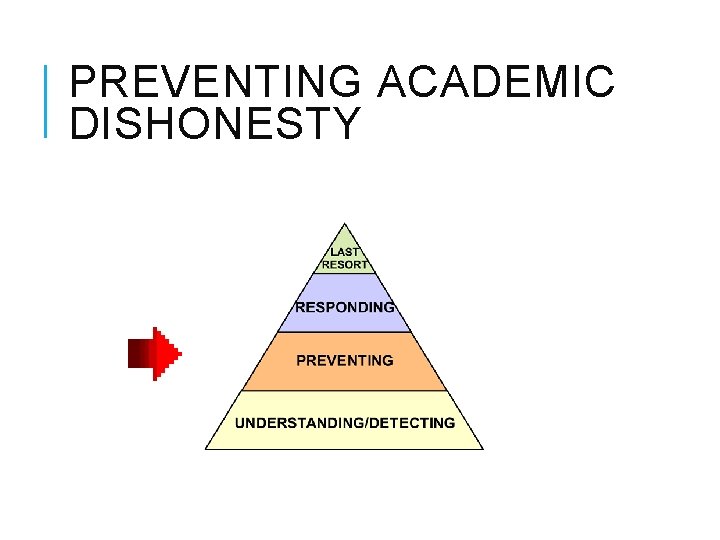
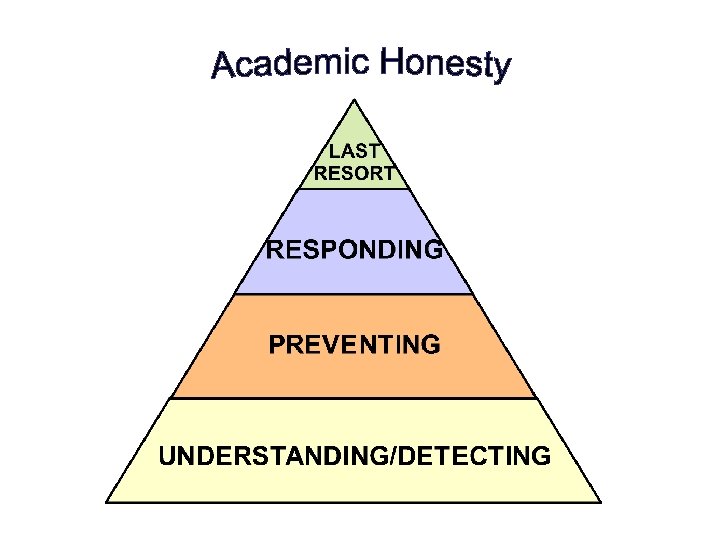
PREVENTING ACADEMIC DISHONESTY
GIVE CREDIT WHERE CREDIT IS DUE! • Acknowledge your sources of ideas and information when you write a research paper, create a poster, design a website, or prepare a presentation. Don’t forget images! • Give yourself time to do this correctly!
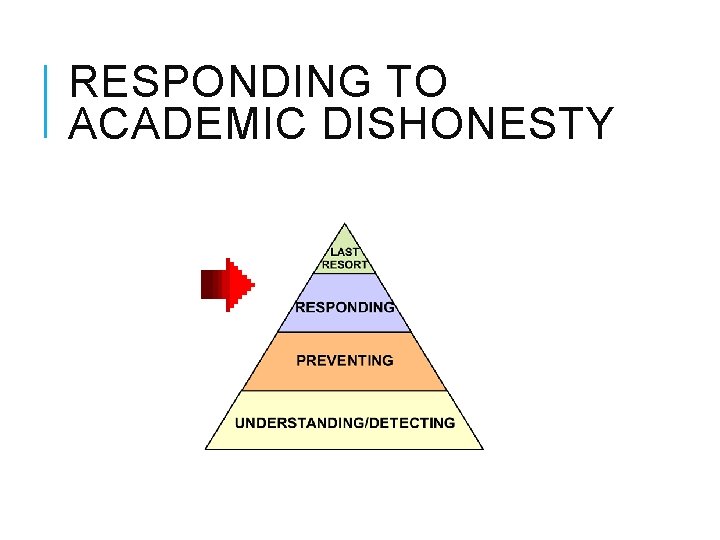
RESPONDING TO ACADEMIC DISHONESTY
CONSEQUENCES • An incomplete on the assignment or zero, or an opportunity to redo the assignment (for partial credit) • Administration will be notified • Parent will be notified • Other consequences to cheating may apply
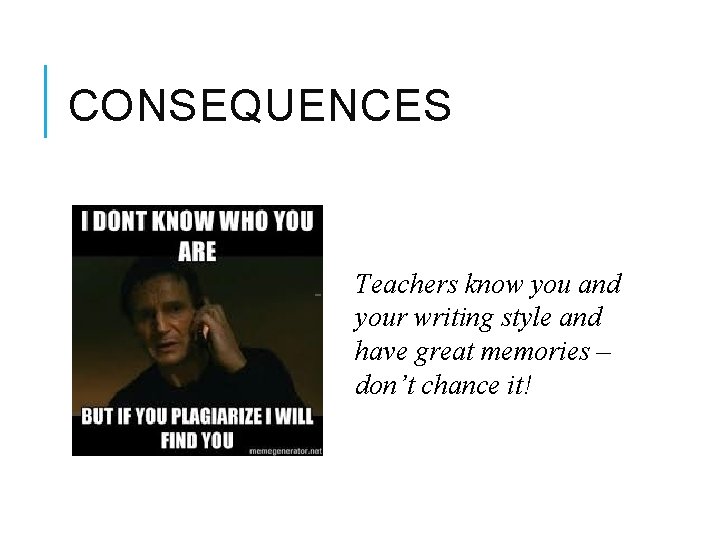
CONSEQUENCES - Teachers know you and your writing style and have great memories – don’t chance it!
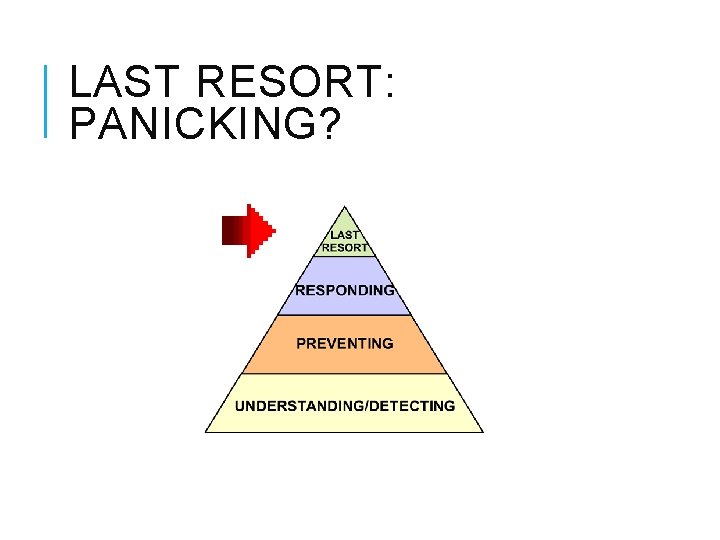
LAST RESORT: PANICKING?
REMEMBER… • It is better to ask for an extension for an assignment than to take the “easy way” out. • Teachers are here to help you to learn. • You are here to learn so you can be successful after high school. • If you don’t understand the assignment, the instructions or the expectations, ask for help!
CITATIONS (ALWAYS!) www. teacherspayteachers. com/Product/Plag iarism-Cheating-Prese ntation-1481614 www. bankscountyhigh. com/uploads/. . . /__ac ademic_integrity_tutorial. pp.
- Slides: 21