
Understanding the Academies Accountability Framework Academies Financial Handbook
Understanding the Academies Accountability Framework Academies Financial Handbook 2014
Purpose of session § To acknowledge the underlying accountability framework applying to academy trusts § To provide an overview of academies’ key financial responsibilities under the Academies’ Financial Handbook § To provide an update on key changes in the 2014 edition of the Handbook
Accountability framework A reminder that academy trusts are: § companies limited by guarantee § so subject to company law – hence avoid conflicts of interest, prepare accounts, undergo audit – and responsible for themselves § charities § so subject to charity law – hence acting in the wider public interest and accountable to beneficiaries § central government public sector bodies § so subject to public standards of accountability – hence accountable to Parliament, and PAC / HMT / NAO interest shapes the rules.
Accountability framework cont’d As they receive public funds academy trusts are also subject to: § a funding agreement with the Secretary of State § which sets out broad conditions for the receipt of grant § an Academies Financial Handbook issued by EFA § which pulls together key financial requirements and freedoms § compliance with Handbook is a condition of funding agreement § it contains principles and requirements, not guidance
A collaborative process § Working with stakeholders § the Handbook is produced in consultation with academy working groups § consultation also with HM Treasury § Giving notice § 2014 Handbook published in advance (effective from 1 Sept 2014) § 2013 Handbook still applies for year ended 31 August 2014 § Will be published on the gov. uk website § May also be accessible via forthcoming EFA Information Exchange
1: Roles and responsibilities Handbook coverage § Academy trustees § take full responsibility for financial affairs § act within powers § promote the company, not themselves § avoid conflicts of interest (etc) § Academy accounting officer (principal/CEO) § ensure regularity (purposes intended), propriety (standards) and VFM § report concerns to EFA § DFE and EFA § ultimate responsibility for adequate framework to ensure proper financial management § intervention powers (issuing financial notice to improve and withdrawal of freedoms)
1: Roles and responsibilities What’s new? § Governance reviews – a “must” for new trusts in their first year § EFA interventions – breaches of rules around connected parties may prompt a financial notice to improve § Accounts – publish on website by 31 January
2: Main financial requirements Handbook coverage § Financial oversight and management challenge – trustees to meet regularly, should have a finance committee, have a chief financial officer § Financial planning, monitoring and reporting - balance the budget, manage cash flow and publish accounts § Operational controls - have controls over decision making, reporting, procurement, asset management, risk management § Internal scrutiny - have an audit committee, or equivalent, and a means of self-checking your internal controls
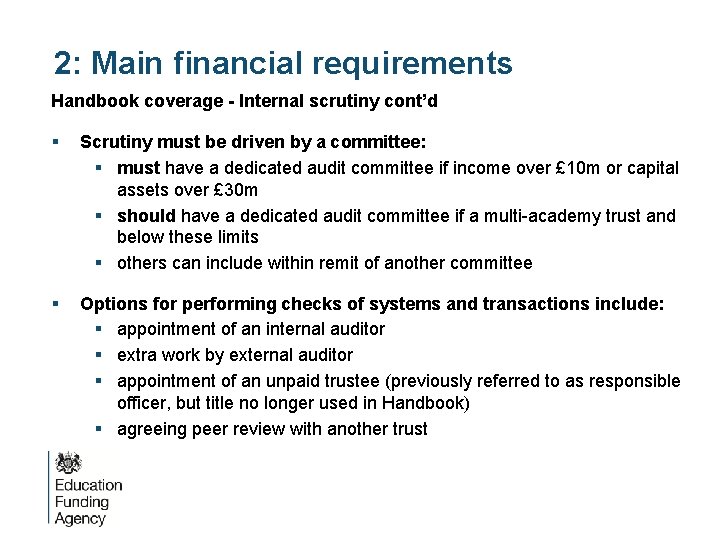
2: Main financial requirements Handbook coverage - Internal scrutiny cont’d § Scrutiny must be driven by a committee: § must have a dedicated audit committee if income over £ 10 m or capital assets over £ 30 m § should have a dedicated audit committee if a multi-academy trust and below these limits § others can include within remit of another committee § Options for performing checks of systems and transactions include: § appointment of an internal auditor § extra work by external auditor § appointment of an unpaid trustee (previously referred to as responsible officer, but title no longer used in Handbook) § agreeing peer review with another trust
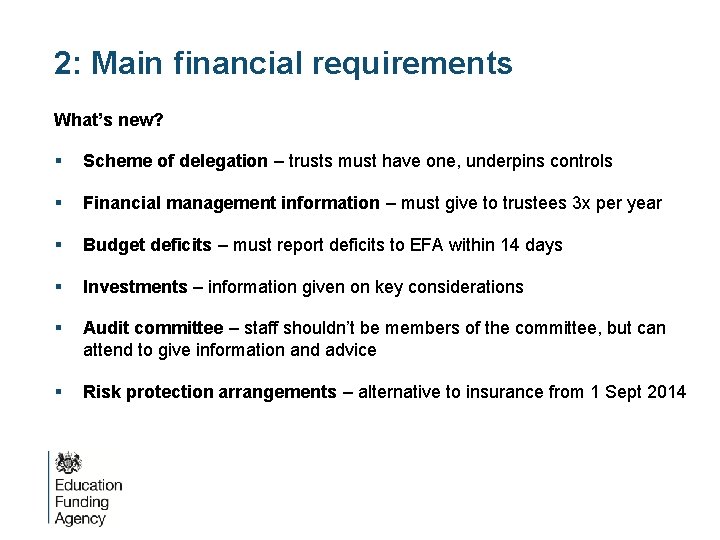
2: Main financial requirements What’s new? § Scheme of delegation – trusts must have one, underpins controls § Financial management information – must give to trustees 3 x per year § Budget deficits – must report deficits to EFA within 14 days § Investments – information given on key considerations § Audit committee – staff shouldn’t be members of the committee, but can attend to give information and advice § Risk protection arrangements – alternative to insurance from 1 Sept 2014
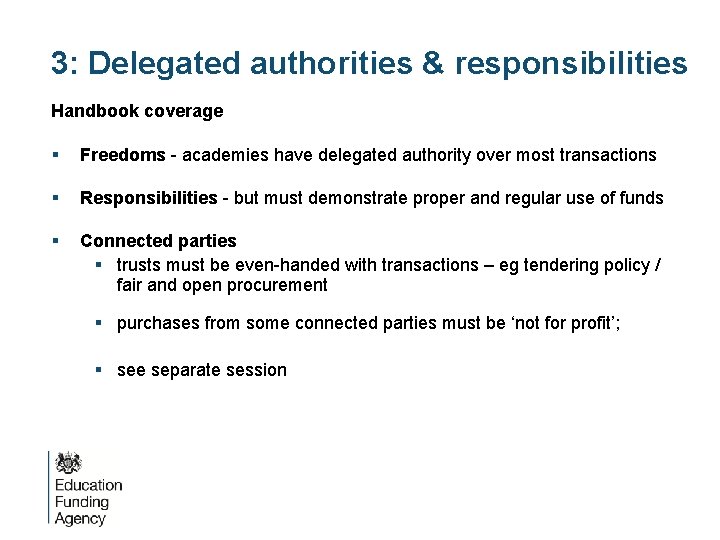
3: Delegated authorities & responsibilities Handbook coverage § Freedoms - academies have delegated authority over most transactions § Responsibilities - but must demonstrate proper and regular use of funds § Connected parties § trusts must be even-handed with transactions – eg tendering policy / fair and open procurement § purchases from some connected parties must be ‘not for profit’; § see separate session
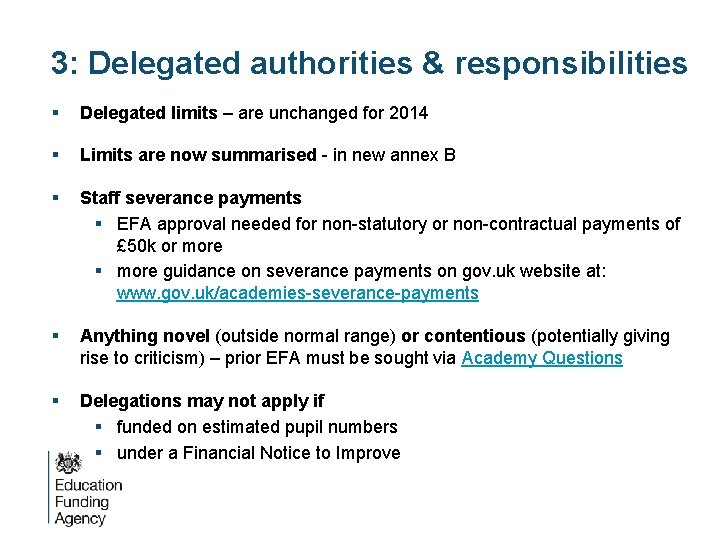
3: Delegated authorities & responsibilities § Delegated limits – are unchanged for 2014 § Limits are now summarised - in new annex B § Staff severance payments § EFA approval needed for non-statutory or non-contractual payments of £ 50 k or more § more guidance on severance payments on gov. uk website at: www. gov. uk/academies-severance-payments § Anything novel (outside normal range) or contentious (potentially giving rise to criticism) – prior EFA must be sought via Academy Questions § Delegations may not apply if § funded on estimated pupil numbers § under a Financial Notice to Improve
3: Delegated authorities & responsibilities What’s new? § Transactions with connected parties § Avoidance of personal gain – emphasis on trustees and staff § Awareness of public scrutiny and perceptions – manage real and perceived conflicts of interest (e. g. with chairs & AOs) so disclose fully § Novel and contentious transactions with connected parties – require prior EFA approval § Register of interests § members, local governors and senior staff to complete it, as well as trustees, but there may be others § the Handbook explains what the register must contain (eg other directorships and employments, and more) § Not for profit – applies only above £ 2, 500 (section 3. 2. 3)
4: Audit requirements Handbook coverage § Public scrutiny - Parliament and public expect assurance that funds are being spent as intended, hence independent audit § Audit framework § statutory audit of annual accounts – appoint external auditors, plan early § regularity audit – same auditor to consider correct use of funds – see separate session § your own financial management and governance self assessment – may be validated by EFA § Fraud and irregularity § EFA may investigate § main message - control, report, investigate
4: Audit requirements What’s new? § Fraud reporting § cases over £ 5 k (both individually or cumulatively) to be reported to EFA § information to be reported in each case is now set out
Summary - what you should do § Act within your powers § understand apply the requirements in the new Handbook § have clearly laid out responsibilities so that everyone knows the parameters § Maintain oversight § have some means of monitoring whether the requirements are being met, and taking action if they are not § Consider standards of conduct § go with the spirit, not just the letter of the Handbook § aim beyond the requirements and apply best practice § be even-handed and transparent

Thank you for watching
- Slides: 17