
Understanding tectonic and other disaster trends since 1900
- Slides: 21
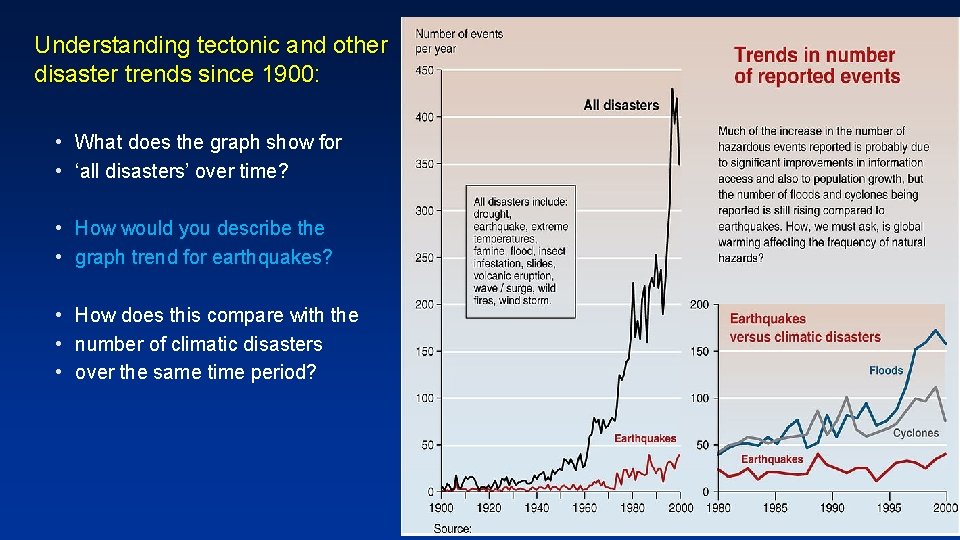
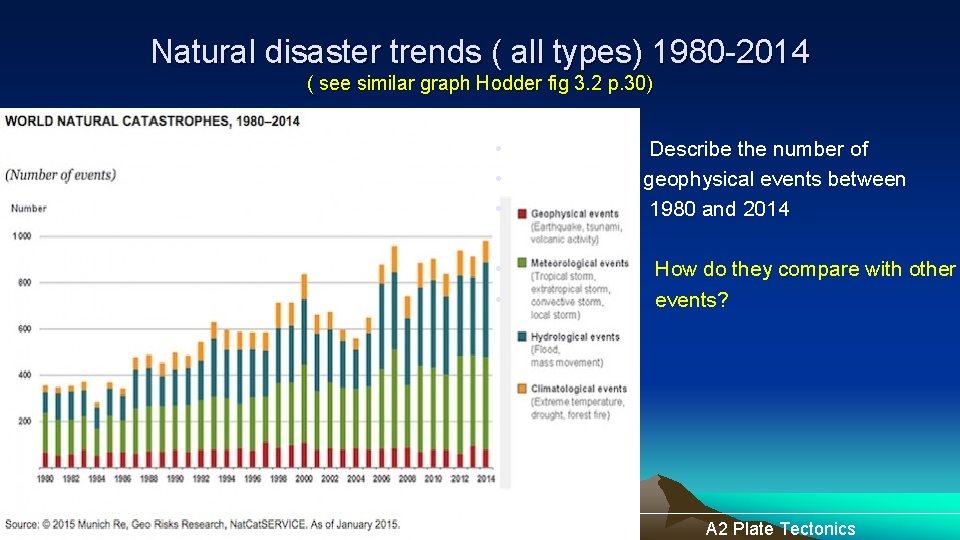
Understanding tectonic and other disaster trends since 1900: • What does the graph show for • ‘all disasters’ over time? • How would you describe the • graph trend for earthquakes? • How does this compare with the • number of climatic disasters • over the same time period?
WHITEBOARD PAIRED TASK/THINKING… • Do you think that we now live in a more hazardous world? • Could certain factors have influenced disaster trends over time? • 3 mins….
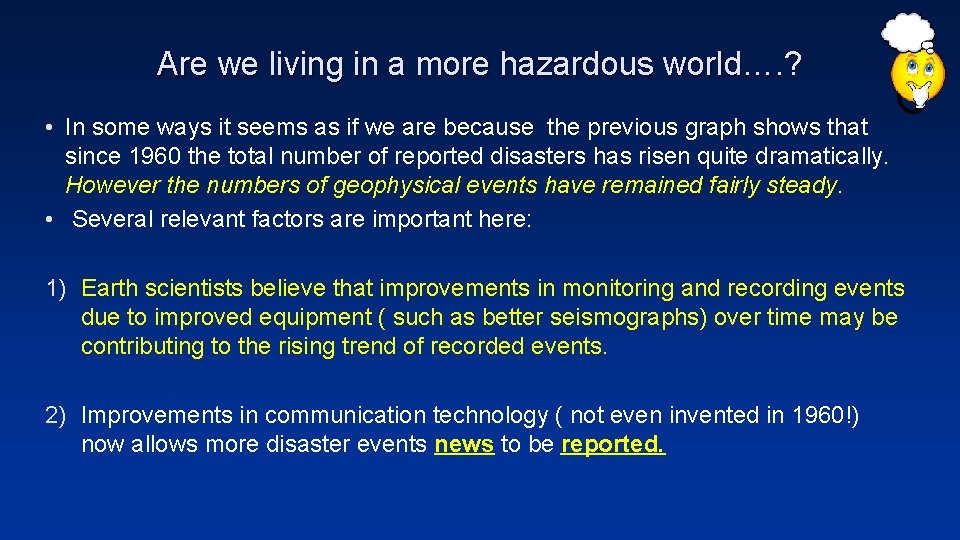
Are we living in a more hazardous world…. ? • In some ways it seems as if we are because the previous graph shows that since 1960 the total number of reported disasters has risen quite dramatically. However the numbers of geophysical events have remained fairly steady. • Several relevant factors are important here: 1) Earth scientists believe that improvements in monitoring and recording events due to improved equipment ( such as better seismographs) over time may be contributing to the rising trend of recorded events. 2) Improvements in communication technology ( not even invented in 1960!) now allows more disaster events news to be reported.
• 3. The global population in 1960 was LESS THAN 3 BILLION whereas by 2016 it had reached 7. 3 BILLION AND IS STILL RISING! • More people therefore OCCUPY MORE HAZARDOUS SPACE ( especially near rivers and coasts) therefore hazardous events affect these people directly. • 4. The increase in occupied living space also means that MORE OF THE WORLD IS NOW COVERED IN CONCRETE/ OTHER IMPERMEABLE SURFACES ( often on or close to flood plains) and therefore flood risk in particular has increased in recent years…
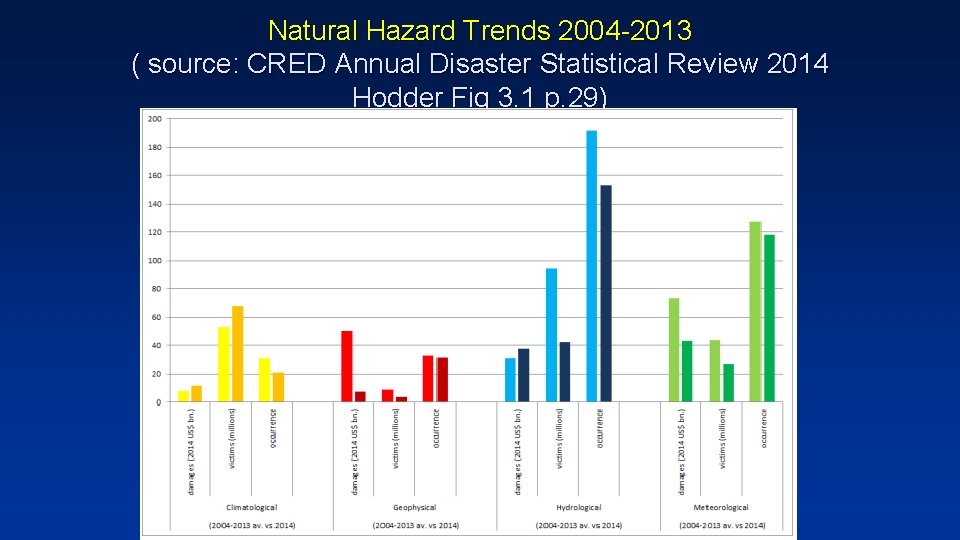
Natural Hazard Trends 2004 -2013 ( source: CRED Annual Disaster Statistical Review 2014 Hodder Fig 3. 1 p. 29)
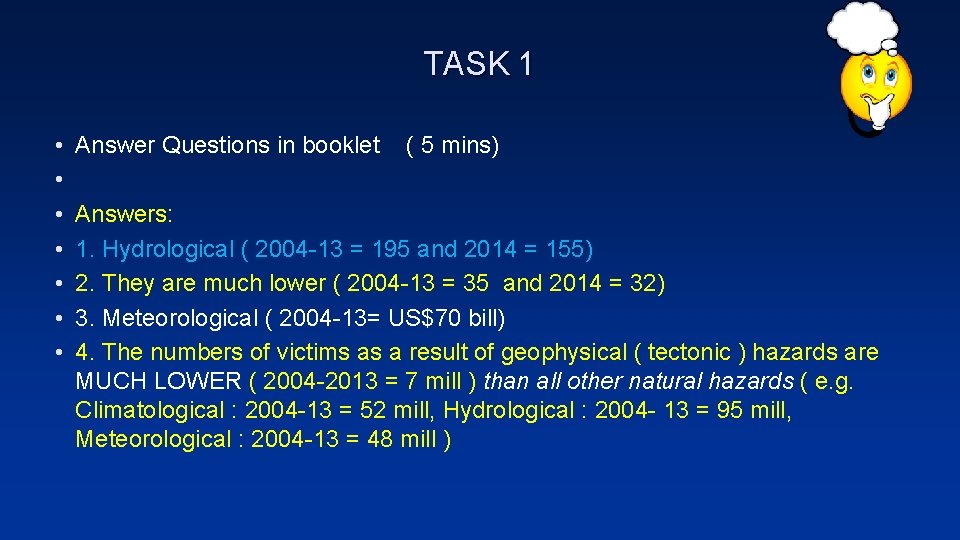
TASK 1 • • Answer Questions in booklet ( 5 mins) Answers: 1. Hydrological ( 2004 -13 = 195 and 2014 = 155) 2. They are much lower ( 2004 -13 = 35 and 2014 = 32) 3. Meteorological ( 2004 -13= US$70 bill) 4. The numbers of victims as a result of geophysical ( tectonic ) hazards are MUCH LOWER ( 2004 -2013 = 7 mill ) than all other natural hazards ( e. g. Climatological : 2004 -13 = 52 mill, Hydrological : 2004 - 13 = 95 mill, Meteorological : 2004 -13 = 48 mill )
Natural disaster trends ( all types) 1980 -2014 ( see similar graph Hodder fig 3. 2 p. 30) • • • St Bede’s College Geography Department Describe the number of geophysical events between 1980 and 2014 How do they compare with other events? A 2 Plate Tectonics
Analysing overall disaster trends over time • 1. The total ( aggregate) number of reported hazards has increased over the last 50 years. • 2. The number of reported disasters seems to be falling , having peaked in the early 2000 s ( but this appears to be an anomaly to the longer- term trend) 3. The number of deaths is also lower than in recent years but there are SPIKES with MEGA EVENTS ( see graph fig 3)
4. The total number of people affected is increasing for some hazard and disaster types, especially meteorological and hydrological ( see previous graph and fig 3. 2 p. 30 Hodder) 5. The economic costs associated with both hazards and disasters of all types have increased significantly since 1960 6. Trends relating to geophysical( tectonic) hazards show a much more STABLE OVERALL TREND. However hidden within this trend is the fact that the number of people affected and number of deaths does vary considerably year on year.
TASK 2 • Analyse the disaster statistics in the booklet and answer the questions 1 -5
WHITEBOARD PAIRED WORK/ THINKING… • How accurate and reliable do you think disaster data is ? • What factors do you think can affect this? • Why is accuracy and reliability of disaster data important? • 5 mins…
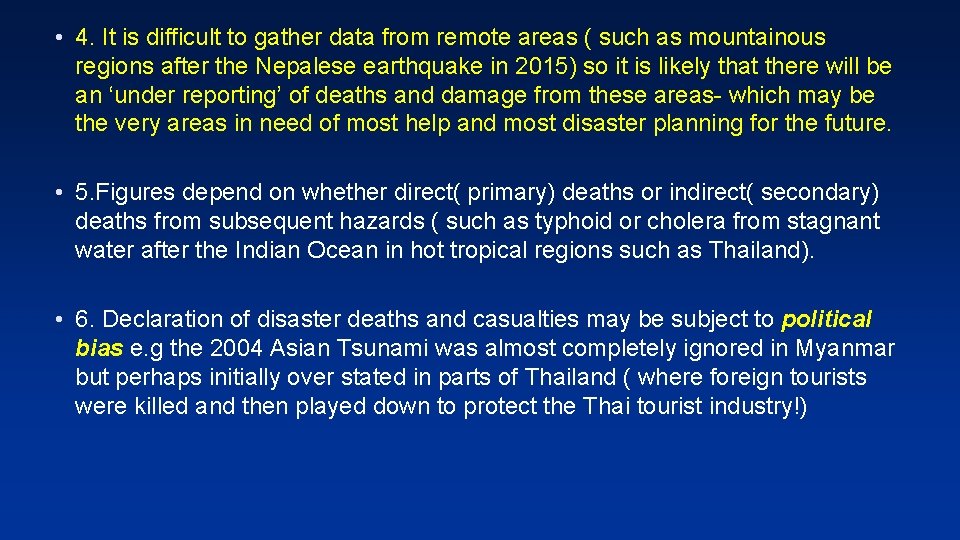
How good are disaster statistics? • Receiving accurate information about the frequency and impact of disasters is an important tool for governments, international organisations and aid agencies. However, the collection of disaster data is often incomplete or inaccurate. Why? • 1) When a disaster strikes , the immediate focus is on organising the rescue and aid efforts- not on collecting data! • 2) No single organisation is responsible for collecting data. As a result, there are often differences in the way data are collected and classified. • 3) There are even differences in the definitions of some of the key terms used such as ‘ disaster’ and ‘damage’.
• 4. It is difficult to gather data from remote areas ( such as mountainous regions after the Nepalese earthquake in 2015) so it is likely that there will be an ‘under reporting’ of deaths and damage from these areas- which may be the very areas in need of most help and most disaster planning for the future. • 5. Figures depend on whether direct( primary) deaths or indirect( secondary) deaths from subsequent hazards ( such as typhoid or cholera from stagnant water after the Indian Ocean in hot tropical regions such as Thailand). • 6. Declaration of disaster deaths and casualties may be subject to political bias e. g the 2004 Asian Tsunami was almost completely ignored in Myanmar but perhaps initially over stated in parts of Thailand ( where foreign tourists were killed and then played down to protect the Thai tourist industry!)
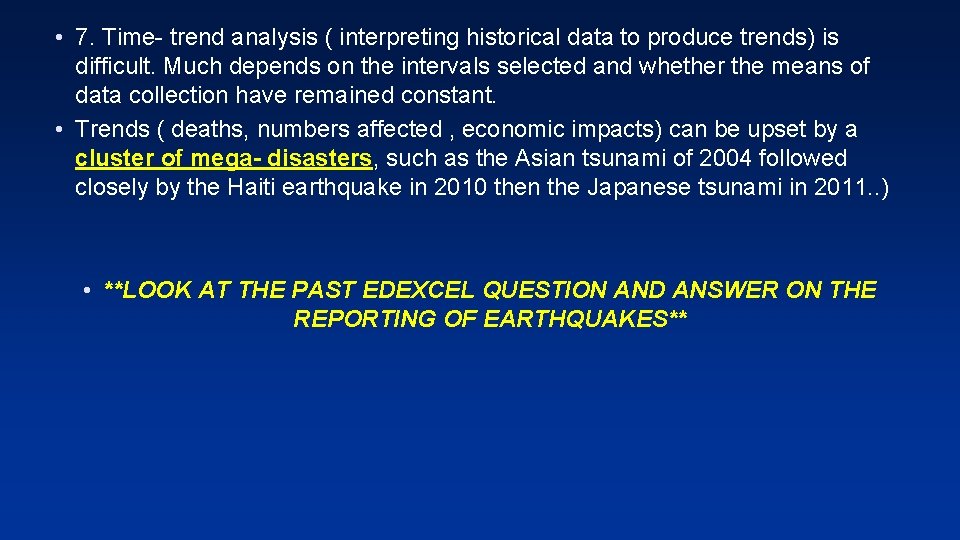
• 7. Time- trend analysis ( interpreting historical data to produce trends) is difficult. Much depends on the intervals selected and whether the means of data collection have remained constant. • Trends ( deaths, numbers affected , economic impacts) can be upset by a cluster of mega- disasters, such as the Asian tsunami of 2004 followed closely by the Haiti earthquake in 2010 then the Japanese tsunami in 2011. . ) • **LOOK AT THE PAST EDEXCEL QUESTION AND ANSWER ON THE REPORTING OF EARTHQUAKES**
TASK 3 • 1. Answer the questions to the ‘Current Trends’ graphs. • 2. Read the article ‘Significance of disasters’ and answer the questions which follow. • 2. Read the Case studies: ‘Global impacts of tectonic hazards’ and complete the activity which follows on the sheet.
EXTENSION TASK • Choose a relatively recent hazard/ disaster. • Find out how RELIABLE different data sources were ( e. g. TV news headlines, newspaper views e. g. Guardian, Times, Facebook and Twitter). • It often takes time for news from events to filter through. • What conclusions can you make?
WHITEBOARD/ PAIRED THINKING • What is a tectonic mega disaster? • What are their unique characteristics? • Give recent examples… • 3 mins…
TECTONIC MEGA- DISASTERS • *Mega -Disaster: An extreme disaster which can have global impacts* • The large scale of such mega disasters poses significant problems: • 1. They are considered large - scale disasters on either an aerial / spatial scale or in terms of their economic and/ or human impact. • 2. They pose serious problems for effective management to minimise the impact. • 3. Communities and governments often require international support in the immediate aftermath as well as during longer- term recovery e. g. at a regional level ( e. g Asian tsunami of 2004) or globally ( e. g. Japan 2011). These events affected more than one country either directly or indirectly.
• 4. Tectonic mega- events and disasters are often classified as ‘ High impact, low probability (HILP) events. • So, one off high- profile crises such as the 2010 Haiti earthquake and the 2011 Japanese earthquake and tsunami were both mega disasters requiring RAPID RESPONSES AT A GLOBAL LEVEL. • 5. The consequences of HILP events spread rapidly across both economic and geographic boundaries , creating other impacts ( negative knock on impacts or what economists call ‘ negative externalities’) that are difficult to plan for… • E. g. The Japanese earthquake in 2011 led to a 5% reduction in the country’s GDP. There were also much wider knock- on impacts for global TNCs such as Sony and Toyota who were FORCED TO HALT PRODUCTION.
TASK 4 • Read the information (Hodder p. 32) about two recent tectonic mega disasters : • 1) 2010 Eyafjallajokull Icelandic eruption and • 2) 2011 Japanease Tokoku Earthquake/ tsunami. • Compare and contrast the economic and human impacts which occurred as a result of each event. ( 8 marks) • • Tips: Compare – what are the similarities? Contrast – what are the differences? DON’T talk all about one event then the other- compare and contrast facts from each event as you go…
Have we met today’s lesson objectives? : • To understand that different types of hazards and disasters exist • To analyse disaster trends using graphs since 1960 • To realise that disaster trend data may be inaccurate and unreliable • To understand that tectonic ‘ mega disasters’ can have regional or global significance in terms of economic and human impacts.