
Understanding Teaching Conditions Module 1 Teaching Conditions Overview



- Slides: 45
Understanding Teaching Conditions Module 1: Teaching Conditions Overview Presenter’s Name | Presenter’s Name JANUARY 2020 10300_12/19
Welcome, Introductions, and Agenda 2
Welcome Center on GREAT TEACHERS & LEADERS at the American Institutes for Research® 3
Objective • To understand what teaching conditions are and how they can help create a more positive teaching and learning environment and improve teacher retention. Center on GREAT TEACHERS & LEADERS at the American Institutes for Research® 4
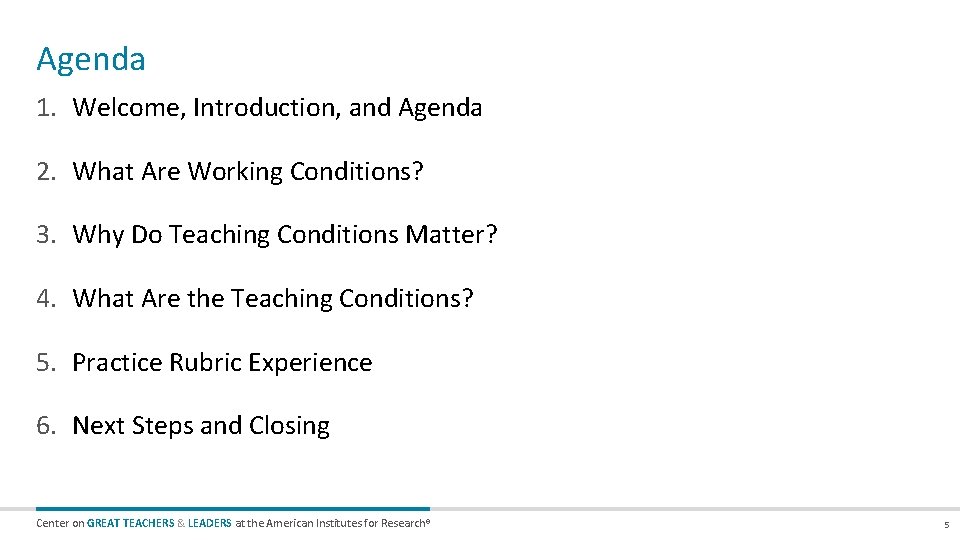
Agenda 1. Welcome, Introduction, and Agenda 2. What Are Working Conditions? 3. Why Do Teaching Conditions Matter? 4. What Are the Teaching Conditions? 5. Practice Rubric Experience 6. Next Steps and Closing Center on GREAT TEACHERS & LEADERS at the American Institutes for Research® 5
What Are Working Conditions? 6
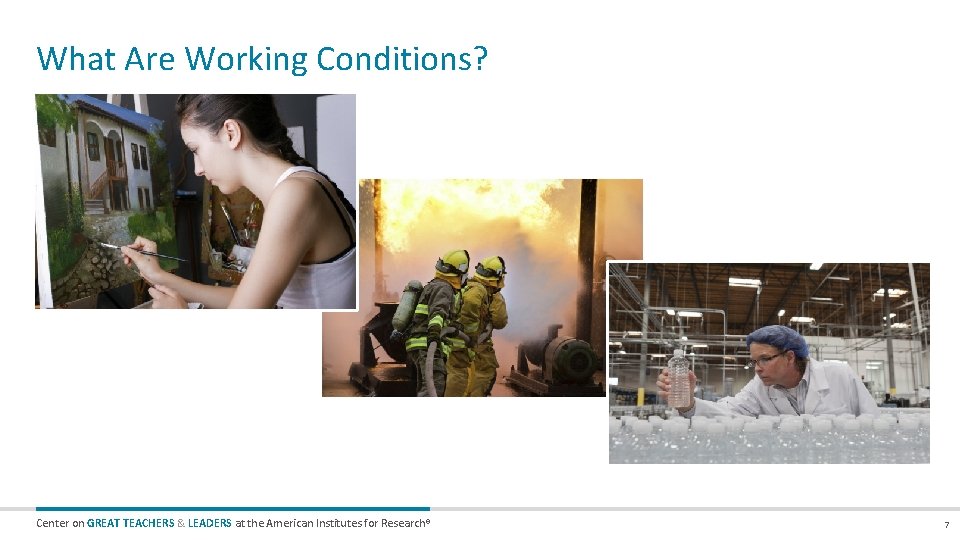
What Are Working Conditions? Center on GREAT TEACHERS & LEADERS at the American Institutes for Research® 7
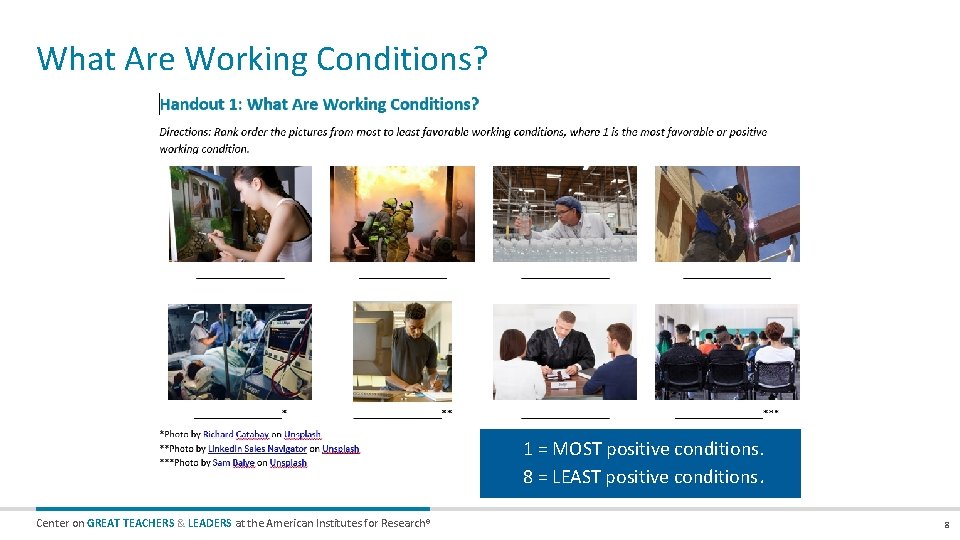
What Are Working Conditions? 1 = MOST positive conditions. 8 = LEAST positive conditions. Center on GREAT TEACHERS & LEADERS at the American Institutes for Research® 8
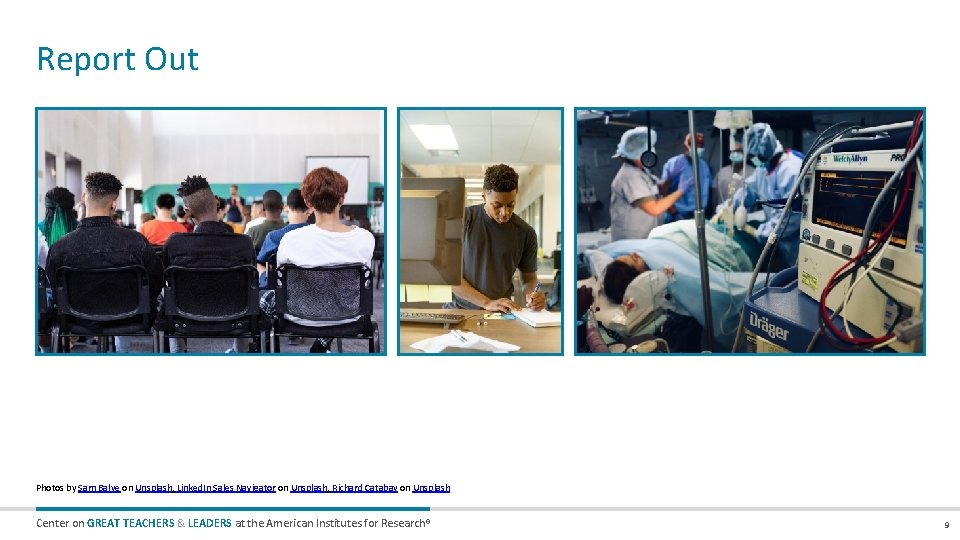
Report Out Photos by Sam Balye on Unsplash, Linked. In Sales Navigator on Unsplash, Richard Catabay on Unsplash Center on GREAT TEACHERS & LEADERS at the American Institutes for Research® 9
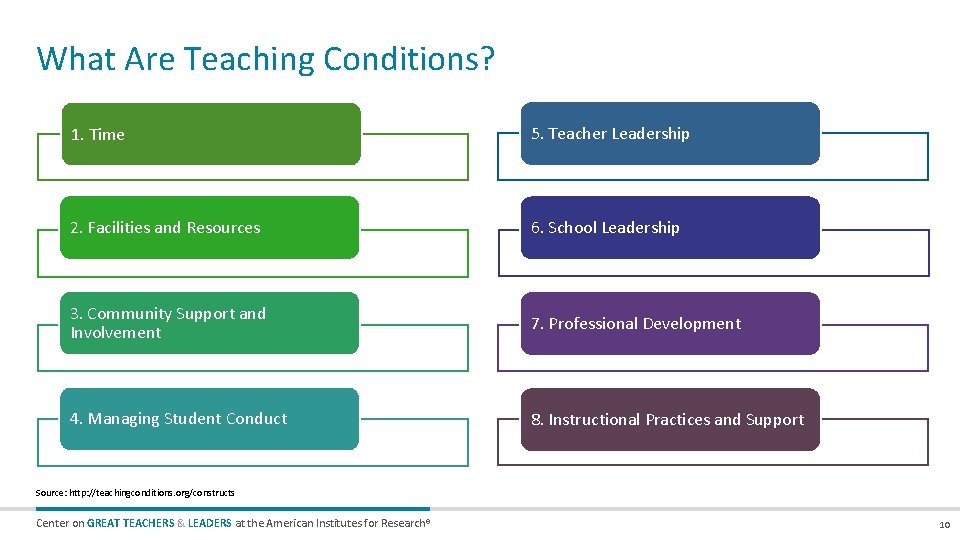
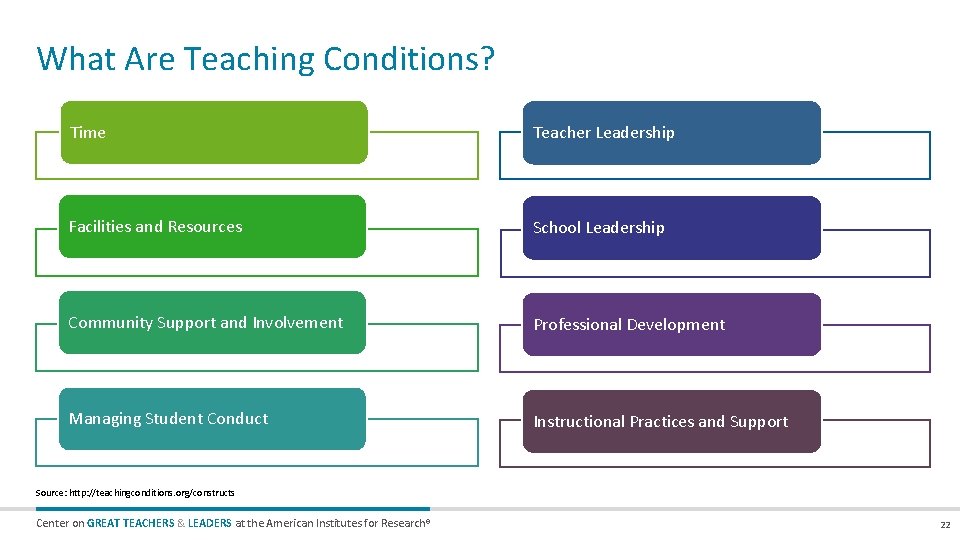
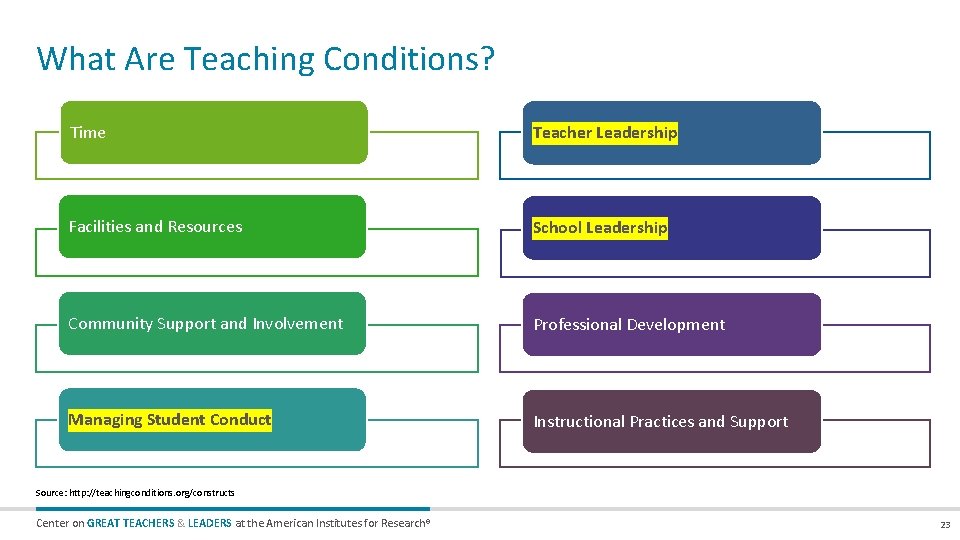
What Are Teaching Conditions? 1. Time 5. Teacher Leadership 2. Facilities and Resources 6. School Leadership 3. Community Support and Involvement 7. Professional Development 4. Managing Student Conduct 8. Instructional Practices and Support Source: http: //teachingconditions. org/constructs Center on GREAT TEACHERS & LEADERS at the American Institutes for Research® 10
Why Do Teaching Conditions Matter? 11
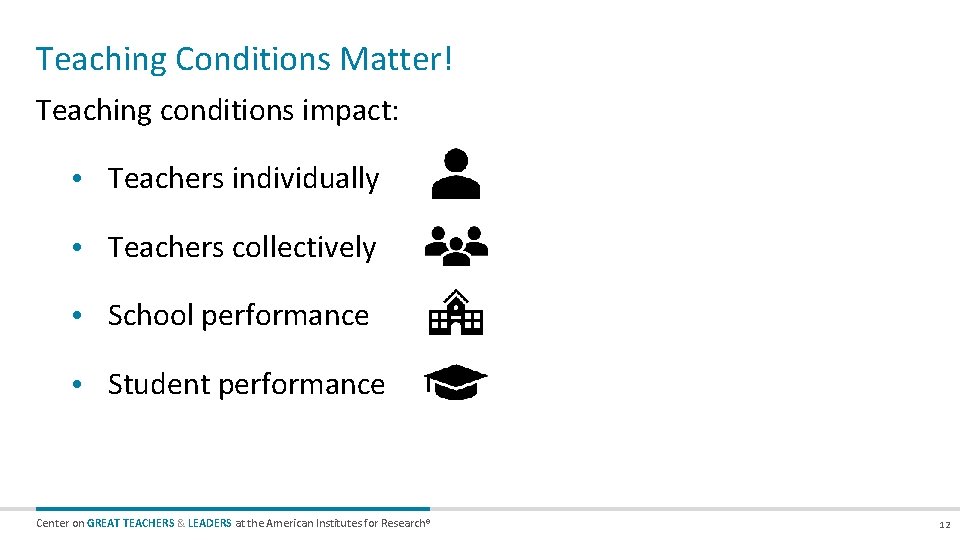
Teaching Conditions Matter! Teaching conditions impact: • Teachers individually • Teachers collectively • School performance • Student performance Center on GREAT TEACHERS & LEADERS at the American Institutes for Research® 12
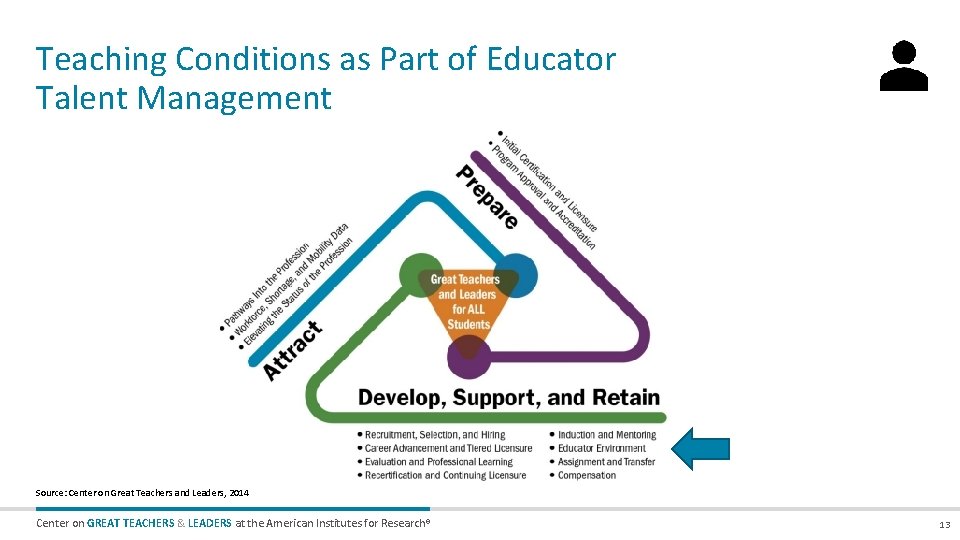
Teaching Conditions as Part of Educator Talent Management Source: Center on Great Teachers and Leaders, 2014 Center on GREAT TEACHERS & LEADERS at the American Institutes for Research® 13
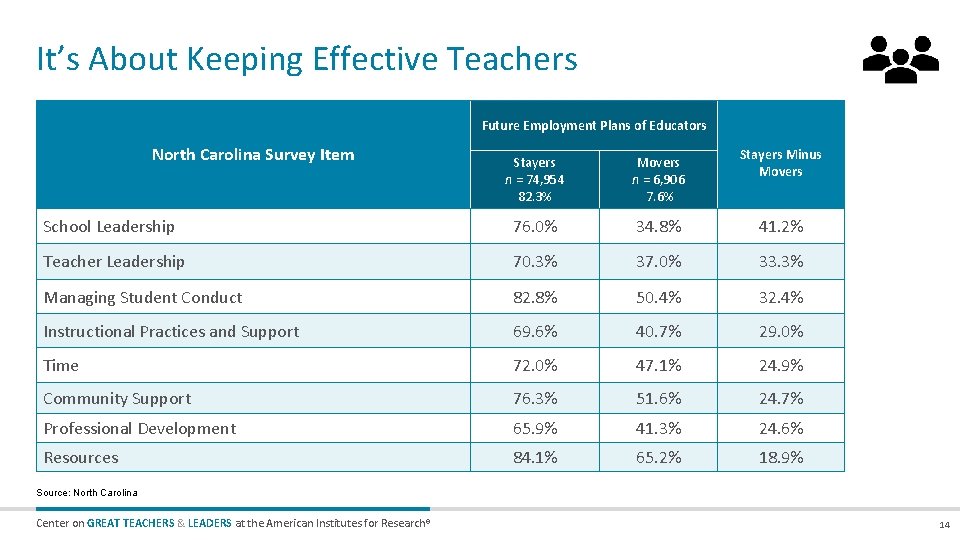
It’s About Keeping Effective Teachers Future Employment Plans of Educators North Carolina Survey Item Stayers Minus Movers Stayers n = 74, 954 82. 3% Movers n = 6, 906 7. 6% School Leadership 76. 0% 34. 8% 41. 2% Teacher Leadership 70. 3% 37. 0% 33. 3% Managing Student Conduct 82. 8% 50. 4% 32. 4% Instructional Practices and Support 69. 6% 40. 7% 29. 0% Time 72. 0% 47. 1% 24. 9% Community Support 76. 3% 51. 6% 24. 7% Professional Development 65. 9% 41. 3% 24. 6% Resources 84. 1% 65. 2% 18. 9% Source: North Carolina Center on GREAT TEACHERS & LEADERS at the American Institutes for Research® 14
Great Teachers Matter • Teacher quality has the greatest impact on student achievement among school-related factors. • School leadership is second only to teacher quality in its impact on student achievement. Sources: Chetty, Friedman, & Rockoff, 2011; The New Teacher Project. , n. d. Center on GREAT TEACHERS & LEADERS at the American Institutes for Research® 15
It’s About Kids • Multiple components of the teaching environment can predict: – Student learning gains – Student perceptions of support and rigor • Teacher working conditions can influence how effective a teacher is in a particular school. Sources: Boyd et al. , 2011; Ferguson & Hirsch, 2014 b; Johnson, 2006; Johnson, Kraft, & Papay, 2012; Ladd, 2011 Center on GREAT TEACHERS & LEADERS at the American Institutes for Research® 16
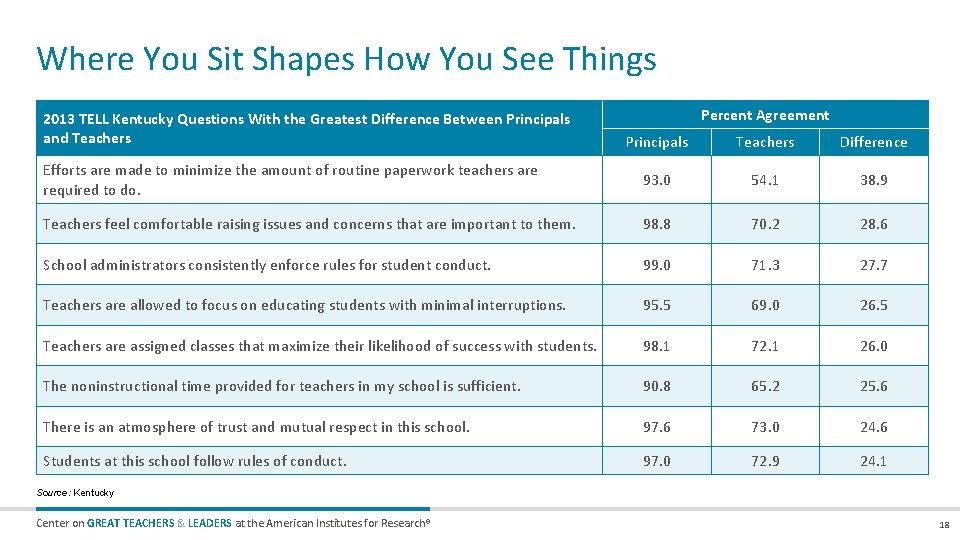
Measuring and Examining Teaching Conditions Matters Because… Where You Sit Shapes How You See Things Center on GREAT TEACHERS & LEADERS at the American Institutes for Research® 17
Where You Sit Shapes How You See Things 2013 TELL Kentucky Questions With the Greatest Difference Between Principals and Teachers Percent Agreement Principals Teachers Difference Efforts are made to minimize the amount of routine paperwork teachers are required to do. 93. 0 54. 1 38. 9 Teachers feel comfortable raising issues and concerns that are important to them. 98. 8 70. 2 28. 6 School administrators consistently enforce rules for student conduct. 99. 0 71. 3 27. 7 Teachers are allowed to focus on educating students with minimal interruptions. 95. 5 69. 0 26. 5 Teachers are assigned classes that maximize their likelihood of success with students. 98. 1 72. 1 26. 0 The noninstructional time provided for teachers in my school is sufficient. 90. 8 65. 2 25. 6 There is an atmosphere of trust and mutual respect in this school. 97. 6 73. 0 24. 6 Students at this school follow rules of conduct. 97. 0 72. 9 24. 1 Source: Kentucky Center on GREAT TEACHERS & LEADERS at the American Institutes for Research® 18
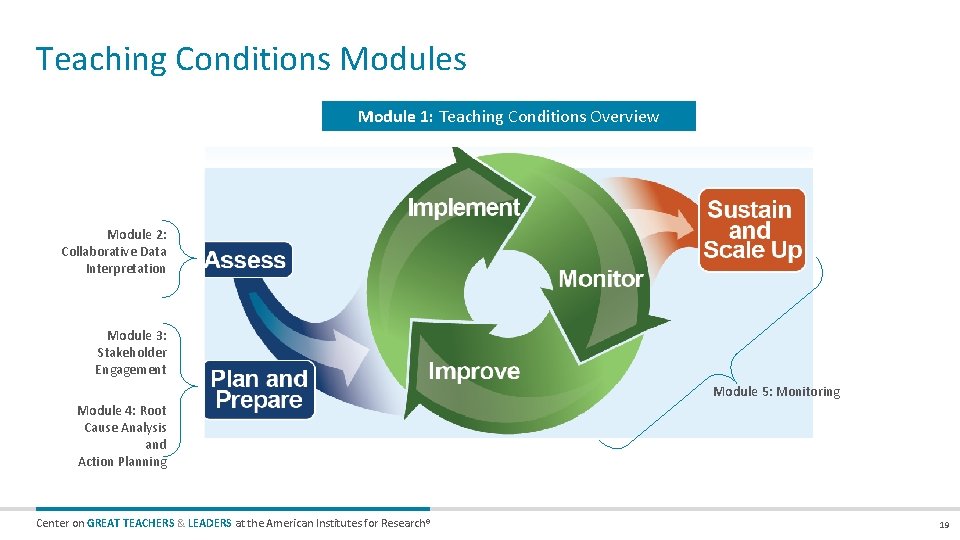
Teaching Conditions Module 1: Teaching Conditions Overview Module 2: Collaborative Data Interpretation Module 3: Stakeholder Engagement Module 5: Monitoring Module 4: Root Cause Analysis and Action Planning Center on GREAT TEACHERS & LEADERS at the American Institutes for Research® 19
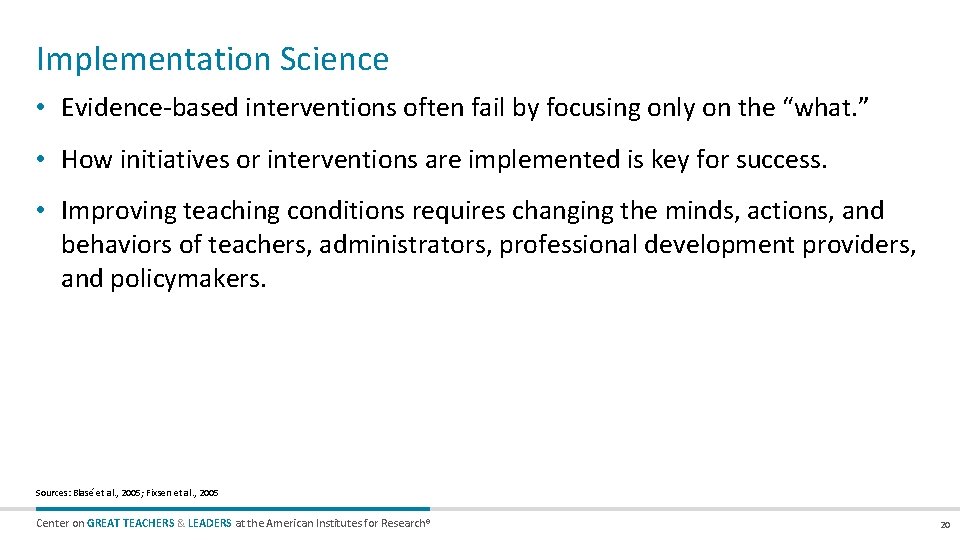
Implementation Science • Evidence-based interventions often fail by focusing only on the “what. ” • How initiatives or interventions are implemented is key for success. • Improving teaching conditions requires changing the minds, actions, and behaviors of teachers, administrators, professional development providers, and policymakers. Sources: Blasé et al. , 2005; Fixsen et al. , 2005 Center on GREAT TEACHERS & LEADERS at the American Institutes for Research® 20
What Are the Teaching Conditions? 21
What Are Teaching Conditions? Time Teacher Leadership Facilities and Resources School Leadership Community Support and Involvement Professional Development Managing Student Conduct Instructional Practices and Support Source: http: //teachingconditions. org/constructs Center on GREAT TEACHERS & LEADERS at the American Institutes for Research® 22
What Are Teaching Conditions? Time Teacher Leadership Facilities and Resources School Leadership Community Support and Involvement Professional Development Managing Student Conduct Instructional Practices and Support Source: http: //teachingconditions. org/constructs Center on GREAT TEACHERS & LEADERS at the American Institutes for Research® 23
Teaching Conditions Reflection 1. Was there anything that surprised you as being defined as a teaching condition? 2. How do these teaching conditions look in your state, district, or school? 3. What are the factors that affect the teaching conditions in your state, district, or school? Center on GREAT TEACHERS & LEADERS at the American Institutes for Research® 24
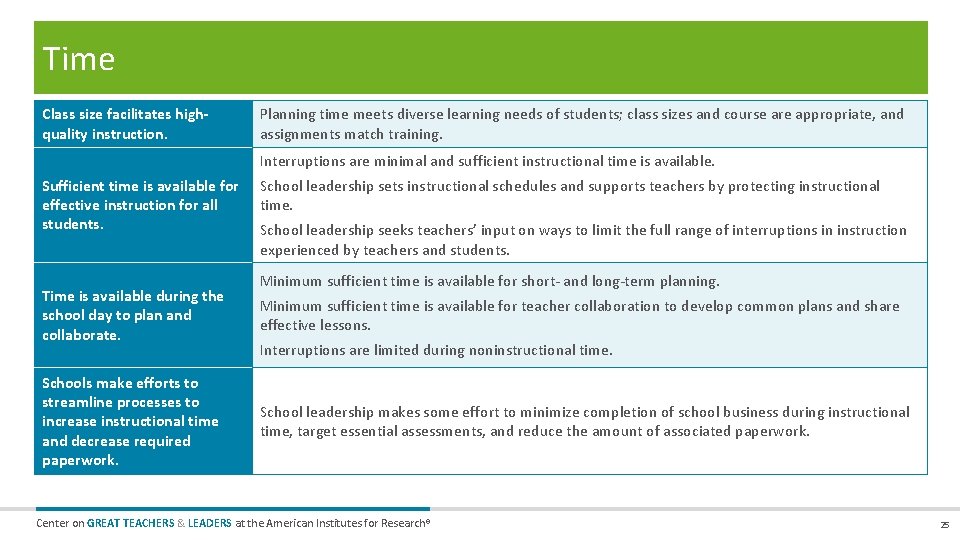
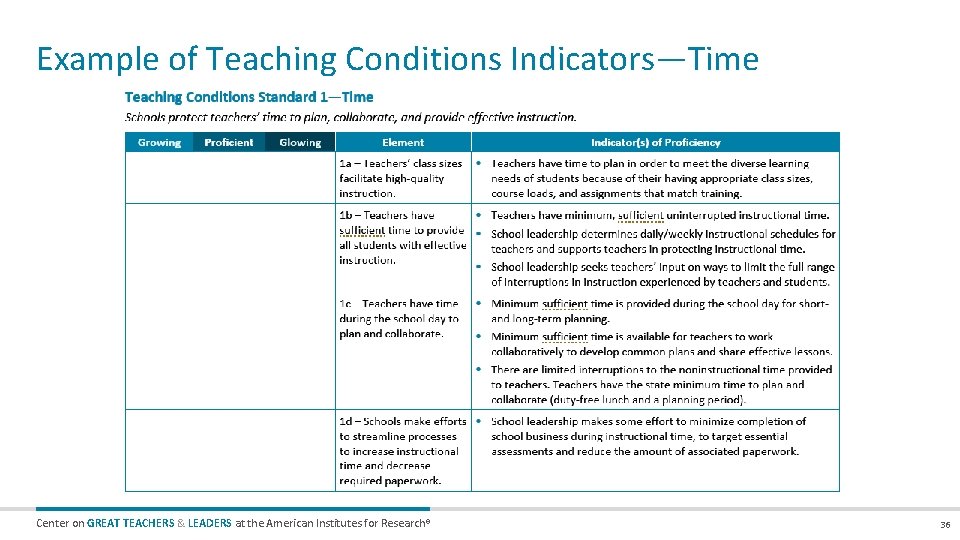
Time Class size facilitates highquality instruction. Planning time meets diverse learning needs of students; class sizes and course are appropriate, and assignments match training. Interruptions are minimal and sufficient instructional time is available. Sufficient time is available for effective instruction for all students. Time is available during the school day to plan and collaborate. Schools make efforts to streamline processes to increase instructional time and decrease required paperwork. School leadership sets instructional schedules and supports teachers by protecting instructional time. School leadership seeks teachers’ input on ways to limit the full range of interruptions in instruction experienced by teachers and students. Minimum sufficient time is available for short- and long-term planning. Minimum sufficient time is available for teacher collaboration to develop common plans and share effective lessons. Interruptions are limited during noninstructional time. School leadership makes some effort to minimize completion of school business during instructional time, target essential assessments, and reduce the amount of associated paperwork. Center on GREAT TEACHERS & LEADERS at the American Institutes for Research® 25
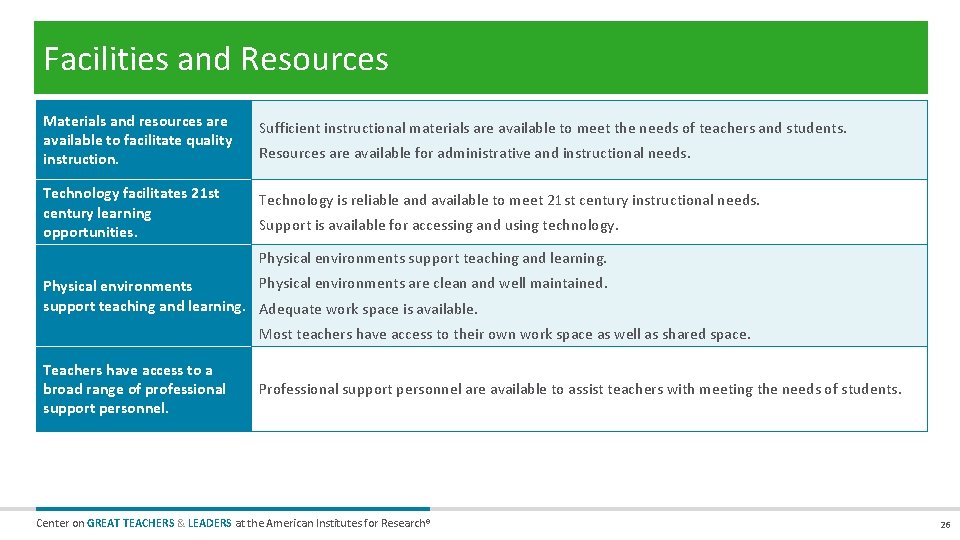
Facilities and Resources Materials and resources are available to facilitate quality instruction. Sufficient instructional materials are available to meet the needs of teachers and students. Technology facilitates 21 st century learning opportunities. Technology is reliable and available to meet 21 st century instructional needs. Resources are available for administrative and instructional needs. Support is available for accessing and using technology. Physical environments support teaching and learning. Physical environments are clean and well maintained. Physical environments support teaching and learning. Adequate work space is available. Most teachers have access to their own work space as well as shared space. Teachers have access to a broad range of professional support personnel. Professional support personnel are available to assist teachers with meeting the needs of students. Center on GREAT TEACHERS & LEADERS at the American Institutes for Research® 26
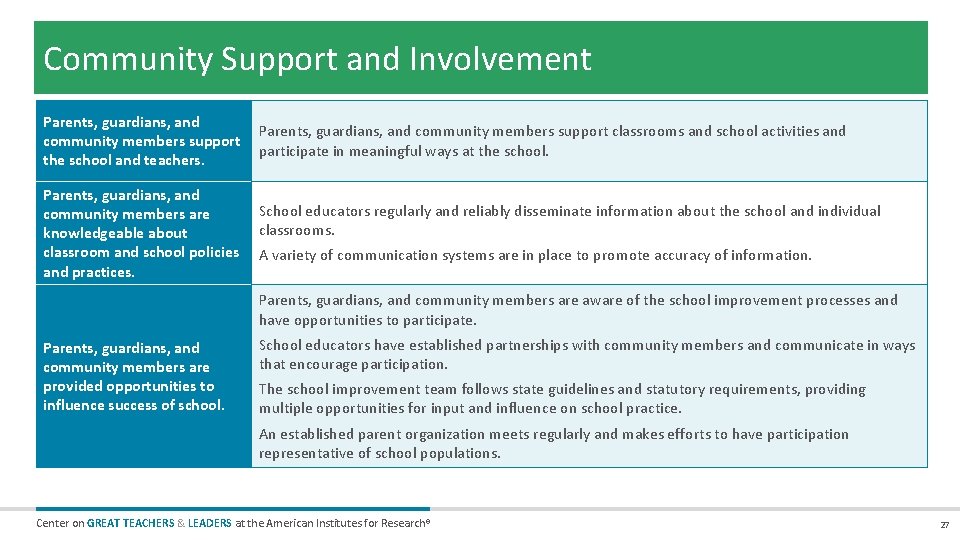
Community Support and Involvement Parents, guardians, and community members support classrooms and school activities and community members support participate in meaningful ways at the school and teachers. Parents, guardians, and community members are knowledgeable about classroom and school policies and practices. School educators regularly and reliably disseminate information about the school and individual classrooms. A variety of communication systems are in place to promote accuracy of information. Parents, guardians, and community members are aware of the school improvement processes and have opportunities to participate. Parents, guardians, and community members are provided opportunities to influence success of school. School educators have established partnerships with community members and communicate in ways that encourage participation. The school improvement team follows state guidelines and statutory requirements, providing multiple opportunities for input and influence on school practice. An established parent organization meets regularly and makes efforts to have participation representative of school populations. Center on GREAT TEACHERS & LEADERS at the American Institutes for Research® 27
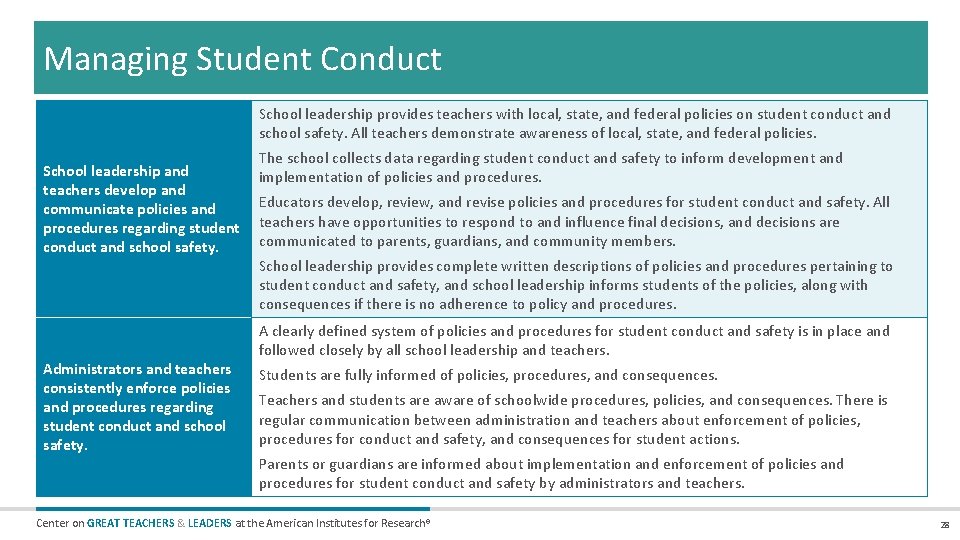
Managing Student Conduct School leadership provides teachers with local, state, and federal policies on student conduct and school safety. All teachers demonstrate awareness of local, state, and federal policies. School leadership and teachers develop and communicate policies and procedures regarding student conduct and school safety. Administrators and teachers consistently enforce policies and procedures regarding student conduct and school safety. The school collects data regarding student conduct and safety to inform development and implementation of policies and procedures. Educators develop, review, and revise policies and procedures for student conduct and safety. All teachers have opportunities to respond to and influence final decisions, and decisions are communicated to parents, guardians, and community members. School leadership provides complete written descriptions of policies and procedures pertaining to student conduct and safety, and school leadership informs students of the policies, along with consequences if there is no adherence to policy and procedures. A clearly defined system of policies and procedures for student conduct and safety is in place and followed closely by all school leadership and teachers. Students are fully informed of policies, procedures, and consequences. Teachers and students are aware of schoolwide procedures, policies, and consequences. There is regular communication between administration and teachers about enforcement of policies, procedures for conduct and safety, and consequences for student actions. Parents or guardians are informed about implementation and enforcement of policies and procedures for student conduct and safety by administrators and teachers. Center on GREAT TEACHERS & LEADERS at the American Institutes for Research® 28
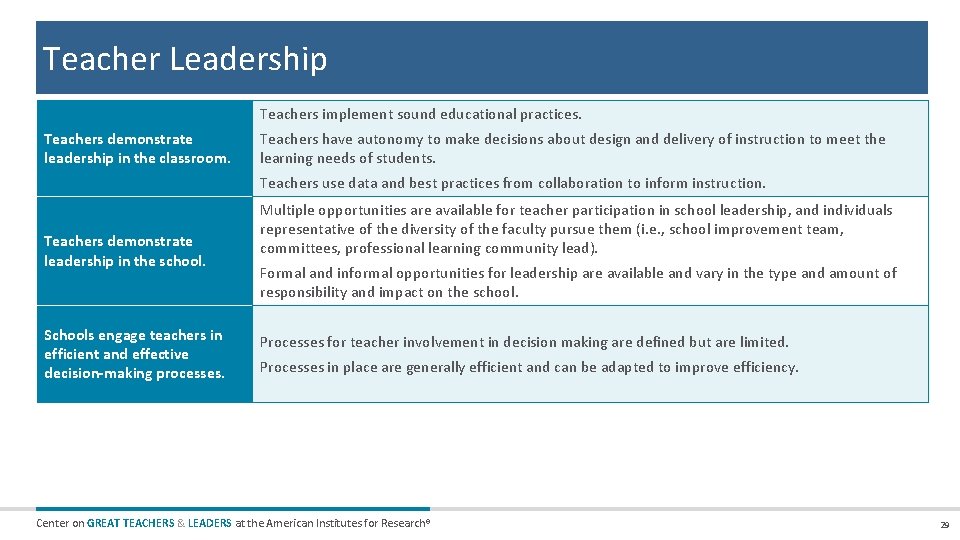
Teacher Leadership Teachers implement sound educational practices. Teachers demonstrate leadership in the classroom. Teachers have autonomy to make decisions about design and delivery of instruction to meet the learning needs of students. Teachers use data and best practices from collaboration to inform instruction. Teachers demonstrate leadership in the school. Schools engage teachers in efficient and effective decision-making processes. Multiple opportunities are available for teacher participation in school leadership, and individuals representative of the diversity of the faculty pursue them (i. e. , school improvement team, committees, professional learning community lead). Formal and informal opportunities for leadership are available and vary in the type and amount of responsibility and impact on the school. Processes for teacher involvement in decision making are defined but are limited. Processes in place are generally efficient and can be adapted to improve efficiency. Center on GREAT TEACHERS & LEADERS at the American Institutes for Research® 29
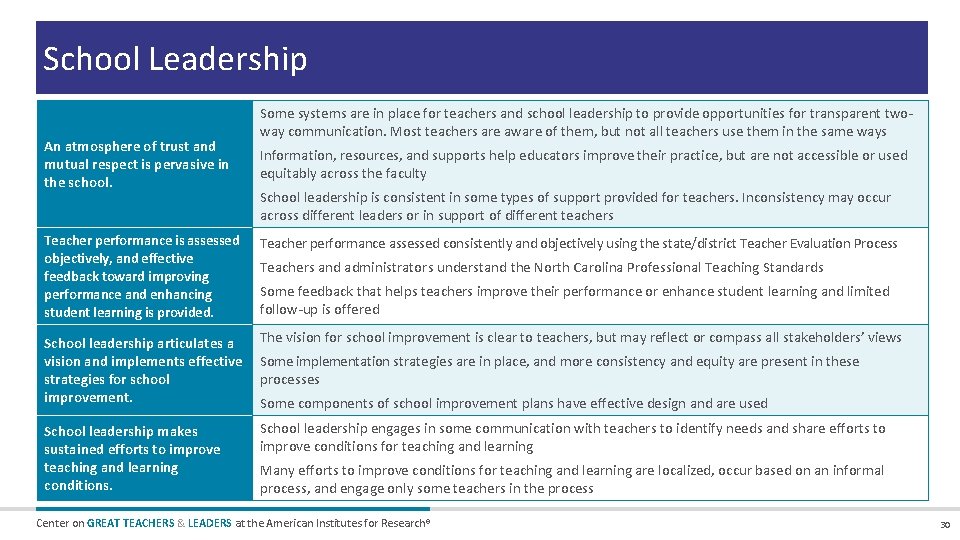
School Leadership An atmosphere of trust and mutual respect is pervasive in the school. Some systems are in place for teachers and school leadership to provide opportunities for transparent twoway communication. Most teachers are aware of them, but not all teachers use them in the same ways Information, resources, and supports help educators improve their practice, but are not accessible or used equitably across the faculty School leadership is consistent in some types of support provided for teachers. Inconsistency may occur across different leaders or in support of different teachers Teacher performance is assessed objectively, and effective feedback toward improving performance and enhancing student learning is provided. Teacher performance assessed consistently and objectively using the state/district Teacher Evaluation Process School leadership articulates a vision and implements effective strategies for school improvement. The vision for school improvement is clear to teachers, but may reflect or compass all stakeholders’ views School leadership makes sustained efforts to improve teaching and learning conditions. School leadership engages in some communication with teachers to identify needs and share efforts to improve conditions for teaching and learning Teachers and administrators understand the North Carolina Professional Teaching Standards Some feedback that helps teachers improve their performance or enhance student learning and limited follow-up is offered Some implementation strategies are in place, and more consistency and equity are present in these processes Some components of school improvement plans have effective design and are used Many efforts to improve conditions for teaching and learning are localized, occur based on an informal process, and engage only some teachers in the process Center on GREAT TEACHERS & LEADERS at the American Institutes for Research® 30
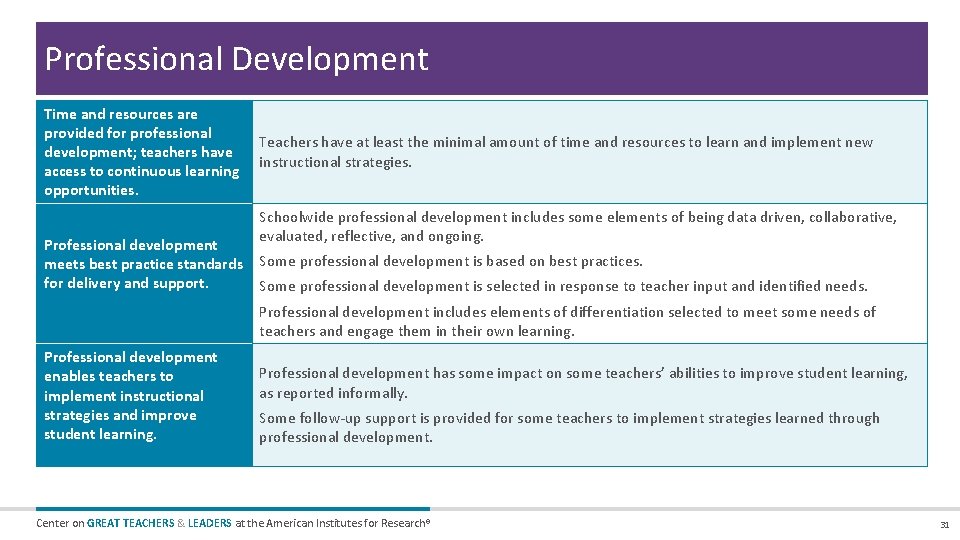
Professional Development Time and resources are provided for professional development; teachers have access to continuous learning opportunities. Teachers have at least the minimal amount of time and resources to learn and implement new instructional strategies. Schoolwide professional development includes some elements of being data driven, collaborative, evaluated, reflective, and ongoing. Professional development meets best practice standards Some professional development is based on best practices. for delivery and support. Some professional development is selected in response to teacher input and identified needs. Professional development includes elements of differentiation selected to meet some needs of teachers and engage them in their own learning. Professional development enables teachers to implement instructional strategies and improve student learning. Professional development has some impact on some teachers’ abilities to improve student learning, as reported informally. Some follow-up support is provided for some teachers to implement strategies learned through professional development. Center on GREAT TEACHERS & LEADERS at the American Institutes for Research® 31
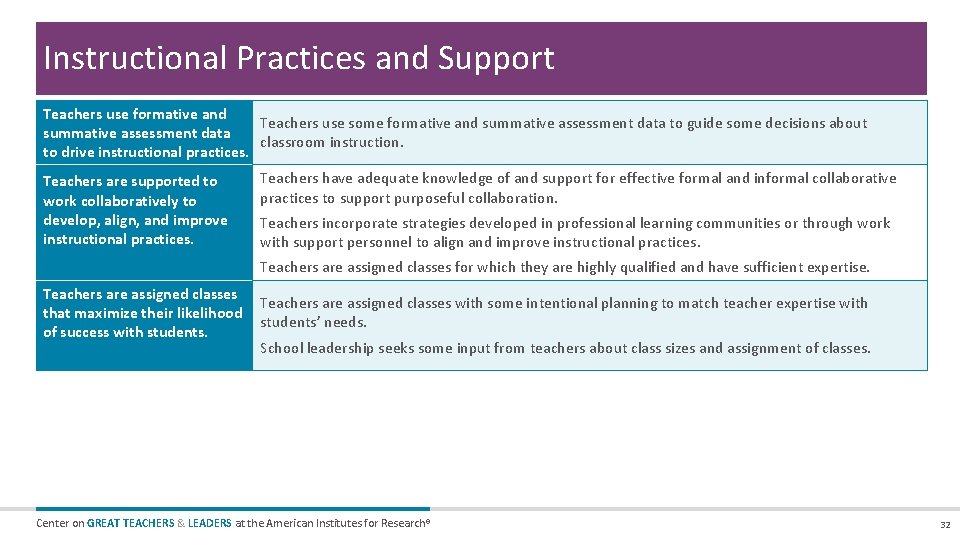
Instructional Practices and Support Teachers use formative and Teachers use some formative and summative assessment data to guide some decisions about summative assessment data classroom instruction. to drive instructional practices. Teachers are supported to work collaboratively to develop, align, and improve instructional practices. Teachers have adequate knowledge of and support for effective formal and informal collaborative practices to support purposeful collaboration. Teachers are assigned classes for which they are highly qualified and have sufficient expertise. Teachers incorporate strategies developed in professional learning communities or through work with support personnel to align and improve instructional practices. Teachers are assigned classes with some intentional planning to match teacher expertise with that maximize their likelihood students’ needs. of success with students. School leadership seeks some input from teachers about class sizes and assignment of classes. Center on GREAT TEACHERS & LEADERS at the American Institutes for Research® 32
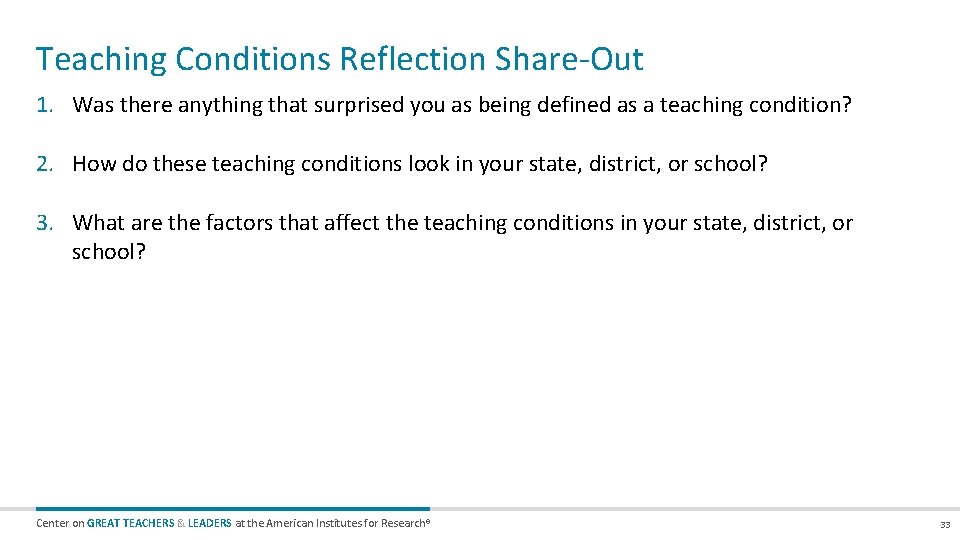
Teaching Conditions Reflection Share-Out 1. Was there anything that surprised you as being defined as a teaching condition? 2. How do these teaching conditions look in your state, district, or school? 3. What are the factors that affect the teaching conditions in your state, district, or school? Center on GREAT TEACHERS & LEADERS at the American Institutes for Research® 33
Practice Rubric Experience 34
Data Collection Macro level Micro level 1. Practice Rubric 1. Guided Discussion 2. Anonymous Survey 2. Individual Item Prompts Center on GREAT TEACHERS & LEADERS at the American Institutes for Research® 35
Example of Teaching Conditions Indicators—Time Center on GREAT TEACHERS & LEADERS at the American Institutes for Research® 36
Activity: Experiencing the Rubric • Use the rubric to reflect on your school’s conditions with your school team. • Select growing, proficient, or glowing for each element by marking an X. • After you review each element within a condition, decide whether the condition is a high priority (to improve or to leverage). After reviewing all eight conditions, rank their order from strongest (1) to weakest (8). Center on GREAT TEACHERS & LEADERS at the American Institutes for Research® 37
Group Share-Out • How was the experience? • Which conditions did you choose and why? • Was it difficult to agree on rank order? Center on GREAT TEACHERS & LEADERS at the American Institutes for Research® 38
Based on Your Opinions From the Rubric Experience. . . • What do you expect to see in your teaching conditions data? – What strengths do you predict will arise? – What areas for growth do you predict you will see? Center on GREAT TEACHERS & LEADERS at the American Institutes for Research® 39
When Using Teaching Conditions Data, Remember. . . • Teaching conditions are not about any one individual. • Perceptual data are real data. • Conversations need to be structured and safe. • A common understanding of your school’s conditions needs to be created. • Focus on what you can solve. • Solutions can be complex and long term. • Teaching conditions data are not intended for external evaluative purposes. Center on GREAT TEACHERS & LEADERS at the American Institutes for Research® 40
Next Steps and Closing 41
Additional Understanding Teaching Conditions Modules • Module 1: Teaching Conditions Overview • Module 2: Collaborative Data Interpretation • Module 3: Stakeholder Engagement • Module 4: Root Cause Analysis and Action Planning • Module 5: Monitoring Center on GREAT TEACHERS & LEADERS at the American Institutes for Research® 42
References Blasé, K. A. , Fixsen, D. L. , Naoom, S. F. , & Wallace, F. (2005). Operationalizing implementation: Strategies and methods. Tampa, FL: University of South Florida, Louis de la Parte Florida Mental Health Institute. Boyd, D. , Grossman, P. , Ing, M. , Lankford, H. , Loeb, S. , & Wyckoff, J. (2011). The influence of school administrators on teacher retention decisions. American Educational Research Journal, 48(2), 303– 333. Center on Great Teachers and Leaders. (2014). Talent development framework for 21 st century educators: Moving toward state policy alignment and coherence. Washington, DC: Author. Retrieved from https: //gtlcenter. org/sites/default/files/142591_GTL_Talent_Dev_Framework-ed_110714. pdf Chetty, R. Friedman, J. , & Rockoff, J. (2011). The long-term impacts of teachers: Teacher value-added and student outcomes in adulthood. Cambridge, MA: National Bureau of Economic Research. Ferguson, R. , & Hirsch, E. (2014 b). Using teacher and student surveys to link school context, classroom learning conditions, and achievement. In T. J. Kane, K. A. Kerr, & R. C. Pianta (Eds. ), New guidance from the Measures of Effective Teaching project. San Francisco, CA: Jossey-Bass. Fixsen, D. L. , Naoom, S. F. , Blasé, K. A. , Friedman, R. M. & Wallace, F. (2005). Implementation research: A synthesis of the literature. Tampa, FL: University of South Florida, Louis de la Parte Florida Mental Health Institute, The National Implementation Research Network (FMHI Publication #231). Center on GREAT TEACHERS & LEADERS at the American Institutes for Research® 43
References (cont. ) Johnson, S. M. (2006). The workplace matters: Teacher quality, retention, and effectiveness. Washington, DC: National Education Association. Retrieved from http: //www. nea. org/assets/docs/HE/mf_wcreport. pdf Johnson, S. M. , Kraft, M. A. , & Papay, J. P. (2012). How context matters in high-need schools: The effects of teachers’ working conditions on their professional satisfaction and their students’ achievement. Teachers College Record, 114(10), 1– 39. Ladd, H. (2011). Teachers’ perceptions of their working conditions: How predictive of planned and actual teacher movement. Educational Evaluation and Policy Analysis, 33(2), 235– 261. New Teacher Center. (n. d. ). TELL Resource Library. Retrieved from http: //teachingconditions. org/constructs Center on GREAT TEACHERS & LEADERS at the American Institutes for Research® 44
Contact Name XXX-XXXX email@air. org 1000 Thomas Jefferson Street NW Washington, DC 20007 -3835 877 -322 -8700 gtlcenter@air. org www. gtlcenter. org | www. air. org Notice of Trademark: “American Institutes for Research” and “AIR” are registered trademarks. All other brand, product, or company names are trademarks or registered trademarks of their respective owners. Copyright © 2019 American Institutes for Research®. All rights reserved. No part of this publication may be reproduced, distributed, or transmitted in any form or by any means, including photocopying, recording, website display, or other electronic or mechanical methods, without the prior written permission of the American Institutes for Research. For permission requests, please use the Contact Us form on www. air. org. 10300_12/19