
Understanding Supply side or producer side of the

- Slides: 34
Understanding Supply side or producer side of the market
Defined as…. • The willingness and ability of seller to produce and offer to sell different quantities of a good at different prices during a specific time period. • Amount of goods available.
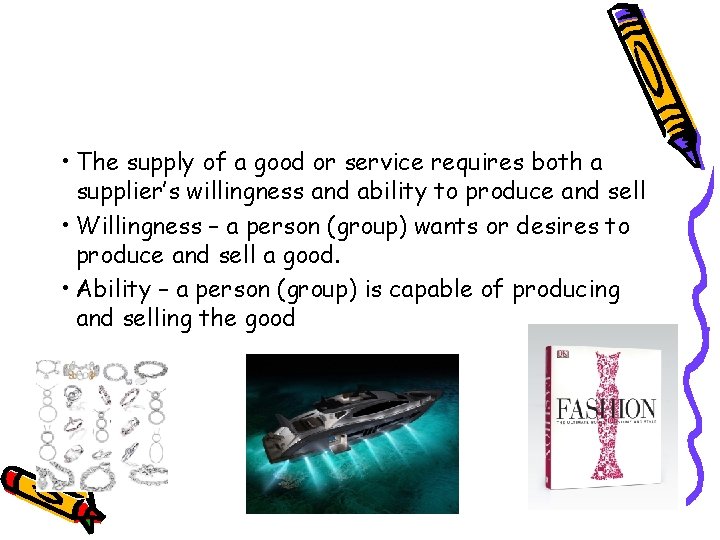
• The supply of a good or service requires both a supplier’s willingness and ability to produce and sell • Willingness – a person (group) wants or desires to produce and sell a good. • Ability – a person (group) is capable of producing and selling the good
Law of Supply • Producers offer more of a good as its price increases and less as its price falls. • As the price of a good increases, the quantity supplied of the good increases. • As the price of a good decreases, the quantity supplied of the good decreases. • Thus, price and quantity supplied move in the same direction. • IF P↑ then Q↑ • IF P↓ then Q↓
Benefits of rising prices • Existing firms will produce more in order to earn additional revenue. • An incentive for new firms to enter the market.
Example • A supply of new houses in the housing market means that firms are currently willing and able to produce and offer to sell new houses.
Quantity Supplied • Refers to the number of units of a good produced and offered for sale at a specific price. • Iphone = $
Creating the Law of Supply • The two movements of individual firms changing their level of production and firms entering or exiting the market.
Higher Production • The promise of higher revenue for each sale encourages the firm to produce more. • The search for profit drives the supplier’s decision.
Market Entry • If a type of business is making money, draws others into that business. • Musicians joined the market pertaining to the music that was popular at the time.
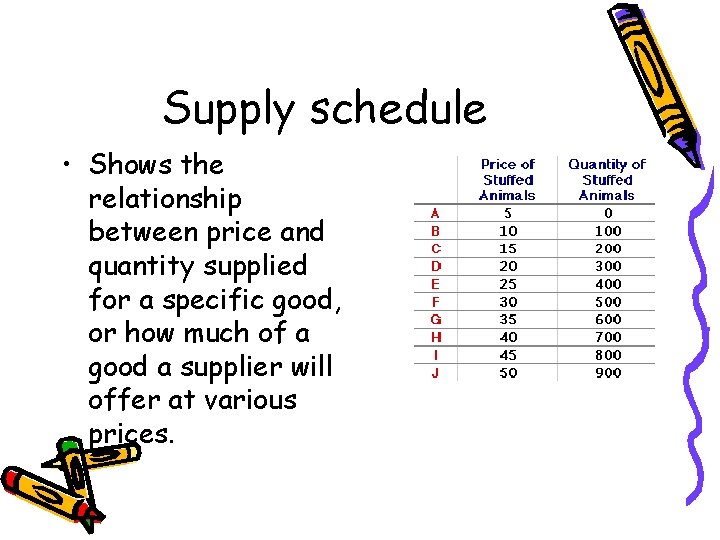
Supply schedule • Shows the relationship between price and quantity supplied for a specific good, or how much of a good a supplier will offer at various prices.
Market Supply Schedule • Shows the relationship between prices and the total quantity supply by all firms in a particular market.
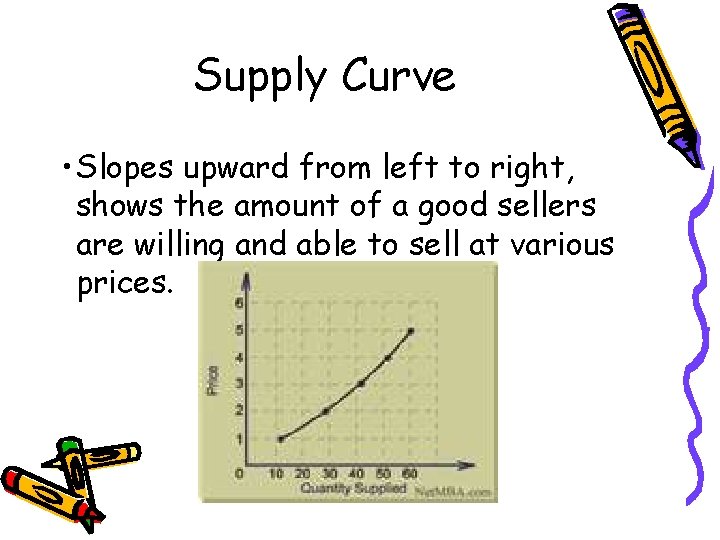
Supply Curve • Slopes upward from left to right, shows the amount of a good sellers are willing and able to sell at various prices.
Elasticity of Supply • Measures how firms will respond to changes in the price of a good. • Elastic – big response to change • Inelastic – small response to change • Elasticity can also be dependant on the type of business and long-term v. short-term changes.
Costs of Production
Labor and Output • One question to ask is how many workers do I hire? • When a new person is hired, production does go up, but also need to consider wages and other benefits. • At some point, you become less profitable.
Marginal Production of Labor • Defined as the change in output from hiring one more worker.
Increasing Marginal Returns • A rising marginal product of labor
Diminishing Marginal Returns • New workers increase output but at a diminishing rate.
Negative Marginal Returns • Adding additional workers actually decreases output.
Production Costs • Two main costs: fixed and variable • Fixed – does not change no matter how much is produced. Rent, cost of loans, property taxes. • Variable – costs that rise or fall depending on the quantity produced. Material, some wages, taxes, electricity
Total Cost • Sum of fixed and variable costs.
Marginal Cost • Cost of production at each level. Additional cost of producing one more unit.
Marginal Revenue • Additional income form selling one more unit of a good. • Business firms need to know marginal cost and marginal revenue to make decisions regarding production. • The ideal level is where marginal cost meets marginal revenue.
Changes in Supply
Input Costs • Any changes in the cost of an input used to produce a goods • An input will cause a fall in supply at all price levels because the good has become more expensive to produce.
Effects of Rising Costs • Cost of labor or raw materials will result in a higher marginal cost • Firm may not be as profitable • May pass costs along to consumer
Technology • Advances in technology can lower production costs in many industries. • Robotics
Government Influence on Supply • By raising or lowering the cost of producing goods, the government can encourage or discourage an entrepreneur or an industry within the country or abroad.
Subsidy • A government payment that supports a business or market (farms) • Governments in developing countries often subsidize manufacturers to protect young, growing industries from foreign competition.
Taxes • Excise tax – tax on the production or sale of a good. • Cigarettes, alcohol
Regulation • Government intervention in a market that affects the price, quantity, or quality of a good.
Secretary Paulson: • “Excessive regulation slows innovation, imposes needless costs on investors, and stifles competitiveness and job creation”.
Other influences on supply • • • Changes in global economy Import restrictions Future expectation of prices Number of suppliers in market Where firms produce? ? ?