
Understanding Subjective Wellbeing and Stress at Work Contents
Understanding Subjective Well-being and Stress at Work
Contents Part 1: Neurodiversity and Mental Health Needs Part 2: Understanding Subjective Well-Being at work Part 3: Legal issues surrounding neurodiversity in the workplace Part 4: Reflection Part 5: Planning next steps
Part 1: Neurodiversity and Mental Health
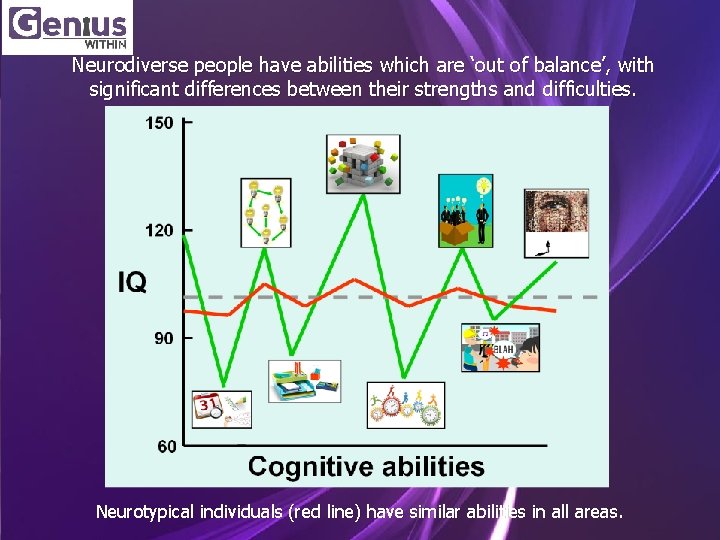
Neurodiverse people have abilities which are ‘out of balance’, with significant differences between their strengths and difficulties. Neurotypical individuals (red line) have similar abilities in all areas.
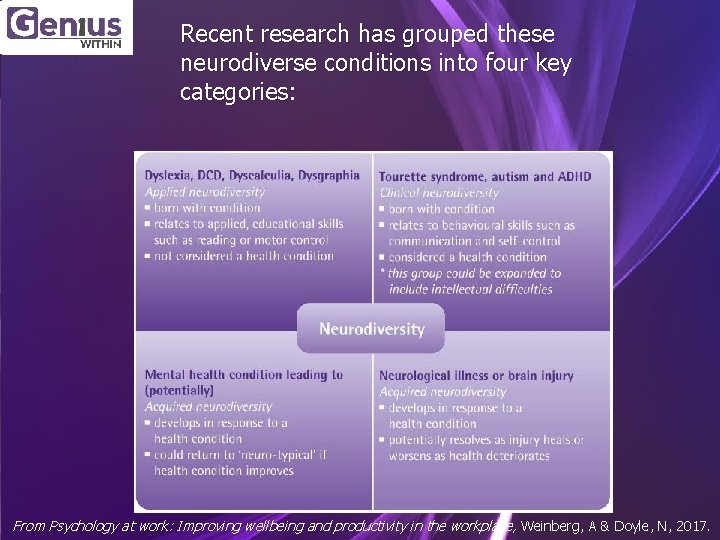
Recent research has grouped these neurodiverse conditions into four key categories: From Psychology at work: Improving wellbeing and productivity in the workplace, Weinberg, A & Doyle, N, 2017.
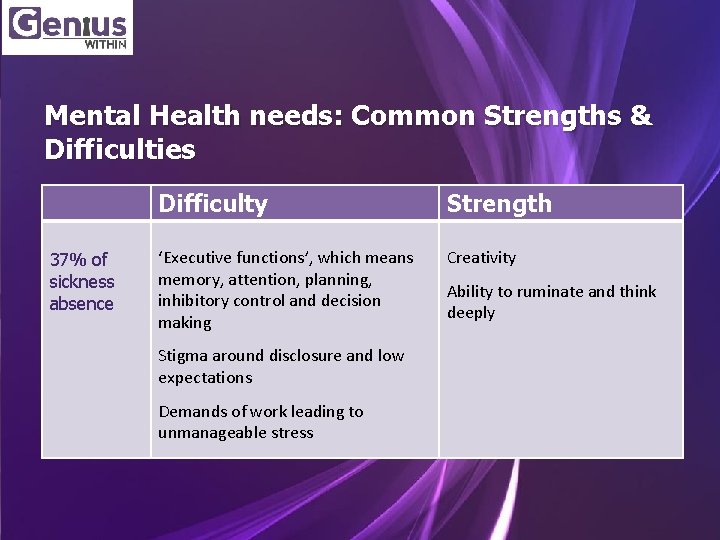
Mental Health needs: Common Strengths & Difficulties 37% of sickness absence Difficulty Strength ‘Executive functions’, which means memory, attention, planning, inhibitory control and decision making Creativity Stigma around disclosure and low expectations Demands of work leading to unmanageable stress Ability to ruminate and think deeply
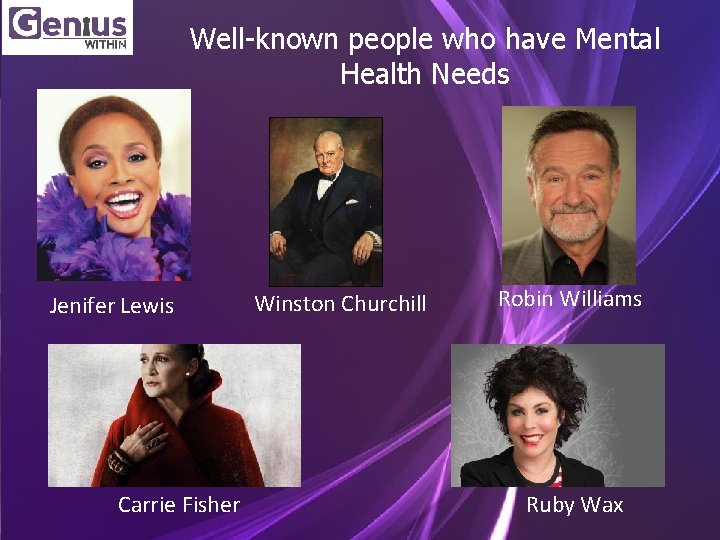
Well-known people who have Mental Health Needs Jenifer Lewis Carrie Fisher Winston Churchill Robin Williams Ruby Wax
https: //www. bps. org. uk/sites/beta. bps. org. uk/files/Policy%20 -%20 Files/Psychology%20 at%20 work%20%20 improving%20 wellbeing%20 and%20 productivity%20 in%20 the%20 workplace. pdf
Getting Support § Getting a workplace needs assessment (free through Access to work or some choose full private assessment). This will give advice on: ü Assistive technology ü Coaching ü Informal adjustments https: //www. gov. uk/access-to-work § Use a free online tool to find out your strengths and difficulties and strategies that might work for you. We have a free strategy profiler on our website: https: //screening. geniuswithin. co. uk/index. php/dyslexiatest/indexhttp s: //screening. geniuswithin. co. uk/index. php/dyslexiatest/index
Part 2: Understanding Subjective Well-Being
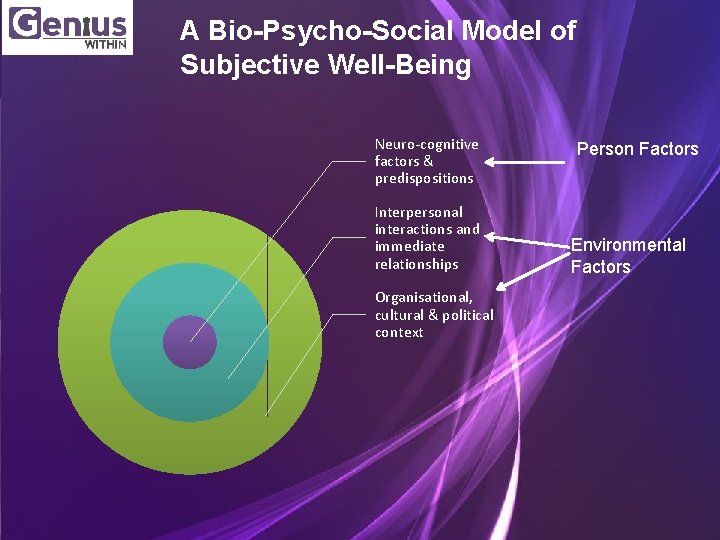
A Bio-Psycho-Social Model of Subjective Well-Being Neuro-cognitive factors & predispositions Interpersonal interactions and immediate relationships Organisational, cultural & political context Person Factors Environmental Factors
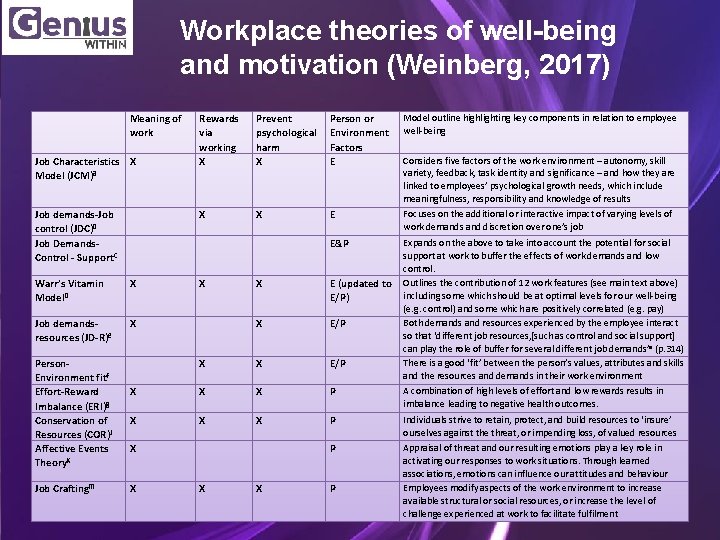
Workplace theories of well-being and motivation (Weinberg, 2017) Meaning of work Job Characteristics X Model (JCM)ᵃ Job demands-Job control (JDC)ᵇ Job Demands. Control - Supportᶜ Warr’s Vitamin Modelᵈ X Job demandsresources (JD-R)ᵉ X Person. Environment fitᶠ Effort-Reward Imbalance (ERI)ᶢ Conservation of Resources (COR)ᴶ Affective Events Theoryᵏ Job Craftingᵐ Rewards via working X Prevent psychological harm X Person or Environment Factors E Model outline highlighting key components in relation to employee well-being X X E Focuses on the additional or interactive impact of varying levels of work demands and discretion over one’s job E&P Expands on the above to take into account the potential for social support at work to buffer the effects of work demands and low control. Outlines the contribution of 12 work features (see main text above) including some which should be at optimal levels for our well-being (e. g. control) and some which are positively correlated (e. g. pay) Both demands and resources experienced by the employee interact so that ‘different job resources, [such as control and social support] can play the role of buffer for several different job demands’ᵉ (p. 314) There is a good ‘fit’ between the person’s values, attributes and skills and the resources and demands in their work environment X Considers five factors of the work environment – autonomy, skill variety, feedback, task identity and significance – and how they are linked to employees’ psychological growth needs, which include meaningfulness, responsibility and knowledge of results X E (updated to E/P) X E/P X X X P A combination of high levels of effort and low rewards results in imbalance leading to negative health outcomes. X X X P Individuals strive to retain, protect, and build resources to ‘insure’ ourselves against the threat, or impending loss, of valued resources P Appraisal of threat and our resulting emotions play a key role in activating our responses to work situations. Through learned associations, emotions can influence our attitudes and behaviour Employees modify aspects of the work environment to increase available structural or social resources, or increase the level of challenge experienced at work to facilitate fulfilment X X P
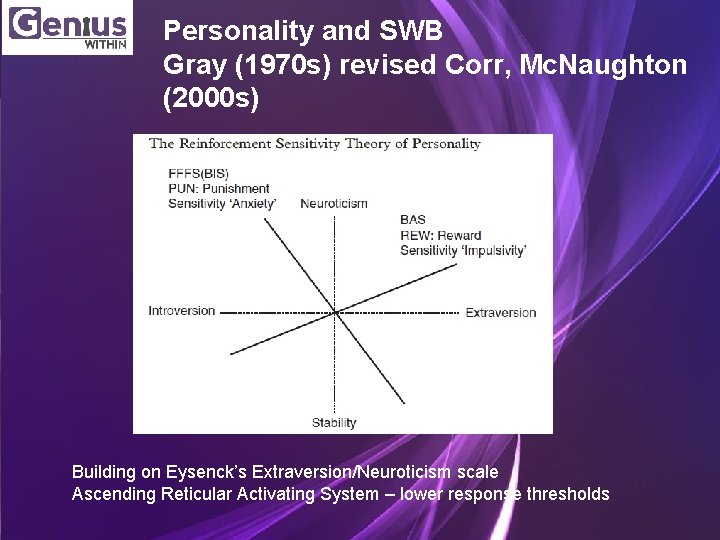
Personality and SWB Gray (1970 s) revised Corr, Mc. Naughton (2000 s) Building on Eysenck’s Extraversion/Neuroticism scale Ascending Reticular Activating System – lower response thresholds
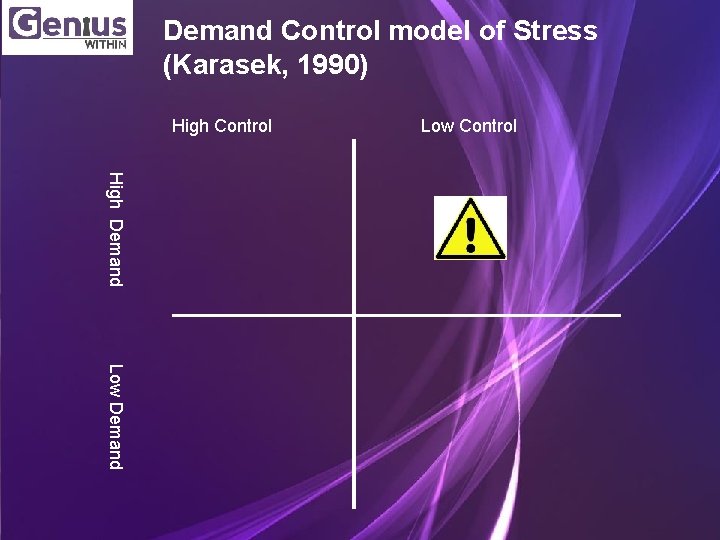
Demand Control model of Stress (Karasek, 1990) High Control Low Control High Demand Low Demand
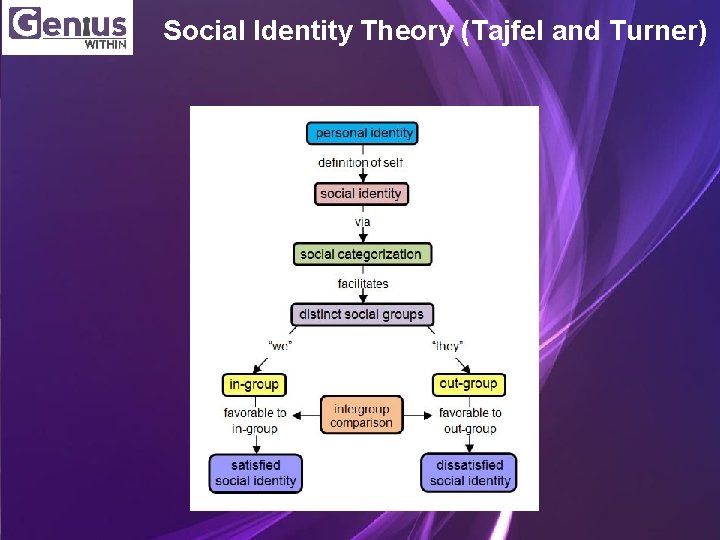
Social Identity Theory (Tajfel and Turner)
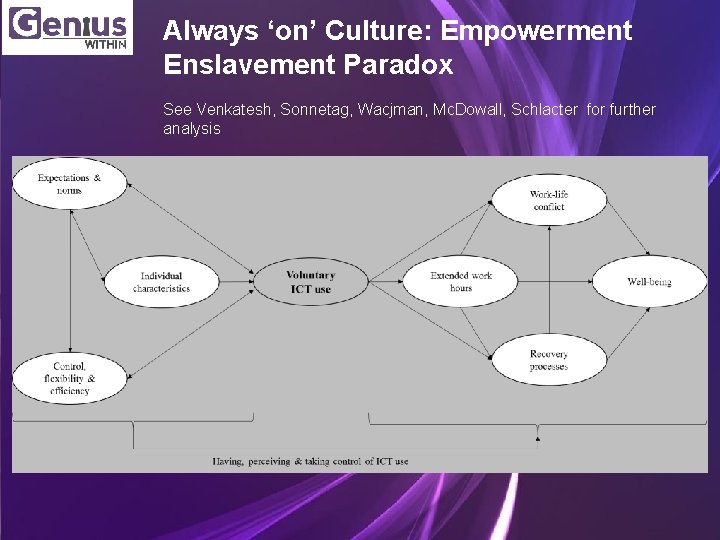
Always ‘on’ Culture: Empowerment Enslavement Paradox See Venkatesh, Sonnetag, Wacjman, Mc. Dowall, Schlacter for further analysis
Sleep Hygiene! Routine and…. Blue screen Boundaries • Perlow, L. A. (2012). Sleeping with your smartphone: How to break the 24/7 habit and change the way you work. Boston, MA: Harvard Business Review Press. • Querstret, D. and Cropley, M. (2012). Exploring the relationship between workrelated rumination, sleep quality, and work-related fatigue. Journal of Occupational Health Psychology, 17, pp. 341 -353.
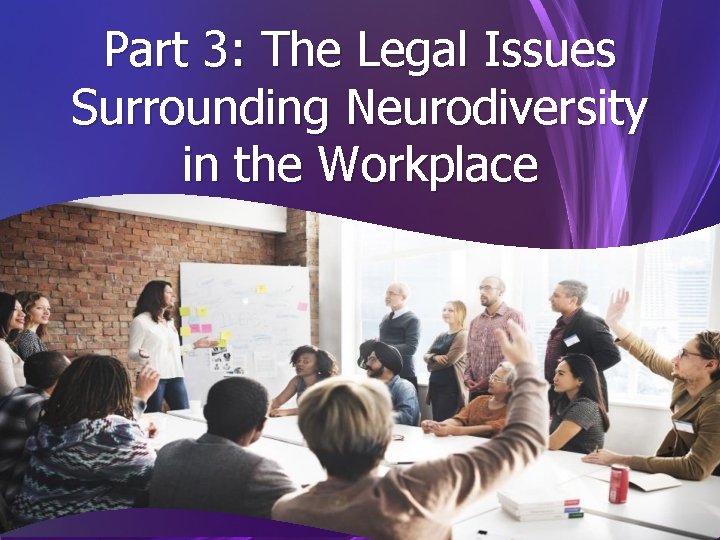
Part 3: The Legal Issues Surrounding Neurodiversity in the Workplace
What are the legal issues surrounding neurodiversity in the workplace? “A person has a disability if she or he has a physical or mental impairment that has substantial and long term (12 months+) adverse effect on his or her ability to carry out normal day-to-day activities. ” Equality Act 2010
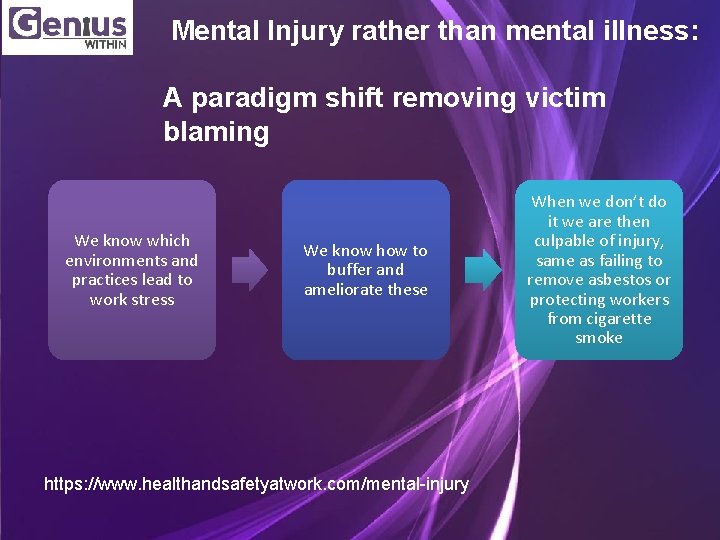
Mental Injury rather than mental illness: A paradigm shift removing victim blaming We know which environments and practices lead to work stress We know how to buffer and ameliorate these https: //www. healthandsafetyatwork. com/mental-injury When we don’t do it we are then culpable of injury, same as failing to remove asbestos or protecting workers from cigarette smoke
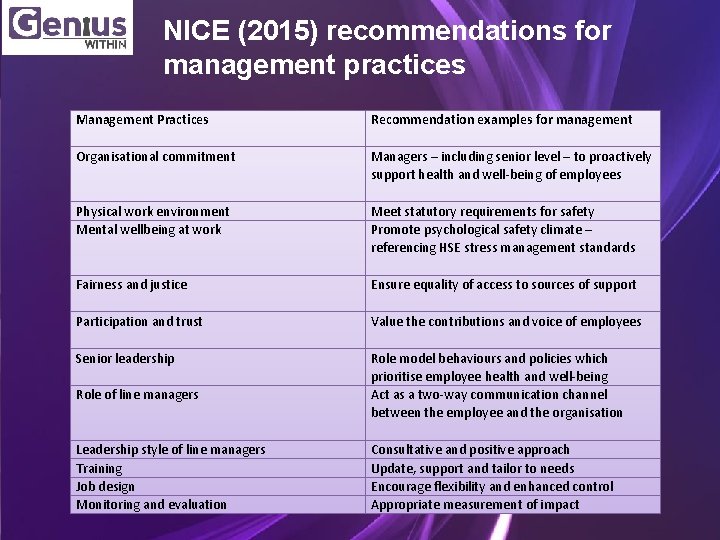
NICE (2015) recommendations for management practices Management Practices Recommendation examples for management Organisational commitment Managers – including senior level – to proactively support health and well-being of employees Physical work environment Mental wellbeing at work Meet statutory requirements for safety Promote psychological safety climate – referencing HSE stress management standards Fairness and justice Ensure equality of access to sources of support Participation and trust Value the contributions and voice of employees Senior leadership Role model behaviours and policies which prioritise employee health and well-being Act as a two-way communication channel between the employee and the organisation Role of line managers Leadership style of line managers Training Job design Monitoring and evaluation Consultative and positive approach Update, support and tailor to needs Encourage flexibility and enhanced control Appropriate measurement of impact
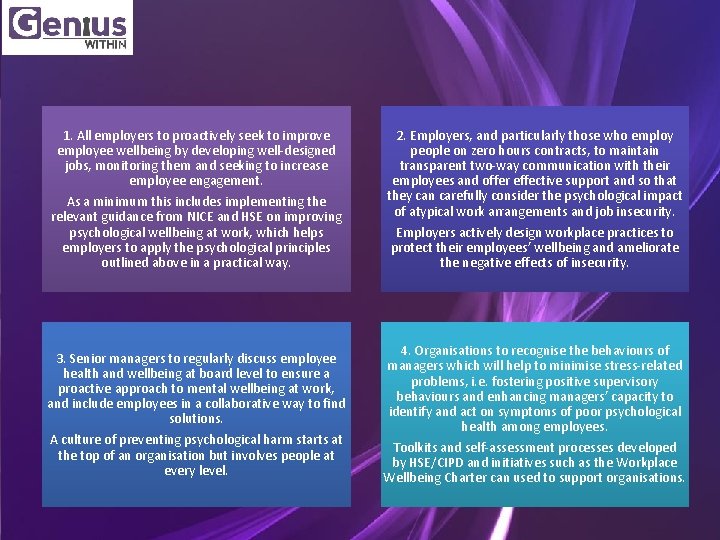
1. All employers to proactively seek to improve employee wellbeing by developing well-designed jobs, monitoring them and seeking to increase employee engagement. As a minimum this includes implementing the relevant guidance from NICE and HSE on improving psychological wellbeing at work, which helps employers to apply the psychological principles outlined above in a practical way. 2. Employers, and particularly those who employ people on zero hours contracts, to maintain transparent two-way communication with their employees and offer effective support and so that they can carefully consider the psychological impact of atypical work arrangements and job insecurity. Employers actively design workplace practices to protect their employees’ wellbeing and ameliorate the negative effects of insecurity. 3. Senior managers to regularly discuss employee health and wellbeing at board level to ensure a proactive approach to mental wellbeing at work, and include employees in a collaborative way to find solutions. A culture of preventing psychological harm starts at the top of an organisation but involves people at every level. 4. Organisations to recognise the behaviours of managers which will help to minimise stress-related problems, i. e. fostering positive supervisory behaviours and enhancing managers’ capacity to identify and act on symptoms of poor psychological health among employees. Toolkits and self-assessment processes developed by HSE/CIPD and initiatives such as the Workplace Wellbeing Charter can used to support organisations.
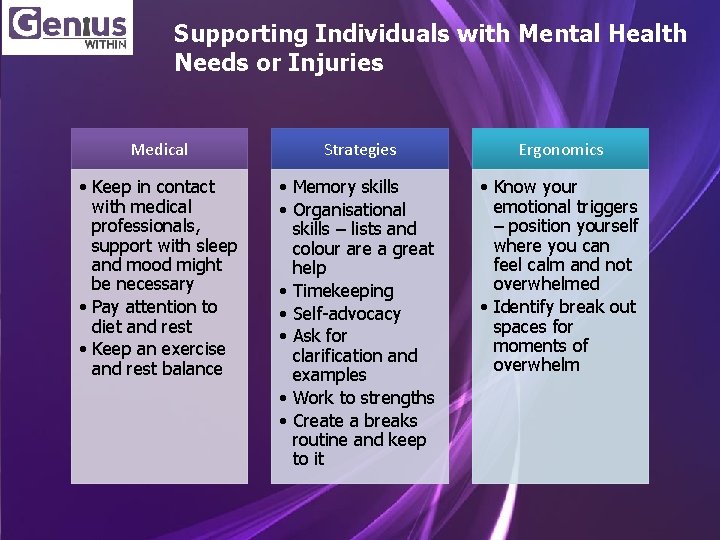
Supporting Individuals with Mental Health Needs or Injuries Medical Strategies Ergonomics • Keep in contact with medical professionals, support with sleep and mood might be necessary • Pay attention to diet and rest • Keep an exercise and rest balance • Memory skills • Organisational skills – lists and colour are a great help • Timekeeping • Self-advocacy • Ask for clarification and examples • Work to strengths • Create a breaks routine and keep to it • Know your emotional triggers – position yourself where you can feel calm and not overwhelmed • Identify break out spaces for moments of overwhelm
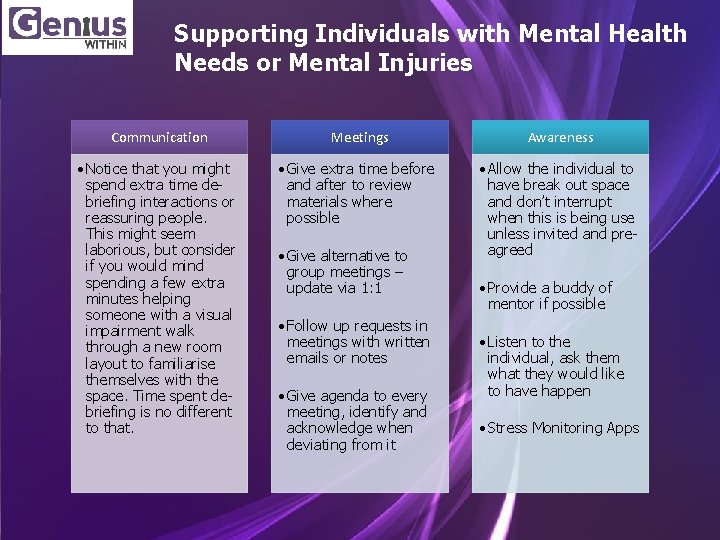
Supporting Individuals with Mental Health Needs or Mental Injuries Communication Meetings Awareness • Notice that you might spend extra time debriefing interactions or reassuring people. This might seem laborious, but consider if you would mind spending a few extra minutes helping someone with a visual impairment walk through a new room layout to familiarise themselves with the space. Time spent debriefing is no different to that. • Give extra time before and after to review materials where possible • Allow the individual to have break out space and don’t interrupt when this is being use unless invited and preagreed • Give alternative to group meetings – update via 1: 1 • Follow up requests in meetings with written emails or notes • Give agenda to every meeting, identify and acknowledge when deviating from it • Provide a buddy of mentor if possible • Listen to the individual, ask them what they would like to have happen • Stress Monitoring Apps
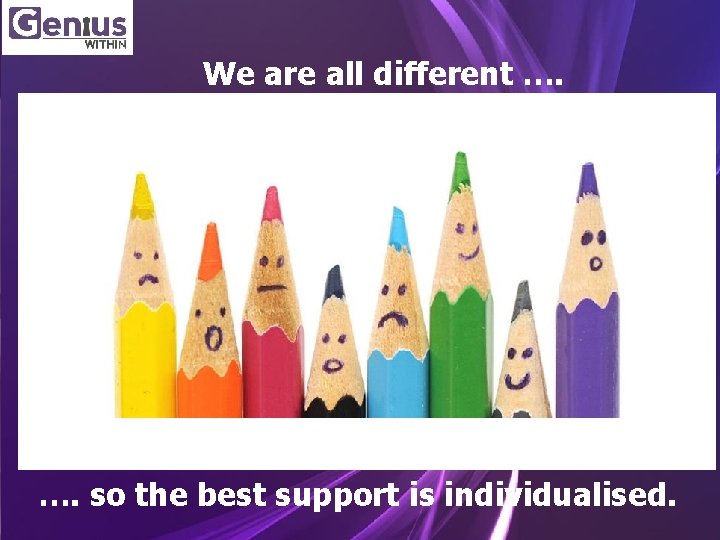
We are all different …. so the best support is individualised.
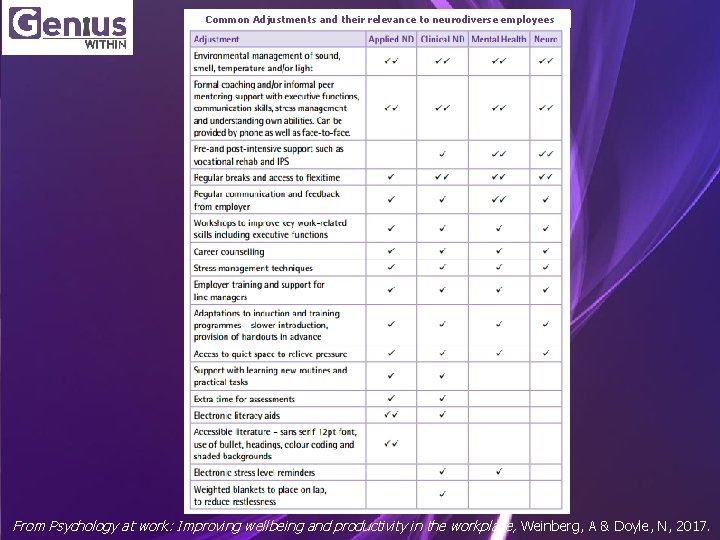
Common Adjustments and their relevance to neurodiverse employees From Psychology at work: Improving wellbeing and productivity in the workplace, Weinberg, A & Doyle, N, 2017.

Part 4: Reflection
REFLECTION 1. What are you doing well to make your workplace inclusive for neurodiverse individuals? What do you see and hear to know this? 2. What are you not doing so well? What do you see and hear to know this? 3. What could you do better? What will you see and hear when you have achieved this?
Part 5: Planning next steps
A social enterprise supporting people with neurodiverse conditions. PLANNING NEXT STEPS § What three things can you do now that will make your workplace more inclusive? § What could you do more of? § What could you do less of? § What could you do differently?
A social enterprise supporting people with neurodiverse conditions. https: //www. geniuswithin. co. uk
For more information, contact: Email: office@geniuswithin. co. uk Tel: 01273 890502 Or visit our website: https: //www. geniuswithin. co. uk
- Slides: 32