
Understanding Students With Disabilities Characteristics of Students with
Understanding Students With Disabilities

Characteristics of Students with Learning Disabilities • difficulty learning certain subjects • inconsistent academic deficits in attention and/or distractibility • Academic Difficulties: Reading – phonemic awareness, alphabetical principal, comprehension, vocab Written expression - receptive and/or expressive, spelling, vocabulary Language – receptive and/or expressive Math – Calculations and/or Problem Solving • Memory & Processing: difficulty remembering skills learned information-processing difficulties struggle with cognitive strategies • Social: social skills deficits poor motor abilities • Behavioral: challenging behavior low self-esteem social/emotional issues Anxiety
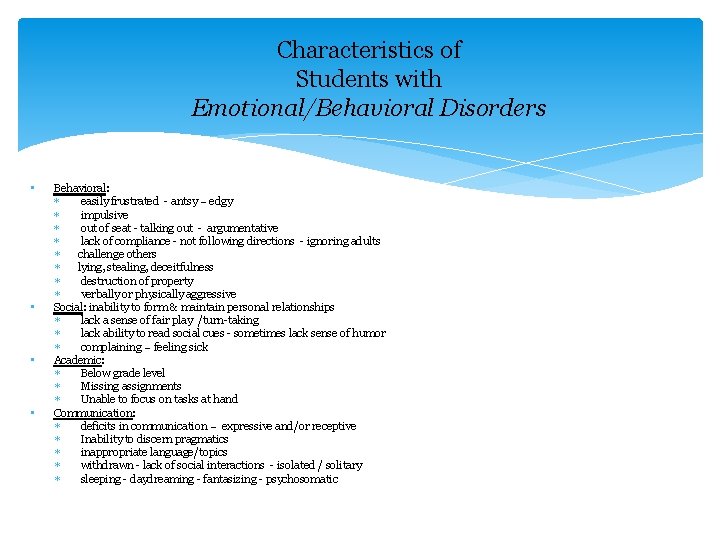
Characteristics of Students with Emotional/Behavioral Disorders • • Behavioral: easily frustrated - antsy – edgy impulsive out of seat - talking out - argumentative lack of compliance - not following directions - ignoring adults challenge others lying, stealing, deceitfulness destruction of property verbally or physically aggressive Social: inability to form & maintain personal relationships lack a sense of fair play /turn-taking lack ability to read social cues - sometimes lack sense of humor complaining – feeling sick Academic: Below grade level Missing assignments Unable to focus on tasks at hand Communication: deficits in communication – expressive and/or receptive Inability to discern pragmatics inappropriate language/topics withdrawn - lack of social interactions - isolated / solitary sleeping - daydreaming - fantasizing - psychosomatic
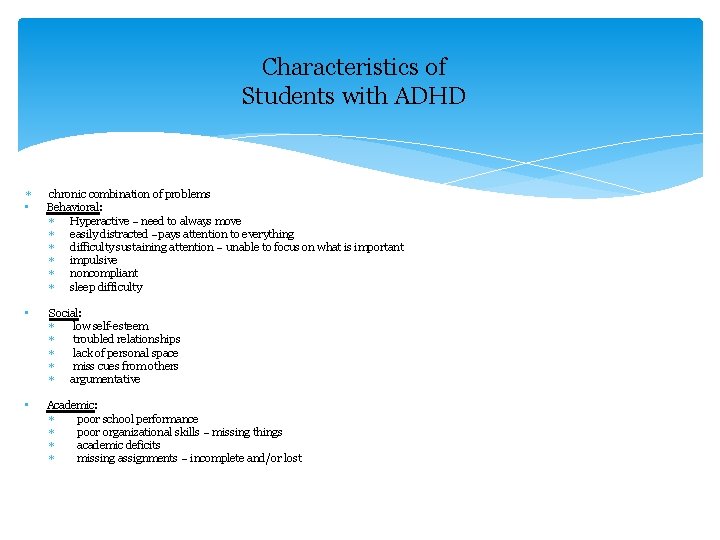
Characteristics of Students with ADHD • chronic combination of problems Behavioral: Hyperactive – need to always move easily distracted –pays attention to everything difficulty sustaining attention – unable to focus on what is important impulsive noncompliant sleep difficulty • Social: low self-esteem troubled relationships lack of personal space miss cues from others argumentative • Academic: poor school performance poor organizational skills – missing things academic deficits missing assignments – incomplete and/or lost
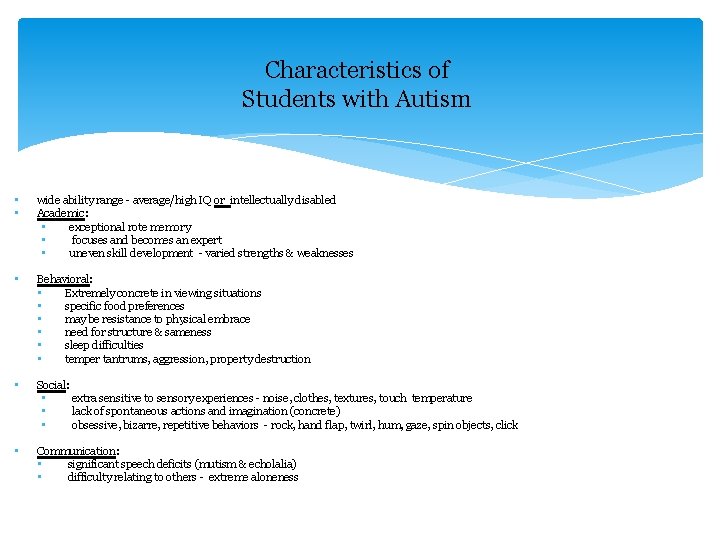
Characteristics of Students with Autism • • wide ability range - average/high IQ or intellectually disabled Academic: • exceptional rote memory • focuses and becomes an expert • uneven skill development - varied strengths & weaknesses • Behavioral: • Extremely concrete in viewing situations • specific food preferences • may be resistance to physical embrace • need for structure & sameness • sleep difficulties • temper tantrums, aggression, property destruction • Social: • extra sensitive to sensory experiences - noise, clothes, textures, touch temperature • lack of spontaneous actions and imagination (concrete) • obsessive, bizarre, repetitive behaviors - rock, hand flap, twirl, hum, gaze, spin objects, click • Communication: • significant speech deficits (mutism & echolalia) • difficulty relating to others - extreme aloneness
Characteristics of Students with Mild Intellectual Disabilities • • • • learns more slowly – needs more repetition academic deficits socially awkward often extra friendly lacks appropriate social skills for getting teacher’s attention doesn’t understand social rules/pragmatics overly dependent on parents/caretakers (learned helplessness) socially immature deficits in adaptive behavior – everyday life skills often easy to please difficulty remembering directions & expectations take longer to accomplish tasks may have difficulty controlling emotions persistent fixated
Characteristics of Students with Other Health Impairments • With many different conditions in OHI there are too many characteristics… but the following are common: • Academic deficits • Socially withdrawn (or socially ignored) • Frequently absent or tardy • Tired – chronic pain, treatments, meds, working extra hard • Physical weaknesses – pale, withdrawn appearance • Overly dependent on parents/caretakers (learned helplessness) • Avoid being singled out/resist drawing attention to themselves • Visible physical attributes – walk different, curled hand, bent over, oxygen tank, walker • Socially immature • Smaller stature • Quiet in classes • Demanding in other ways
Characteristics of Students who are Deaf/Hard of Hearing • • • Literacy Deficits/Struggles Academic deficits Understanding Social Cues Knowing expectations Miss cues of activity change Withdrawn Altered speech or speech patterns May use sound language Miss out on peer interactions Isolated Feel Lost most of the time in school
Characteristics of Students who are Blind/Visually Impaired • • Academic Deficits Squints or holds objects close Difficulty getting around May miss instructions that involve gestures Struggle to make friends b/c they cannot read people’s faces May be isolated & appear uninterested Limited friendship b/c of unique need for specialty items (ball that makes noise) • Eyes may be very light sensitive • Hear well, but may misinterpret the unknown • Difficulty with everyday life activities
Characteristics of Students with Orthopedic Impairments • • • Limited mobility of body, hands, head, etc Tire easily Difficulty making friends Isolated/withdrawn Need more space in group settings Normal intelligence & intellectual ability Academic deficits due to physical limitations May suffer chronic pain Misses class for PT, OT, S/L therapy May have a personal para-pro that separates him/her from classmates b/c of awkwardness • May have alternative way of responding or requesting assistance • May have difficulty communicating with others
Strengths Students with disabilities are students! They want to learn. They want to be accepted. They are often as confused about their limitations & struggles as the teachers are…. Look for: • Sense of humor • Creativity • Special talents • Eagerness to be liked & to please • Unique perspective • Unique view of things • Need YOU…. a special, caring teacher • Compassionate - understand the underdog • Energetic • Extra strong in one area to compensate for another area • Excellent actors – because they’ve hide so much!
Questions?
- Slides: 12