
Understanding Students Perception of Assessment Fairness and Its
- Slides: 9
“Understanding Students’ Perception of Assessment Fairness and Its Impact on Attainment” STUDENT RESEARCHER : CHARLES WILSON, BA EDUCATION SUPERVISORS : DR XIAOTONG ZHU, LHERI, LEAP P, ROJECT LEAD DR HELEN CHILDERHOUSE , SCHOOL OF EDUCATION
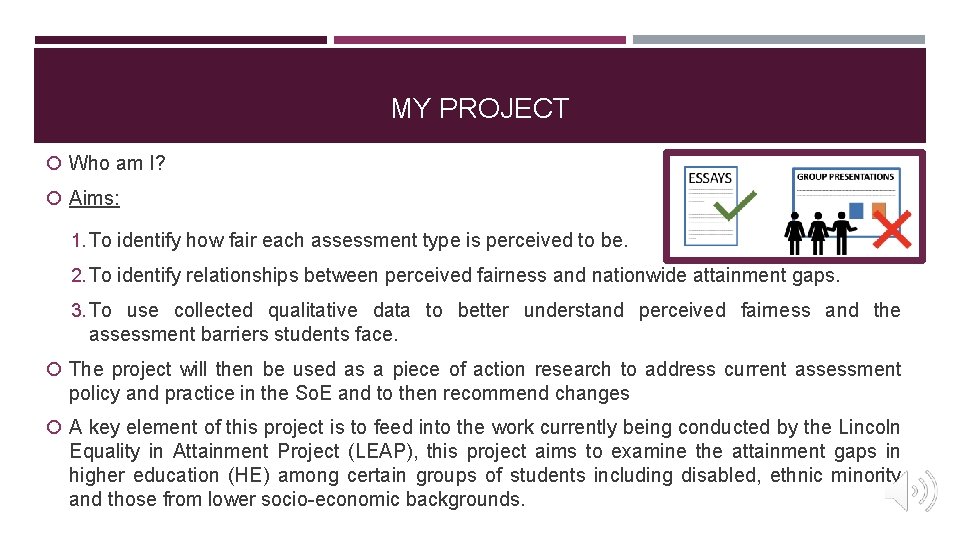
MY PROJECT Who am I? Aims: 1. To identify how fair each assessment type is perceived to be. 2. To identify relationships between perceived fairness and nationwide attainment gaps. 3. To use collected qualitative data to better understand perceived fairness and the assessment barriers students face. The project will then be used as a piece of action research to address current assessment policy and practice in the So. E and to then recommend changes A key element of this project is to feed into the work currently being conducted by the Lincoln Equality in Attainment Project (LEAP), this project aims to examine the attainment gaps in higher education (HE) among certain groups of students including disabled, ethnic minority and those from lower socio-economic backgrounds.
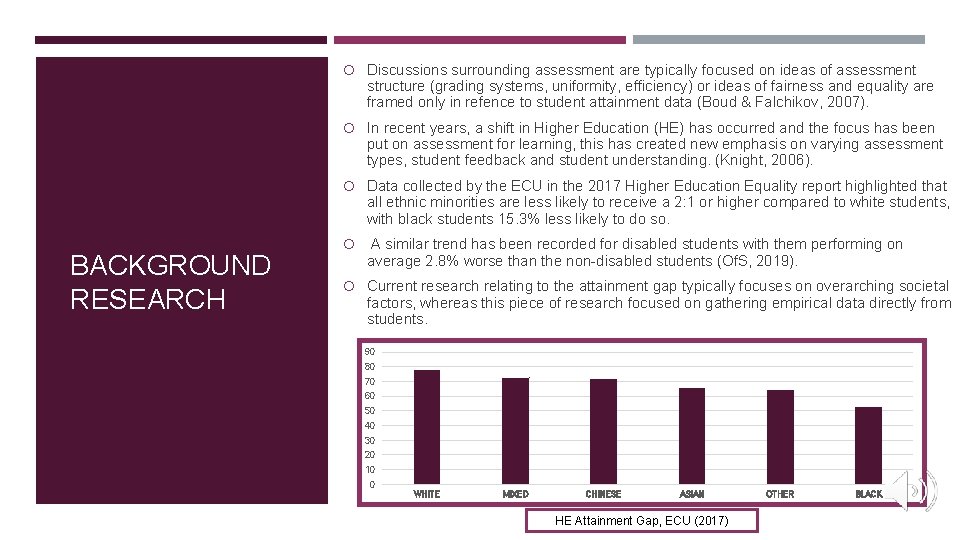
Discussions surrounding assessment are typically focused on ideas of assessment structure (grading systems, uniformity, efficiency) or ideas of fairness and equality are framed only in refence to student attainment data (Boud & Falchikov, 2007). In recent years, a shift in Higher Education (HE) has occurred and the focus has been put on assessment for learning, this has created new emphasis on varying assessment types, student feedback and student understanding. (Knight, 2006). Data collected by the ECU in the 2017 Higher Education Equality report highlighted that all ethnic minorities are less likely to receive a 2: 1 or higher compared to white students, with black students 15. 3% less likely to do so. BACKGROUND RESEARCH A similar trend has been recorded for disabled students with them performing on average 2. 8% worse than the non-disabled students (Of. S, 2019). Current research relating to the attainment gap typically focuses on overarching societal factors, whereas this piece of research focused on gathering empirical data directly from students. 90 80 70 60 50 40 30 20 10 0 WHITE MIXED CHINESE ASIAN HE Attainment Gap, ECU (2017) OTHER BLACK
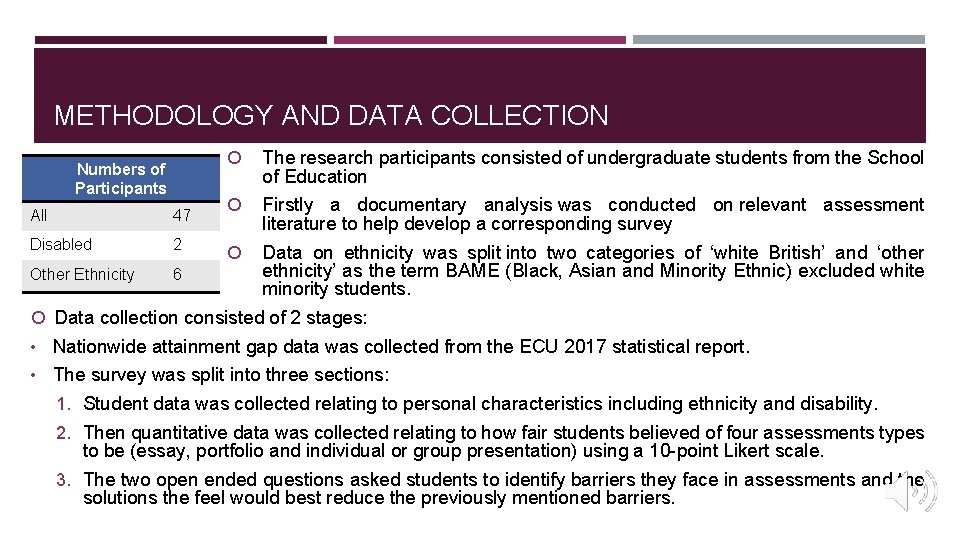
METHODOLOGY AND DATA COLLECTION Numbers of Participants All 47 Disabled 2 Other Ethnicity 6 The research participants consisted of undergraduate students from the School of Education Firstly a documentary analysis was conducted on relevant assessment literature to help develop a corresponding survey Data on ethnicity was split into two categories of ‘white British’ and ‘other ethnicity’ as the term BAME (Black, Asian and Minority Ethnic) excluded white minority students. Data collection consisted of 2 stages: • Nationwide attainment gap data was collected from the ECU 2017 statistical report. • The survey was split into three sections: 1. Student data was collected relating to personal characteristics including ethnicity and disability. 2. Then quantitative data was collected relating to how fair students believed of four assessments types to be (essay, portfolio and individual or group presentation) using a 10 -point Likert scale. 3. The two open ended questions asked students to identify barriers they face in assessments and the solutions the feel would best reduce the previously mentioned barriers.
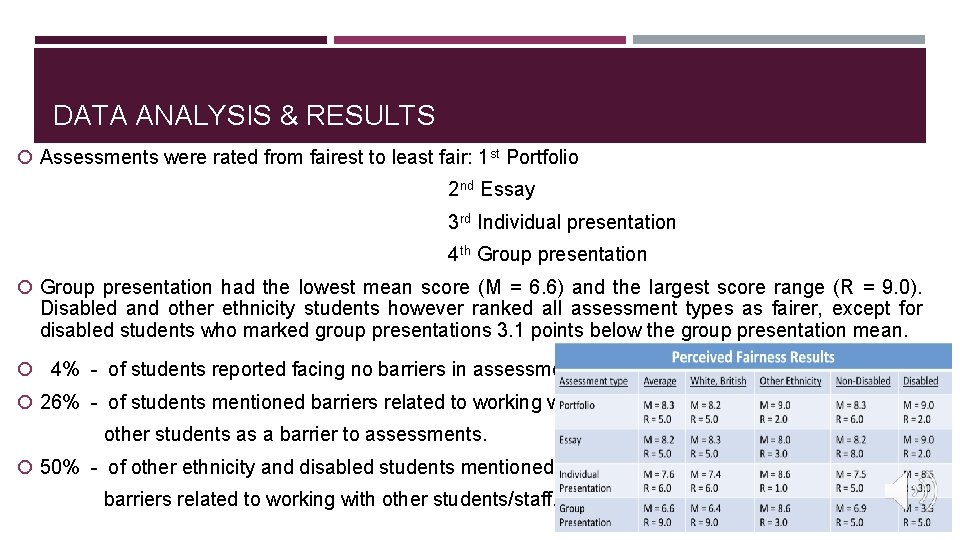
DATA ANALYSIS & RESULTS Assessments were rated from fairest to least fair: 1 st Portfolio 2 nd Essay 3 rd Individual presentation 4 th Group presentation had the lowest mean score (M = 6. 6) and the largest score range (R = 9. 0). Disabled and other ethnicity students however ranked all assessment types as fairer, except for disabled students who marked group presentations 3. 1 points below the group presentation mean. 4% - of students reported facing no barriers in assessments. 26% - of students mentioned barriers related to working with other students as a barrier to assessments. 50% - of other ethnicity and disabled students mentioned barriers related to working with other students/staff.
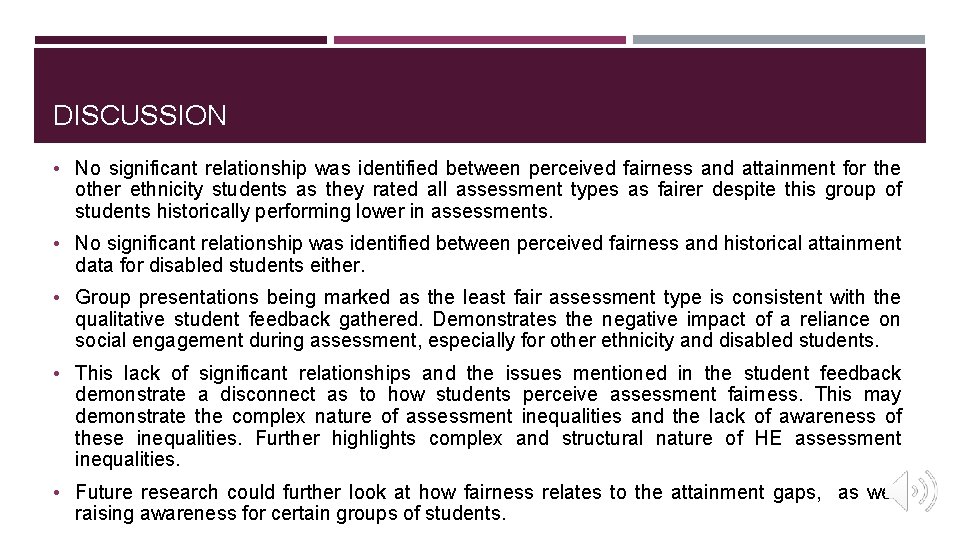
DISCUSSION • No significant relationship was identified between perceived fairness and attainment for the other ethnicity students as they rated all assessment types as fairer despite this group of students historically performing lower in assessments. • No significant relationship was identified between perceived fairness and historical attainment data for disabled students either. • Group presentations being marked as the least fair assessment type is consistent with the qualitative student feedback gathered. Demonstrates the negative impact of a reliance on social engagement during assessment, especially for other ethnicity and disabled students. • This lack of significant relationships and the issues mentioned in the student feedback demonstrate a disconnect as to how students perceive assessment fairness. This may demonstrate the complex nature of assessment inequalities and the lack of awareness of these inequalities. Further highlights complex and structural nature of HE assessment inequalities. • Future research could further look at how fairness relates to the attainment gaps, as well raising awareness for certain groups of students.
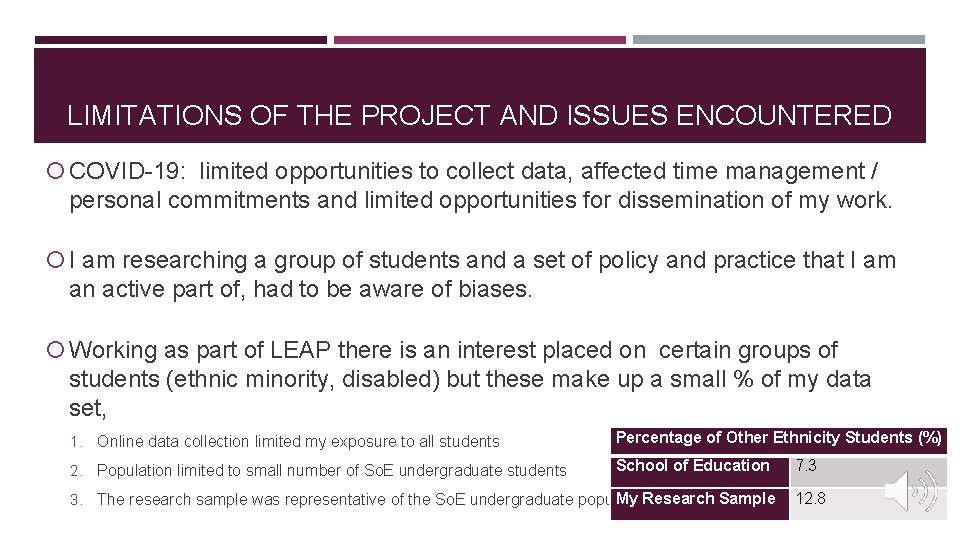
LIMITATIONS OF THE PROJECT AND ISSUES ENCOUNTERED COVID-19: limited opportunities to collect data, affected time management / personal commitments and limited opportunities for dissemination of my work. I am researching a group of students and a set of policy and practice that I am an active part of, had to be aware of biases. Working as part of LEAP there is an interest placed on certain groups of students (ethnic minority, disabled) but these make up a small % of my data set, 1. Online data collection limited my exposure to all students Percentage of Other Ethnicity Students (%) 2. Population limited to small number of So. E undergraduate students School of Education My Research Sample 3. The research sample was representative of the So. E undergraduate population 7. 3 12. 8
REFERENCES • Boud, D. , & Falchikov, N. (2007). Rethinking Assessment in Higher Education • Education Challenge Unit. (2017). Equality in higher education statistical report. • Knight, P. (2006). The local practices of assessment. • Office for Students. (2019). Beyond the bare minimum: Are universities and colleges doing enough for disabled students?
THANK YOU FOR LISTENING Any Questions?