
Understanding Statistics for HumanComputer Interaction and Related Disciplines
![[ 0. 2, 3. 7 ] 95% conf. int. p-values, confidence[-0. 1, +3. 2]](https://slidetodoc.com/presentation_image_h/1b1fc6745d2b0d577e0e4227580d91e0/image-2.jpg "[ 0. 2, 3. 7 ] 95% conf. int. p-values, confidence[-0. 1, +3. 2]")
- Slides: 15
Understanding Statistics for Human–Computer Interaction and Related Disciplines Alan Dix http: //alandix. com/statistics/ Understanding Statistics for HCI and Related Disciplines – Alan Dix
[ 0. 2, 3. 7 ] 95% conf. int. p-values, confidence[-0. 1, +3. 2] intervals, Bayesian stats xxx what does it all mean? Understanding Statistics for HCI and Related Disciplines – Alan Dix
confused? Understanding Statistics for HCI and Related Disciplines – Alan Dix
focus on understanding concepts and ideas Understanding Statistics for HCI and Related Disciplines – Alan Dix
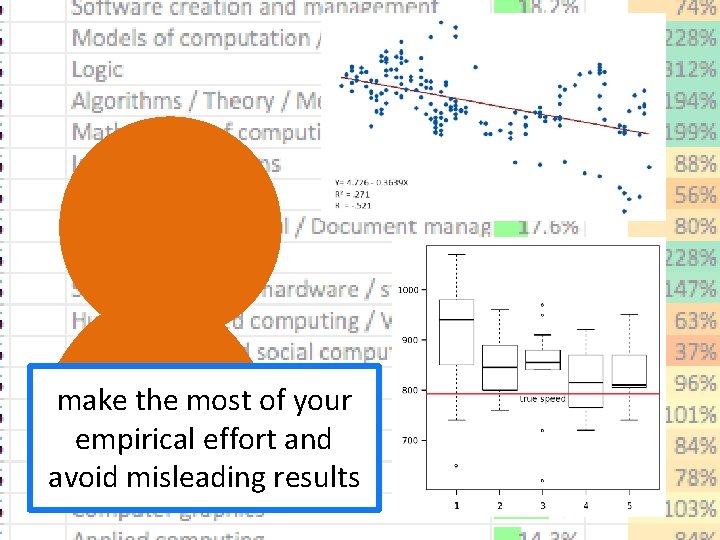
make the most of your empirical effort and avoid misleading results Understanding Statistics for HCI and Related Disciplines – Alan Dix
overview – four parts wild and wide exploring randomness, uncertainty and 'distributions’ doing it alternative statistical analyses: the ubiquitous 'p' to Bayesian gaining power avoid the dreaded 'too few participants’ so what? making sense of your data and avoiding the pitfalls Understanding Statistics for HCI and Related Disciplines – Alan Dix
do I need statistics? just eyeball the data … Understanding Statistics for HCI and Related Disciplines – Alan Dix
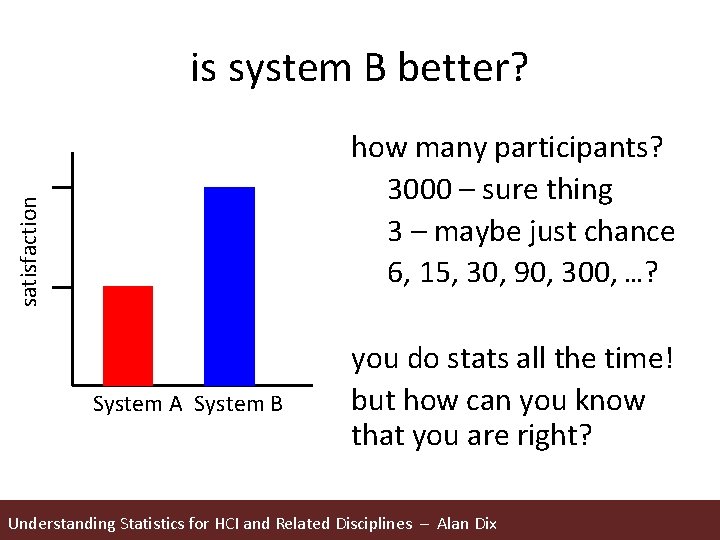
is system B better? satisfaction how many participants? 3000 – sure thing 3 – maybe just chance 6, 15, 30, 90, 300, …? System A System B you do stats all the time! but how can you know that you are right? Understanding Statistics for HCI and Related Disciplines – Alan Dix
Understanding Statistics for HCI and Related Disciplines – Alan Dix
why are you doing it? exploration vs. validation process vs. product Understanding Statistics for HCI and Related Disciplines – Alan Dix
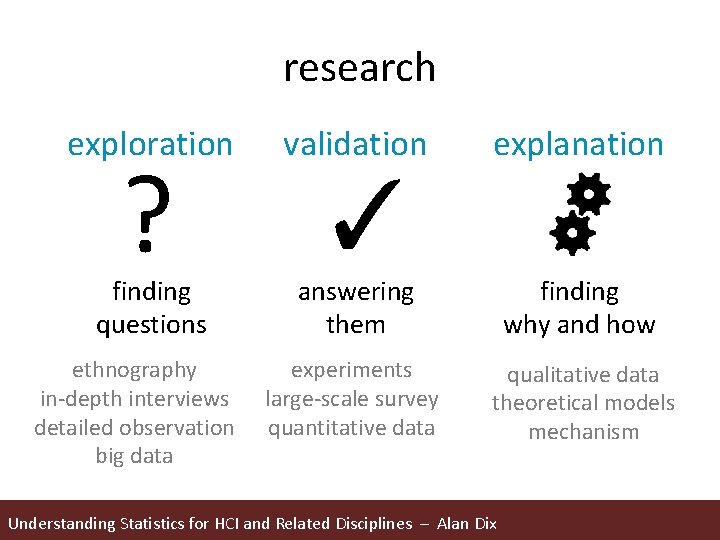
research exploration ? finding questions ethnography in-depth interviews detailed observation big data validation explanation ✓ answering them finding why and how experiments large-scale survey quantitative data qualitative data theoretical models mechanism Understanding Statistics for HCI and Related Disciplines – Alan Dix
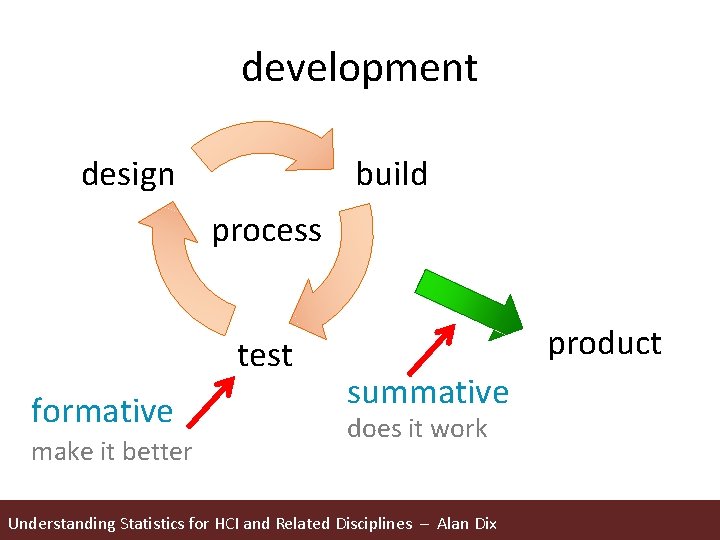
development design build process test formative make it better product summative does it work Understanding Statistics for HCI and Related Disciplines – Alan Dix
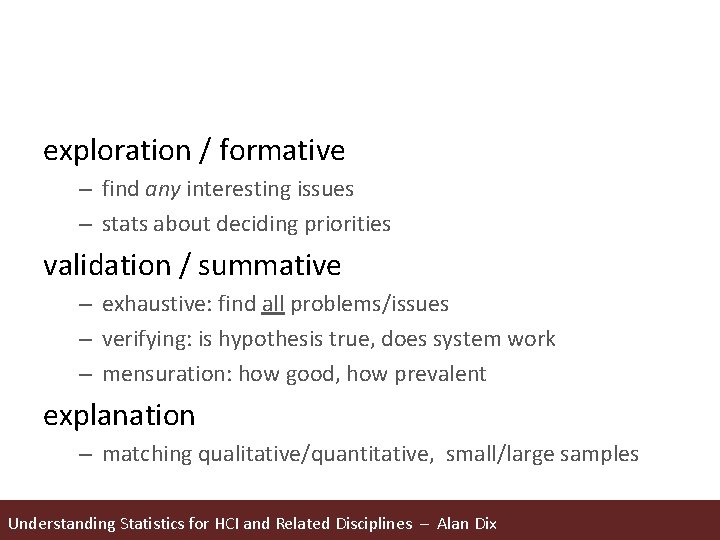
exploration / formative – find any interesting issues – stats about deciding priorities validation / summative – exhaustive: find all problems/issues – verifying: is hypothesis true, does system work – mensuration: how good, how prevalent explanation – matching qualitative/quantitative, small/large samples Understanding Statistics for HCI and Related Disciplines – Alan Dix
are five users enough? original work Nielsen & Landauer (1993) about iterative process not summative – not for stats! N. B. later work how many? on saturation to find enough to do in next development cycle depends on size of project and complexity now-a-days with cheap development maybe n=1 but always more in next cycle Understanding Statistics for HCI and Related Disciplines – Alan Dix
Understanding Statistics for HCI and Related Disciplines – Alan Dix